This post contains affiliate links. We may earn a small commission when you buy through our links — at no extra cost to you.
A hiking sandal is a simple bargain: air and a fast dry in exchange for the armor of a shoe. The cost usually shows up in the same place — the strap line, the heel, the spot between your toes where grit collects and, four miles later, a blister announces itself. I’ve limped back from a creek crossing that way, and it’s made me picky about which pairs earn space in my pack. The right pair is forgettable by mile three and steady enough that you stop watching your footing on the downhill.
Comfort and fit come first, but arch support has to last past lunch and the outsole has to survive gravel. Looks count too — a pair that fits beautifully and comes in one drab color won’t get worn. My team and I have spent the past six months hiking, wading, and walking in 14 pairs, and the ones below are the ones we kept reaching for on the longer days.




Best for Rocky, Wet Trails
KEEN Whisper
Key Features
- Fit: Runs small; size up
- Water use: Rivers, lakes, tidal pools
- Toe coverage: Enclosed toe
- Price: Premium
The toe bumper is why these sit at the top of our list. On root-covered ground and wet, sloped rock, a sandal that covers your toes changes the day: you stop placing every step and start walking normally. Traction matched it on the wet sections we walked — the tread held on slick stone that had us stepping carefully in the open-toe pairs — and the footbed kept its shape through a long afternoon.
Sizing is the one thing to get right. These run small, so a half size up is the usual call, and the toe box is generous once you are in the right length: good for a wider forefoot, and roomy enough for a thin sock. Getting them on takes a beat longer than a two-strap sandal, with a strap to pull and a heel to settle. We minded that for the first week and stopped noticing after.
Water is the other argument for them. They drain, they stay wearable when soaked, and they wash clean when a trail turns to mud — the pair we kept by the tent rather than in it. Watch the soft material around the ankle, which is the first place to show its age; rinsing and air-drying rather than leaving them to bake in a hot car will add seasons to them.
Pros
- Closed toe protects on rocky ground
- Grip holds on wet rock
- Supportive enough for a full day
- Washes clean and drains fast
Cons
- Runs small; size up
- Small toes can slip out of the toe opening
Our top pick for women who want trail protection without a boot: a closed toe, real grip on wet rock, and support that lasts all day. Size up.
Best for Mixed Trails, Rivers
Teva Hurricane 4
Key Features
- Closure: Hook-and-loop straps
- Footbed: Contoured, molds to foot
- Adjustment points: Three
- Price: Midrange
For a good deal less than our top pick, these deliver most of what makes it work: three hook-and-loop straps that split the fit between heel, ankle and forefoot, a contoured footbed with real arch, and a sole that holds on wet street and river rock alike. What you give up is the bumper over your toes.
We kept reaching for them on days when we were not sure the ground would stay tame — a rail trail that turned to gravel, a river crossing on the way back — and they never felt like the compromise pair. The heel strap does more work than it looks like it does: it stops the sandal sliding forward on descents, which is the failure that makes people give up on sandals entirely.
Two things to know before you buy. The footbed gets sweaty and holds odor through a hot summer of hard wear, and a scrub with mild soap fixes it. And the length runs a touch short if you are between sizes, so take the larger one.
Pros
- Three-point adjustment dials the fit in
- Real arch support for all-day wear
- Grip holds on wet street and river rock
- Costs far less than the top pick
Cons
- Open toe leaves toes exposed on rocky ground
- Footbed holds sweat and odor
We recommend these to anyone who wants three-point adjustability, honest arch support and reliable grip on wet rock without paying premium prices. Loose ground and river crossings suit them best.
Best for All-Day Walking and Travel
ECCO Yucatan
Key Features
- Break-in: Short break-in period
- Water use: Rain and wet ground
- Adjustment points: Three
- Price: Premium
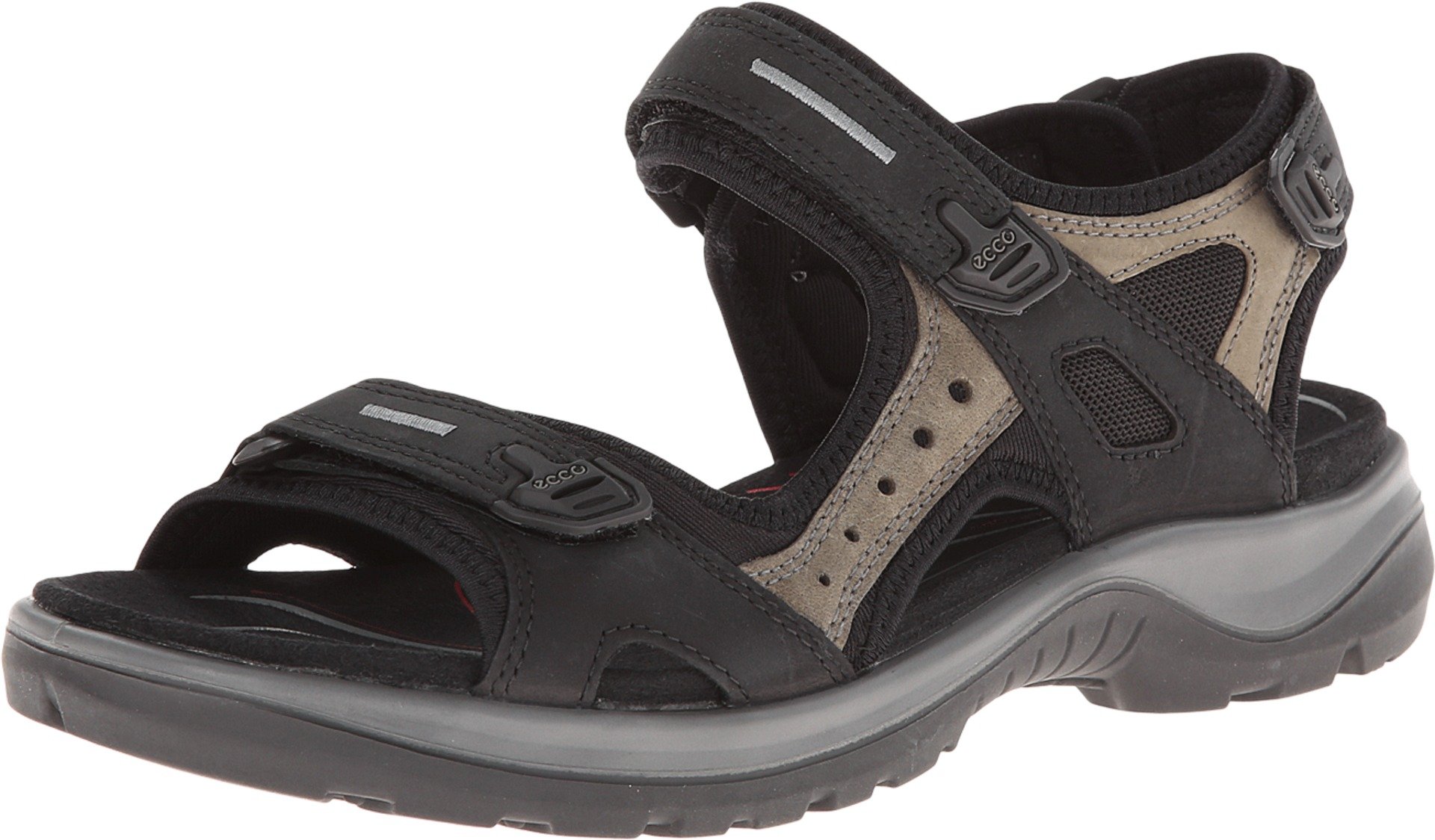
For a trip that mixes pavement, cobbles and a coastal path, this is the pair we packed: one sandal instead of two, and no blister tape by the third day. Three adjustment points let you loosen the forefoot after a long morning and tighten everything before a descent, which is the small flexibility that makes a sandal wearable from breakfast to dinner.
Support is where they earn their premium. The arch is high and firm rather than pillowy, so hours on hard ground do not leave your feet aching at the ankle, and the straps sit flat without digging. They also feel like the most solidly built pair here — the stitching, the strap anchors and the sole all look specified for more than one summer.
Give them a couple of short days to soften up; the uppers are stiff out of the box and the arch is assertive at first. We recommend them for travel, long town days and gentle trails rather than steep, loose scrambling, where the Whisper’s toe protection and quicker drainage serve you better. For everything short of that, they are the most comfortable sandal in this set to be in for eight hours.
Pros
- Firm, high arch for long days
- Most solidly built pair here
- Three adjustment points, flat-lying straps
- Handles pavement and trail in one pair
Cons
- Premium price within this set
For travel days that mix pavement and trail, this is the pair we reach for: firm arch support, sturdy build, and enough adjustment to loosen up at lunch.
Best for Narrow Feet, High Arches
Teva Tirra
Key Features
- Fit: Cut for narrow feet
- Arch support: High, firm arch
- Adjustment points: Three
- Price: Midrange
This is the sandal in our set with a real chafe problem, and it is worth saying first: the webbing across the toes and the strap behind the heel are where blisters start, especially on a long first day in heat. Wear them on two short walks before a trip, loosen the toe strap before you tighten the heel, and most of that disappears.
Underneath the caveat is a sandal we rate very highly. Three points of adjustment — forefoot, ankle, heel — make it the easiest pair here to fit precisely, and the arch is the firmest of the group for high arches. Narrow feet do best of all: the footbed is cut slim, so the straps have somewhere to tighten to instead of maxing out.
On trail they have been steady on gravel, packed dirt and rock slabs. The tread is not the most aggressive here, so wet, sloped rock is the place to slow down, and the webbing holds water longer than a padded upper does. A small hook on the heel strap makes them easy to kick off at a tent door, which we appreciated more than we expected to.
They are also the best-looking pair in this group, with a multi-strap profile that reads as deliberate rather than technical and a color range well past the usual grey and black. That is not why we recommend them, but it is why they get worn on rest days too.
Pros
- Precise three-point fit, best for narrow feet
- Firmest arch support here
- Steady on gravel and packed dirt
Cons
- Webbing rubs and blisters before it softens
- Tread less aggressive on wet, sloped rock
If your feet are narrow and your arches high, this is the best-fitting sandal here — just break it in slowly, because the webbing rubs before it softens.
Best for Wide Forefeet
Dannto Hiking Sandal
Key Features
- Toe box: Wide
- Water use: Water-friendly
- Toe coverage: Closed toe
- Price: Midrange
If your forefoot is wide enough that most sandals leave a red line across the little toe, start here. The toe box is the roomiest in our set and it is closed, so width and protection come in the same shoe — unusual enough that it makes this the easiest pair on the page to justify as a second or third sandal.
The sizing is generous. If you are between sizes, take the smaller one and use the Velcro strap at the back for the rest of the length, letting the front straps handle width. The closed toe also does quiet work: no gravel inside, no roots catching a toenail, and nothing to think about on a rough descent.
Water is where they surprise you. They drain, they dry, and the closed toe means you are not fishing pebbles out after a crossing — the catch is the footbed, which lets your foot slide once everything is soaked, so snug the rear strap before you step in. Arch support is the modest part: fine for a few hours, less so if you need a firm, high arch, in which case the Tirra or the Yucatan is the better fit.
Pros
- Roomiest toe box here
- Closed toe keeps gravel and roots out
- Drains and dries after water crossings
Cons
- Modest arch support for high arches
Our pick for wide forefeet: a roomy closed toe, water-friendly build and dependable grip on gravel, with arch support that is adequate rather than generous.
Best for Comfort on a Budget
UBFEN Hiking Sandal
Key Features
- Fit: Generous, wide-foot friendly
- Sole: Soft and flexible
- Footbed: Cushioned, shaped arch
- Price: Budget
The insole is the first thing you notice: soft, slightly springy, and shaped under the arch rather than flat. On a sandal that costs about as little as anything here, that is a genuinely comfortable footbed, and it is why these get worn for a boardwalk stroll as readily as a day hike.
The fit is built wide. The straps sit over a generous footbed, which suits a broad forefoot or a bunion, and the forefoot strap is easy to shift while you are wearing them. Narrow feet will cinch the straps to their limit and still feel the volume; half sizes are the weak spot, since the length is true but there is a lot of room over the instep.
We rate these the best of the budget pairs for comfort, with one caveat. The sole is the soft part of the package: it flexes nicely underfoot and feels great on day one, and it is also what wears first if you are on rocky ground week after week. For casual trails, travel and everyday walking, that is a trade worth making.
Pros
- Soft, shaped insole at a low price
- Generous fit for wide feet and bunions
- Straps adjust easily while worn
Cons
- Soft sole wears quickly on rocky ground
We think these are the most comfortable sandals here for the money — a soft, shaped insole and a wide fit, best kept to casual trails.
Best for Wide Feet, Light Trails
WHITIN C51

Key Features
- Fit: Wide, runs long
- Footbed: Supportive arch
- Adjustment points: Three Velcro straps
- Price: Budget
Order these a size down. That is the most useful thing we can tell you about the C51: the length runs long, and the three Velcro straps are generous enough that going down does not pinch — it just puts the arch where it belongs.
Once the size is right, there is a lot here for the money: a supportive footbed, straps that adjust across the toes, over the instep and behind the heel, and enough cushioning that a full day at an amusement park or on a wide gravel path does not leave you sore. Wide feet get a genuine advantage from the volume rather than having to cinch around it.
The straps are the weak point over time. The ankle webbing is the first thing to fray, which is why these sit among our also-consider picks rather than higher up. Treat them as a light-trail and everyday sandal and they will earn their place; push them through rough country every weekend and the strap will give out before the sole does.
Pros
- Supportive footbed and straps for the money
- Genuinely roomy for wide feet
- Comfortable for full days on easy ground
Cons
- Ankle webbing frays with heavy use
A light-trail sandal we like for wide feet and long days on easy ground, provided you order a size down and do not push it through rough country.
Best for River Days, Beaches
Muboliy Sport Sandal

Key Features
- Upper: Webbing straps
- Arch support: Padded arch
- Adjustment points: Three Velcro straps
- Price: Budget
These are the closest thing in our set to a Teva Original — three Velcro straps, a webbing upper, a similar low profile — at a fraction of what the branded sandal costs. That comparison is the right frame for them, because it explains both what they get right and where they stop.
The straps are the best part. Three points of adjustment, all Velcro, all easy to move, and they hold a narrow foot or a wide one without wandering while you walk. On adjustability alone, they beat several pricier sandals on this page.
Where they fall down is underneath. The footbed is comfortable and the arch is padded, but the construction is light: the sole and the strap anchors are what fail when these are used hard, and they are not the pair for a rocky multi-day trip.
So we recommend them for river days, beach walks and short summer hikes — the sandals you keep by the door and do not worry about. If your feet are narrow, the strap tails run long; trimming them keeps the ends from flapping against your ankle.
Pros
- Three Velcro straps, highly adjustable
- Padded arch comfortable for short walks
- Costs a fraction of a branded equivalent
Cons
- Light construction fails under hard use
We reach for these for river days and short summer hikes: three adjustable straps, a padded arch and a price that makes keeping a second pair easy.
How We Tested the Best Hiking Sandals for Women
We started with every women’s hiking sandal we could find from brands we already trust on the trail, then narrowed by price, size range (including wide), closure style, and whether the footbed was genuinely contoured or just flat foam. We also counted colorways, since a sandal you like the look of is a sandal you actually wear. That filtering left 14 pairs, which we wore over six months.
Testing happened where sandals really live: a rocky creek crossing on a warm Saturday, a humid four-mile climb, a weekend of car camping, and a lot of ordinary dog walks in between. Testers logged the first day, the tenth mile, and everything after — where straps landed across the instep and ankle, whether the footbed shifted once wet, and whether thong-style toe posts rubbed between the toes.
We weighed each pair dry and again soaked, timed how long they took to dry in shade, and pressed a thumb into the midsole at the arch to see whether it sprang back or collapsed. To get at the blister problem directly, we wore each pair barefoot for a two-mile walk on the first outing and checked for hot spots at the end.
Durability got the long view: we scuffed toes against granite, dragged the pairs through sand, and inspected strap stitching and tread wear at the six-month mark. Then we sorted the survivors by foot shape — wide, narrow, high arch — since the sandal that suits one woman’s foot is a blister machine on another’s.
How to Choose Hiking Sandals for Women
The right sandal is decided by three things before anything else: how much protection your trails demand, how much arch your feet need, and how often the pair will get wet.
Decide on toe coverage first
The split between enclosed and open toes changes more about a hike than any other choice on this list. A closed toe — the KEEN Whisper and the Dannto both have one — turns rocky, root-covered ground into something you stop thinking about, and it keeps gravel out when you cross a river bar. Open sandals like the Hurricane 4 and the Tirra breathe better and dry faster in heat, but they leave your toes to look after themselves.
If your trails are smooth and your weather is hot, open is a reasonable choice. If there is rock, roots or scree involved, take the bumper and accept the extra warmth.
Fit the straps in the right order, and check the size
The trap with sandals is ordering your sneaker size and expecting the straps to cover the difference. They can’t: sizing in this group swings half a size in both directions, and straps only shape the fit around a foot that is already the right length. Set the heel strap first, then the ankle, then the forefoot; doing it in that order is what stops the sandal sliding forward on descents, a problem people usually blame on the sandal rather than the order they tightened it in.
Half sizes should go up in the Whisper and the Hurricane 4 and down in the WHITIN. Ankle straps should be snug enough that you cannot slide a finger under them on a descent.
Arch support and width beat cushioning
A soft footbed feels wonderful in the shop and tells you almost nothing about hour five. What carries a long day is arch contour and a footbed that holds the heel, which is why the Tirra and the Yucatan are our picks for high arches and all-day walking. Wide forefeet do better with a roomier box, as on the Dannto and the UBFEN, while narrow feet need a slim cut so the straps have somewhere to tighten to instead of bottoming out.
If you wear orthotics, check whether the footbed lifts out before you commit; many sandals bond it in place.
Grip has two halves: the outsole and the footbed
It is easy to check the tread and forget the other half of traction. A lugged rubber outsole holds on wet rock; a footbed that turns slick when wet lets your foot slide around inside the sandal, which feels like a failure of grip even when the sole is doing its job. The Dannto and the Hurricane 4 both want the rear strap snugged down before a crossing.
Wet sand and fine gravel are the real test. Walk a damp, sandy slope and notice which end of the sandal moves — if it is your foot, the fit is wrong, not the tread.
Plan for wear, not just for the first season
Sandals fail at the seams, the strap anchors and the sole bond, not in the middle of the tread. It is the reason we rate the Yucatan and the Whisper highest here for construction and treat the budget pairs as seasonal buys. If you will hike in them weekly, pay for the build. If they live by the door for vacations and river days, a light pair is the sensible purchase and the savings are real.
Rinse them after salt water and air-dry them out of the sun either way; heat is what kills adhesives.
Frequently Asked Questions
Can you actually hike in sandals instead of boots?
Yes, on the right ground. Sandals work well for day hikes on maintained trails, in heat, and anywhere you will cross water — the pairs here have real arch support and soles that grip. They stop being the right call with a heavy pack, on loose scree, in cold or wet weather, or anywhere you need ankle protection.
The rule of thumb: if the route makes you want to kick a step into a slope, wear boots.
Should I wear socks with hiking sandals?
For the first long walk in a new pair, yes. A thin synthetic or merino sock is the cheapest blister insurance you can buy while the straps settle into their final position. Once the sandal is broken in and the straps are set, most people go barefoot in warm weather.
Skip socks for river crossings — wet cotton against wet webbing is the one combination that reliably rubs.
How do I clean hiking sandals and stop the footbed smelling?
Rinse them in fresh water after sweat, salt or mud, then scrub the footbed with mild soap and a soft brush — that is where odor lives, not in the straps. Air-dry them out of direct sun and away from a radiator, because heat softens the adhesives that hold a sole on.
For odor that has already set in, a spoonful of baking soda left in the footbed overnight pulls most of it out.
Final Verdict
The KEEN Whisper is the pair we point most women toward: an enclosed toe for rocky ground, grip that holds on wet rock, and enough support for a full day, provided you size up. If your feet are narrow and your arches high, the Teva Tirra fits better once the webbing is broken in.
If you will not spend much and your trails are gentle, the UBFEN is the comfortable budget choice, and the Dannto is the one to take if your forefoot needs room.