This post contains affiliate links. We may earn a small commission when you buy through our links — at no extra cost to you.
A hangboard is the rare piece of climbing gear that pays for itself in a season — and the one most likely to spend that season as a decorative wooden rectangle above a doorway. Usually the board isn’t the problem. It’s a mounting job that wobbles, edge depths that don’t match where your fingers actually are, and holds that shred skin in fifteen minutes so you quietly stop using it. Get those right and it becomes the most efficient finger-strength tool you own, usable in ten-minute windows while dinner cooks.
We mounted 12 hangboards over eight months — some in a garage training corner, some in a hallway doorway — and hung on every one of them at least twice a week. The boards that stay in use share three things: comfortable jugs, a sensible ladder of edge depths, and mounting hardware that doesn’t assume you own a drill press. One piece of advice from someone with chalk permanently in the carpet: measure your doorframe and your shoulder width before you buy, since the best board is useless if reaching the outer pockets tweaks your shoulder. Here’s what earned a permanent spot on the wall.




Best for All-Round Home Training
YY Vertical Verticalboard One
Key Features
- Material: Poplar
- Edge depths: 45, 25, 20 and 18 mm
- Grip positions: 15
- Depth reduction: 10 mm inserts
- Price: Premium
The Verticalboard One hides its best idea in a set of small magnetic wedges. Drop one into a main pocket and it takes 10 mm off the depth, so the 25 mm edge becomes 15 mm and the 20 mm becomes 10 mm. That is why it is our top pick: a hangboard is furniture you keep for years, and the one that stays useful is the one that can get harder without being replaced. A first-season climber and a fifth-season climber can work off the same board.
The fixed layout is unusually complete on its own. Edges at 45, 25, 20 and 18 mm cover warm-ups through to serious crimping, including the 20 mm most training plans are built around and the 18 mm the cheaper boards here skip entirely. Two-finger pockets at 50 and 30 mm, slopers at 35 and 20 degrees, and a central handle sized for one-arm work and banded pull-ups finish it off. Poplar is a kind wood on skin, and the rounded hold angles are the sort your fingertips do not resent after a long session.
What you spend on it is money and wall space. This is one of the pricier boards in the group, and it is a fixture rather than something you throw in a pack. Neither has bothered us. The wedges stay where you put them, the board has needed no retightening, and the range of depths means we keep finding a hold that suits the session instead of working around what is missing.
Pros
- Fifteen grip positions from a single board
- Magnetic inserts cut crimp depth by 10 mm
- Covers the 20 mm benchmark and an 18 mm edge
- Central handle for one-arm and banded work
Cons
- One of the pricier boards in this group
- Wall fixture only; it does not travel
This is the board we tell most climbers to buy: fifteen grip positions and magnetic inserts that take an edge from a beginner’s hang down to a 10 mm crimp as you improve.
Best for Wide Hold Variety
Metolius Simulator 3D
Key Features
- Dimensions: 28 x 8.75 in
- Construction: CNC milled
- Package weight: 12.9 lb
- Price: Premium
Where the Verticalboard One asks you to think about depth, the Simulator 3D simply gives you more holds. Twenty-eight inches across and 8.75 inches tall, it is a broad composite face packed with jugs, pockets, slopers and edges, and there is nothing to insert, adjust or misplace. You bolt it up and it is what it is, which for a lot of people is exactly the point.
That simplicity is why it is the board we suggest when someone wants one big face and no fiddling. There is more than one hold for every angle of work, so a session can move from two-finger pockets to open-hand slopers without changing boards, and the width means your shoulders are not crammed together on two-arm hangs. The symmetry Metolius machines into it is not a marketing line you can feel only on paper — paired holds really do match.
The texture is the part we kept coming back to. It is grippy enough that fingers do not skate and fine enough that a long session does not leave your tips shredded, a balance the wood boards here do not all hit. Combined with the size, it makes the Simulator feel like a training wall rather than a training aid. It costs about what the Verticalboard does, so the choice between them is inserts and progression on one side, raw hold count on the other.
Pros
- Huge 28 x 8.75-inch spread of holds
- Grippy texture that is not abrasive
- Nothing to adjust, insert or lose
Cons
- Heavy enough to need a second pair of hands
We suggest this one to climbers who want maximum hold variety with nothing to adjust or lose — a wide, grippy board that behaves like a gym training wall.
Best for Value Wall Board
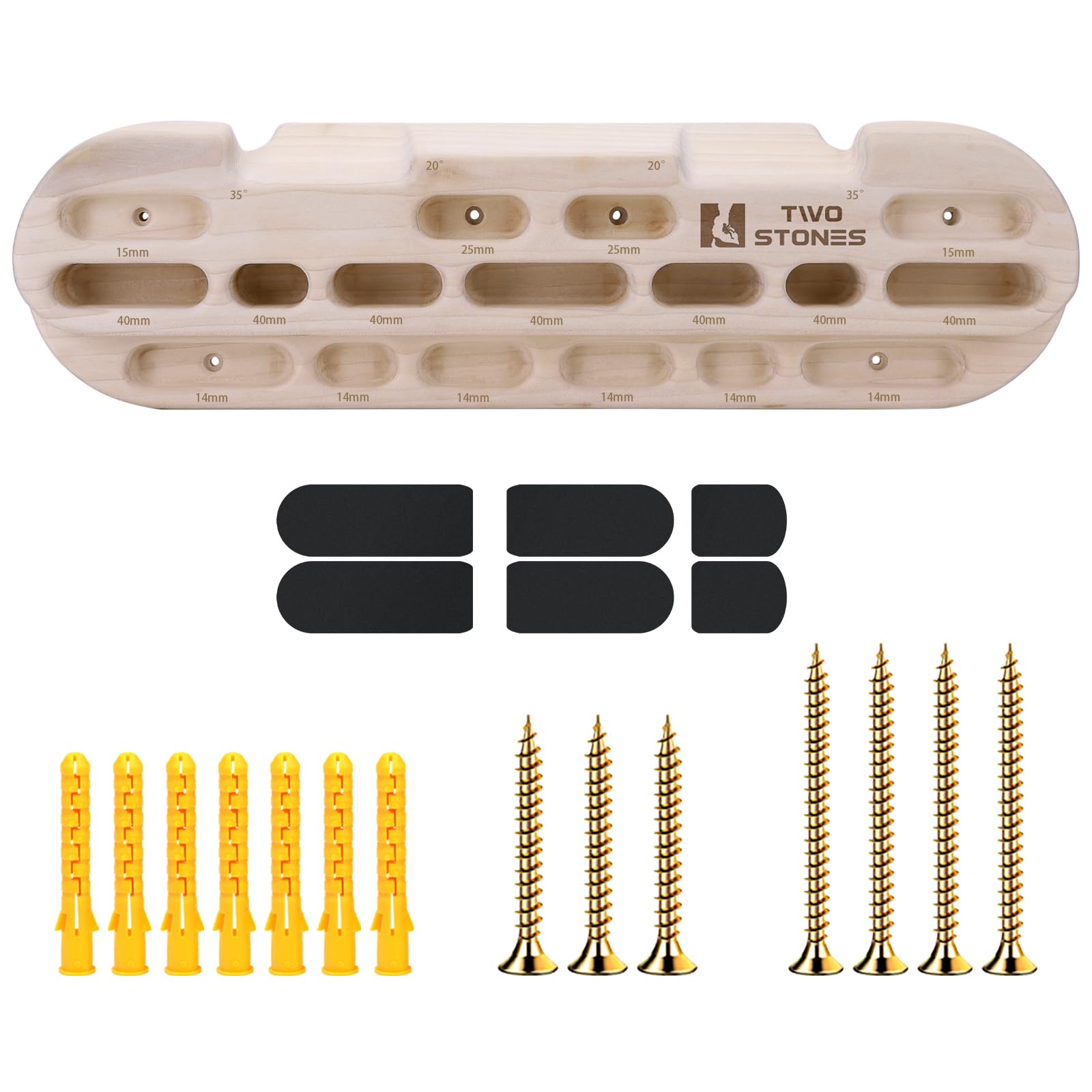
TWO STONES Wooden Hangboard
Key Features
- Holds: Jugs, slopes, 2/3/4-finger pockets
- Weight: 16 oz
- Material: Solid wood
- Dimensions: 21.65 x 5.91 x 1.89 in
- Price: Midrange
TWO STONES mills this board from a single block rather than gluing up offcuts, and you can feel it. There are no seams across the face and no sharp shoulders where an edge meets the body, and every pocket gets an R5 fillet plus a polish. That finish is the difference between a board you hang on for twenty minutes and one you start avoiding on rest days. At its price, it is the wooden board we recommend most readily.
The footprint helps as much as the finish. At 21.65 by 5.91 by 1.89 inches it sits above a doorway header without eating the whole wall, and it tapers from top to bottom so your forearms have somewhere to go. Jugs, two slope angles, 2/3/4-finger pockets at four depths and a set of edges cover the basics, and the box includes seven screws and seven expansion tubes, so you are not hunting for hardware on installation day.
The polish is also the catch for the first few sessions. A new board is slicker than a chalked-up gym hold, and it takes chalk and a little use to settle into the friction you actually want. Once it does, the surface is genuinely pleasant under the fingers, which is not something you can say about every board at this end of the price range.
Pros
- Solid one-piece wood with no glue lines
- Filleted, polished edges that are kind on skin
Cons
- No edge near 20 mm for benchmark hangs
Our value pick for a wall board: one-piece wood, kind edges and a doorway-friendly footprint, as long as you do not need a 20 mm edge for benchmark hangs.
Best for Doorframe Mounting
FingerPeg 1.0
Key Features
- Slopers: 20° and 35°
- Board size: 28.35 x 7.08 x 2.16 in
- Load rating: 265 lb
- Pocket depths: 0.6 to 1.6 in, six levels
- Price: Premium
Most boards want a wall. The FingerPeg is designed around the strip of wall directly above a door frame, and the shape explains why it works there: a 28.35 by 7.08 by 2.16 inch beech board that leaves enough clearance for your legs to hang free instead of knocking the trim. GRIPNATIC quotes under fifteen minutes to mount, and nothing in the design argues with that.
The hold set is built for someone who also wants to train the rest of the chain. Six calisthenics bar holes let you run a bar through the same footprint, and the pockets — two, three and four finger, at six depths from 0.6 to 1.6 inches — plus slopers at 20 and 35 degrees cover warm-ups, hangs and bodyweight work without a second purchase. The finish is finely sanded with rounded edges throughout, and it shows.
It is 3.5 kg of class A beech, and we like that heft in something you load with one arm; it feels like furniture rather than a training toy, and the 265 lb rating is reassuring when you are pulling hard on a doorframe mount. Where it makes most sense is a room with no spare wall, a rented flat, or a garage where the door header is the only structural thing at the right height.
Pros
- Designed to mount above a door frame
- Rated to 265 lbs of load
- Six pocket depths plus two slopers
- Bar holes add pull-ups to the same footprint
Cons
- Shallowest pocket stops at about 15 mm
The board we choose when the only space is above a door frame and you want pull-ups from the same footprint, with a 265 lb rating behind it.
Best for Crag Warm-Ups
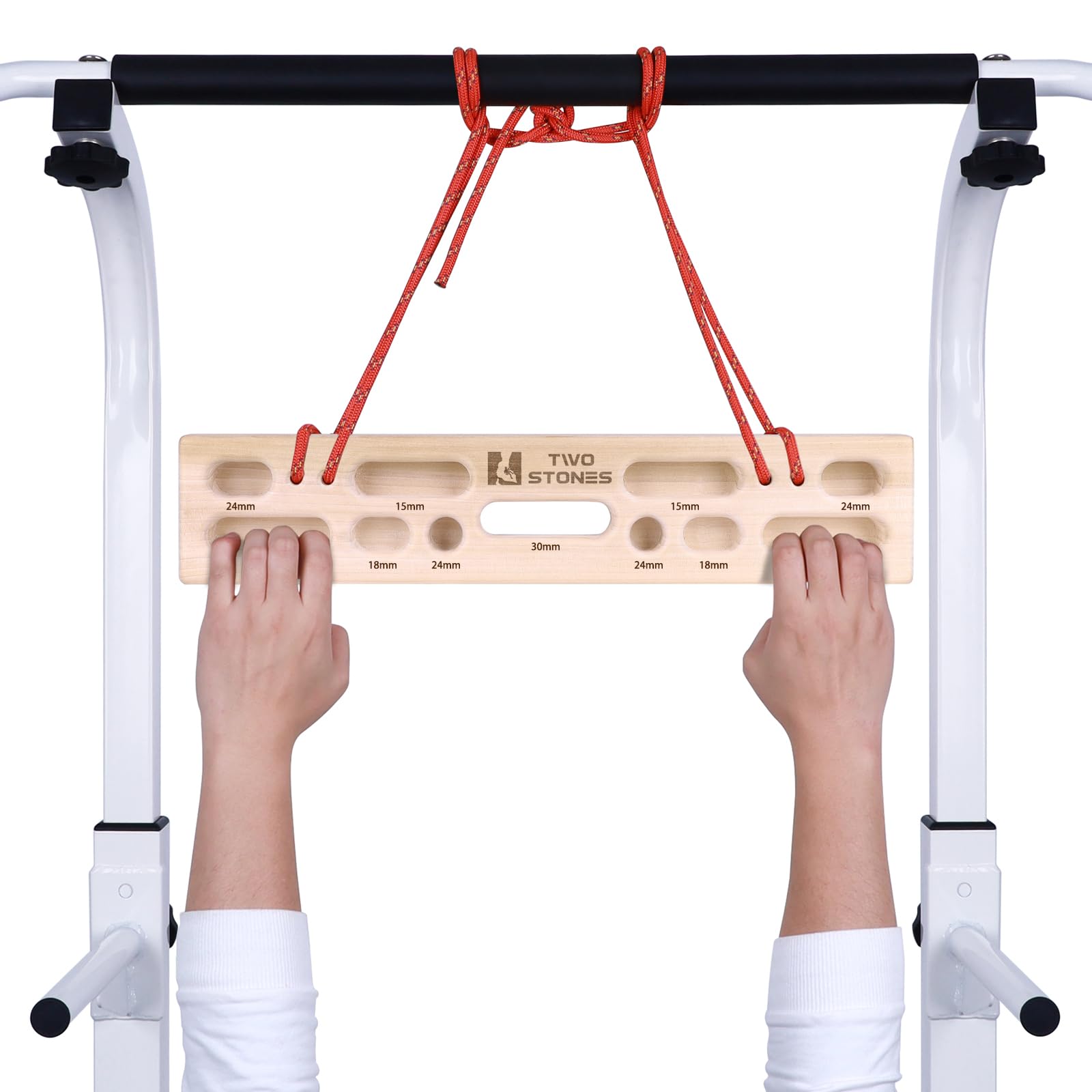
TWO STONES Portable Hangboard
Key Features
- Holds: 1/2/3/4-finger pockets, edges
- Weight: 1.54 lb
- Dimensions: 19.69 x 3.94 x 1.18 in
- Price: Budget
Hanging this board is a ten-second job. It hooks over a pull-up bar, or you run a strap through it and clip it to something solid, and a bar, a beam or a climbing-wall frame becomes a fingerboard. No drill, no backboard, no conversation with a landlord about the deposit.
At 19.69 by 3.94 by 1.18 inches and 0.7 kg it is the board that actually leaves the house. The face carries 1/2/3/4-finger pockets at four depths plus edges, enough to run a real session and small enough to live in a pack. We reach for it on the days when getting to the wall is not happening, and it has become the piece of kit we lend out most, because there is nothing to explain about it.
One thing to know before you load it hard: over a smooth bar it can rock back very slightly as you hang, which feels worse than it is but is distracting on maximum efforts. Thread a strap through the mounting holes and anchor it to something solid and the movement goes away.
Pros
- 0.7 kg, so it goes anywhere
- Hooks over a bar in seconds
- Four pocket depths plus edges
Cons
- Narrow face puts your hands close together
We keep this one in the bag: 0.7 kg, no drilling, and enough depth variety that a warm-up still feels like training rather than a stretch.
Best for First Hangboard
Metolius Project
Key Features
- Weight: 5.3 lb
- Included: Hardware and training guide
- Dimensions: 24.5 x 6 in
- Construction: CNC milled
- Price: Midrange
The Project is the board Metolius built for people who are not sure yet. It is smaller than the Simulator at 24.5 by 6 inches, and the holds are arranged along a broad arc rather than in rows, with the easier grips up top where a beginner can reach them and the harder edges lower down where they should be.
That arrangement makes it the easiest board here to grow on. The top row is essentially a pull-up bar, the middle wants two knuckles in, and the bottom edges are genuinely hard, so one board covers a first dead hang and sessions years later. The taper from top to bottom keeps your forearms clear on two-handed hangs, and the arc spreads the load across the shoulder rather than stacking it.
It ships with mounting hardware, a written training guide and instructions. That matters more than it sounds: a program is the difference between a board that gets used and a board that decorates a wall. As with any wall-mounted board, budget for a plywood backboard across studs rather than trusting the plaster.
For someone buying their first board, this is the one we hand over. It is the least intimidating piece of kit here and it does not feel like a toy — the holds are shaped for hands that are still learning what a crimp is, and the guide tells you what to do with them on the first night.
Pros
- Difficulty ladder from easy jugs to hard edges
- Ships with hardware and a training guide
Cons
- Colorway may not match the listing photo
The first board we hand to a new climber: an easy-to-hard ladder of holds, a written training guide in the box, and enough room to grow for years.
Best for Travel and Warm-Ups
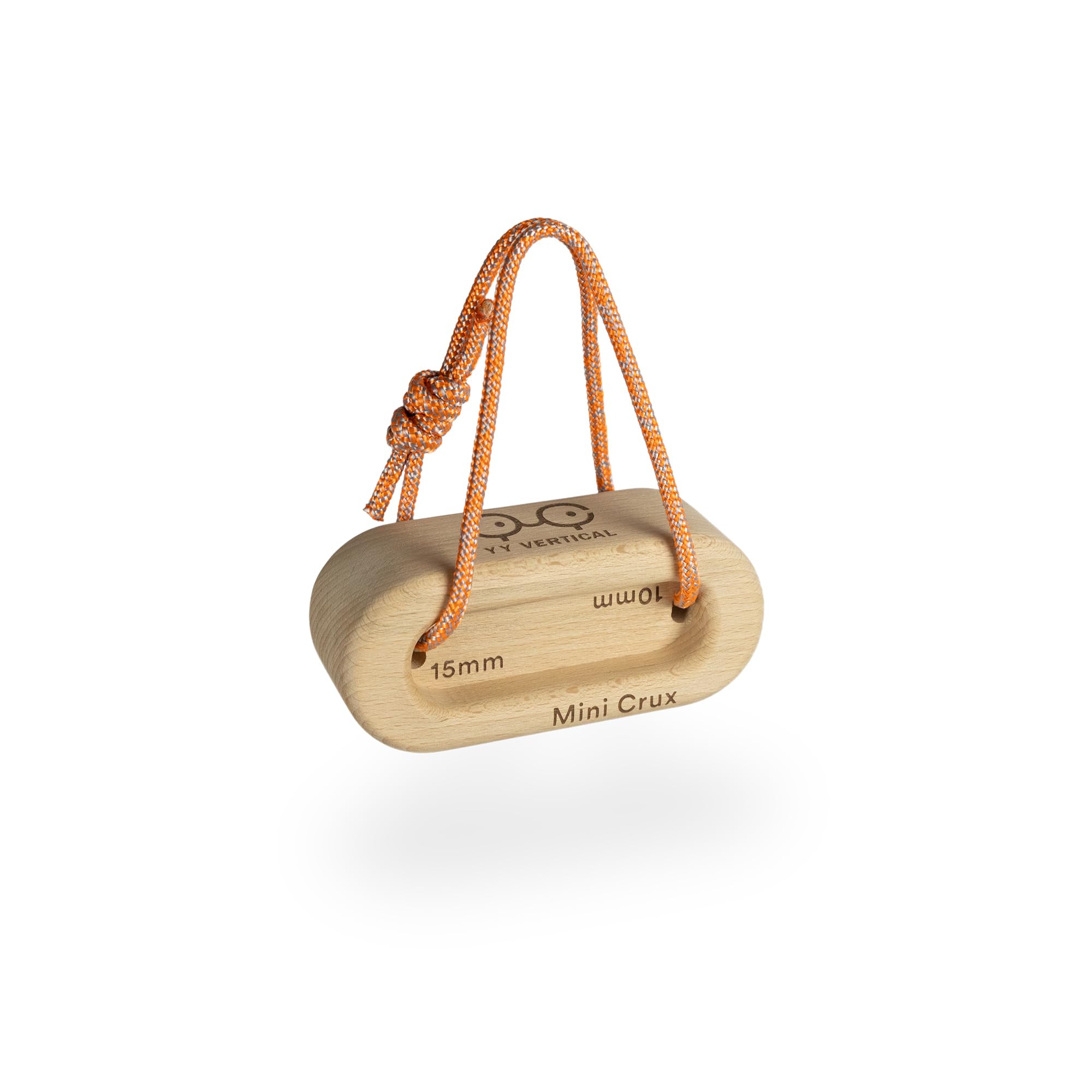
YY Vertical Mini Crux
Key Features
- Pinch: 55 mm
- Weight: 4.41 oz
- Included: Ropes
- Edge depths: 25, 20, 15, 10 mm
- Price: Budget
One hundred and twenty-five grams, roughly the size of a paperback, and it ships with ropes. The Mini Crux is not trying to be a wall board: YY Vertical cuts four edges into a parallelogram of beech — 25, 20, 15 and 10 mm — adds a 55 mm pinch block on the side, and calls it done.
The angled shape is the clever part. Because the faces sit at different angles, the way you hang it changes which edge your fingers land on, so one small block covers everything from a warm-up to a genuinely thin crimp. The laser-engraved texture gives extra bite on the pinch, where smooth wood would let your thumb slide.
We treat it as a warm-up tool and a travel board rather than a replacement for a wall board, and that is the honest ceiling: on a rope it swings as you load it, and it cannot double as a pull-up bar. As the thing you clip to a bolt or a branch while you stretch before a session, it earns its place in the pack.
Pros
- 125 g, so it disappears into a pack
- Four edges plus a 55 mm pinch
- Ropes included, so it hangs straight away
Cons
- Rope-hung only, so it needs an anchor
A 125 g block of beech we take travelling: four edges and a pinch for warm-ups when there is no wall to hang on.
Best for Budget Portable Kit
Bellaroca Portable Hangboard

Key Features
- Board size: 5.12 x 5.12 x 1.1 in
- Set includes: 2 boards, 2 ropes, 4 plates
- Pocket depths: 25, 20, 15 mm
- Weight per board: 4.23 oz
- Price: Budget
What arrives is a small kit: two triangular beech boards, two two-metre ropes and four 3 mm rubber plates, all inside a package 10.28 by 5.67 by 1.65 inches. Two boards is the underrated part — one can live in the pack while the other stays wherever you train, or two people can work at once.
Each board carries three four-finger pockets at 25, 20 and 15 mm, a single-finger slot for mono work and a top pinch. The plates are the interesting bit: drop one into a pocket and you shave 3 mm off the depth, which turns three pockets into something closer to eleven combinations across the pair. For a beginner moving from open-hand hangs toward crimps, that is a real ladder rather than a token adjustment.
At 120 g a board they are as portable as anything here, and setup takes under a minute on a branch, a bar or a bolt. Hung free they do swing, so a steady anchor matters more than it does with a fixed board, and the plates are small enough that you want a routine for where they live between sessions.
As a first portable set, we rate it: you get two boards, a genuine depth ladder and adjustable plates for less than a single wall board. If you are mostly training at home, put the money into a mounted board instead and add this later.
Pros
- Two boards, two ropes and four plates
- Rubber plates add eleven-plus grip combinations
Cons
- Small rubber plates are easy to misplace
The cheapest way into rope-hung training: two boards, two ropes and rubber plates that stretch three pockets into eleven combinations.
How We Chose and Tested the Best Hangboards
We started by pulling every hangboard we could find from climbing specialists and general outfitters, then filtered by the things that actually matter at home: whether mounting hardware came in the box, how many distinct edge depths the board offered, the gap between the inner and outer pockets, and price per usable hold. Boards that only worked on a dedicated training wall, or that required hardware sold separately, dropped off early. That left 12, spanning wood, resin, and composite.
Installation was the first real test. Where we could, we hung each board twice — once straight into wall studs, once on a plywood backer — timing the job solo and noting whether the kit included every bolt, spacer, and template it promised. We loaded each one with a two-handed hang and watched the top edge for movement, and we checked whether any screw head sat proud enough to catch a knuckle mid-hang.
Then we trained on them, at least twice a week for eight months. Sessions ran through 10-second and 7-second hangs in half-crimp and open hand, plus repeaters and pull-ups where the jugs allowed. We logged which edges we actually reached for and which never got touched, how fast skin wore down on the sharper pockets, whether the jugs stayed comfortable past the third set, and whether the bottom edge dug into forearms on deep hangs. Color came up too: we held each board next to its listing photos, and a few arrived noticeably darker or more orange than advertised.
Durability got checked monthly — chalk and sweat buildup, grain raising on wooden edges, resin chipping at the lip, bolts that needed re-tightening. Value came down to usable variety rather than hold count: a board with four well-spaced depths beat one with twelve overlapping pockets every time.
How to Choose a Hangboard
The number that decides whether a hangboard is worth owning is not the width or the wood — it is the depth of the edges, because that is the one thing you cannot change later.
Start with edge depth, not the outline
Twenty millimetres is the depth most training plans are written around, and it is the first number to look for. A board that jumps from a comfortable ledge straight to a thin crimp leaves you nowhere to put a program built on 20 mm hangs — TWO STONES’ wall board is lovely to touch and has exactly that gap. Edges of 18 mm and below are for later seasons and stronger fingers.
We weight depth range above hold count every time. You can always find a way to hang a deep jug; you cannot make a missing edge appear.
Decide where it will hang before you buy
Three answers cover almost everything: a board screwed to a wall or backboard, a shaped board that fits above a door frame, and a rope-hung portable. The trap is drywall. Anchors sized for a picture frame will not hold a body-weight hang, so plan on finding studs or fixing a plywood backboard across them first.
Above a door frame, check the header height and whether your legs will clear the trim. And measure the face: the Metolius Simulator 3D is 28 inches across, which wants a wider stretch of wall than a doorway header gives you.
Wood or composite
Wood is kinder to skin, warms up with your hands and improves with chalk. Composite is grippier when new and shrugs off the temperature swings of a cold garage or shed. Polished hardwood can feel slick for the first weeks — that same polish is what makes it comfortable, and chalk plus use settles it.
We take wood for a board that lives indoors and gets used bare-handed, and composite when the board is going somewhere unheated and you want friction from day one. If your tips tear easily, rounded wooden edges are the safer bet.
Portable boards are a supplement, not a replacement
A 120 gram block on a rope is a warm-up tool and a travel companion. It gives you a couple of depths and a pinch, it swings while you hang, and it will not carry a structured progression the way a fixed board with a full depth ladder will.
Buy one second — unless you are on the road more than you are home, in which case a portable board and a bar you trust will do more for your fingers than a wall board you never see.
Frequently Asked Questions
Can I use a hangboard if I can’t do a pull-up yet?
Yes. Hangboarding is hanging, not pulling, and you can take weight off by keeping one foot on a chair or the floor. Start on the deepest jugs and work toward a full bodyweight hang on a 20 mm edge before you add anything else.
If your foot is doing most of the work for the first month, that is normal, not a failure.
How often should I hangboard?
Two or three sessions a week is plenty for most climbers, with at least a day between them. A common format is five to eight hangs of seven to ten seconds with three to four minutes of rest between sets.
Stop a set when your grip starts to open up — the last good rep trains more than the sloppy ones after it.
Is a fingerboard the same thing as a hangboard?
Yes. They are the same equipment under two names — fingerboard is the more common term in Europe, hangboard in North America — and listings use them interchangeably.
Search both when you shop, and expect small rope-hung blocks to be called fingerboards more often than wall-mounted boards are.
Final Verdict
The YY Vertical Verticalboard One is the hangboard we recommend to most climbers, because the magnetic inserts turn one purchase into years of progression: the same 20 mm edge is a beginner’s hang today and a 10 mm crimp two seasons from now. That is worth more than any single feature on the other boards here.
If you want the widest spread of holds on the wall without ever thinking about depth, the Metolius Simulator 3D is the alternative — it costs about the same and asks nothing of you but chalk.