This post contains affiliate links. We may earn a small commission when you buy through our links — at no extra cost to you.
Freeze-dried meals are the rare pantry item that has to work twice: dinner at a windy campsite and backup food in the closet when the power goes out. The tradeoff is texture—lightweight pouches and long shelf lives often mean sauces that turn chalky and vegetables that collapse into paste. I’ve eaten plenty on backpacking trips, and the best ones don’t just survive boiling water; they make you want a second bite. What they fix is narrow but real: a little hot water and a pouch become dinner when cooking from scratch isn’t practical.
Over the past six months, we tested 18 meals, from camp dinners to emergency-kit staples, and the spread in flavor, texture, and portion size was wider than I expected. A first-time buyer should know that cost per serving means little if the pouch leaves you hungry an hour later, and that printed best-by dates vary widely. The picks below are the ones we’d eat at a rainy picnic table or keep in the emergency bin without feeling like we settled.



Best for Backpacking Dinners
Peak Refuel Beef Stroganoff
Key Features
- Packed weight: 5 oz
- Protein source: 100% real USDA beef
- Servings per pouch: 2
- Price: Premium
Plenty of pouches list meat somewhere after the noodles. Peak Refuel builds this one around 100% USDA-inspected beef, with no textured vegetable protein, and that near-double protein claim is the reason it earns the top spot: after a long day it eats like a meal rather than a side dish. Flavor is where it separates from the rest of this set, too — the mushrooms come back big and savory, and the sauce tastes like stroganoff instead of brown gravy.
Water is the part worth practicing. The pouch is designed to need less than most, but a full cup is the realistic starting point, stirred once halfway through the wait. Undershoot and the sauce turns thick and pasty, with meat that stays chewy; that texture is the main thing to complain about here, and it is almost always a water problem rather than a recipe problem. Give it the extra splash and the noodles hydrate properly and the sauce turns creamy.
Two servings at 5 ounces is honest: one pouch makes a serious dinner for one hungry hiker, or a shared dinner for two moderate appetites, and it is not the item that breaks your pack weight. On a genuinely big day, plan on eating all of it yourself. Per serving it costs far more than either bucket here, which is the trade — meat and flavor instead of calories per dollar. It is the pouch that goes in our own packs for a planned dinner, and the first one we hand to someone who has only eaten cheap freeze-dried food.
Pros
- Real USDA beef with close to double the protein
- Creamy sauce and flavor that survive rehydration
- Two filling servings at 5 ounces
Cons
- Premium price per serving
- Needs about a full cup of water
This is the trail dinner we hand people first: real beef, close to double the protein, and a sauce that comes back creamy. Pay the premium when dinner has to carry a hard day.
Best for Trail Breakfasts
Mountain House Breakfast Skillet
Key Features
- Dietary: Gluten-free
- Packed weight: 3.7 oz
- Servings per pouch: 2
- Shelf life guarantee: 30 years
Texture is where this one divides people, and it is fixable. With the full stated amount of water the eggs come out loose and soupy, closer to a hash than a skillet; hold back a splash, stir once, and let it stand the full time, and it firms into something that eats like a proper breakfast scramble. That single adjustment is the difference between a pouch you tolerate and one you look forward to.
What surprised us is how much flavor survives the process. Sausage, peppers and potato carry the whole thing, the eggs come back better than freeze-dried eggs have any right to, and there are no artificial flavors or colors in the pouch. It is gluten-free as well, which makes it the breakfast to bring when the group has mixed needs and nobody wants to cook two different things at 7 a.m.
Preparation is as simple as this category gets: hot water, ten minutes, eat out of the pouch, no dishes to scrub in the dark. Two servings is realistic for two people and stretches to three with tortillas. Cost per meal is the sticking point — you are paying for convenience and a 30-year taste guarantee, and if you only want calories, a bucket beats it outright. The empty pouches recycle through TerraCycle, which is a nicer detail than it sounds when everything you carry has to come back out with you.
Pros
- Tastes like a real breakfast scramble
- Ten-minute prep with no dishes
- Gluten-free with no artificial flavors or colors
Cons
- Costs more per meal than bucket food
Buy it for a hot, gluten-free breakfast that takes one pot of water and no cleanup, as long as you pour a little less than the pouch says.
Best for 72-Hour Emergency Kits
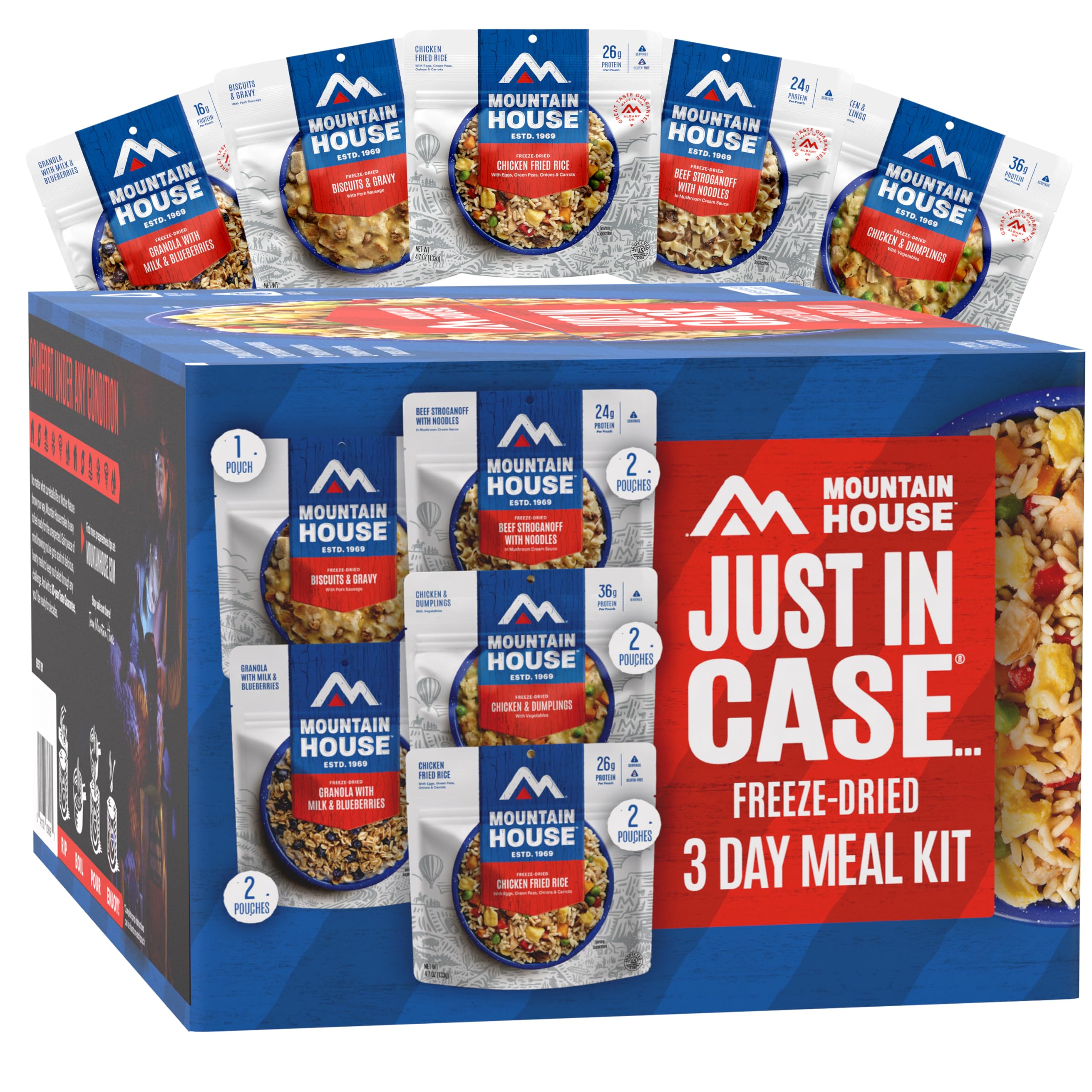
Mountain House 3-Day Kit
Key Features
- Kit weight: 3.6 lb
- Calories per day: 1,706
- Pouches included: 9
- Shelf life guarantee: 30 years
1,706 calories a day for three days is the number this kit is built around, and it is a far more useful figure than any serving count on a bucket. Nine pouches, 3.6 pounds, 12 cups of water to prepare the lot — that is a box you can hand someone and say it covers three days, which is the entire job of an emergency kit.
As a backpacking menu it is fine rather than exciting. The variety is thin, with chicken and fried rice turning up more than once, so by the third day you are eating a repeat. As something that sits in a closet for years and then works, we are impressed: real entrées rather than ration bars, no artificial flavors or colors, and the 30-year taste guarantee Mountain House puts behind everything it packs.
The detail that sold us is the cold-water instruction. In a power outage you can prepare any of these with room-temperature water by doubling the water and the wait, which turns a camping convenience into an actual emergency plan. The box is 13 by 10 by 9 inches, so it fits a car trunk or the bottom of a hall closet and stays out of the way until the week you need it.
Pros
- 1,706 calories a day for three days
- Prepares with cold water when the power is out
- Nine pouches in a 3.6-pound kit
- Backed by a 30-year taste guarantee
Cons
- Fixed menu repeats meals across the three days
Keep one in the car or the hall closet: nine pouches, 1,706 calories a day, and a menu you can prepare with cold water if the power is out.
Best for Pantry Stockpiles
Ready Hour 120-Serving Bucket
Key Features
- Shelf life: Up to 25 years
- Bucket weight: 20 lb
- Total servings: 120
- Resealable pouches: 22
- Price: Midrange
Twenty-two resealable pouches instead of 120 singles sounds like a downgrade until you cook for two. Open a pouch, take what you need, reseal it, and the rest keeps for about a year — which makes this the bucket we actually eat through and rotate rather than one we are afraid to break the seal on.
The rest of the spec sheet is what a stockpile needs: up to 120 servings of entrées, a shelf life of up to 25 years, and a flood-safe bucket with a handle that tucks into a pantry corner. At 20 pounds it is manageable to carry and annoying to drag off a top shelf, so give it a floor-level spot and it stops being a consideration. The food is entrées only, the rice-and-creamy-pasta sort of thing, which is what you want a bucket to cover.
Taste is the honest caveat. These rehydrate into competent, filling food rather than something to look forward to, and a few come out bland without salt, pepper or hot sauce. Keep a shaker and a bottle of hot sauce on the shelf beside the bucket; it is a small addition that decides whether the food gets eaten or dreaded. For a household putting away a couple of weeks of dinners, the count you can plan around and the resealable format are what earn it a place over the cheaper sample bucket.
Pros
- 22 resealable pouches, so you use only what you need
- Up to 25 years of shelf life
- Flood-safe bucket with a carry handle
Cons
- Entrées only, so no breakfasts in the bucket
- Costs more up front than the sample bucket
The stockpile bucket we suggest to most households: 22 resealable entrée pouches, 25 years of shelf life, and a format you can eat half of tonight.
Best for First Emergency Bucket
ReadyWise 120-Serving Sample Bucket

Key Features
- Shelf life: Up to 25 years
- Total servings: 120
- Bucket dimensions: 15 x 10 x 12 inches
- Price: Budget
The 120 on the lid is the number that sells this bucket and the number that disappoints. What arrives is a stack of larger multi-serving pouches, several servings in each, plus drink mixes, so the total adds up while the dinners do not. Read the pouch list before you order and plan on feeding fewer people for fewer days than the label implies. Our advice is to treat it as a tasting menu and a starter stash rather than as a 120-meal plan: eat through it over a few weeks, then restock only the entrées you actually finished, in a bigger bucket.
What it does well is get you started cheaply. It is the lowest-priced bucket here, the shelf life runs to 25 years, the buckets stack, and the split lid doubles as a tray or a bowl when there is no sink in sight. The entrées — cheesy macaroni, lasagna, teriyaki rice, chicken-flavored noodle soup — are the kind of food that gets eaten rather than hoarded, though taste is genuinely uneven between them, and some come out seasoned while others taste of not much at all.
The footprint is the other quiet advantage: 15 by 10 by 12 inches slides onto a pantry shelf and stacks under a workbench. Nothing here is a long-term plan on its own, but as the bucket that teaches you what your household will eat before you spend on a bigger one, it does a job the others do not.
Pros
- Lowest-priced bucket here, with a 25-year shelf life
- Split lid doubles as a tray or bowl
- 15 x 10 x 12-inch footprint stacks in a pantry
Cons
- 120 servings include drinks and multi-serving pouches
A cheap way to find out which emergency entrées you will actually eat, as long as you read the pouch count rather than the 120 on the lid.
How We Chose and Tested the Best Freeze-Dried Meals
We built the shortlist from outdoor retailers, emergency-preparedness catalogs, and brands our team already trusted, then filtered out pouches that were mostly filler, too bulky for a pack, or priced far above the rest. That left us with 18 meals to test over six months.
Testing happened on weekend camping trips, day hikes, and a planned power-outage drill at home. We boiled water on a camp stove and on a kitchen range, timed how long each meal took to rehydrate, and tasted it at the recommended mark and again five minutes later. We noted whether rice and noodles softened evenly, whether chicken shredded or turned rubbery, and whether the sauce coated the spoon or pooled watery at the bottom; flavor and texture separated the good pouches from the forgettable ones quickly. We also looked for recognizable vegetables and meat rather than a uniform powder.
Portability got checked by weighing each pouch and packing it into a daypack and a car emergency tote, where bulk and seal integrity mattered as much as calories. We logged printed best-by dates for shelf life, then ate one pouch as a solo dinner and shared another between two people to judge portion size and quantity. We also compared cost per serving and calories per dollar, because value for money only holds up if the meal actually fills you up.
How to Choose Freeze-Dried Meals
The serving count on the package is the least reliable number on it; the pouch count, the calories inside, and the water it takes to bring them back tell you far more.
The serving count is the least honest number on the package
Every bucket here leans on a big number, and none of them mean that many dinners. Servings get counted as half-cups, drink mixes get counted at all, and one multi-serving pouch can present itself as eight meals. Before you compare anything else, count the pouches and read what is in them: 22 resealable entrée pouches and 120 single-serve packets are not the same purchase, even when both labels read 120.
Our rule is to compare pouch counts and entrée counts first, then look at the headline. A bucket that breaks down into a dozen large bags is a household supply you cook from; a box of nine single pouches is what you hand someone for three days.
Pouch or bucket: match the format to where the food lives
Single pouches are for a pack: 3.7 to 5 ounces, eaten straight from the bag, no dishes. Buckets are for a shelf: 20 pounds and a footprint that wants a floor-level spot, sealed against damp and mice, with a shelf life measured in decades. Neither is a failure at the other’s job, and the most common mistake is buying a bucket to carry up a hill.
Most households end up with both, and the split is roughly what you carry this season versus what sits in the garage. If you only buy one, buy for where the food will actually be a year from now.
Water, fuel, and the ten-minute promise
Every meal here is just-add-water, but the water adds up: the Mountain House three-day kit takes 12 cups to prepare all nine pouches. On a dry stretch that is a planning problem rather than a cooking one, so count your water capacity before you count flavors.
Two things make it easier. Sauce-based entrées rehydrate in a single pot with a stir halfway, and Mountain House meals can be made with room-temperature water if you double both the water and the wait — useful in a power outage, tedious on a trail. Carry a little more fuel than you think you need.
Texture is where these meals fail, not flavor
The recurring disappointment with freeze-dried food is a pouch that comes out soupy or, worse, gritty. Egg and potato dishes are the usual culprits, and the fix is water discipline: hold back a splash, stir once, and let the pouch stand the full time rather than the impatient half of it. Noodle and rice entrées are more forgiving and can take a little extra water.
Seasoning is the second lever. Salt, pepper, and a small bottle of hot sauce turn a bland bucket dinner into something you finish rather than something you endure.
Shelf life is a storage promise, not a guarantee
Twenty-five and 30 years are the numbers the buckets sell, and they assume a cool, dry, dark shelf. A garage that bakes in summer, a car trunk in July, or a damp basement shortens that considerably. Store these where you store canned goods, not where you store a spare tire.
Rotation is the part most buyers skip. Ready Hour’s resealable pouches keep about a year once opened, which makes for a bucket you can actually eat through and refill instead of one you are afraid to break the seal on.
Frequently Asked Questions
How many freeze-dried meals should I pack per day?
For hard miles, plan two pouches a day plus snacks; for an easy day, one pouch plus snacks is enough. Treat a two-serving pouch as a single dinner after a long climb, because that is how most people eat it.
The Mountain House three-day kit’s 1,706 calories a day is a sensible benchmark for what a full day of food looks like when nothing else is in your pack.
Are freeze-dried meals high in sodium?
Often, yes — salt is doing a lot of the work in flavor and shelf stability. The useful move is to read the nutrition panel per pouch rather than per serving, since a pouch labeled two servings frequently goes down as one, which doubles what you actually take in.
If you are watching salt, alternate pouches with plain rice or oatmeal you season yourself, and drink more than you think you need.
Can I fly with freeze-dried meals?
Sealed pouches are shelf-stable and are not treated as liquids, so they travel fine in a checked bag or carry-on.
The complication is the border rather than the airport: pouches built around real beef, chicken, or dairy can be restricted on entry to some countries, so check the destination’s rules before you pack a week of them.
Final Verdict
If the food is going in a pack, buy the Peak Refuel stroganoff. Real beef, close to double the protein, and a sauce that comes back creamy make it the one dinner here that feels like a reward rather than a ration, and the water handling is easy once you know to start with a full cup.
The decision flips the moment the food stays home. For a closet, a garage shelf, or a car trunk, the Ready Hour bucket’s 22 resealable entrée pouches and 25-year shelf life make it the better spend per meal, and it is the one we keep in our own storage.