This post contains affiliate links. We may earn a small commission when you buy through our links — at no extra cost to you.
A dry bag has one job, and you usually learn whether it’s any good at the worst possible moment: a wave over the bow, a rainstorm that settles in, a leaky bottle of camp soap. I once opened a roll-top after a long paddle and found a fleece that felt like a used dishrag, so I’m fussy about seams, closures, and coated fabric. The right one keeps your sleeping bag, phone, and spare layers bone dry, period.
Over six months, we put 14 dry bags through paddle trips, rainy commutes, and day hikes, packing the same load into each to compare usable size and timing how fast they dried after a dunking. The keepers share a roll-top that seals without a fight, a shape that slides into a kayak hatch or daypack, and fabric that shrugs off scrapes. We also learned that a dry bag is only as versatile as its closure—if it’s a pain to open with cold hands, you’ll stop using it. The picks below run from a phone-sized pouch to a week’s worth of camp gear.


Best for All-Around Day Trips
Earth Pak 20L Dry Bag
Key Features
- Carry: Adjustable shoulder strap
- Capacity: 20 liters
- Included: IPX8 phone case
- Material: 500D PVC
- Price: Midrange
Twenty liters is the Goldilocks size in this set: enough for a change of clothes, lunch, a towel, and a small camera, but not so much that the bag turns into a duffel you resent carrying. The Earth Pak makes that size easy to live with, thanks to a 500D PVC shell, a roll-top buckle, and an adjustable shoulder strap. A front zip pocket keeps small items from disappearing into the main compartment.
What makes it our top pick is how little it asks you to compromise. The PVC is stiff enough to shrug off abrasion, the roll-top seals with a familiar fold-and-clip motion, and the included IPX8 phone case is a genuinely useful extra rather than a throwaway. We also like that the 20L is small enough to stow under a boat seat but roomy enough for a proper day out. It is the bag we recommend first because it covers the most common trip without a specialist’s trade-offs.
The shape is simple, so packing takes a little thought: put the heaviest items at the bottom, leave headroom for the roll, and keep snacks in the front pocket. At the end of the day it wipes out easily, and the wide opening lets you see what is left before you roll it shut. Those are small things, but they are the ones we notice on the second or third trip.
Pros
- Tough 500D PVC shell
- Useful 20L day-trip capacity
- IPX8 phone case included
- Easy adjustable shoulder strap
Cons
- Single shoulder strap, no backpack harness
We recommend the Earth Pak 20L as the default day bag: tough PVC, easy shoulder carry, and a bundled phone case make it the best all-around choice here.
Best for River Floats
MARCHWAY 10L Dry Bag
Key Features
- Carry: Removable crossbody strap
- Capacity: 10 liters
- Material: PVC tarpaulin
- Listed weight: 10.6 oz
- Price: Budget
A crossbody dry bag is the quiet winner for float trips, and the MARCHWAY 10L is the version we reach for when the plan is a short carry and a lot of splashing. We like its removable shoulder strap, welded PVC tarpaulin shell, and the way the round bottom traps air so the bag floats when it is sealed with care. It is not a backpack, but it is not pretending to be one either.
Ten liters is enough for a towel, sunscreen, a phone, and a dry layer, and the bag weighs a little over ten ounces when empty. The roll-top closure needs three to five folds to sit properly, and the buckle pulls the folds together without a fight. A removable crossbody strap makes it easy to sling over a rain jacket or clip to a tube, while the compact shape keeps it from swinging around in the boat.
The simple single compartment is part of the appeal: there are no pockets to trap sand and no harness to tangle when you are getting in and out of a kayak. We found the 10L best for one person’s essentials rather than a shared lunch bag, so treat it as a personal day sack. The round bottom is the detail we appreciate most: spread it, trap some air, roll and clip, and the bag rides beside you instead of sinking out of reach.
Pros
- Welded PVC tarpaulin shell
- Floats when sealed with air
- Removable crossbody strap
- Useful 10L day capacity
Cons
- Single strap is tiring on long portages
We pick the MARCHWAY 10L for river floats and quick carries; the welded PVC sack, removable crossbody strap, and float-ready seal make it a strong budget choice.
Best for Multi-Day Camping
Earth Pak 55L Dry Bag
Key Features
- Capacity: 55 liters
- Material: 500D PVC
- Warranty: 5 years
- Listed weight: 2.7 lb
- Price: Premium
Fifty-five liters is not a day bag; it is the bag that swallows a tent, a sleeping bag, camp clothes, and a few meals, then still has room for the small stuff. The Earth Pak 55L is built for that job with the same 500D PVC shell and roll-top closure as its smaller sibling, plus a five-year warranty and an IPX8 phone case in the box. The front zip pocket gives you a place for a headlamp or snack that you do not want to excavate from the main compartment.
We recommend it for paddlers and campers who want one bag to hold a full camp kit, because the capacity is genuinely useful rather than just a headline figure. The adjustable shoulder strap makes a loaded bag manageable from the car to the launch, and the PVC shell is the sort that shrugs off being set down on gravel or shoved under a deck. What it is not is a pack you will want to carry up a mountain; the volume belongs to boat-based trips and short portages.
The bag’s scale also makes it a good shared option: one person can carry the group’s dry gear while another handles the cooler, or a couple can split a weekend’s kit between two boats. It rolls down smaller as you empty it, and the wide opening makes packing a tent easier than wrestling it into a narrow stuff sack. This is the bag that turns a kayak deck into a cargo hold, without asking you to leave the tent at home.
Pros
- Huge 55L camp capacity
- Five-year warranty
- Tough 500D PVC shell
- Included IPX8 phone case
Cons
- 2.7 pounds before any gear
We recommend the Earth Pak 55L for paddlers who need one bag for a full camp kit; its huge capacity and five-year warranty make it the large-load pick here.
Best for Phone and Keys
Unigear 2L Dry Bag
Key Features
- Seams: High-frequency welded
- Capacity: 2 liters
- Material: 500D PVC
- Listed weight: 6.7 oz
- Price: Budget
Two liters sounds almost too small to matter, until you are standing on a beach with a phone, car keys, and a snack that need to stay dry. The Unigear 2L is a pocket-sized roll-top sack made from stiff 500D PVC, with high-frequency welded seams and a compact round profile. It is the sort of small bag that earns a place in a larger pack or a boat’s seat pocket.
The 2L size fits the essentials: a phone, a small wallet, keys, sunscreen, and maybe a granola bar. The 7.48-inch width gives it a round, compact profile, and the 0.19 kg weight barely registers when you clip it on. There is no wasted material or extra pocket to add bulk.
What we appreciate most is the construction at this size. The stiff PVC and welded seams feel more substantial than the price suggests, and the roll-top buckle is easy to work with cold, wet hands. It floats when sealed with air, so a dropped bag stays visible instead of disappearing. The bright yellow shell is easy to spot in a dark pack, and for a phone and keys on a wet day, that is exactly the kind of small assurance we want.
Pros
- Tough 500D PVC shell
- Welded seams resist leaks
- Floats when sealed with air
Cons
- Too small for clothes or towels
We choose the Unigear 2L when you need a tiny waterproof sack for essentials, not a day bag; the tough PVC and welded seams make it a dependable pocket companion.
Best for Backpack Organization
Wise Owl 3-Pack Dry Bags
Key Features
- Sizes: 5L, 10L, and 20L
- Material: 190D ripstop nylon
- Pack count: 3 bags
- Packed weight: 7.05 oz
- Price: Midrange
A three-bag set solves a different problem than one big dry sack: you can separate clean clothes from a damp towel, keep food smells away from a sleeping bag, and find the small bag at the bottom of a pack by color. We like the Wise Owl set for that job because the 5L, 10L, and 20L sacks nest inside one another when empty and weigh almost nothing when you are counting grams. It is organization first, waterproofing second.
The 190D ripstop nylon is the reason they pack so small. It is coated for water resistance, rolls down through a simple clip closure, and has a D-ring for clipping to a pack or boat. The fabric feels thinner than the PVC sacks here, and the seam tape is the kind you see on lightweight tents: neat, but not the same as a heavy welded shell.
That makes this a rain-and-splash set rather than a bag for a swamped canoe. Used inside a backpack, the three sizes cover a useful range: the 5L for electronics and a first-aid kit, the 10L for a layer and lunch, the 20L for clothes or a sleeping bag. We keep coming back to the color coding when a group is unpacking in the dark. Just do not treat the light nylon as a substitute for a submersible PVC sack.
Pros
- Three useful sizes
- Lightweight 190D nylon
- D-rings for clipping
- Good value as a set
Cons
- No shoulder strap, only D-rings
We recommend the Wise Owl 3-pack for backpackers who want a light, packable way to separate clothes, food, and electronics inside a pack without adding much weight.
Best for Backpack-Style Day Use
IDRYBAG 20L Dry Backpack
Key Features
- Pockets: Front zip, inner zip
- Capacity: 20 liters
- Material: 500D coated polyester
- Listed weight: 1.76 lb
- Price: Midrange
The front zip pocket is the feature that makes the IDRYBAG feel like a daypack rather than a sack: you can reach for sunscreen or a snack without opening the main roll-top every time. The pocket is splash-proof rather than submersible, which is fine for a rain shell or a wrapped snack, and there is a second zip pocket inside for things you want more protected. That split between quick access and secure storage is the right idea for a day on the water.
The 20L main compartment uses a 500D vinyl-coated polyester shell with welded seams, and it carries on two adjustable backpack straps rather than a single shoulder sling. At 800 g it is not the lightest bag here, but the weight buys a more structured carry and two adjustable straps instead of one. The roll-top still needs a deliberate three or four folds, but the buckle is easy to seat.
We like this one for kayak days and wet hikes where you are getting in and out of the bag often. It is the most daypack-like option in this set, and that convenience is worth the extra grams if you will carry it for more than a few minutes. Keep the outer pocket for items that can take a splash, and use the inner pocket for the phone and keys. The IDRYBAG is not the least expensive way to keep gear dry, but it is one of the easiest to live with.
Pros
- Backpack-style adjustable straps
- Quick-access front pocket
- Inner zip pocket
- Tough 500D shell
Cons
- Side pocket can tear under load
We like the IDRYBAG 20L for paddlers who want backpack carry and quick-access pockets; it is the most daypack-like dry bag here.
Best for Budget Visibility
HEETA 5L Clear Dry Bag
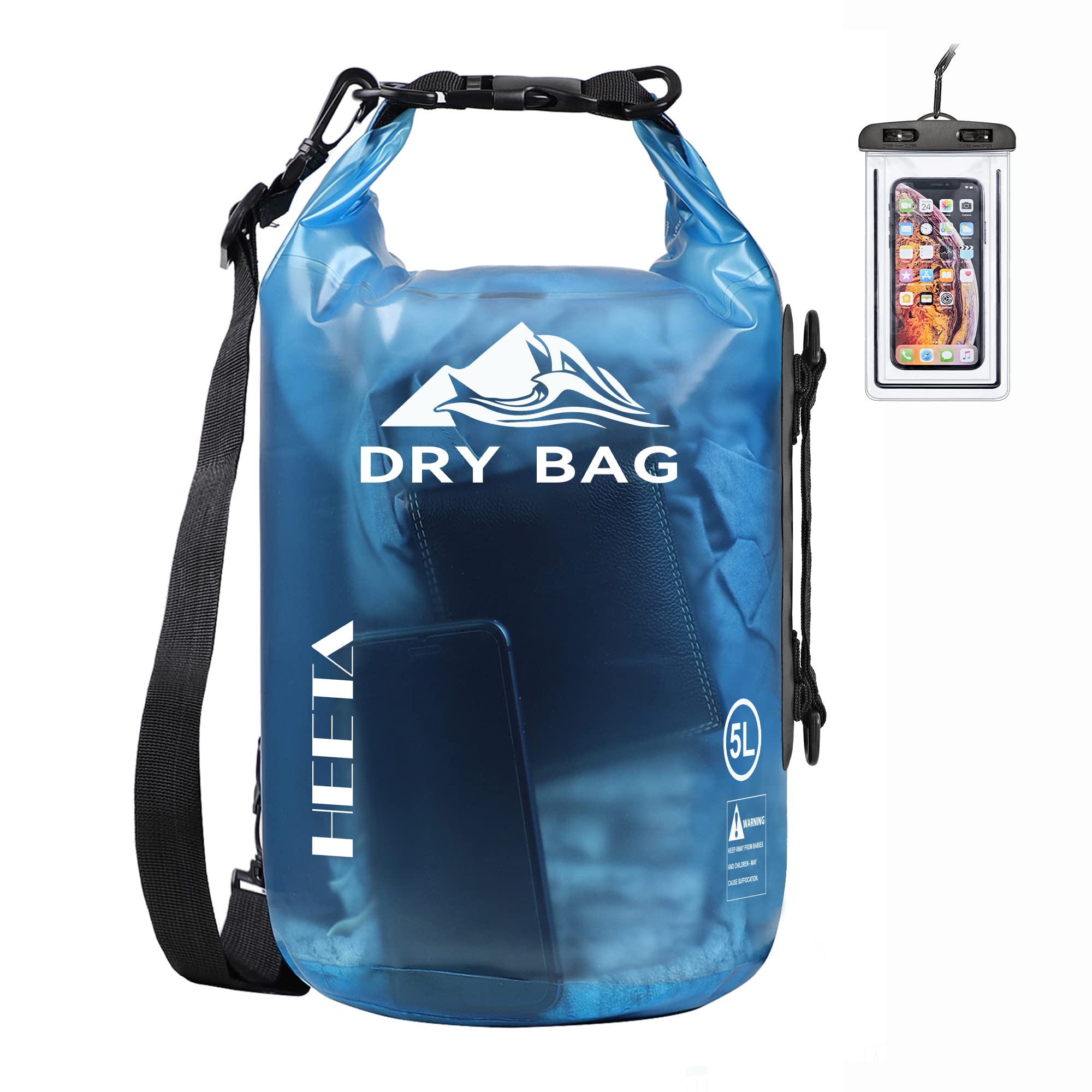
Key Features
- Carry: Shoulder straps
- Capacity: 5 liters
- Material: PVC
- Visibility: Transparent
- Price: Budget
A clear dry bag is a small luxury: you can see the dry socks, the sunscreen, and the phone without unpacking the whole thing in the rain. The HEETA 5L makes that visibility its main selling point, with a transparent PVC body and a roll-top closure that works like the opaque bags here. It is also the least expensive way in this set to get a usable dry sack and a phone case together.
Five liters is a sensible size for a beach bag or a short paddle: a phone, keys, a small towel, sunscreen, and a snack fit with a little room for the roll. The adjustable shoulder straps let you wear it as a small backpack or carry it by the side handle, and the clear material wipes clean after sand and sunscreen have had their way with it. It is not a bag for a full day of clothing.
The clear body also makes it easy to check that the roll-top is seated and that nothing is pressing against the closure. On a crowded beach, that quick visual check is more useful than a rugged shell you have to open to inspect. The included phone case is a welcome extra at this end of the range, though it deserves the same tissue-paper leak test as any pouch.
We recommend the HEETA for a second bag, a kid’s beach kit, or anyone who wants to see the contents without unpacking. It is the one we hand to a friend who needs a budget way to keep a phone and wallet dry, and the clear shell is the reason to choose it over the opaque sacks here. For a bag that lives in a tote, that transparency is the whole point.
Pros
- See-through PVC body
- Adjustable shoulder straps
- Useful 5L capacity
- Bundled phone case
Cons
- Less tear resistance than thicker PVC
We recommend the HEETA 5L for beach days and casual paddles where seeing your gear matters; it is the budget see-through pick here.
Best for Backpacking Splash Protection
Osprey 6L Dry Sack

Key Features
- Capacity: 6 liters
- Material: Coated nylon
- Listed weight: 1.12 oz
- Water resistance: IPX5, non-submersible
- Price: Midrange
IPX5 is the first thing to understand about the Osprey Ultralight: it is a splash-and-rain sack, not a submersible one. That sounds like a caveat, and for a kayak capsize it is. But inside a backpack, where rain, condensation, and a wet tent fly are the realistic threats, the rating is plenty and the low weight is the reward.
At 1.12 ounces and six liters, this is the bag that disappears into a pack until you need it. The rectangular shape packs more efficiently than a round stuff sack, so it slides alongside a sleeping bag or a folded jacket instead of leaving awkward gaps. The roll-top closure and D-ring are simple, and the waterproof-coated fabric has a light, packable hand.
The six-liter size is best for a layer, a small camera, or a day’s food rather than a whole pack’s worth of clothing. It is the bag we reach for when the weather is uncertain and we want a little insurance around a down jacket. The D-ring lets you hang it to dry, which matters for a coated fabric that should not stay crumpled and wet.
We recommend the Osprey to hikers who want a light, rectangular dry sack inside a larger pack. The low weight and efficient shape are what earn it a place in this set, and the six-liter capacity is easy to justify when every ounce in a pack is contested. It is the specialist here, and it does its narrow job well.
Pros
- Very light 1.12 ounces
- Rectangular packing shape
- IPX5 splash protection
- D-ring for drying
Cons
We recommend the Osprey 6L for backpackers who want a light, rectangular dry sack that slides into a pack and keeps clothes organized.
How We Tested Dry Bags—and What Actually Kept Gear Dry
We started by reading specs and reviews for dozens of dry bags, then narrowed the field to 14 that represented main formats—roll-top, zippered, and a few hybrid designs—across 5- to 40-liter sizes and coated fabrics. We ruled out anything with sealed seams that looked painted on, buckles that felt brittle, or a roll-top too short to fold three times. We lived with them for six months.
On paddle days, we packed each bag with the same load—a sleeping bag, fleece, phone, snack bag—strapped it to a kayak deck, and opened it after spray and splashes. On rainy commutes, we wore them as backpacks or slung them over a shoulder, then checked whether water had crept past the closure. Back home, we filled them with paper towels, submerged them in a cooler for ten minutes, and felt for damp patches at the seams and corners. We also dragged loaded bags over wet rocks and through brush, rolled and unrolled closures until our hands ached, and noted where coatings scuffed or buckles loosened.
To judge size, we packed the same kit into every bag and noted whether the roll-top still folded three times with room to spare. For drying, we turned each one inside out and hung it in the garage, checking at two, four, and eight hours to see whether water lingered in corners or under seams.
Functionality came down to cold, wet hands: could we open and close the bag one-handed, find the handle in the dark, clip it to a boat? Versatility showed up on trips—which bags worked as a pillow, a dirty-laundry sack, or a daypack. The ones that lasted kept their shape and coating; the ones that didn’t showed frayed stitching or a closure that stopped sealing.
How to Choose a Dry Bag
Start with the water you expect, not the liter count on the label: a bag for rain and spray is a different purchase from one that has to survive a capsize.
Match the waterproofing to the water
The IPX rating tells you what a bag is built to survive. A sack like the Osprey 6L is rated IPX5, which is fine for rain and splashes inside a pack but not for a dunking. For kayaking, rafting, or anything where the bag can go overboard, choose a roll-top PVC sack with welded seams, such as the Earth Pak or Unigear picks, and test the closure in a sink before a trip. Waterproof on a product page can mean either job, so look for the rating and the closure together.
Size around usable volume, not the maximum
Dry bag liters are measured to the brim, and a roll-top needs several inches of fabric to fold over; a 20L bag packed to the top is not really a 20L bag. We treat 2-5L as pocket and essentials territory, 10-20L as a day on the water, and 30-55L as overnight or shared camp gear. If you are between sizes, go up for a towel or a layer, but step back down if you will carry it far. The Earth Pak 20L is the useful middle for most day trips.
Choose a carry style for the portage
A dry bag spends time on your back as well as on the water. A crossbody strap is easy to sling for a short walk to the launch, while backpack straps make a loaded bag much more comfortable over a longer carry. A no-strap stuff sack is best kept inside another pack. Think about the walk back to the car when the bag is empty and wet, not just the paddle. The MARCHWAY 10L suits quick carries; the IDRYBAG 20L is the daypack-style pick.
Look at seams, hardware, and openings
Welded or taped seams are the ones to look for on a bag that will be submerged; stitched seams alone are a weak point unless they are sealed. Buckles should be easy to work with cold hands, and D-rings let you clip the bag to a boat or pack. A clear front pocket or window helps you find sunscreen without unpacking everything, but keep the outside pocket for items that can tolerate a splash. The HEETA’s clear body is the visibility play here.
Protect the seal between trips
Roll the top three to five times, close the buckle, and check that the folds lie flat rather than creased at the corners. Sand and grit in the closure can open a path for water, so rinse and dry the bag after saltwater or muddy trips. Store it open and loosely folded, away from hot cars, and avoid packing sharp tools against the coating. A dry bag is simple equipment, but the seal is the part that repays a little care.
Frequently Asked Questions
Can I put a wet swimsuit in a dry bag?
Only if you accept a damp interior. A dry bag keeps water out; it does not dry wet contents or stop moisture from spreading. Pack the suit in a separate small sack, or plan to air and wipe the bag before the next use.
Can I use my phone while it’s inside a dry bag?
A roll-top bag blocks touch and can blur photos, even when the bag is clear. Use a dedicated IPX8 phone case for maps and pictures on the water; several picks here include one, including the Earth Pak bags. Test the case with a tissue before you trust a phone to it.
Are dry bags bear-proof?
No. A dry bag is not bear-resistant, and food smells can linger in the coating. Use an approved bear canister or follow local hanging rules, and keep food in its own sealed bag inside the pack.
Will a dry bag keep me afloat?
A sealed bag with trapped air can float and may help you retrieve gear, but it is not a personal flotation device and should never be relied on to support a person. Wear a properly fitted PFD, and test any floating bag in shallow water before a trip.
Final Verdict
For most paddlers, the Earth Pak 20L is the dry bag to buy: it holds a day’s gear, seals with a roll-top, carries on one shoulder, and includes a phone case without becoming a heavy expedition pack. It is the best default in this set.
If your trips are short float-and-splash days, the MARCHWAY 10L is the lighter, less expensive crossbody choice. If you need one bag for a full camp kit, step up to the Earth Pak 55L; for backpacking rain protection rather than immersion, the Osprey 6L is the specialist.