This post contains affiliate links. We may earn a small commission when you buy through our links — at no extra cost to you.
A dry bag is easy to ignore until you’re treading water beside an overturned kayak, watching your lunch float past. I learned that the hard way years ago, and I’ve been fussy about closures ever since. The right one keeps spare layers, a phone, and snacks bone dry through splashes, rain, and the occasional swim. Over the past four months, my team and I put 14 dry bags through lake paddles, river runs, and a deliberately sloppy capsize drill, then checked how fast each one dried out between trips.
Here’s what first-time buyers miss: a roll-top that’s stiff and slippery is a nightmare to seal with cold, wet hands, and a bag that’s technically waterproof but a pain to pack ends up left at home. Price matters, but the cheapest bags often skimp on coated fabric and welded seams. The picks below are the ones we’d trust with our own gear and hand to a friend without a caveat.



Best for Day Paddling
Earth Pak 20L Dry Bag
Key Features
- Carry: Shoulder strap, 24-42 in
- Shell: 500D PVC
- Capacity: 20 L
- Included: IPX8 phone case
- Price: Midrange
The zippered pocket on the front is the detail that made this our default: you can get at keys, a headlamp or a snack without unrolling the top and letting the spray in. The rest is the shape a kayak bag should be — a 500D PVC sack with a roll top and snap buckle, about 9.5 by 9.5 by 17 inches packed, small enough to sit behind the seat or under the deck rigging.
For a day on the water it’s hard to beat. A towel, a fleece, lunch and a phone fit with the top rolled four times, and at 13.6 ounces it adds nothing to the boat. We also like that the shoulder strap runs out to 42 inches, so it slings across a drysuit and still buckles with cold hands.
That strap is the compromise. Backpack straps only arrive at the 30-liter size in this range, so the 20-liter asks to be carried on one shoulder from the car to the launch — fine for a hundred yards, tedious on a real portage. One compartment also means a wet towel shares space with a dry fleece unless you pack the damp things in their own sack.
The included IPX8 phone case is the kind of freebie that usually stays in the box; this one is worth keeping in the front pocket, both for photos from the water and for a phone that has no business being in a cockpit. Roll it properly — three folds, buckle tight, no sand in the fold — and it keeps a day’s gear dry through rain and paddle drips. Rush the roll and no bag here will save you.
Pros
- Front zip pocket keeps small gear reachable
- 20 liters covers a day paddle load
- IPX8 phone case included in the box
- Light to carry at 13.6 ounces
Cons
- Shoulder strap only; backpack straps start at 30 liters
- Single compartment mixes wet and dry gear
This is the bag we tell most kayakers to buy: 20 liters, a front pocket you can reach without unrolling, and a 500D shell that seals with three folds.
Best for Multi-Day Trips
Earth Pak 55L Dry Bag Backpack
Key Features
- Carry: Backpack straps
- Shell: 500D PVC
- Pockets: Front zip and interior mesh
- Capacity: 55 L
- Price: Premium
Same shell, same roll top, same included phone case as our top pick — the difference is 55 liters and a pair of backpack straps. If your kayaking involves a tent, a sleeping pad and three days of food, this is the Earth Pak to load instead of the 20-liter.
It is the bag in this set we point at for kayak camping. The main compartment swallows a full camp kit, the front zip pocket takes a headlamp and a chart, and an interior mesh pocket keeps a phone or a passport where you can find it. The adjustable pack straps cinch down hard enough that a half-loaded bag stops flopping behind you, which matters more than headline capacity on a short trip.
Empty, it weighs 2.8 pounds, and the shoulder straps are wide and stiff compared with a hiking pack — comfortable on the walk from car to water, less so on a mile-long portage. Earth Pak states a five-year warranty on the bag, which takes some of the worry out of dragging it over rocks.
Pros
- Backpack straps make a loaded carry workable
- Front zip and interior mesh pockets organize gear
- Compression straps shrink a half load
- Five-year warranty stated by the maker
Cons
- 2.8 pounds empty, with stiff wide straps
Fifty-five liters on backpack straps, with the same 500D shell and phone case as our top pick and room for a full camp kit.
Best for Value Day Trips
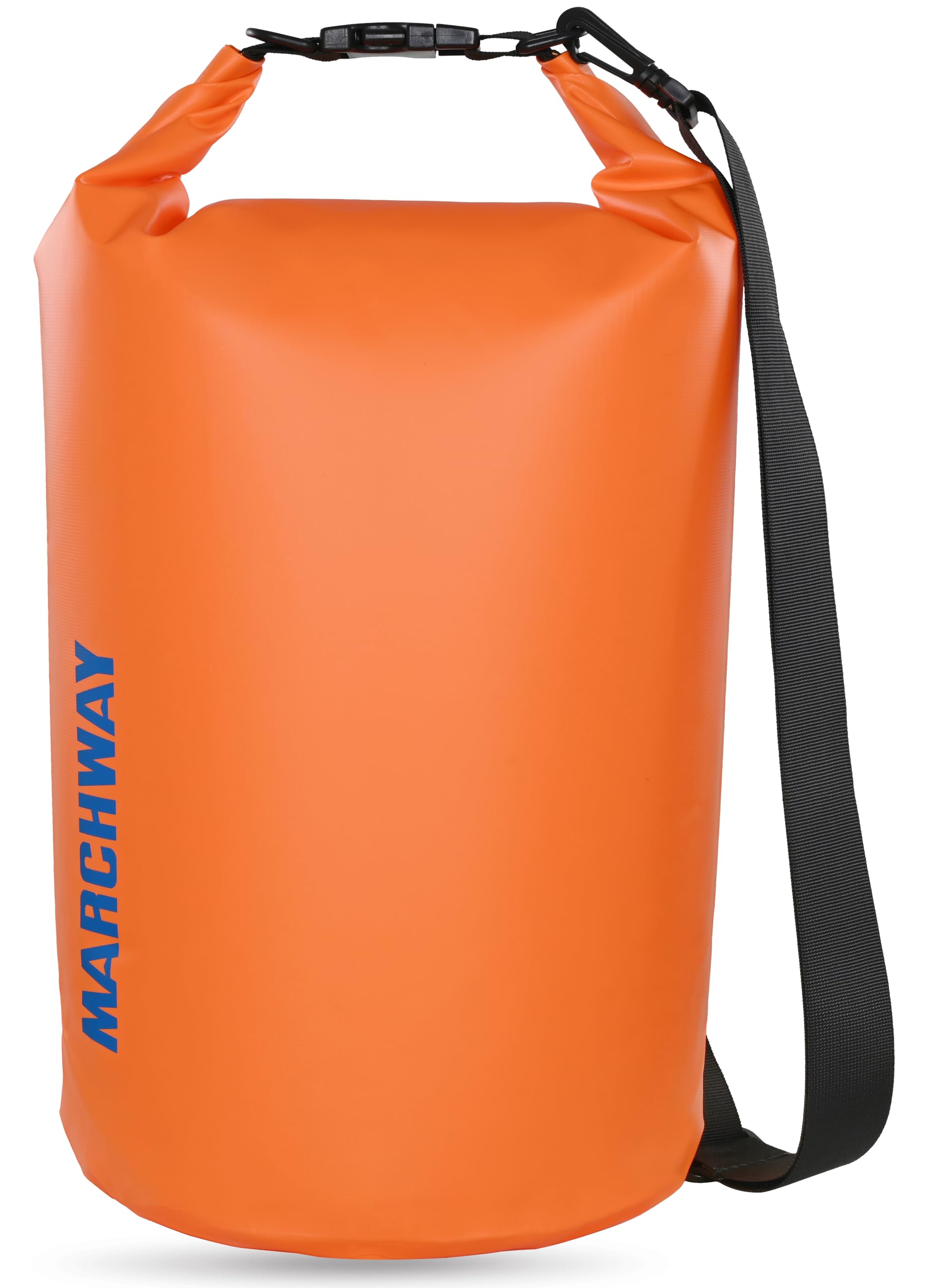
MARCHWAY 20L Dry Bag
Key Features
- Carry: Backpack straps
- Shell: Layered PVC, welded seams
- Buoyancy: Floats when sealed
- Capacity: 20 L
- Price: Budget
The round bottom is the trick: spread it open, roll the top three to five times, buckle it, and the sack traps enough air to float beside you if it goes over the side. That single behaviour is why this is our value pick — a 20-liter bag with proper backpack straps that comes back up when you drop it.
The build is layered PVC with welded seams and heavy-duty buckles, and the 20-liter size gets backpack straps rather than a shoulder sling, which matters when the walk from the car turns out longer than planned. The shell is flexible enough to squash into a hatch or between your knees once the air is out of it.
Durability is the question mark. The fabric and welds hold up to ordinary use, but the strap anchors and seams are where a failure starts when one happens, so check those joints before your first trip. Treat it as a river-and-lake bag rather than something to drag through a rock garden, and it does everything the pricier sacks do.
Pros
- Traps air and floats when sealed properly
- Backpack straps at the 20-liter size
- Welded seams and heavy-duty buckles
Cons
- Strap anchors and seams are the weak point
A 20-liter bag that traps air and floats, carries on backpack straps, and leaves budget for the rest of your kit.
Best for Group Gear
Lanedo 80L Dry Duffel
Key Features
- Carry: Side straps, top handle, shoulder strap
- Pockets: External zip, interior pocket
- Capacity: 80 L
- Dimensions: 25.6 x 12.6 x 13.8 in
- Price: Midrange
Eighty liters is a different category of object. Laid out, this duffel measures about 25.6 by 12.6 by 13.8 inches, which is two people’s camping kit — tents, pads, sleeping bags, a stove — or one paddler’s gear for a week with room left over for wet shoes.
The roll top closes with the same three or four folds as everything else here, and the coated shell has an external zip pocket plus an interior pocket for the things you don’t want to dig for. Side straps and a top handle let two people carry it between them, and the adjustable strap rigs cross-body or as a backpack. Rain and spray stay out; it is the same idea as the smaller sacks, scaled up.
We think of it as a boat-to-camp duffel rather than a pack. Loaded, it is heavy, and the shoulder straps are webbing rather than padded — fine for the twenty steps from cockpit to tent, punishing on a genuine portage. If your trip means carrying the boat and the gear any distance, split the load across two smaller bags instead.
Pros
- 80 liters holds a two-person camp kit
- External and interior pockets for small gear
- Side straps and top handle for two-person carries
Cons
- Webbing shoulder straps dig in on long carries
Eighty liters that swallow a two-person camp kit and stay dry, as long as nobody has to carry them far.
Best for Spare Clothes
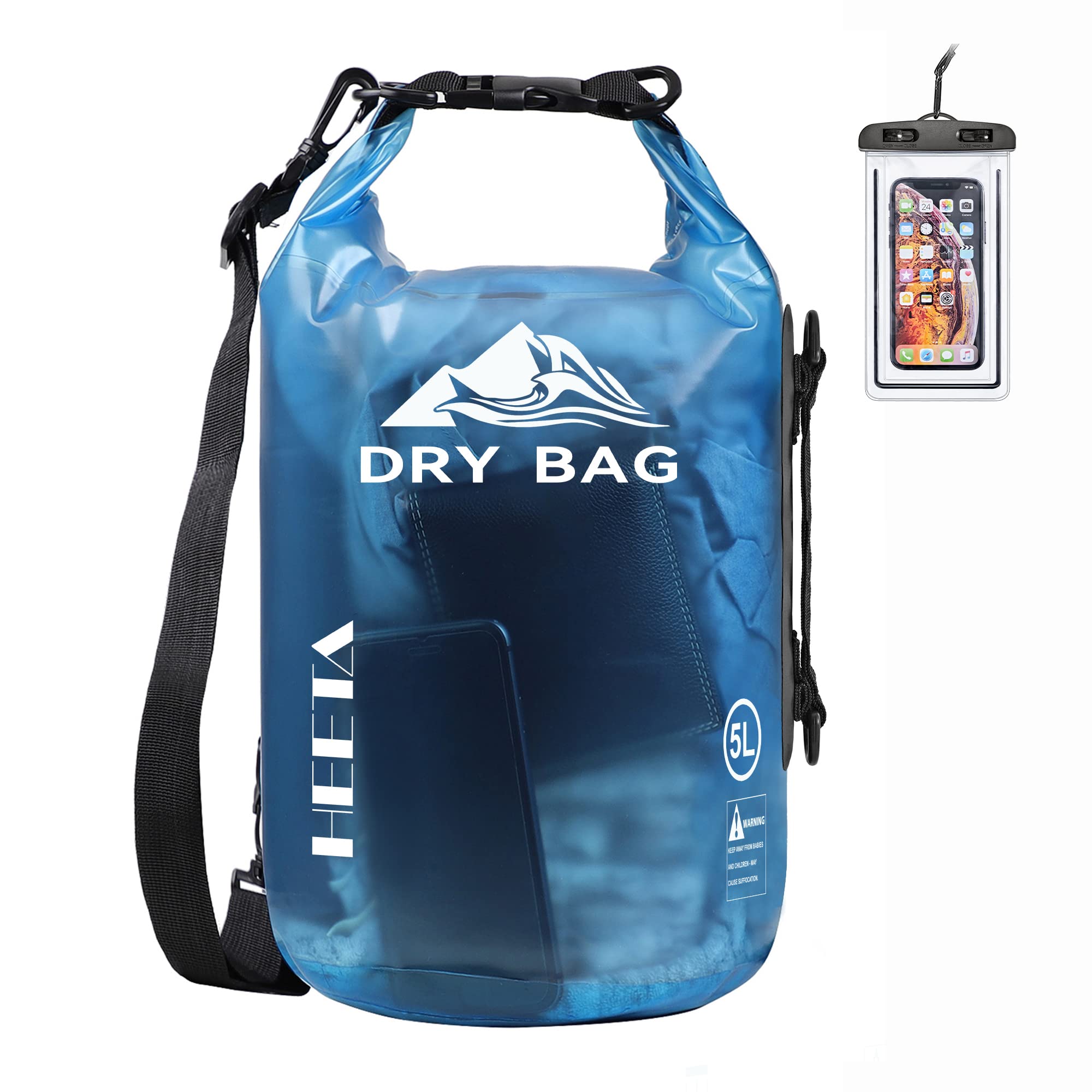
HEETA 5L Dry Bag
Key Features
- Carry: Shoulder straps, side handle
- Shell: Clear PVC, 0.3 mm sides
- Capacity: 5 L
- Visibility: Transparent panels
- Price: Budget
Five liters, clear walls and the lowest price of anything here. For a sit-on-top paddler who wants a spare t-shirt, sunscreen and a phone to survive a capsize, that combination is genuinely useful: you can see what is in the bag without opening it, and the whole thing rolls down small enough to stash under a bungee.
The PVC is thicker where it counts, at 0.6 mm across the base and 0.3 mm up the sides, and the roll top buckles shut with adjustable shoulder straps plus a side handle for carrying. It comes in eleven colors, all transparent, at 8 by 8 by 13 inches, and there is a waterproof phone case in the box.
The thin side walls are the catch. A tear is a real possibility if the bag rides against anything sharp, and a dry bag that fails on the day the weather turns is worse than no bag at all. Put this one inside a larger sack or use it for beach days where a soaking is inconvenient rather than disastrous, and set it down on sand rather than gravel.
Pros
- Transparent walls let you see the contents
- Thicker 0.6 mm base where it wears
- Phone case and shoulder straps included
Cons
- Thin 0.3 mm side walls can tear
- Five liters holds very little
A cheap, see-through second bag for a spare layer and a phone — useful on a sit-on-top, not the sack we trust as primary protection.
Best for Light Day Loads
Cressi Ocelot 10L
Key Features
- Carry: Single crossbody strap
- Shell: PVC-coated polyester and nylon
- Extras: Front zip pocket, D-rings
- Capacity: 10 L
- Price: Midrange
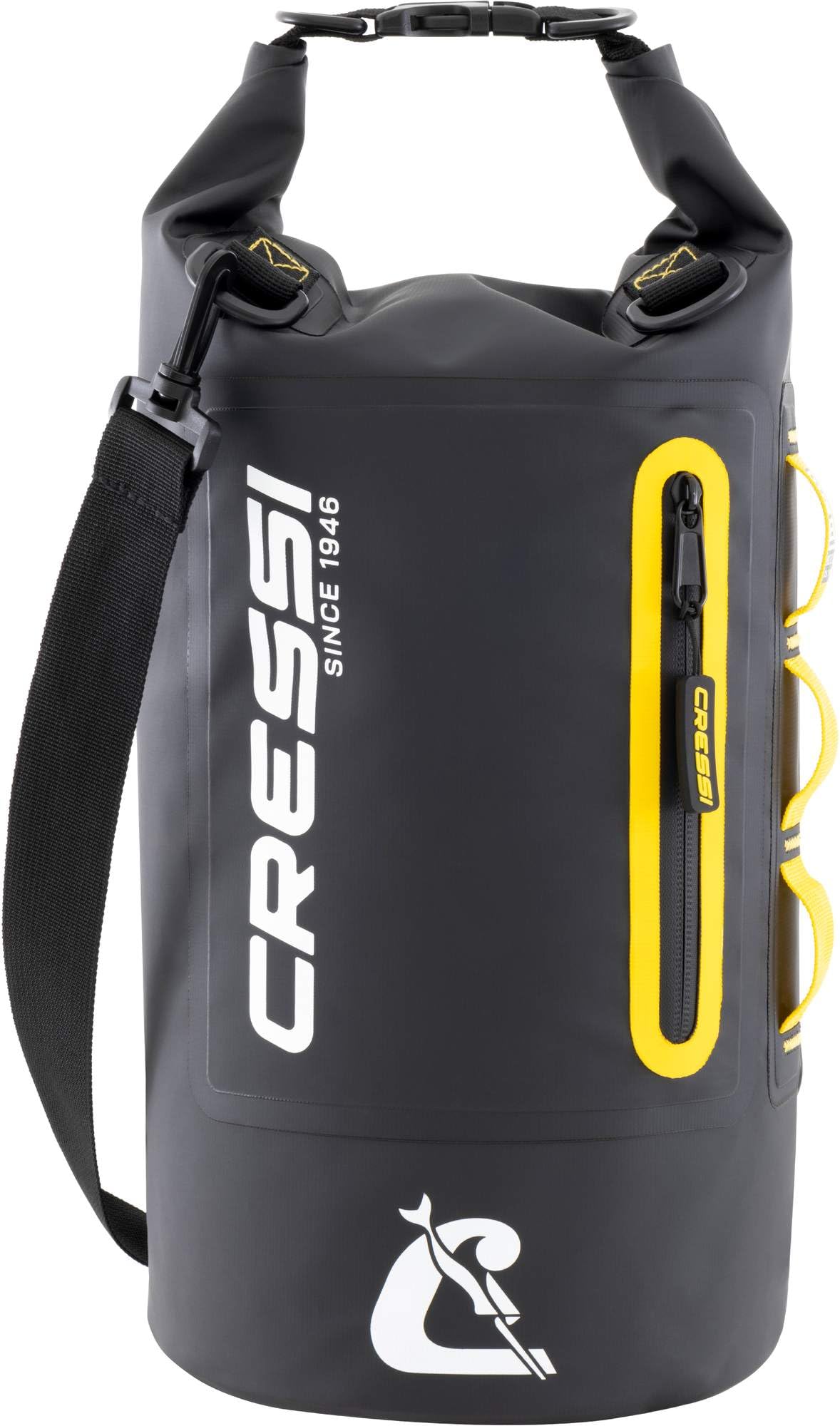
Reinforced webbing loops and D-rings run along this bag, which is a small thing that changes how you use it: clip a pair of fins, a wet bag or a bottle to the outside and keep the inside for things that must stay dry. The front zip pocket does the same job for a phone, a key and a sunscreen stick that would otherwise sink to the bottom of a roll top.
It is a 10-liter bag with a single crossbody strap; the 20 and 30-liter versions switch to two shoulder straps for backpack carry. The shell is PVC-coated polyester and nylon, it weighs about 1.1 pounds, and Cressi covers it with a two-year limited warranty.
Read the water-resistance wording carefully. Cressi describes the roll-down top as a barrier against splashes, spray and sudden rain, which is exactly what a kayak cockpit throws at a bag on a normal day and is not the same as a sack rated to be submerged. If your gear regularly goes swimming, choose one of the heavier welded bags here instead.
Where it earns its place is as the bag that stays packed and gets grabbed: light, tidy, with a pocket and a clip point for everything you need on the water and nothing you don’t. The 10-liter size is the one for a narrow boat where a full 20-liter sack is forever in the way of your feet.
Pros
- D-rings and webbing loops for clipping gear
- Front zip pocket for small essentials
- Light at about 1.1 pounds, two-year warranty
Cons
- Splash-rated closure, not built for submersion
- Single crossbody strap on the 10-liter
A tidy, light 10-liter for splash-and-spray paddling, with clip points and a pocket that make it easy to live with on the water.
Best for Phone and Keys
Freegrace 5L Dry Bag Set

Key Features
- Shell: 500D tarpaulin
- Closure: Double zip-lock and roll top
- Capacity: 5 L
- Included: Waist pouch and IPX8 phone case
- Price: Budget
If you paddle with a phone, keys, a card and one dry layer, this set covers all four for less than most single bags. The piece that earns it is the waist pouch: a 9.1 by 6.5 inch waterproof pack on a 33.5 to 47.5 inch strap that stays on you while you paddle, instead of sitting in a bag you have to open with wet hands.
The 5-liter bag has a double zip-lock under the roll top — press the two seals shut, then fold and buckle — which gives water a second barrier right where it usually gets in. It is 500D tarpaulin, it floats when sealed, and the shoulder strap is removable and adjusts from 27.6 to 49.6 inches so it can clip around a thwart or a deck line.
The accessories are the weak links. The waist pouch seam and the phone case are the parts that let go, and 5 liters holds a towel and a layer and not much else. Test the case with a paper towel before you trust a phone to it, and treat the pouch as the place for keys and a card rather than anything you would mourn.
Packed as a set for a day paddle, though, it works: phone and wallet on your waist, dry clothes in the bag, a spare case for the keys. It is the kit we hand to someone new to paddling who has not yet accumulated a shelf of bags.
Pros
- Waist pouch keeps phone and keys on you
- Double zip-lock beneath the roll top
- Removable strap clips to a boat or deck line
Cons
- Pouch seam and phone case are the weak links
- Five liters holds very little
The best small-kit set here: a waist pouch that keeps phone and keys on you, plus a double-sealed 5-liter bag for a dry layer.
Best for Ditch Bag
Unigear 2L Dry Bag

Key Features
- Carry: Shoulder strap
- Shell: 500D PVC, welded seams
- Buoyancy: Floats when sealed
- Capacity: 2 L
- Price: Budget
Two liters is barely a bag — a phone, keys, a wallet and a snack and you are done. What that buys you is a sack small enough to clip to the deck rigging and forget about, which is exactly what plenty of paddlers want out of a dry bag.
The 500D PVC is thick for something this small, with high-frequency welded seams and a roll top that buckles shut against a pair of D-rings. At 7.5 inches square it fits a compact camera or a spare lens with a useful layer of padding around it, and it floats once sealed and rolled.
This is the bag we treat as a ditch bag: keys, phone and a headlamp while a 20-liter does the real work. If you need a towel and a change of clothes, it is not the bag for you — that is the point where you move up to the 10 and 20-liter sacks on this list.
Pros
- Small and light enough to clip on deck
- Thick 500D PVC with welded seams
- Floats when sealed and rolled
Cons
- Holds only the barest essentials
The ditch bag: two liters of thick PVC for keys, phone and a headlamp, small enough to clip to the deck and forget.
How We Chose and Tested the Best Dry Bags for Kayaking
We started with more than 30 dry bags from brands we’ve paddled with and ones we hadn’t, narrowing the list by closure type, fabric, sizes, and price. We ruled out anything with glued seams only or a closure that looked flimsy. The final 14, from 5 to 30 liters, covered the range most kayakers actually buy.
For four months, those bags lived in our boats. We packed each with the same load — a fleece, a phone in a case, lunch, a first aid kit, a headlamp, and a towel — then sealed them kneeling in shallow water with wet, cold hands, timing how long the roll-top took and whether the buckle snapped easily. On the water, we clipped them to deck rigging and stuffed them through hatch openings, noting which sizes slid in without a fight; back at the launch, we filled each bag with paper towels and a weight, submerged it in a stock tank for 15 minutes, and checked for damp corners, with a waist-deep capsize drill as the messier real-world version. We also dragged loaded bags across gravel, rolled and unrolled the closures repeatedly, and left them in the sun to see how the coating and seams held up.
Drying was its own test: after each wet session, we turned bags inside out, hung them in a garage, and checked at 6, 12, and 24 hours to see how long the interior stayed clammy. We judged value by whether a budget bag felt as solid as a pricier one after four months of use, comparing seam construction, buckle quality, and fabric wear. The bags that rose to the top stayed dry, packed sensibly, and didn’t make us dread sealing them in a chop.
How to Choose a Dry Bag for Kayaking
Pick for the closure you will actually seal properly, the carry you will actually put up with, and the volume you will actually use — the liter count on the listing is the least reliable number in the aisle.
Match the volume to the trip you take most
Most kayak days need less room than the bag aisle suggests. A 10 to 20-liter sack holds a layer, a towel, lunch, a phone and a camera for one paddle; 40 liters and up is a camping load, and a 70 or 80-liter duffel is group gear or a week of food. Remember that a roll top needs three or four folds to seal, and those folds eat height, so a 20-liter bag filled to the buckle is really carrying about 15. Pack your kit, then buy a size up from the dry volume you measured.
Judge the closure before anything else
Every bag here seals with a roll top and a buckle, so what separates them is how much material you get to roll and what sits underneath the fold. A second seal, like the double zip-lock on the Freegrace set, gives water one more thing to get past. Watch the wording on submersion: Cressi describes its closure as a barrier against splashes, spray and rain, which covers cockpit drips and not a bag that swims. A roll top buckled with a single fold and grit in the seam will leak whatever the shell costs.
Carry style decides how much you use it
If the boat lives on a roof rack and the water is fifty yards from the car, a shoulder strap is plenty. If you portage, backpack straps earn their keep: the Earth Pak range adds them from 30 liters up, and the MARCHWAY 20-liter has them at a size most makers only give a sling. Duffels are a third category — handles and side straps for two-person carries, not for wearing. Think about the worst carry of your trip rather than the average one.
Shell, seams and the life you are asking of it
Fabric weight is the clearest proxy you have. A 500D PVC sack shrugs off sand, rocks and being sat on; the 0.3 mm side walls of a clear budget bag will not, and an ultralight polyester stuff sack is for organizing inside a pack rather than for the deck of a kayak. Welded seams beat stitched ones on anything holding water out. Where the strap anchors meet the shell is the first place to inspect on any bag, before you trust it with a sleeping bag.
Extras worth paying for, and extras that just add cost
Three extras keep coming up: an included phone case, a front pocket, and a way to clip the bag to the boat. Test the case yourself — paper towel inside, sealed, ten minutes under water in the sink — before you trust a phone to it. A front zip pocket earns its place every time you want a headlamp without unrolling the top. D-rings and webbing loops cost the maker almost nothing and make the bag twice as useful on the water.
Frequently Asked Questions
Do I still need a dry bag if my kayak has watertight hatches?
Yes, for two reasons. Hatches seep — a loaded boat in chop or surf takes water past the covers — and a bag inside the hatch keeps that seepage away from your sleeping bag. It also lets you lift your kit out in one piece at camp instead of ferrying armfuls. Check your hatch opening against a bag’s packed dimensions before buying; a 40 to 55-liter sack or a duffel is the usual size for a multi-day load.
Can a dry bag double as a flotation device?
No. A sealed bag with air trapped in it will float, and that is worth knowing if one goes over the side, but it is not a life preserver and it cannot be relied on to hold a person. Air escapes, seals fail, and a loaded bag sinks. Wear a properly fitted, approved PFD every time you paddle and treat anything the dry bag does in the water as a bonus.
Where should a dry bag ride in a kayak?
Clip it to a deck line with a carabiner rather than leaving it loose in the cockpit, and keep the space in front of your spray skirt clear so nothing blocks a wet exit. Heavy bags go low and central — in a hatch, or between your knees if the cockpit has room — because weight up on the deck makes a tippy boat tippier. Avoid wedging one behind the seat where you cannot reach it.
How do I dry and store a dry bag so it lasts?
Wipe the inside with a towel, turn the bag inside out over a chair and let it air dry out of direct sun before storage. Then keep it loosely rolled or hung rather than folded flat on the same crease for months; a roll top that lives on one fold line wears there first. Check the fold and the buckle at the start of each season.
Final Verdict
The Earth Pak 20-liter is the bag we point most kayakers to, and the reason is dull in the best way: a 500D PVC shell, a roll top that seals with three folds, a front pocket that saves you unrolling the whole sack for a headlamp, and a phone case in the box. It holds a day’s gear, carries on one shoulder, and stops asking for attention.
Go to the 55-liter Earth Pak when the trip involves a tent and a sleeping pad, or to the Lanedo duffel when the kit belongs to two people. If budget decides it, the MARCHWAY 20-liter floats and costs less — check its strap anchors and it does the same day job.