This post contains affiliate links. We may earn a small commission when you buy through our links — at no extra cost to you.
A dry bag is one of those camp items you don’t think about until the sky opens up or the canoe tips, and then it’s the only thing standing between your sleeping bag and a very cold, very wet night. The label waterproof covers a lot of wishful thinking, though: thin fabrics, stingy roll-top closures, and seams that give up after a season. What you actually want is a bag that keeps its shape when stuffed, closes easily with cold hands, and doesn’t turn every packing job into a wrestling match. The right one fixes all of that, and it also dries out before your next trip instead of turning into a mildew factory.
I’ve spent years stuffing gear into dry bags on river trips and rainy weekend camps, and over the past eight months our team tested 14 bags side by side, from simple roll-tops to portage packs with shoulder straps. We packed them with the same camp load, soaked them, dropped them, and dried them out to see which ones held up. The differences were not subtle: capacity claims often miss real-world fit, and a bag that feels sturdy empty can turn floppy and hard to close once it’s full. The picks below are the ones we’d trust with our own sleeping bags.




Best for All-Round Camping
Earth Pak Waterproof Dry Bag 20L
Key Features
- Carry: Adjustable shoulder strap, 24-42 in
- Weight: 13.6 oz
- Capacity: 20 liters
- Shell material: 500D PVC
- Price: Midrange
The 500D PVC shell is what settled it for us. This is a thick, slightly stiff fabric that shrugs off gravel, truck beds and the bottom of a canoe, and it’s the same grade of material the pricier bags here use. At 9.5 by 9.5 by 17 inches, the 20-liter body takes a change of clothes, a towel, a phone, snacks and a small camera without a fight, then rolls down to a cylinder you can wedge behind a seat or clip to a pack. Real abrasion resistance in a size that covers a day out is exactly what most campers need, which is why this is the one we recommend first.
The seal is simple and it works: flatten the top, roll three or four times, clip the buckle, and the contents stay dry through rain, spray and a bag set down in a puddle. The IPX8 phone case in the box is a better extra than it sounds, because it’s rated for actual submersion — your phone can ride inside the bag instead of in your pocket. We also appreciated that the roll-top opens in a second, so you’re not fighting the closure every time you want a layer.
Twenty liters is also where the straps change: the 10 and 20 get an adjustable shoulder strap, while 30 liters and up add backpack-style straps. We minded that less than we expected, since the bag is 13.6 ounces empty and easy to sling across one shoulder on a short walk in. But if the campsite is a proper hike from the trailhead, the 35-liter Earth Pak below is the better carrier.
Pros
- Abrasion-resistant 500D PVC shell
- Roll-top seal keeps gear dry in rain and spray
- IPX8 phone case included
- Light 13.6 ounces empty
Cons
- Single compartment mixes small items
Our default camping dry bag: a tough 500D PVC sack that holds a day’s kit, seals reliably, and throws in a submersible phone case.
Best for Overnight Backpacking
Earth Pak 35L Dry Bag Backpack
Key Features
- Carry: Adjustable backpack straps
- Capacity: 35 liters
- Warranty: 5 years
- Shell material: 500D PVC
- Price: Premium
The clearest difference between this and our top pick is on your shoulders. The 35-liter Earth Pak wears two adjustable backpack straps instead of one shoulder strap, adds a zippered front pocket for the things you want without unpacking, and ships with a 6.5-inch IPX8 phone case. The body is 14 by 9 by 19 inches of the same 500D PVC.
This is the one we carry when the walk in is the hard part. Thirty-five liters takes a weekend’s clothes and a sleeping bag with room to spare, the harness puts the weight across both shoulders on a mile of trail, and the front pocket means a headlamp or a snack doesn’t cost you a full unpack at dusk. If you hike your gear to a campsite instead of driving it, this is the better buy.
The harness is the compromise. The straps came out of the box wide and stiff and only softened after a few trips — comfortable enough with a full load on flat ground, less so on a long climb. Set against that, the five-year warranty is the longest backing in this group and goes a long way toward making sense of the premium.
Pros
- Backpack harness for real carries
- 35 liters suits an overnight load
- Front zip pocket for quick access
- Five-year warranty
Cons
- Heavy at 2.5 pounds empty
The camping dry bag we carry when we have to walk: 35 liters, a real backpack harness, a front pocket and the longest warranty here.
Best for River and Lake Trips
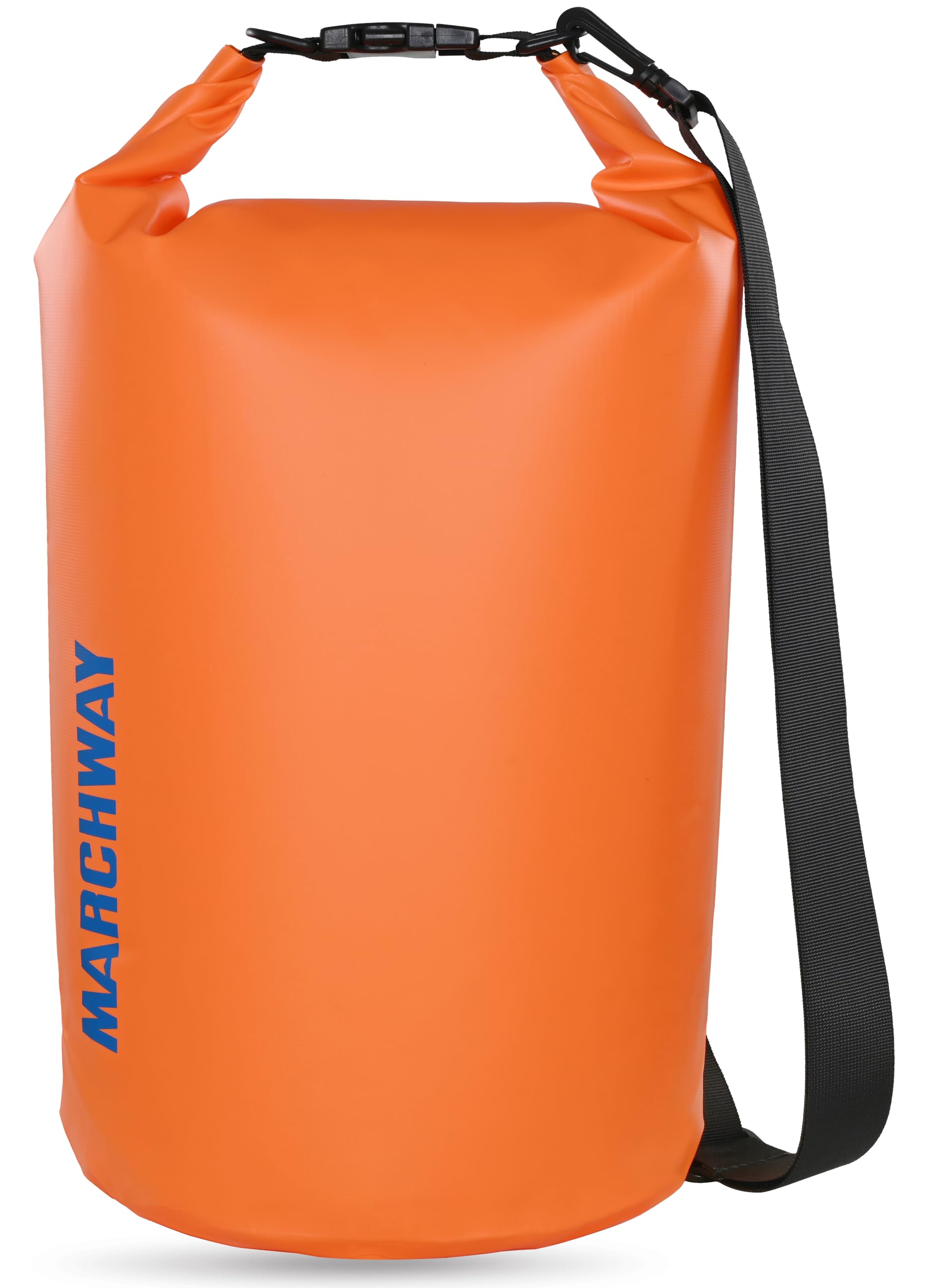
MARCHWAY Floating Dry Bag 20L
Key Features
- Carry: Backpack straps (20L-40L)
- Capacity: 20 liters
- Flotation: Floats when sealed
- Shell material: PVC, welded seams
- Price: Midrange
A bag that floats changes how you handle it around water. This one works because of the round bottom: spread it open, trap a pocket of air, roll the top three to five times and buckle it, and the whole thing bobs instead of sinking. We like that on float trips and kayak decks, where the bag spends as much time in the water as on it, and it’s the reason this is our pick for wet days rather than dry ones.
It’s also the only 20-liter bag here that gives you a proper backpack harness. Two adjustable straps turn it into a small pack for the walk from the car to the put-in, where the Earth Pak 20L hands you a single shoulder strap at the same size. The shell is PVC with welded seams rather than stitched ones, so there are no needle holes along the join, and the heavy-duty buckle takes a firm shove to close — which is what you want.
The hardware is the part to watch. Buckles and seams are what give out when a bag is stuffed past its roll zone and then hauled by one strap, so keep the fill below the closure and this holds up fine. For the money, we take the harness and the buoyancy and accept slightly less confidence in the fittings than the top pick gives us.
Pros
- Floats when sealed with trapped air
- Backpack straps at 20 liters
- Welded seams with no stitch holes
- Costs less than our top pick
Cons
- Buckles and seams can fail under hard use
Floating, backpack-wearable and cheaper than our top pick — this is the one we take on river and lake trips.
Best for Group Basecamps
Lanedo 80L Dry Bag Duffel
Key Features
- Carry: Top, side, shoulder and backpack straps
- Pockets: Exterior zip and interior pocket
- Capacity: 80 liters
- Shell material: PVC
- Price: Premium
Eighty liters isn’t a personal bag. It’s the bag the whole pitch gets packed into: sleeping bags, spare clothes, towels that never quite dried, the lot. At 25.5 by 13.7 by 20.4 inches it eats most of a trunk, and that’s the point — one bag instead of three, with everything inside staying dry while it rides in an open truck bed or an open kayak.
The carrying options are what make it usable. A top handle, two side handles, a shoulder strap and a pair of backpack straps mean one person can wrestle it out of the truck alone. An exterior zip pocket and a separate interior pocket keep the small stuff findable, and the three compartments let you keep damp towels away from clean clothes.
We like it for basecamp and boat trips, not for carrying far. Loaded, the backpack straps dig into your shoulders after a few hundred yards, so treat them as a way to get the bag from vehicle to tent rather than a hiking harness. That’s a fair trade for something that swallows an entire camp’s soft gear and wipes clean in a minute.
Pros
- 80 liters takes a whole camp’s gear
- Four different carrying options
- Exterior zip and interior pockets
- PVC wipes clean after muddy trips
Cons
- Backpack straps dig in on long carries
For car camping and boat trips we want this in the truck: 80 liters swallows a whole pitch and carries four different ways.
Best for Packing Organization
Wise Owl Dry Bag 3-Pack
Key Features
- Closure: Roll-top with D-ring
- Capacities: 5, 10 and 20 liters
- Set weight: 7.05 oz
- Shell material: 190D ripstop nylon
- Price: Midrange
Three sacks in three sizes answer a question one big bag can’t: where is anything? The 20-liter takes a sleeping bag or a day of soft gear, the 10-liter holds clothes, and the 5-liter is the one that ends up with a phone, wallet, keys and a small first-aid kit. Splitting a pack this way beats digging through one sack for a dry pair of socks in the rain.
The fabric is what you’re buying. It’s 190D ripstop nylon with a waterproof coating rather than the 500D PVC of our top picks, and the difference shows up as weight: all three sacks together come to 0.2 kg. They roll down to nothing inside a pack, and the D-ring on each one clips to a strap or a pack loop so a full sack doesn’t migrate to the bottom.
That lightness is also the limit. These are rain and splash bags, not submersible ones. A coated nylon sack sitting in the bottom of a wet canoe is a different proposition from a PVC one, and we treat them accordingly — good for a downpour on the walk in, not for a bag you drag through a river.
For backpackers and anyone packing a rucksack for a camping trip, this is the set we recommend before they buy a fourth stuff sack. They organize a pack, keep a sleeping bag dry when the weather turns, and cost about what one mid-size PVC bag here does — as long as you’re not planning to dunk them.
Pros
- Three sizes sort a whole pack
- 0.2 kg for all three together
- D-rings clip to a pack
- Floats when sealed
Cons
- Splash protection, not submersion
- No carry straps included
We hand these to anyone packing a rucksack: three ultralight sacks that organize a pack and keep a sleeping bag dry in rain.
Best for Wet Day Trips
Lamicall 10L Dry Bag

Key Features
- Capacity: 10 liters
- Included: IPX8 phone pouch to 7 in
- Water rating: IPX6
- Shell material: 500D PVC, welded seams
- Price: Midrange
IPX6 is a specific promise and it’s worth reading correctly: the 10-liter Lamicall is built to take heavy rain and spray, not a dunking. Within that, it packs in a lot — a 500D PVC shell, welded seams, a roll-top that closes in three folds, an adjustable cross-body strap, and a splash-proof front pocket sized for keys, sunscreen and an ID. The included IPX8 pouch takes phones up to 7 inches, which covers most of the big ones.
For day trips and wet hikes, this is the bag we reach for when we want the phone accessible rather than buried. The pouch is usable through the plastic, so you can shoot a photo without unpacking, and the front pocket saves opening the main compartment every time someone wants sunscreen. It’s a better thought-out day bag than most of the plain sacks here.
The caveats are small but real. The front pocket is only splash-resistant, so a phone left in there during a downpour gets wet — that’s what the IPX8 pouch is for. And at this size the only carry option is the cross-body strap. A two-year warranty backs it, which is more cover than most of this group offers.
Pros
- IPX6 shell with welded seams
- Phone pouch fits screens up to 7 inches
- Splash-proof front pocket
- Two-year warranty
Cons
- Front pocket only splash-resistant
- Cross-body strap only at 10 liters
Our pick for wet day trips: an IPX6 shell, a 7-inch phone pouch and a front pocket you can reach without opening the bag.
Best for Wet Weekends
STOVER 30L Dry Backpack
Key Features
- Carry: Padded, removable shoulder straps
- Pockets: 2, including mesh front
- Capacity: 30 liters
- Shell material: Vinyl
- Price: Premium
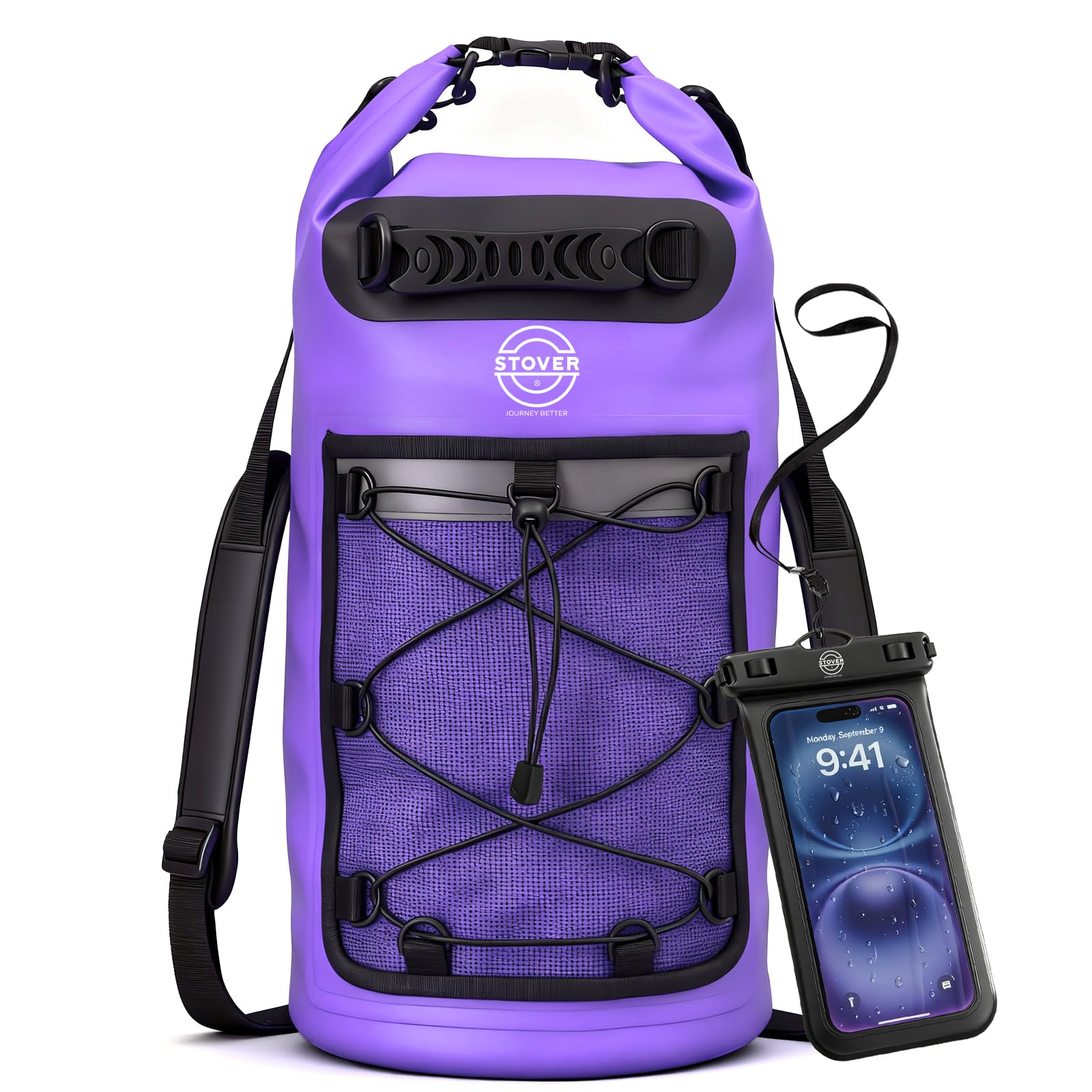
The front of this 30-liter bag is a mesh pocket with cargo straps, which sounds like a small detail until you’re standing in the rain holding a soaked shell and have nowhere to put it. Mesh drains, the straps cinch the load down, and the reflective strip across the front catches a headlamp when you’re walking back from the washhouse in the dark.
The rest is a serious carry setup: padded, adjustable and removable shoulder straps, an over-molded top handle, and a vinyl shell that wipes clean after a muddy weekend. It holds 30 liters in one main compartment with an extra pocket, and the straps come off if you want to lash the bag to a boat or a roof rack instead of wearing it.
We rate it for camp because the straps are padded enough for a real walk and the mesh pocket solves the wet-shell problem no plain PVC sack handles well. The shell is stiff, so rolling the top down takes a couple of firm folds rather than one — a small tax on a bag that otherwise suits wet weekends.
Pros
- Padded, removable shoulder straps
- Mesh front pocket drains wet gear
- Reflective strip for dark campsites
- Vinyl shell wipes clean
Cons
- One main compartment for 30 liters
We like this for wet weekends: padded straps, a mesh pocket for a soaked shell, and a reflective strip for dark campsites.
Best for Phone and Keys
Unigear 2L Dry Bag

Key Features
- Weight: 6.7 oz
- Closure: Roll-top with buckle and D-rings
- Capacity: 2 liters
- Shell material: Ripstop 500D PVC
- Price: Budget
Two liters is a phone, a wallet, keys, a headlamp and a small first-aid kit, and not much else. The Unigear at this size is a pouch rather than a pack — 7.48 inches square, 0.19 kg empty, small enough to disappear into a bigger bag until the moment you need it.
What it has going for it is the material. Ripstop 500D PVC with welded seams is the same family of construction as the full-size bags here, which is unusual this far down the price range, and the buckle and D-rings let you clip it to a pack strap or a canoe thwart so it isn’t loose in the boat.
Sealed with a few rolls and a pocket of air, it floats. That makes it the bag for a phone and a car key on a river float — the two things you genuinely can’t replace if they go over the side and under.
As an add-on rather than a main bag, we think it earns its place. It takes the two or three items you can’t risk, it clips out of the way, and if it does go missing you haven’t lost the bag your sleeping bag was in. Buy it as your second dry bag, not your only one.
Pros
- 500D PVC with welded seams
- Floats when sealed
- D-rings clip to a pack or boat
- Weighs 0.19 kg empty
Cons
- Two liters holds essentials only
We treat it as the bag for the things you can’t replace: phone, keys and cards, sealed in 500D PVC and clipped to your pack.
How We Chose and Tested Camping Dry Bags
We began with a shortlist of more than 40 camping dry bags, then narrowed it by packed volume, closure style, fabric and seam construction, carry options, and price. The goal was a spread of sizes and designs rather than a lineup of near-identical sacks. We ended up with 14 bags and used them for eight months on weekend canoe trips, a wet three-day car camp, and day hikes where the rain never really stopped.
At camp, we packed each bag with the same core load: a sleeping bag, a puffy layer, two days of clothes, a headlamp, and a small cook kit. We noted whether that load fit with room to spare, whether the bag still slid into a backpack or wedged under a canoe seat, and whether the handles or straps were comfortable once it was heavy. We also closed and opened each one with wet, cold hands, because a roll-top that fights you at the end of a rainy day is not much use.
For water resistance, we filled each bag with dry paper towels, rolled the closure as we would in the field, and submerged it in a tub for five minutes; then we checked the corners and seams for dampness. We also left loaded bags out in steady rain and hosed them down. For durability, we dragged them over gravel, dropped them from waist height, and worked the buckles and seams repeatedly. To judge drying, we turned each bag inside out and hung it in shade, checking after two hours and again the next morning. Quality showed in taped seams, thick fabric, and hardware that did not flex or jam; the bags that scored best got all of those right without making packing a chore.
How to Choose a Dry Bag for Camping
Two things decide the bag you need before any fabric matters: how much has to stay dry, and how far you have to carry it.
Match liters to the trip, not to the gear list
A 5- or 10-liter sack is for the things you can’t replace — phone, keys, cards, a headlamp — and it lives inside a bigger pack. Twenty liters is the classic day size: a change of clothes, a towel, snacks and a small camera, which is what the Earth Pak 20L and the Marchway both hold comfortably. Thirty to 40 liters covers an overnight with a sleeping bag and spare clothes. Eighty liters is a group bag for the car or the boat, not something you carry down a trail.
Buy for the trip you take most often. If you camp two ways, a 20-liter day bag plus a small essentials pouch serves you better than one 60-liter compromise that travels half empty every time.
Carry style matters more as the bag fills
A full 20-liter bag on a single shoulder strap is fine for a quarter mile and miserable after a mile. That’s why the strap change around 20 to 30 liters is the real decision point in this group: the Earth Pak 20L gives you an adjustable shoulder strap, while its 35-liter sibling and the Marchway at 20 liters give you two straps and a harness.
The trap is buying capacity you then have to carry. A big bag with one strap is a bag you resent by the second hill. Duffel handles and side grab handles belong on vehicle-based camping, where the bag gets lifted out of a truck bed rather than walked anywhere.
Fabric and seams decide how long it stays waterproof
Three materials show up here and each trades something away. 500D PVC is thick, abrasion-resistant and comparatively heavy — it’s what you want dragged over gravel and rock. Coated ripstop nylon in the 190D to 210T range packs to nothing and weighs almost nothing, but it punctures and it is usually rain-resistant rather than submersible. Welded seams, heat-bonded rather than stitched, remove the needle holes that are the first place a sewn bag leaks.
Choose by what the bag will touch. In a canoe or on a wet campsite floor, PVC. Inside a backpack on a long hike, coated nylon that disappears into the load.
The roll-top only works if you roll it
Every bag here closes the same way: fold the top down three to five times, then clip the buckle. What separates a dry bag from a wet one is whether you left room to do it. Fill past the stiffened roll zone and you can’t get a clean fold, and the fabric bunches instead of sealing.
Three folds is the working minimum for camp use and four or five is what we use once a bag is going near water. Re-roll every time you open it — a bag that was sealed at breakfast and reopened at lunch is not sealed at dinner.
Frequently Asked Questions
Do dry bags actually float?
Some do, and only when they’re sealed with air trapped inside. The Marchway and the Wise Owl sacks are both built to float once you’ve spread the base open, caught a pocket of air and rolled the top down. A bag packed solid with dense gear and no air has nothing holding it up.
Test yours in shallow water before you trust it, and never treat a floating bag as a flotation device. It isn’t rated for that and it won’t hold a person.
Can I put wet gear in a dry bag?
You can, but don’t seal it that way for a day. A soaked shell inside a closed bag is how mildew starts, and the smell doesn’t come back out of the coating. Keep wet items in a mesh outer pocket if the bag has one — the STOVER’s front pocket is made for exactly this — or in a separate sack.
Dry everything inside out, open, before it goes back in the car.
How do I check a new dry bag before a trip?
Wrap a paper towel or a tissue inside, seal the bag with four folds, and hold it under water in a sink or bathtub for a minute. Open it and look for damp patches along the seams and at the corners.
Do this before you trust the bag with a phone or a sleeping bag. If the tissue stays dry, you also know how many folds your closure needs.
Is a dry bag bear-proof for food storage?
No. A dry bag keeps rain off and smell in, which is the wrong combination around camp. It isn’t bite-resistant or odor-proof, and a rolled PVC sack is no harder for an animal to open than a stuff sack.
Use a hard-sided container or hang your food properly, and keep the dry bag that held food away from where you sleep.
Final Verdict
Start with the Earth Pak 20L. It covers more camping trips with less fuss than anything else here: a shell that survives gravel and truck beds, a seal that has kept our gear dry through rain and spray, and a submersion-rated phone case thrown in.
If you walk your gear in rather than drive it, the extra money for the 35-liter Earth Pak buys the one thing the 20L can’t give you — a backpack harness — and that is the difference between a bag you carry and a bag you haul. For everyone else, 20 liters is the right answer.