This post contains affiliate links. We may earn a small commission when you buy through our links — at no extra cost to you.
A dry bag backpack makes one promise: what goes in comes out dry. The problem is that they all look the same online — same roll-top, same heavy-looking shell — and you don’t find out until you’re standing in the rain that the seams were sewn rather than welded. I learned that on a ferry ride with a camera bag that turned out to be ‘water resistant,’ which is marketing for ‘a little bit wet.’ A real dry bag backpack fixes that. It gives you a soft, packable sack you can actually carry on a hike, a commute, or a paddle, without bagging your gear in plastic first.
My team and I have spent the past eight months using 12 of them on river days, rainy commutes, and more garden-hose water than I’d like to admit, and the differences come down to the closure, the seams, and whether the thing is bearable to wear when it’s loaded. One thing worth knowing before you shop: a roll-top needs at least three folds before it seals, so an overstuffed bag is a leaking bag. What’s below covers day paddles, carry-on travel, and the sweaty hike in between.


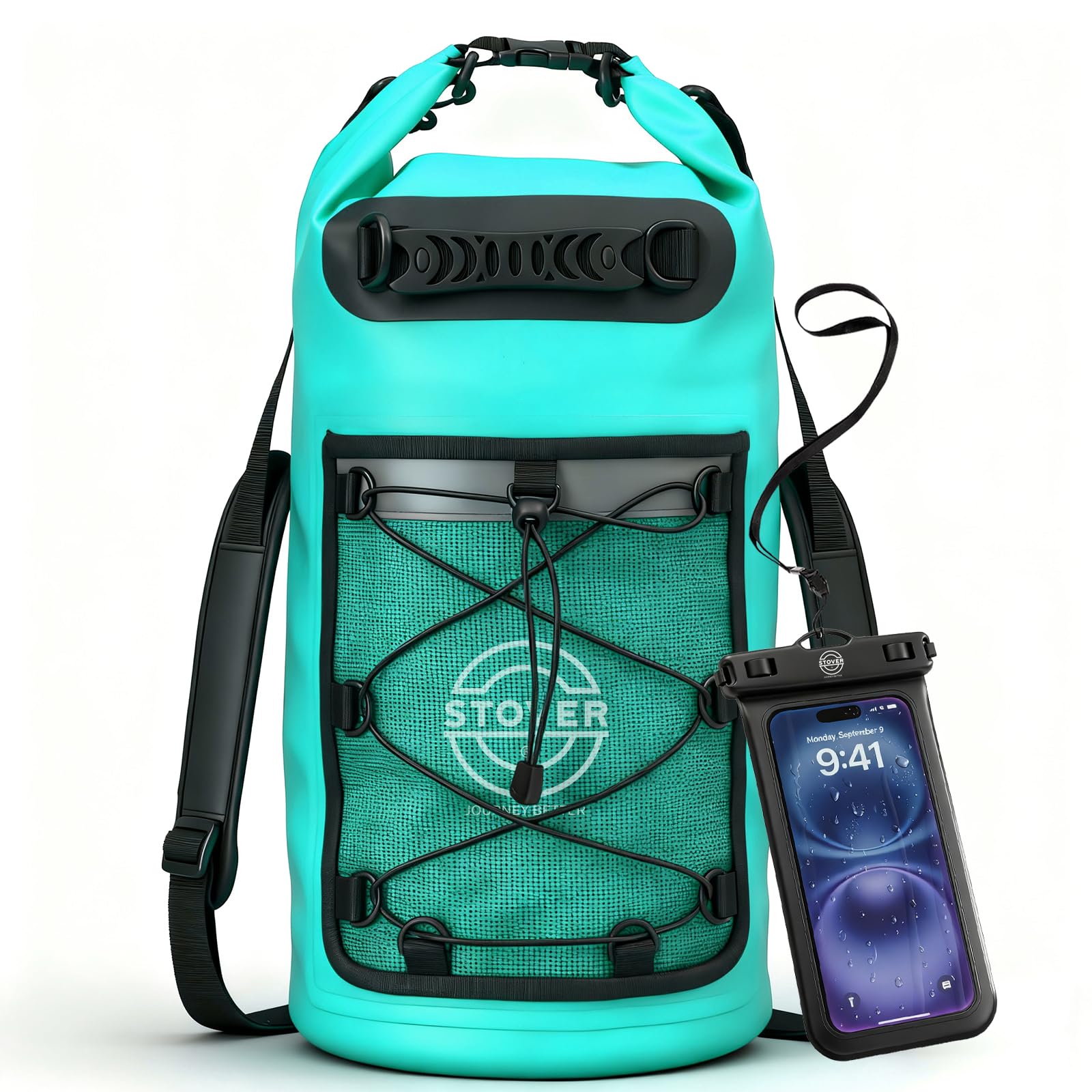
Best for All-Round Water Days
Earth Pak 40L
Key Features
- Closure: Roll top with buckle
- Capacity: 40 liters
- Material: 500D PVC
- Front pocket: Zippered
- Price: Midrange
A zippered pocket on the front sounds like a small thing until you’re standing in the wind on a gravel bar and need the car keys without unrolling your whole pack. That pocket is the first reason we reach for this Earth Pak: 40 liters of 500D PVC with thermowelded seams and a roll top, plus a zip you can get into one-handed. It’s the most useful all-round dry bag backpack in this group, and the one we hand most people first.
The harness is the bigger deal. Earth Pak fits backpack-style straps from 30L up, so the 40L is the smallest of its bags you can genuinely wear on a carry, and it makes the walk from the launch to the truck uneventful. The sealed roll traps air and the bag floats alongside you, which takes a lot of the anxiety out of a tipped canoe, and an IPX8 phone case that fits phones up to 6.5 inches comes in the box.
What you give up is packability. 500D PVC is thick and stiff and won’t squash into a suitcase the way the Osprey here does, and the front zip is the place for keys, sunscreen, and a snack rather than a second dry compartment — anything that has to stay bone dry goes in the main roll. For wet days out and the occasional overnight, that’s a trade worth making.
Pros
- Backpack straps from 30L up
- Zippered front pocket saves unrolling
- Roll top traps air so it floats
- IPX8 phone case included
Cons
- Stiff PVC doesn’t squash into a suitcase
We recommend the 40L Earth Pak as the default dry bag backpack: real backpack straps, thermowelded 500D PVC, and a roll top that floats.
Best for Multi-Day Expeditions
Earth Pak 85L
Key Features
- Weight: 2.5 lb
- Capacity: 85 liters
- Material: 500D PVC
- Warranty: 5 years
- Price: Premium
There’s a particular kind of trip where the boat carries the weight and the pack only has to get from the truck to the water and back: a two-person tent, a camp chair, a canopy, and clothes for a few days. The 85L Earth Pak is the biggest bag in this group and the only one built for that scale, which is why it’s here at all.
It’s the same abrasion-resistant 500D PVC as the smaller Earth Paks, with a large zippered front pocket, a mesh pocket inside, an IPX8 phone case in the box, and a five-year warranty. Empty, it’s listed at two and a half pounds. The pack straps cinch down hard, so a half-filled 85L stops sloshing around like a bin bag and starts behaving closer to a 35L.
Where it lands for us: excellent as a gear hauler for a multi-day float, awkward the moment you have to walk any real distance with it loaded. Internal organization is thin for the volume — one front zip and one mesh pocket — so pack in stuff sacks or you’ll be excavating to the bottom for a headlamp. If you’re hiking in rather than floating in, take the 40L.
Pros
- 85 liters holds a full camp kit
- Five-year warranty
- Straps cinch a part-full load
- Front zip plus interior mesh pocket
Cons
- Sparse internal pockets for 85 liters
- Awkward to carry when packed full
We keep the 85L Earth Pak for trips where the boat carries the load — it swallows a whole camp, though you feel the bulk on any long walk.
Best for Budget Day Trips
Piscifun 20L
Key Features
- Weight: 1.6 lb
- Capacity: 20 liters
- Material: 500D PVC
- Outer pocket: Mesh
- Price: Budget
Piscifun undercuts every other 20-liter bag in this group and still fits two shoulder straps, a fully welded seal, and an IPX8 phone case. On paper it looks like the bargain of the group, and for a day bag that’s most of what matters.
Twenty liters is a towel, a change of clothes, lunch, and a phone. The mesh outer pocket is the tell that this is a budget bag, and it’s a useful tell: it drains instantly, so wet shoes, an empty bottle, or a sandy shell go there and nothing else. We like the double straps because they turn a sack into something you can walk a mile with. The 500D PVC body is stiff and 1.6 pounds empty, so it isn’t the bag for a luggage-only trip — it’s the bag for the boat, the river, and the back of the truck.
Pros
- Two shoulder straps at a budget price
- Fully welded 500D PVC seal
- Mesh pocket drains wet gear
- IPX8 phone case included
Cons
- 1.6 pounds and stays bulky
We point budget-minded paddlers to the Piscifun: it’s the cheapest 20-liter bag here with two shoulder straps and welded seams.
Best for Packable Travel
Osprey Ultralight 20L
Key Features
- Weight: 6.88 oz
- Capacity: 20 liters
- Material: Recycled nylon
- Water rating: IPX5, non-submersible
- Price: Premium
Six point eight eight ounces. The Osprey Ultralight weighs less than a filled water bottle and compresses down to roughly the size of a fist when it’s empty, which is the entire argument for owning one.
It’s 20 liters of waterproof-coated recycled nylon with a roll-top closure, mesh shoulder straps, an adjustable sternum strap, and stretch pockets on the sides for a bottle. The sternum strap is what keeps it steady when you’re moving — without it, a pack this light tends to migrate.
The rating is where you have to read carefully. IPX5 means it shrugs off rain and spray but isn’t submersible, so this is the pack for a wet hike or a ferry crossing, not for a day when the bag might go in the water. The light fabric tells the same story: it never complains about being stuffed in a suitcase, and it wears faster than 500D PVC if you drag it over rock. For rain, that’s exactly the job it’s rated for.
For travel, this is the one we take: it disappears into a suitcase, comes out for a rainy day hike, and handles a full day of walking without a second thought. Anyone whose trips involve actual submersion should look at the welded PVC bags instead.
Pros
- 6.88 ounces and packs to fist size
- Sternum strap and mesh shoulder straps
- Waterproof-coated fabric and seams
- Side stretch bottle pockets
Cons
- IPX5 only, not submersible
- Light nylon wears faster than PVC
We choose the Osprey when the bag has to travel in a suitcase — 6.88 ounces, fist-sized packed, splash-proof rather than submersible.
Best for Beach and Boat
STOVER 25L
Key Features
- Straps: Padded, detachable
- Weight: 1.48 lb
- Capacity: 25 liters
- Front pocket: Wet/dry mesh
- Price: Midrange
Rolling this one shut takes a bit of muscle at first. The vinyl body is stiff and the top doesn’t fold over as obligingly as the thinner bags here, which is a small annoyance every time you open and close it. What that stiffness buys is a 25-liter pack with a wet/dry mesh front pocket, cargo straps, a reflective strip across the front, and an over-molded top handle.
The front pocket is why we pick it for a beach day: sandy sandals, a dripping swimsuit, and empty bottles ride outside the dry compartment held by the cargo straps, while towels and clothes stay dry inside. The shoulder straps are padded and detachable, which makes it one of the few here that works as a backpack on the walk in and a plain sack once it’s on the boat.
Pros
- Wet/dry mesh front pocket with cargo straps
- Padded, detachable shoulder straps
- Reflective strip for low light
- High-frequency bonded seams
Cons
- Stiff body makes the roll top fiddly
We like the STOVER for beach days: a wet/dry mesh front pocket separates dripping gear from dry clothes, if you can live with a stiff roll top.
Best for Dive and Boat
Cressi Ocelot 30L

Key Features
- Capacity: 30 liters
- Material: PVC-coated polyester
- Warranty: 2-year limited
- Front pocket: Zippered
- Price: Premium
Webbing loops and D-rings run down the sides of the Cressi, and they’re the reason to look at it: clip fins, a wet bag, or a dive light to the outside and keep the 30 liters inside for things that have to stay dry.
The body is PVC-coated polyester and nylon with a roll-down top and plastic clip, plus a front zip pocket for the small stuff that usually sinks to the bottom of a dry bag. The 20L and 30L sizes get two shoulder straps, so it wears like a backpack instead of hanging off one shoulder all day.
The detail we noticed reading the listing: Cressi’s own description promises protection from splashes, spray, and sudden rain, and stops there. That’s a boat-and-dive-bag claim rather than a submerge-it claim, and it’s worth taking at face value. For dive decks and rocky shore entries, with a two-year limited warranty behind it, it earns its place; for a pack you plan to dunk, the welded PVC bags here are the safer bet.
Pros
- D-rings and webbing loops for extra gear
- Front zip pocket for small essentials
- Two shoulder straps on 20L and 30L
- Two-year limited warranty
Cons
- Water protection described only against splash and rain
- Premium price for a simple roll top
We recommend the Cressi for dive and boat days, where the D-rings and front pocket matter more than the splash-level water rating.
Best for Minimal Day Carry
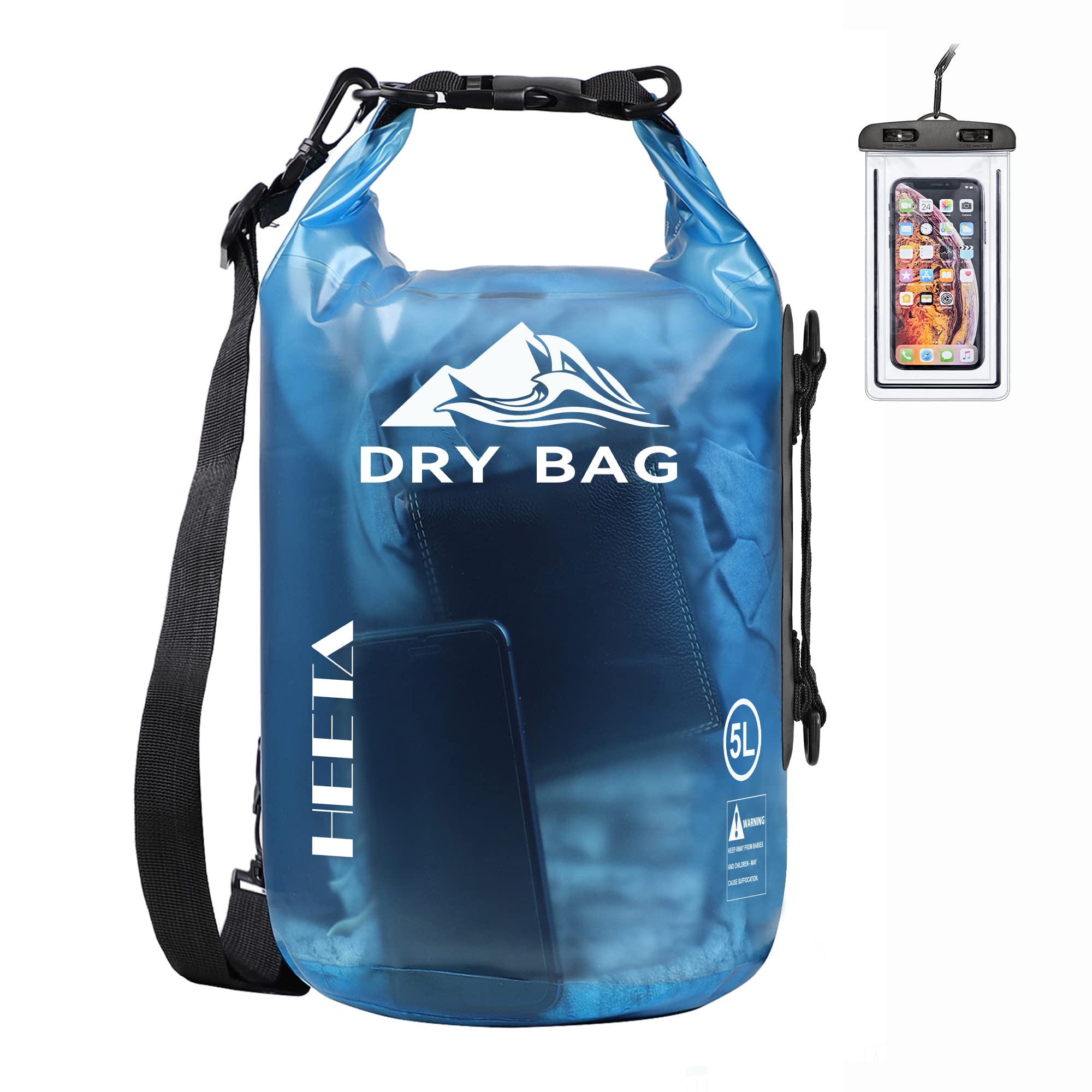
HEETA 5L
Key Features
- Carry: Shoulder strap and handle
- Capacity: 5 liters
- Material: Transparent PVC
- Dimensions: 8 x 8 x 13 in
- Price: Budget
The clear PVC body is what sells this one: you can see the sunscreen, the keys, and the dry T-shirt without unpacking anything, which matters more than it sounds when your hands are wet and sandy. It’s a 5-liter bag with a roll top, a shoulder strap, a side handle, and it comes with a waterproof phone case.
On durability it’s the weakest bag in this group. The sides are 0.3 mm PVC against a 0.6 mm base, and tearing is where it comes up short. The thicker floor is a sensible place to put the extra material, since that’s what scrapes along a boat deck, but we treat the HEETA as a pool bag, a spare, or a kid’s water-day kit rather than something to trust with a camera. For that job, the price is the whole point.
Pros
- Transparent body, contents visible at a glance
- Thicker 0.6 mm base where it scrapes
- Shoulder strap plus side carry handle
- Sold with a waterproof phone case
Cons
- Thin 0.3 mm sides are the wear point
We keep the 5L HEETA as a cheap, see-through bag for pool and beach kit, not for anything you’d mourn getting wet.
Best for Organized Day Trips
IDRYBAG 20L

Key Features
- Weight: 1.76 lb
- Capacity: 20 liters
- Material: 500D vinyl-coated polyester
- Front pocket: Splash-proof zip
- Price: Midrange
At 17.7 inches tall and under 10 inches wide, the IDRYBAG is the narrowest bag here, and that shape does real work: it stands upright in a footwell, slides down between seats, and takes up less room on a crowded deck than a wide duffel.
The build is 500D vinyl-coated woven polyester with welded, watertight seams, and the closure is a straightforward roll — load it, roll three or four times, clip the buckle. Inside there’s a zip pocket for keys and a phone, and outside there’s a zippered front pocket that IDRYBAG describes, unusually honestly, as splash-proof rather than waterproof.
At 800 grams empty it sits in the middle of this group: heavier than the 6.88-ounce Osprey, lighter than the big PVC haulers. The adjustable shoulder straps handle 20 liters of day gear without any drama on a walk in.
Where it lands for us: the tidiest of the small bags, with an internal layout that beats the other 20-liter packs here and a front pocket honesty we’d like to see from everyone else. It doesn’t match the 40L Earth Pak on capacity or the Piscifun on price, but if you want your keys, phone, and snack in their own places, this is the one.
Pros
- Welded seams on 500D fabric
- Inner zip pocket for keys and phone
- Tall shape stows in narrow spaces
- Front pocket for quick access
Cons
- Outer zip pocket is splash-proof only
- Side and interior pockets can give way
We rate the IDRYBAG a solid, well-organized 20L day bag, with the caveat that its outer and inner pockets are the weakest part.
How We Tested the Best Dry Bag Backpacks
We started with about 40 dry bag backpacks sold by outdoor retailers and narrowed the list by reading spec sheets and customer reviews, sorting by closure type (roll-top, waterproof zipper, or both), claimed capacity, and whether the bag had a real harness instead of two flat webbing straps. That left 12, which we’ve now used for eight months.
Each one came on at least one paddle trip — kayak, canoe, or paddleboard — plus a rainy bike commute and a beach day, and we deliberately overpacked a couple to see what happens when a roll-top can’t manage its three folds. To compare water resistance head to head, we loaded every bag with a folded paper towel, sealed it, hit it with a garden hose for five minutes, then floated it in a stock tank for ten and checked the paper again. We also wore each one through a 40-minute downpour.
Between trips we looked at the parts that fail. Every zipper was opened and closed several hundred times over the eight months, and we noted sliders that caught or waterproof coatings that began to peel. Loaded bags got dragged across gravel and concrete to see how the shells scuffed. For comfort, we carried 15 pounds on a three-mile hike and paid attention to strap padding, hip belts, and whether the back panel soaked through — none of these breathe much. We packed the same load into all 12 — laptop, fleece, towel, water bottle, lunch — to compare real capacity against the claimed liters, and after each dunking we turned bags inside out to see how quickly the interior dried and whether water pooled in the corners.
How to Choose a Dry Bag Backpack
The first thing to check is the harness on the exact size in your cart, because on several of these bags the straps change as the liters go up.
Check the straps on the size you’re buying
Backpack in a product title often describes the biggest size in a range, not the one you’re looking at. Earth Pak fits a single shoulder strap to its 10L and 20L bags and only adds two backpack straps at 30L and above, while Piscifun and Cressi put two straps on their 20L bags.
If you plan to walk more than a few hundred yards with the bag on, buy the size that has the harness or a brand that fits it earlier. A one-strap dry bag slings neatly into a kayak cockpit and turns into a nuisance on a portage.
Match liters to the walk, not the trip
Five liters takes a phone, keys, a towel, and a bottle; 20 to 25 liters covers a day of clothes and lunch; 30 to 40 liters handles a night away; 85 liters is a camp. The trap is buying the volume your gear needs at camp and then carrying it.
A full 40L bag on a soft harness feels very different at the end of a mile than it did in the parking lot. Load what you’ll actually carry and walk around the block with it before you commit.
Know what the waterproof claim covers
Every bag here rolls shut; the differences are the fabric, the seams, and how honest the rating is. Welded 500D PVC with a clipped roll is the most protective combination in this group, and splash ratings are a different promise entirely — Osprey labels its Ultralight pack IPX5 and non-submersible, which is exactly what a rainy hike needs and nothing like a dunking.
The other trap is the outer pocket. On most of these bags the zip is quick access rather than dry storage, and IDRYBAG says so outright about its front pocket. Phones travel in the included case or in the main compartment.
Weigh bulk against packability
500D PVC earns its protection with bulk: it’s stiff, it doesn’t fold into a suitcase, and an empty 85L pack still weighs two and a half pounds. If the bag spends most of its life in luggage between trips, a coated nylon pack like the 6.88-ounce Osprey is the better travel companion, at the cost of abrasion resistance.
Decide which of those two lives yours looks like before you shop the liters, then let the capacity decide the rest.
Frequently Asked Questions
Can I take a dry bag backpack on a plane as a carry-on?
Yes, within your airline’s size limit, and the roll top helps: a 20 or 25 liter bag shrinks as you empty it, so it behaves like a daypack at the gate. An 85 liter pack filled for a week is going in the hold.
Measure it rolled and packed rather than open, since the height depends entirely on how much is inside.
How do I keep a dry bag from smelling like vinyl or going musty?
New PVC smells like a new inflatable, so leave it open and unrolled for a day before you pack clothes in it. After salt water, rinse with fresh water, wipe the inside, and store it open.
Clipping a damp bag shut is what turns a dry bag musty — the roll top that keeps water out also keeps moisture in.
What’s the right way to roll the top closed?
Flatten the top band, fold it over three or four times so the rolled section sits over the stiffened strip, then clip both buckles together evenly rather than one side first. A single fold, or a corner of fabric caught in the fold, is where leaks start.
Test a new bag before you trust it with a camera: roll it shut with a paper towel inside and hold it under the tap.
Final Verdict
Buy the 40L Earth Pak. It’s the dry bag backpack that gets the whole job right — two real backpack straps, thermowelded 500D PVC, a roll top that floats, and a front zip so you don’t have to unroll everything for the car keys.
If your trips are flights and rainy day hikes rather than rivers, the Osprey Ultralight weighs 6.88 ounces and disappears into a suitcase until you need it.