This post contains affiliate links. We may earn a small commission when you buy through our links — at no extra cost to you.
A dry bag is the one piece of kayak gear you never think about until you’re treading water beside a flipped boat, watching your lunch and your phone drift toward the far shore. The job sounds simple — keep the water out — but the difference between a bag that survives a capsize and one that just looks the part comes down to the closure, the seams, and whether the coating still flexes after a season of sun. Get it right and you stop thinking about it entirely. Get it wrong and you’re replacing a soaked phone and a down jacket that mildewed in a hatch.
The mistake most first-time buyers make is shopping by liter count alone. A roll-top eats two or three inches of usable height, so the bag that claims 20 liters may barely swallow a day’s kit, while the one that would fit your hatch perfectly holds more than you need. My team and I have spent eight months paddling with 12 dry bags — flatwater mornings, a couple of Class II stretches, one very deliberate capsize drill — and the ones that earned a place here got the basics right before anything else. What follows is sorted by how you’ll actually use them, from a quick afternoon loop to a fully loaded weekend.


Best for Day Paddling
Earth Pak Waterproof Dry Bag 20L
Key Features
- Weight: 13.6 oz
- Capacity: 20 liters
- Included: IPX8 waterproof phone case
- Material: 500D PVC
- Price: Midrange
Twenty liters is the day-trip default for us: a towel, a spare layer, lunch, sunscreen and a phone, with enough fabric left over to roll the top down three proper turns. The bag measures 9.5 inches across and 17 inches tall, which is worth checking against your hatch opening before you order — that diameter is fine through a big oval hatch and snug on a small round one.
What earns it the top spot is how little it asks of you. The 500D PVC shell takes gravel at the put-in and a wet cockpit without complaint, the roll-top seal clips shut in seconds, and 13.6 ounces is light enough that you stop noticing it in the boat. The included IPX8 case fits phones up to 6.5 inches, so the most valuable thing you carry doesn’t need a bag of its own.
We kept reaching for this one on short paddles for a small reason: the front zippered pocket holds keys, lip balm and a snack without unrolling the whole bag. The 24-to-42-inch shoulder strap is the other practical detail — it turns the walk from the water back to the car into one trip instead of two.
Empty, it rolls down small enough to live in the car between outings, which is why it ends up on more trips than the bigger bags. We stow the phone case in the front pocket, so the thing most likely to drown is also the thing we can reach without unrolling anything.
Pros
- 500D PVC shrugs off abrasion and wet storage
- Shoulder strap and front zip pocket for day use
- IPX8 waterproof phone case included
- Packs down small when empty
Cons
- Shoulder strap only; backpack straps start at 30L
For day paddling, this is the dry bag we recommend: a 500D PVC body, a shoulder strap, a front pocket and a waterproof phone case in one purchase.
Best for Multi-Day Trips
Earth Pak 55L Dry Bag Backpack
Key Features
- Weight: 2.8 lb
- Pockets: Front zip, interior mesh
- Capacity: 55 liters
- Material: 500D PVC
- Price: Premium
The reason to spend more on this one is the harness. Two backpack straps turn 55 liters of tent, sleeping bag and clothes into something you can walk from the car to the launch and then to camp, instead of hauling a duffel by one handle while your boat slides around on the roof rack.
Fifty-five liters is genuinely big: a two-person tent, a sleeping bag, a pad and a few days of clothes fit with room to spare, and the large front zip pocket plus the interior mesh pocket keep the small stuff findable without unpacking the whole load. The shell is the same 500D PVC as our top pick, there’s an IPX8 phone case in the box, and the bag carries a five-year warranty.
We noticed the straps before we noticed anything else. They’re wide and stiff out of the box and take a few trips to soften, but the payoff is that a loaded bag rides on both shoulders instead of cutting into one.
Fifty-five liters also needs a boat that can take it. Open cockpits, tank wells and big oval hatches swallow it; a narrow kayak with a round day hatch means this one rides on deck, strapped down, which is a different packing decision entirely.
Pros
- Backpack harness makes portages a one-trip job
- 55 liters swallows a full camping kit
- Front zip and interior mesh pockets organize gear
- Five-year warranty and phone case included
Cons
- 2.8 pounds empty, the heaviest bag here
For kayak camping, we think the harness is what sells it: 55 liters of 500D PVC you carry on your back instead of dragging by a handle.
Best for Budget Day Trips
MARCHWAY Floating Dry Bag 10L
Key Features
- Weight: 10.6 oz
- Capacity: 10 liters
- Material: PVC tarpaulin
- Dimensions: 7.87"L x 7.87"W x 19.3"H
- Price: Budget
At this end of the price range you expect thin material and a stitched seam that weeps. The MARCHWAY uses a multilayer PVC tarpaulin with welded seams, and 10 liters of it weighs 10.6 ounces — light enough to forget in a hatch and thick enough that you don’t have to handle it like glass.
The feature we didn’t expect at this price is the round bottom. Spread it open, roll the top down three to five times and buckle it, and the shape traps air so the bag floats beside the boat rather than sitting in the bilge. We like that on a river where everything eventually gets wet, and it makes the bag easy to fish out of the water at the take-out.
Ten liters is one person for one day: towel, layer, lunch, sunscreen, phone. The shoulder strap is removable and adjustable, so it carries cross-body on the walk in and disappears into the bag once you’re paddling. For an overnight, size up — 10 liters will not take a sleeping bag.
Pros
- Welded multilayer PVC at a budget price
- Round bottom traps air so the bag floats
- Removable, adjustable shoulder strap
- Light enough to pack as a spare
Cons
- Buckle clips are the first thing to go under load
Cheap enough to buy a spare and built well enough that you probably won’t need one — this is the budget bag we hand to friends.
Best for Quick Access
Skog Å Kust DrySak 10L
Key Features
- Pocket: Zippered exterior pocket
- Weight: 12.5 oz
- Capacity: 10 liters
- Material: Heavy-duty vinyl
- Price: Midrange
A zippered pocket on the outside of a dry bag sounds like a small thing until you’ve unrolled a full bag on a moving deck to find the sunscreen. The DrySak’s exterior pocket is sized for a phone, keys or a wallet and opens in one motion, which is the whole reason it earns a place here.
The rest of the bag is built for repeat trips: heavy-duty puncture-resistant vinyl, a roll top that buckles shut, and a removable shoulder strap. Ten liters holds two towels and a change of clothes, or a camera and a phone if you’re shooting from the boat. It’s heavier than the MARCHWAY at 353.8 grams, which is what the thicker material costs you.
Where it earns its place is on-deck days: a bag that sits between your knees or under a bungee is one you want to open once, not three times. In a hatch the pocket matters less and the extra weight matters more, so the two bags split cleanly by where yours rides.
Pros
- Exterior pocket keeps phone and keys handy
- Heavy-duty puncture-resistant vinyl shell
- Removable shoulder strap
- Ten liters holds a full day kit
Cons
- Outer pocket is splash-proof, not submersible
The outside pocket is the difference: we reach for this one when the bag rides on deck and you want your phone within arm’s reach.
Best for Seeing Your Gear
HEETA Dry Bag 5L
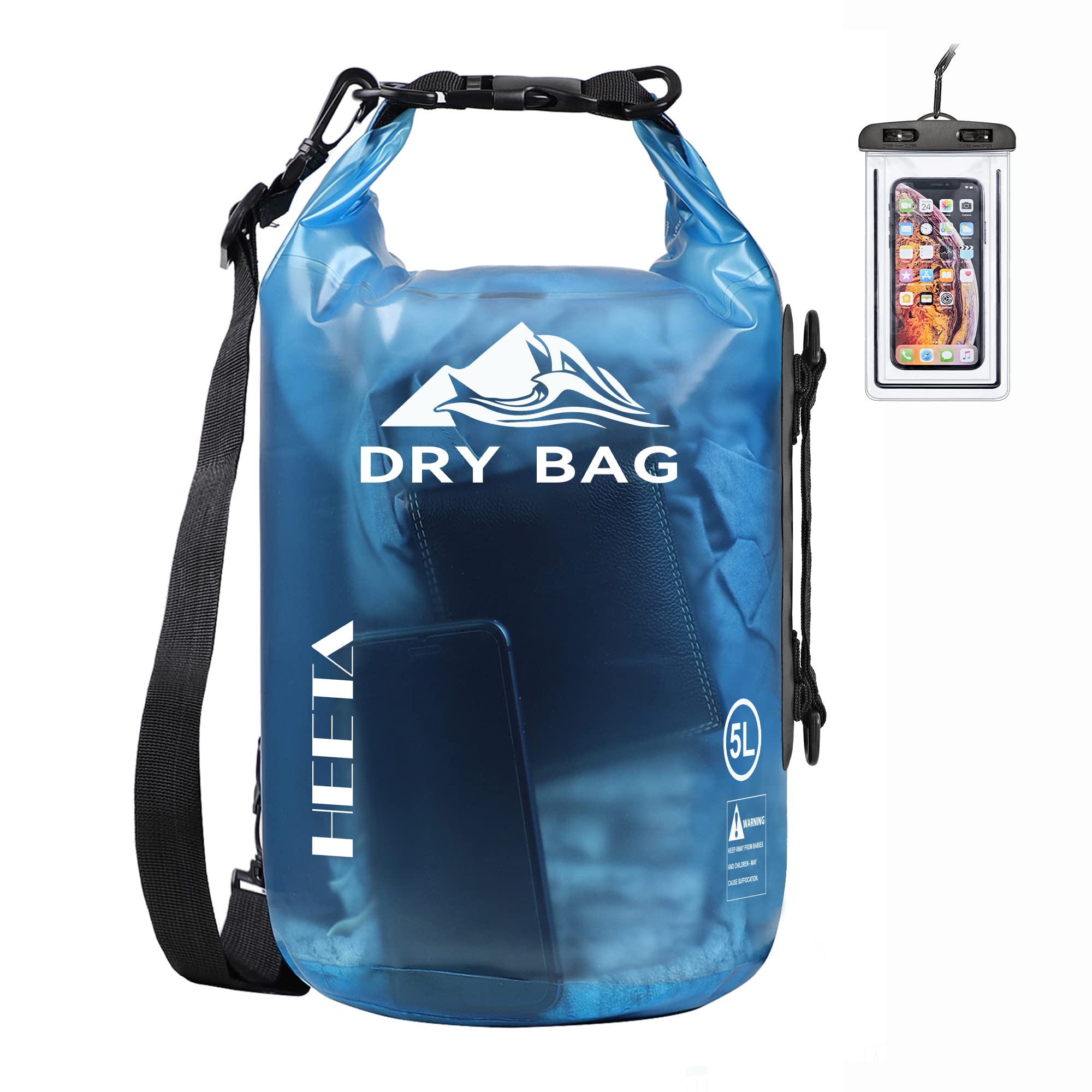
Key Features
- Carry: Adjustable straps, side handle
- Capacity: 5 liters
- Material: Transparent PVC
- Dimensions: 8"L x 8"W x 13"H
- Price: Budget
Clear PVC is a gimmick until you’re kneeling in a cockpit trying to find the dry socks. This bag shows you where everything is without opening it, and at 5 liters it slides under a deck line or into the space behind the seat.
The rest is ordinary in a good way: a roll-top buckle closure, adjustable straps that let you wear it as a small backpack, and a side handle for lifting it out of the boat. Eleven colors means one per paddler, and the smooth PVC wipes clean of sand and lake weed with a hand.
We found the see-through body most useful on group trips, where it doubles as a quick check that everyone’s phone and keys are accounted for before the shuttle leaves. Five liters is a personal kit, though — a towel and a layer will fill it.
Pros
- Transparent body makes gear easy to find
- Backpack straps plus a side handle at 5L
- Wipes clean and comes in eleven colors
Cons
- Thin 0.3 mm sides can tear at creases
- No exterior pocket
We were surprised how often we used the see-through body — if you’re tired of digging through a bag on the water, this is the one.
Best for Small Essentials
Unigear Floating Dry Bag 2L

Key Features
- Weight: 6.7 oz
- Capacity: 2 liters
- Material: 500D PVC
- Dimensions: 7.48"L x 7.48"W
- Price: Budget
Two liters is smaller than it sounds: a phone, keys, a wallet, a headlamp and a snack bar, and the bag is full. If that is the list of things you genuinely can’t afford to soak, this is the one to buy, because it costs less than almost anything else here and does the narrow job properly.
It’s built like the bigger bags: 500D PVC, high-frequency welded seams, a buckle that closes the roll top, and D-rings on the sides. It weighs 190 grams and floats when you trap air in it, so a dropped bag stays where you can grab it rather than going down.
We kept one clipped to a deck line, and it’s the bag we hand someone who only needs their keys and phone to survive a wet exit. It’s also the one to give a kid paddling their first river, because there’s nothing in it that can’t be replaced.
Pros
- Welded 500D PVC construction at a low price
- D-rings and buckle for clipping to the boat
- 190 grams, small enough to forget
Cons
- Too small for a towel or a spare layer
We use the 2-liter for keys, phone and a headlamp — welded 500D PVC that clips to a deck line and does the small job better than a big bag does.
Best for Organizing Gear
Wise Owl Outfitters Dry Bag 3-Pack

Key Features
- Sizes: 5L, 10L, 20L (3-pack)
- Weight: 7.05 oz
- Closure: Roll top with clip
- Material: 190D ripstop nylon
- Price: Midrange
190D ripstop nylon is a splash fabric, not an immersion one. That is the whole story with this set: the three sacks keep rain, spray and a wet towel away from your clothes inside a pack, and they float if you trap air in them, but water can work through the fabric and seams if a bag sits in it for any length of time.
What they’re good at is organization. You get 5, 10 and 20 liters, all grey, each with a D-ring to clip inside a hatch or a pack, and the whole set weighs 0.2 kg. Folded flat, all three take less room than a paperback, which is why they end up in every bag we own.
We ended up using the 5-liter for the things that must not get wet — phone, keys, wallet — and the 20-liter as a pack liner for a sleeping bag. That’s the honest use case: dry bags inside a dry bag, and a cheap way to sort a weekend’s gear into three loads you can find in the dark.
Pros
- Three sizes cover a whole trip’s sorting
- Ultralight and pack flat
- D-rings clip inside a hatch or pack
Cons
- No strap; each sack is a stuff sack, not a carry bag
Our advice: buy this set for organizing gear inside a hatch or a pack, not for keeping a bag dry through a capsize.
How We Tested: Eight Months, 12 Bags, and a Capsize Drill
We started with roughly 40 bags sold through paddle shops and outfitters, then cut anything with a closure we wouldn’t trust in a capsize, anything outside the 10-to-40-liter range that actually suits kayaking, and anything whose capacity claim looked invented. That left 12 bags, which we paddled with for eight months across flatwater mornings, two river stretches, and a windy day in the surf.
Water resistance got tested the hard way. We sealed a folded paper towel and a sheet of paper inside each bag, followed the maker’s rolling instructions to the letter, and left it submerged in a cooler of lake water for 10 minutes. Then we did it again in the surf, and finally held a hose at full pressure on the closure for a solid minute. A bag only passed if the paper came out crisp; we also noted which ones beaded water off the fabric and which ones darkened and wetted out on contact.
Size and functionality we judged against the same day kit every time — dry top, fleece, lunch, phone, headlamp, keys — and counted how many rolls the closure still gave us once the bag was full. On the water we opened and resealed each one with cold, wet hands, sometimes one-handed while the boat drifted, clipped them to deck rigging, and shoved them through hatches to see which shapes fought back.
After each trip the bags came home, got turned inside out, and hung in the garage; we checked at 12 and 24 hours and noted which were still clammy in the creases. Durability was the slow part: loaded bags dragged over gravel and a concrete ramp, the same crease folded 50 times, weeks of sun on a back deck. And because a dry bag is rarely just a dry bag, we used them as pillows, hung them from trees, and carried one on a hike to see which straps were worth having.
How to Choose a Dry Bag for Kayaking
Three things decide whether a dry bag earns its space in your boat: what it’s made of, how big it is, and whether you can seal it with cold, wet hands.
Material Comes Before Anything Else
For a bag that rides in a wet cockpit, gets dragged up a launch ramp or sits in the bilge, you want PVC in the 500D to 600D range. It’s heavier and stiffer, and it’s the material that shrugs off gravel, hatch rims and being sat on. Coated nylon or polyester in the 190D to 210T range weighs a fraction as much and packs to nothing, but it’s a splash-and-rain fabric — excellent inside a backpack, not what you want for a bag that might go over the side.
Buy the material for the wettest thing that will happen to the bag, not for the average day. If you paddle flatwater and the bag lives under a bungee, a light sack set will do. If it goes in the bilge or comes out of a capsize with you, buy the thicker PVC.
Size It to the Hatch and the Day
Measure your hatch opening before you fall in love with a capacity. The 10- and 20-liter bags here run roughly 8 to 10 inches across, which slides through a big oval hatch and jams in a small round one.
For a day paddle, 10 liters holds a towel, a layer, lunch and a phone; 20 liters adds room for a camera, a thermos or a dry change of clothes and still rolls down properly. Thirty liters and up is overnight territory, and those bags usually ride in the cockpit or strapped on deck rather than in a hatch.
Get the Roll-Top Right
Every bag here seals the same way: fold the top over at least three times, squeeze out the air — or leave some in if you want the bag to float — then clip the buckle. The failure is nearly always the same one. A bag packed to the very top has no fabric left to roll, so the seal sits on a single fold that springs open the first time something presses on it.
Leave four or five inches of bag above the load, and if the buckle has to strain to close, take something out rather than forcing it.
Decide How It Travels
A shoulder strap covers the walk from the car to the water. A backpack harness is what you want when the carry is a mile, or when both hands are busy with a boat — and it’s the difference between a camping kit that arrives dry and one that arrives dragged.
Then think about the boat itself. If the bag has a D-ring or a buckle loop, run a short line or a carabiner from it to a deck line. A dry bag that goes over the side in a capsize is dry only until someone finds it.
Pay for the Pocket, Not the Gadgets
An exterior zippered pocket is the upgrade we value most in daily use: it means reaching for sunscreen or a phone without unrolling the whole bag on a moving deck. Treat those pockets as splash protection, though. A zip on the outside of a roll-top bag is not a dry compartment, and anything that truly can’t get wet belongs inside the roll.
The rest — extra colors, printed patterns, a lanyard — is taste, and it’s fine to buy on taste.
Frequently Asked Questions
Do the waterproof phone cases that come with these bags actually work?
The IPX8 cases bundled with the Earth Pak bags fit phones up to 6.5 inches measured diagonally. Before you trust one with a phone, fold a tissue inside, seal the closure, and float the case in a sink for ten minutes. Dry tissue means a dry phone.
Touchscreens generally work through the window, though wet fingers are another matter.
Can I put a wet swimsuit or towel in the same bag as dry clothes?
Yes, with a caveat: a dry bag keeps water out, it doesn’t sort wet from dry inside. A damp towel will share its moisture with everything it touches. Put wet kit in its own small stuff sack first, or run two bags — one for damp gear, one for clothes and electronics.
What’s the best way to dry a dry bag between trips?
Turn it inside out, hang it by the buckle or a D-ring somewhere with airflow, and leave it unrolled until the inside is completely dry. Rolling a damp bag up traps moisture in the folds, which is where the smell starts.
Sand and lake scum wipe off with a damp cloth; save the soap for when it’s actually dirty.
Final Verdict
If you paddle day trips and want one bag to do it all, the Earth Pak 20L is the one we point to: 500D PVC, a shoulder strap, a usable front pocket and a phone case in the box. Move up to the 55L backpack when the trip runs overnight and you’ll be carrying the load on your back.
On the tightest budget, the MARCHWAY 10L covers a single day with welded seams and a bottom that floats, and it’s the bag to buy two of.