This post contains affiliate links. We may earn a small commission when you buy through our links — at no extra cost to you.
A collapsible trekking pole is only as good as the moment it locks. I have had a pole shorten under my weight on a downhill, and that half-second of doubt ruins the rhythm of a hike. What you want is a pair that disappears into your pack, extends to the right height without a fight, and then stays there when you lean on it. Weight matters because you are swinging these for miles, and portability matters because they are useless if you leave them in the car.
Over the past eight months, our team tested 12 pairs of collapsible trekking poles on day hikes, steep descents, and muddy trails, and the differences came down to the locking mechanism and how the poles felt after a few hours. I noticed that the lightest pairs were not always the most stable, and the most adjustable ones sometimes had more play at the joints. The best ones balanced those tradeoffs, packed down small enough for a daypack, and still felt solid when we put real weight on them. Below are the pairs that earned a spot on the trail.



Best for All-Round Hiking
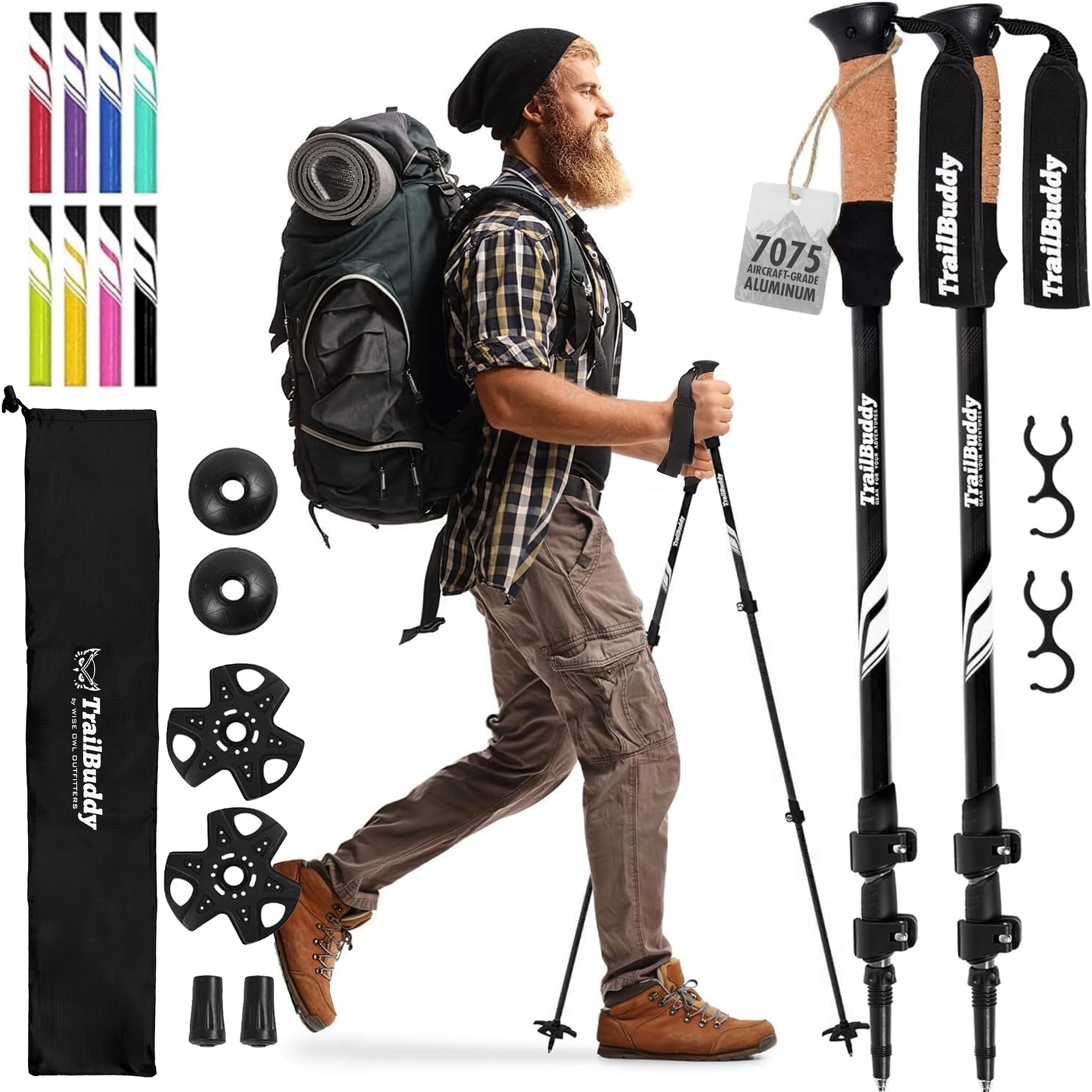
TrailBuddy Trekking Poles
Key Features
- Lock type: One-hand lever
- Height range: 24.5 to 54 in
- Weight per pole: 9.7 oz
- Collapsed length: 24.5 in
- Price: Midrange
The TrailBuddy pair is the one we hand to a hiker who wants a single set of poles and no homework. At 9.7 ounces per pole, they are light enough to forget on the climb, and the 54-inch maximum gives tall users room to set a comfortable elbow angle. The lever locks are the detail that kept them at the top of our list: one hand sets them, even with gloves on, and you can shorten one pole for a sidehill without breaking stride. Collapsed to 24.5 inches, they are compact for a daypack but not as pack-flat as the 14- and 15-inch folders here. That is the trade we accept for a simpler telescoping design.
Cork grips and padded wrist straps do the quiet work on long days, and the tungsten carbide tips bite on rock and packed dirt. The kit includes mud and snow baskets, four rubber tips, and a carry bag, so you are not hunting for accessories before a trip. We did not treat the cork as a luxury: it stays grippy when your hands warm up, which is exactly when a foam handle starts to feel slick.
The caveat is durability under hard use. These are trail poles, not load-bearing crutches or tent supports, and the lower sections are the part to watch if you regularly lean your full weight on a pole. The five-year limited warranty is the practical backstop, and it is a longer commitment than most of this group makes. For everything from local paths to alpine day hikes, the balance still lands here.
Pros
- One-hand lever locks are quick to set
- 9.7-ounce poles stay light on long days
- Cork grips and padded straps remain comfortable
- Five-year limited warranty backs the pair
Cons
- Folded length is 24.5 inches, not pack-flat short
Our default pick: a light, one-hand-adjustable pair that fits most hikers and most day hikes, though it packs longer than travel-first folders.
Best for Travel and Daypacks
Hiker Hunger Foldable
Key Features
- Lock type: Metal flip lock
- Folded length: 14 in
- Height options: 100-120 cm or 115-135 cm
- Weight per pole: 9.95 or 10.7 oz
- Price: Midrange
Fourteen inches is the number that earns this Hiker Hunger pair a place in the travel slot. It folds into a daypack or a small suitcase in a way the telescoping poles here cannot, and the two height-specific versions mean a short hiker is not stuck with a long pole. The short version is listed at 9.95 ounces per pole, the long at 10.7, so the weight stays reasonable for a folding design.
This is the packability leader of this set, with a caveat. The metal flip locks and reinforced joints feel more substantial than the price suggests, and the cork grip gives you a familiar handhold when you are moving fast. The two sizes are not cosmetic: the 100-120 cm version is for hikers 5 feet 8 inches and under, while the 115-135 cm version suits 5 feet 9 inches and taller. Buy the size that matches your height, not the one that happens to be in stock.
The accessory kit covers mud, snow, and pavement with baskets, rubber feet, and a carry bag, which saves a separate order. The long version tops out at 135 cm, so very tall hikers should check the fit before committing; the short version tops out at 120 cm. For everyone in those bands, the folded size is the reason to pick it.
Pros
- Folds to 14 inches for small packs
- Under 10 ounces in the short size
- Two height-specific versions improve fit
- Metal flip locks and cork grips feel substantial
Cons
- Folding joints add maintenance points
Our travel pick is this Hiker Hunger folder: 14 inches packed, under 10 ounces in the short size, and two height bands.
Best for Budget Day Hikes
Cascade Mountain Tech
Key Features
- Lock type: Quick lever
- Height range: 26 to 54 in
- Weight per pole: 10.1 oz
- Collapsed length: 26 in
- Price: Budget
The Cascade box arrives with more pieces than the budget position suggests: two poles, a carry case, mud baskets, rubber tips, snow baskets, and a clip. For a first pair or a spare set for the car, that completeness matters. The cork grip and extended EVA lower grip give you somewhere to put your hand on a steep pitch, and the 26- to 54-inch range covers a wide spread of hikers.
The basics are right: 10.08 ounces per pole, a quick lever lock, and a cork handle that does not turn slick the moment you start sweating. It spreads the money across grip, tips, and baskets rather than shaving grams. The telescoping build is simple to extend and simple to break down at the trailhead.
We rate it as the value pick of this set, with one setup caveat. Set the locking clamps at home, test each pole under your weight, and recheck them after the first mile; a clamp that is only half closed will creep down. Do that and the Cascades feel secure on the trail. The included snow baskets and rubber tips extend the season without another purchase, and that is the sort of value that lasts past the first trip.
Pros
- Complete accessory kit for changing terrain
- Cork and extended EVA grip suit steep pitches
- 10.08 ounces per pole is light for the price
- Quick lever lock is easy to operate
Cons
- Folded length is 26 inches, not travel-short
We think it is the budget pair to beat for day hikes, provided you set the lever locks carefully and do not need a short packed length.
Best for Ultralight Hiking
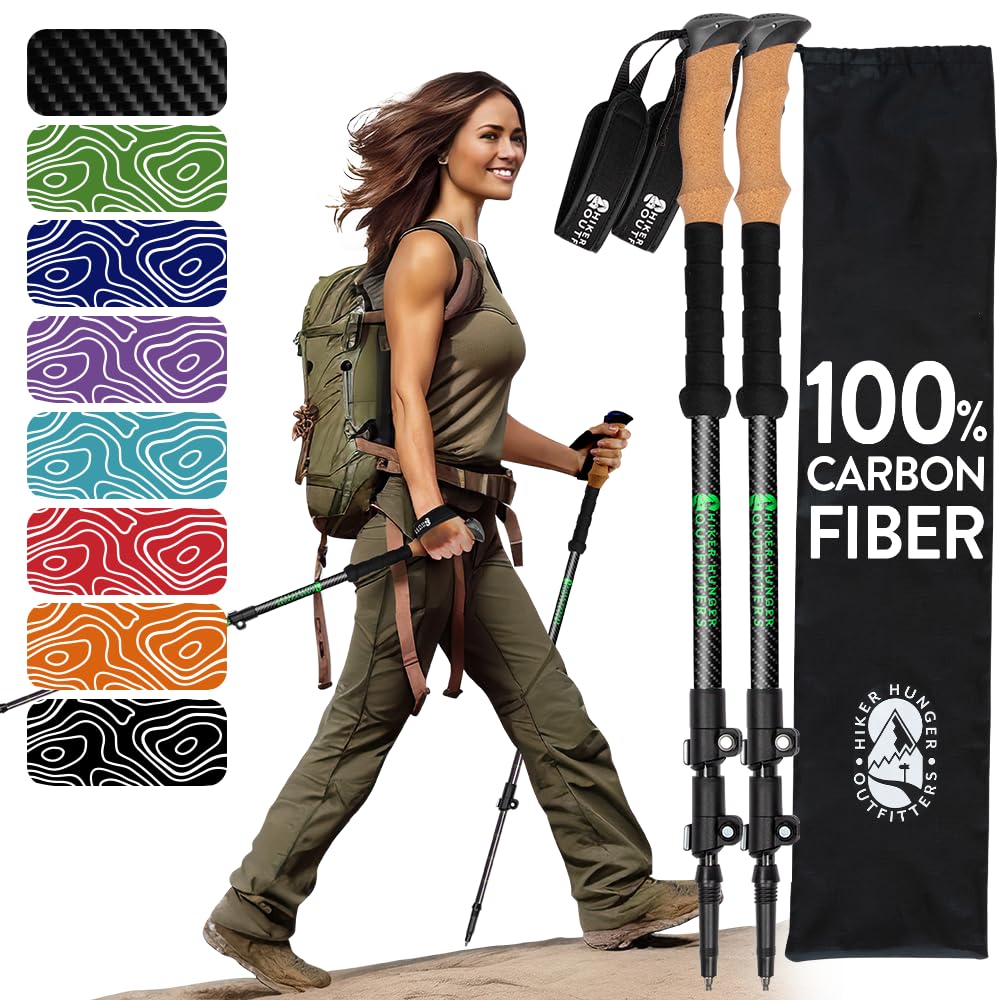
Hiker Hunger Carbon
Key Features
- Height range: 24 to 55 in
- Shaft material: 3K carbon fiber
- Weight per pole: 7.6 oz
- Collapsed length: 24 in
- Price: Premium
At 7.6 ounces per pole, the Hiker Hunger carbon pair is the one that disappears in your hands. That is the lightest build in this set, and the 24- to 55-inch range makes it a rare ultralight option that still fits tall hikers. The difference shows up on long climbs, where a few ounces per pole stop being a spreadsheet number and start being a reason to keep moving.
Carbon is a weight upgrade, not a toughness upgrade. The shafts are stiff and light, but they are less forgiving of being wedged in a rock crack or used as a lever. The flip locks are easy to set, and the cork grip with an EVA extension gives you a lower hand position for steep steps. If you want a pole you can abuse without a second thought, the aluminum TrailBuddy pair is the safer spend.
The 55-inch top is genuinely useful for taller hikers, and the 24-inch collapsed length is short enough for a pack strap. That combination is why these stay in the set. We keep them for trips where the pack weight is already counted.
Pros
- Lightest pair here at 7.6 ounces per pole
- 55-inch reach suits taller hikers
- Cork and EVA grips give two hand positions
Cons
- Premium price relative to aluminum picks
We reach for these when saving weight matters more than saving money: the lightest poles here, with 55 inches of reach for taller hikers.
Best for Simple Trail Use
KINGGEAR Trekking Poles
Key Features
- Lock type: Quick flip lock
- Height range: 25.5 to 54 in
- Weight per pole: 9.35 oz
- Collapsed length: 25.5 in
- Price: Budget
The Kinggear pair does not try to be the lightest or the most compact pole here, and that is part of its appeal. It is a straightforward 7075 aluminum telescoper with cork grips, a quick flip lock, and a 25.5- to 54-inch range. The 9.35-ounce weight is close enough to the premium aluminum picks that you will not notice the difference on a day hike.
It lands near the top of this set on simple value. The cork grip is comfortable over miles, the lever locks are easy to operate with gloves, and the poles adjust down far enough for shorter walkers without feeling like a kids’ set. There is no clever folding mechanism to learn and no proprietary accessory to lose. For someone who wants a dependable pair for local trails and the occasional national park trip, that simplicity is the feature.
The 54-inch top has enough reach for taller hikers, while the 25.5-inch minimum lets shorter walkers set a comfortable elbow angle. We also like that the tips screw on with a clear stop, so you can tell they are seated. It is not a fancy pole, but it is an easy one to live with.
Pros
- 9.35 ounces per pole is light for aluminum
- Cork grips and flip locks are simple to use
- 54-inch range fits a wide spread of hikers
Cons
- Folded length is 25.5 inches, not travel-short
- Levers may need re-tensioning
We recommend these for budget-minded day hikers who want a light aluminum pair and do not need a short packed length.
Best for Small-Pack Travel
Covacure Tri-Fold

Key Features
- Lock type: Quick lock
- Height range: 110 to 130 cm
- Folded length: 14 in
- Weight per pair: 1.6 lb
- Price: Budget
The Covacure tri-fold is the short-travel specialist of this group. It folds to 14 inches and adjusts from 110 to 130 cm, which puts it in a different fit bracket from the 54- and 55-inch poles. If you are tall, that 51-inch ceiling is the first thing to check.
The tri-fold takes a moment to learn. The sections click together in a set order, and the top tension screw needs to be snug before you load the pole. Once set, the EVA grips are comfortable and the height lock adjusts quickly. We stop short of calling it a premium build; it feels best on maintained trails and travel walks.
We see it as a practical second pair or a first pair for a shorter hiker who values pack size over all-out lightness. What it gets right is the travel equation: short folded, simple to stow, and easy to leave in the suitcase between trips. The three types of rubber tips let it move from pavement to dirt without another purchase.
Pros
- Folds to 14 inches for small bags
- Adjusts from 110 to 130 cm
- Three rubber tip types included
Cons
- Pair weight is 1.6 pounds
We like this budget tri-fold for shorter hikers and small packs, but the 51-inch ceiling rules out taller users.
Best for Cork-Grip Travel
Trekology Trek-Z

Key Features
- Grip: Natural cork
- Height range: 110 to 130 cm
- Folded length: 15 in
- Weight per pole: 11.5 oz
- Price: Midrange
Cork on a folding pole is the reason to look at the Trek-Z. It folds to 15 inches and weighs 11.5 ounces per pole, so it lands in the travel section rather than the ultralight one. The natural grip is the part that separates it from the cheaper foam-handled folders.
The metal flip lock adjusts from 110 to 130 cm, and the sections assemble with a satisfying click. The cork handle stays warm and slightly tacky in the hand, while the EVA extension gives you a lower grip on steep steps. That makes it more comfortable on long descents than the foam handles on some of the cheaper folders.
On maintained trails, the Trek-Z feels stable and predictable. The carbide tip bites, the baskets are easy to swap, and the folded package is small enough to live in a daypack. It is a travel pole first, not a mountaineering tool, and it makes the most sense on paths where you are not levering it out of rock cracks.
It sits behind the top pick for all-round use because the tri-fold design adds complexity, but the cork grip is what makes it worth the extra care. If you are indifferent between cork and foam, the cheaper folders here make more sense. If your hands run hot and you want a compact pole that feels good on the descent, this is the one we point to.
Pros
- Natural cork grip is comfortable on descents
- Folds to 15 inches for travel
- Flip lock adjusts from 110 to 130 cm
Cons
- Cable and joints are the durability weak point
We see it as the comfort-first travel folder: natural cork, a 15-inch fold, and a more involved setup than a simple telescoper.
How We Tested Collapsible Trekking Poles
We started by scanning spec sheets and customer reviews for poles that collapsed to a compact length, came in at a reasonable weight, and offered adjustable height ranges that could suit different hikers. We filtered out models with vague locking descriptions, loose-looking joints in photos, or fixed lengths that only worked for one body type. That narrowed the field to 12 pairs across a range of materials and price points.
Testing ran for eight months. We used the poles on local day hikes, rocky descents, muddy sections after rain, and one tester packed a pair into a carry-on for a weekend trip. On the trail, we set each pole to our height, leaned our weight into the downhill, and noted whether the lock slipped, creaked, or held. We also weighed every pair on a kitchen scale, collapsed and deployed them repeatedly, and checked how small they packed into a daypack side pocket and a car trunk.
We adjusted length while wearing gloves, swapped baskets, and used the straps on climbs, noting whether grips rubbed or straps needed constant readjustment. For durability, we scraped tips on rock, let mud dry, cleaned the joints, and rechecked each locking mechanism for play. Pairs that stayed quiet and solid after that got higher marks than ones that needed fussing mid-hike.
How to Choose Collapsible Trekking Poles
The best collapsible pole is not the lightest one in the listing; it is the one whose lock you trust and whose folded length matches how you carry it.
Put Lock Security Before Weight
There are three lock families here: external flip levers, twist locks, and the internal tension cable used by folding poles. Levers are the easiest to set with gloves and the easiest to check at a glance; twist locks have fewer snag points but demand a firm hand; folders combine a lever with a cable that has to be tensioned correctly. A pole that slips under weight is worse than one that costs you an ounce.
Set every pole at home, extend it, and press down hard before you trust it on a slope. Recheck the levers after the first mile, especially on a new pair. If a lock creeps no matter how you set it, return the pole rather than nursing it down a mountain.
Match Folded Length to the Trip
Telescoping poles usually collapse to 24 to 26 inches; tri-fold designs reach 14 to 15 inches. The difference is not cosmetic. A 14-inch folder fits inside many daypacks and small suitcases, while a 25-inch telescoper tends to ride on a pack strap or in a car trunk. If your daypack is small, start with the folded length and work backward, because a great pole that does not fit your bag stays home.
Folding poles pay for that compactness with more joints and an internal cable. That does not make them fragile, but it does mean more places to clean and check. For car-based hikes, a simpler telescoper is easier to live with.
Fit the Height Range to the Hiker
Maximum length gets the attention, but the ceiling is what rules people out. A pole that tops out at 51 inches will not give a tall hiker a comfortable elbow angle, no matter how nicely it folds. The 54- and 55-inch poles here cover more height, while the shorter model is best for shorter users. Check the range against your height before you fall for the packed size.
Set the pole on level ground so your elbow sits at roughly 90 degrees, then shorten it slightly for uphill and lengthen it for downhill. The marked sections on models like the Hiker Hunger and Covacure make repeat settings easier, but any pole can be set by feel. If you are between sizes, choose the longer range rather than the shorter one.
Decide How Much Weight and Material You Need
Carbon saves real weight: the Hiker Hunger carbon pair is 7.6 ounces per pole against roughly 9 to 10 ounces for the aluminum picks here. On a long climb, that difference is noticeable; on a two-hour walk, it is not worth a premium. Aluminum is the more forgiving choice around rock and grit, and it costs less. We treat carbon as a weight upgrade, not a toughness upgrade.
The grip matters as much as the shaft. Cork handles stay comfortable when hands warm up, while EVA foam is easier to rinse and often cheaper. Neither is a mistake. Pick cork if you hike long days and foam if you want low maintenance. Then check the accessory kit: mud and snow baskets are worth having if you hike in changing conditions.
Frequently Asked Questions
Can I take collapsible trekking poles in a carry-on?
Not automatically. Airline and security rules vary, and a folding pole is still a long metal object even when it packs to 14 inches. Check your airline’s carry-on rules before you fly, and put the poles in checked baggage if you are unsure. A collapsible pole is easier to pack, not a guarantee of cabin clearance.
How often do trekking pole tips need replacing?
Rubber tips and baskets wear faster than carbide. Inspect the tip before a trip: replace rubber feet when the tread smooths or splits, and replace a carbide tip when it stops biting or the holder wears through. Most pairs here include spares, so keep them in the carry bag rather than in a drawer at home.
Can I use trekking poles as tent poles?
Only if the manufacturer explicitly approves that use. Trekking poles are designed for body-weight support, not for the bending loads of a tent, and Cascade’s warranty excludes tent-pole and ski use. Carry the tent’s own poles or a purpose-made adapter, and do not exceed the pole’s stated height or load limits.
Final Verdict
We recommend the TrailBuddy pair as the default because it gets the everyday balance right: 9.7 ounces per pole, a one-hand lever lock, and a 54-inch range that fits most hikers. Its 24.5-inch fold is the compromise.
If you need a smaller packed size, the Hiker Hunger Folder drops to 14 inches; if you want the lightest possible pair, the carbon Hiker Hunger saves weight for a premium. The Cascade is the budget choice when the basics matter more than pack size.