This post contains affiliate links. We may earn a small commission when you buy through our links — at no extra cost to you.
A Class 1 e-bike is the simplest electric bike there is: the motor only helps while you’re pedaling, there’s no throttle, and the assist cuts out at 20 mph. That single rule is why these bikes are welcome on most paths and trails where faster, throttle-driven models aren’t, and why the good ones have to earn their speed through gearing, weight, and motor tuning rather than a twist grip. What they fix is the reason a lot of people quietly stopped riding: the hill to work, the headwind home, the errand that somehow felt longer than it was.
My team and I have spent the past eight months on six of them, commuting, hauling groceries, and grinding up the same steep climb twice a week. The lesson that surprised me most is that motor wattage tells you almost nothing about how a bike feels; total weight and the way the assist engages matter far more. The picks below held up to all of it. A couple of others didn’t.

Best for Everyday Commuting
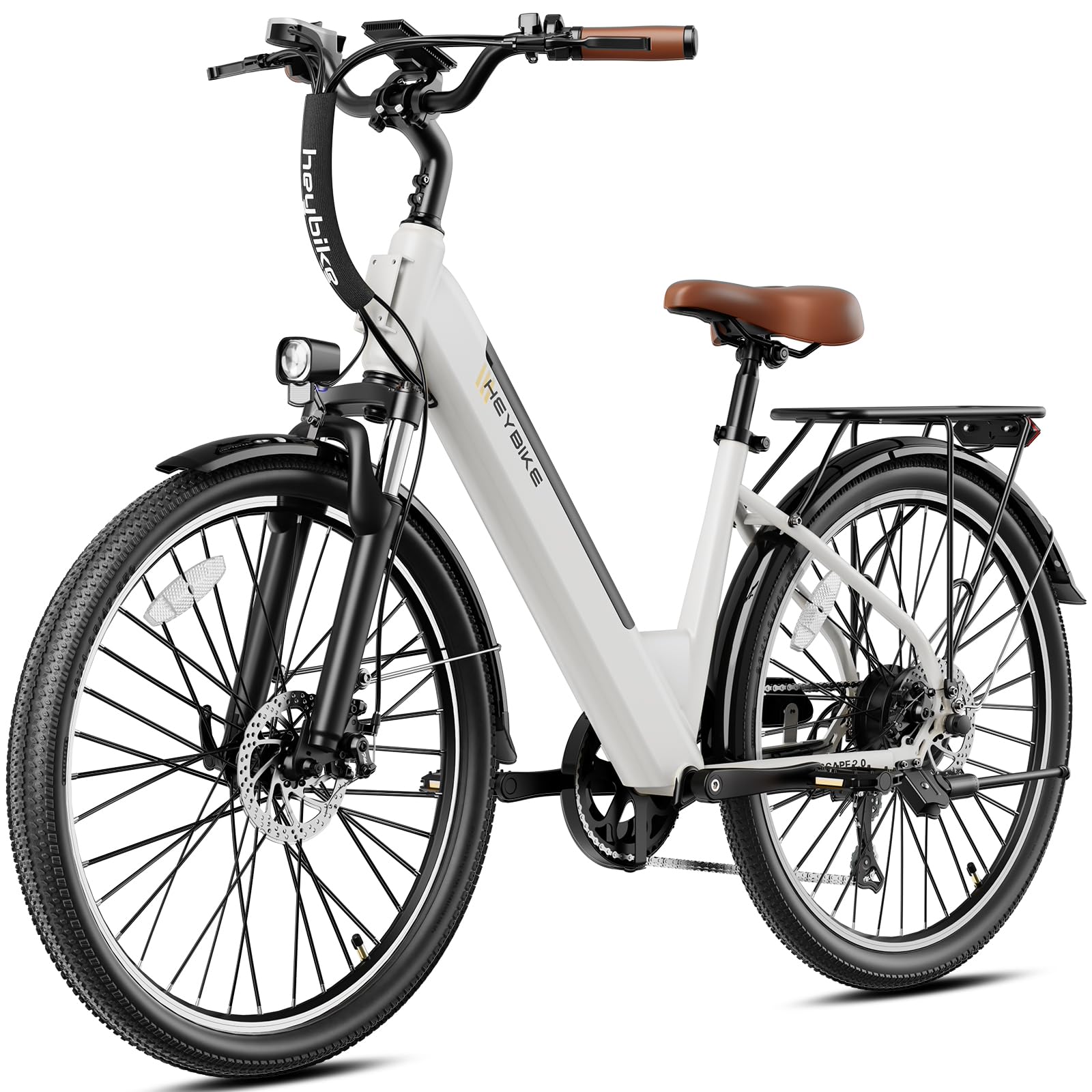
Heybike Cityscape 2.0
Key Features
- Motor: 500 W rated, 1200 W peak
- Tires: 26 x 1.95 in puncture-resistant
- Battery: 468 Wh, UL-certified, removable
- Gearing: 7-speed
- Price: Midrange
A 468 Wh battery is the number that sets the Cityscape 2.0 apart here. Nothing else in this group carries as much, and on a bike that stops assisting at 20 mph it translates into a week of short commutes between charges rather than a nightly ritual. The pack is removable, sealed to IPX6 and UL-certified, which matters more than capacity if you are charging it in a hallway or an attached garage.
The ride is the other reason it earns the top spot. A 500 W rated motor with 1200 W of peak headroom, a 7-speed drivetrain and a front fork take the sting out of broken pavement, and the 26 x 1.95 puncture-resistant tires roll well enough that pedaling with the assist switched off is not a punishment. Disc brakes and a bright headlight round out a bike that feels finished rather than assembled.
What we kept coming back to is how ordinary it feels. Chalky white with tan grips and a matching saddle, it reads as a bike someone chose rather than a device someone shipped, and that is not a small thing when you are wheeling it into an office or chaining it up outside a shop. It is the pick that makes the least fuss about being electric.
Pros
- Largest battery here at 468 Wh
- Composed ride on rough pavement
- Finish and styling read as a real bike
- Removable pack charges anywhere
Cons
- Thumb throttle fitted, so not strictly Class 1
We think this is the one most riders should buy: the largest battery here, a settled ride over rough pavement, and a look that passes as an ordinary bike.
Best for Value Commuters
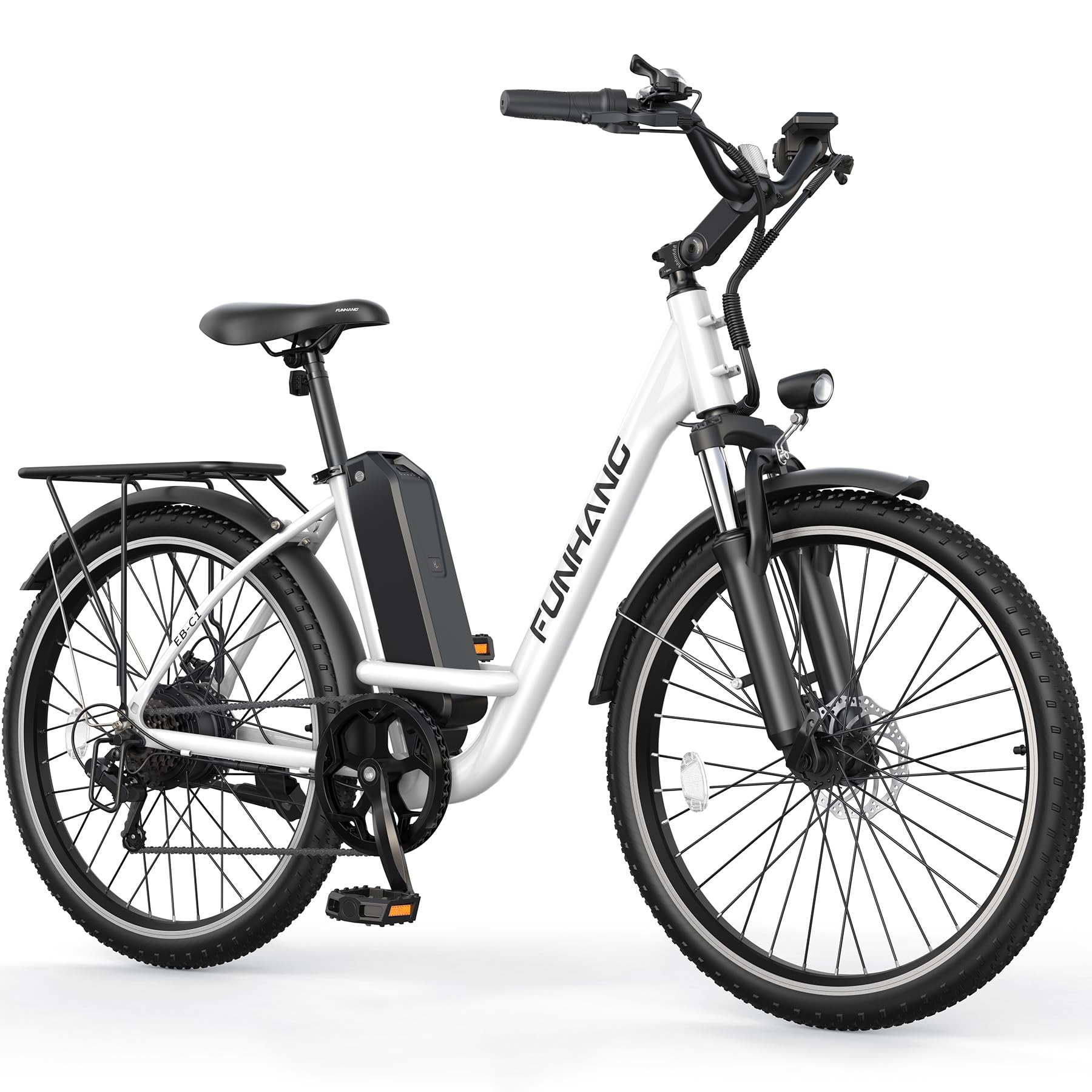
Funhang EB-C1
Key Features
- Motor: 500 W rated, 1000 W peak
- Weight: 61.5 lb
- Battery: 374.4 Wh, removable
- Certification: UL 2849
- Price: Budget
UL 2849 certification is the first thing we check on a budget e-bike, and the Funhang carries it. That standard covers the whole electrical system — battery, motor, controller, charger — rather than just the cells, and on a bike that costs less than most of this group it is the difference between a bargain and a gamble.
Where the money went is the frame, the rack and the electrics rather than the finish. A 500 W rated motor with 55 Nm of torque and a 374.4 Wh removable pack is enough for a flat-ish commute, and the adjustable stem and seatpost stretch the fit down to about 5 foot 1. A rear rack, fenders and a headlight come included, and those are the parts that turn a bicycle into transport.
Assembly is the pleasant surprise. It arrives largely built, and the front wheel, bars and pedals went on without the swearing that usually accompanies a boxed bike. What we did not love is the weight — 61.5 lb is a steel frame, a rack and a large battery, and you feel all three when you are carrying it up a flight of stairs rather than riding it.
Pros
- UL 2849 certified electrical system
- Rack, fenders and headlight included
- Adjustable stem widens the fit range
Cons
- Real-world range trails the advertised figure
We rate it the value pick because the electrics are UL 2849 certified and the rack, fenders and 20 mph cutoff are all there for very little money.
Best for Flat City Rides
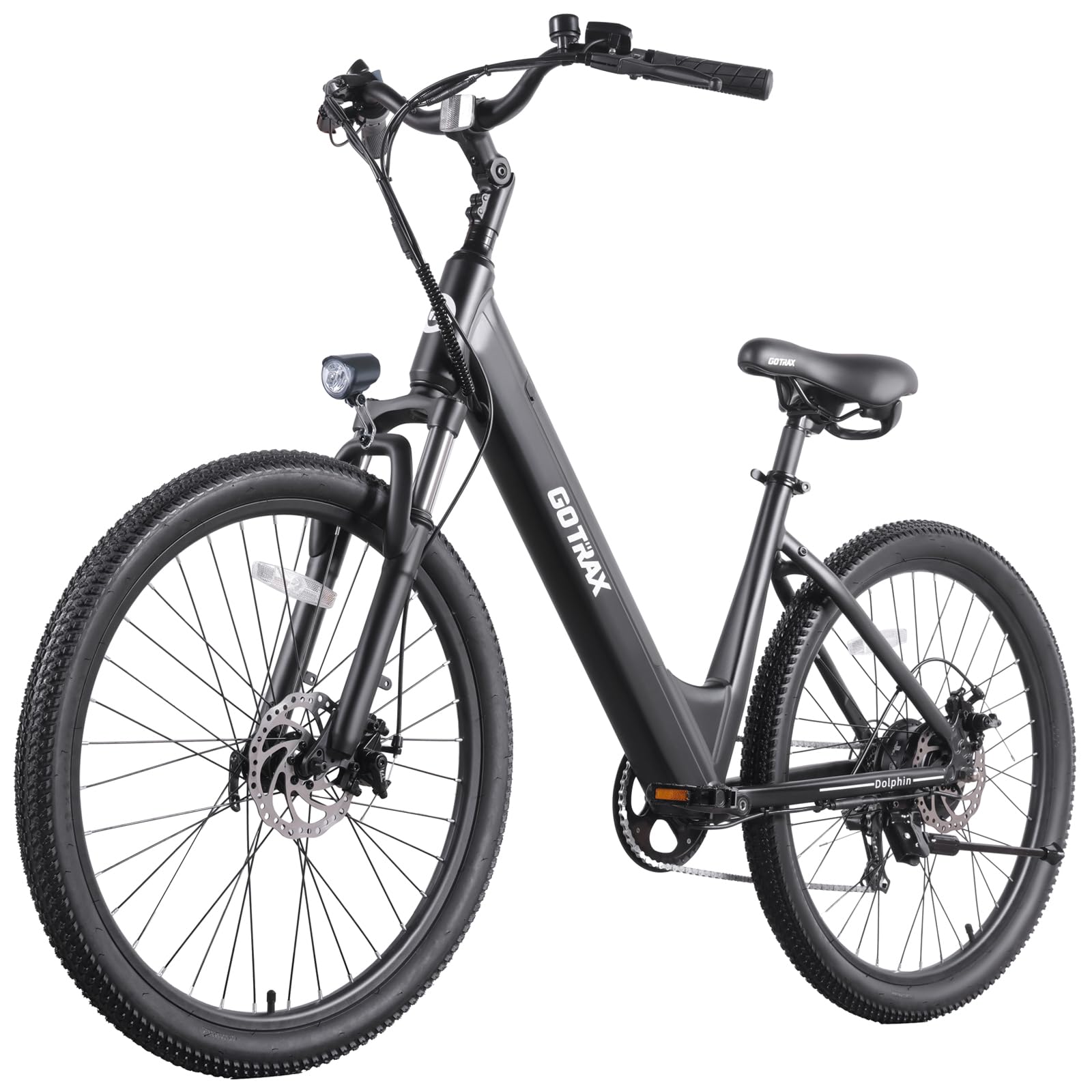
Gotrax Dolphin
Key Features
- Motor: 350 W rated, 500 W peak
- Weight: 48.9 lb
- Battery: 280.8 Wh, removable
- Rider limit: 264 lb
- Price: Midrange
A 350 W motor looks like a compromise next to the 500 W bikes around it, and for a lot of riders it is the more sensible choice. It is what keeps the Dolphin near 49 lb with the battery on, and it is why the bike turns and lifts without the heft of everything else in this group. On flat town streets and short errands, you will not miss the extra power.
The geometry is set up for exactly that. You sit upright rather than stretched out, the seat drops low enough for riders around 5 foot 2, and the aluminum frame on 26-inch tires handles potholes without drama. Dual disc brakes and a Shimano 7-speed drivetrain are more than a 20 mph bike strictly needs, which is another way of saying you will not grow out of it.
Where we hesitate is the long view. First-ride impressions are as good as anything in this group — smooth, quiet, easy to handle — but the reliability picture is the least settled of our full-size picks, and that is the sort of thing that surfaces in year two rather than week one. Buying where the 365-day warranty is simple to claim matters more on this bike than on the others.
Pros
- Light and easy to lift at about 49 lb
- Upright, comfortable riding position
- Disc brakes and Shimano 7-speed gearing
Cons
- Smallest battery here at 280.8 Wh
For flat-town riding we reach for the Dolphin before anything else here, because it does the same job with far less weight to push around.
Best for Small Spaces
AYOLNY EB1
Key Features
- Motor: 500 W rated, 1000 W peak
- Weight: 48.9 lb
- Battery: 36V 7.8Ah (280.8Wh)
- Fits riders: 4’9"–5’8"
- Price: Budget
One lever folds the handlebar stem flat, and that is the whole argument for the EB1 over a full-size bike. In a hallway, a dorm room or the corner of an office it turns a bicycle into a package you can tuck against a wall, and at 48.9 lb it is light enough that the fold actually gets used instead of admired once.
Fourteen-inch wheels are the trade you make for that. A 500 W rated motor is quick away from a light and fine up to the 20 mph cutoff, but small wheels pass on more of the road than a 26-inch tire does, and the sealed front drum brake is a low-maintenance choice rather than a sharp one. The seatpost and stem both adjust, and AYOLNY gives the fit range as 4 foot 9 to 5 foot 8 — unusually specific, and unusually useful if you are shopping for a teenager or a shorter adult.
What it is not is a distance bike. The motor is built for stop-start city riding rather than for grinding out a long commute, and the drum brake and small wheels point the same way. Treat the EB1 as the bike you keep for the short trips a car would otherwise handle, and it makes a great deal of sense — especially for a rider the full-size frames do not fit.
Pros
- Folds flat at the stem for tight storage
- Fits riders from 4 foot 9
- Sealed drum brake needs little upkeep
Cons
- Small 280.8 Wh battery
- Two-speed drivetrain limits climbing
Space is what sells a folder, and we think the EB1 folds smaller and fits shorter riders better than anything else here without asking much of your budget.
Best for Full-Size City Riding
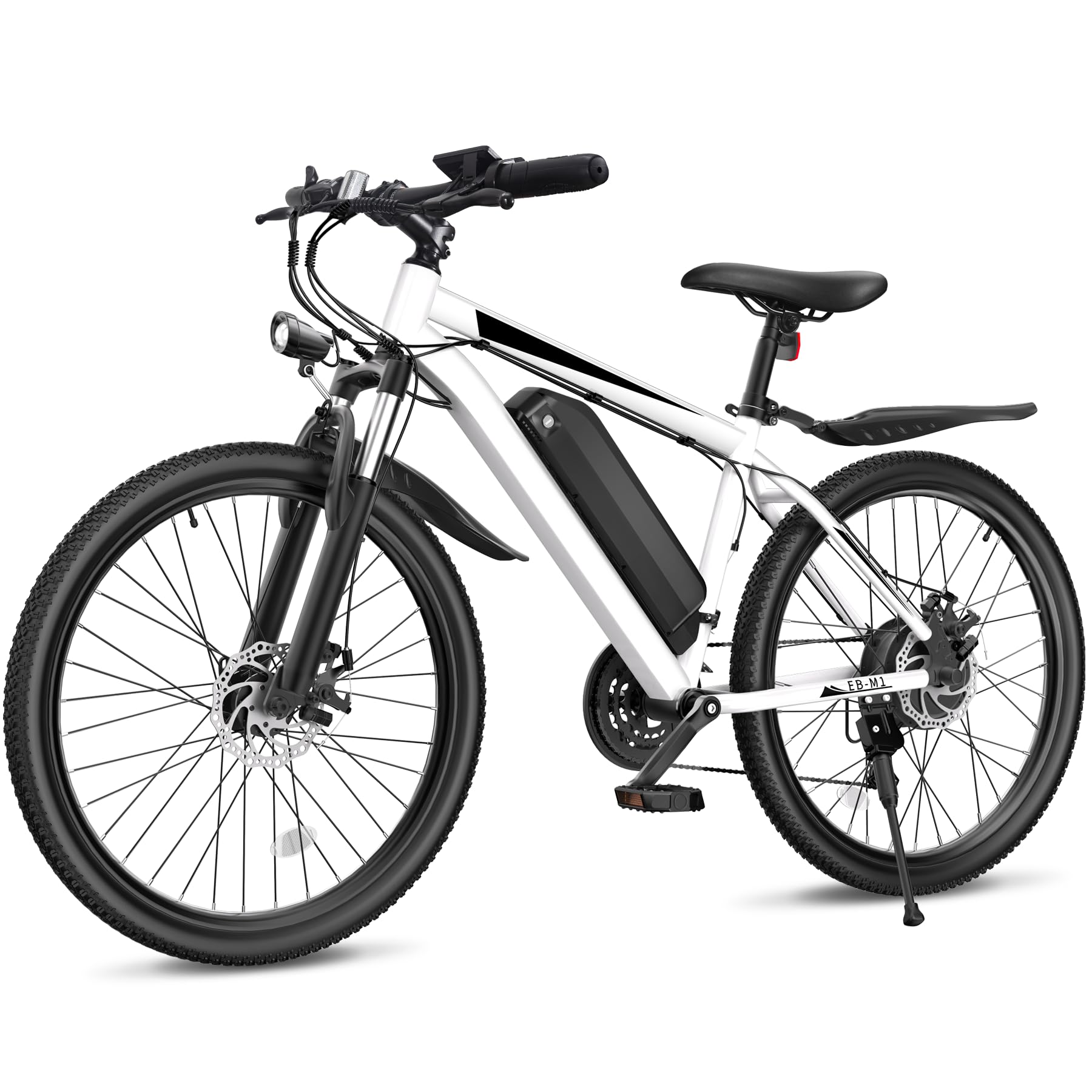
Loeook EB-M1
Key Features
- Motor: 500 W rated, 1000 W peak
- Weight: 56.9 lb
- Battery: 374.4 Wh, IPX5, removable
- Certification: UL 2849
- Price: Budget
At 56.9 lb the EB-M1 is one of the heavier bikes in this group, and that is the first thing to be honest about: it rides fine and it lifts badly. With a garage or a ground-floor hallway the weight costs you nothing. With a third-floor walk-up it costs you every single ride.
What the weight buys is a 26-inch wheel, front suspension, disc brakes, fenders and a headlight, plus a 374.4 Wh removable pack and UL 2849 certification — the right combination for a commuter. Range claims of 40 to 50 miles are the usual optimistic arithmetic; the pack is big enough that a 15-mile round trip does not need planning.
Where it gives ground to our value pick is in the parts that touch the road. The frame and motor hold up, but pedals working loose, tires wearing early and squealing brakes are the recurring weak spots, and on a budget bike those decide how much you enjoy month six. If you will swap pedals and tires on day one, this is a lot of bike for the money. If you will not, the Funhang EB-C1 is the safer version of the same idea.
Pros
- UL 2849 certified, with a removable pack
- Fenders, headlight and front suspension included
- Big enough pack for a real commute
Cons
- Pedals, tires and brakes wear early
If the bike lives on the ground floor we are happy to recommend it; if it lives up two flights, the 56.9 lb will make the decision for you.
Best for Tight Budgets
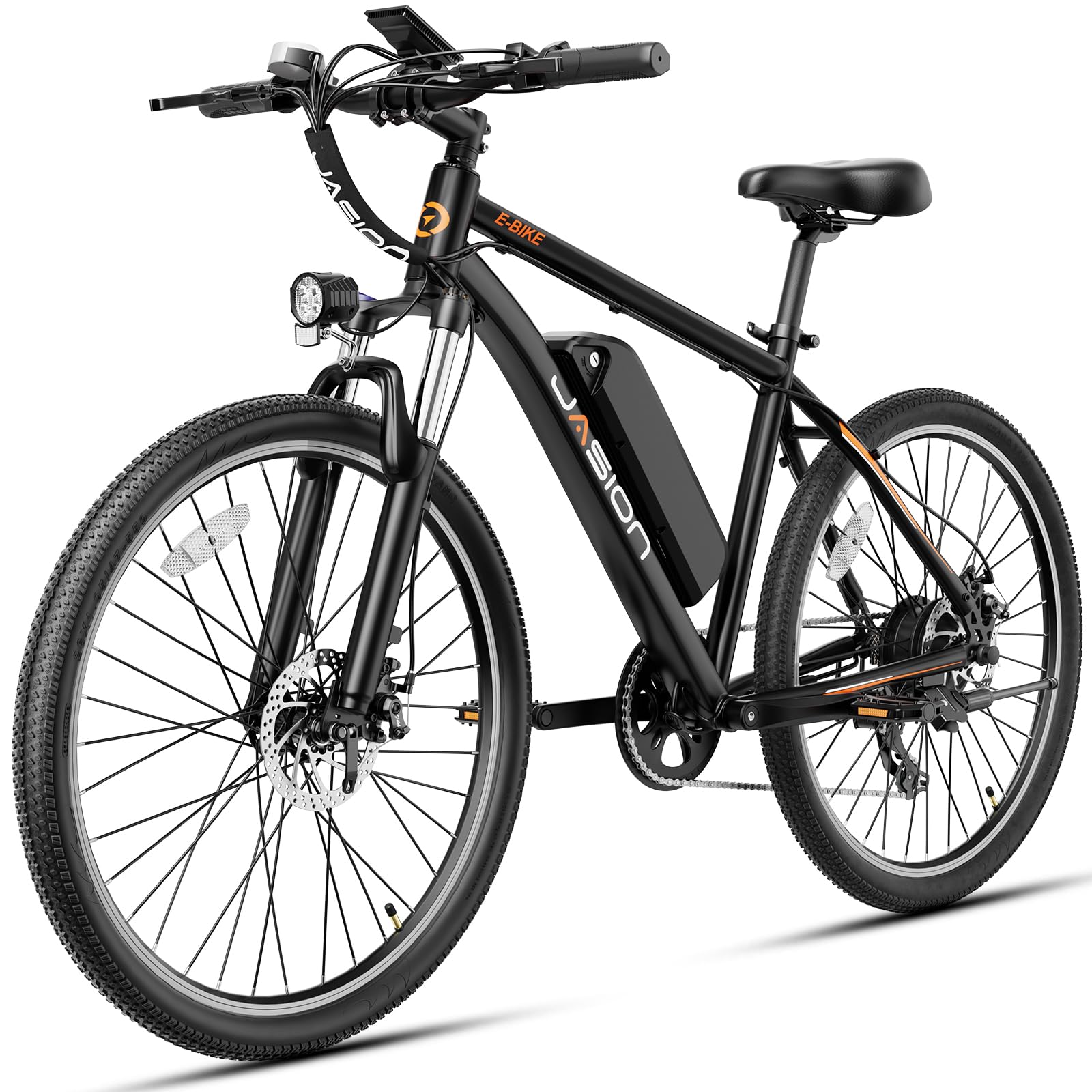
Jasion EB5
Key Features
- Motor: 1000 W peak
- Weight: 49.6 lb
- Wheels: 26 in
- Battery: 360 Wh, removable
- Price: Budget
The EB5 is the cheapest way into a full-size 26-inch e-bike here, and it is also the one where the parts that are not the motor deserve the most scrutiny. The assist, the 49.6 lb weight and the 20 mph cutoff are all fine. It is the parts that wear that decide whether you are still riding it next spring.
On paper it is tidy. A 360 Wh removable battery, 7-speed gearing, front suspension and a pair of lights, in a minimalist city frame that keeps it under 50 lb. It pedals like a bicycle, which is the point of a Class 1 machine, and the assist levels are easy to work out on the first ride rather than the third.
What tempers our enthusiasm is how it ages. The frame and the motor hold up; the consumables and the battery are where this bike asks you to take a chance, and that is a large part of why it sits near the bottom of our list rather than the top. It is not universal, but it is the risk you are accepting in exchange for the price.
So: buy it if the budget is genuinely fixed and you are willing to put a little more into better tires and a spare tube before the first ride. Otherwise the Funhang EB-C1 costs a bit more and buys you certification, a rack and a quieter ownership experience.
Pros
- Cheapest full-size 26-inch bike here
- Light for its class at 49.6 lb
- Removable battery with real capacity
Cons
- Tires and chains wear early
It is the cheapest way into a full-size Class 1 bike here, and we think you should spend part of the savings on better tires.
Best for Hilly Commutes
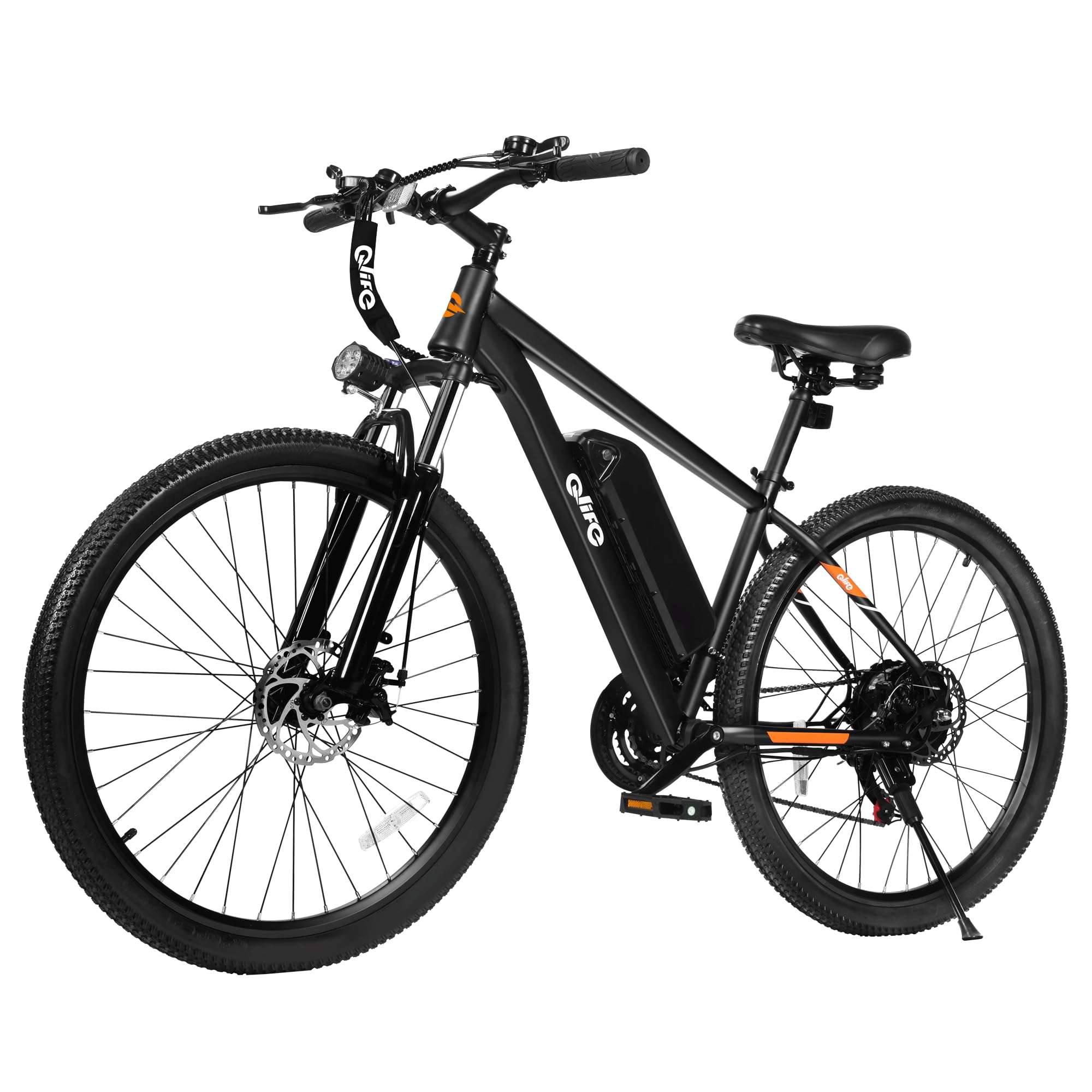
Qlife Racer
Key Features
- Gears: 21-speed
- Motor: 1000 W peak
- Weight: 48.1 lb
- Battery: 48V 7.8Ah, removable
- Price: Budget
Twenty-one gears is the odd thing out here — everything else in this group runs a 7-speed — and it changes how the Racer feels when the assist runs out. On a flat street you will not notice. On a long climb with the battery fading, having a low gear to drop into is the difference between pedaling home and walking.
Beyond the gearing, the Racer is competent rather than exciting. A 375 Wh removable battery with a key lock, 26 x 2.1 tires, front suspension and disc brakes cover the basics, and at 48.1 lb it is the lightest 26-inch bike we are recommending — light enough that getting it onto a hitch rack is not a two-person job.
What holds it back is definition. Qlife does not publish a top speed, so the one number a Class 1 buyer needs is the one number you have to check yourself. Past that it is steady: assembly is straightforward, the ride is smooth, and the money is low. It is the gear-range pick of this group, and we keep coming back to it for anyone whose ride home is not flat.
Pros
- 21-speed gearing, unique in this group
- Lightest 26-inch frame here at 48.1 lb
- Removable battery with a key lock
Cons
- No published top speed to confirm the cutoff
Real hills are where the Racer earns its place for us: 21 gears and 48 lb do more on a climb than another 100 watts of motor.
How We Chose and Tested the Class 1 E-Bikes
We started with a list of more than 40 Class 1 models pulled from spec sheets and reader suggestions, then filtered hard: no throttles, a true 20 mph cutoff, and enough dealer and parts support that a broken derailleur wouldn’t sideline the bike for a month. Six made the cut, spanning hub-drive and mid-drive motors, step-through and traditional frames, and a wide spread of prices.
Each arrived boxed. I assembled all six alone with a stopwatch running, using only what came in the box, and noted whether the brakes rubbed, the derailleur needed indexing, and the included tools were worth keeping. Anything that demanded a shop visit got flagged, and I re-checked every bolt after the first 50 miles.
Then came eight months of real riding: a four-mile commute in all weather, grocery runs with the rear rack loaded to its stated limit, a half-mile climb at 12 percent grade, and weekend gravel. I logged top speed by GPS to confirm where the assist actually cut out, ran a fixed 12-mile loop in two assist levels to see how far each battery really went, and weighed every bike on a hanging scale before carrying it up a flight of stairs. Long rides on chip-seal pavement were where comfort separated: saddles, grips, and how much road buzz came through the frame.
Over the months I watched for creaks, loose spokes, brake pad wear, and batteries that lost capacity after sitting, and tallied what came stock, including lights, fenders, and a rack, because a bike that needs a couple hundred dollars of accessories is worse value than the sticker suggests.
How to Choose a Class 1 E-Bike
Class 1 comes down to three things — pedals, a motor rated under 750 watts, and assist that quits at 20 mph — and everything after that is a comfort decision.
The 20 MPH Cutoff and the Throttle Problem
The cutoff is the part of Class 1 you actually feel: the motor pulls you to 20 mph and then hands the bike back to your legs. It is easy to check before you buy and just as easy to check after. Put the bike in its top assist level on a flat street and pedal — if it keeps pushing past 20, it is not Class 1, whatever the box says.
The throttle is the part people miss. A thumb lever that drives the bike without pedaling makes a machine Class 2 in the states that separate the classes, and most budget e-bikes ship with one fitted. If you ride rail-trails or municipal paths where rangers check, ask before you buy, because the rule attaches to the bike rather than to how you choose to use it.
Rated Watts, Peak Watts, and Hills
Peak wattage sells bikes; rated wattage is what counts. A 1000 W peak motor is usually a 500 W rated one that can surge for a few seconds, and the rated figure is the one tied to the legal ceiling and to how hot the motor runs on a long climb. Do not pay extra for a peak number.
What gets you up a hill is torque and gearing. Fifty-five newton-metres through a 7-speed cassette will out-climb a bigger motor stuck in one gear, and the 21-speed bike in this group proves the point — more gears do more for a steep street than another hundred watts of assist.
Battery Size and Honest Range
Watt-hours compare cleanly across bikes in a way that claimed mileage does not. The packs here run from about 280 Wh to 468 Wh, and the gap is roughly a day of commuting between charges. Treat every advertised range as the best case at the lowest assist level on flat ground, then halve it for a hilly ride with a loaded rider.
Removability matters as much as capacity. A pack you can carry inside is what makes an e-bike workable in an apartment or an office with no garage outlet, and it is the first thing to check if you do not park at ground level with power nearby.
Weight, Fit, and Where It Sleeps
These bikes run from about 48 lb to 62 lb, and that spread is the difference between carrying one upstairs and not. Decide where the bike sleeps before you decide anything else: a garage or a hallway opens up the heavier, cheaper, longer-range machines, while a walk-up points you at the folders and the low-power city bikes.
Fit is the other half. The listings here state rider ranges from 4 foot 9 to 6 foot 1, and a bike outside your range is uncomfortable no matter how good the specification looks. Under 5 foot 3, start with the small-wheel folders; over six foot, skip them entirely.
Assembly and the Parts You Will Replace
Most of these arrive 85 to 90 percent built, and the last tenth — front wheel, bars, pedals, brake alignment — is where an hour disappears. Do that work with real tools rather than the folded multitool in the box, check the stem and every bolt before the first proper ride, and bed the brakes in somewhere quiet.
Then budget for consumables. Tires and pedals are the first parts to go on a budget e-bike, and a pair of decent tires is the cheapest upgrade you can make to one. On a bike you plan to keep for years, that is where the money should go before it goes anywhere else.
Frequently Asked Questions
Do I need a license or registration for a Class 1 e-bike?
In most US states, no. A Class 1 bike is treated as a bicycle, so there is no license, registration or insurance, and you ride where bicycles ride. The exceptions are local rather than statewide: some trail systems and land managers ban motors outright, and a few require a permit. Check the specific path you plan to use, not just your state’s vehicle code.
What size rider do these bikes fit?
It varies more than the spec sheets suggest. The AYOLNY EB1 covers 4 foot 9 to 5 foot 8, the Funhang EB-C1 sets its floor at 5 foot 1, and the Loeook EB-M1 runs from 5 foot 3 to 6 foot 1. Under 5 foot 3, start with the folders; over six foot, ignore anything on 14-inch wheels.
How much does it cost to charge one?
Very little. The largest battery here is 468 Wh, which is under half a kilowatt-hour, so a full charge costs cents at typical US residential rates and daily charging is pocket change across a month. The real running cost is the battery when it eventually needs replacing, not the electricity.
Final Verdict
The Heybike Cityscape 2.0 is what we hand most riders. The 468 Wh pack is the biggest here, the ride stays composed on bad pavement, and it looks like a bicycle — which matters more than it should when you are locking it outside a café.
Two requirements flip that decision. If certified electrics at the lowest price settle it for you, the Funhang EB-C1 covers the same ground and leaves money for a helmet and lights. If the bike has to live in a closet, no full-size machine works; the AYOLNY EB1 folds flat and fits riders the others do not.