This post contains affiliate links. We may earn a small commission when you buy through our links — at no extra cost to you.
clipless pedals are the ones you clip into—the name is the first thing that trips people up. They don’t lock you down; they connect your foot to the bike so you can pedal through rough ground instead of skittering over it. A good pair disappears under your shoes: easy to get into at the top of a climb, predictable to release when a rock garden goes sideways, and smooth enough that you forget the bearings. The wrong pair makes every trail feel like a negotiation.
I’ve ridden clipless for years, and the difference between a great pedal and a mediocre one shows up in the details—float that returns to center, a mechanism that still snaps cleanly after a muddy spring. Over the past eight months, our team put 10 pairs through trail rides, bike park laps, and wet, gritty days. We watched for ease of entry and release, bearing smoothness, float, and whether they still felt tight after months of abuse. Durability and value matter as much as the spec sheet; the picks below are ones I’d run.


Best for Trail and Xc
Shimano PD-M520 SPD
Key Features
- Binding: Dual-sided SPD
- Body material: Aluminum and chromoly steel
- Release tension: Adjustable
- Weight per pair: 13.4 oz
- Price: Budget
There is no design story here. The PD-M520 is an aluminum body, a steel spring on each side, a tension screw, and a listed 380 grams for the pair, and that is exactly why it is our top pick. What Shimano put into this pedal went into the binding and the axle rather than a cage, a finish or a name.
Dual-sided entry is the part we keep coming back to. Clipping in after a dab on a root does not depend on finding the right face: you put your foot down, pedal away, and something catches. The tension screw matters just as much. Wound out, a first-timer can twist free without a fight; wound in, the pedal holds through a rock garden. One pedal covers both riders, which is why a pair stays on our own bikes.
The build is deliberately plain. A chrome-moly spindle, steel springs and an alloy body, with no cage to bend, no pins to lose and very little enclosed space for mud to pack into. This is the sort of pedal you fit and stop thinking about until the bearings eventually ask for attention.
Setup is one adjustment and a bit of patience: set the release tension, ride a week, then set it again once the springs have settled. After that the pedal asks nothing of you, and there is nothing on it to straighten after a rock strike.
Pros
- Clips in from either side, no hunting
- Release tension adjusts from beginner to race
- Simple steel-and-alloy build with little to clog
Cons
- No platform to stand on when a clip misses
We point most trail and XC riders to the PD-M520 first: clip in from either side, set the spring to your nerve, and then forget the pedals exist.
Best for Commute and Trail
Shimano PD-EH500
Key Features
- Binding: SPD one side, flat the other
- Warranty: 2 years
- Thread size: 9/16 inch
- Body material: Aluminum
- Price: Midrange
This is the pedal we recommend when one bike has more than one rider. One side is a genuine Shimano SPD binding; the other is a pinned aluminum platform. The clipped-in rider gets the same engagement as the PD-M520, and whoever grabs the bike in trainers gets a flat pedal. No swap, no spare set in the garage.
The details are sensible. The SPD side has the usual tension screw, so a rider new to clipping in can back the spring off. The platform side is machined aluminum with pins along the edges that you can fit for wet days, the thread is the standard 9/16 inch, and Shimano backs the whole thing for two years.
The flat side is a convenience rather than a substitute for a real flat pedal. It is narrower than a dedicated platform, so a wet, muddy shoe has less to push against than it would on the Mamba. For errands, fire roads and the school run that is plenty, and fitting the pins makes a wet-weather difference worth the ten minutes.
Pros
- SPD on one side, flat platform on the other
- Adjustable tension suits riders new to clipping in
- Aluminum body with a two-year warranty
Cons
- You flip the pedal to find the binding after a stop
We rate the PD-EH500 the best answer for a bike ridden in trainers as often as in cycling shoes: real SPD on one side, a usable platform on the other.
Best for Muddy Xc Racing
Crankbrothers Eggbeater 1
Key Features
- Cleats: Included
- Binding: Four-sided, Crankbrothers
- Warranty: 5 years
- Weight per pair: 9.88 oz
- Price: Budget
Four sides, no wrong way up. The Eggbeater wraps steel wings around the axle so the binding is there whichever way your foot lands, two more entry faces than anything else in this guide. Stab at it blindly on a race start and something catches.
The open frame is the other half of the argument. There is almost nothing for wet clay to pack against, and the mechanism keeps working when a platform pedal has turned into a brick of mud. At a listed 280 grams for the pair it is the lightest thing here, cleats come in the box, and Crankbrothers covers it for five years.
Muddy cross-country, cyclocross and gravel are its territory. The low weight is a bonus, but the real win is entry: four faces means you rarely look down, and a start does not hinge on getting the pedal the right way up while everyone else is already moving.
Two things to know first. There is no platform at all, so a soft-soled shoe feels every bit of pressure through the cleat; pair it with a stiff sole and it is fine. And the float is generous, which knees tend to like and riders who want a locked-in SPD feel tend not to.
Pros
- Four-sided entry from any angle
- Open frame sheds mud instead of packing it
- Lightest pair in this guide at 280 g
- Cleats included and a five-year warranty
Cons
- Crankbrothers cleats only, not a drop-in for SPD shoes
If your races are muddy, we hand you the Eggbeater: four-sided entry from any angle, the lightest pair here, and a frame that sheds rather than packs.
Best for Enduro and Descents
Crankbrothers Mallet E
Key Features
- Cleats: Included
- Binding: Crankbrothers with platform
- Warranty: 5 years
- Platform pins: 6 per side
- Price: Premium
Most clipless pedals are a mechanism with a little metal around it. The Mallet E is closer to a flat pedal with a binding sunk into the middle: an aluminum body, a concave profile, and six adjustable pins on each side.
That shape is what makes it the best descending pedal in this group. When your foot pops out in a rock garden there is a real platform to stand on while you get organized again, and the pins bite hard enough that you can finish the section unclipped. We also appreciated the chamfered edges, which are shaped to slide off rock strikes rather than catch on them.
Crankbrothers engagement takes a few rides to feel right. Fresh cleats are tight, then the release lightens as they bed in, and after that entry is easy from either side of the mechanism. Float is generous, cleats are in the box and the warranty runs five years, which softens the cost of the body if you are hard on pedals.
Pros
- Real platform with six pins a side
- Stable underfoot when you are not clipped in
- Cleats included and a five-year warranty
- Chamfered body slides off rock strikes
Cons
- Most expensive pedal of these picks
- 419 g is a lot to turn uphill
For enduro and bike-park riding we take the Mallet E: a genuine platform under a Crankbrothers binding, so a missed clip does not cost you the descent.
Best for Trail and Town
Funn Mamba
Key Features
- Cleats: Included
- Weight: 1 lb
- Binding: Single-sided SPD
- Body material: 6061 alloy
- Price: Premium
A grease port on a pedal sounds like a marketing line until you have spent an evening digging bearings out of an axle. Funn’s Grease Renew System pushes fresh grease through in about a minute without taking the pedal apart, which turns bearing maintenance from a job you postpone into one you do on a rainy afternoon.
The rest is just as purposeful. The body is CNC-machined 6061 alloy at roughly 101 by 102 mm, with a single-sided SPD binding on one face and a full-size flat platform on the other, studded with steel nubs. The axle is 9/16-inch chrome-moly on a sealed cartridge bearing, and SPD-compatible cleats come in the box.
The platform side is the part that sold us. It is genuinely full size rather than a token ledge, and the studs hold a shoe when things get loose. The flip is the tax: after a dab the flat side is as likely to be up as the binding, so there is a toe-flick before every restart. On a big-travel bike that is a shrug; in a cross-country race it is a lost place.
Pros
- Grease-renew service takes about a minute
- Full-size pinned platform on the flat side
- CNC alloy body with SPD cleats included
Cons
- 455 g, the heaviest pedal here
We like the Mamba for trail and enduro riders who want a flat pedal’s footprint with a clip for the climb, plus grease service that takes a minute.
Best for Budget Spd Option
Look X-Track
Key Features
- Weight: 15.9 oz
- Binding: SPD-compatible
- Thread size: 9/16 inch
- Body material: Aluminum
- Price: Budget
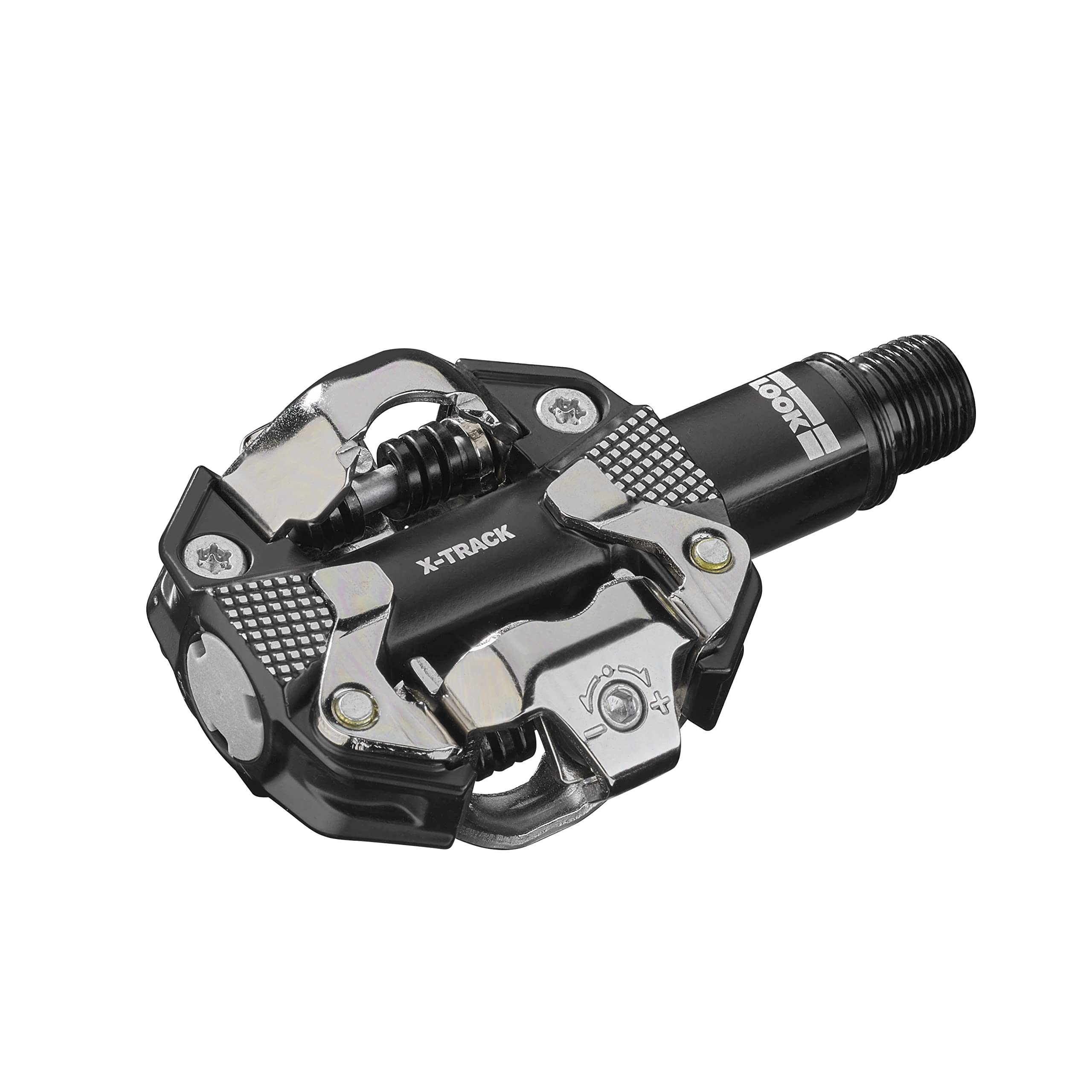
The X-Track is a Look pedal that takes Shimano SPD cleats, and that one fact is most of its case. If your shoes are already set up for SPD it bolts on with no new cleats to buy, and it puts a wider contact frame around the mechanism than a bare race pedal.
Look machines an aluminum body with contact area on both sides of the binding, so your foot has a landing pad even when the cleat has not caught yet. That is worth something on a slow, technical climb where you are half-pedalling and half-balancing. Tension adjusts with a screw, the thread is the standard 9/16 inch, and Look sells the pedal with either a standard cleat or an easy-release version for riders new to clipping in.
It is a narrower case than the top pick’s. The frame is smaller than the platform on the EH500 or the Mamba, so it is extra shoe contact rather than a true flat side, and it does not do anything the SPD pedals above do not. What it does is put a little more pedal under your foot for budget money, and on a long fire-road climb that is a real comfort.
Pros
- Takes standard Shimano SPD cleats
- Wider contact frame than a bare race pedal
- Adjustable tension and a two-year warranty
Cons
- 450 g listed is heavy for a race-shaped pedal
We keep the X-Track on this list for riders already on SPD cleats who want a wider landing pad than a bare race pedal offers.
How We Tested the Best MTB Clipless Pedals
We started by pulling together 10 pairs from brands we trust, filtering for mechanism type, platform size, bearing design, and price so the spread ran from budget-friendly to nicer builds. Each pair went on a tester’s own trail bike and stayed there for the full eight months—no swapping around mid-test.
Testing happened on local trails with rocky descents, muddy climbs, and rooty switchbacks, plus a few bike park days and a lot of wet spring rides. Every tester clipped in and out dozens of times per ride, noting whether the mechanism snapped cleanly or needed a second stab. We paid attention to how much float each pedal allowed and whether it felt stable or vague, spun the bearings by hand after every few rides to check for grind or play, and inspected the seals and body edges for wear after rock strikes and muddy days.
At the end of the eight months, we re-checked bearing smoothness, release tension, and play in the spindle. Pedals that still felt tight and released predictably got high marks; ones that developed a wobble or a mushy engagement didn’t. We also weighed each pair and compared ride feel against price to judge value. The best ones were the pairs we forgot about mid-ride—no creaks, no fussing, just consistent performance.
How to Choose Mtb Clipless Pedals
Three things decide which clipless pedal suits you: the cleats already on your shoes, how often your foot leaves the pedal mid-ride, and how much platform you want under your arch when the clip misses.
Start with your cleats, not the pedal
If your shoes already take a two-bolt SPD cleat, most of this guide is open to you: Shimano pedals and Look’s X-Track all run the SPD standard, and cleats are easy to find. Crankbrothers uses its own cleat, which comes in the box, and the two systems do not mix. Check the sole of your shoe first: two slots means SPD-family and any pedal here will work; three bolts means a road cleat, and none of these pedals take it.
Buy the pedal that matches shoes you already own, or budget for both at once. Changing systems later means new cleats on every pair of shoes you ride.
Dual-sided, single-sided, or a flat side
Entry speed is the difference you feel on every ride. Dual-sided pedals let you stab and go without looking; the Eggbeater adds two more faces on top of that. Single-sided designs put a flat platform on the other face for street shoes or a foot-out moment, but the wrong face is often up when you restart, and a toe-flick costs a second on a steep climb.
That is a fair trade for commuting, family rides and bikes with more than one rider, and a poor one for racing. If people who do not clip in ever ride your bike, a hybrid makes it shared property instead of a negotiation.
Tension, float, and mud
Every Shimano-style pedal here has a spring-tension screw, and it is the setting most riders never touch. Back it out for the first weeks so a panicked unclip actually works, then wind it in as the movement becomes automatic. Float is the other variable: SPD gives a modest amount of rotational movement, Crankbrothers noticeably more. Generous float is kind to knees and vague to riders who like a locked-in feel.
For clay, wet roots and cyclocross, favour a binding that stays open. A wide platform gives mud somewhere to pack; a four-sided cage has almost nothing to pack against.
Platform support, weight, and upkeep
A cage or platform around the mechanism gives your foot somewhere to sit when you are not clipped in, which matters on descents and in rock gardens. It costs weight: from around 280 grams a pair for the open race designs to the mid-400s for the caged pedals here. Upkeep runs the same way. Sealed cartridge bearings run quietly until they do not, and then a rebuild kit is the fix, or, on the Mamba, a minute with a grease gun.
Spin any pedal in your hand before you fit it. Roughness out of the box is a return, not a project.
Frequently Asked Questions
Do I need special shoes for clipless MTB pedals?
Yes, a shoe with a two-bolt recessed cleat. That recess is what lets you walk without clicking across a cafe floor, and it is the standard every pedal here except the Crankbrothers pair uses. Road shoes with three exposed bolts will not work. Check the sole before ordering, and check whether the pedals you want ship with cleats.
Can I ride these pedals in normal shoes?
Only on the ones with a flat side. The PD-EH500 and the Funn Mamba both give you a real platform for trainers. The race-shaped pedals, the PD-M520 and the Eggbeater included, have nothing to stand on and will be miserable in soft shoes. If the bike runs errands as well as trails, buy the hybrid.
Will these pedals fit my bike?
Almost certainly. Every pedal here uses the 9/16-inch crank thread that has been standard on mountain bikes for decades. The thing to get right is direction: the left pedal is reverse-threaded, so start it by hand and turn it counter-clockwise. If it fights you after a turn, stop and start again rather than forcing it.
Final Verdict
The Shimano PD-M520 is where most riders should start, and the reason is deliberately unexciting: two-sided SPD entry, a tension screw that meets a nervous beginner where they are, and almost nothing to go wrong. Spend more only for a specific job. The PD-EH500 is the one to fit if the same bike gets ridden in trainers, the Mallet E or the Funn Mamba if you spend real time unclipped on descents, and the Eggbeater if your races are muddy.
If none of those jobs is yours, the M520 is the answer, and it will still be the answer after the first scuff.