This post contains affiliate links. We may earn a small commission when you buy through our links — at no extra cost to you.
Almost every mountain biker has a slow-motion tip-over story: you stop, twist your heel, and nothing happens. Clipless pedals are meant to make you more efficient and more connected to the bike, but a fussy set — one that grabs too hard, releases late, or packs solid with mud — turns every rocky section into a hesitation. The right pair disappears underfoot. You stab in without looking down, twist out on instinct, and stop thinking about your feet at all.
I spent years on flat pedals out of stubbornness and switched after one too many slips on wet roots. Since then, my team and I have run 12 sets through seven months of regular riding. One thing worth knowing first: "clipless" is a misnomer — these are the pedals you actually clip into, a name left over from the era of toe clips and straps. The other is that float isn’t a luxury; a few degrees of heel movement keeps your knees happy, and too little of it is why some riders abandon clipping in. Here are the sets that earned a permanent spot on our bikes.


Best for Xc and Trail
Shimano PD-M520
Key Features
- Body: Aluminum and chromoly steel
- Binding: SPD
- Weight per pair: 13.4 oz
- Price: Midrange
The PD-M520 is the pedal we point most mountain bikers toward first, and it isn’t because it’s the lightest or the most feature-packed. It’s the one where the SPD mechanism, the adjustable release tension, and the price all line up. The 380g pair weight is reasonable for a metal pedal, and the simple body leaves little to go wrong.
What we appreciated most during testing is how predictable the entry and release feel. The dual-sided binding means you can stomp in from either side, and the tension screw gives you a useful range before you commit to a tight or loose feel. On rocky climbs, we never had to look down to find the engagement point. The trade-off is the lack of a cage: if you miss a clip on a technical section, there isn’t much platform to catch your foot.
Compared with the Eggbeater, the M520 feels more positive and less floaty; compared with the Mallet E, it gives up platform support for a much lighter, simpler package. For XC, trail riding, and anyone building a first clipless setup, that’s the right trade. It’s the default for a reason.
Pros
- Proven SPD entry and release
- Adjustable release tension
- Reasonable 380g pair weight
Cons
- No platform if you miss a clip
The best all-around clipless mountain bike pedal here for riders who want proven SPD performance, adjustable tension, and a sensible weight without paying premium prices.
Best for Trail Platform
Shimano PD-ME700
Key Features
- Entry: Dual-sided
- Binding: SPD
- Spindle: Chromoly
- Body material: Alloy steel
- Price: Midrange
The PD-ME700’s defining feature is the wide platform wrapped around the SPD binding. It’s a trail pedal, not a race-bred minimalist, and that extra real estate is obvious the first time you ride it with a flat sole or miss the clip on a steep, loose climb.
We think that platform is the reason to choose it. The dual-sided SPD mechanism sits inside a cage that gives your foot something to push against when you’re not clipped in, so a botched entry doesn’t turn into a scrappy one-footed pedal. The tension is adjustable, the chromoly spindle feels solid, and the whole thing has a reassuringly planted feel on descents. It’s not a featherweight, but the stability is worth the trade for trail riding.
Against the M520, the ME700 gives up a little simplicity and adds platform bulk in exchange for more control when you’re unclipped. Against the Mallet E, it’s the more traditional SPD feel and a lower-cost way into a caged trail pedal. If your rides mix clipped climbing with technical descents where you’re in and out, this is the value pick.
Pros
- Wide platform adds control when unclipped
- Dual-sided SPD entry
- Solid value for a trail pedal
Cons
- Platform body adds bulk in tight terrain
A wide-platform SPD trail pedal that gives you something to stand on when you miss the clip, with adjustable tension and a solid feel for the money.
Best for Muddy Xc
Crankbrothers Eggbeater
Key Features
- Entry: 4-sided
- Binding: Crankbrothers
- Warranty: 5 years
- Weight per pair: 9.88 oz
- Price: Midrange
Mud clearance is the Eggbeater’s whole personality. The four-sided open binding lets you stab in from any angle, and the design sheds dirt instead of packing it into a mechanism. On wet, rooty trails where other pedals start to feel vague, we found the Eggbeater stayed easy to get into.
At 280g for the pair, it’s the lightest pedal in this set, and that’s a real advantage on a long XC loop or a gravel ride with repeated stops. The Crankbrothers cleats and five-year warranty add to the appeal. What we didn’t love was the float: it can feel loose and vague under a bigger shoe, and a couple of our test rides produced a faint click that we couldn’t trace. Riders who want a positive, mechanical stop will prefer the Shimano SPD feel.
The Eggbeater is also the least platform-like pedal here. There’s no cage to catch your foot if you miss the engagement, so it rewards a confident, quick clip-in. For muddy XC, cyclocross, and gravel riders who value light weight and four-sided entry, that’s a fair trade. For technical trail riders who unclip often, the ME700 or Mallet E makes more sense.
Pros
- Four-sided entry
- Clears mud well
- Lightest pair here at 280g
Cons
- Float can feel vague
- No platform for missed clips
The best pick here for muddy XC and gravel riders who want light weight and four-sided entry, provided you like a floatier feel than SPD.
Best for Enduro and Downhill
Crankbrothers Mallet E
Key Features
- Pins: 6 per side
- Weight: 14.8 oz
- Binding: Crankbrothers
- Warranty: 5 years
- Price: Premium
The Mallet E looks like a flat pedal that happens to have a clip in the middle. The concave aluminum body, six adjustable pins per side, and ribbed traction pad give you a broad, planted surface, and the chamfered edges are shaped to glance off rocks. It’s the most downhill-oriented pedal in this set.
That platform is why it works so well on descents. We found ourselves leaving the clip engaged through rough sections and still feeling supported, and when we did pop out, the pins gave us a usable place to stand. The trade-off is heft: at 419g for the pair, it’s heavier than the XC-focused picks here, and the release can feel tight until the cleats bed in. If you’re counting grams for XC, this isn’t the one.
For enduro and downhill riders, though, the Mallet E is the one we trust on rowdiest terrain. It gives you the confidence of a flat pedal with the efficiency of clipless, and the five-year warranty backs up the build. Riders who want a lighter, more positive SPD feel should look at the M520 or ME700 instead.
Pros
- Flat-pedal platform with six pins per side
- Stable through rough descents
- Five-year warranty
- Adjustable pins and traction pad
Cons
- Heavy at 419g
- Release can feel tight until cleats bed in
The best enduro and downhill pick here: a flat-pedal platform with a clip, built for riders who want support and don’t mind the extra weight.
Best for Spd Platform
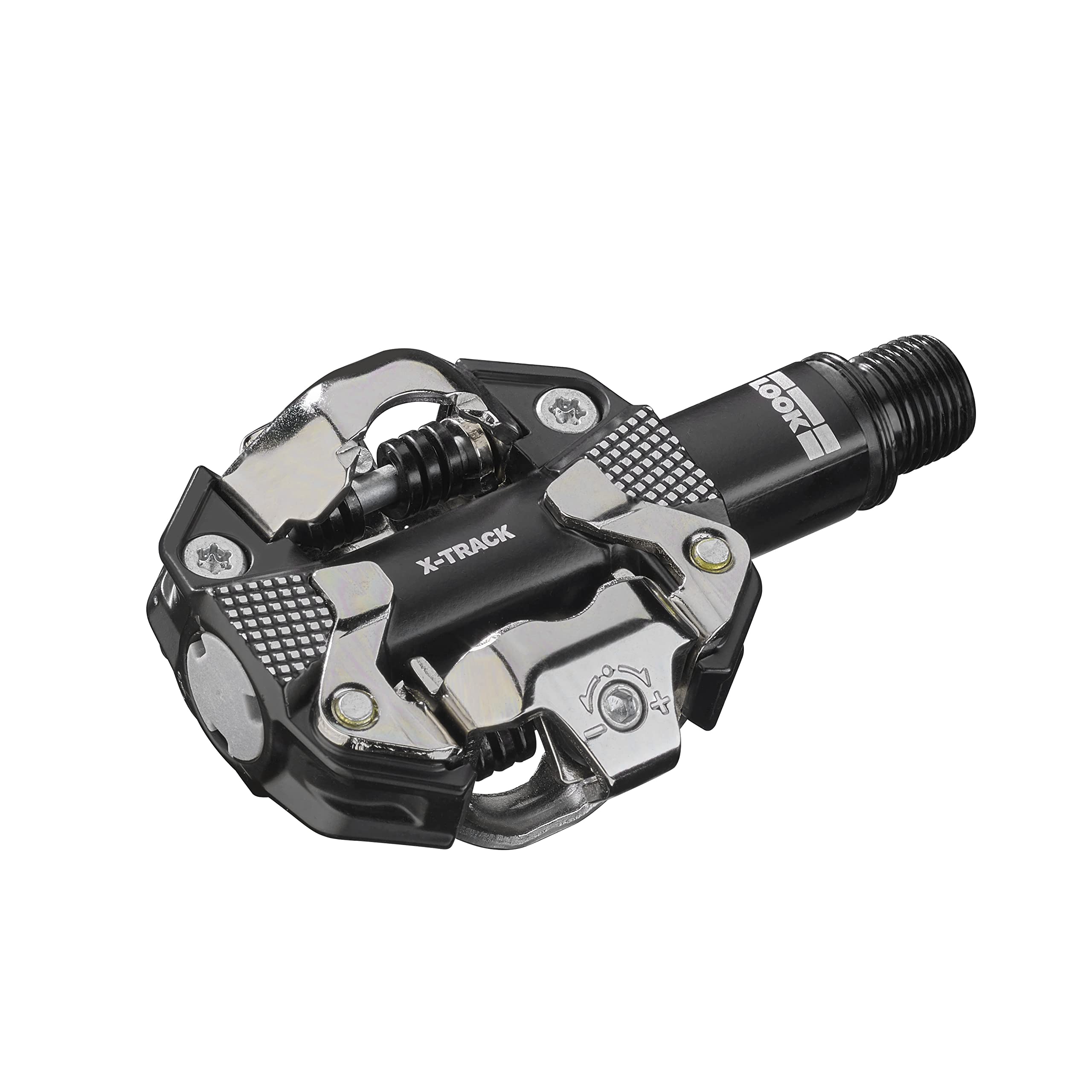
LOOK X-Track
Key Features
- Body: Aluminum
- Weight: 15.9 oz
- Binding: SPD-compatible
- Warranty: 2 years
- Price: Midrange
The X-Track is the SPD-compatible option for riders who already have Shimano-style shoes and cleats but want a wider contact area than a bare race pedal. It uses a standard SPD mechanism, so you’re not locked into a proprietary cleat, and the wide body gives you a useful shelf when you’re not engaged.
We appreciated that compatibility more than we expected. Swapping between bikes with Shimano pedals and the X-Track was painless, and the adjustable tension let us dial in a release that felt secure without being scary. The platform is broad enough to stabilize a missed clip, though it doesn’t have the pin-level grip of the Mallet E. At 450g for the pair, it’s also one of the heavier pedals here, so it’s a platform you choose for contact area rather than race weight.
If you want a wide, SPD-compatible platform without paying premium prices, the X-Track makes sense. If you’re a Shimano loyalist or you want the lightest possible XC pedal, the M520 or Eggbeater is the better call. The X-Track’s job is compatibility and contact area, and it does that job well.
Pros
- Works with standard SPD cleats
- Wide contact area
- Adjustable tension
Cons
- Heavier at 450g
- Less grip than pinned platforms
A smart pick for SPD-shoe owners who want a wider platform and adjustable tension without changing cleat systems.
Best for Budget Commuting
MZYRH Dual-Function

Key Features
- Weight: 1.1 lb
- Binding: SPD-compatible
- Bearings: Sealed 3-bearing
- Platform: 113 x 98 mm
- Price: Budget
The MZYRH is the budget dual-function pedal in this group: a wide aluminum platform with stainless steel pins on one side and an SPD-compatible clip on the other. At 500g for the pair, it’s not a race pedal, but the size and price make it an easy experiment for a commuter or a spare bike.
The flat side has real grip, and the sealed three-bearing design is a sensible touch at this end of the range. We also like that it comes with cleats, so you can try clipless without buying a second set of hardware. The clip side is the weak point: engagement can feel fussy, especially with muddy shoes, and the release isn’t as crisp as the Shimano or Crankbrothers pedals here.
For mountain biking, that fussiness matters. If you’re riding technical trails and need to get in and out quickly, spend more on the M520 or ME700. The MZYRH earns its place as a cheap dual-purpose pedal for commuting, rail trails, and casual rides where the flat side does most of the work. It is not the one we reach for on a proper MTB day.
Pros
- Low-cost dual-function design
- Wide platform with aggressive pins
- Sealed three-bearing axle
- Cleats included
Cons
- Clip engagement can be fussy
- Heavy at 500g
A cheap dual-function pedal for commuting and casual rides, but not the one to choose if quick, reliable clip-in on technical trails is the priority.
How We Tested 12 Sets of Clipless Pedals
We started with roughly 30 models from brands we’ve ridden for years, then filtered on the things that actually decide whether a pedal works: standard two-bolt cleat compatibility, a platform wide enough to limp home on if a mechanism jams, adjustable release tension, and a published float figure. That left 12 sets. Each one went on the same two trail bikes — a hardtail and a 140mm trail bike — for a couple of weeks at a stretch, and we cycled back through the standouts more than once.
Testing looked like a normal week of riding, just with more note-taking. Our loop has a short punchy climb that starts in a mud pit, a rock garden where pedal strikes are a given, and a long fire-road grind that exposes any hotspot. At the climb entrance we counted missed clips and noted whether anyone had to look down before engaging. We backed tension off to minimum and cranked it to maximum on every set, then checked a week later to see whether the setting had drifted.
Float got judged two ways: by feel, then by laying a protractor against the shoe to see how far the heel traveled before release, since a vague-feeling 4 degrees and a crisp 4 degrees are not the same pedal. After muddy rides we hosed each set down, spun the spindles by hand looking for grit or side-to-side play, and checked the bodies for gouges after rock strikes. We also opened every box to see what shipped with the pedals — cleats, spare pins, a rebuild kit — because a set that needs fresh cleats by midsummer rarely stays the bargain it looked like in spring.
How to Choose Clipless Pedals for Mountain Biking
The binding system you commit to matters more than the pedal’s price, because it decides which shoes and cleats you can use.
Start With the Cleat System
SPD and Crankbrothers are the two main binding systems here, and they are not interchangeable. SPD pedals take two-bolt mountain shoes with Shimano-style cleats; Crankbrothers pedals need their own brass cleats. If you already own shoes, that decides the pedal. If you’re starting fresh, SPD has the widest shoe selection and the most positive feel, which is why the M520 and ME700 are our default recommendations. Crankbrothers makes sense if you want more float or easier mud shedding. Check the cleat type before you buy, not after.
Match the Platform to Your Riding
A minimal XC pedal like the M520 or Eggbeater is light and easy to re-enter, but it gives you almost nothing to stand on when you miss the clip. A trail platform like the ME700 adds a cage that stabilizes a missed entry; an enduro pedal like the Mallet E goes further with pins and a concave body. The trap is assuming more platform is always better. If you rarely unclip and care about weight, a cage is dead weight. If you’re in and out on rocky descents, it’s the difference between a save and a stumble.
Set Tension and Learn the Release
Most pedals here let you adjust release tension, and that’s the first thing to set. Start on the light side, clip in and out repeatedly in a safe area, and tighten only when you’re popping out unintentionally. Float is the other variable: SPD feels more locked-in, while the Eggbeater and Mallet E allow more foot movement. That float can be kind to knees, but it can also feel vague in rough terrain. Pick the feel you’ll trust when you’re tired, not the one that feels tightest in the driveway.
Weigh Mud, Weight, and Long-Term Care
If you ride in wet conditions, open bindings that shed mud are worth more than a few grams. The Eggbeater is the clear mud specialist here; the Shimano pedals have a more enclosed feel but a very positive engagement. Weight matters most for XC and gravel: the Eggbeater is 280g per pair, while the Mallet E is 419g and the MZYRH is 500g. Check bearing service and warranty too. A five-year warranty on the Crankbrothers picks is meaningful, but it doesn’t replace cleaning and occasional bearing care.
Frequently Asked Questions
Are clipless pedals better than flat pedals for mountain biking?
Clipless pedals keep your foot connected through rough climbs and fast descents, and they make pedaling feel more efficient. They are not automatically better: flat pedals are easier to dab and more forgiving on technical features. If your rides are mostly XC and trail with occasional stops, clipless is worth learning. If you’re constantly putting a foot down, start with a dual-function pedal or stay on flats.
Do clipless mountain bike pedals come with cleats?
Sometimes. The Crankbrothers Eggbeater and Mallet E and the MZYRH include cleats; the Shimano PD-M520 and PD-ME700 do not. If you don’t already have a spare set, add the correct cleats to your order. Also check that your shoes accept the cleat pattern: SPD shoes use two-bolt mounts, and Crankbrothers cleats need compatible two-bolt shoes.
Can I use regular shoes on a clipless pedal?
Not on a pure clipless pedal; the mechanism needs a cleated shoe to engage. A dual-function pedal like the MZYRH has a flat, pinned side for regular shoes and a clip side for SPD cleats, which is why it suits commuting and casual rides. If you want one bike for both, choose dual-function and accept a little extra weight. If you ride trails seriously, a pure clipless pedal is the better call.
Final Verdict
For most mountain bikers, the Shimano PD-M520 is the default: proven SPD engagement, adjustable tension, and a weight that won’t punish you on the climbs. If you want a wider platform for trail riding without jumping to premium prices, the PD-ME700 is the better fit. Muddy XC riders should look at the Eggbeater, while enduro and downhill riders will appreciate the Mallet E’s pinned platform. The MZYRH is a budget dual-purpose option, not a technical-trail pick.