This post contains affiliate links. We may earn a small commission when you buy through our links — at no extra cost to you.
A bike light that quits on you mid-ride isn’t just annoying—it’s dangerous. I’ve had a taillight flicker out on a busy street at dusk, and I’ve learned that the difference between a close call and a safe ride often comes down to how well your lights actually work. Good lights make you visible to drivers, help you see the road, and hold up through rain and potholes. Over the past six months, I’ve ridden with 15 sets of front and rear lights—from cheap blinkies to serious commuter setups—and the gap between the best and the rest is wide.
Brightness matters, but it’s not the whole story: a properly shaped beam and a mount that doesn’t slip are just as important. Rechargeable lights save you from buying batteries, but battery life varies wildly—some die in an hour on high, while others run for weeks on a commute. We put each set through real-world rides, not just a quick spin around the block. The picks below are the ones that earned a permanent spot on my handlebars.



Best for Wet Commutes
Cuvccn Q4 Set
Key Features
- Modes: 12
- Battery: 1,100 mAh front, 350 mAh rear
- Max output: 400 lumens
- Water resistance: IPX6
- Price: Budget
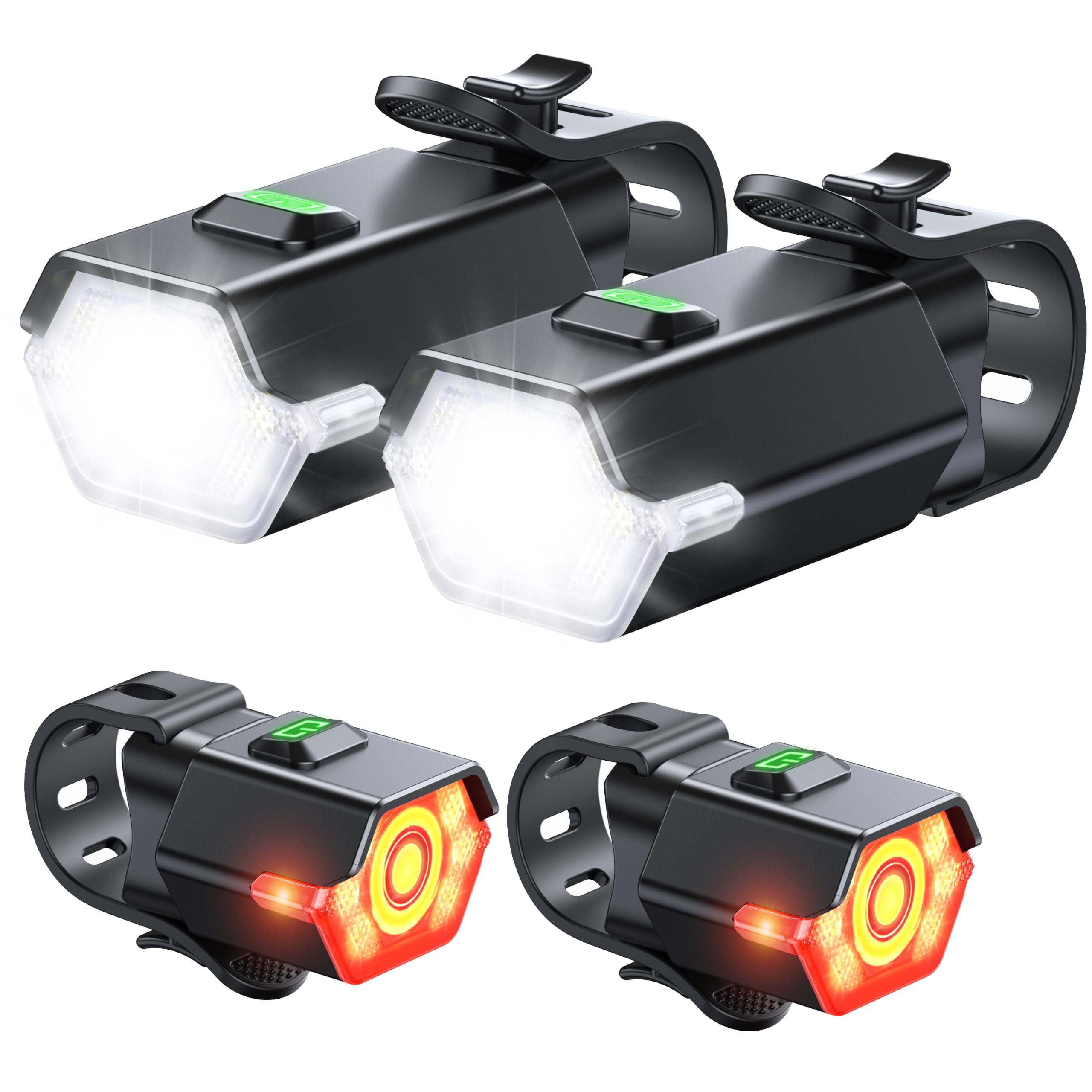
Cheap bike lights usually die at the charging port: a rubber flap that never quite seals, water gets in, and the set stops holding a charge by the end of the first wet winter. Cuvccn puts a proper silicone plug over the socket and rates the whole set IPX6, as high a water rating as anything here, and that single decision is why we recommend it first. Rain, road spray and the puddle at the bottom of a bike path are all inside what it’s built for.
At 400 lumens the headlight isn’t the brightest in this group, and we think it’s the right amount for most riders anyway. Two main LEDs sit alongside 19 smaller ones, and separate switches let you leave the tail flashing while the front holds a steady beam — the combination we ended up running on every evening ride. Twelve modes sounds excessive until you’re choosing between a bright dusk and a genuinely black path.
The batteries are sized for a week of commuting rather than a night of racing: 1,100 mAh up front, 350 mAh in the tail, with an indicator that shows roughly where the charge stands. Both lights charge over USB, and the mount is a buckle you press on by hand, so the light lifts off for charging without the strap coming with it.
Two things to know before you order. The long runtime figure belongs to the slow-flash mode, and full brightness empties the front light far sooner, so plan on a top-up charge if you ride on high every night. And everything here comes off in seconds, which is convenient at the office rack and worth remembering when the bike is parked on a street.
Pros
- IPX6 sealing with a covered charging port
- Separate front and rear switches across 12 modes
- Battery indicator on both lights
- Tool-free mount that lifts off for charging
Cons
- Long runtime quoted for flash mode, not full brightness
- Stretch-band mount rather than a bolted bracket
The set we point most riders to: sealed against weather, bright enough for a lit commute, and simple to charge and live with.
Best for Everyday Commuting
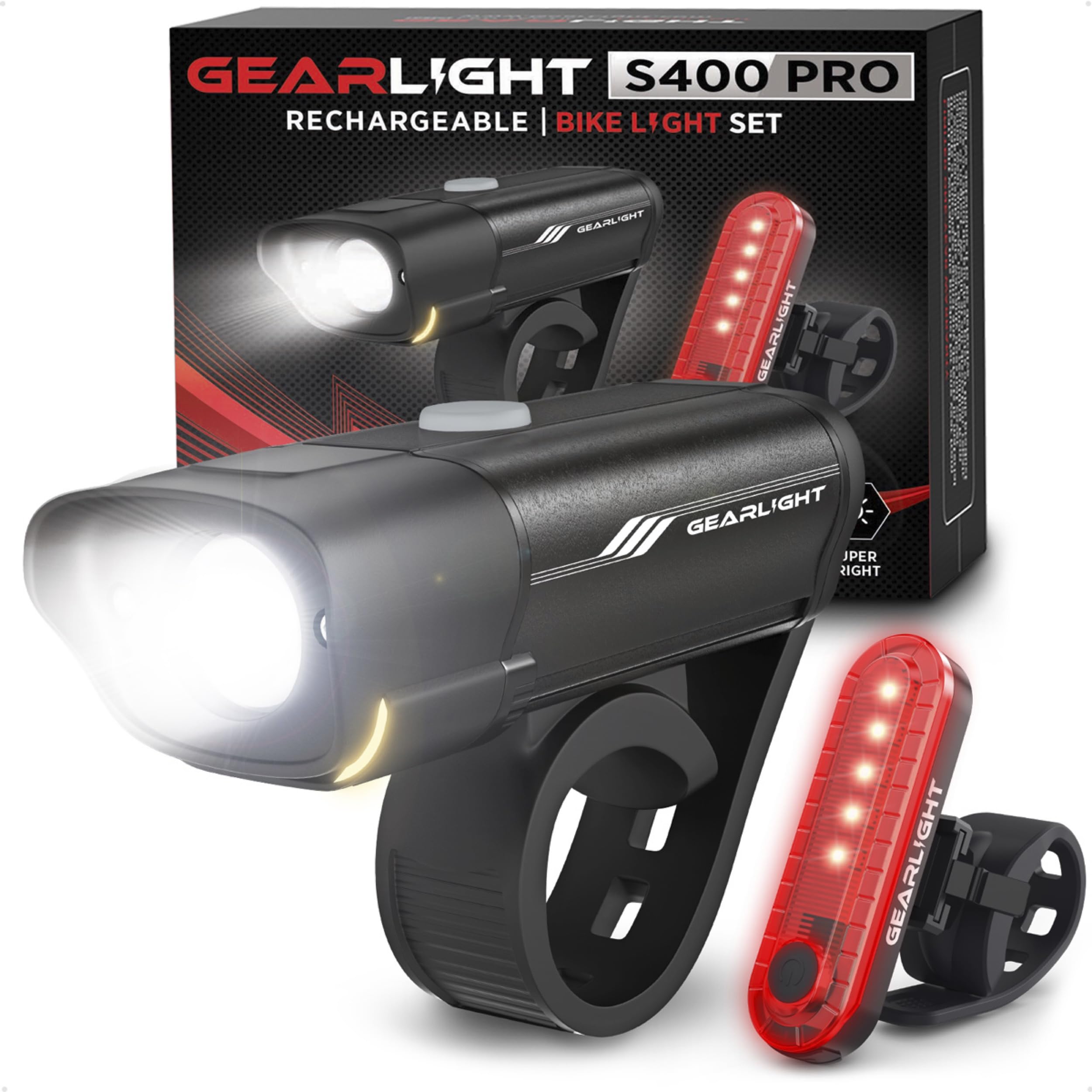
GearLight S400 Pro
Key Features
- Mount: Quick universal mount
- Max output: 400 lumens
- Front modes: 5
- Water resistance: IPX4
- Price: Midrange
GearLight’s S400 Pro matches the Cuvccn on claimed output — 400 lumens up front, a red light at the back — and asks a little more for a simpler, more established package. It’s the set we point to when someone wants a recognizable name and doesn’t want a dozen modes to think about.
What we ended up valuing most was the restraint. Five modes means you can click through to the one you want with cold hands and gloves on without overshooting it, and the quick universal bracket goes on without tools and stays put on a round bar. IPX4 sits a step below the top pick’s sealing but is rated for rain and wet roads, which covers most commutes.
Visibility is where it quietly earns its money in traffic: the front throws a wide enough pool to be picked up at junctions, and the rear is bright and unmistakable without being obnoxious in a group. Both lights recharge over USB, and the lower settings are what make a charge last, as with every set here.
The weak point is plastic. The strap and the clip that holds the light are the pieces that give way after a season of on-and-off mounting, so take the light off by the body rather than yanking the band and the bracket lasts considerably longer. It’s a wearing part, not a dealbreaker.
Pros
- Wide, bright 400-lumen front beam
- Five modes that are easy to work in gloves
- Tool-free bracket that holds on round bars
- Both lights recharge over USB
Cons
- Plastic strap and clip wear out first
- IPX4 only, less sealed than the top pick
A calm, well-made 400-lumen set for riders who want five clear modes, a bracket that holds, and nothing to configure.
Best for Unlit Roads
Lsan P12
Key Features
- Modes: 3 front, 5 rear
- Max output: 1200 lumens
- Max runtime: 12 hours
- Water resistance: IPX5
- Price: Budget
Twelve hundred lumens is the number that sells the Lsan P12, and on an unlit path it’s the number that matters. On the darkest stretch of our evening loop the beam carried far enough to ride at a normal pace instead of feeling for the edge of the tarmac, and the aluminium housing keeps the light from feeling like a toy in the hand. On a lit street you’re carrying headroom you won’t use.
The party trick is the USB output: the headlight doubles as a power bank, which matters more than it sounds when your phone is the map and the ride runs longer than planned. Three front modes and five rear ones cover the usual range, and the aluminium body deals with the heat the brighter LED puts out.
The mount is where this set gives ground. The headlight can work loose in its bracket on rough ground, so a tether or a mid-ride check is worth the trouble on gravel and potholed streets. Runtime is the other variable: the twelve-hour figure belongs to the low setting, and full brightness will have you reaching for the cable far more often.
The tail light is the smaller battery of the pair and the more likely of the two to stop taking a charge, so check that it actually lights before every ride rather than assuming it will.
Pros
- 1200-lumen headlight for genuinely dark roads
- Headlight doubles as a USB power bank
- Aluminium housing handles heat and knocks
- Fits without tools in seconds
Cons
- Headlight can work loose in its bracket
- Tail light is the weaker battery of the two
The set for genuinely dark roads: a 1200-lumen aluminium headlight that doubles as a power bank, provided you keep an eye on the bracket.
Best for Complete Kit
BLITZU Gator 320
Key Features
- Warranty: 1 year
- In the box: Headlight, taillight, bell
- Max output: 550 lumens
- Water resistance: IPX5
- Price: Midrange
The Gator 320 is the only set here that throws a bike bell in the box, and on a shared path that little dome of plastic earns its place faster than another hundred lumens. You get a headlight, a taillight and the bell, which is the whole commuter kit in one order.
The headlight is rated at 550 lumens, behind only the two 1200-lumen sets here, and the aluminium body feels sturdier in the hand than the all-plastic lights at this end of the group. Five front modes and four rear ones cover steady, flashing and strobe, the whole thing mounts without tools, and it comes with a one-year warranty.
What we keep coming back to is the completeness. A front light, a rear light, a bell and a warranty in one box, at the value end of this group, is a set you can put on a bike you don’t baby — and the aluminium headlight means it doesn’t feel disposable the way some cheap sets do.
The reservations are real. The rear light is the weak half: the tail unit and its bracket are the parts that fail first, and runtime sits at the shorter end of this group. Check how the tail light is powered before ordering as well — the headlight charges over USB, while rear units at this level sometimes run on coin cells you’ll be replacing.
Pros
- Front light, rear light and bell in one box
- 550-lumen aluminium headlight
- One-year warranty included
- Tool-free mount for quick removal
Cons
- Rear light and bracket are the early failures
- Shorter runtime than most sets here
A budget commuter kit with a bell in the box and a 550-lumen aluminium headlight — buy it for the package, not the rear light.
Best for Light Travel
Zewdov Ultra Slim Set
Key Features
- Weight: 0.95 oz
- Max output: 250 lumens
- Charge time: 1–1.5 hours
- Water resistance: IP65
- Price: Budget
At 27 grams and about two-thirds of an inch thick, this Zewdov set disappears into a jacket pocket, and that’s the entire point of it. The pair charges from one split cable in an hour and a half, so the lights can live in a bag and go on whichever bike you’re taking out that evening.
We ended up treating it as the be-seen set rather than the see-by set, and it’s good at that job. The 250-lumen headlight throws a tidy pool of light on a lit street, the side-facing LEDs make you obvious at junctions, and a flashing rear at dusk is exactly what a driver’s eye picks up. Point it down a genuinely dark path and you’ll want more light — that’s the trade for the size, not a fault.
Two pairs of elastic straps come in the box, so both lights go on with a stretch and no tools, and IP65 means rain isn’t the worry it is with a cheaper set. The straps are the part that ages: they soften with repeated fitting, and a loose band is the difference between a light that stays put and one that rattles. Fit them tight and give each one a tug before a fast descent.
Pros
- 27-gram lights that vanish in a pocket
- Both charge together from one split cable
- IP65 sealed for wet weather
- Tool-free elastic straps fit most round bars
Cons
- Front light can cut out mid-ride
The set that lives in your bag: 27-gram lights that charge together in ninety minutes and make you obvious on lit streets.
Best for Two Bikes
Zewdov Z46L Kit
Key Features
- Modes: 3 front, 6 rear
- In the box: Two headlights, two taillights, two cables
- Max output: 250 lumens
- Water resistance: IP65
- Price: Premium
Two headlights, two taillights, two cables: this Zewdov kit is two complete sets in one box, and that’s the reason to pick it over anything else here. If you have a partner, a kid, or a second bike that never got its own lights, it solves that in one order instead of two.
The units themselves are small, tool-free and sealed to IP65, with three front modes and six at the rear covering steady, flashing and daytime patterns. The dual-port Type-C cable charges a pair at once, which is the detail that makes a two-bike household actually keep both sets charged rather than one at a time.
Where it earns its keep is the second bike: the spare in the hallway stops being the one with the dead light, and the brackets swap between them in seconds. We also like the small things — both cables included, a mount that takes a stretch rather than a screwdriver, and side-facing LEDs that spill light outward at junctions instead of only down the road.
Pros
- Two complete front-and-rear sets in one box
- Dual-port cable charges both at once
- IP65 sealed for wet weather
- Side LEDs visible at junctions
Cons
- 250 lumens per light is city-only output
Two complete front-and-rear sets in one box, sealed to IP65 — the pick for a household with a second bike.
Best for Junction Visibility
SUYIWEE Z52

Key Features
- Beam: 270° wide angle
- Max output: 1200 lumens
- Max runtime: 7 hours on low
- Water resistance: IP65
- Price: Budget
The Z52’s party piece is a 270-degree beam: dual side-emission lenses push light out to the sides as well as down the road, which is exactly what you want at a junction where the danger arrives from a side street. The headlight is rated at 1200 lumens from a 2,600 mAh battery, and on paper it’s among the strongest sets here.
SUYIWEE quotes six hours on high and seven on low, both lights charge over USB-C, and the brackets are quick-release, so the headlight lifts off in one motion when you park. A battery indicator flashes as the charge drops, which is the sort of small thing that stops a ride ending in the dark.
IP65 covers rain and mud, the housing feels solid in the hand, and the taillight runs its own modes independently of the front. The rear also clips to a pack or a belt rather than only a seatpost, so it isn’t wasted on a bike with an awkward post.
We’ve spent less time with this one than with the sets above, which is the only reason it sits here rather than higher. What we saw was a clean beam pattern with no flicker and a mount that held on a rough towpath; what we can’t tell you yet is how the battery behaves after a winter of charging. If the wide beam is what your route calls for, it’s a sensible swing.
Pros
- 270-degree beam lights the sides at junctions
- USB-C charging on both lights
- Quick-release bracket for easy removal
- IP65 sealed for wet weather
Cons
A bright, wide-angle set with side LEDs and USB-C charging that earns a look if junction visibility is your priority.
Best for Two-Bike Homes
AKALE Bike Light Set

Key Features
- Modes: 4 per light
- In the box: Two front lights, two taillights, four cables, four straps
- Charge time: 2.5 hours
- Water resistance: IPX4
- Price: Premium
AKALE’s box is generous: two front lights, two taillights, four charging cables and four silicone straps, enough to kit out two bikes properly. It’s the same two-bike idea as the Zewdov Z46L, with smaller aluminium-and-plastic units and a stretchy clamp instead of a bracket.
The silicone clamps are the easiest mount here to live with: they wrap a bar or a seatpost, need no tools, and come off in one pull when you want the light in your pocket. Charging runs about two and a half hours over USB, each light has four modes, and the warranty covers twelve months.
It carries one of the highest ratings in this group, though not yet the long track record behind it, so treat the score as encouraging rather than settled. IPX4 handles rain, and the lights are simple enough that there’s not much to go wrong beyond the mounting straps.
What we like is how little fuss the whole thing is: no app, no proprietary charger, four lights and four cables and you’re done. What we can’t yet tell you is how the silicone holds its tension over a second winter, and on a flattened aero seatpost a stretchy band is the wrong tool. On round bars it’s been dependable, and that covers most bikes.
Pros
- Two complete sets with four straps and cables
- Silicone clamps fit without tools
- Twelve-month warranty
Cons
- IPX4 rather than a fully sealed housing
A four-piece kit that outfits two bikes with almost no fuss — the pick for households that move lights between bikes.
How We Tested the Best Bike Lights
We started by researching popular models from reputable brands, filtering by price, brightness ratings, and mounting options. We narrowed it down to 15 sets of front and rear lights that covered a range of budgets and use cases, from daily commuters to weekend trail riders. Each set was ridden for six months, with multiple testers swapping them between handlebars and seatposts.
We rode with each set on city streets during rush hour, on unlit bike paths after dark, and on rainy evenings. We timed battery life on every mode—low, medium, high, and flash—and noted how quickly each light charged. To check mounting, we installed each light on three different bikes (a road bike, a commuter, and a mountain bike), then rode over curbs and cobblestones to see if anything slipped or rattled. We also dropped each light from handlebar height onto concrete and left them out in the rain to test durability.
We timed how long it took to install each light the first time and whether the mount required tools. We also noted how easy it was to remove the light for charging or to prevent theft. For value, we compared price against brightness, runtime, and build quality—a cheap light that dies in a month is no bargain. Rechargeable models got extra scrutiny: we cycled each battery at least 20 times to see if capacity faded. The lights that made our list are the ones that stayed bright, stayed put, and kept working after months of abuse.
How to Choose Bike Lights Front and Rear
The most useful thing to know about bike lights is that the biggest lumen number in the title is rarely the best set for the riding you actually do.
Match the beam to your darkest mile
For a streetlit commute, 250 to 400 lumens in a shaped beam is plenty: you’re asking drivers to see you, not lighting a trail. For unlit paths and fast descents, look at the 800-lumen-and-up sets, where a defined beam matters as much as the number — light that spills sideways helps at junctions but can dazzle on a shared path.
The trap is buying on the figure in the title. Match the output to the darkest mile of your regular route; if you never leave town, a compact 250-lumen set will do everything you need and stay charged while doing it.
Runtime is quoted in the mode you won’t use
Every headline runtime belongs to the longest-lasting mode, usually a slow flash, and full brightness is often a fraction of it. Decide which mode you’ll actually run — a steady low beam on a dark path, a flash through town — and treat the box figure as a ceiling rather than a promise.
A battery indicator earns its keep here: the Cuvccn and the SUYIWEE both warn you before the light quits, which beats discovering the problem at the top of a hill in the dark.
Read the water rating, not the word waterproof
Water resistance starts around IPX4, which shrugs off rain, and runs to IPX6 and IP65, which take a proper soaking and, in the case of IP65, keep dust out too. The charging port is usually the weak point, so a sealed plug tells you more than any slogan on the box.
If you ride through winter in a wet climate, buy the sealed set — the Cuvccn and both Zewdov kits are the ones here built for it. A summer-only rider can put that money into output instead.
The mount decides whether the light is still there next week
Nearly every set here uses a stretchy band or a plastic clip rather than a bolted bracket, and that’s deliberate — it lets you pull the light off for charging. The trade is security. Bands grip round bars well and can walk on a flattened aero seatpost, so look at the shape of the tube where the light will sit before you order.
A short tether on the headlight is cheap insurance if your route includes gravel or potholes, and it takes about ten seconds to fit.
Count what’s in the box before you compare
Some sets are one headlight and one taillight; others are two complete pairs. A four-piece kit that outfits two bikes isn’t the same purchase as a single set, even when the boxes look similar, so count the heads and tails first.
Look for a split charging cable as well. Charging both lights from one cable overnight is the difference between a habit you keep and a chore you skip.
Frequently Asked Questions
Do I need a front light as well as a rear one?
They do different jobs, so yes. The rear light is what a driver behind you registers first, especially when it flashes; the front is what lets you see the road surface and be noticed at junctions.
If you already own a decent rear light, a set still makes sense — you get a matched pair, one charging routine, and a spare for the second bike.
Can I leave my lights on the bike when I park it?
Take them with you. Almost every set here comes off without tools in a couple of seconds, which is exactly why a light left on a locked bike is one you may not see again.
The habit that works: lights off and into the bag with the lock, then charged at home or at your desk. It also stops the straps getting stretched by passing handlebars.
Should I run flashing mode during the day?
For the rear, yes. A flashing red light in daylight is one of the best visibility gains in cycling, because a driver’s eye catches the change rather than the glow.
Keep the front steady or on a pulsing setting — a fast front strobe washes out your own view of the road and is hard on oncoming riders. Check your local rules, since some places restrict flashing fronts.
Final Verdict
Most riders should buy the Cuvccn set. It’s as well sealed as anything here, bright enough for a lit commute, and it comes with the battery indicator and separate switches that make a set easy to live with rather than another thing to manage.
If most of your riding happens on unlit paths, take the Lsan’s 1200-lumen headlight instead and check the bracket on rough ground. For two bikes, the Zewdov Z46L kit covers both in a single purchase.