This post contains affiliate links. We may earn a small commission when you buy through our links — at no extra cost to you.
A bike helmet only protects you if you actually put it on, and the reason most end up gathering dust usually comes down to fit and appearance. I’ve ridden in plenty that pinched at the temples, sat crooked no matter how I adjusted them, or made me feel like a mushroom. The right one disappears on your head, adjusts with one hand, and looks good enough that you don’t mind being seen in it.
Over the past six months, my team and I have tested 14 men’s bike helmets on commutes, weekend road rides, and a few muddy trail loops. We focused on what you can’t tell from a spec sheet: whether the dial tightens evenly, how the straps sit against your ears, and whether the padding stays put after a sweaty hour. The best ones are light enough to forget, snug without squeezing, and priced fairly for what you get. The picks below range from budget-friendly to invest-in-it, but each earned its place after weeks of real riding—and held up without loose straps or frayed padding.


Best for All-Round Riding
OutdoorMaster Gem MIPS
Key Features
- Size: Medium
- Vents: 25
- Weight: 14.1 oz
- Rotational protection: MIPS
- Price: Midrange
Two sets of liners come in the box, one around a quarter-inch thick and one closer to a third of an inch, and that pair of foam strips does more for the fit than the dial does. Put the thicker set in and the shell stops swimming around your temples, so the retention wheel only has to fine-tune instead of clamping the back of your skull. On the product page it reads as a spare part; in practice it was the first thing we reached for.
MIPS is the other half of the decision. It’s the liner that does the rotational work in an angled fall, and having it here at mid-range money is what pushes this helmet ahead of the cheaper shells in this set. Add the mesh screen across the front openings and a visor that comes off when you want a cleaner profile on the road, and you have one helmet covering trail, commute and weekend riding without a second purchase.
At 399 grams it is one of the heavier shells in this group, which you notice at the end of a long road ride more than on a two-hour trail loop where the coverage earns its keep. The listed size is Medium and only Medium, so measure your head before you order — the liners buy a little room, not a lot.
For a man buying one helmet to cover commuting, weekend trails and the occasional long ride, this is where we point first. The liner swap solves the fit problem that sends most people back to the returns desk, the ventilation is real rather than decorative, and the rotational liner is there without premium money attached. Road riders chasing airflow and e-bike commuters who want built-in lights have better answers further down this list.
Pros
- MIPS rotational liner at a mid-range price
- Two liner thicknesses fine-tune the fit
- 25 vents with a front bug screen
- Removable visor for road use
Cons
- 399 g is heavy for a road helmet
- Listed in a single Medium size
This is the helmet we recommend to most men: MIPS protection, 25 vents and a two-liner fit system that handles a range of head shapes at a mid-range price.
Best for City Commuting
Findway Pro
Key Features
- Shell: ABS over EPS
- Vents: 14
- Weight: 1.48 lb
- Fit range: 54-61.5 cm
- Price: Budget
A small ring at the back of the Findway pulls out far enough to thread a cable lock through, which means the helmet can stay with the bike instead of riding in your bag all afternoon. It’s a tiny piece of plastic, and it’s the reason we kept this one in the roundup rather than writing it off as the cheap option: someone who locks a bike up every day designed it.
Everything else is sensible rather than exciting. An ABS shell over EPS foam, 14 vents, a dial at the back and straps that adjust at the ears and under the chin. The fit range runs 54 to 61.5 cm, which covers most adult men without a fight, and the urban shape sits closer to a rounded city lid than to the teardrop road helmets here — good for upright riding, less so if you spend your weekends in the drops.
Fourteen vents and a 0.67 kg shell make this the warm one on a still afternoon, and there’s no rotational liner at this price. What we appreciate is that the savings don’t show up in the parts you touch: the dial turns with a firm click, the buckle feels solid rather than brittle, and the padding sits where your forehead meets the shell. For a helmet that lives on a rack outside a shop or a station, that’s the right set of compromises.
Pros
- Hidden ring takes a cable lock
- 54-61.5 cm fit range
- Dial, ear and chin adjustment all present
- Solid adjusters and padding for the money
Cons
- 14 vents run warm in still air
- No rotational-impact liner
We point budget-minded commuters here: a wide fit range, a lock-through ring and adjusters that don’t feel like the cheap part.
Best for Night Riding
VICTGOAL HT-23
Key Features
- Vents: 21
- Weight: 10.9 oz
- Fit range: 57-61 cm (size L)
- Rear light: USB, 3 modes
- Price: Midrange
The magnetic goggles are what make the HT-23 worth a second look. They snap onto the shell in front of the visor, fit over a pair of glasses, and come off with one hand at a red light — a much better answer to wind, grit and low sun than sunglasses sliding down your nose.
The rear light is the other half of the pitch. It’s USB rechargeable with steady, fast-flash and slow-flash modes and sits high enough on the shell to stay visible over a jacket collar, so it’s one less thing to clip on and charge separately. The visor itself is short: it shades your eyes but it won’t replace sunglasses, so the goggles are doing the real work.
At 21 vents and 10.88 ounces it stays cool and light enough for a summer commute, and the three-size run — medium at 54-58 cm, large at 57-61 cm — means you need your measurement before you order rather than assuming one shell covers everyone. It’s the helmet we hand anyone who rides at dusk or in traffic, and the goggles and light together do more for real-world visibility than a couple of extra vents would.
Pros
- Magnetic goggles fit over glasses
- Rechargeable rear light with three modes
- Light shell with 21 vents
- Three shell sizes with stated ranges
Cons
- No rotational-impact liner
Buy this if you ride after dark: magnetic goggles, a rechargeable rear light and three shell sizes make it the best night-riding helmet here.
Best for Trail Riding
Giro Fixture MIPS II
Key Features
- Fit range: 54-61 cm
- Fit system: Roc Loc Sport
- Reflective trim: Yes
- Rotational protection: MIPS
- Price: Midrange
Seven centimeters of adjustment is the number that matters on the Fixture. Giro’s Roc Loc Sport dial covers that spread in a single universal shell, so the listed 54-61 cm range is genuinely one size for most adults rather than a compromise nobody fits. The click is firm enough that you can set it one-handed while rolling.
MIPS is why we rate it above the plain-shell helmets here. Giro builds the liner into the shell rather than adding it as an afterthought, and the coverage runs lower at the back of the head than a road helmet’s, which is what you want when a root or a rock catches your rear wheel.
Reflective details at the back are a quiet plus for anyone riding home after dark, and the visor earns its place on low sun and low branches. Ventilation is adequate rather than dramatic, which is about right for a do-everything trail helmet that also sees commuting duty.
For trail riding it earns its spot: MIPS, a visor, reflective trim and a fit system that copes with a wide spread of heads, at the lower end of what the big brands charge for a rotational liner. Add it up and this is the most complete trail package here that isn’t a premium helmet.
Pros
- 7 cm of dial range, one universal shell
- Integrated MIPS rotational liner
- Reflective details for low light
- Lower rear coverage for trail riding
Cons
- Chin strap has little length adjustment
- Visor is fixed, not adjustable
Trail riders get MIPS, a visor and genuine dial range here — the Giro we send most mountain bikers to.
Best for E-Bike Commuting
ILM E3-10L
Key Features
- Vents: 10
- Lights: Front and rear, USB
- Weight: 14.9 oz
- Size range: Large-X-Large
- Price: Midrange
Front and rear lights on the same shell, both charged over USB, is a combination nothing else in this roundup offers. At e-bike speeds in traffic, being seen from the front matters as much as the flasher behind you, and lights built into the helmet are the ones you can’t leave at home.
The tinted visor is the second reason it suits faster riding: it shields your eyes from wind and grit, works over prescription glasses, and detaches if you’d rather ride clear. Together with the certifications behind it — ASTM, CPSC, CE and EN1078 — that makes this the helmet we recommend for anyone riding an e-bike or covering distance in traffic.
Two things to check before you buy. The sizing is listed only as Large-X-Large with no centimeter range attached, so measure and check the size chart rather than assuming you’re a large. And 10 vents is a thin spread for a helmet built to go fast, which you notice most when you’re stopped at a light in August. Get past both and the removable, washable liner and padded chin strap make it comfortable for a daily commute.
Pros
- Front and rear USB lights built in
- Tinted visor works over glasses
- Multiple certifications stated
- Removable washable liner
Cons
- 421 g makes it the heaviest helmet here
The pick for e-bike commuters: front and rear lights, a visor that works over glasses, and a heavier shell that suits traffic speed.
Best for Road Riding
Giro Agilis MIPS
Key Features
- Size: Medium
- Weight: 1.48 lb
- Fit system: Roc Loc 5
- Rotational protection: MIPS
- Price: Premium
Where the trail helmets here carry visors and extra shell at the back, the Agilis is cut for a head-down position: a smooth, low-profile shell with vent openings running from the brow to the tail and internal channels between them. It’s the shape that tells you what it’s for before you read a word of the spec sheet.
The Roc Loc 5 cradle is the part we rate highest. Giro builds it for stability rather than a quick click, and the payoff is a helmet that holds its position when you turn to check a shoulder at speed, with one-handed adjustment that stays where you leave it.
Airflow is where the premium goes, and on a climb it’s money well spent — this is the coolest of the road-oriented shells here, with air moving right across the top of your head. What you give up is coverage and eye protection: there’s no visor, so low sun goes straight to your eyes, and the shell is shaped for speed rather than for branches. This listing is Medium only, so check the size chart rather than assuming.
Pros
- Vented shell that moves real air
- MIPS rotational liner
- Roc Loc 5 fit cradle
- Light for a road shell at 0.67 kg
Cons
- No visor, so low sun reaches your eyes
- Listed in Medium only
Road riders who want airflow and a stable cradle should start here; it’s the most expensive helmet we recommend, and it earns the money.
Best for First Helmet
Schwinn Thrasher

Key Features
- Vents: 20
- Visor: Yes
- Fit range: 58-62 cm
- Certification: CPSC
- Price: Budget
At the bottom of the price range sits a CPSC-certified shell with a dial, 20 vents and a visor, which is more helmet than the money suggests. As a first helmet, a spare to leave at a relative’s house, or a lid for a teenager who has just started riding to school, the Thrasher is an easy yes — and if the alternative is riding without one, it isn’t a close call.
The catch is in the fittings. The visor and the front trim are the parts that can work loose, and the retention wheel is the piece to treat gently — a helmet that loses its dial stops fitting properly, and one that doesn’t fit properly doesn’t protect you. None of that makes it unsafe out of the box; it makes it a helmet to inspect now and then rather than set and forget.
The fit range is 58 to 62 cm, narrower than most of the helmets here and skewed large, so a 56 cm head has no business in it however good the price looks. Twenty vents is respectable at this end of the market, the dial and straps set up quickly, and there’s a two-year limited warranty behind it. What you don’t get is a rotational liner, and that’s the honest trade.
Pros
- CPSC-certified at the bottom of the price range
- 20 vents and a visor included
- Two-year limited warranty
Cons
- No rotational-impact liner
- Visor and front trim can work loose
Our pick if the budget is tight: certification, 20 vents and a dial at the bottom of the price range, with fittings that need care.
Best for Light Commuting
Zacro Adult Helmet
Key Features
- Vents: 18
- Weight: 7.94 oz
- Fit range: 54-62 cm
- Certification: CPSC and CE
- Price: Budget
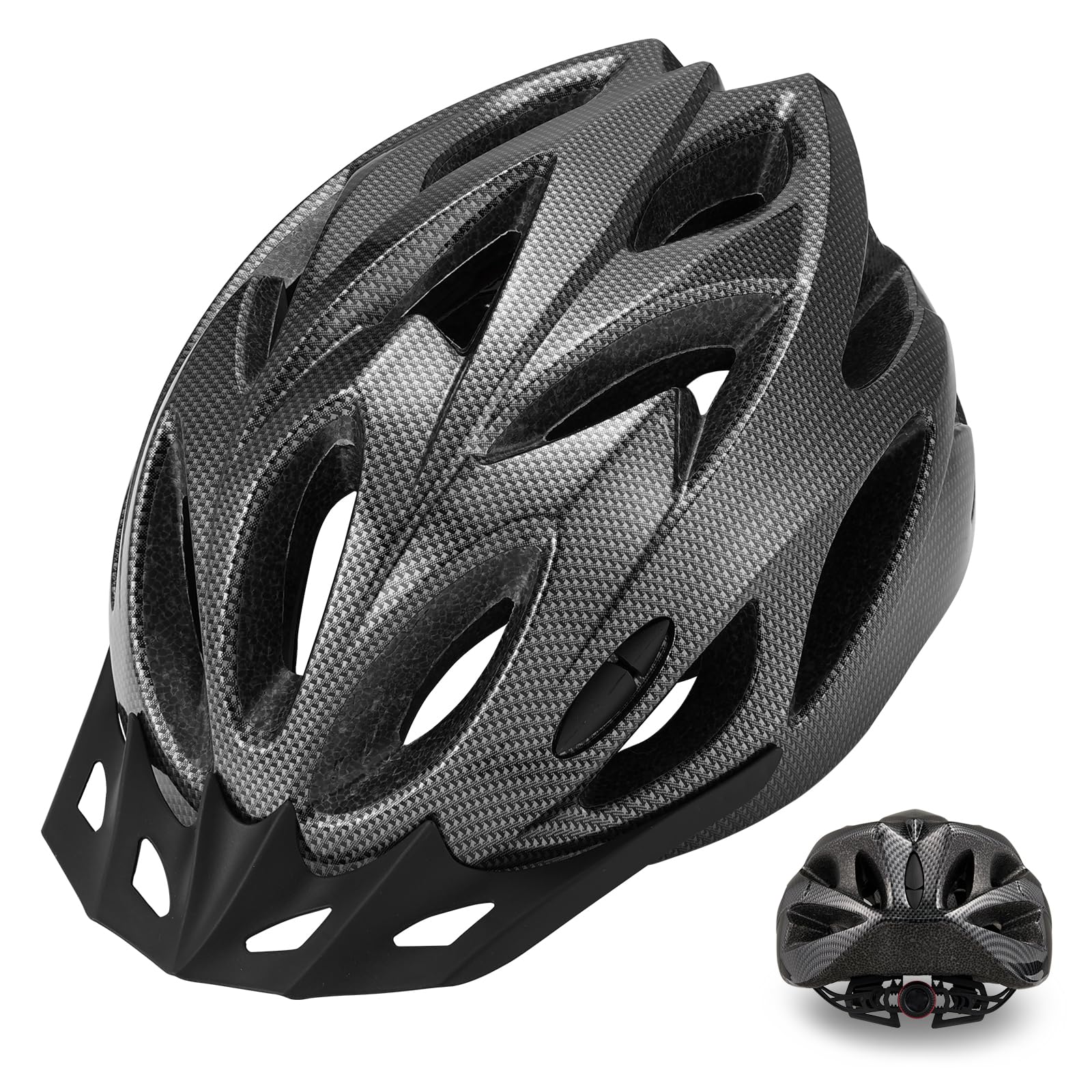
The visor pops off without tools and the wrap-around pad lifts out for washing, which makes the Zacro the easiest helmet here to live with day to day. Commuter helmets get sweaty faster than anything else you own, and being able to rinse the liner and hang it to dry is worth more in August than another two vents.
At 225 grams it’s lighter than anything else in this group, and 18 vents keep it from turning into a sauna on a short ride. That combination is the whole pitch: it’s the helmet you forget you’re wearing on a twenty-minute ride to the office, and the one you don’t mind clipping to a bag when you stop.
The 54-62 cm range is one of the wider ones here, and the dial and straps only need setting once. The visor is short enough to shade rather than block, the shell wipes down easily, and the profile stays neat under a hood or a cap in a way bulkier helmets don’t. For a fair-weather commute, that’s a fair set of compromises.
Pros
- Lighter than anything else here at 225 g
- Removable visor and washable pads
- CPSC and CE certified
- 54-62 cm fit range
Cons
- No rotational-impact liner
- Minimal interior padding
The light one: 225 grams, a removable visor and washable pads for short commutes where a rotational liner isn’t the priority.
How We Tested 14 Men’s Bike Helmets
We started by pulling together a shortlist of 30 helmets from brands we trust, then narrowed it down by checking sizing ranges, vent counts, adjustment systems, and price. We eliminated anything that only came in one or two sizes, skipped helmets with straps that couldn’t be adjusted at the ears, and made sure the final 14 covered a spread of prices—from budget-friendly commuters to pricier road helmets. Every helmet we tested carried a CPSC safety certification, so the differences came down to fit, comfort, and how they held up.
For six months, I wore each helmet on my daily commute, on weekend road rides, and on a handful of trail loops with my family. I also passed them around to two colleagues who ride more aggressively than I do, so we could compare notes on fit across different head shapes. We noted whether the dial could be tightened with one hand while riding, whether the straps needed re-adjusting after a few miles, and whether the padding stayed in place after a sweaty hour. We weighed each helmet on a kitchen scale and noted how it felt on long rides—whether we noticed the weight at mile 20 or forgot it was there.
After each ride, we checked for signs of wear: loose rivets, frayed straps, padding that compressed or shifted, and dials that started to slip. We also paid attention to appearance—how the helmet looked with sunglasses, whether the visor felt flimsy, and if the colorways held up after a few scuffs. At the end of six months, we compared notes on value: which helmets felt like a fair deal for the price, and which ones asked for more money without delivering a better fit or lighter weight. The ones that made the list are the helmets we kept reaching for, even after the testing period ended.
How to Choose a Bike Helmet for Men
Fit first, then the liner you can’t see, then everything else — a helmet that doesn’t sit right on your head is one you’ll stop wearing.
Measure first; the size letter means nothing
Brands use medium, large and extra large differently, so ignore the letter and find the centimeter range. Run a tape around the widest part of your head, just above the ears and across the forehead, and compare that number with the listing. In this set the ranges run from 54 cm up to 62 cm and they are not interchangeable: a helmet listed at 58-62 cm leaves a smaller head with nowhere to go, while a 54-62 cm shell covers most adults.
The dial buys you a centimeter or two, and interchangeable liners buy shape rather than size. The OutdoorMaster’s two liner thicknesses change how the shell sits against your temples; they don’t change how far around it reaches.
MIPS, and what the certification already covers
Every helmet worth buying meets CPSC in the United States or EN1078 in Europe, so a sticker tells you the minimum was met, not which certified helmet is safer than another. What separates them is the rotational liner: MIPS and similar systems let the shell slide a few millimeters against your head in an angled impact, which is the fall that produces most head injuries on a bike.
We put a rotational liner ahead of brand name, vent count and cosmetics. The OutdoorMaster Gem and both Giro helmets here carry it; the cheaper picks do not, and that is the main thing their price buys.
Weight and vents against the riding you actually do
Listed weights here run from 225 g to 421 g, and the spread matters most when you’re climbing or out for hours. Vents tell you less on their own than the number suggests: a 10-vent helmet moving at 20 mph can feel cooler than a 25-vent one stopped at a traffic light.
Match the shell to the ride. Light and heavily vented for distance; heavier, with lights and a visor, for short trips in traffic where being seen beats being cool.
Lights, visors and the glasses problem
A built-in rear light is the most useful commuting feature in this set and the least useful when it’s flat. Rechargeable lights run off the same cable as your phone, so the habit is the feature — check the charge before a night ride the way you check a bike light.
Visors are shorter than they look in photos. They shade the eyes; they don’t block low sun the way sunglasses do. If you wear prescription glasses, a magnetic goggle that snaps over them is the more practical answer.
Frequently Asked Questions
Do I need a new helmet after a crash if it looks fine?
The foam liner is designed to crush once. A hard knock can compress it without cracking the outer shell, and a helmet that has taken an impact is no longer the protection you paid for. Replace it after any crash where your head hit something, and after a drop from waist height onto a hard floor. Retire it if you can see cracks or crushed patches in the foam.
Can I use a bike helmet for skating or an e-scooter?
Not ideally. Bike helmets are certified to bicycle standards and built for a single high-energy impact, while skate and multi-sport helmets use a harder shell aimed at repeated lower-speed knocks. If you want one helmet for both, buy one whose certification names both uses, and don’t assume a bike sticker covers a skatepark fall.
Can I wear a cycling cap or beanie under these helmets?
Yes, if it’s thin, and if the dial still has room to tighten. A skull cap takes up a centimeter or so, which is fine on a helmet where you sit mid-range and not fine on one that’s already snug. Test the fit with the cap you’ll actually wear; if the dial is maxed out, the shell is too small for winter riding.
Final Verdict
Buy the OutdoorMaster Gem. It’s the helmet we recommend to most men because it gets the two things that change outcomes right — a MIPS liner and a fit that adapts to the shape of your head — and adds ventilation you’ll notice on a climb, all at mid-range money.
If you ride a road bike fast and want airflow above everything, the Giro Agilis is the better shell. If most of your riding happens after dark, the VICTGOAL’s goggles and rear light do more for you than any number on a spec sheet.