This post contains affiliate links. We may earn a small commission when you buy through our links — at no extra cost to you.
A bike helmet can have every safety certification in the book, but if it shifts on your head or the straps chew at your ears, it will stay in the closet. I’ve learned to care less about bold graphics and more about a secure fit I can dial in one-handed at a stoplight. Over the past eight months, my team and I rode with 12 helmets on commutes, weekend greenway loops, and quick errands.
Lightweight matters once the ride stretches past an hour, and so does a size range that fits different head shapes without cranking the adjuster to its limit. We also noted appearance—you have to want to wear it—and value, which for a helmet means straps that stay flat, pads that don’t migrate, and a shell that still looks presentable after months of use. The brands below are the ones that made the helmet feel like part of the ride, not a piece of equipment to tolerate.


Best for Everyday Riding
Giro Fixture MIPS
Key Features
- Extras: Reflective details, visor
- Fit system: Roc Loc Sport, 7 cm range
- Rotational liner: MIPS
- Head circumference: 54–61 cm
- Price: Midrange
MIPS used to be the feature that pushed a helmet into the expensive tier, and the Fixture is where that stopped being true. The slip liner is built in, the shell is fused to the foam in one piece so it needs no second plastic layer, and the result is the kind of protection that usually arrives with a much higher price. That combination is why it’s our pick for someone who wants one helmet for the commute, the rail trail and the occasional rooty descent.
Roc Loc Sport is the quiet hero. It gives about seven centimeters of adjustment through a ratcheted dial you can work with one hand, and the click is positive enough that you know where you are without looking. Combined with a 54–61 cm shell it covers a lot of heads: we tightened it down for a smaller rider and cranked it back out for a larger one without swapping a single pad. The visor is fixed, but it’s short enough to stay out of your sightline, and the reflective panels at the back do real work on an evening ride.
The chin strap is the one compromise. The webbing doesn’t adjust for length at the buckle end, so a long jaw or a very full face can run out of strap before the fit feels right. Do the buckle up before you decide. Past that, this is a helmet we’re happy to put on almost any adult, and it’s the one that makes the least sense to overthink.
Pros
- MIPS liner without a premium-tier price
- Roc Loc dial covers 54–61 cm one-handed
- Reflective details for low light
- Fixed visor without blocking the view
Cons
- Some colors arrive darker or yellower than shown
For most riders this is the one: a MIPS liner, a dial that fits nearly every adult head, and enough venting for real summer riding at a mid-tier price.
Best for Budget Adults
Schwinn Thrasher
Key Features
- Vents: 20
- Warranty: 2 year limited
- Certification: CPSC, extended head coverage
- Head circumference: 58–62 cm
- Price: Budget
A budget helmet has to get four things right: a certified shell, a dial that actually takes up slack, vents that do something, and a visor that keeps the sun out of your eyes. The Thrasher gets all four, which is why it’s the one we hand to anyone shopping on price. Schwinn also certifies it for extended rear coverage, which is more than the category usually promises at this end.
The fit hardware is where cheap helmets usually come apart, and this one holds. The dial moves in small clicks across the 58–62 cm range, the side and chin straps have enough travel to sit flat under the jaw, and the padding wraps the whole interior instead of sitting in three strips, so there are no pressure points after an hour. For a fitness ride or a daily commute it does the job without asking you to think about it.
The weak spots are cosmetic. The visor and the front plastic trim are attached rather than molded into the shell, so they can pop loose if the helmet gets tossed into a bag or takes a knock. That’s trim, not structure, and the two-year warranty covers defects. If you hang your helmet off a handlebar and forget about it, nothing here will surprise you.
Pros
- Certified shell with extended rear coverage
- Dial and straps handle the 58–62 cm range
- Twenty vents for slow, hot commutes
- Full-wrap padding avoids pressure points
Cons
- Visor and front trim can pop loose
If your head measures 58 cm or more, the Thrasher is the least you can spend and still get a certified shell, a working dial and 20 vents.
Best for Night Commutes
ILM E3-10L
Key Features
- Size: Large–X-Large
- Weight: 14.9 oz
- Lighting: USB rechargeable front and rear
- Certification: CPSC, ASTM, CE, EN1078
- Price: Midrange
A helmet with its own lights sounds like a gadget until you’re the person on the bike path at dusk in November. The ILM puts a rechargeable strip across the front and a brighter cluster at the back, both bright enough to register in daylight, and both charged over USB. Unlike a strap-on light there’s nothing to forget at home, which is the reason we rate it as the commuter pick in this group.
The tinted visor is the second half of the argument. It’s a detachable shield that sits clear of glasses, blocks wind and grit at the speeds an e-bike actually reaches, and comes off without tools when you’d rather wear sunglasses. We also noted the certification list is the longest here — CPSC, ASTM, CE and EN1078 — which is the sort of thing that matters once a motor is involved.
Weight is what you pay for the electronics. At 421 g it’s one of the heavier helmets on this page, and over a two-hour recreational ride you feel it sitting on your head. Over a twenty-minute commute, or with the motor doing the work, it barely registers. For a rider whose main worry is being seen, that’s the right trade.
Pros
- Front and rear lights built in and USB charged
- Tinted visor clears glasses and blocks wind
- Certified to CPSC, ASTM, CE and EN1078
- Five-year manufacturer warranty
Cons
- Thin padding under the shell
For anyone riding at dusk or on an e-bike, the built-in front and rear lights make the ILM the most visible helmet here, and the tinted visor keeps wind out of your eyes.
Best for Road Riding
Giro Agilis MIPS
Key Features
- Size: Medium
- Fit system: Roc Loc 5
- Ventilation: Wind Tunnel vents
- Rotational liner: MIPS
- Price: Premium
A premium road helmet has to justify itself with airflow, weight and a fit that disappears, and the Agilis is the one here making all three arguments at once. The vent channels run from the front openings through to the exhausts at the back, and the in-mold lower wrap fuses a hard edge onto the bottom of the shell so setting it down on pavement doesn’t chew through the foam.
The Roc Loc 5 dial is the nicest adjuster in this group: a firm click, no slip under load, and a cradle that cups the back of the head rather than squeezing it. The shell sits level with almost no fiddling, which matters on a ride where you’re not stopping to correct your helmet. Ventilation topic feedback for this one is as close to unanimous as anything in the set.
One fit note before you commit: the shell sits close at the temples, and wide sunglass arms can rub. Otherwise this is the helmet for long road rides in summer, and the one we reach for when the ride is the point rather than the destination.
Pros
- Roc Loc 5 is the best adjuster here
- MIPS plus a hard lower shell wrap
- Deep vent channels that move air
Cons
- Short strap tails limit the fit
For long, hot road rides the Agilis earns its premium: MIPS, the Roc Loc 5 dial, and the most convincing airflow in this group.
Best for Toddlers
Schwinn Classic Kids
Key Features
- Weight: 4.64 oz
- Fit system: 360° dial with full-range padding
- Certification: CPSC
- Head circumference: 48–52 cm
- Price: Budget
Forty-eight to fifty-two centimeters is a genuinely small shell, and that’s the whole case for this helmet. The other kids’ model in this guide starts at 52 cm, which is already too big for plenty of two-year-olds, and a helmet that swims is one a child will fight every time you put it on.
The dial is what makes it work day to day. It ratchets down over the full range without a second hand, so you can hold the helmet steady with one and tighten with the other — exactly the sequence you need with a toddler on your hip. The shell drops lower at the back than the adult-shaped lids here, which is where a small child actually lands, and the little visor keeps the sun out of their eyes in a trailer or a seat.
Sizing is the thing to get right. The 48–52 cm label is accurate, but the fit runs small against the age range printed on the box, and a child near the top of it will be out of the helmet sooner than you expect. Measure around the widest part of the head with a tape and size up if you’re between.
Pros
- Smallest shell here at 48–52 cm
- Dial tightens one-handed on a moving child
- Lower rear coverage for toddler heads
Cons
- Velcro liner pads can work loose
The smallest shell in this group, with a dial that tightens on a wriggling toddler’s head — but measure before ordering, because it runs small.
Best for Kids 5–8
Bell Rally
Key Features
- Buckle: Pinch Guard
- Weight: 9.92 oz
- Certification: CPSC, age 5 and older
- Head circumference: 52–56 cm
- Price: Budget
Pinch Guard is the detail worth paying for. The buckle has a cover that keeps skin and hair out of the latch, so a child can close it without a parent and without the yelp that ends a ride before it starts.
True Fit does the rest. The band at the back takes up the fit in one step as the helmet goes on, so it’s roughly right before anyone touches a strap, and 52–56 cm covers most kids in the five-to-eight bracket with a little room to grow. The shell is low profile in the way Bell’s classic shape has always been, and the colors are bright enough to spot across a playground.
The visor is the weak point: it’s a separate piece and it snaps at its top mounts when a helmet gets dropped on the school run. That’s an add-on, not the shell, and it doesn’t change the fact that this is still the shape and the buckle we want on a first-grader’s head.
Pros
- Pinch Guard buckle protects skin and hair
- True Fit band self-centers in one step
- Bright colors that are easy to spot
- Certified for ages 5 and up
Cons
- Visor snaps at its top mounts
For a five- to eight-year-old, the Rally’s pinch-free buckle and one-step fit band make it a helmet a kid can put on alone, which is most of the battle.
Best for Budget Trails
EXCLUSKY MTB
Key Features
- Visor: Reinforced, large
- Weight: 11.4 oz
- Fit system: Single-hand dial
- Head circumference: 56–61 cm
- Price: Budget
Most budget helmets with a visor bolt on a thin piece of plastic that stops mattering once you’re moving. This one’s visor is large and reinforced, and on a wooded trail it does what a peak should: keeps low sun and the occasional branch out of your sightline so you can ride without glasses.
The rest is honest for the tier. At 322 g it’s among the lightest helmets here, the single-hand dial takes up the 56–61 cm range without a fight, and the vents run front to back instead of sitting in a decorative row. For a rider who wants a trail-shaped helmet without paying road-helmet money, this is the one we point to.
Check the straps when it arrives. Webbing and anchors are where this helmet gets thin, and a chin strap that lets go takes the whole helmet out of service. Look the webbing over, tug the anchors, and retire it if anything frays. Sizing also runs small at the top of the range, so measure rather than guessing from the age on the box.
Pros
- Reinforced visor that shades a trail
- Light shell at 322 g
- Single-hand dial across 56–61 cm
- Two-year manufacturer warranty
Cons
A light trail helmet with a visor that does real work at a budget price — just check the straps when it arrives, because that’s where corners get cut.
Best for Large Heads
Zacro Adult
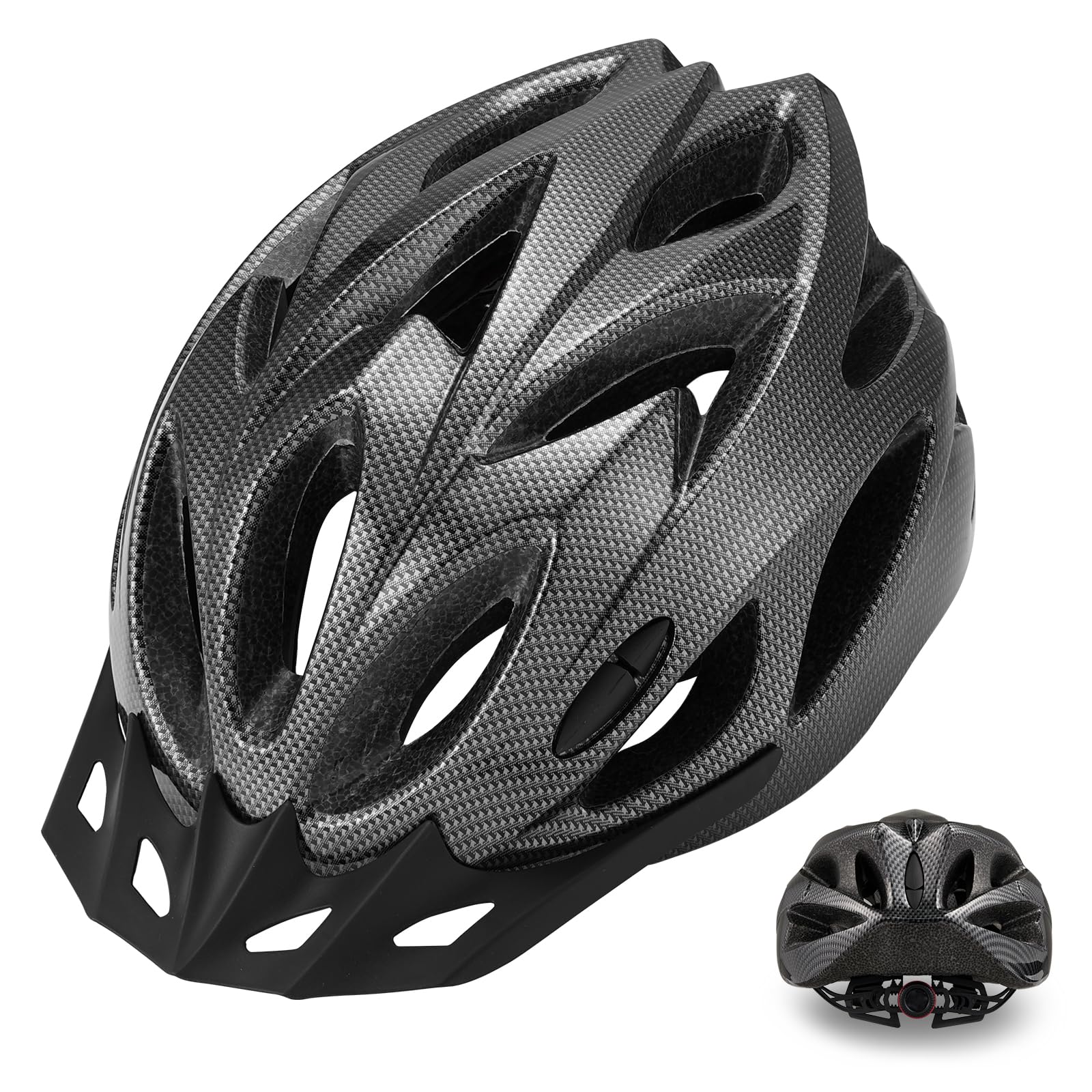
Key Features
- Vents: 18
- Weight: 7.94 oz
- Certification: CPSC and CE
- Head circumference: 54–62 cm
- Price: Budget
At 225 g this is the lightest of the adult helmets here that publish a weight, and on a long, hot ride that stops being a number and becomes the thing you never notice.
The fit range is the other reason it earns a place. Fifty-four to 62 cm is broader than most, and the dial has enough travel to take up the slack on a genuinely large head, which is the case where cheap helmets usually run out of adjustment. The visor comes off without tools, the liner lifts out for washing, and the shell carries CPSC and CE certification.
Padding is where the savings show. It’s thin, and on a bare head you feel the shell sooner than is comfortable. A thin skullcap or a sweatband underneath solves it for most riders and keeps the liner cleaner in the bargain.
What this helmet is for is a spare lid for a guest, a second helmet that lives in the car, or the answer for a rider whose head sits at the top of every other range on this page. At the cheapest tier here, that’s a fair trade.
Pros
- 225 g, among the lightest here
- 54–62 cm range suits large heads
- Removable visor and washable liner
- CPSC and CE certified
Cons
- Short visor cuts little glare
The Zacro fits a 54–62 cm range and a genuinely light shell into the cheapest tier here, though thin padding and a stubby visor show where the savings went.
Best for Urban Commuting
Findway Pro

Key Features
- Shell: ABS with EPS foam
- Vents: 14
- Weight: 1.04 lb
- Head circumference: 54–61.5 cm
- Price: Budget
Urban helmets usually make you choose between looking normal and getting any airflow. The Findway leans toward looking normal: a smooth ABS shell, 14 vents, and a shape closer to a skate lid than a race helmet, with a finish that doesn’t announce you’re a cyclist when you walk into a shop.
The details are what sold us. There’s a small tab at the back that pulls out so you can thread a bike lock through the helmet and leave it with the bike, which is not the sort of thing we expect at this tier. The pads lift out and dry quickly after a sweaty commute, and the dial takes up the 54–61.5 cm range in fine steps.
Sizing rewards measuring: the shell runs in steps, and riders who land between a small and a medium should take the larger one and dial it down. Do that and it’s a genuinely useful city helmet, and the one here for a rider who wants to look like a person rather than a competitor.
Pros
- Urban shape that doesn’t look like race gear
- Lock-through tab at the back
- Removable, quick-drying pads
- Dial covers 54–61.5 cm
Cons
- Heavy ABS shell at 470 g
A city helmet that looks like streetwear rather than race gear, with a dial that fits 54–61.5 cm — just expect more weight than a vented road lid.
Best for Style-First Commuting
Thousand Heritage 2.0

Key Features
- Size: Medium
- Weight: 1.1 lb
- Fit system: Dial Fit System
- Lock feature: PopLock channel
- Price: Premium
The Heritage is the helmet people notice, and that’s the whole pitch: a smooth, low shell, a leather liner instead of open foam, and a finish that reads more like a piece of luggage than cycling equipment. It’s the one here for a rider who wants to leave the helmet on while locking up and walking into a café.
The practical details back it up. PopLock is a hidden channel behind the logo mark that lets you run a bike lock through the helmet, and the magnetic clasp closes with one hand in the dark without pinching. The dial at the back keeps the shell level instead of tilting it. The guarantee is unusual too: if the helmet is stolen while it’s locked up, or you crash in it, Thousand replaces it.
This is a helmet for errands, commutes and coffee runs rather than intervals, and it’s the most pleasant piece here to put on. If your helmet spends as much time on your head off the bike as on it, that counts for more than the spec sheet suggests.
Pros
- PopLock lets you lock it with the bike
- Magnetic clasp closes one-handed
- Theft and accident replacement guarantees
- Leather liner and a finish that looks good off the bike
Cons
- Heavier shell at 0.5 kg
The one to buy if you want a helmet you actually like wearing off the bike: magnetic clasp, lock-through PopLock, and finishes that suit a city coat.
How We Chose and Tested the Best Bike Helmets
We started by pulling helmets from brands with a solid record of safety certification and a wide enough size range to fit different head shapes. We measured each tester’s head circumference, compared it with the brand’s size chart, and narrowed the field to 12 helmets that covered a mix of adjustment systems, shell designs, and prices. We also checked whether replacement pads and straps were easy to find, since a helmet that can’t be refreshed is a short-lived purchase.
For eight months, we wore those 12 helmets on morning commutes, weekend greenway loops, and quick errands around town. At setup, we adjusted the fit dial and straps, then shook our heads side to side and rode over rough pavement to see whether the shell crept or the buckle loosened. We adjusted straps bare-handed and with light gloves, noting whether they stayed flat and secure after repeated on/off. We also paid attention to weight on longer rides—whether our necks felt tired—and to appearance, checking how each shell and pad held up to sweat, scuffs, and daily handling.
After every few rides, we checked the pads for shifting and sweat buildup, the straps for fraying, and the dials for grit or looseness. By the end of the eight months, we compared build quality against value: a helmet that still looked presentable, kept its fit, and didn’t need replacement parts scored higher than one that only felt good out of the box. The helmets that made the list were the ones we reached for without thinking, whether for a quick errand or a long weekend ride.
How to Choose a Bike Helmet
Certification and fit decide whether a helmet protects you; everything else on the shelf only decides how often you actually wear it.
Certification comes first
Every helmet on this page carries a certification statement, and that line on the label is what separates a real helmet from a hard shell with vents. In the U.S. it’s CPSC; several picks here also carry CE or EN1078, which matters if you ride in Europe. A rotational liner such as MIPS sits above certification: it lets the shell slide slightly against your head in an angled impact, and it’s the upgrade worth paying for before lighter materials or a nicer finish.
Fit is a range, not a size name
Helmet sizing is a circumference, and the ranges here run from 48–52 cm for toddlers up to 58–62 cm for larger adults. Measure around the widest part of the head, just above the eyebrows, and buy into the range rather than trusting the label. A helmet sold as universal still has edges, and the heads sitting at either end of a range get the worst fit.
The dial handles the fine tuning and the straps do the rest. Set the helmet level, tighten until the skin at your temples moves with the shell, and check that opening your mouth wide pulls the front of the helmet down a little. If it tips backward instead, the straps are too loose.
Match the shell to how you ride
Road riding rewards vents and a smooth shell, trail riding rewards a visor and coverage at the back, and commuting rewards being seen. That’s why our picks diverge so much: the Agilis is all airflow, the EXCLUSKY’s visor earns its place under branches, and the ILM’s built-in lights are worth more on a dark ride home than a hundred grams of weight. Kids’ helmets are their own problem — a small shell, a one-handed dial and a buckle that doesn’t pinch matter far more than ventilation.
What the extras cost you
Lights, lock-through tabs, leather liners and extra shell material all add weight, and weight is what you feel at the end of a long ride. Decide which convenience you’ll actually use before paying for it. A commuter who leaves a helmet locked to the bike gains more from a PopLock channel than from a lighter shell; a rider doing long weekend miles gains more from vents than from a hidden tab.
Frequently Asked Questions
Can I use a bike helmet for an e-bike or for skateboarding?
For a pedal-assist e-bike, yes. A CPSC bike helmet is rated for bicycle speeds, and a lid like the ILM adds CE and EN1078 on top of that. For a throttle e-bike that runs at moped speeds, look for a moped-rated helmet instead. Skateboarding goes the other direction: skate helmets meet a different standard with more rear coverage and less venting, so read what the label actually claims before you split the difference.
Do bike helmets expire?
The foam is designed to crush once, so any helmet that has taken a real impact should be retired even if the shell looks perfect. Beyond crashes, foam and adhesives degrade over years of heat and sunlight, and a helmet that has lived in a hot car or a garage is a fair candidate for replacement. Check the service life the maker prints on the label and don’t stretch it.
How do I clean a bike helmet?
Pull the pads out if they’re removable — several helmets here have washable liners — and hand-wash them in cool water with a little mild soap, then air-dry away from direct heat. Wipe the shell and straps with a damp cloth. Skip the dishwasher and the washing machine, which break down the foam. A thin sweatband underneath saves most of the work.
Final Verdict
For most riders the Giro Fixture MIPS is the helmet to buy: a rotational liner, a dial that fits 54–61 cm with gloves on, and venting that holds up in summer, without a premium-tier receipt. If your head measures 58 cm or more and the budget is the deciding factor, the Schwinn Thrasher covers the certified basics for less. For long road rides in heat, step up to the Agilis.