This post contains affiliate links. We may earn a small commission when you buy through our links — at no extra cost to you.
The last thing you want after a long climb is to worry whether the water in your bottle is safe. A good backpacking water filter fixes that—it turns a questionable creek or lake into drinking water without adding much weight. But the lightest, most packable filters can clog fast, while the ones that last tend to be heavier or fussier to use. I’ve learned the hard way that a slow filter means waiting around while everyone else drinks.
Over the past seven months, we’ve tested 14 filters on weekend backpacking trips, day hikes, and group outings, plus two kept in emergency kits. The best ones earn their place through reliable flow, simple operation, and enough durability to survive being stuffed into a pack day after day. Portability matters, but so does value—a filter that saves an ounce but clogs after two trips isn’t a bargain. The picks below are the ones we’d carry again.


Best for Solo and Duo Trips
Sawyer Squeeze SP129
Key Features
- Weight: 2 oz (filter)
- Flow rate: 1.7 liters per minute
- Filter life: 100,000 gallons
- Filter pore size: 0.1 micron absolute
- Price: Midrange
The number that decided this one is 1.7 liters per minute, the fastest rated flow in this group. That matters because flow is what a water stop actually costs you: with the Squeeze, a 32-ounce bottle fills in about the time it takes to check the map, so topping up stops being a decision. We drank more on the trips where this was in the pack, which is a strange thing to say about a filter but the most useful thing about it.
It’s also the most adaptable filter here. One end threads onto a standard 28 mm bottle, the other onto the two 32-ounce collapsible pouches in the box, and there’s a hydration pack adapter for a bladder hose. We’ve run it screwed to a bottle, squeezed from a pouch, and hung off a branch as a gravity rig when three of us were sharing it at camp. That last trick is worth knowing: a full pouch hung above a bottle turns the Squeeze into a hands-free filter while you get the tent up.
The one thing to get right is the threads. Snug is tight enough — cranking a full pouch down can crack the filter body, and that’s the end of your filtering until you’re home. Hand-tight, every time, and the element will outlast a stack of pouches.
Inside is a 0.1 micron absolute hollow fiber membrane that covers bacteria, protozoa and microplastics, rated to 100,000 gallons — a figure no weekend will ever approach, though it does mean backflushing is the only maintenance you’ll ever do. Where this stops being the right answer is a group of four at basecamp, where a gravity bag does the same work without anyone’s hands. For one or two people moving all day, nothing here is easier to live with.
Pros
- 1.7 liters per minute, the fastest here
- Threads onto standard 28 mm bottles
- Two 32-ounce pouches and hydration adapter included
- Works as a gravity filter in camp
Cons
- Pouches split before the filter wears out
Our default recommendation for backpacking: the fastest flow in this group, 2 ounces of filter, and threads that fit the bottles you already carry.
Best for Ultralight Backup
Sawyer MINI
Key Features
- Weight: 2 oz per filter
- Bottle fit: Standard 28 mm threads
- Kit contents: Two filters, two pouches, two straws, two plungers
- Filter pore size: 0.1 micron absolute
- Price: Midrange
Think of this as the Squeeze shrunk down and doubled: two 2-ounce filters, each with a 16-ounce squeeze pouch, a 7-inch drinking straw and a cleaning plunger. The body is the same 0.1 micron hollow fiber, palm-sized, with 28 mm threads at the business end and Sawyer’s usual 100,000-gallon rating attached to each one.
We keep reaching for the MINI on trips where the filter is insurance rather than infrastructure — a fast overnight with one reliable spring on the route, a winter climb where everything above treeline is snow. The straw is the reason. When there’s a pool and no flat spot to balance a bottle on, you kneel down and drink without unpacking anything, and the whole kit goes back into a hipbelt pocket.
Against the Squeeze you trade volume for size. A 16-ounce pouch means more refills on a hot afternoon, and the smaller body is happiest filling one bottle at a time. Screw it onto a Smartwater bottle and hang that from a branch and you have a slow but workable gravity setup for two people. Two filters in the box covers a partner, a backup, or one that lives in the car between trips.
Pros
- Two complete filters in one box
- 2 ounces each, palm-sized
- Straw lets you drink at the source
- Fits standard 28 mm bottles
Cons
- 16-ounce pouches mean frequent refills
The lightest way to guarantee clean water on a trip where every gram gets argued over, and you get two of them for a partner or a spare.
Best for Emergency Kits
LifeStraw Personal
Key Features
- Weight: 1.6 oz each
- Pack count: Five filters
- Shelf life: 5 years
- Filter life: 4,000 liters
- Price: Midrange
Five straws in one box is an odd way to sell a backpacking filter until you think about where they actually end up: one in the top of a pack, one in the glovebox, one in the emergency bin, two for whoever forgot theirs. Each LifeStraw is a 1.6-ounce tube with a fixed mouthpiece. There’s no bottle thread, no pouch and no hose — you put one end in the water and drink through it.
That design makes it a poor primary filter for a long hike. You’re on your knees at the bank, and you can’t carry water away from the source without a bottle anyway. As a backup it’s close to ideal: nothing to assemble, nothing to lose, a five-year shelf life and a 4,000-liter rating per straw that is more water than most of us will filter in a decade.
We treat these as the second layer — the thing already in the pack when a filter clogs, or in the car when a trip goes sideways. The hollow fiber membrane handles bacteria, parasites and microplastics, and each straw is individually sealed, which is why they survive years in a kit. If you want one filter to do the actual work of a trip, spend the weight on a squeeze filter; if you want four bags and a car to each have a working filter in them by Saturday, this is the box.
Pros
- 1.6 ounces each, 4,000 liters per straw
- Five filters cover pack, car and kit
- No parts to assemble or break
- Five-year shelf life for stored kits
Cons
- No bottle filling — you drink at the source
A five-pack of 1.6-ounce straws rated for 4,000 liters each: the simplest way to put a working filter in every bag you own.
Best for Filling Bottles Fast
Katadyn Hiker Pro
Key Features
- Weight: 11.2 oz
- Flow rate: 1 liter per minute
- Pore size: 0.2 micron
- Cartridge life: 1,150 liters
- Price: Premium
Eleven point two ounces is a lot of filter to carry, and it’s the first thing to get straight about the Hiker Pro. On a solo ultralight trip that’s the end of the conversation. Where it earns the weight back is output and effort: the pump moves a liter a minute straight into a bottle, a bladder or a hydration hose, and you never touch a squeeze pouch.
The details are the ones a pump has to get right. There’s a pre-filter on the intake hose to keep silt out of the cartridge, quick-connect fittings on the output, and an easy-fill adapter that sits in a wide-mouth bottle. Our favorite part is the transparent housing — you can watch the cartridge darken and know exactly when it needs cleaning instead of guessing from a slowing flow. The activated carbon granules inside also knock down taste and odor, which matters when the source is a pond.
For two people at the end of a day, this is the best tool here. A filtration session that would be twenty minutes of squeezing becomes five, and the person with the bladder doesn’t have to hold anything. The 0.2 micron glass fiber cartridge is rated to 1,150 liters, a couple of seasons of weekend trips. If you hike alone and light, skip it; if you’re the one filtering for the group, it’s worth the extra half-pound.
Pros
- 1 liter per minute with no squeezing
- Transparent housing shows cartridge condition
- Fills bottles, bladders and hydration packs
- Carbon stage improves taste
Cons
- Housing can crack under hard use
- Replacement cartridges add ongoing cost
Bring this when you’d rather pump than squeeze: a liter a minute into any bottle or bladder, and enough output to keep two people drinking.
Best for Camp and Groups
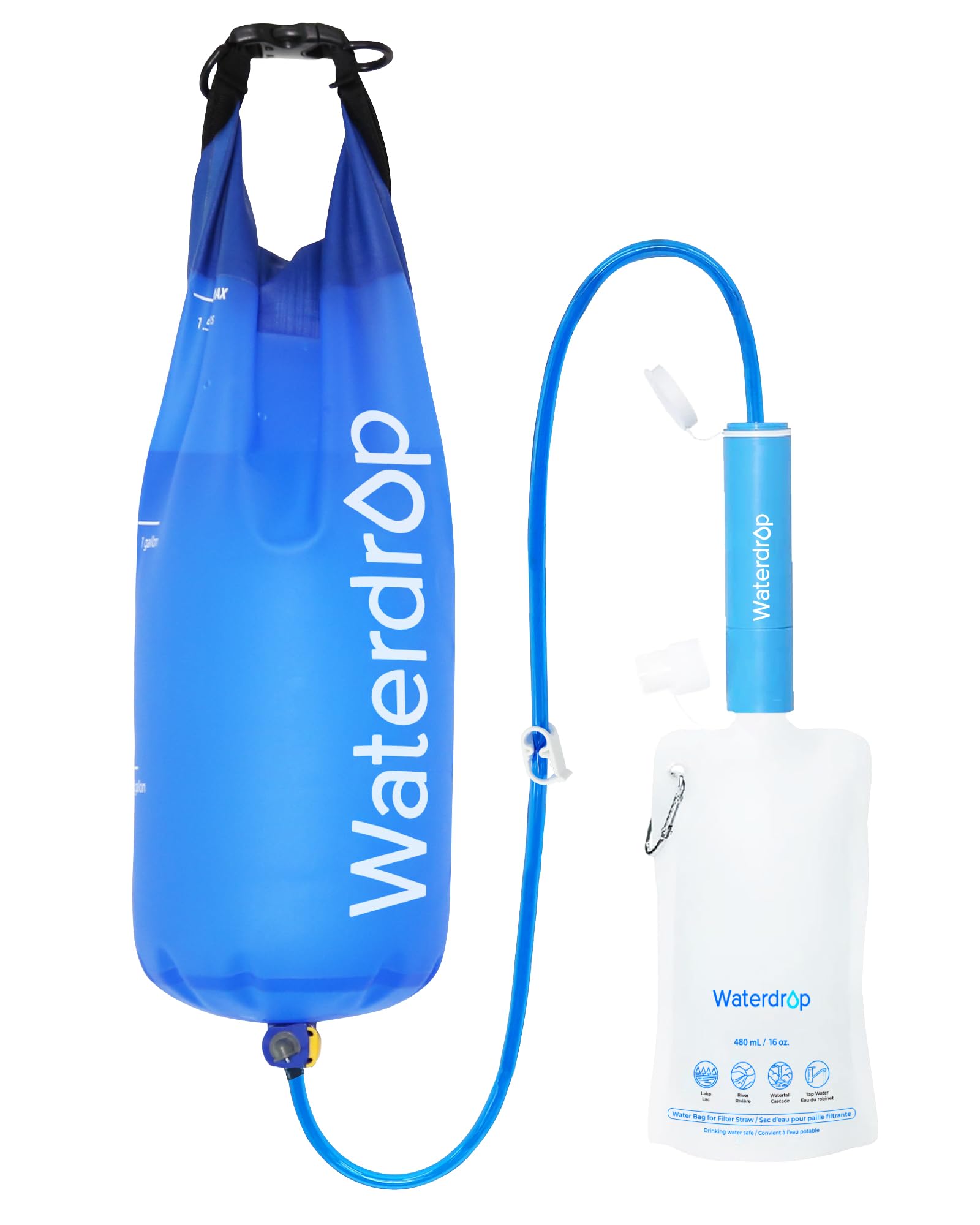
Waterdrop Gravity Filter
Key Features
- Weight: 4.64 oz
- Flow rate: 700 ml per minute
- Reservoir: 1.5-gallon gravity bag
- Filter life: 1,400 gallons
- Price: Budget
Fill the bag, hang it from a branch and walk away. That’s the whole appeal of a gravity filter, and the Waterdrop is the one here with enough volume to make it count: a 1.5-gallon reservoir feeding a 0.1 micron hollow fiber element at up to 700 ml a minute. We hang it at camp and come back to water ready for bottles, dinner and the next morning’s coffee. Of everything on this list, it asks the least of you.
The five-stage element includes a carbon layer aimed at taste. Give the bag a thorough rinse before its first trip and taste the first liter — a new reservoir can carry a plastic note into the water, and it fades. A 16-ounce pouch is included for carrying water away from camp, and the whole thing packs down smaller than a stuff sack when it’s empty.
Speed is the variable. Clear lake water runs at a decent clip; silty runoff slows it and costs you a backflush, and there’s a backwash function built in for exactly that. The filter and straw weigh 4.64 ounces, so it’s the full bag that takes up room — this is a camp tool, not something for a running vest. For a couple or a small group, it beats taking turns on a squeeze bag every evening.
Pros
- 1.5 gallons filtered without effort
- Hangs from a branch or hook
- Built-in backwash restores flow
- Packs small when empty
Cons
- Flow slows on silty water
- Full bag is bulky in a pack
Hang 1.5 gallons and walk away: the pick here for filtering a camp’s worth of water while you do something more interesting.
Best for Travel and Viruses
GRAYL GeoPress

Key Features
- Weight: 15.9 oz
- Capacity: 24 fluid ounces per press
- Pathogens: Viruses, bacteria and protozoa
- Cartridge life: 65 gallons (250L)
- Price: Premium
Viruses are the gap in almost every filter on this page. A 0.1 or 0.2 micron hollow fiber membrane catches bacteria and protozoa, but rotavirus, norovirus and hepatitis A are small enough to slip through. The GeoPress is a purifier instead: electroadsorption and activated carbon pull out viruses along with bacteria and protozoa, plus the chemicals, PFAS and heavy metals a membrane simply ignores.
Using it is a physical act. You fill the outer cup, drop in the press and push the inner vessel down through the water — 24 ounces in about eight seconds, and the eight seconds are honest. They are also work. It takes body weight, and on a cold morning with tired arms it’s the least pleasant part of the routine. We still carry it for travel, where a hotel tap or a village well is the question, because nothing else here answers that question.
The arithmetic is what rules it out for backpacking. The cartridge is good for 65 gallons (250L) — a couple of months of hard use, then a replacement — and the bottle is 15.9 ounces before you put water in it. For an alpine lake, that’s a lot of weight and a short cartridge for protection you don’t need. For water you genuinely don’t trust, it covers viruses, chemicals and sediment in one press with no hoses and no batteries.
Pros
- Removes viruses, chemicals and heavy metals
- No hoses, pumps or batteries
- 24 ounces in about eight seconds
- Drink straight from the bottle
Cons
- Cartridge rated for only 65 gallons
- Pressing takes real body weight
The one that removes viruses as well as bacteria, at the cost of arm effort and a heavy bottle — worth it for travel and genuinely suspect water.
Best for Budget Four-Pack
Membrane Solutions S1

Key Features
- Weight: 2 oz
- Pore size: 0.1 micron
- Filter life: 1,320 gallons
- Certification: NSF/ANSI 42, 372, 401
- Price: Budget
Four certified filter straws for less than one premium purifier is the kind of listing worth a second look, and the certification is what makes it credible: NSF/ANSI 42 for chlorine and taste, 372 for lead-free materials and 401 for microplastics and particulates, with a test report number to go with it.
Each straw is 7.1 inches long and an inch around, weighs 2 ounces, and has 28 mm threads so it works screwed onto a bottle as well as sipped from directly. Inside is a five-stage stack — coarse screen, double PP cotton, coconut-shell activated carbon and a 0.1 micron hollow fiber membrane. The carbon is what separates this from a bare straw, since it’s there for chlorine and taste rather than for pathogens.
Flow is rated at 500 ml per minute, roughly a third of the Squeeze’s, which sets the role: one person drinking at the source, not four bottles at dinner. The 1,320-gallon rating per straw is still several thru-hikes’ worth. Nothing else is in the box — no pouch, no bottle — so plan on a 28 mm bottle or drink where you stand.
That’s why it lands in also-consider rather than the top tier: it’s a certified, inexpensive straw that’s happiest as a spare. Buy the four-pack, put one in each pack, one in the car and one in the kitchen drawer, and keep a squeeze filter for the trips where water is the day’s main task. The plastic bodies are the open question — a straw can stop passing water well before its rated capacity, and buying four is how you hedge that.
Pros
- Four filters for a budget price
- NSF/ANSI 42, 372 and 401 certified
- Threads onto standard 28 mm bottles
- Carbon stage improves taste
Cons
- No pouch or bottle in the box
- Plastic body can fail early
Four NSF-certified straws for the price of one premium purifier, happiest as a spare in every bag rather than the filter a trip depends on.
Best for Questionable Water
Survivor Filter PRO

Key Features
- Weight: 12.8 oz
- Flow rate: 500 ml per minute
- Filter life: 100,000 liters
- Ultra filter: 0.01 micron
- Price: Midrange
A 0.01 micron ultrafilter is an order of magnitude finer than the 0.1 micron membranes everywhere else here, and that’s the number Survivor Filter is selling: a three-stage stack with a 0.1 micron pre-filter, a carbon stage for heavy metals and chemicals, and the 0.01 micron element that catches viruses alongside bacteria and protozoa.
It’s a pump, not a squeeze. An inlet hose goes in the source, an outlet hose goes in your bottle or bladder, and you get 500 ml a minute for as long as your arm holds out. The kit is unusually complete — cup, bag, hoses, a backwashing syringe and a clip that keeps the intake where you dropped it. All three stages are replaceable, which is rare in this group and the reason this is gear you keep rather than replace.
The pump is the part to watch. Gritty water can load the stages and drop the flow to a trickle, which is what the included syringe is for — a backflush at camp usually brings it back. Split between two people, 12.8 ounces is less than a bottle of water each, which is the fairest way to look at it.
We’d carry this where the water is genuinely dirty — runoff below farmland, a river downstream of a town — and where the pumping can be shared. For a clean alpine lake it’s more machine than the job needs. The 100,000-liter rating on the ultra filter is several lifetimes of backpacking, and with replaceable stages the body is the only part that has to survive.
Pros
- 0.01 micron ultrafilter removes viruses
- Three replaceable filter stages
- Carbon stage reduces heavy metals
- Complete kit with cup, bag and syringe
Cons
- Hoses kink easily
- Stages clog on gritty water
A virus-removing pump with replaceable carbon stages for genuinely dirty water, provided two people share the weight and the pumping.
How We Tested 14 Backpacking Water Filters
We started by researching the field—reading spec sheets, scanning customer reviews, and narrowing the list by weight, packed size, filter pore size, and price tier so we weren’t comparing a pocket squeeze filter to a gravity-fed basecamp system. From that shortlist, we bought 14 filters and used them for seven months, rotating them across weekend backpacking trips, day hikes, and a few group trips where several people shared one filter. We also kept two in emergency kits and practiced using them after a simulated primary-filter failure.
On the trail, we timed how long it took to fill a one-liter bottle from a creek, a lake, and a tap, and we noted whether the filter needed priming or a lot of pumping. We ran silty creek water through each unit repeatedly and tracked when the flow slowed enough to need cleaning—clogging was the most common reason a filter dropped out of consideration. We also packed each one into a side pocket, weighed it, and checked whether it leaked or came apart in transit. Ease of use got tested one-handed, with cold hands, and while wearing a pack.
Durability testing was simple but unkind: we dropped each filter from waist height onto rock, stuffed it into overfull packs, and kept using it after the scratches and scuffs. We compared what each one delivers for the money—flow rate, lifespan, and how much fuss it adds to camp—rather than assuming the lightest or priciest option was best. The filters that rose to the top shared a few traits: they were easy to operate without instructions, kept flowing after repeated use, and felt like they could survive a full season of abuse. We’ll keep using them and update this list if anything changes.
How to Choose a Backpacking Water Filter
The best filter is the one you’ll actually use at every water stop, so start with how you hike rather than with the spec sheet.
Match the format to the way you move
Five formats cover nearly every trip. A straw weighs 1.6 to 2 ounces and lets you drink at the source, which makes it a backup rather than a primary filter. A squeeze filter threads onto a pouch or a bottle, weighs about 2 ounces, and suits the solo hiker who stops two or three times a day. A pump runs 11 to 13 ounces and fills bottles and bladders without squeezing. A gravity bag hangs and filters while you pitch the tent, and a purifier bottle is the heaviest option of all.
If you filter for one and walk all day, buy a squeeze filter. If you filter for two at camp every evening, a pump or a gravity bag spares your hands and about twenty minutes.
Weigh the device against the water it saves
Every filter here replaces water you would otherwise carry, and that is the case for carrying one at all: a liter weighs more than two pounds, so a 2-ounce squeeze filter pays for itself the first time it lets you leave a bottle in the car. The more interesting comparison is between formats. Moving from a 2-ounce squeeze filter to a 12-ounce pump costs about nine ounces — under half a liter of water — and buys you a liter a minute without squeezing. That’s a fair trade for two people and a poor one for a solo ultralight trip.
Filters remove microbes; purifiers also remove viruses
Pore size is the headline. Hollow fiber membranes at 0.1 to 0.2 microns catch bacteria, protozoa and microplastics, which covers most backcountry water in North America. They do not catch viruses, which are small enough to pass straight through. If you’re drinking from a tap or a river where human waste is a real possibility, look for a purifier: the GeoPress uses electroadsorption and carbon, the Survivor Filter PRO a 0.01 micron element, and both add a carbon stage for chemicals and taste. For an alpine lake, a filter is enough and the purifier is dead weight.
The bag fails long before the filter does
Almost every filter here is rated for thousands of gallons, and the failure that turns up most is the container: pouches that cloud and split at the seam, bladders that develop pinholes. Two habits cover it. Carry a hard 28 mm bottle, since a Smartwater bottle fits most of these filters, so a split pouch doesn’t end your water supply. And don’t overtighten — hand-tight is enough, and cranking a full pouch onto a plastic thread can crack the housing. Backflush after every trip; silt is what costs you flow.
Frequently Asked Questions
Can a backpacking filter handle muddy or silty water?
Yes, with a little patience. Fill from the clearest part of the pool, strain the water through a bandana or a shirt to take out the worst of the grit, and let the rest settle for a few minutes before filtering. Silt is what clogs a hollow fiber membrane, so a prefilter is the difference between a slow filter and a dead one. Backflush at the end of the day, and if the flow drops to a trickle, backflush again before you blame the filter.
How much water should I carry if I have a filter?
Less than you think, and more than nothing. One 32-ounce bottle plus a collapsible liter is enough for most three-season hikes with reliable sources, and drinking a bottle at the source before you refill keeps your pack light. The planning question is the gap between water, not the total: if the map shows eight miles with no creek, carry enough for eight miles.
Will a water filter survive a winter trip?
It will if it never freezes. Water trapped in a hollow fiber membrane expands when it turns to ice and can ruin the element, and a filter that has been allowed to freeze is one to stop trusting. Sleep with it in your bag, carry it inside your jacket on the cold hours, and don’t leave a wet filter in a pack overnight. The LifeStraw’s 1 °C low rating tells you how little margin there is.
Final Verdict
The Sawyer Squeeze is the filter we recommend to almost any backpacker: 2 ounces of filter, the fastest flow in this group, and threads that fit a bottle from any gas station. Add a spare bottle and you have the whole kit.
Change the trip and the answer changes. Filtering for two at a basecamp, the Katadyn Hiker Pro’s pump saves your hands. Drinking from taps you don’t trust, the GeoPress removes viruses that the hollow-fiber filters here can’t touch. For everything in between — a weekend, a thru-hike, a partner who forgot theirs — the Squeeze is the one to buy.