This post contains affiliate links. We may earn a small commission when you buy through our links — at no extra cost to you.
A bottle that leaks doesn’t just dampen a map — it soaks the down quilt you were counting on, and you find out at dusk. Backpacking bottles work harder than the one on your desk: crammed into side pockets, dropped on granite, filled from a silty creek, and asked to keep water cold through a July afternoon. The right one seals, survives, and doesn’t make you fight it every time you’re thirsty with a pack on.
I’ve carried everything from a gas-station special to a titanium showpiece, and price is rarely what decides it. The details that matter are boring: whether lid threads still seal after a gritty refill, whether a bottle slides into a pack pocket one-handed, whether the weight and cost earn their place. We spent six months with 14 bottles — insulated stainless, rigid plastic, collapsible flasks, and a few squeeze-style options — and the standouts separated fast. What follows covers ounce-counters, weekenders who want cold water at lunch, and anyone who has sworn off a wet sleeping bag.
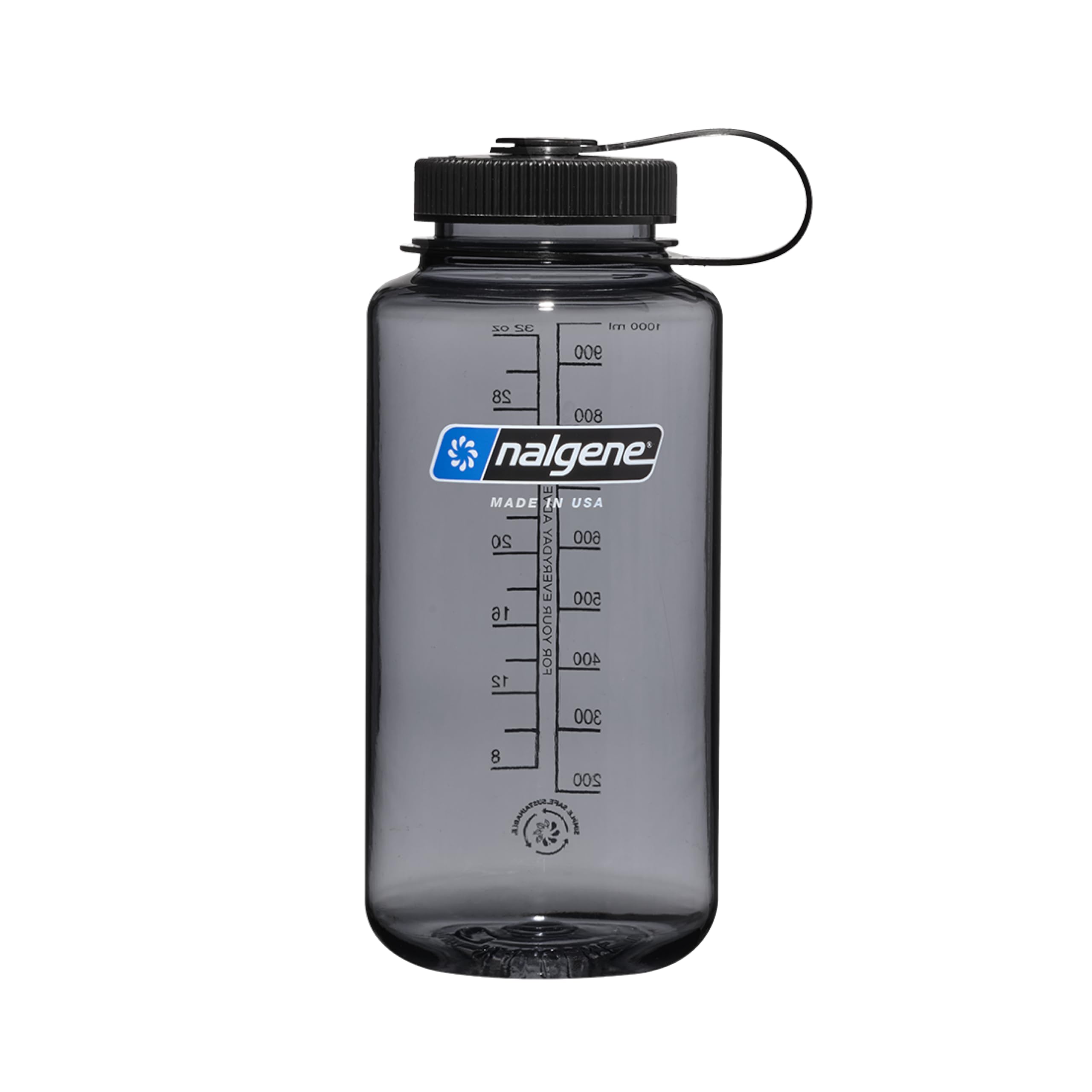


Best for All-Around Backpacking
Nalgene 32 oz Wide Mouth
Key Features
- Mouth: Wide, 63 mm cap
- Capacity: 32 fl oz
- Material: Tritan Renew
- Bottle weight: 6.25 oz
- Price: Budget
The case for the Nalgene 32 oz Wide Mouth is almost annoyingly simple: it holds a liter, weighs 6.25 ounces, and does not ask you to learn a new lid on a cold morning. We kept coming back to it because the wide 63 mm opening makes filling from a stream, a tap, or a camp pot quick, and the lid seals with enough friction that we stopped thinking about it inside a pack. For most backpackers, that combination is the default for a reason.
The Tritan Renew body is impact-resistant and dishwasher safe, and the curved corners make it easy to scrub. We appreciated that it does not hold onto last night’s drink or leave a plastic aftertaste, which is more than we can say for every bottle we have carried. The measurement lines are a small thing until you are rationing water and want to know what is left.
The mouth is the compromise. Wide is great for filling, cleaning, and adding ice or drink mix; it is less tidy when you drink while walking, and a careless tilt can send water down your chin. A narrow-mouth bottle is better for sipping on the move, but then filling and scrubbing become the chores. We think the wide mouth is the better backpacking trade because the jobs it makes easier happen every day.
A filter, a camp pot, and a dishwasher all work with it without an adapter. That is the kind of boring compatibility that keeps a bottle in the pack trip after trip.
Pros
- Holds 32 fl oz at a 6.25 oz empty weight
- Wide 63 mm mouth fills and cleans easily
- Leakproof lid and impact-resistant Tritan body
- Dishwasher safe with useful measurement marks
Cons
- No insulation for hot or cold drinks
- Rigid body takes space when empty
The Nalgene 32 oz Wide Mouth is the default we reach for: a leakproof, wide-mouth liter that takes trail abuse without fuss.
Best for Ultralight Extra Capacity
Platypus Platy 2L
Key Features
- Mouth: Screw top, narrow
- Capacity: 2 liters (70 fl oz)
- Material: BPA-free polyethylene
- Bottle weight: 1.3 oz
- Price: Budget
The Platy 2-Liter is the bottle we reach for when the pack is already full. It weighs 1.3 ounces, holds 70 ounces, and collapses flat as you drink, so the space it takes up tracks the water you have left. On a long climb or a trip where every liter comes from the last source, that is a real advantage.
We liked it most for camp and for extra capacity, not as the only bottle on a rough route. The screw top and narrow mouth are simple, and the food-grade polyethylene lining does not leave a plastic taste. It stands up when full, which makes it easier to fill from a tap or a filter. The cap threads need a careful seat; when they are cross-threaded, water can escape. We check the cap every time before it goes in the pack.
The flexible body is not the bottle to toss onto granite or drag through scrub, and the narrow opening is harder to scrub than a wide-mouth Nalgene. It is hand wash only, so it is not the lazy option. But for the weight, nothing else here disappears into a pack so completely. The weight is the whole argument, and at 1.3 ounces it is a persuasive one.
Pros
- Weighs 1.3 oz and collapses flat
- Holds 2 liters for camp and dry stretches
- Food-grade lining resists plastic taste
Cons
- Hand wash only
- Cap threads can cross-thread and leak
A second bottle that vanishes into the pack is what the Platypus Platy 2L gives us, though the cap needs care.
Best for One-Handed Sipping
CamelBak Chute Mag 25 oz
Key Features
- Lid: Magnetic cap
- Capacity: 25 fl oz
- Material: Tritan
- Bottle weight: 5.96 oz
- Price: Budget
The Chute Mag’s magnetic cap is the detail that makes it feel smarter than a plain screw-top bottle: it flips open, parks out of the way while you drink, and snaps back without you having to find the threads one-handed. We think that matters on a trail when the other hand is holding a trekking pole or a map case. It is the best one-handed lid in this set.
The 25-ounce body weighs 169 grams and is made of Tritan, so it is light enough to forget in a side pocket and tough enough for daily use. The carry handle takes a carabiner, the bottle is dishwasher safe, and the wide opening is easy to fill. We found the size handy for shorter days and refill stops, though it empties faster than the 32-ounce bottles here.
The cap is also the part to watch. It seals when screwed down firmly, and the magnetic parking feature does not change that. If you prefer a lid you can close without thinking, the Nalgene’s simple screw top is more forgiving. The magnetic cap is the part that keeps it in the rotation.
Pros
- Magnetic cap parks out of the way
- Light 169 g Tritan body
- Carry handle and dishwasher-safe cleaning
Cons
- Cap needs firm tightening to seal
One-handed sipping is why we take the CamelBak Chute Mag; the magnetic cap is excellent, but it needs a firm close.
Best for Long Water Carries
Nalgene 48 oz Silo
Key Features
- Mouth: Wide mouth
- Capacity: 48 fl oz
- Material: Tritan Renew
- Bottle weight: 7.38 oz
- Price: Midrange
Forty-eight ounces is the point where a bottle stops being a personal drink and starts being a water carry. The Nalgene Silo holds 48 fl oz, weighs 7.375 ounces, and keeps the same wide-mouth lid and roughly the same footprint as the 32-ounce bottle, just taller. On a dry ridge or at a camp with no reliable source, that extra pint and a half is the difference between rationing and drinking normally.
We liked it for long carries and cold-weather trips where we wanted a buffer, and the wide mouth makes it easy to fill from a pot or a slow spring. The 48-ounce capacity is the reason to pick it over the 32; it is not a bottle for fast-and-light days.
The trade-off is weight and bulk. A full Silo is heavy on the shoulder, and the taller body can crowd a shallow pack pocket. The Silo’s durability is less settled than the 32-ounce bottle’s, so we kept it inside the pack and avoided using it as a camp hammer. That is not a reason to baby it, but it is a reason to treat it as a capacity bottle rather than a bombproof one.
Pros
- 48 fl oz capacity for long carries
- Wide mouth fills and scrubs easily
- 7.375 oz empty weight for the volume
Cons
- Tall body can crowd shallow pockets
- Durability is less settled than the 32 oz
When the next source is far away, the Nalgene 48 oz Silo earns its place with a full extra pint and a half.
Best for Questionable Water Sources
Grayl GeoPress 24 oz
Key Features
- Capacity: 24 fl oz
- Filter life: 65 gal (250 L)
- Purification: Viruses, bacteria, protozoa
- Bottle weight: 15.9 oz
- Price: Premium
The GeoPress is the one bottle here that can turn a questionable stream into something you can drink without a separate filter. It holds 24 ounces, weighs 15.9 ounces, and uses a replaceable cartridge rated for 65 gallons. The cartridge removes viruses, bacteria, and protozoa, and the filter stage handles sediment, microplastics, and some chemicals.
That capability is why it earns a place in a backpacking roundup. Fill the outer cup, press the inner cup down, and drink from the clean side. There are no pumps, hoses, or batteries, and the pour spout keeps the dirty water away from your mouth. We like the simplicity of that system when the source is a lake or a tap you do not trust.
The cost is effort and weight. Pressing the inner cup down takes real force, especially when the cartridge is cold or the bottle is full, and 15.9 ounces empty is the heaviest bottle here. Twenty-four ounces is also a small payload for that weight. We carry it when purification is the point, not as an everyday bottle.
For a weekend on a maintained trail with reliable water, the Nalgene is simpler and lighter. For a trip where the water source is a question mark, the GeoPress is the bottle that lets you stop worrying about it. The security is real; so is the effort.
Pros
- Removes viruses, bacteria, and protozoa
- No pumps, hoses, or batteries
- 65-gallon cartridge life
Cons
- Heavy at 15.9 oz empty
- Pressing the filter takes real effort
Uncertain water is where the Grayl GeoPress makes sense for us: it purifies as you press, and the weight is the price.
Best for Cold Camp Drinks
POWCAN 26 oz Insulated

Key Features
- Lid: 2-in-1 straw and spout
- Capacity: 26 fl oz
- Insulation: Double-wall vacuum
- Bottle weight: 15.2 oz
- Price: Budget
If the day’s luxury is a mouthful of cold water at camp, the POWCAN 26 oz is the bottle that delivers it. The double-wall vacuum insulation is rated to keep drinks cold for 24 hours and warm for 12, and the outside stays dry instead of sweating onto your pack.
The 26-ounce body fits most car cup holders and backpack side pockets, and the handle is easy to clip to a pack. The 2-in-1 lid gives you a straw for sipping and a spout for pouring, which is more useful at camp than a single fixed opening. It is a stainless bottle with a wide mouth for filling, though the cup is hand wash only.
We liked the two lid options more than we expected, but the cost is weight and toughness. At 15.2 ounces empty, it is more than twice the Nalgene’s weight before you add water, and the stainless body can dent. The lid is leak-resistant when closed, but it is not the bottle to toss loose in a pack. We treat it as a camp and cold-weather bottle, not an ultralight one. The insulation is the reason it stays in the camp box.
Pros
- Keeps drinks cold for 24 hours
- Two lid options for straw or spout
- Fits most cup holders and side pockets
Cons
- Heavy at 15.2 oz empty
- Stainless body can dent
Cold camp drinks are the reason we carry the POWCAN 26 oz; it is not an ultralight bottle.
Best for Slim Pack Pockets
Opard Slim 32 oz

Key Features
- Width: 2.95 in
- Capacity: 32 fl oz (1000 ml)
- Material: Tritan
- Bottle weight: 4.87 oz
- Price: Midrange
The Opard Slim is the bottle for the pack pocket that everything else fights. At 2.95 inches wide, it slips into side pockets and cup holders that a 3.5-inch Nalgene will not, and the 32-ounce capacity means you are not trading away a full liter for the slim shape.
The Tritan body is BPA-free, the strap is detachable, and the volume markings are printed rather than stickers. We liked the narrow shape in a daypack and the fact that it does not rattle around in a cup holder. The 138-gram body is light, and the detachable strap makes hand washing easier.
The lid is the weak point. The seal can come loose from the cap, and when that happens the bottle leaks into a bag rather than just sweating. The plastic around the lid is also the first thing to show wear. We check the seal every time we fill it, and we do not put it loose next to a laptop.
That makes it a light-travel bottle, not the one we trust on a rough backpacking route. The slim profile is genuinely useful for commuting, school, and tight pack pockets, and the shape is the reason to consider it. The slim shape solves a real problem; the lid is the part that decides whether it stays in the rotation.
Pros
- Slim 2.95-inch body fits tight pockets
- Light 138 g Tritan build
Cons
- Lid seal can come loose
- Durability is mixed around the lid
Tight pockets are where the Opard Slim 32 oz earns a spot for us, although its lid seal keeps it out of rough trail use.
How We Tested Backpacking Water Bottles
We started with every bottle that turns up on thru-hiker packing lists and gear shop shelves, then cut the list by the specs that matter on trail: weight, capacity around the one-liter mark, mouth diameter, thread size for pairing with a squeeze filter, and whether the shape slides into a pack side pocket. That left 14 bottles across four styles — insulated stainless, rigid plastic, collapsible flasks, and squeeze bottles — spanning budget to premium. Each one went into rotation for six months.
Testing happened where bottles actually live. They rode in side pockets and, deliberately, upside down inside packs on day hikes and three overnight trips, including one four-day section where every refill came from a silty creek; I checked sleeping bag shells and spare layers for damp each evening. We counted how many turns it took to open each lid with cold, tired hands and noted whether we could drink one-handed without breaking stride. Filled bottles got dropped onto rock from waist height, frozen half-full, and run through repeated dishwasher cycles to see whether threads cracked or gaskets quit early.
For temperature retention, we filled each bottle with ice water at breakfast and took readings at lunch and again before camp, on shaded stretches and exposed ridges alike. Ease of use came down to field notes: did the cap end up in the dirt, did a soft flask collapse mid-sip, did a wet bottle go back into the pocket on the first try. We weighed every extra gram and dollar against what it bought, because a bottle at twice the price has to earn it somewhere other than the paint job. These are the ones we kept reaching for after the novelty wore off.
How to Choose a Backpacking Water Bottle
The right bottle is the one you will actually fill, carry, and drink from at the end of a long day, so start with capacity and leak resistance before you shop for features.
Start With Capacity and Carried Weight
A liter of water weighs about 2.2 pounds, so the bottle’s empty weight is only part of the load. A 32-ounce bottle is the useful default for most day hikes and weekend trips: it holds enough to get between refills without becoming a chore to carry. Step up to 48 ounces when the next source is far away, and accept the extra swing weight. A collapsible two-liter bottle makes more sense as camp capacity than as the bottle you sip from all day. We treat the 32-ounce Nalgene as the baseline and ask what the trip adds before going bigger.
Make the Lid Prove Itself
Leak resistance lives in the cap, not the bottle body. A screw top with a clean gasket is the most forgiving design; magnetic and flip caps are faster one-handed but depend on the lid seating fully. Before a trip, fill the bottle, close it, shake it over a sink, and then wrap it in a towel inside your pack for the first hour. If the cap has threads, start it straight and tighten firmly. The CamelBak Chute Mag’s magnetic cap is a good example: convenient, but it rewards a deliberate close.
Choose Rigid or Collapsible for the Way You Pack
Rigid bottles stand up for filling, protect the water inside, and take a drop without turning into a puddle. They also keep their full volume when empty. Collapsible bottles shrink as you drink and disappear into a pack, which is why the Platypus Platy is so useful for camp and long dry stretches. The trade-off is less structure and more care with the cap and seams. If you carry one bottle, make it rigid; if you carry two, make the second one collapsible.
Pick a Mouth That Fits Your Day
A wide mouth is easier to fill from a stream, a tap, or a pot, and it is far easier to scrub. It is also easier to slosh down your shirt when you drink while walking. A narrow mouth is tidier on the move but harder to clean and slower to fill. We prefer a wide mouth for backpacking because filling and cleaning happen every day, while the occasional splash is a minor cost. If you use a filter, check the thread and cap compatibility before you rely on the combination.
Decide Whether You Need Filtration or Purification
A regular bottle is fine when you can count on clean water. A filter bottle earns its weight when you will drink from streams, lakes, or questionable taps. Filters remove bacteria and protozoa; purifiers also handle viruses, which matters in some backcountry and international settings. The Grayl GeoPress is the clear purifier pick here, but it is heavier and takes effort to press. Read the cartridge life and replacement cost before you commit, because the bottle is only half the ownership story.
Frequently Asked Questions
Can I freeze water in a backpacking bottle?
Check the bottle’s temperature range before freezing. The Nalgene 32 oz Wide Mouth is rated from -40F to 212F, so it can handle a frozen overnight, but leave an inch or two of headspace for expansion and do not fill it to the brim. Collapsible and insulated bottles vary; if the maker does not list a freezing range, use cold water instead.
How do I clean a water bottle on a multi-day trip?
Rinse it with filtered or boiled water after each fill, scrub the inside with a bottle brush when you can, and let it air dry with the cap off. Avoid soap unless you can rinse it thoroughly, because residue affects taste. Check the maker’s care instructions; some bottles are hand wash only.
Are BPA-free plastic bottles safe to reuse?
Yes, when the bottle is designed for reuse and you follow its care instructions. Tritan and HDPE bottles from established makers are made without BPA and BPS, and they are fine for cold or ambient water. Do not pour boiling water into a flexible bottle or one that is not rated for it; check the temperature range first.
Final Verdict
For most backpackers, the Nalgene 32 oz Wide Mouth is the bottle to buy: it holds a useful liter, seals without drama, and takes the knocks that come with a pack. The wide mouth makes filling and cleaning easier, and the 6.25-ounce body is light enough to carry without thinking about it. If you will drink from questionable sources, choose the Grayl GeoPress and accept the extra weight and pressing effort. If pack space matters more than drop protection, the Platypus Platy 2L is the better second bottle.