This post contains affiliate links. We may earn a small commission when you buy through our links — at no extra cost to you.
A water bottle should be the least dramatic thing you own. The wrong one leaks across a laptop, keeps water lukewarm by noon, or needs two hands and a prayer to close. I’ve had all three happen—one bottle emptied itself into my gym bag during a commute, which is how I started caring about sealing, lid function, and size rather than whatever the label promised. What you’re really buying is a bottle that fits your day: the cup holder, the backpack pocket, the long stretch between refills.
We put 12 bottles through six months of ordinary use, from desk refills to weekend hikes, and the differences came down to details you notice only after carrying one daily. Capacity numbers lie a little—an oversized bottle can be too tall for a car cup holder or too heavy when full—and a pretty finish can scratch in the dishwasher. Color and appearance matter more than a water bottle usually admits, but not if the lid leaks or the insulation quits by lunch. The picks below are the ones that held up.




Best for All-Day Hydration
Iron Flask 40 oz Wide Mouth
Key Features
- Lid: Straw cap with carabiner
- Care: Hand wash only
- Capacity: 40 oz
- Cold retention: Up to 24 hours
- Price: Midrange
Forty ounces, up to 24 hours of cold, a double wall that will not sweat onto a desk, and a straw lid with a carabiner on it. That is the whole case for the Iron Flask, and it is a strong one: nothing else here covers a full day of water and clips to a pack strap at the same time for the money. The 3.5-inch base sits steady on a tailgate, and the wide mouth swallows ice from a gas station dispenser.
We kept reaching for it because of the small stuff. The straw means you can drink at a red light without tipping the bottle into your own face, the molded handle on the lid hooks over a finger when your other hand is full, and the 18/8 steel does not leave a metal taste in the water. Of everything in this group, it is the bottle that asks the least of you.
The one habit it demands is clicking the straw spout shut before the bottle goes in a bag. A lid left open is how a backpack gets wet, and it is the only thing about this bottle you have to think about. If it has to go in the dishwasher at the end of the week, the YETI Rambler and the Takeya are the two here that can.
Pros
- 40 ounces covers a full day out
- Straw lid clips to a pack
- Double wall stays sweat-free and cold
- Best value here for the capacity
Cons
- Hand wash only
- Dents on hard drops
We think this is the bottle most men should buy: 40 ounces, a day of cold water, and a clip-on straw lid, provided you will hand wash it.
Best for One-Handed Sipping
Owala FreeSip 40 oz
Key Features
- Lid: FreeSip straw or swig
- Care: Hand wash only
- Capacity: 40 fl oz
- Cold retention: Up to 24 hours
- Price: Midrange
The FreeSip spout is the best drinking mechanism in this group, and it is not close. Tip the bottle up and swig from the opening, or stay upright and pull on the built-in straw through the same spout: one button, one hand, no lid to unscrew. The push-to-open lid locks, and the carry loop doubles as the lock, which is the sort of detail that only proves itself after a bottle has popped open in a bag.
The rest of the package is competent rather than remarkable. Forty ounces, double-wall insulation rated to 24 hours, a wide opening for ice, and a base 3.6 inches across. It is hand wash only. What you are really buying is the spout, and for anyone who drinks while walking, driving or holding a dog leash, that is enough.
Two things put it behind the Iron Flask for us. The listing says outright that it will not fit standard car cup holders, so it rides in a door pocket or a bag. And the finish and base take the damage when one of these lands on pavement: paint chips, and the button assembly can take the hit. Neither matters much if your bottle lives on a passenger seat rather than a trail.
Pros
- Sip or swig from a single spout
- Locking push-button lid opens one-handed
- Keeps drinks cold up to 24 hours
- Big 40 oz capacity for a day out
Cons
- Won’t fit standard car cup holders
- Paint chips and body dents on drops
Buy this if you drink one-handed all day: the FreeSip spout is the best here, as long as the bottle rides in a bag rather than a cup holder.
Best for Hiking and Camping
Nalgene 32 oz Wide Mouth
Key Features
- Care: Dishwasher safe
- Capacity: 32 oz
- Material: Tritan Renew
- Empty weight: 6.25 oz
- Price: Budget
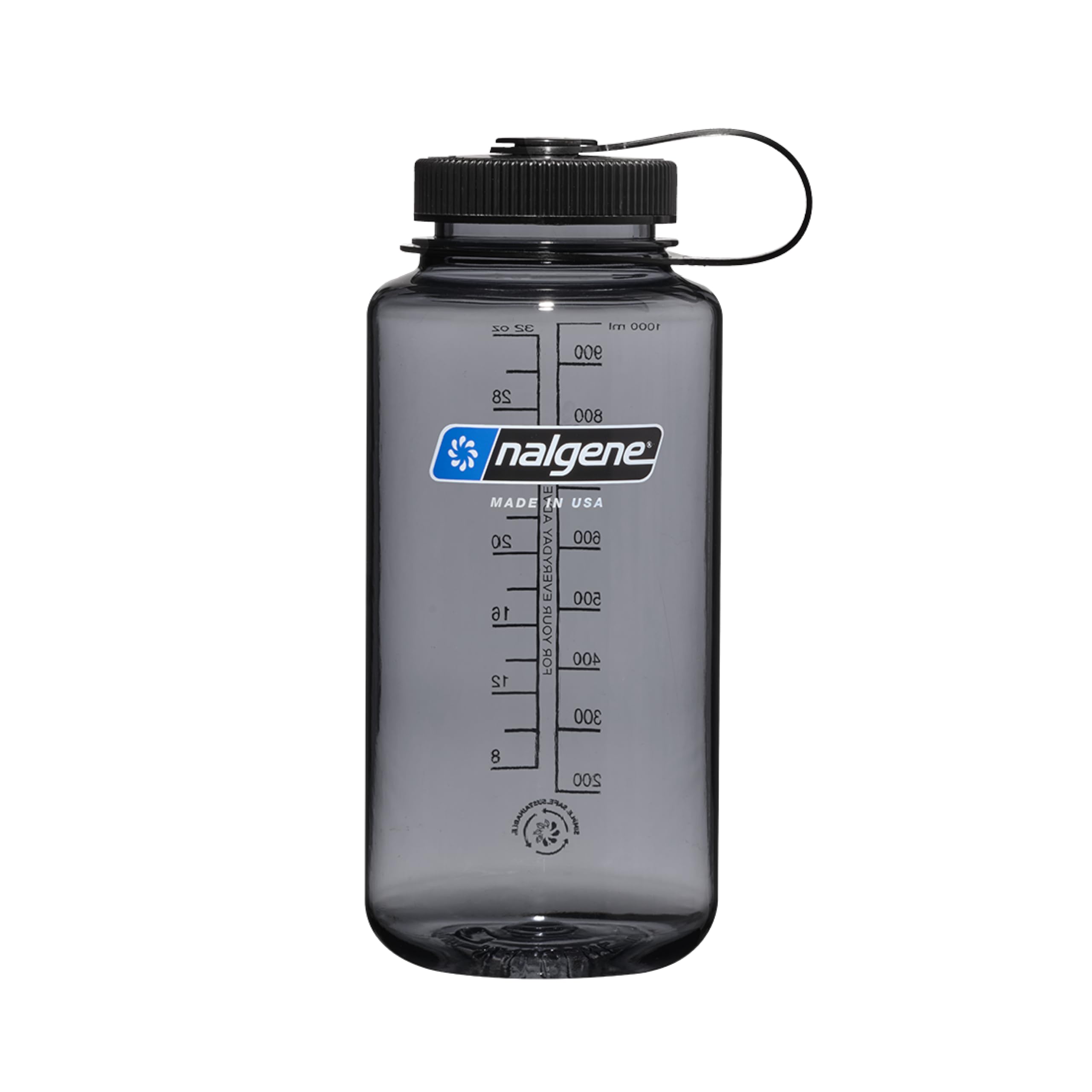
There is no insulation here at all, and that is the reason to buy it. A 32-ounce Nalgene weighs 6.25 ounces empty, so it disappears into a pack, and it does not mind being thrown into a truck bed, dropped on rock, or filled at a trailhead tap.
The Tritan Renew body is free of BPA, BPS and phthalates, goes in the dishwasher, and is rated from -40F to 212F, so hot tea or camp ramen will not hurt it. The wide mouth takes big ice cubes and a bottle brush, and the measurement markings down the side are genuinely useful when you are mixing drink powder in the dark.
We reach for this one when weight matters and the water will not sit in the sun for eight hours. Six ounces on your back beats a heavy insulated bottle on a long climb, and you refill more often because refilling is cheap. What you give up is temperature: the water goes lukewarm by afternoon and tastes like the day. For a hike that is a fair trade; for a workday in a hot truck it is not.
Pros
- Weighs 6.25 ounces empty
- Dishwasher safe with a scrub-friendly mouth
- Handles knocks without cracking
- Rated -40F to 212F for hot and cold
Cons
- Not insulated, so water warms up
- Too wide for most car cup holders
We recommend it to anyone whose bottle goes in a pack and not a cup holder: light, dishwasher safe, and unbothered by being dropped.
Best for Truck and Campsite
YETI Rambler 36 oz
Key Features
- Lid: Chug Cap with handle
- Care: Dishwasher safe
- Capacity: 36 oz
- Material: 18/8 stainless steel
- Price: Premium
A half-twist of the TripleHaul handle opens the Chug Cap, and that is the entire ritual: no lid to unscrew, no straw to lose, no button to find with a glove on. The handle hooks over a finger, the 36-ounce body is 3.75 inches across, and both bottle and cap go in the dishwasher.
The dishwasher is what makes the money easier to justify. Only a couple of the insulated bottles here can go straight into the machine, and in our experience that is the difference between a bottle you use every day and one that sits in the sink until the weekend. The chug opening is also wide enough to rinse in a gas station bathroom, which is more of a feature than it sounds.
What you are paying for is insulation, build and finish as much as the name. Bare stainless resists scuffs better than the painted colors, which show scratches and chips around the base. It is also a substantial thing to carry, so it suits a truck, a campsite or a desk more than a long climb. Value is where opinions split, and we understand both sides of that.
Pros
- Half-twist cap opens one-handed
- Bottle and cap are dishwasher safe
- Cold all day and ice still solid
- Handle is easy to hook on a finger
Cons
- The most expensive bottle here
- Painted finishes scratch and dent
We point anyone who wants a bottle that goes in the dishwasher and opens with gloves on to this one; the price is the whole argument against it.
Best for Commute and Gym
Takeya Actives 24 oz
Key Features
- Lid: Insulated spout lid
- Care: Dishwasher safe
- Capacity: 24 fl oz
- Warranty: Limited lifetime
- Price: Midrange
Twenty-four ounces is the size that fits an ordinary life: a 3.25-inch base that drops into most car cup holders, a spout lid with a covered mouthpiece, and a body short enough to stand on a desk without looming over the keyboard. We think this is the insulated bottle to buy if you refill at a cooler rather than carry a day’s supply.
It keeps drinks cold for up to 24 hours, the bottle and lid are dishwasher safe, and a limited lifetime warranty sits behind it. The lid is a screw-on cap with a flip top, so the drinking opening stays small enough to sip from without a straw, and the loop on the cap takes two fingers comfortably. Nothing about it is fussy, which is why it ends up in a bag every morning.
The cap is the part to watch. The plastic around the hinge is what gives out first, and a bottle without its cap is a mug, so do not lever it open or stand the bottle on it. Treat the cap as the wear item and the rest of this bottle will outlast the novelty of buying it.
Pros
- Fits most car cup holders
- Dishwasher-safe bottle and lid
- Covered spout keeps the mouthpiece clean
- Backed by a limited lifetime warranty
Cons
- The cap is the weak point
We send commuters here: 24 ounces that fit a cup holder, a covered spout, and a dishwasher-safe body, with a cap to treat gently.
Best for Long Workdays
Stanley Classic 1.1 qt
Key Features
- Lid: Screw cap doubles as cup
- Care: Hand wash only
- Capacity: 1.1 quarts
- Hot or cold: Up to 24 hours
- Price: Midrange
Picture a bottle the size of a thermos, with a screw cap that doubles as a cup and a hammertone green finish that has looked the same for decades. This Stanley holds 1.1 quarts, stands 14.3 inches tall on a 4.5-inch base, and carries a collapsible handle on the neck.
It is built for the day you do not come back to the truck. Hot or cold for up to 24 hours, 18/8 stainless inside, a powder coat outside that grips wet hands, and a cap that pours without dribbling down the side. Fill it once in the morning and you are done thinking about water until the drive home.
The height is the whole decision. Fourteen inches does not go in a daypack pocket and does not go in a cup holder, and a full one makes a shoulder bag lopsided. None of that matters if it rides in a truck cab, a pack frame or a deer stand, which is exactly where a bottle this size belongs. Buy it for the job site and leave the light bottles for the trail.
What we like most is that it is one vessel for everything: water in July, coffee in November, soup if the day goes long. It is the closest thing in this guide to a canteen, and it is the bottle we would hand to someone who works outside and is tired of refilling.
Pros
- Over a quart for a full workday
- Hot or cold for up to 24 hours
- Screw cap doubles as a cup
- Grippy powder coat and collapsible handle
Cons
- Too tall for bags and cup holders
- Hand wash only
- Handle and cap dent or break
We recommend it for workdays and truck cabs: over a quart, hot or cold all day, and shaped like a canteen rather than a gym bottle.
Best for Light Daily Carry
CamelBak Chute Mag 25 oz

Key Features
- Lid: Magnetic cap
- Care: Dishwasher safe
- Capacity: 25 fl oz
- Empty weight: 5.96 oz
- Price: Budget
The cap is magnetic. Flip it open and it parks on the lid instead of swinging back into your face, which sounds like a small thing until you have drunk from a bottle whose cap has a mind of its own. It is a 25-ounce Tritan bottle, 2.99 inches across and 169 grams empty.
The wide opening is easy to fill and easy to drink from without a straw, the bottle and cap both go in the dishwasher, and a lifetime guarantee sits behind it. It is the least expensive bottle in this guide, which makes it the one to buy two of and leave one in the car.
We like it as the bottle that lives in a bag: light, cheap, and unlikely to be mourned if it goes missing. It is not insulated, so it suits water you will drink within a couple of hours rather than a day in a hot truck, and the cap has to be screwed down fully, not half a turn, or it will weep into a backpack.
Pros
- Magnetic cap stays out of the way
- Dishwasher-safe bottle and cap
- Light and cheap enough to buy two
- Backed by a lifetime guarantee
Cons
- Not insulated
We recommend it as a knockaround bag bottle: light, dishwasher safe, and inexpensive enough that losing one is not a disaster.
Best for Team Sports
Gatorade Squeeze 32 oz (2-Pack)

Key Features
- Lid: High-flow squeeze valve
- Care: Hand wash only
- Pack: 2 bottles
- Capacity: 32 oz each
- Price: Budget
You squeeze, water comes out of the valve, you stop squeezing, it stops. That is the entire interface: no lid to unscrew, no straw, no button, which is why these bottles end up on sidelines and gym floors rather than in hiking packs.
Two 32-ounce bottles come in the pack, with a fast-cap that comes off in a single turn for filling and a high-flow valve that holds water until the bottle is squeezed. That is enough for a game, a practice or an hour on a bike, and the grip is easy to hold with a glove on.
The limits are honest ones. There is no insulation, so the water is warm by the second half. Hand wash only, and anything but water lingers: a sports drink leaves a smell that a rinse will not shift, so keep one bottle for water and one for the rest.
For us these are the pair that lives in the trunk for game day, not the bottle you carry up a mountain. If you want one bottle for everything, spend a little more. If you want two that can be dropped, sat on and handed to a teammate without a second thought, this is the cheap answer and it is a good one.
Pros
- Two 32-ounce bottles per pack
- High-flow valve works one-handed
- No lid to unscrew mid-game
- Cheap enough to keep a spare
Cons
- Not insulated
- Hand wash only; sports drinks linger
We keep a pair in the car for game days: squeeze, drink, no lid to lose, and no insulation to worry about.
How We Tested These Water Bottles
We built the shortlist by looking at bottles made for daily carry—roughly 18 to 32 ounces—then filtering by lid style, insulation, replacement parts, and whether the shape was likely to fit a car cup holder or a backpack sleeve. That left 12 bottles, which we used for six months.
Every bottle went through a normal week, not a lab bench: desk refills, commutes, gym sessions, weekend hikes, and one long road trip. We filled each with ice water at 7 a.m., checked the temperature at lunch and again at 4 p.m., then sealed and shook it and left it upside down on a towel for 20 minutes. We also opened and closed each lid one-handed while walking, counted how many turns a screw cap took, and washed the lids by hand to see whether water got trapped in the spout or gasket.
Size got checked against real life: car cup holders, bike cages, backpack side pockets, and the weight of a full bottle in hand. We dropped each one from counter height onto concrete and looked at dents, cracked lids, stretched gaskets, and scratched finishes. For color and appearance, we lined them up in daylight, then looked again after a month of washing to see which finishes still looked clean. The bottles that rose to the top were the ones that sealed, poured, and cleaned without drama.
How to Choose a Water Bottle for Men
Start with how long you are away from a tap, then let the lid, the care routine and the cup holder decide the rest.
Capacity: How Long You Are Away From a Tap
Twenty-four ounces covers a gym session or a commute. Thirty-two ounces gets a man through a half day of ordinary errands. Forty ounces and up is for a full shift, a long hike, or a day when refilling is not on the schedule.
The trap is treating capacity as free. Every extra ounce is weight in a pack and width on a counter, and the biggest bottles are the ones that miss cup holders and pack pockets. Count how many times a day you actually pass a water fountain, then buy for the gaps.
Insulation: What the Extra Money Buys
A vacuum-insulated stainless bottle holds cold for up to a day and keeps condensation off the outside, which matters if the bottle rides on a desk or a passenger seat. A single-wall bottle like the Nalgene weighs a fraction as much and costs less, but the water takes on the temperature of the room it is sitting in.
We think insulation is worth paying for if the bottle lives in a hot truck or you fill it once in the morning. If you drink it within a couple of hours, single-wall is lighter on your back and easier on your wallet, and the difference is smaller than the marketing suggests.
Lids Decide How Much You Actually Drink
A straw lid lets you drink without tipping the bottle, which is why it wins at a red light or on a treadmill; the trade is a spout that must be clicked shut before the bottle goes into a bag. A chug cap moves more water faster but wants a free hand. A screw cap with a cup, like the Stanley’s, is slower to use and better for pouring.
Pick the lid for the moment you drink most often, not for the one you imagine. If you have ever left a bottle on a desk because opening it was a hassle, a push-button lid is the feature worth paying for.
Cleaning Is the Habit That Decides Whether You Keep Using It
Dishwasher-safe bottles get used; hand-wash-only bottles end up in the sink with yesterday’s water in them. Several picks here are hand wash only, and that is fine if you have a bottle brush and a two-minute routine. If you know you will not scrub, buy one of the dishwasher-safe ones and skip the rest of this paragraph.
A wide mouth is the other half of the story: it takes a brush, takes ice from a machine, and rinses out in seconds. Narrow-necked bottles look tidier and are the ones that grow things in the gasket.
What Survives a Drop
Stainless steel dents where plastic cracks, and a dented bottle still holds water. Painted finishes chip at the base and around the rim; bare stainless hides scuffs better. The parts that actually fail are the caps, straws and handles, so look at how thick the hinge and handle are before you fall for the color.
Check the lid you will use most, not the spare: a bottle with a broken cap is a cup. Treat the cap as the wear item and the body as the part that lasts.
Frequently Asked Questions
How do I get a plastic or metal taste out of a new water bottle?
Fill it with warm water and a spoonful of baking soda, let it sit a few hours, then rinse and dry it with the lid off. A half-and-half mix of white vinegar and water does the same job for stainless steel.
If the taste comes back after two rounds, the smell is in the lid gasket rather than the bottle. Pull the gasket and the straw out, soak them separately, and let everything air dry before it goes back together.
Can I put coffee or a sports drink in an insulated bottle?
Yes, with one habit: rinse it the same day. Coffee oils and the sugar in sports drinks are what leave a taste behind, and a wide-mouth bottle rinses clean at any sink in under a minute.
Hot coffee is fine in a vacuum bottle like the Stanley, which is built for it. In a single-wall bottle, hot liquid makes the outside hot to hold, so wrap it or wait.
How do I carry a 40 oz bottle on a hike or a bike?
Plan on carrying it outside the pack. A 40-ounce insulated bottle is usually too wide for a side pocket and too fat for a bike cage, both of which are built around roughly 3-inch bottles.
Look for a lid with a carabiner loop or a molded handle: the Iron Flask’s straw lid clips to a shoulder strap, and the YETI’s TripleHaul handle hangs off a finger or a lash point. If your pack pockets are tight, a 32-ounce bottle is the easier carry.
Final Verdict
If you want one bottle and no further decisions, buy the Iron Flask 40 oz. It holds a day of water, keeps it cold, and the straw lid clips to a pack; hand wash it and click the spout shut and it will do everything else you ask.
Pay more for the YETI Rambler 36 if the bottle has to go in the dishwasher and open with a gloved hand. Take the Nalgene instead if you are counting ounces on a long hike and can live with water that warms up by afternoon.