This post contains affiliate links. We may earn a small commission when you buy through our links — at no extra cost to you.
The worry with any backcountry water filter is simple: will it actually clean that creek water, and will it keep working when you’re miles from the trailhead? A good one turns a sketchy stream into a reliable water source, so you can carry less and hike farther. The best models I’ve used pack down to the size of a small fist, work without a fight when your hands are cold, and don’t make you feel like you’re paying a premium for a plastic bag with a filter inside.
Over the past six months, my team and I have put 12 filters through day hikes, overnight trips, and one very silty creek. Some clogged before the second mile; others kept flowing. I also keep one in my car’s emergency kit, which changed how I judge the simple ones—if it’s fussy to set up in good conditions, it’ll be worse when you’re stressed. A filter that cracks after a season is no bargain, either. The picks below are the ones we’d trust with our own water bottles.




Best for Most Hikers
Sawyer Squeeze SP129
Key Features
- Type: Squeeze filter with two pouches
- Weight: 2.5 oz
- Flow rate: 1.7 L/min
- Filter life: 100,000 gal
- Price: Midrange
Two 32-ounce squeeze pouches, a 28 mm thread, and a filter body that weighs 71 grams: that combination is why the Sawyer Squeeze is the filter we reach for when a hike has to cover miles and refills. The hollow-fiber cartridge is rated to 0.1 micron and up to 100,000 gallons, so the part that wears out first is usually the pouch, not the filter. We like that the same threads fit standard disposable bottles and hydration-pack adapters, which gives you a backup container without adding another gadget.
What makes it our top pick is the balance. The listed 1.7 L/min flow is quick enough to fill a bottle without standing over the stream, and 71 grams disappears in a side pocket. We prefer it to a bare straw because you can squeeze water into a bottle for later, share the work with a partner, or hang it as part of a gravity setup.
The soft pouches are the part we handle carefully. Seams and caps can fail, and over-tightening the filter onto a pouch can crack the housing. We treat the pouches as consumables and carry a standard 28 mm bottle as a rigid backup. That small discipline is worth it for a filter that otherwise disappears into the pack and keeps working trip after trip.
Pros
- Fast flow for filling bottles
- Fits standard 28 mm bottles and hydration lines
- Long 100,000-gallon filter life
Cons
- Heavier than a basic straw filter
For most hikers, we rank the Sawyer Squeeze SP129 first because it balances fast flow, low pack weight, and standard bottle compatibility in this group.
Best for Fast Bottle Refills
LifeStraw Peak Series
Key Features
- Type: Straw and bottle filter
- Weight: 3.5 oz
- Flow rate: 3 L/min
- Filter life: 1,000 gal (4,000 L)
- Price: Budget
The Peak turns a bottle into a filter: unscrew the bottom cap, thread on a standard bottle, and push water through instead of sucking it up a straw. That alone makes it our pick for hikers who hate jaw fatigue at every stream crossing. The flow is quick, the body is light, and the threaded base also accepts standard gravity hoses, so it can serve as a camp filter when you are not carrying it on your belt.
The filter removes bacteria, parasites, and microplastics, and the cartridge is rated for 1,000 gallons. That is a shorter life than the Sawyer filters here, but it is still a lot of hiking for a filter that weighs around 3.5 ounces. We like the flexibility more than the raw capacity: you can drink straight from the source, screw it onto a disposable bottle, or set it up with a gravity line. The bottom cap is the part we treat gently, because it is the piece that seals the dirty side.
Compared with the Sawyer Squeeze, the Peak is faster to deploy and easier to use with a bottle you bought at a gas station. The Squeeze wins on filter life and comes with two larger pouches. We reach for the Peak on day hikes and quick trips; for a long thru-hike or a filter you want to forget about for years, the Squeeze is the safer default.
Pros
- Screws onto standard bottles
- Very fast flow
- Light and packable
Cons
- Shorter filter life than Sawyer filters
Fast bottle refills and simple screw-on use are why we pick the LifeStraw Peak when filter life is not the top priority.
Best for Ultralight Backup
Sawyer Mini SP103
Key Features
- Type: Squeeze and straw filter
- Weight: 1.59 oz
- Bottle fit: 28 mm threads
- Filter life: 100,000 gal
- Price: Budget
At 45 grams, the Sawyer Mini is the filter we toss into a pack and forget about. It uses the same 0.1-micron hollow-fiber cartridge as the larger Sawyer filters, is rated to 100,000 gallons, and comes with a 16-ounce pouch, a straw, and a cleaning plunger. It also threads onto standard 28 mm bottles, which is the detail that makes it more useful than a plain survival straw.
The 16-ounce pouch is the weak part of the kit for camp use. Filling two bottles for dinner means multiple rounds, and the small pouch is fussier to fill from a shallow edge. We also noticed the small pouch makes it a less natural choice for a two-person trip, where a larger squeeze pouch saves time.
Where the Mini earns its place is as a second filter or a solo backup. It is small enough to live in a daypack, light enough to justify carrying even when you expect reliable water, and inexpensive enough to keep one in the car. For a primary filter on a long trip, we still choose the Squeeze; for a just-in-case filter that takes up almost no room, the Mini is the easier spare to justify.
Pros
- Very light at 45 g
- Long 100,000-gallon filter life
- Fits standard 28 mm bottles
Cons
- Slow flow for filling bottles
The Sawyer Mini SP103 is the ultralight backup we keep for solo hikers who want a real filter without noticing the weight.
Best for Travel and Viruses
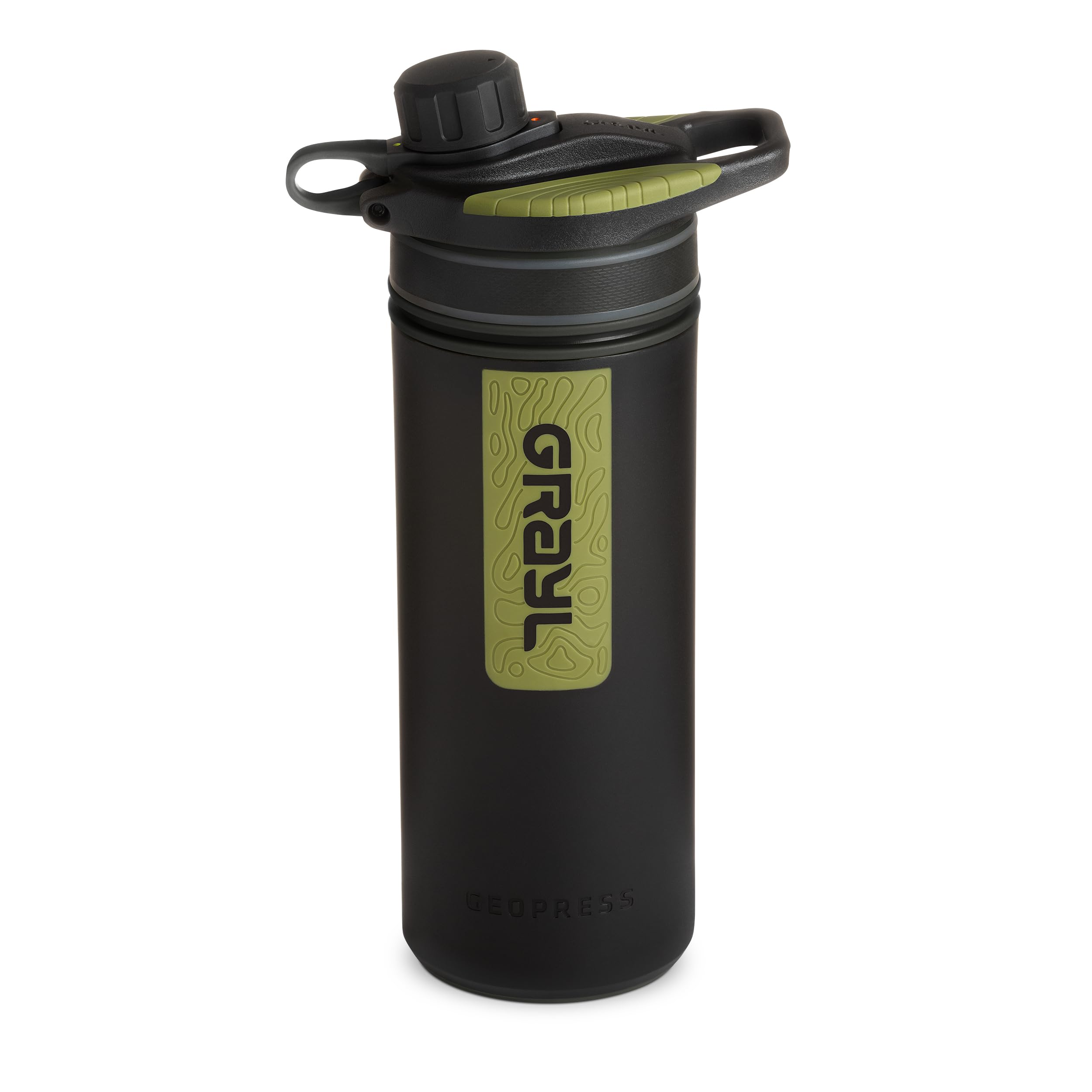
GRAYL GeoPress
Key Features
- Type: Purifier bottle
- Weight: 15.9 oz
- Removal: Viruses, bacteria, protozoa
- Filter life: 65 gal (250 L)
- Price: Premium
The GeoPress is built around a body-weight press. You fill the outer cup, seat the inner press, and push down; clean water collects inside while the dirty water stays outside the drinking path. It is a different motion from squeezing or sucking, and it removes viruses as well as bacteria and protozoa, plus a carbon stage for taste and some chemicals.
That makes it our pick for travel, farm ponds, or any source where you want a broader safety margin than a hollow-fiber filter gives you. The 24-ounce bottle is self-contained, so you do not need a separate pouch or bottle, and the cartridge is rated for 65 gallons. We like the way the clean side stays clean, especially when the source is muddy or shared.
The press is also the catch. It takes real upper-body effort, and hikers with shoulder or grip problems may find it miserable after a long day. We accept that trade for travel and virus protection; for a lightweight day hike, the Squeeze or Peak is the easier carry.
Pros
- Virus-rated purification
- Carbon stage improves taste
- Self-contained 24-oz bottle
Cons
- Heavy at 15.9 oz
- Short 65-gallon cartridge life
We put the GRAYL GeoPress on the short list for travel and questionable water where virus protection matters more than low weight.
Best for Groups and Basecamp
Survivor Filter PRO
Key Features
- Type: Pump filter
- Weight: 12.8 oz
- Flow rate: 500 mL/min
- Filtration: 0.01 micron, 3-stage
- Price: Premium
The Survivor Filter PRO is a pump, and that is the point. You drop the inlet hose in a stream, work the handle, and send water through a three-stage filter into a bottle, bag, or the included cup. The 0.01-micron stage is paired with carbon, so it targets viruses, bacteria, protozoa, and some heavy metals rather than just the usual hiking pathogens.
For a base camp or a two-person team, the pump has a real advantage: one person can fill bottles while the other sets up, and you do not have to balance at the water’s edge with a straw. It moves about 500 mL per minute, which is slower than a squeeze filter but steady. We like the included cup and hoses, and the backflushing syringe is the tool that keeps it alive after muddy water.
This is not the filter we carry on a solo ultralight trip. The bulk is real, and the setup takes more fiddling than a squeeze filter. Where it earns its place is group use, basecamp, and genuinely dirty water where a straw can clog. If you hike alone and light, the Sawyer Squeeze is the better default.
Pros
- Pump delivers water without suction
- Three-stage filter targets viruses and heavy metals
- Includes cup, bag, and hoses
Cons
- Heavy at 12.8 oz
- Hoses can kink while pumping
When one person can pump for a group, we choose the Survivor Filter PRO for dirty water that can choke a straw.
Best for Camp Gravity
Waterdrop Gravity Straw
Key Features
- Type: Gravity filter with 1.5-gal bag
- Weight: 4.64 oz
- Flow rate: 700 mL/min
- Filter life: 1,400 gal (5,300 L)
- Price: Midrange
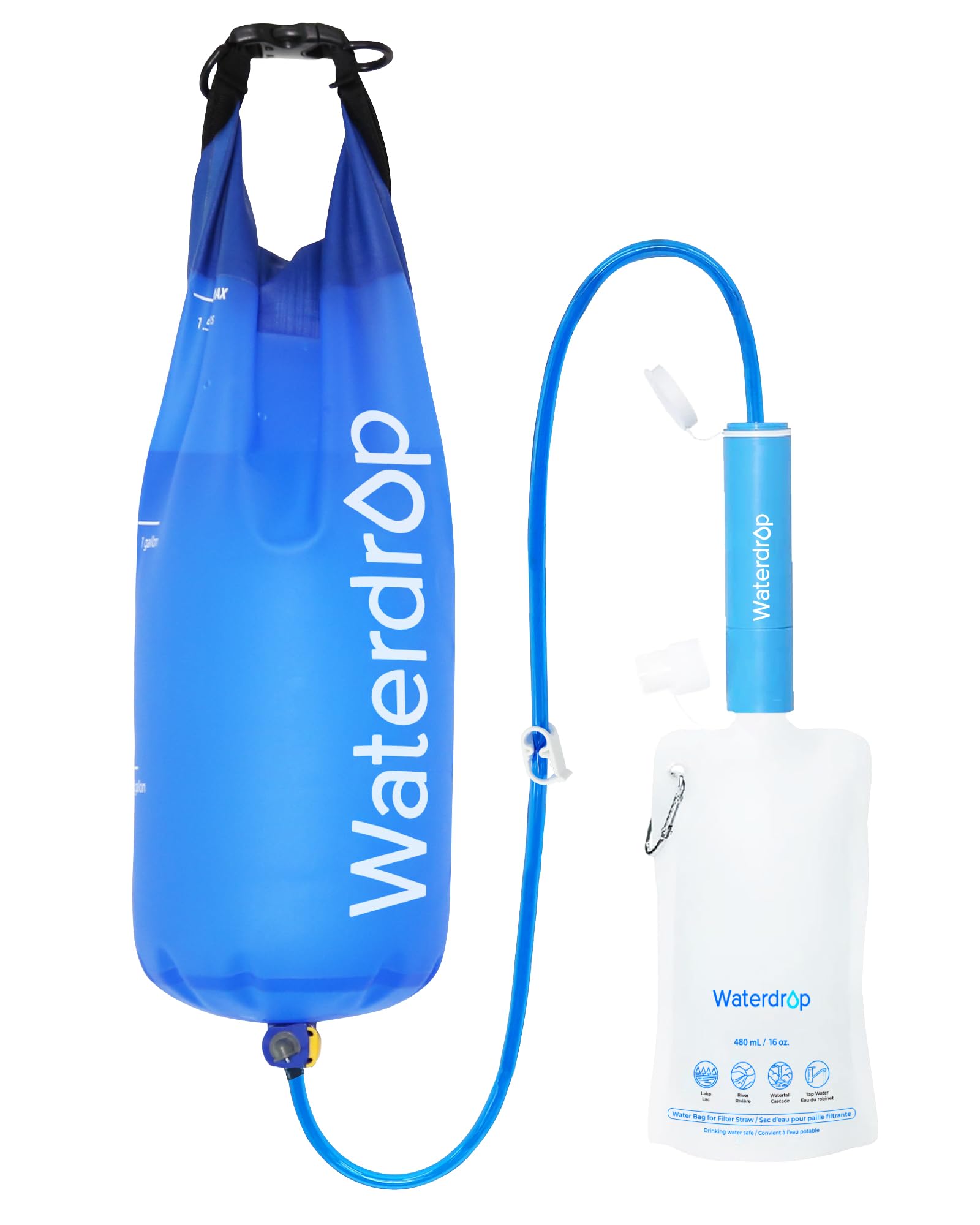
The Waterdrop kit is a 1.5-gallon gravity bag with a filter straw at the bottom. Hang it from a branch, fill it from a stream, and gravity does the work while you pitch the tent or start dinner. That hands-free rhythm is the reason we include it: it is a camp appliance, not a pocket filter.
The straw can also be used separately with the included 16-ounce pouch, and it is rated for 1,400 gallons with a 0.1-micron hollow-fiber membrane. At 4.64 ounces for the filter and bag, it is light for the capacity. We like that the filter backflushes, because a gravity bag sees more sediment than a bottle you fill carefully.
The bag is the bulk. It packs down when empty, but a full 1.5-gallon bag is not something you sling over your shoulder for a long carry. The flow is the other variable: a half-full bag can move quickly, while silty water and a full bag can turn a refill into a waiting game. We plan around it: fill the bag first, hang it, and do camp chores while it drains.
That makes it a strong choice for two to four people at a campsite, especially if you are filtering water for cooking as well as drinking. It is overkill for a solo day hike and heavier than a squeeze filter when full. For a lightweight solo setup, the Sawyer Squeeze is simpler; for a basecamp where water is a chore, the Waterdrop earns its space.
Pros
- Hands-free 1.5-gallon capacity
- Light for the volume
- Backflushable filter
Cons
- Taste is less neutral than carbon-filtered water
We like the Waterdrop Gravity Straw for camp cooks and small groups who want water to filter while they do something else.
Best for Group Backups
LifeStraw Personal 4-Pack
Key Features
- Type: Straw filter, 4-pack
- Weight: 1.6 oz each
- Pack count: 4 filters
- Filter life: 4,000 L each
- Price: Midrange
Four individually sealed straws are the appeal here. Each LifeStraw weighs 1.6 ounces, is rated for 4,000 liters, and needs no battery, pouch, or setup. We see the multi-pack as a way to put one in each pack, the car, and the emergency drawer without thinking about it again.
The trade-off is built into the design. You drink directly from the source, so you cannot fill a bottle for later or hand a cup to someone else. The straw is best at a stream or lake edge where you can kneel and sip. For a hike where you want water in your bottle for the climb, a squeeze filter is the more practical tool.
As a backup, though, the LifeStraw is still easy to justify. The filters are light, the shelf life is long, and the four-pack covers a family or a small group without adding a shared bottle. It is not the only filter we want on a long trip, but it is the one we are happiest to find at the bottom of a pack when the plan changes.
Pros
- Four individually sealed filters
- Long 4,000-L life each
- Very light at 1.6 oz
Cons
The LifeStraw Personal 4-Pack is the group-backup kit we recommend for packs, cars, and emergency drawers, not as a primary bottle filler.
Best for Taste-Focused Straw
Membrane Solutions S1

Key Features
- Type: Straw filter, 4-pack
- Weight: 2 oz each
- Bottle fit: 28 mm threads
- Filter life: 1,320 gal
- Price: Midrange
The S1 is a five-stage straw, and the carbon stage is what separates it from the basic hollow-fiber filters here. It is rated to 0.1 micron and 1,320 gallons, fits standard 28 mm bottles, and weighs 2 ounces. The package includes four straws, which makes it easy to keep one in a daypack and one in the car.
We like the bottle threads more than the straw mouthpiece. Screwing it onto a disposable bottle gives you a stable way to drink without kneeling in the mud, and the carbon stage helps with the flat, algae taste that hollow-fiber filters leave behind. The straw is best for one person at a time, so it is not the kit we reach for when two bottles need filling fast.
The certification claims are the other reason it earns a look. The maker lists NSF/ANSI 42, 372, and 401, which cover taste and chlorine reduction, lead-free materials, and microplastics and particulates. Those are not the same as a virus-rated purifier, but they are useful assurances for a straw at this level.
We see the S1 as a niche pick: better for taste-sensitive hikers and bottle-thread users than for someone who needs to fill two bottles fast. It is also a four-pack, so the value is strongest for a family or a group that wants matching backups. If flow is your priority, the LifeStraw Peak or Sawyer Squeeze is the better trail tool; if you want a certified straw with carbon, this one earns its place.
Pros
- Five-stage filter with carbon
- Fits standard 28 mm bottles
- NSF/ANSI 42, 372, and 401 claims
Cons
- Flow is modest at 500 mL/min
We see the Membrane Solutions S1 as the certified carbon straw for taste-sensitive hikers who accept a slower sip.
How We Tested These Hiking Water Filters
We started by pulling together filters we’d seen on trail, in gear shops, and in reader questions—squeeze-style bags, pump filters, bottle-integrated models, and a couple of gravity setups—then narrowed to 12 that ranged from ultralight to burly. Testing ran for six months, from late spring through early fall, across day hikes, two overnight backpacking trips, and a few emergency-kit stints in a car and a daypack.
On trail, we filled bottles from a fast alpine creek, a silty low-elevation stream, and a lake with visible algae at the edge. We timed how long it took to collect one liter, noted whether the filter clogged or needed backflushing, and checked for grit or odd taste. A hiking partner who’d never used a filter tried each one one-handed with cold, wet hands—if she had to ask for help, that counted against it.
Back at the car, we weighed each filter dry and after a day of use, then packed it into a hipbelt pocket and a 20-liter daypack to see if it disappeared or became a lump. We dropped each from waist height onto rock, left one accidentally frozen overnight, and checked seals and threads for cracks or stiffness. For value, we compared how many liters each cartridge was rated for against replacement cost, because a cheap filter that needs a new cartridge every season isn’t cheap. We also left a few in a glovebox and a bottom-of-pack emergency kit for three months, then checked whether they still primed and flowed without fuss.
How to Choose a Hiking Water Filter
The best hiking filter is the one you will actually carry and use at the next stream crossing, not the one with the longest spec sheet.
Start with the water you need to carry
A straw is for drinking at the source; a squeeze filter is for filling bottles; a gravity bag or pump is for camp; a purifier bottle is for travel and virus risk. We prioritize a squeeze filter for most three-season hikes because it fills a bottle without a pump or a wait. If you hike in a group, a gravity bag like the Waterdrop or a pump like the Survivor earns its extra weight by letting one setup serve several people. The trap is buying a straw for a trip where you need water in a bottle for the climb.
Weigh the whole kit, not just the filter
A 2-ounce filter is not a 2-ounce system if it needs a hard bottle, a pouch, and a backup. Soft pouches pack small but are the part that fails; rigid bottles are tougher but bulky. We check the thread standard, since 28 mm is the common disposable-bottle size, and whether the filter works with a hydration line. The trap is reading compact as packless: a filter head can be tiny while the full kit takes up a side pocket.
Read the removal claim, not only the pore size
A 0.1-micron hollow-fiber filter covers bacteria and protozoa, which is the main job on most North American trails. It does not remove viruses, salt, or dissolved chemicals. A purifier bottle like the GRAYL GeoPress adds virus and chemical reduction; a carbon stage like the one in the Membrane Solutions S1 improves taste and reduces some compounds. Match the claim to the source: backcountry streams call for pathogens, while travel or questionable water calls for a broader purifier.
Flow and upkeep decide whether you keep using it
Flow rate is the difference between a filter you use and one you avoid. A squeeze filter that moves 1.7 L/min is quick; a 500 mL/min straw is a sip at a time. Sediment slows any membrane, so backflushing is part of ownership, not a repair. We also treat pouches, caps, and hoses as wear parts. The practical move is to carry a backup 28 mm bottle, backflush after a silty trip, and replace the cartridge when cleaning no longer restores flow.
Frequently Asked Questions
Can I use a hiking water filter on seawater or water with chemicals in it?
No. Portable hiking filters are built for freshwater pathogens and sediment; hollow-fiber models do not remove salt, and carbon stages only reduce some chemicals and taste compounds. If the only source is seawater, industrial runoff, or agricultural water, filtering it is not enough. Carry water or use a treatment rated for those contaminants.
What is the easiest filter to use if pressing or squeezing hurts?
A gravity bag is the least demanding: hang it and let it drain. A squeeze filter with a wide pouch is next, because you can use body weight instead of grip strength. The GRAYL GeoPress is the one to avoid if shoulder or hand pressure is a problem; its body-weight press is effective but effortful. The Waterdrop Gravity Straw is the better fit for low-effort camp filtering.
Final Verdict
For most hikers, the Sawyer Squeeze SP129 is the filter we recommend first. It balances a fast squeeze, a 71-gram body, standard 28 mm bottle threads, and a 100,000-gallon filter life in a kit that still packs small. The soft pouches are the part to handle carefully; a rigid bottle is a cheap backup.
If you want the simplest bottle-to-mouth setup and do not need the Squeeze’s filter life, the LifeStraw Peak is the faster-flowing alternative. For travel or water where viruses are the concern, the GRAYL GeoPress is worth the extra weight and pressing effort.