This post contains affiliate links. We may earn a small commission when you buy through our links — at no extra cost to you.
Bad-tasting water is annoying; water you can’t trust is a different problem. A portable filtration system is what lets you fill a bottle from a trailside stream, a hotel tap, or your own kitchen sink during a boil-water notice without hauling gallons home. I’ve used filters that made clean water feel easy and others that clogged, leaked, or stayed buried in my pack, and the good ones get the unglamorous details right — not just the pore size printed on the box.
Over the past six months, my team and I have put 14 portable systems through hikes, road trips, everyday sink duty, and a staged boil-water drill. We paid attention to whether each one survived being tossed in a bag, whether it was simple enough to operate when we were tired or rushed, and whether the water tasted clean rather than merely “filtered.” Price mattered only when it lined up with how much water a system could treat before a cartridge swap, because value in this category is never just the sticker.


Best for All-Round Trips
Sawyer Squeeze SP129
Key Features
- Weight: 2 oz
- Methods: Squeeze, straw, bottle, gravity
- Rated capacity: 100,000 gallons
- Filter pore size: 0.1 micron
- Price: Midrange
The thread is the thing. Both ends of this filter take a standard 28 mm bottle top, so a soda bottle from a gas station becomes a filter bottle, the 32-ounce pouches in the box become squeeze reservoirs, and the little adapter turns the whole thing into an inline stage for a hydration bladder. We kept finding new uses for it: squeeze into a bottle for dinner, hang the pouch from a branch and let gravity work while we pitched the tent, or drink straight through the pop-up cap on a break.
At two ounces with a 100,000-gallon rating, the filter itself is the least dramatic part of the kit in the best way — you stop thinking about it. It’s a 0.1-micron hollow-fiber membrane, the same class as the straws here, so it handles bacteria, protozoa, and microplastics. What separates it is what happens next: you can fill a bottle for the climb instead of drinking where you kneel.
The soft pouch is the weak link, not the membrane. Collapsible pouches are the first thing to go on any squeeze system, and we treat these as consumables rather than trusting them for a third season. Screw the filter onto a rigid bottle with standard threads and the issue stops mattering. Snug is tight enough, by the way — overtightening is how housings crack, and the lifetime warranty covers defects rather than enthusiasm.
Set against the LifeStraw, this is the filter for someone who wants water in a container. Set against the Survivor pump, it’s less work in clear water and much less capable in mud. For three-season hiking with decent streams, that’s an easy trade to make.
Pros
- Threads onto standard 28 mm bottles
- Squeeze, straw, bottle, gravity, or inline from one unit
- Rated for 100,000 gallons
- Two ounces in a pack
Cons
- No stated virus or chemical reduction
The most versatile filter in this group: it screws onto a soda bottle, squeezes from a pouch, hangs as gravity, or runs inline. We recommend it as the one filter to own if you only own one.
Best for Emergency Kits
LifeStraw Personal 4-Pack
Key Features
- Weight: 1.6 ounces each
- Pack count: 4 filters
- Filter type: Hollow fiber straw
- Rated capacity: 4,000 liters each
- Price: Midrange
A four-pack solves a problem single filters don’t: you stop rationing. One goes in the car, one in the daypack, one in the emergency bin, and one gets handed to whoever forgot theirs. Each straw is sealed in its own wrapper, which matters more than it sounds — a filter that has rattled loose in a pack for two years is a filter you’re trusting on faith.
Using one is as simple as it gets: unscrew the cap, put the mouthpiece in, drink from the source. That’s also the boundary. You’re kneeling at the creek rather than filling a bottle for later, and the posture gets old on a hot afternoon. We treat this as the backup and the emergency tool, not the only filter in a hiking kit.
What keeps it in our packs is the weight and the forgetting. At 1.6 ounces with a 4,000-liter rated life and no moving parts, there is no good reason for a glovebox or a storm drawer to be without one. The first few sips from a new straw taste flat and plasticky, so purge it once before you rely on it; after that it disappears into the kit until the day it matters.
Pros
- Four individually wrapped straws to spread across kits
- 1.6 ounces each, with no setup or charging
- 4,000-liter rated life per filter
- Drinks straight from the source, no bottle needed
Cons
- Straw only — cannot fill a bottle or a camp pot
Four sealed straws that need no setup, no charging, and no bottle — buy the pack, put one in each bag, and stop thinking about water.
Best for Bottle-Top Sipping
Membrane Solutions S1 4-Pack
Key Features
- Weight: 2 ounces each
- Certification: NSF/ANSI 42, 372, 401
- Rated capacity: 1,320 gallons each
- Filter pore size: 0.1 micron
- Price: Budget
The pitch here is certification plus carbon. This straw carries NSF/ANSI 42, 372, and 401 testing — chlorine and taste, lead-free materials, microplastics — and backs its hollow-fiber membrane with a coconut-shell carbon stage. In practice, creek water comes out tasting like water rather than like the creek, which is the difference between a filter you use and one you avoid.
At two ounces and 7.1 inches it slides into a bottle cage or a hipbelt pocket, and the 28 mm threading means it screws onto a standard bottle instead of demanding you kneel. Four to a pack at the lowest per-filter cost in this roundup makes it the sensible way to kit out a family or a scout troop — we hand these out before we hand out anything more expensive.
One caution: the durability picture is uneven. The rated life is 1,320 gallons per straw, and a straw that stops passing water well before that is a possibility rather than a certainty. Test one at the kitchen sink before a trip, flush it after silty water, and keep the receipt; the one-year warranty is the recourse if a unit quits early.
Pros
- NSF/ANSI 42, 372, and 401 tested
- Carbon stage improves the taste of dull water
- Fits any 28 mm threaded bottle
- Lowest cost per filter in this roundup
Cons
- Filter life can fall well short of the 1,320-gallon rating
Four certified straws with a carbon stage that fixes the taste of questionable water — the lowest cost per filter here, and the pack we hand out to a group.
Best for Muddy Water
Survivor Filter PRO Pump
Key Features
- Weight: 12.8 oz
- Flow rate: 500 ml per minute
- Rated capacity: 100,000 liters
- Filtration stages: Three, down to 0.01 micron
- Price: Premium
Every straw here shares a blind spot: it’s only as good as the water you’re willing to put your mouth near. The Survivor PRO sidesteps that. Drop the inlet hose into a silty creek, work the handle, and water lands in your bottle or the included cup — no kneeling, no sucking, no grit in your teeth.
The filtration stack is the most thorough in this group: a 0.1-micron pre-filter, a carbon stage for heavy metals and chemicals, and a 0.01-micron final membrane, with a stated virus claim that none of the straws make. Every stage is replaceable, and the whole assembly weighs 12.8 ounces — the heaviest filter here, and the price of being able to process water a straw can’t.
Pumping is work, and 500 ml a minute is a claim rather than a promise once the cartridge starts loading. The mechanism is also the part that can fail: a pump that stops priming leaves you with nothing to drink, so we carry a two-ounce straw as insurance whenever this is the primary filter. The lifetime defect warranty is genuine comfort, but it doesn’t help you a day’s walk from the trailhead.
Pros
- Handles muddy, silty water a straw chokes on
- 0.01-micron final stage with a virus claim
- Fills a bottle or the included cup
- Replaceable stages and a lifetime defect warranty
Cons
- Heaviest filter here at 12.8 ounces
- Hoses kink if they are not routed carefully
The pick for water you normally walk past: a three-stage pump with a 0.01-micron final filter that turns muddy creek water into something you can bottle.
Best for Basecamp Gravity
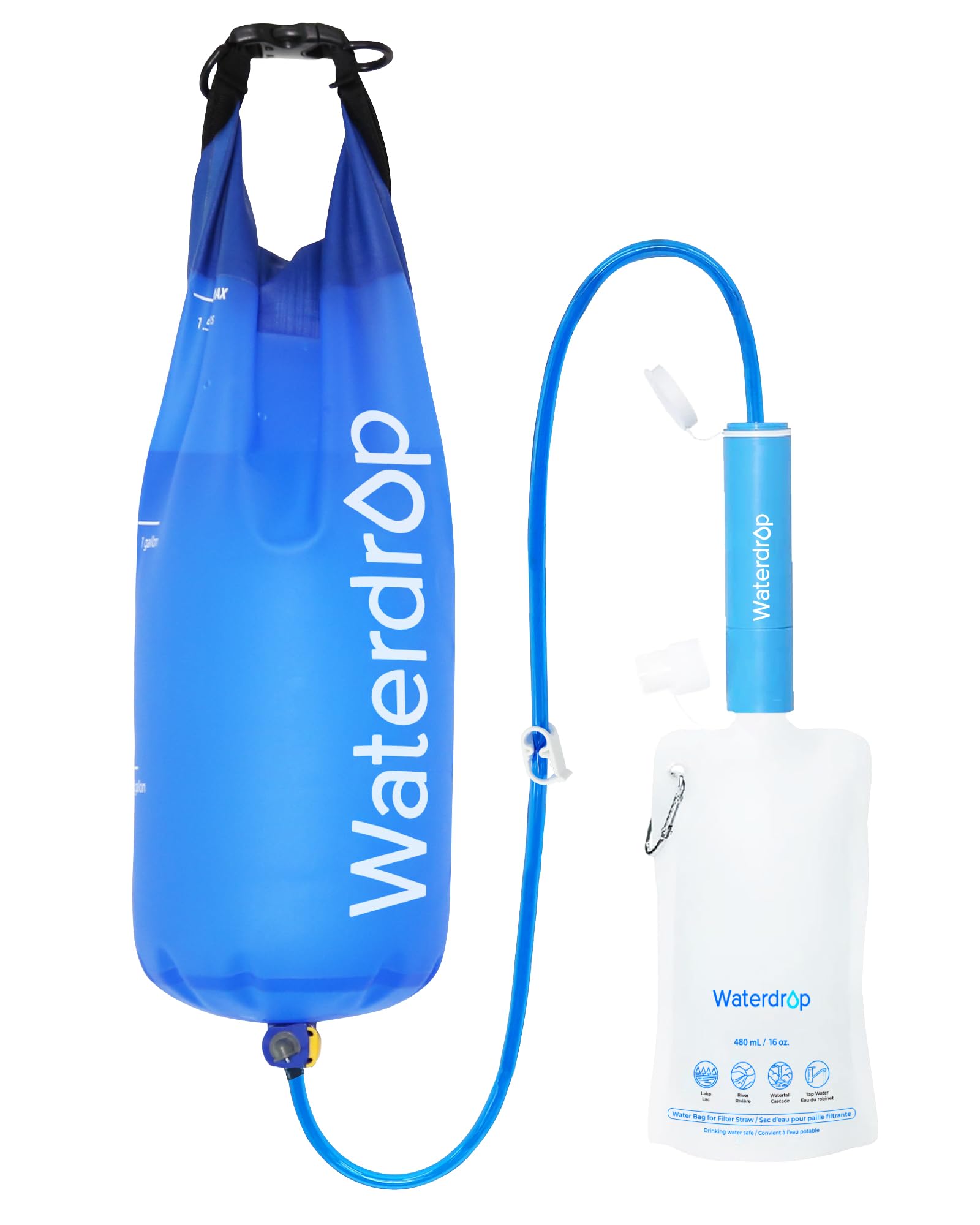
Waterdrop Gravity Filter Straw
Key Features
- Flow rate: 700 ml per minute
- Gravity bag: 1.5 gallons
- Maximum TDS: 300 ppm
- Rated capacity: 1,400 gallons
- Price: Budget
Gravity is the least glamorous way to filter water and the one we reach for at camp. Fill the bag, hang it from a branch, and the filter does the work while you cook. The 1.5-gallon reservoir covers a two-person day of drinking and cooking, and it rolls down small enough to vanish into a pack when it’s empty.
The straw itself is a five-stage hollow-fiber unit rated for 1,400 gallons, with a backwash function that keeps it running. It also unhooks, so you can use it on a bottle or the included 16-ounce pouch on a day hike away from camp. That flexibility is why it beats a bigger one-piece gravity system for a pair of hikers.
Speed is the split personality. Clear water moves at a decent clip; add algae or silt and it slows to a trickle, which is the standard gravity-filter story and the reason the backwash function earns its place. The carbon stage helps with taste, though it won’t rescue a bad source.
The number we keep coming back to is the 300 ppm TDS ceiling — the lowest in this group by a wide margin. That rules out mineral-heavy wells, some desert springs, and runoff near roads or fields. For clear mountain water it’s a light, inexpensive, genuinely restful system; for anything with dissolved solids in it, the pump is the better tool.
Pros
- 1.5-gallon bag serves two people for a day
- No pumping or squeezing at camp
- Straw detaches for bottle or pouch use
- Backwash function keeps flow up
Cons
- 300 ppm TDS ceiling is the lowest here
- Only a 30-day filter warranty
Hang the 1.5-gallon bag from a branch in the morning and you have water for two people all day without squeezing anything — provided your source isn’t mineral-heavy.
Best for Long-Term Storage
Practical Survival 5-Pack

Key Features
- Weight: 2 ounces each
- Pack count: 5 filters
- Rated capacity: 1,800 gallons each
- Stated shelf life: 6 years
- Price: Premium
1,800 gallons per straw is the highest capacity of any straw here, and the sealed, long-shelf-life framing is what makes this pack interesting for a vehicle or a basement shelf. Five of them at two ounces apiece, each with a flushing plunger, means one goes in every bag you own and a spare stays in the drawer. This is the pack we leave in the car and forget about, which is precisely the job.
Taste is where it gives ground. There’s no carbon stage, and water from it can carry a plastic note. The capacity and storage figures are also the manufacturer’s claims rather than anything a season of use can confirm. What we can say is that as a stash-and-forget filter the numbers are the most generous in this group, and at two ounces apiece the cost of being wrong is small.
Pros
- 1,800-gallon rated life per straw
- Stated six-year shelf life for storage
- Five filters, each with a flushing plunger
Cons
- No carbon stage, so taste can carry a plastic note
- Most expensive per straw of the multipacks here
If your filter lives in a drawer and needs to work three years from now, this is the pack: five straws, 1,800 gallons each, and a stated six-year shelf life.
Best for Group Outfitting
Sawyer MINI 4-Pack

Key Features
- Weight: 2 ounces each
- Rated capacity: 100,000 gallons each
- Filter pore size: 0.1 micron
- Included pouches: Four 16-ounce pouches
- Price: Premium
Same membrane family as our top pick, different packaging. The MINI is Sawyer’s palm-sized 0.1-micron hollow-fiber filter — two ounces, rated to 100,000 gallons, and able to screw onto a standard bottle or be drunk through like a straw. Four filters, four 16-ounce pouches, four drinking straws, and four cleaning plungers makes a complete kit for a family or a club.
Compared with the Squeeze, the MINI asks more of your hands. The body is smaller, so the same volume of water takes more pressure per squeeze, and the 16-ounce pouches mean more refills. For one person filling a bottle twice a day that’s a noticeable difference; for a pack that comes out twice a year it isn’t.
Where it earns a place is longevity and outfitting. A 100,000-gallon rating per filter is the highest on this page by a wide margin, and four of them is more capacity than a family will use in a decade. It’s the most expensive multipack here, and the case for it is the least glamorous one: you buy once, hand them out, and stop thinking about water filters.
Pros
- 100,000-gallon rating per filter
- Complete kit with pouch, straw, and plunger
- Threads onto standard disposable bottles
Cons
- Slower, harder squeeze than the full-size version
- Most expensive multipack here
Four complete Sawyer MINI kits in one box — the practical way to put a filter in every family member’s pack, as long as nobody minds a slower squeeze than our top pick.
How We Tested Portable Water Filtration Systems
We began by comparing specs and real-world constraints: filter pore size or certification, cartridge life, packed dimensions, and replacement availability, then cut anything that looked too bulky for a daypack or too dependent on a proprietary cartridge we couldn’t source. That left 14 systems, which we tested over six months on hikes, road trips, everyday sink duty, and a staged boil-water afternoon at home.
In the field, we filled bottles from silty creeks, campground spigots, and unfamiliar hotel taps, timing setup from bag to first sip with cold, wet hands. We weighed each packed kit with a full cartridge installed, carried them loose in daypacks to see what rattled or leaked, and dropped each from waist height onto pavement before running another batch to check for cracks or changed flow. We also noted whether pumps needed two hands, whether bite valves dribbled, and how much effort it took to fill a one-liter bottle.
For taste, we chilled samples and sipped them beside unfiltered tap water, looking for plastic or chlorine notes and lingering aftertaste. For value, we tracked how many liters each cartridge handled before flow dropped and compared that lifespan with the upfront kit cost. Emergency use got its own drill: we filled from a bucket with no faucet pressure and repeated the process in dim light with a headlamp, because the moment you need a filter most is rarely convenient.
How to Choose a Portable Water Filter
Method decides almost everything: how you get water out of the source and into your mouth matters more than any number printed on the box.
Match the method to the trip
The first question isn’t pore size, it’s posture. A straw means kneeling at the source and drinking there. A squeeze filter means filling a pouch and pushing water into a bottle. A pump means standing at the edge working a handle. A gravity bag means filling it once and walking away to pitch the tent. Hikers covering miles tend to land on a squeeze filter, because it fills a bottle for the climb instead of making them drink on the spot.
The trap is assuming the simplest-looking option is the simplest to live with. A straw is the lightest thing here and the worst choice for a long, dry climb, since it fills nothing. Basecamps and groups get more from gravity, and anyone drawing from shallow, silty, or awkward water should look at a pump — it lets you pull water without putting your face in it.
Read the removal claims, not the adjectives
A 0.1-micron hollow-fiber membrane catches bacteria, protozoa, and microplastics, which is what most backcountry water throws at you. Viruses are smaller, and only a filter that states a virus claim addresses them; the Survivor pump’s 0.01-micron final stage is the one here that does. Dissolved chemicals, salt, and heavy metals need carbon or a different technology altogether, and a carbon stage also improves taste — which matters more on day four than day one.
Resist assuming the smaller micron number is the better filter. Finer membranes cost flow and effort, so a 0.01-micron pump is the right answer for dubious water and the wrong answer for a fast solo hike.
The connection fails before the membrane
On most of these systems the membrane outlives the bottle it arrived with. Soft squeeze pouches split at the seams, and a filter with nothing to squeeze is dead weight. Treat pouches as consumables or replace them with a hard bottle. Check the thread before you buy: a standard 28 mm connection — the Sawyer filters and the Membrane Solutions straw both take one — turns any shop-bought soda or water bottle into a reservoir.
If a filter has no standard thread, plan on carrying the pouch it came with and a spare, and accept that the bag is the part you will replace first.
Capacity, shelf life, and the water you actually visit
Rated capacity runs from 4,000 liters to 100,000 gallons, and every one of those figures assumes reasonably clear water. Silt and algae load a membrane faster and cost you flow, so a filter rated for a decade of drinking can slow to a trickle in a week of glacial runoff. Match the rating to how often you get out, then check the TDS ceiling: the Waterdrop bag’s 300 ppm is low enough to rule out mineral-heavy wells, while the straws here are rated several times higher.
Shelf life matters if the filter lives in a car or a drawer rather than a pack. Sealed straws store well, and a stated six-year shelf life is worth more than an extra 500 gallons of capacity you will never drink.
Frequently Asked Questions
Why does water from a new filter taste like plastic?
Carbon dust and manufacturing residue sit inside a new cartridge, and the first pass picks them up. Flush a new straw or filter with about a liter of clean water before you drink from it in the field — or take a few pulls and spit.
Store the filter dry between trips. A membrane that goes away damp picks up a musty edge that no amount of flushing at the creek will fix.
Will my filter survive a freezing night?
A hollow-fiber membrane that freezes while saturated can crack internally, and the filter will still pass water afterward while no longer filtering it. On cold trips, sleep with the filter inside your jacket or sleeping bag rather than in a pack left outside the tent.
If a wet filter froze solid, retire it. There is no field test that will tell you the membrane is still intact.
Should I pack a backup filter?
For a day hike, no — one working filter and a bottle is enough. For multi-day trips, or any setup where a pump or gravity bag is your only source, yes. A two-ounce straw costs little and weighs less than the water you would carry out after a failure.
It also covers the two failures that end trips: a cracked housing and a split pouch.
Final Verdict
One filter covers an unknown trip better than anything else here: the Sawyer Squeeze. It screws onto a bottle you can buy anywhere, squeezes from a pouch, hangs as gravity, and runs inline, and at two ounces it is rated for more water than you will drink in a decade.
Two exceptions are worth planning around. Basecamps where nobody wants to work for their water want the Waterdrop gravity bag, as long as the source is low in dissolved solids. Muddy, agricultural, or unfamiliar water wants the Survivor pump and its 0.01-micron final stage — and a two-ounce straw in the pack as insurance.