This post contains affiliate links. We may earn a small commission when you buy through our links — at no extra cost to you.
I switched from a hand pump to a gravity filter a few seasons back and never went back — no squatting over a squeeze bag, no arm workout before coffee. But this category has its own ways of disappointing you: a bag that trickles so slowly you give up and drink from your backup bottle, a seam that lets go inside your pack, or a filter that leaves creek water tasting faintly of creek. A good gravity setup fixes all of that at once, turning questionable water into enough to drink for a whole camp without anyone babysitting it.
My team and I have spent the past eight months running 11 gravity filters through weekend car camps, a muddy four-day backcountry trip, and plenty of kitchen-sink fills in between. Weight and packed size mattered as much as taste, and value surprised me — the priciest setups weren’t the ones we reached for. One thing first-timers rarely account for: box flow rates are measured with clean water on day one, and what actually decides whether you like a filter is how it behaves after a dozen fills. The picks below are the ones that kept pouring.
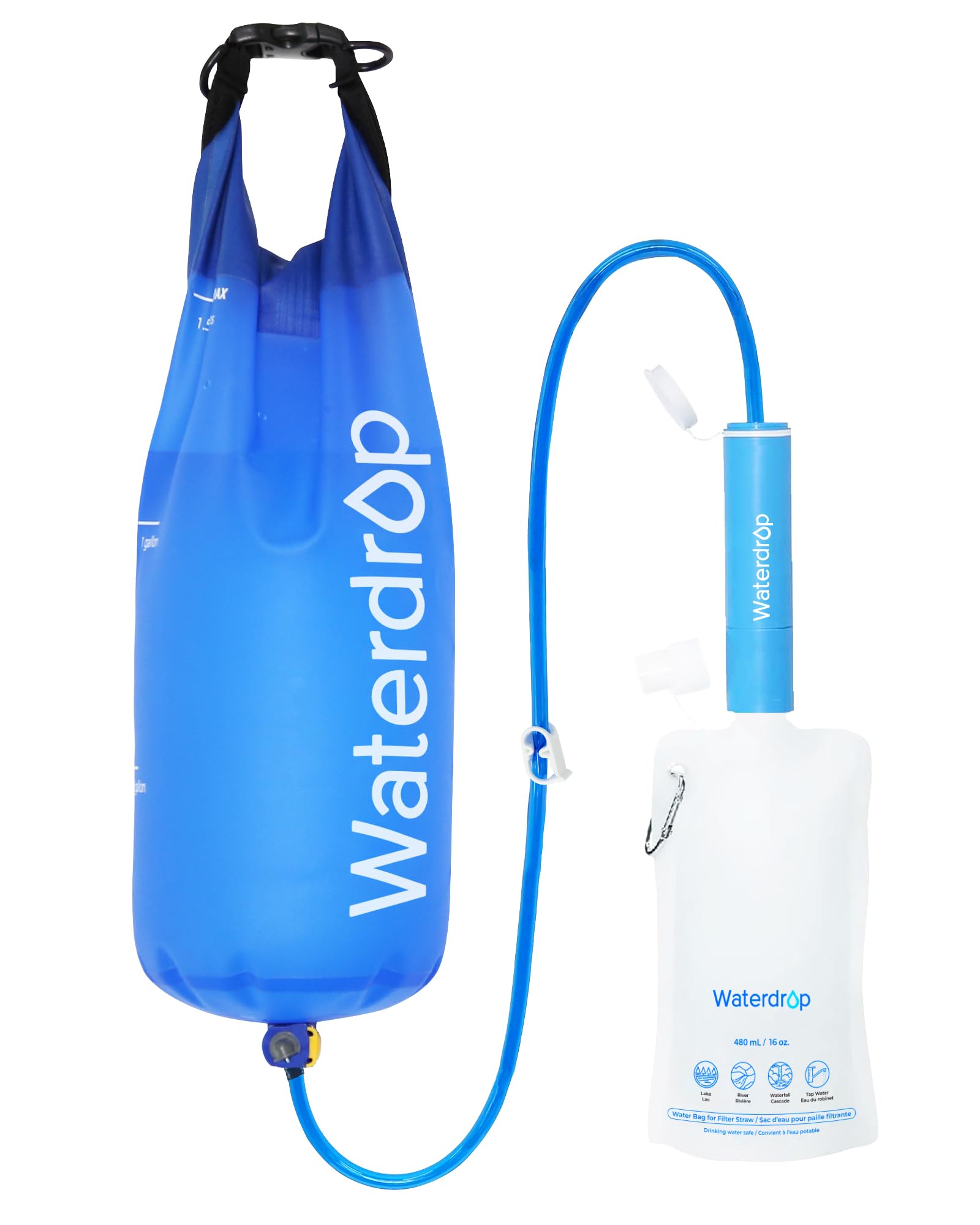


Best for All-Around Camping
Waterdrop Gravity Filter Straw
Key Features
- Weight: 4.64 oz
- Capacity: 1.5 gal bag
- Flow rate: 700 ml/min
- Filter life: 1,400 gal
- Price: Midrange
The 1.5-gallon bag and 700 ml/min flow rate are the combination that makes the Waterdrop our default pick for most camping trips. That is enough capacity for a couple of people to fill bottles and a cook pot without constant refills, and the filter moves water fast enough that gravity does not feel like a penalty. The listed 4.64-ounce weight is light for a filter, and the 1,400-gallon filter life means you are not budgeting for a new cartridge every season.
What keeps it from being perfect is the filter-straw format. You are not just carrying a bag; you are managing a filter, a hose, and a clean-water container, and the flow can slow when the bag gets low or the source is silty. Taste is the other variable. Some campers get clean, neutral water, while a metallic edge can show up; we treat that as a source-water issue and start with the clearest water we can find. The 700 ml/min figure is a maximum, not a promise from a muddy creek.
We still recommend it because it gives you more capacity than the ultralight picks without a big weight penalty. The included 16-ounce pouch is a useful extra for dipping or carrying treated water to a tent. For two to four people who want one hanging station that fills bottles quickly, the Waterdrop is the straightforward choice.
Pros
- Strong capacity-to-weight balance
- Fast gravity flow for bottle filling
- Long 1,400-gallon filter life
Cons
- Flow can slow as the bag empties
We recommend the Waterdrop for couples and small groups that want one gravity station with strong capacity and flow for its weight.
Best for Ultralight Trips
Sawyer SP160 Gravity System
Key Features
- Weight: 1.52 oz
- Capacity: 1 gal
- Filtration: 0.1 micron absolute
- Filter life: 100,000 gal
- Price: Midrange
The Sawyer SP160 pairs a palm-size 0.1-micron absolute filter with a 100,000-gallon rating and a 1-gallon bladder. The filter is the star: it is small enough to live in a daypack pocket, and the dual-threaded Mini gives you on/off control at the filter itself. The wide-mouth bladder fills easily from a tap or a bottle, and the included cleaning plunger and coupling make the system feel complete rather than improvised.
We recommend it for solo trips and backup kits, not as the group station. The flow is the catch: it can run fast on clear water and slow to a trickle on silty sources, so backflushing is part of the routine. The 1-gallon bag is also a sensible size for one person, which means a pair will be making more trips to the source. None of that bothers us on a solo trip where the filter disappears into the pack.
What we appreciate most is the flexibility of the Mini format. The cap on the filter gives you easy on/off control without unclipping the hose, and the whole setup packs down small when the bladder is empty. For a hiker who wants a long-lived filter and does not mind a slower pace, this is the one we hand over.
Pros
- Palm-size filter with huge rated life
- Simple gravity setup with on/off cap
- Light enough for a daypack
Cons
- Bladder can develop pinholes or seam leaks
We recommend the Sawyer SP160 for solo hikers and backup kits where a palm-size filter and huge rated life matter more than speed.
Best for Group Basecamps
Practical Survival Gravity Kit
Key Features
- Kit: Two hanging bags
- Weight: 1.5 lb
- Flow rate: 0.6 gpm
- Filter life: 1,800 gal
- Price: Premium
The Practical Survival kit is the only one here that gives you a dirty bag and a clean bag as part of the system. That matters at a basecamp: you can leave the dirty bag hanging at the source and draw treated water from the clean bag without putting the filter back into the mud. The kit also includes a cleaning plunger, connectors, and a carry bag, so it arrives as a complete water station rather than a bag with a filter screwed on.
We recommend it for car camping, hunt camps, and groups of four or more. The 0.6 gpm rating is the highest maximum flow figure here, though it will drop as the filter loads, and the 1,800-gallon filter life is generous for a weekend-to-week kit. The 1.5-pound weight and the premium price are the trade-offs; this is not the system we choose for a fast solo hike. The two-bag design also means more connections to check, so seat every fitting before you hang it.
For a group, the extra bulk buys a calmer workflow. One person can fill the dirty bag while another pours from the clean one, and nobody is queued around a single bladder. The clean bag can stay at the cooking table while the dirty bag hangs at the source, which is the detail that makes this feel less like camping plumbing and more like a camp kitchen.
Pros
- Two-bag dirty/clean setup
- High flow for a gravity system
- Long 1,800-gallon filter life
- Complete kit with carry bag
Cons
- Heavier and bulkier than solo filters
- Premium price for a camp kit
We recommend this kit for car camping and group basecamps where two bags and a long-life filter are worth the extra weight.
Best for Solo and Pairs
SimPure 3L Gravity Filter

Key Features
- Weight: 3.2 oz
- Capacity: 3 L bag
- Flow rate: 27 L/h
- Filter life: 5,000 L
- Price: Budget
At 3.2 ounces, the SimPure filter is the lightest in this group, and the 3-liter bag is a sensible size for one or two people. That makes it our budget pick for solo trips and pairs. The bag rolls up small, the tree strap is included, and the 5,000-liter filter life is long enough that replacement cost stays out of the way. The 0.1-micron hollow-fiber membrane is the same basic class of filtration as the other picks here.
The trade-off is speed and simplicity. The 27 L/h rating is lower than the Waterdrop’s 700 ml/min, so it is not the pick for filling a group’s bottles in a hurry. It is also a single-bag system, which means no dirty/clean separation; you have to be deliberate about which bottle and hose touch which water. For one or two people, that is a fair exchange for the low packed weight and the lower price.
What we appreciate is the dual use. The filter can run as a personal filter or in the gravity bag, so if the bag or strap gives out, you still have a working filter rather than a dead system. That is the kind of backup we want in a solo kit, and it is why the SimPure stays on our short list even without the capacity of the bigger bags.
Pros
- Very low packed weight
- Useful 3L capacity for one or two
- Long 5,000-liter filter life
- Doubles as a personal filter
Cons
- Single bag offers no dirty/clean separation
We recommend the SimPure for solo trips and pairs when low weight and a low price matter more than group capacity.
How We Tested the Best Gravity Water Filters
We started by pulling every gravity filter we could find from established backcountry brands and a few crossover camping names, then narrowed by capacity, filter pore size, replacement-filter availability, and price. That left 11 models, ranging from two-bag setups to single-bottle gravity kits, and each one got used the way it would be used on a real trip rather than on a bench.
Testing ran eight months, from late spring into a cold-weather trip, and every filter was filled from a kitchen faucet first so we could taste the water before taking it outside. On car-camping weekends we filled from campground spigots and hung bags off a tailgate; on a four-day backcountry trip we hauled them to a silty creek and filtered for four adults at dinner, then again for morning coffee.
At each fill we timed how long two liters took to reach a bottle, watched whether the stream ran straight or wandered, and counted how many fills passed before flow dropped off and a backflush was needed. We weighed every filter dry and again after a soak, stuffed them into full packs beside cook pots and a sleeping bag, and shook the pack to see whether caps and seams stayed dry. Bags were dropped off a picnic table and refilled from a shallow pool to check durability and how easily one person could scoop water without dunking the filter.
Taste was judged side by side against the tap water we started with, and we kept a tally of what replacement filters cost and how often they need swapping. Anything that leaked, slowed to a drip, or demanded two hands and a foot to fill didn’t stay in the rotation long.
How to Choose a Gravity Water Filter for Camping
Start with the size of your group and the water source, because a gravity filter is a camp appliance, not a bottle you sip from as you walk.
Match capacity to your group
Start with how many people you are filtering for and how often you want to walk back to the source. A 1-gallon bladder suits a solo hiker or a pair, a 1.5-gallon bag covers a small group, and a 3-liter bag is a useful middle for two. A bigger bag means fewer refills, but a full bag is heavy to hang and carry. We prefer a smaller bag refilled twice over a full one hauled across camp. If you are filtering for four or more, look at a two-bag kit rather than a single large bladder.
Treat flow ratings as a best case
Flow ratings are a best case, usually measured with clean water and a full bag. Silty creeks, algae, and a bag that is nearly empty slow the filter, and that is where the real-world slowdown shows up. Look for a backwash or cleaning method and plan to use it. A 700 ml/min filter can still feel slow if you are filling from a muddy puddle; letting sediment settle or carrying a prefilter helps. We watch how a filter behaves at the end of a trip, not just on the first liter.
Read filter life as a cost signal
Most camp gravity filters use a 0.1-micron hollow-fiber membrane, which targets bacteria and protozoa. Check whether the maker claims absolute or nominal filtration, and read the lifespan number as a cost signal rather than a daily performance guarantee. Sawyer rates its Mini at 100,000 gallons, while SimPure rates its filter at 5,000 liters; those are not the same kind of claim. A long-life filter is only a bargain if you can clean it and replace it without buying a whole new system.
Plan for hanging, filling, and drying
A gravity filter needs a hang point and a bag you can fill without a funnel. Wide-mouth openings and a tree strap make the difference between a quick refill and a wrestling match. Check the packed size when the bag is empty, not just the capacity when it is full, and pack a short cord even if the system includes a strap. Cleaning and drying matter too: a bag that cannot dry fully can turn a good filter into a science project.
Decide whether you need dirty-clean separation
For solo use, one bag is fine. For a group, a two-bag system keeps dirty water away from treated water and lets one person fill while another draws. The Practical Survival kit is built around that workflow; the single-bag picks ask you to be more careful about which bottle touched which hose. If you are filtering for several people, we think the extra bulk is worth it.
Frequently Asked Questions
Do gravity water filters remove viruses?
Most camping gravity filters here use a 0.1-micron hollow-fiber membrane, which is aimed at bacteria and protozoa such as Giardia and Cryptosporidium. They do not claim virus removal. If you are filtering water where viruses are a concern, use a purifier or boil the water; do not assume a gravity filter covers that gap.
What is the difference between a gravity filter and a filter straw?
A gravity filter hangs and fills a bottle or bag hands-free; a straw relies on suction and is best for sipping on the move. The Waterdrop sits in between: it uses a straw-style filter with a 1.5-gallon gravity bag. If you want a camp water station, choose the gravity setup; if you want the smallest possible kit, a straw or the Sawyer Mini is the better shape.
How much weight does a full gravity bag add to my pack?
Water weighs about 8.3 pounds per gallon, so a full 3-liter bag adds roughly 6.6 pounds and a 1.5-gallon bag adds about 12.5 pounds. That is why we carry the bag empty and fill it at camp whenever the source is close. If you have to haul water a long way, a smaller bag and more trips are usually easier on your shoulders.
Final Verdict
For most camping trips, the Waterdrop Gravity Filter Straw is the best default: 1.5 gallons of capacity, a 700 ml/min maximum flow, and a 4.64-ounce package give you a camp water station that does not feel like a chore. Choose the Sawyer SP160 if you are packing ultralight, the SimPure 3L if you want a budget solo setup, and the Practical Survival kit if you are filtering for a basecamp. The right pick is the one whose capacity matches your group, not the one with the biggest bag.