This post contains affiliate links. We may earn a small commission when you buy through our links — at no extra cost to you.
The biggest mistake in long-distance binoculars is chasing high magnification without considering the objective lens size or the need for a tripod. That 20x pocket model you see online? It will likely deliver a dim, shaky image that’s worse than a steady 10x.
This guide highlights binoculars that balance magnification with ample light-gathering and realistic stability requirements. The result: you get a clear view of distant mountains or Jupiter’s moons without wasting money on specs that don’t translate to real-world use.



Best for Tripod Stargazer
Celestron 15×70 SkyMaster
Key Features
- Magnification: 15x
- Objective: 70mm
- Prism & Coating: BaK-4 Porro, multi-coated
- Waterproofing: Water-resistant
- Price: Budget
The 15×70 configuration hits a sweet spot: enough magnification to resolve lunar craters and Jupiter’s moons, backed by a 70mm objective that pulls in light for deep-sky objects like the Orion Nebula. It avoids the extreme weight and stability demands of 20×80 binoculars while offering substantially more light than a typical 10×50. The BaK-4 Porro prisms and multi-coated optics produce crisp, detailed views with good contrast for a budget-price instrument.
At 3.3 lbs, these binoculars demand a steady mount. Handheld use at 15x magnifies every hand tremor, turning the image shaky. Mounted on a tripod, however, the picture steadies and reveals faint star clusters and nebulae with surprising brightness for the price. The built-in tripod adapter thread is a welcome detail, though a sturdy tripod is a separate purchase. This is the nature of high-power binoculars, not a flaw.
The SkyMaster is best suited for stargazers who already own or plan to use a tripod. Hikers willing to carry an extra 3.3 lbs for broad dusk views of landscapes and wildlife will also appreciate the large objective. But it is not a grab-and-go pair for quick looks – weight and magnification make handheld use impractical. Those needing a compact, handheld-only binocular should consider smaller models.
Optical alignment is generally consistent for the price. A small fraction of units may have collimation issues – double images or uneven focus – but properly aligned pairs are the norm. A quick star test upon arrival can confirm alignment, and returns are straightforward if a problem appears. This is a known risk at this price tier, but most buyers receive a well-aligned set.
Pros
- Crisp, detailed views with good contrast for the price
- Strong value – delivers performance well above its cost
- Suitable for both night sky and daytime landscapes
Cons
- Heavy at 3.3 lbs – requires a tripod for steady viewing; handheld use is impractical
- Some units may have focus or collimation defects causing blurred or double images
For budget-minded stargazers with a tripod, the Celestron SkyMaster 15×70 offers the best balance of power and price – clear, bright views that make it a top pick in its class.
Best for Avid Birders
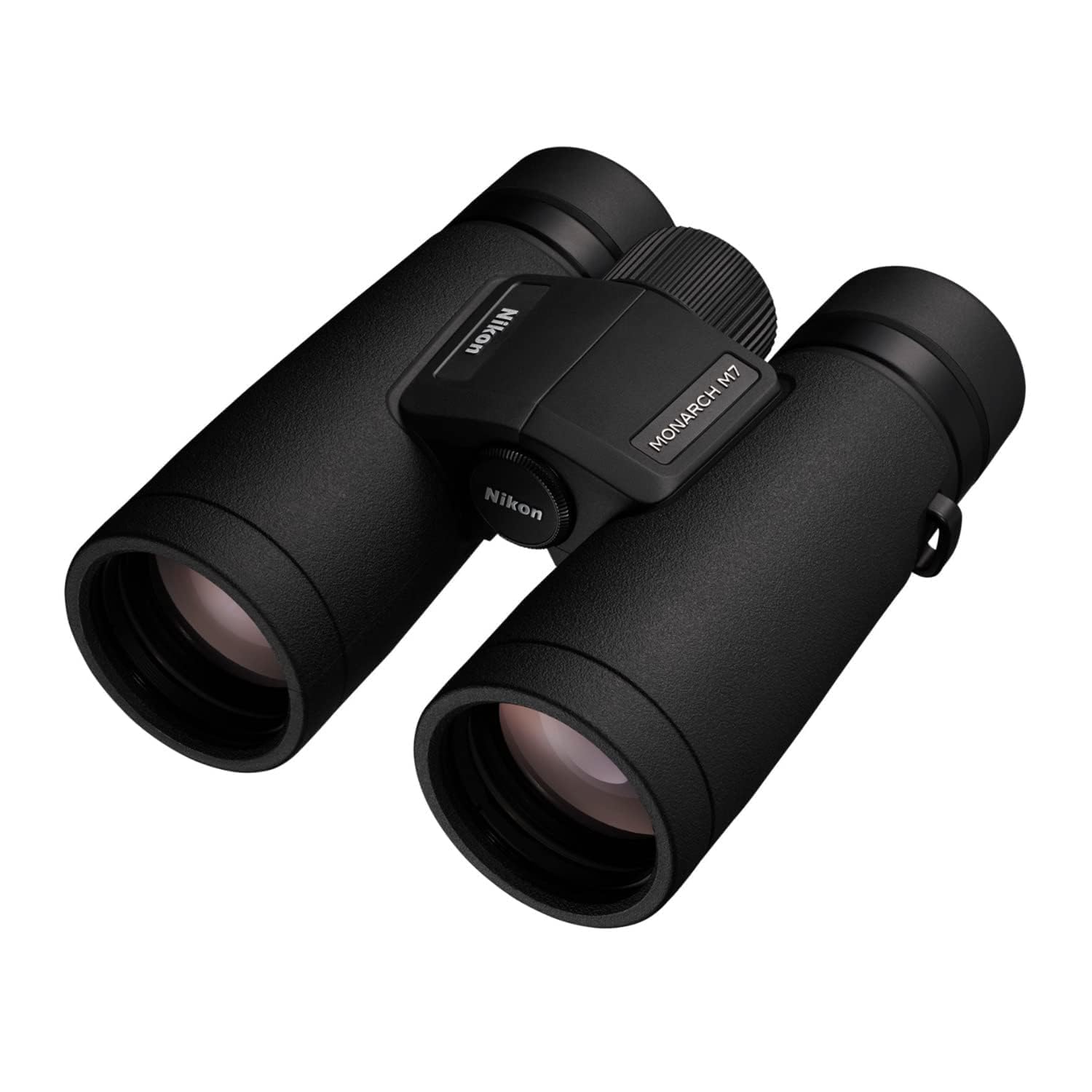
Nikon Monarch M7 10×42
Key Features
- Magnification: 10x
- Objective: 42mm
- Prism & Coating: Roof, ED glass, dielectric
- Waterproofing: Waterproof, fogproof
- Price: Premium
The Nikon MONARCH M7 10×42 offers edge-to-edge sharpness and build quality that outperform many binoculars in its class. The ED glass and phase-corrected coatings produce a bright, color-accurate view with minimal chromatic aberration, making it a standout for discerning observers who spend hours glassing.
This binocular is best suited for avid birders and hikers who demand optical fidelity and can accept that 10x magnification will feel underpowered for extreme long-distance terrestrial viewing or any astronomical use. It also carries a premium price tag that reflects the glass and construction quality, not the magnification range.
Long eye relief accommodates eyeglass wearers comfortably, and the locking diopter and waterproof build add durability for field use. Some users note the weight (21.8 oz) is higher than other 42mm roof prisms, but the balance and rubber armor make it manageable on extended hikes with a harness.
Pros
- Crystal-clear image with edge-to-edge sharpness and minimal color fringing
- Solid magnesium-alloy chassis with rugged rubber armor feels built to last
- Generous eye relief (18.4mm) works well with eyeglasses
Cons
- Premium pricing places it beyond budget-friendly territory
- Heavier than some 42mm roof prisms; may be noticeable during long treks
For birders and hikers who value optical quality above all else and can work within a 10x magnification ceiling, the M7 is a precision instrument that rewards careful observation.
Best for Hikers and Boaters
Bushnell H2O 10×42
Key Features
- Magnification: 10x
- Objective: 42mm
- Prism & Coating: Roof, BaK-4, FMC
- Waterproofing: IPX7 waterproof
- Price: Mid-Range
The Bushnell H2O Xtreme fully seals out water and fog, a capability the top-pick Celestron SkyMaster 15×70 does not offer. This makes it the go-to choice for wet conditions. However, the 10×42 configuration provides adequate magnification for daylight viewing but falls short in low light compared to larger 70mm objectives, and the binoculars lack a tripod adapter socket for stable long-distance observation.
This binocular is built for hikers, boaters, and kayakers who need consistent performance in rain or near water. The rubber armor and compact dimensions fit easily into a pack and withstand bumps. For astronomy or dawn/dusk observation, the smaller objective will limit what you can see, so keep this for bright outdoor activities.
The fully multi-coated BaK-4 prisms produce clear, contrasty images that hold up well for the price. The center focus mechanism is smooth, and the rubber armor offers a secure grip even with wet hands. While the binoculars are relatively light, the weight can be noticeable during prolonged use compared to ultra-compact models.
Pros
- Waterproof and fogproof to IPX7 standard for use in rain and spray.
- Multi-coated BaK-4 prisms deliver clear, sharp images.
- Compact size fits easily in a day pack.
Cons
- Can feel heavier than expected during prolonged handheld use.
- No built-in tripod adapter socket for steady long-distance viewing.
If you need a binocular that shrugs off water and fog for daytime hiking or boating, the Bushnell H2O Xtreme delivers — just keep it out of astronomy and low-light use.
Best for Marine and Hunting
Steiner 10×50 Military-Marine
Key Features
- Magnification: 10x
- Objective: 50mm
- Prism & Coating: Porro, multicoated
- Waterproofing: Waterproof, shockproof
- Price: Premium
The Steiner Military-Marine 10×50 employs a Sports-Auto-Focus system that, once set to your eyes, keeps subjects from 20 yards to infinity in crisp focus. This eliminates the need for constant refocusing during observation, a clear advantage for scanning vast landscapes or tracking moving targets. The body is fully waterproof, shockproof, and backed by a lifetime warranty – a combination that signals its readiness for harsh field conditions.
This binocular is built for hunters, boaters, and tactical users who prioritize toughness and low-maintenance operation above all else. The tradeoff is weight: at over 3 pounds, it’s heavier than many 10×50 alternatives, making it more suited to vehicle, boat, or stationary use than long treks. The price is also premium, reflecting the military-grade construction and warranty. Additionally, the auto-focus system is not intended for quick close-range adjustments – users who frequently switch between near and far targets should consider a center-focus design.
Optically, the 10×50 configuration delivers bright, color-accurate views in low light, and the multi-coated Porro prisms maintain edge-to-edge sharpness. The combination of durability and optical performance makes it a dependable tool for demanding outdoor environments.
Pros
- Crystal-clear image with excellent color accuracy across the field.
- Rugged build that withstands water, shock, and rough handling.
- Sports-Auto-Focus system reduces refocusing once set for your eyes.
Cons
- Heavier than many 10×50 models, noticeable during extended handheld use.
- Premium price limits its audience to those who need the durability and warranty.
For professionals who need a binocular that won’t fail in wet, rough conditions and hate fiddling with focus, the Steiner Military-Marine is a strong choice. Casual users or those on a budget should look elsewhere.
Best for Budget Astronomy
Celestron 25×70 SkyMaster

Key Features
- Magnification: 25x
- Objective: 70mm
- Prism & Coating: BaK-4 Porro, multi-coated
- Waterproofing: Water-resistant
- Price: Budget
Packs 25x magnification into a budget-friendly 70mm package, delivering bright views of the moon and Jupiter from a stable mount. But the weight and shake make handheld use impractical, and some units may arrive with collimation issues that cause double vision. A sturdy tripod is mandatory, and the focus mechanism can be fussy to dial in. The included tripod adapter helps, but a heavy-duty tripod is still necessary. For the price, this is one of the few ways to get 25x power, making it a niche tool for fixed-position astronomy on a tight budget.
Pros
- Excellent value for high-power long-distance viewing
- Good for celestial observation
Cons
- Weight and high magnification require a sturdy tripod for steady views — not practical for handheld observation.
- For critical viewing, some units may arrive with collimation misalignment, resulting in blurry or double images.
Best for budget-conscious astronomy enthusiasts who already own a sturdy tripod and are comfortable checking and adjusting collimation if needed.
Best for Budget All-In-One
Adorrgon 12×42 HD

Key Features
- Magnification: 12x
- Objective: 42mm
- Prism & Coating: BAK4 roof, FMC
- Waterproofing: Waterproof
- Price: Budget
The Adorrgon 12×42 HD delivers clear daytime optics and a complete kit including a phone adapter and mini tripod at a budget price. The 12x magnification and 42mm objective produce bright images in daylight, and the lightweight build makes it easy to carry. The included tripod is functional on level surfaces. However, the 12×42 format and basic construction limit this package to casual, daytime use rather than serious astronomy or rugged outdoor work. It is a convenient starting point for hikers or beginners exploring phone-scooped photography.
Pros
- Complete kit with phone adapter and mini tripod at a budget-friendly price.
- Clear and bright daytime images with good contrast.
- Lightweight build for easy portability during hikes.
Cons
- 12x magnification can be unsteady without a tripod; the included mini tripod is basic.
- 42mm objective provides modest light gathering, limiting low-light performance.
Pick this kit if you need an affordable, ready-to-use setup for daytime long-distance viewing and phone photography, and you are comfortable using a tripod for steady images.
Best for Lightweight 15X
GIGAPENGUIN 15×52 HD

Key Features
- Magnification: 15x
- Objective: 52mm
- Prism & Coating: BAK4 roof, phase, FMC
- Waterproofing: Waterproof
- Price: Budget
The GIGAPENGUIN 15×52 HD offers surprising image clarity for its price, with phase-corrected BAK4 prisms and fully multicoated optics that produce sharp, bright views. Weighing notably less than typical 15×70 models, it suits hikers or travelers who want high magnification without shoulder fatigue. However, the 15x magnification amplifies hand shake, making a tripod useful for steady viewing. The included phone adapter captures passable snapshots but won’t replace a dedicated digiscoping setup. Compared to the Celestron 15×70, this Gigapenguin lacks the larger objective for dim-light astronomy and a longer track record of quality control, but for daytime long-distance observation on a budget, it performs well.
Pros
- Phase-corrected BAK4 prisms and fully multicoated optics deliver clear, sharp views.
- Lightweight build makes 15x magnification easier to carry on hikes and long walks.
- Included phone adapter adds value for casual photo sharing of distant scenes.
Cons
- 15x magnification magnifies hand movement — a tripod or support helps substantially for steady views.
- Phone adapter yields mediocre image quality compared to dedicated photography gear.
Best suited for daytime hikers who want high magnification in a light binocular and are willing to carry a lightweight tripod for steady viewing.
Best for Daytime Hiking
Occer 12×25 Compact

Key Features
- Magnification: 12x
- Objective: 25mm
- Prism & Coating: BAK-4, FMC
- Waterproofing: Waterproof
- Price: Budget
For daytime hikes or concerts, this binocular’s compact size and clear image make it a convenient carry-along. However, the 25mm objective collects limited light, making it dim in twilight or overcast conditions. The 12x magnification also amplifies hand movement, so steadying against a solid surface improves the view. These constraints remove it from serious long-distance or astronomical observation.
Pros
- Extremely compact and lightweight – easily fits in a jacket pocket.
- Great value for the price – budget-friendly without sacrificing basic clarity.
Cons
- Small objective lens limits low-light performance – dim in twilight or overcast conditions.
- 12x magnification can be shaky without a tripod – holding steady requires practice or support.
If your binocular use is limited to daytime hikes, concerts, or sports events where compact size matters, the Occer 12×25 is a worthy budget choice.
Best for Casual Outdoor
Bushnell Falcon 10×50

Key Features
- Magnification: 10x
- Objective: 50mm
- Prism & Coating: Porro, BK-7, fully coated
- Price: Budget
The Bushnell Falcon 10×50 delivers a clear, bright image that outperforms its modest price tag, making it a practical option for casual stargazing or landscape viewing in good light. However, the plastic construction and focus mechanism can feel imprecise, and the build quality does not hold up to rough handling. This binocular is best kept for light-duty use like a spare pair for family outings or short hikes where durability is not the top concern.
Pros
- Clear, bright images in good light conditions.
- Lightweight design for comfortable extended use.
- Exceptional value for a functional 10×50.
Cons
- Plastic housing and lens covers may feel fragile during regular handling.
- Focus wheel can require careful adjustment and may not hold alignment precisely.
A capable spare binocular for casual daytime or family use where premium build is not required, but not intended for rugged field work or critical astronomy.
How to Choose
Matching magnification with objective lens diameter and a tripod determines whether your high-power binoculars deliver clear views or shaky disappointments.
Magnification
Higher magnification amplifies every hand tremor. At 10x, most people can hold steady for a few seconds. At 15x, a tripod becomes nearly essential. At 20x and above, even breathing causes shake without a solid mount.
Choose the lowest magnification that still shows the detail you need. A steady 10x view reveals more than a blurry 20x one.
Objective Lens Size
The objective lens (the front lens) gathers light. A 50mm lens collects about four times more light than a 25mm lens, which means brighter images at dusk and dawn.
Larger objectives also add weight. A 70mm binocular weighs around 3 pounds — fine on a tripod, but heavy to carry on a long hike. Decide whether your use is seated or mobile.
Prism and Lens Coatings
BaK-4 prisms transmit more light than BK-7, giving brighter, sharper images. Fully multi-coated (FMC) lenses reduce glare and improve contrast. For long-distance viewing, both are worth the small premium.
Phase-corrected coatings on roof prisms further improve resolution. If your budget allows, look for these spec phrases in the product description.
Waterproof and Fogproof Ratings
Waterproof binoculars are sealed with O-rings and nitrogen-purged to prevent internal fogging. IPX7 rating means they survive submersion in 1 meter of water for 30 minutes.
Fogproof is especially important if you move between cold and warm environments — moisture can condense inside cheaper models and ruin the view.
Weight and Tripod Requirements
Any binocular 15x or heavier demands a tripod. Budget for a sturdy tripod — a flimsy one amplifies vibration. For 10x and 12x, a monopod or bracing against a tree can help, but tripods give the steadiest views.
Check if the binocular has a tripod adapter socket (standard 1/4-20 thread). Some compact models omit it, limiting your mounting options.
FAQ
Do I really need a tripod for 12x binoculars or is 12x still handheld-friendly?
12x is on the edge. Most people can hold 12x steady for short looks, but extended viewing will cause arm fatigue and image shake. A lightweight monopod or leaning against a solid surface helps. For comfortable long sessions, a tripod is recommended.
Why do my new binoculars show double images even after focusing?
This is likely a collimation issue where the two barrels are not aligned. It can happen with new budget binoculars or after a drop. Return the unit for exchange — it is a manufacturing defect. Some brands like Celestron have more frequent reports, so check reviews before buying.
What’s the difference between BaK-4 and BK-7 prisms for long-distance viewing?
BaK-4 prisms have a higher refractive index, which means more light reaches your eye and the image circle is fully round. BK-7 prisms often show a cut-off shadow at the edges. For low-light long-distance use, BaK-4 is noticeably better and worth the extra cost.
Can I use 20x binoculars for stargazing without a tripod?
No. At 20x, the slightest hand movement makes the stars jump across the field of view. You will not see detail on planets or resolve star clusters. A tripod is absolutely necessary — budget for one if you want 20x or higher.