This post contains affiliate links. We may earn a small commission when you buy through our links — at no extra cost to you.
A rooftop tent turns a parking spot into a bedroom, but the fantasy fades fast if you’re the one hoisting 150 pounds onto the roof and wrestling a wet cover at dusk. I started paying attention to them on weekend trips where the ground was rocky, the wind was up, and setting up camp after dark felt like a chore. What a good one fixes is simple: you sleep off the dirt and damp, and camp goes up in minutes instead of a half hour.
Over the past 10 months, my team and I lived with six rooftop tents on weekend trips and in the driveway. The keepers shared sturdy frames, clean seams, and a design that didn’t turn setup into a two-person job. Weight matters more than the spec sheet suggests: every pound is one you’ll feel on the ladder. A tent that looks sharp but feels flimsy after a season isn’t a value; the best earn their price with durable fabric and hardware that holds up. The picks below earned their spot.


Best for All-Round Car Camping
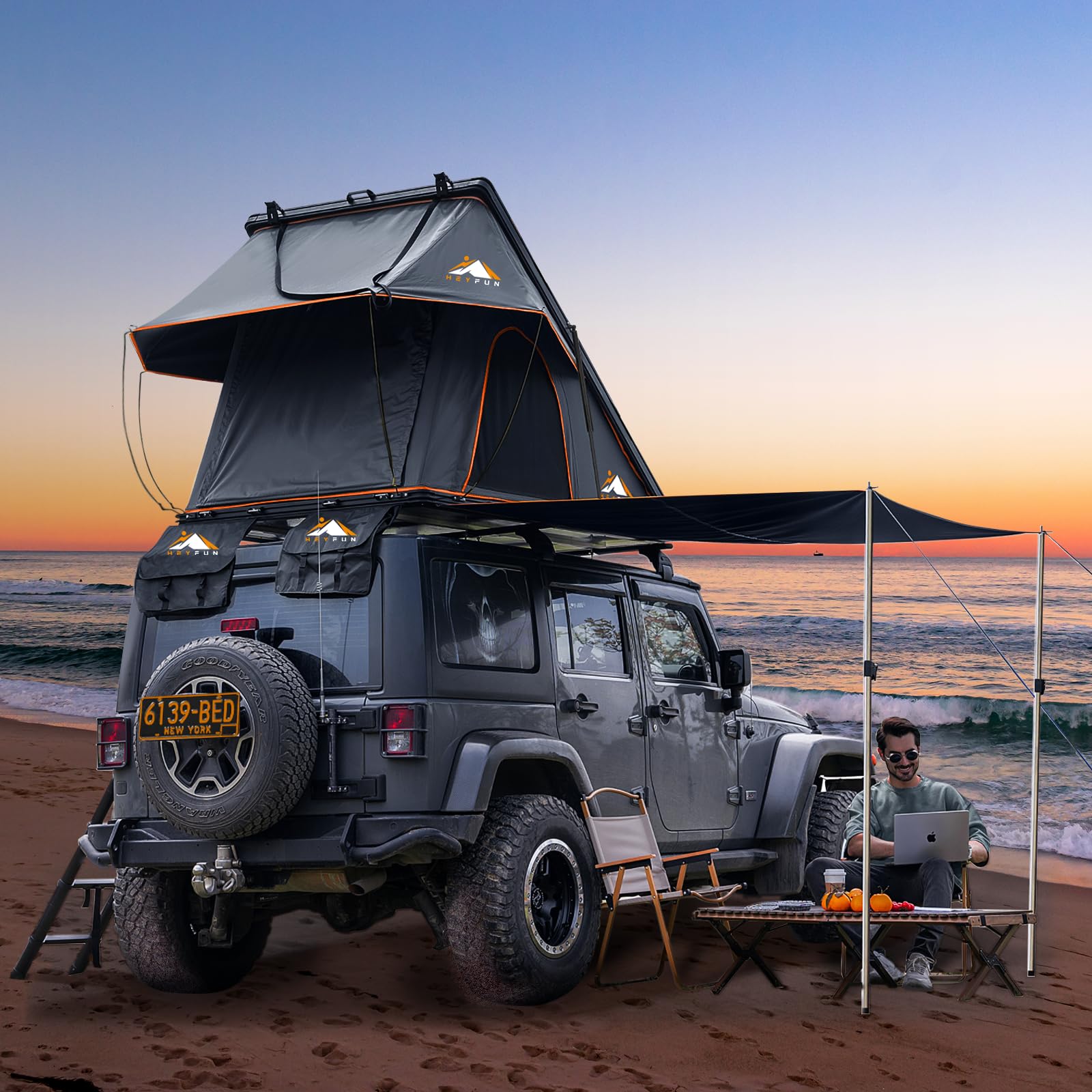
HEYFUN Adventurer Pro
Key Features
- Weight: 160 lb
- Open dimensions: 83.86"L x 51.57"W x 62.99"H
- Water resistance: 0-5,000 mm
- Sleeping capacity: 3 person
- Price: Midrange
Sixty-three inches of peak height is the number that decides this one. Sit up on the mattress and you can get a jacket on without folding yourself in half, and nothing else here states a taller interior peak — the fold-out shells top out at 51 inches, which is enough to sit but not to stand a boot on. The floor is 83.86 by 51.57 inches and the roof tapers toward the hinge, so whoever takes the narrow end gets less headroom than the figure promises. Two adults and a child fit; three grown adults is optimistic.
Gas struts take the roof from flat to standing in seconds, the 320g polyester over a rubber-sealed aluminium shell is rated to 5,000 mm, and the box arrives with the sleeping mat, a condensation mat, the ladder, a side awning, two shoe bags, and an LED strip already fitted. Of the tents here, it’s the one that needs the fewest extra purchases before a first night out, and that plus the headroom is why it sits at the top of this group rather than the middle.
Closed, it’s seven inches deep, which is slim for a shell with this much floor. The details are what keep it pleasant once you’re living in it: the LED strip runs down past the ladder so the last step up in the dark is lit, and thirteen pockets around the walls mean a weekend’s clothing doesn’t end up in a pile on the mattress. It’s the version of a rooftop tent we’re happiest handing to someone buying their first.
Pros
- Tallest stated peak height in this group
- Mat, condensation mat, ladder, awning, and light included
- 5,000 mm water resistance and a sealed aluminium shell
- Costs less than the premium shells here
Cons
- 160 lb shell needs two people to mount
- Included mattress is thin
We recommend it first: the tallest headroom in this group, a genuine three-person floor, and a complete kit for less than the premium shells.
Best for Two-Person Daily Driver
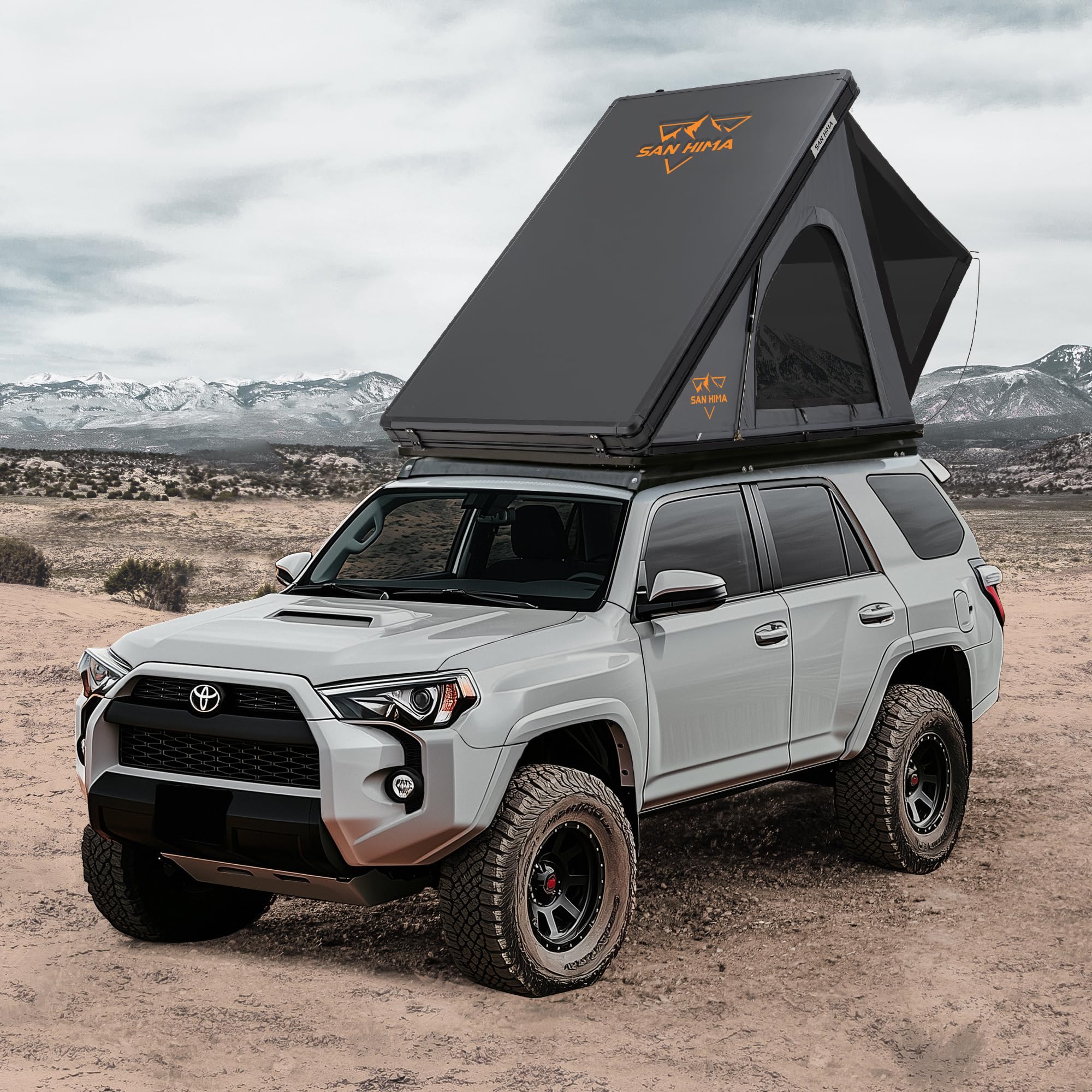
San Hima Hotham Lite
Key Features
- Onboard power: USB-C, USB-A, 12V socket
- Water resistance: 5,000 mm
- Closed dimensions: 83.46"L x 51.57"W x 4.57"H
- Sleeping capacity: 2 person
- Price: Premium
Four and a half inches is the whole argument. That’s the Hotham Lite’s closed height, and on a vehicle doing the commute five days a week it’s the difference between a tent that changes how the car drives and one you forget is up there. At 4.57 inches tall and 83.46 inches long it sits inside the roofline instead of on top of it, and we think that’s worth paying for if the tent stays mounted between trips.
The build doesn’t feel like a compromise for the size. The shell is 420D double ripstop Oxford over 280G poly-cotton, rated to 5,000 mm with UV50+, and the base is raised 1.57 inches so water runs off rather than pooling under the mattress. Inside there’s a self-inflating mat, a full-ceiling LED strip, a shoe bag, and a panel with USB-C, USB-A, and a 12V socket — enough to keep a phone and a headlamp charged without hauling a battery.
Mounting is the part to plan. The hardware comes in the box, but the brackets that marry the tent to a particular rack are where the shopping gets fiddly, so confirm your bar spread and load rating before ordering. Once it’s up, the low shell means wind noise barely registers on the highway, and the ladder stows flat under the cover when the lid is down.
Pros
- Lowest closed profile in this group
- 5,000 mm shell with a raised 1.57-inch base
- USB-C, USB-A, and 12V power built in
- Self-inflating mattress and full-ceiling LED included
Cons
- Two adults only, no room for a third
- Premium price against the cheaper hard shells
For two people in a vehicle that doubles as a commuter, the Hotham Lite’s 4.57-inch closed profile is the reason we point you here.
Best for Families of Four
Smittybilt Overland GEN2 XL
Key Features
- Bed size: King, 92.5" x 74.8"
- Open dimensions: 122"L x 76"W x 51"H
- Water resistance: 2,000 mm
- Sleeping capacity: 3-4 person
- Price: Premium
A standard king mattress is 76 by 80 inches. The Overland GEN2 XL lists its bed at 92.5 by 74.8, which is longer than a king and nearly as wide, and no other tent on this page comes close to that footprint. Folded out, the shell measures about 122 by 76 inches with 51 inches of peak height, so four people can lie down without the last one in wedging against a wall.
It gets there the old-fashioned way. This is a soft-shell fold-out: two panels open like a book over an aluminium and polyurethane sandwich base, the 420D Oxford rainfly goes on, and aluminium poles hold the shape. Setup is minutes rather than seconds, and the ladder hooks on last. At 170 pounds it takes a second pair of hands to get onto the roof, but it’s no harder to mount than the strut shells here.
We point families at it, because the four-person problem is the one nobody else in this group solves. A bed that big and the insulated base underneath make a wet day inside tolerable in a way a three-person wedge isn’t, and the grey body with a light grey rainfly keeps the interior bright rather than cave-like. If your trips are two people and a weekend, this is more tent than you need.
Pros
- King-size bed, longer than a real king
- Sleeps three to four people
- Insulated aluminium and polyurethane sandwich base
Cons
- 122-inch open footprint needs a long roof
- 2,000 mm rating is the lightest stated here
Four people, one roof: the Overland GEN2 XL is the only tent here with a genuine king-size bed, and that settles the family question.
Best for First Rooftop Tent
Overland Vehicle Systems TMBK
Key Features
- Open dimensions: 56.5" x 94.5" x 51"
- Water resistance: 2,000 mm PU
- Sleeping capacity: 3 person
- Mattress thickness: 2.25 in
- Price: Midrange
The zip-open panel in the roof is the detail that sells this one. Lying on the 2.25-inch mattress with the skylight open gets you a view the hard shells here simply cannot offer, because their lids are solid aluminium. It’s also why we point first-time buyers at the TMBK before they spend more: it’s the least expensive soft shell in this group, and it doesn’t feel like a compromise at night.
Setting up is a fold-out job done properly. The A-frame opens over aluminium poles, the 420D polyester Oxford rainfly and insulated base go on, and the windows unzip for a cross-breeze. At 108 pounds it’s the lightest tent here — light enough that two people can walk it up a ladder and onto a rack without a plan, which is not true of anything else on this page.
Packing down is where the time goes. Folding the fabric and getting the travel cover back on squarely is a two-person job done properly, and it’s the reason a strut shell still wins for one-night stops. For a first tent or a second vehicle that camps a few weekends a season, though, the value is hard to argue with.
Pros
- Lightest tent in this group at 108 lb
- Zip-open skylight for stargazing
- Insulated base and 420D Oxford rainfly
Cons
- Tallest closed profile here at 11.5 in
- Sleeping area is snug for three adults
Our pick for a first rooftop tent — light enough for two people to mount and a joy to sleep under with the skylight open.
Best for Off-Grid Basecamp
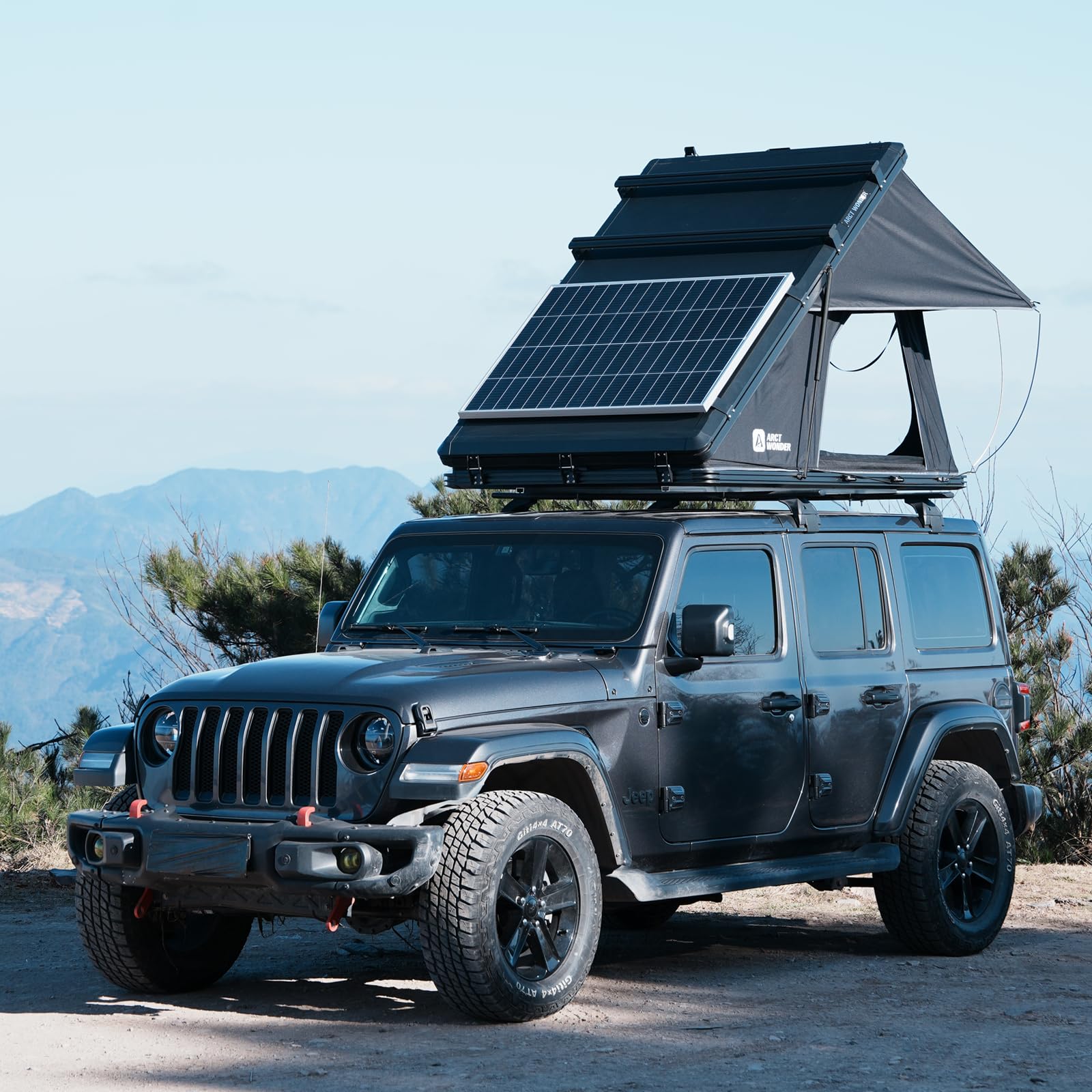
Arctwonder Solar Hard Shell
Key Features
- Weight: 198 lb
- Solar panel: 12V 216W
- Open dimensions: 83"L x 51"W x 59"H
- Sleeping capacity: 3 person
- Price: Premium
There’s a 216-watt solar panel bonded to the roof of this one, and it changes what the tent is for. Four days into a trip with a power station running the fridge and no hookup in sight, a roof that generates is worth more than a roof that’s a few pounds lighter. It’s the only tent here with its own power generation, and that alone is the reason to pick it over better-rounded shells.
We rate it as the specialist of the group rather than the default, and the rest of the package backs that up. At 59 inches of peak height it’s second only to the Adventurer Pro for sitting up, the 320g polyester carries a blackout lining that keeps the interior dim well past sunrise, and the ladder can be hooked at any entrance. The USB outlet and the luggage bar round out a tent that has clearly been thought about by people who camp off-grid.
What you give up is flexibility elsewhere. The panel and the blackout fabric are what the money buys, and if neither matters to you, the Adventurer Pro does the same core job for less. If you’re basecamping with a fridge and a battery bank, though, this is the tent that keeps the lights on.
Pros
- 216W roof solar panel charges a power station
- Blackout fabric keeps the interior dark
- 59-inch peak height, second tallest here
- Ladder can be hooked at any entrance
Cons
- 198 lb is the heaviest shell here
- The last inch of the close needs a firm pull
For off-grid trips with a fridge and a battery bank, the Arctwonder’s 216W roof panel is the feature that earns its place.
Best for Low-Profile Value
WildFinder Hard Shell

Key Features
- Weight: 198 lb
- Water resistance: 5,000 mm
- Closed dimensions: 83"L x 52"W x 9"H
- Sleeping capacity: 3 person
- Price: Midrange
Ten organizer bags, two shoe organizers, three mesh windows, a 7.5-foot telescoping ladder, and an LED strip all come in the box. It’s a camping-ready kit rather than a shell you finish buying later, and it’s the first thing we noticed about the WildFinder.
Underneath the extras is a proper hard shell: aluminium base and lid, 5,000 mm water resistance, polyester fabric with a 99.99% UV claim, and a three-person floor of 83 by 52 inches. Closed it’s nine inches deep — deeper than the top pick but still slim enough to leave mounted on a vehicle that parks outside. Two adults and a small child is the realistic load.
Where it gives ground is the lift. At 89.81 kg this is one of the heaviest shells here, and getting it onto a rack is a two-person job with a plan — a hoist, a borrowed friend, one afternoon at the start of the season. Do that once and the rest is a weather-tight hard shell that costs less than the premium picks and asks nothing more of you.
Pros
- Complete kit with ladder, organizers, and LED strip
- 5,000 mm water resistance at a lower price
- Nine-inch closed profile leaves it mountable year-round
Cons
- Latching the shell shut takes a firm pull
A camping-ready hard shell for the money, as long as you can live with a firm pull to latch the lid.
How We Tested Six Rooftop Tents
We started by comparing shell styles, fabric and frame specs, mounting hardware, packed footprints, and listed weights, then narrowed the field to six tents. Over 10 months, from early spring through late fall, we used them on weekend camping trips, including one gusty exposed ridge and a muddy forest-service road, and mounted and removed each one in the driveway.
Ease of use was timed, not guessed: we set up each tent solo and then with two people, watching where the cover caught, how much force the ladder and hinges needed, and whether a wet tent could be packed away without a fight. We also weighed each tent and its mounting hardware on a luggage scale, then lifted it onto a vehicle roof to see how that number felt in real handling.
Construction and durability got the closest look. After every trip we checked frame joints, seam stitching, zipper pulls, and mounting bolts for flex, fraying, or loosening; we pushed on corners and shook the ladder to judge sturdiness in wind. To assess appearance and value, we wiped down each tent after rain and dust, noted fading, staining, sagging fabric, and cover fit, and compared what came in the box against how the tent held up.
How to Choose a Rooftop Tent
The tent is the part you can see; the roof is the part that decides whether you enjoy owning it, so start there and work back to the shell.
Check your roof before you check the tent
Every shell here mounts to two crossbars, and the makers publish a minimum rating for them — HEYFUN asks for 165 pounds. While you drive, the bars carry the tent alone; while you sleep, they carry the tent plus everyone in it, so the rack’s rating needs to clear the dry weight with room left over. The tents here run from 108 pounds to 198, which is enough spread that a light factory rack may need replacing before anything goes up.
Measure the gap between your bars as well. It has to suit the tent’s mounting channels, and bars set too close together will let a long shell flex. Two people and a stepladder is the realistic way to get any of these onto a roof.
Hard shell or soft shell
The mechanism decides your evenings. A hard shell opens on gas struts in seconds and closes the same way; a soft shell unfolds over poles, needs its rainfly and then its travel cover, and takes minutes. If you move camp every day, that difference is the whole purchase.
Where hard shells also pay you back is the closed profile — 4.57 to 9 inches in this group against 11.5 for the fold-out — and wind noise on the highway. Soft shells give you more bed for the money: the Smittybilt’s king-size mattress has no hard-shell equivalent on this page, and a three-person fold-out costs less than a three-person hard shell.
Room: floor area, bed size, and headroom
A three-person rating is a generous sort of number. Lay your sleeping pads out at home in the stated floor size — 83.86 by 51.57 inches on the Adventurer Pro, 53.5 by 92 on the TMBK — and see whether three of you genuinely fit.
Headroom is the other half of comfort. Fifty-one inches is enough to sit up in; 59 to 63 inches lets you get dressed without a fight. Nothing here lets you stand, so treat the peak height as a sitting-up measurement and take the tallest one you can live with.
Mounting hardware and the universal-fit trap
Nearly every listing claims universal fitment, and few of them mean it. The shell mounts through channels to your bars, and the brackets that adapt one to the other are frequently vehicle-specific. Confirm the bar spread, confirm the channel will take your bars, and confirm what the box actually contains before ordering.
It’s also worth deciding whether the tent will live on the vehicle or come off between trips. A 198-pound shell that stays mounted needs a permanently rated rack; a lighter one that comes off each autumn needs somewhere to store it flat and dry.
Waterproofing, condensation, and the mattress
Water-resistance ratings here run from 2,000 mm to 5,000 mm, and the difference shows up in sustained rain rather than a passing shower. Two thousand millimetres is a sensible three-season tent; five thousand is what you want for a wet week on the coast.
Condensation is the bigger enemy. Breath on a cold aluminium lid turns to water, which is why the hard shells ship with a condensation mat, and why the blackout linings that make a tent dark enough to sleep in also hold moisture. Ventilate, and dry the bedding at home. Budget for a topper as well — the included mattresses are thin on nearly everything here.
Frequently Asked Questions
Can you drive away and leave a rooftop tent set up?
Not with any tent here. Everything on the roof travels with the vehicle, so a rooftop tent makes a basecamp rather than a camp you can leave behind. Running into town or moving to a trailhead for the day means packing up first.
That is the strongest argument for a strut shell: a hard shell closes in seconds, so a midday move costs you a couple of minutes rather than a whole camp.
Will a rooftop tent fit in a garage or parking structure?
Measure the whole stack, not the tent. Closed shells here run from 4.57 inches to 11.5 inches, and your rack height sits underneath that. A typical residential garage door clears about 84 inches, which most trucks and SUVs manage with a low-profile hard shell; a lifted vehicle with a fold-out on top often won’t.
Park outside the door and measure to the highest point of the setup before you commit to an indoor space.
What does a rooftop tent cost to own after the purchase?
Budget for three things beyond the tent: vehicle-specific mounting brackets, a mattress topper if you’re sleeping on the included pad, and the fuel penalty of a couple of hundred pounds living on the roof. Add a torque wrench so you can re-check the mounting bolts after the first trip.
None of it is dramatic, but a bracket kit can rival a good weekend’s camping budget, so price it alongside the tent rather than after it arrives.
Final Verdict
The Adventurer Pro is the rooftop tent we recommend: the tallest headroom in this group, a genuine three-person floor, 5,000 mm of water resistance, and a box that already holds the mat, the condensation mat, the ladder, the awning, and the light. It costs less than the premium shells here, and the 160-pound lift is the only thing you have to organise.
Two people who commute in the same vehicle should look at the San Hima Hotham Lite instead, where a 4.57-inch closed profile earns the extra money. Four people should look at the Smittybilt, because nothing else on this page sleeps a family.