This post contains affiliate links. We may earn a small commission when you buy through our links — at no extra cost to you.
Many campers assume more BTUs means better cooking, but real-world performance depends on burner design and wind protection. The result: stoves that look powerful on paper often underperform when it counts.
This guide cuts through the confusion. We focus on what actually matters: how well a stove simmers, how it handles wind, and whether its build will survive a season of trips. You’ll find options for every setup, from ultralight backpacking to family car camping.
The key is matching the stove to your typical meal and conditions. A 22,000 BTU two-burner is plenty for most groups; anything higher just burns through propane faster.



Best for Car Camping Families
Coleman Triton 2-Burner
Key Features
- BTUs: 22,000
- Burners: 2
- Fuel: Propane
- Weight: 5 lbs
- Price: Mid-Range
The Triton delivers 22,000 BTUs across two independent burners, enough to boil a pot of water or sear burgers simultaneously. The integrated wind guards shield flames from gusts, keeping cooking consistent on breezy campsites. Removable grates and a seamless drip tray simplify post-meal cleanup.
Flame adjustment allows for a decent simmer range, suitable for chili or pancakes, though it won’t match the fine control of premium stoves. On high, the stove consumes a standard 16.4-ounce propane cylinder in about an hour, so longer cooking sessions may require spare cans.
This stove suits car campers who prioritize simplicity and dependability over compact size or gourmet control. First-time buyers will appreciate the straightforward setup: unfold, attach a propane bottle, turn the knobs, and light with a match or lighter. It is not for backpackers needing ultralight gear — at 5 pounds it is heavy for hiking — nor for cooks who demand precise simmer for sauces. The construction is functional; a minority of units may arrive with minor cosmetic finish issues or thinner metal panels, but these do not affect cooking performance.
Compared to the Triton+ which adds push-button ignition and a slightly better build, the standard Triton offers the same heat output at a lower price — a practical trade-off for buyers willing to use a match. Its established reputation among campers speaks to its balanced package of price, performance, and ease of use.
Pros
- Quick to assemble and clean after cooking.
- Strong cooking performance at a mid-range price that undercuts many competitors with similar specs.
- Heats quickly and can handle a range from rapid boiling to low simmer for sauces.
- Built-in wind guards prevent flame blowout in light winds, ensuring consistent cooking.
Cons
- Finish quality on some units may show cosmetic imperfections such as scratches or uneven metal – the stove’s performance remains unaffected.
- On high heat, the stove uses a 16.4-ounce propane cylinder in about an hour, so longer cooks require extra fuel cans.
For car campers and tailgaters who want a balanced, well-priced dual-burner stove, the Triton delivers consistent heat, easy cleanup, and broad compatibility.
Best for Backpackers
Fire-Maple Fixed Star 1
Key Features
- BTUs: 7,500
- Burners: 1
- Fuel: Isobutane/Propane
- Weight: 18 oz
- Price: Mid-Range
The Fire-Maple Fixed Star 1 matches the boil speed of premium backpacking stoves like Jetboil, yet costs about half as much. At 18 ounces with a 1-liter pot, it is light enough for thru-hikes and compresses to fit inside a pack easily. The 7,500 BTU burner brings water to a rolling boil in under two minutes, which is the core need for dehydrated meals and hot drinks.
The integrated pot supports direct boiling but offers no simmer control – the flame is all or nothing. In breezy settings, the built-in windscreen reduces flame flicker, but finding a windbreak remains beneficial for consistent boil times.
Thru-hikers and solo campers who prioritize weight and boil speed will get the most from this system. Those who need to cook for multiple people or want to simmer sauces should look at larger stoves. The piezo igniter can become non-functional after some use, so keeping a backup lighter is a practical precaution. The plastic bowl may crack under packing strain, but that accessory is replaceable.
Pros
- Boils water faster than most competing stoves in this price range.
- Weighs only 18 ounces and packs compactly for backpacking.
- Delivers Jetboil-level performance at a fraction of the cost.
Cons
- Piezo igniter may stop working after moderate use – a backup lighter is needed.
- Included plastic bowl can crack during packing or travel.
For solo backpackers who value speed and weight savings over simmer control, this stove delivers Jetboil performance without the premium price – just tuck a lighter in your pack.
Best for Group Camp Cooks
Camp Chef Everest 2X
Key Features
- BTUs: 40,000
- Burners: 2
- Fuel: Propane
- Weight: 15 lbs
- Price: Premium
The Camp Chef Everest 2X delivers 40,000 BTUs across two burners, enough to boil a pot of water in minutes or sear steaks with a hard crust. The flame control is unusually precise for a high-output stove, allowing gentle simmering without flare-ups — a rare combination in portable propane stoves.
This stove is purpose-built for car camping where weight and bulk aren’t dealbreakers. At 15 pounds and a premium price, it’s not something you throw in a backpack or bring on a tight budget. The folding lid doubles as a windscreen, which helps maintain performance in breezy conditions, and the construction feels sturdy enough for regular, heavy use.
Pros
- Extremely high heat output for fast boiling and searing
- Sturdy build that feels solid and durable
- Precise flame control allows low-heat simmering without flaring
Cons
- Igniters may stop working after a few trips; a backup lighter is recommended
- Heavy and bulky — only practical for car camping, not backpacking
For car campers who prioritize cooking performance over portability and cost, this stove justifies its premium price with genuine pro-level heat and build quality.
Best for Large Group Meals
Camp Chef EX60LW
Key Features
- BTUs: 60,000
- Burners: 2
- Fuel: Propane
- Weight: 12-14 lbs
- Price: Mid-Range
The Camp Chef EX60LW delivers serious heat with two 30,000 BTU burners and a modular design that easily accommodates large pots and canning rigs. Where the top pick balances portability and power, this stove leans entirely into raw output — no compromises on flame strength for the sake of a smaller footprint.
This stove is built for home canners, outdoor preserver enthusiasts, and large group cooking sessions where power matters more than polish. The detachable legs snap on quickly and create a stable platform, but even without them the unit is bulky — this is a car-camp fixture, not a backpacking companion or a tailgate stove you grab without thought. Knobs and leg locks may wear over time, and rust has been reported on some units, so it rewards careful storage and periodic inspection.
Performance is consistent and fast: the burners heat up quickly and hold high heat well, which is exactly what you need for boiling water for a crowd or processing jars. Assembly is straightforward. The tradeoff is in long-term durability — mixed fit and finish means you may need to replace a knob or deal with surface rust on the frame after a few seasons. Treated as a dedicated camp kitchen piece rather than a throw-in-the-back item, it holds up fine.
Pros
- 60,000 total BTUs handle large pots and canning loads with fast heating.
- Snap-on leg assembly provides a stable cooking platform in minutes.
- Lower price than comparable high-BTU stoves, offering strong value for raw power.
Cons
- Knobs and leg locks may wear or break with repeated use.
- Surface rust can develop, especially if the stove is stored outdoors or without cover.
A no-compromise power stove for those who prioritize heat output over size — just plan to store it protected and keep an eye on the small parts.
Best for Emergency Kits
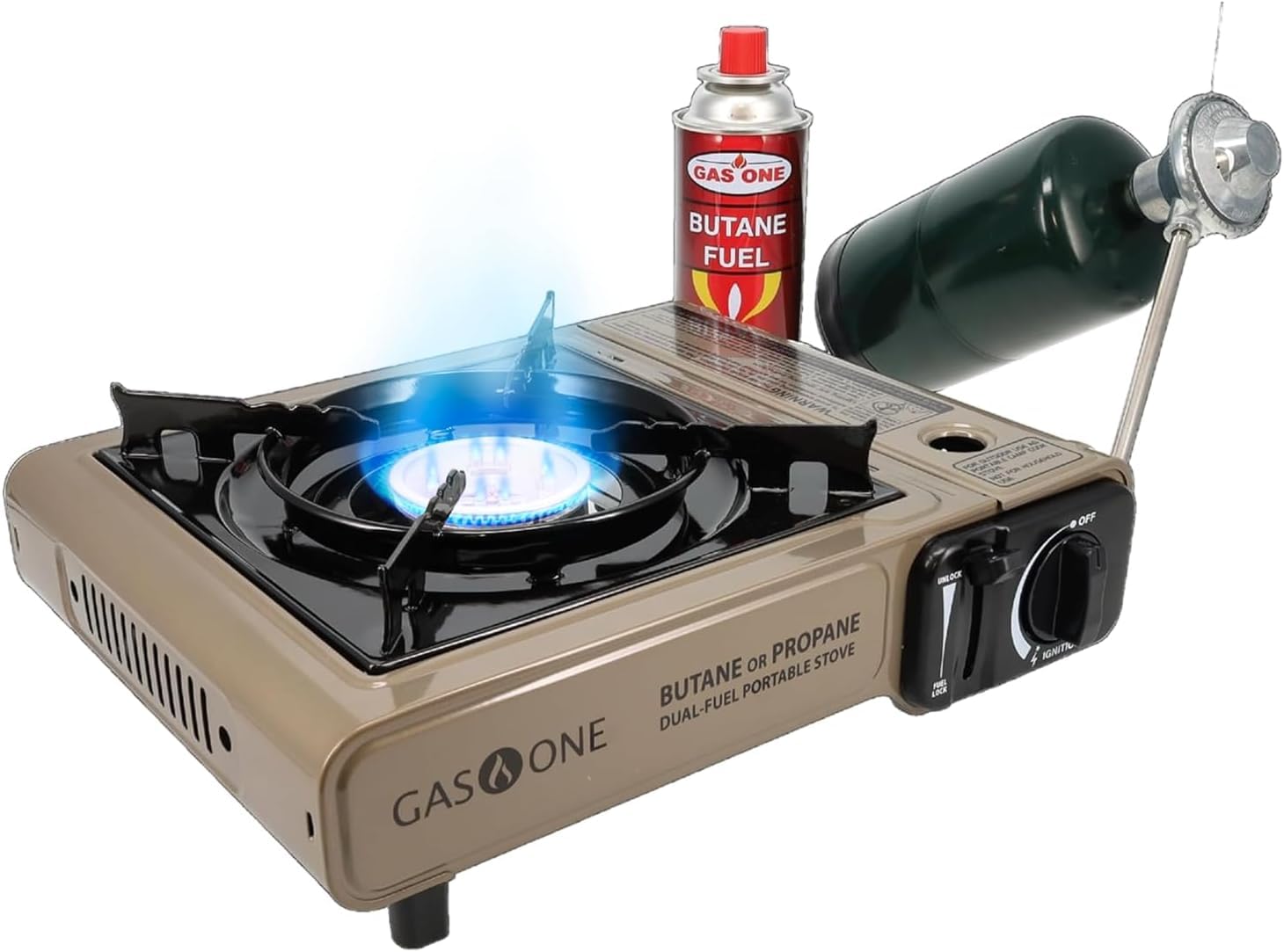
Gas One GS-3400P
Key Features
- BTUs: 7,650-10,000
- Burners: 1
- Fuel: Dual
- Weight: 3.1 lbs
- Price: Budget
The Gas One GS-3400P stands out for its ability to run on either butane or propane in a package that weighs just over three pounds. Unlike simpler butane-only stoves that lose performance in cold weather, this dual-fuel design means you can switch to propane canisters when temperatures drop. It’s a best-seller in emergency preparedness circles for that exact reason, and the included carrying case keeps everything tidy in a backpack or go-bag.
This stove is a natural fit for budget-conscious campers who need a lightweight extra burner for solo trips, and for emergency kits where fuel flexibility matters. The plastic feet and burner components can soften or distort under sustained high heat — keeping the flame on low to medium will extend the stove’s life and avoid damage, which is why it’s best reserved for moderate cooking sessions rather than heavy-duty searing or all-day use.
At a price that undercuts most dual-fuel alternatives, the GS-3400P offers essential functionality without unnecessary frills. It won’t compete with larger, sturdier stoves for group cooking or high-output tasks, but for a solo camper or a backup burner in a survival kit, it gets the job done without stretching your budget.
Pros
- Accepts both butane and propane canisters for fuel flexibility.
- Compact and lightweight with a carrying case for easy transport and storage.
- Offers essential cooking features at a budget-friendly price.
Cons
- Single burner limits cooking to one pot at a time — not ideal for larger groups.
- Not designed for frequent or heavy-duty use; best for occasional trips and moderate heat.
For campers and preppers who need an affordable, dual-fuel stove for occasional use, the Gas One GS-3400P delivers where it matters — just keep the heat moderate.
Best for Ultralight Backpacking
Coleman BottleTop
Key Features
- BTUs: 10,000
- Burners: 1
- Fuel: Propane
- Weight: ~1 lb
- Price: Budget
The Coleman BottleTop is a tiny screw-on burner that turns any 16.4 oz propane canister into a camp stove. Weighing barely a pound, it stows in a jacket pocket and sets up in seconds — just screw it onto the bottle and light. For its size, it puts out a solid 10,000 BTUs, enough to boil a pot of water in minutes. There’s no regulator, no hose, no extra pieces to lose.
This stove is purpose-built for backpackers, hikers, and anyone assembling an emergency kit who prioritizes weight and simplicity above all else. It works with standard propane bottles, which hold pressure even in freezing temperatures — a clear advantage over butane models that falter below 40°F. But the narrow, bottle-top design creates two limits: it tips over easily on uneven ground (use only on flat surfaces), and the flame control is too aggressive for low simmering. You’ll boil water fast, but you won’t cook delicate sauces or gently reheat food.
Compared to butane-powered portable stoves at the same price point, the BottleTop wins on cold-weather dependability and fuel availability. Propane canisters are easier to find and store, and the stove itself has no moving parts to fail. If your trips involve prepared meals that just need hot water — coffee, freeze-dried dinners, instant soup — this is the lightest, simplest way to boil.
Pros
- Extremely compact and lightweight — fits in a backpack without adding bulk.
- Simple and reliable operation — just screw onto a propane bottle and light.
- Good heat output for its size — boils water quickly for a single-burner unit.
Cons
- Achieving a low simmer is difficult; the flame stays relatively high, so delicate dishes may scorch.
- When placed on uneven ground, the stove can tip over — must be used on a flat, stable surface.
A no-frills burner that excels in portability and simplicity — best for boiling water and quick meals in a pack, not for camp cooking that requires stability or precise heat.
Best for Convenience Seekers
Coleman Triton+
Key Features
- BTUs: 22,000
- Burners: 2
- Fuel: Propane
- Weight: ~5 lbs
- Price: Mid-Range
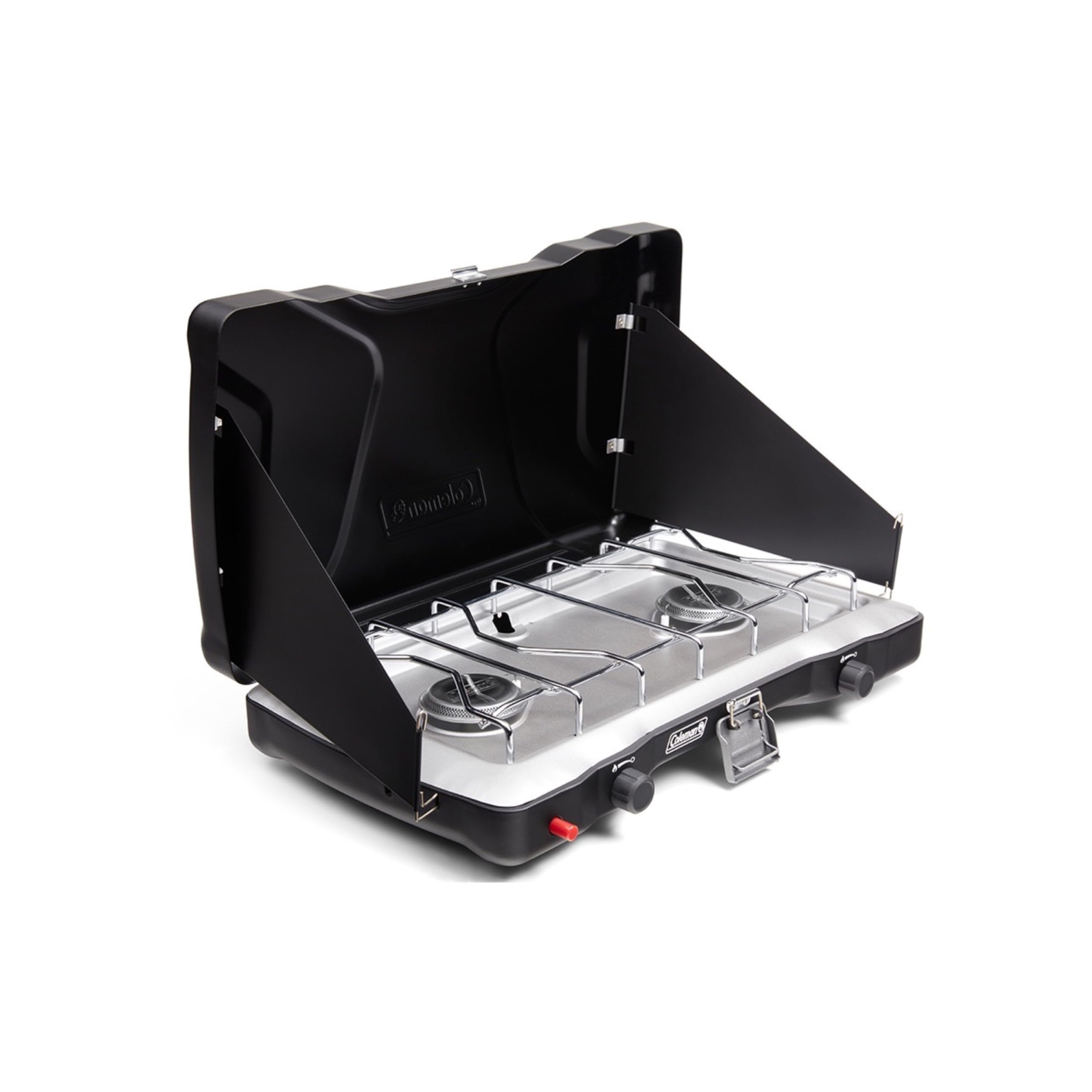
The Triton+ delivers push-button ignition that lights quickly and a compact, sturdy design with even heat output across two burners. Its wind guards improve performance in breezy conditions. However, the standard Triton is nearly identical in cooking performance and costs less, while the InstaStart igniter can become unresponsive after several trips on some units. This stove is a worthwhile pick only if the convenience of matchless lighting justifies the premium.
Pros
- Push-button ignition lights consistently
- Compact and easy to carry when folded
- Even heat distribution across burners helps prevent scorching
Cons
- InstaStart igniter may become unresponsive after several uses on some units
- Premium price over the standard Triton with no gain in cooking performance
Choose this if push-button ignition is a must-have feature; otherwise, the standard Triton offers the same cooking experience for less.
Best for Weekend Car Campers
ODSD 2-Burner

Key Features
- BTUs: 20,000
- Burners: 2
- Fuel: Propane
- Weight: 8.66 lbs
- Price: Mid-Range
The ODSD 2-Burner offers a foldable design, piezo ignition, and a generous set of accessories including a coffee stand, griddle pan, and carry bag – all at a mid-range price. Setup is straightforward, and the compact form suits car camping and tailgating. However, the build quality shows compromises: the coffee holder and handle may warp under high heat, and overall durability lags behind established models like the Coleman Triton or Camp Chef.
Pros
- Compact and portable with an included carry bag for easy transport.
- Simple setup with piezo ignition – no matches needed.
- Good value – includes coffee stand, griddle, and bag for the price.
Cons
- Coffee holder and handle can warp or become damaged when exposed to high heat.
Best for weekend car campers who want a complete kit with extras rather than maximum durability.
Best for Complete Kit Seekers
WLSINJL 2-Burner
Key Features
- BTUs: 17,000
- Burners: 2
- Fuel: Propane
- Weight: 9.74 lbs
- Price: Mid-Range
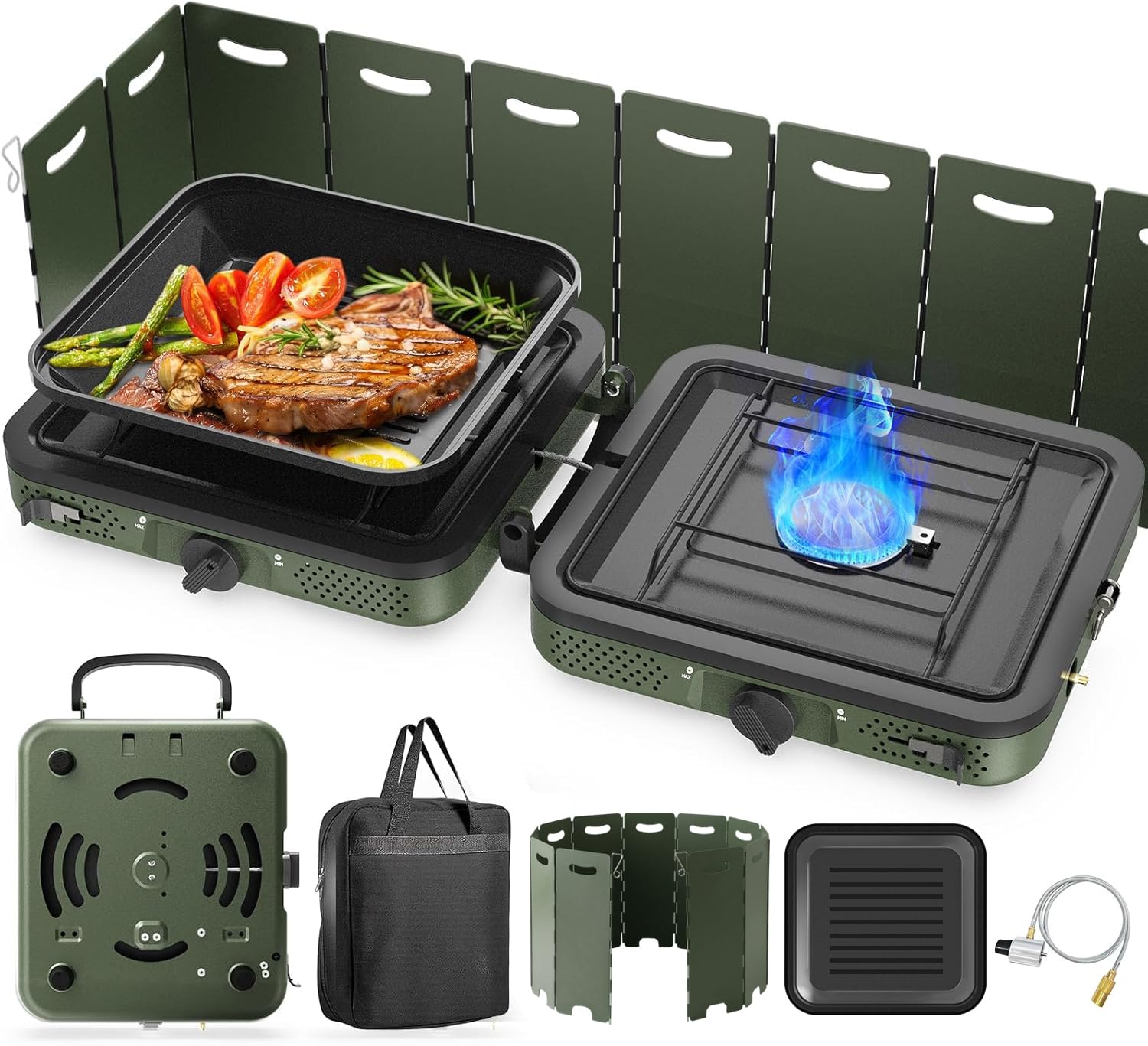
With a total of 17,000 BTUs across two burners, the WLSINJL 2-burner stove handles typical camping meals like boiling water or simmering sauces. The included grill pan adds flexibility for searing meat. The compact fold and carry bag make it easy to stash in the trunk. The wind guard works well in moderate breezes. However, the piezo igniter may fail after a few trips, so keeping a lighter on hand is a simple precaution.
Pros
- Portable and folds compactly for easy storage and transport.
- Wind-resistant design with a windscreen that works well in breezy conditions.
- Good build quality for the price, feeling sturdy and well-made.
Cons
- Igniter can stop working after a few uses.
A suitable choice for campers who want a complete kit and are comfortable carrying a backup ignition method.
Best for High-Heat Cooking
Gas One Double Burner

Key Features
- BTUs: 150,000
- Burners: 2
- Fuel: Propane
- Weight: 27 lbs
- Price: Mid-Range
This double burner delivers raw heat for large pots and woks, with adjustable legs for uneven ground. However, it is heavy (27 lbs), fuel-thirsty, and components like paint and knobs may degrade over time. For campers needing portability or long-term reliability, this is overkill – it suits home canners and outdoor cooks who prioritize power above all else.
Pros
- Extremely high heat output – great for wok cooking, canning, and large pots.
- Sturdy construction with adjustable legs for stable cooking on uneven surfaces.
- Good value for a high-BTU burner – less expensive than comparable restaurant-grade models.
Cons
- Paint and knobs can degrade under high heat; rust may appear over time.
- Propane consumption is very high – burns through 1 lb canisters quickly.
Best for home canners or outdoor cooks who prioritize heat output over portability and longevity – not for typical camping trips.
Best for Budget Solo Trips
Gas One Butane Single

Key Features
- BTUs: 7,650
- Burners: 1
- Fuel: Butane
- Weight: 3.1 lbs
- Price: Budget
The Gas One single burner delivers dependable heat for its size at an entry-level price, making it a practical addition to emergency kits or for solo campers in warm conditions. The automatic ignition and included case add convenience for occasional use. However, build quality varies — some units have plastic parts that may break or a case that feels flimsy. Combined with butane’s poor performance below 40°F, this stove suits only mild-weather, light-duty tasks rather than regular camping or cold trips.
Pros
- Very affordable price for a complete stove with case
- Lightweight at 3.1 lbs, easy to pack for short trips
- Automatic piezo ignition for quick, matchless lighting
Cons
- Build quality can be inconsistent; plastic hinge or case may break in some units
- Butane fuel fails to vaporize in cold temperatures below 40°F – not for winter use
Best for emergency kits and budget-minded solo campers who cook only in warm weather and accept possible build inconsistencies.
Best for Warm-Weather Camping
Coleman Butane Single

Key Features
- BTUs: 7,650
- Burners: 1
- Fuel: Butane
- Weight: ~2 lbs
- Price: Budget
The Coleman Classic Butane Stove offers the convenience of an included carrying case and a simple twist-and-click ignition that fires up every time. Its 7,650 BTUs heat water quickly for a single-burner setup. However, butane fuel loses vapor pressure below 40°F, limiting this stove to warm-weather outings. The plastic case can arrive cracked in some units, and the stove lacks the fuel versatility of a propane alternative like Coleman’s BottleTop model. For its intended use — lightweight backup cooking on mild days — it performs without fuss, but buyers expecting a do-it-all camping stove should look at propane options.
Pros
- Includes a fitted carry case for easy storage and transport.
- Ignition is straightforward and consistent — no matches needed.
- Heat output is sufficient for boiling water and simple meals.
Cons
- Below 40°F, butane vapor pressure drops, making the stove unusable in cold weather.
- The plastic carry case is fragile and may crack during shipping or normal handling.
A decent backup stove for warm-weather camping or as an extra burner at picnics, but not a primary camping stove for cold or heavy-duty cooking.
Best for Grill/griddle Fans
Coleman 1900 3-in-1

Key Features
- BTUs: 24,000
- Burners: 2
- Fuel: Propane
- Weight: 24.2 lbs
- Price: Premium
The Coleman 1900 delivers even heating and a durable cooking surface with its included cast iron griddle and grill inserts, while the vintage look stands out at campsites. At 24 lbs it’s strictly for car camping, and the shallow griddle can produce grease splatter during cleanup – a niche choice for collectors and retro enthusiasts rather than the broader camping audience.
Pros
- Cast iron cooking surface heats evenly and retains heat well for searing and grilling
- Retro aesthetic with solid, robust build gives it a premium presence at the campsite
Cons
- 24 lb weight restricts it to car camping and tailgating – not a portable option
- Shallow griddle design can cause grease splatter, making cleanup messier than flatter alternatives
Best suited for Coleman collectors or car campers who specifically want cast iron cooking in a single stove – most others will find the lighter, more affordable Triton a better fit.
Best for Slim Form Factor
Coleman Cascade 222

Key Features
- BTUs: 22,000
- Burners: 2
- Fuel: Propane
- Weight: ~6 lbs
- Price: Mid-Range
The Cascade 222 delivers a solid cooking experience with its dual burners, rotary ignition, and removable grate that simplifies cleanup. Its slim, sleek closed profile fits easily into tight storage spaces, a clear advantage over bulkier two-burner models. Build quality is consistent with Coleman’s standard, offering dependable heat output with satisfying wind guards.
Where the Cascade stumbles is price: it costs more than the Triton without any real-world performance advantage. The Triton matches its 22,000 total BTUs and includes the same wind guards and easy-clean features for less money. Unless the narrower closed dimensions are essential to your storage situation, the Triton delivers the same cooking capability at a better value.
Pros
- Good build quality and dependable performance in the field
- Easy to clean thanks to the removable grate and simple operation
Cons
- Higher price than the Triton with no performance advantage
Choose the Cascade 222 only if the compact closed dimensions make a real difference in your storage or car setup — otherwise the Triton offers the same cooking performance for less.
Best for Three-Burner Cooking
Coleman Classic 3-Burner

The Coleman Classic 3-Burner stands out in the brand’s lineup with three cooking zones — a rare feature that lets campers cook multiple dishes at once. Combined with push-button ignition and 28,000 total BTUs, it offers solid heat output for car camping meals.
Because user feedback is absent, we cannot confirm simmer control or wind resistance. Buyers prioritizing documented performance may look elsewhere, while those who value burner count over verified data will find a capable stove. Its mid-range price and Coleman brand suggest reasonable build quality, but this remains an assumption.
Pros
- Three independent burners allow simultaneous cooking of multiple dishes.
- Push-button ignition eliminates the need for matches or lighters.
- Mid-range pricing fits within typical car camping budgets.
Cons
- Simmer control is unconfirmed; low-flame cooking may not hold steady.
- Wind resistance is unknown; gusts could affect flame stability.
Best for campers who need three burners and accept the risk of unverified performance — a niche pick within the Coleman lineup.
How to Choose
The most important buying insight is that higher BTUs don’t automatically mean better cooking — burner design and wind protection matter more for real-world performance.
Total BTU Output
BTUs measure maximum heat potential, but most cooking — simmering sauces, melting cheese, warming tortillas — happens at much lower settings. A stove with 20,000 total BTUs from two burners handles family meals easily; 60,000 BTUs may boil water faster but burns through propane twice as quickly.
For typical car camping, a 20,000-30,000 BTU two-burner is the sweet spot. Backpackers need far less — 7,000-10,000 BTU single burners boil water fast enough for dehydrated meals without the weight penalty.
Number of Burners
One burner works well for solo hikers boiling water or heating a can of soup. Two burners let you cook a main dish and a side simultaneously, which is the minimum for group meals. Three burners are overkill for most car campers — they add weight and complexity without a proportional benefit in speed.
If you regularly cook for four or more, a two-burner stove with decent simmer control is more practical than a three-burner model that forces you to juggle pots.
Fuel Type
Propane is the most versatile: it works down to -40°F, burns cleanly, and is widely available in 16.4 oz disposable cylinders or refillable tanks. Butane is quieter and easier to ignite but stops vaporizing below 40°F, making it useless for cold-weather camping or spring trips.
Dual-fuel stoves that accept both butane and propane give you flexibility: use butane for warm-weather picnics and propane for cooler conditions. Note that butane canisters often cost less per unit but deliver fewer BTUs per gram.
Weight and Packed Size
Every pound matters when you carry a stove on your back. Backpacking stoves aim for under 1 lb; integrated systems like the Fire-Maple Fixed Star 1 pack the burner and pot together at 18 oz. Car camping stoves can be 5-15 lbs because they stay in the trunk. A stove that’s too heavy for your trip will end up left behind.
Look at packed dimensions as well as weight. Some two-burner stoves fold to a slim profile that fits in a small bin, while others are bulky even when closed. Measure your car’s storage space before buying.
Wind Protection
Wind is the enemy of even cooking. A gust can drop flame temperature by 30% or blow it out entirely. Built-in wind guards (metal flaps or a folding lid that blocks the breeze) are far more effective than placing a rock around the burner. Some stoves integrate the guard into the lid design, which also doubles as a heat reflector.
If you camp in exposed sites like beaches or mountaintops, prioritize stoves with robust wind protection. A stove with no guard will frustrate you even on moderately breezy days.
Ignition Method
Piezo igniters and push-button sparkers are convenient but notoriously unreliable after a few trips — grease, moisture, or vibration can break them. A stove with matchless ignition that works every time (like the Coleman InstaStart) is a nice upgrade, but a backup lighter or waterproof matches cost pennies.
Don’t let a broken igniter ruin your trip. Even with a built-in ignition, always carry a separate fire source. Some cheap stoves have igniters that fail on the first use; check reviews for that specific model.
FAQ
Why does my camping stove flame flicker or go out in windy conditions?
Wind disrupts the gas-air mixture and cools the burner, causing uneven flame and potential blowout. Even stoves with built-in wind guards struggle in strong gusts. Position your stove behind a natural windbreak (a rock, cooler, or vehicle) and consider adding a portable windscreen — but never block the ventilation holes. If your stove lacks guards, upgrading to one with integrated wind protection is the real fix.
Can I use a butane camping stove in cold weather?
Butane stops vaporizing effectively below 40°F (4°C), so a butane stove will produce weak flame or none at all in cold conditions. Propane works down to -40°F and is the better choice for winter camping. Dual-fuel stoves let you switch to propane when temperatures drop. In moderate cold (30-40°F), you can warm the butane canister by hand or keep it inside your jacket before use, but it’s not reliable.
How many BTUs do I really need for a camping stove?
For most family car camping meals, a two-burner stove with 20,000 to 30,000 total BTUs is plenty. That range handles everything from boiling water for pasta to simmering a sauce. Higher BTUs (40,000+) boil water faster but burn through propane quickly and add weight. Backpackers need only 7,000-10,000 BTUs for boiling water efficiently. Focus on burner design and simmer control rather than peak BTU numbers.
Why does my new camping stove smell like gas after first use?
A slight gas smell during the first use is normal as the manifold and internal parts cure. Some grease or manufacturing oils burn off, creating a temporary odor. If the smell persists after 5-10 minutes of burning, turn off the stove and check all connections for leaks using a soapy water test — bubbles indicate a leak. Never ignore a strong, continuous gas smell; it could mean a faulty regulator or loose fitting.