This post contains affiliate links. We may earn a small commission when you buy through our links — at no extra cost to you.
Many kayakers discover too late that their new camera’s battery drains in under an hour of 4K recording, or that the image stabilization can’t handle choppy water. The real challenge isn’t finding a camera that claims to be waterproof – it’s finding one that actually works through a full day on the water.
Short battery life is the top complaint across the category, followed by overheating and unreliable water seals. The best cameras for kayaking balance video resolution with realistic runtime, and use sensors that handle low light without washing out the scenery.
This guide focuses on cameras that deliver stable footage, long battery life, and dependable waterproofing – so you can spend more time paddling and less time fiddling with settings or spare batteries.


Best for All-Day Action
DJI Action 5 Pro
Key Features
- Waterproof Depth: 20m
- Video: 4K/120fps
- Stabilization: RockSteady+, HorizonSteady
- Battery Life: 240 min
- Mounting: Action mount
- Price: Mid-Range
The Action 5 Pro’s battery holds up for a full day of recording, eliminating the need to swap batteries while kayaking. Combined with HorizonSteady stabilization — which keeps the horizon level even during rough water — and 47GB of internal storage, this camera is designed for uninterrupted sessions. The built-in subject tracking also helps frame shots automatically when you’re focused on paddling.
Video quality from the 1/1.3-inch sensor is sharp and vibrant at 4K/120fps, with low-light performance that handles overcast skies or late-afternoon shadows without clipping detail. Audio captured by the internal microphones remains clear even when submerged, which is rare for an action camera at this price tier. RockSteady+ provides a smooth image for bouncier sections of water.
This camera suits kayakers, vloggers, and adventure filmmakers who need long recording times and reliable footage without fiddling with external batteries or storage cards. It is not for extreme budget shoppers or those requiring 5.3K or 8K resolution — the 4K ceiling is a conscious tradeoff for battery efficiency. Some users may find the initial app pairing and setup process takes a few extra minutes, but after that the camera operates predictably.
The dual OLED touchscreens are responsive and easy to read in bright sunlight, which helps when adjusting settings mid-paddle. The waterproof depth rating of 20 meters (66 feet) covers most kayaking and snorkeling scenarios without a housing. The overall build quality feels solid enough to handle drops on rocky shores.
Pros
- Long 4-hour battery allows all-day shooting without swapping packs
- Sharp 4K/120fps video with strong low-light capability
- Intuitive dual OLED touchscreens and straightforward controls
- Solid build quality that inspires confidence in wet environments
Cons
- Initial setup and app pairing can take extra time for some users
For kayakers who want to record an entire day without interruptions, the Action 5 Pro’s combination of battery life and stabilization is a clear step ahead of alternatives.
Best for Value 4K Video
DJI Action 4
Key Features
- Waterproof Depth: 18m
- Video: 4K/120fps
- Stabilization: RockSteady, HorizonBalancing
- Battery Life: 160 min
- Mounting: Action mount
- Price: Mid-Range
The Action 4 matches the top-tier image quality and stabilization of the newer model, making it a strong choice for kayakers who prioritize video clarity and smooth footage over maximum battery endurance. Its 1/1.3-inch sensor captures clean low-light shots and 4K/120fps video with professional color, while RockSteady and HorizonBalancing handle rough water without issue.
On the water, the stabilization keeps paddle strokes and waves from ruining the shot, and the 10-bit D-Log M color profile gives flexibility in post. The camera is waterproof to 18 meters without a housing, so you can mount it directly on a kayak deck or helmet without worrying about splashes or brief submersion.
This camera is a smart buy for action and vlog users who want premium video quality without paying flagship prices. Battery life is good for shorter outings, but heavy 4K recording will reduce runtime, and a handful of users have noted the camera can overheat and shut down when recording for long periods in hot sun. If you plan full-day trips, carry a spare battery or consider the top pick’s longer endurance.
Pros
- Outstanding image quality with strong low-light performance and accurate color science.
- Effective rock-solid stabilization keeps footage smooth in rough kayak conditions.
- Intuitive touchscreen interface makes setup and operation quick on the water.
- Excellent value — offers features of far more expensive cameras at a mid-range price.
Cons
- Battery life may fall short of advertised runtime when recording 4K continuously.
- Extended 4K recording in warm climates can cause the camera to overheat and shut down.
- Some units may allow water ingress, limiting reliability in consistently wet environments.
For kayakers focused on image quality and stabilization who are willing to manage battery life on longer trips, this is the cost-effective choice.
Best for Underwater Stills
OM System TG-7
Key Features
- Waterproof Depth: 15m
- Video: 4K
- Mounting: Tripod socket
- Price: Premium
The TG-7 brings a level of physical toughness uncommon in compact cameras: it handles drops from 2.1m, withstands 100kgf of crushing force, and operates down to -10°C. Where action cameras excel at mounting and stabilization, this OM System camera prioritizes still image quality and macro detail. Its 12MP BSI CMOS sensor and dedicated underwater modes produce crisp photos even in murky water.
For kayakers who primarily shoot photos and need a camera that survives submersion to 15m and rough handling, the TG-7 delivers. The macro mode is particularly strong for capturing small marine life or details on gear. However, video is limited to 4K without high frame rates, so slow-motion clips require post-processing. The menu system takes time to learn, and a few units have been reported to stop functioning — testing before a trip is advisable.
Pros
- Crisp still images with outstanding macro performance for underwater detail.
- Effective water resistance for scuba and snorkeling, supported by dedicated underwater modes.
- Rugged build withstands drops, impacts, and freezing conditions without damage.
Cons
- Some units may stop functioning without warning; inspect and test before extended use.
- Menu system and button layout can be confusing, requiring a learning period.
For kayakers who value still photography over video and want a camera that can take a beating, the TG-7 is a strong choice — just allow time to learn the interface and verify individual unit reliability.
Best for 360° Content
Insta360 X5
Key Features
- Waterproof Depth: 10m
- Video: 8K 360°, 4K
- Stabilization: FlowState, 360° Horizon Lock
- Battery Life: 208 min
- Mounting: Standard mount
- Price: Premium
The Insta360 X5 delivers 8K 360-degree video that stays sharp and vibrant even in dim conditions, a clear step up from earlier 360 cameras. Dual 1/1.28-inch sensors capture enough detail for post-capture reframing without looking compressed, and the FlowState stabilization keeps the horizon locked no matter how the camera rotates during paddle strokes.
Battery life is listed at 208 minutes, but in practice it can fall short depending on recording resolution and temperature — a spare battery is worth packing for full-day kayak trips. The IP68 waterproofing to 10 meters means it handles splashes and submersion without a housing, and the replaceable lens design adds peace of mind for rough use.
This camera is built for content creators who want to shoot first and choose the frame later — ideal for kayakers who can’t predict where the action will happen. The tradeoff is that 360 footage requires dedicated editing time in the app or desktop software, and a minority of units have shown reliability issues such as DOA or early failure. For buyers who value creative flexibility over simplicity, the X5 is a capable tool.
Pros
- Sharp 8K 360 video with strong low-light performance
- AI-assisted editing and intuitive reframing software
- Horizon-lock stabilization stays level even during rapid rotation
Cons
- 360-degree video requires post-processing time that may not suit every workflow
- Battery life can vary and may not always reach the claimed duration
- Some units have experienced reliability issues, including DOA or early failure
For kayak creators who want the creative freedom of reframing after the paddle, the X5 offers the highest-quality 360 capture at the cost of editing time and occasional battery variance.
Best for High-Res Video
GoPro HERO13
Key Features
- Waterproof Depth: 10m
- Video: 5.3K60
- Stabilization: HyperSmooth
- Mounting: Action mount
- Price: Premium
The GoPro HERO13 captures the sharpest 5.3K60 footage and offers a unique HB-series lens system for creative framing — an advantage over the top pick’s longer runtime. Stabilization via HyperSmooth keeps water-level shots steady without extra gear.
This camera suits boaters who prioritize video quality over endurance. The battery drains faster than the market leader’s, especially at high resolutions, and some units may have charging irregularities. Spare Enduro batteries are essential for any trip longer than a short paddle.
Build quality feels solid, with a waterproof depth of 10m that handles splashes and brief submersion. The lens mods expand creative options, but the extra accessories add bulk — less convenient for minimalists.
Pros
- Sharp 5.3K60 video and 27MP photos with rich detail
- Robust build that feels durable in wet conditions
- HB-series lens system for wider or telephoto shots
Cons
- In extended recording, especially at high frame rates, battery drain can cut sessions short
- A small number of units arrive with batteries that refuse to charge
For paddlers who value resolution and creative lens options over all-day endurance, the HERO13 delivers — provided you pack spare batteries.
Best for Budget Adventurer
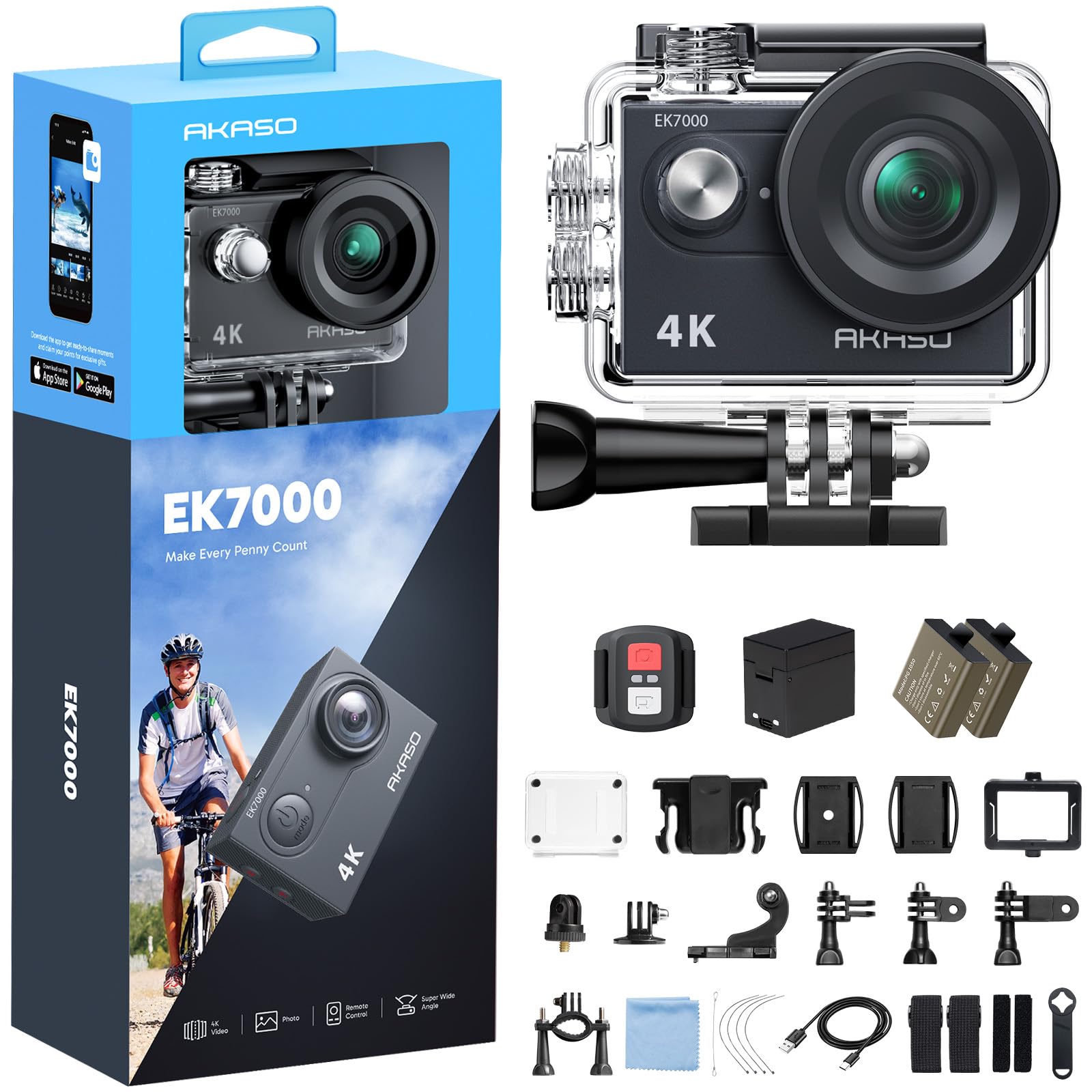
AKASO EK7000
Key Features
- Waterproof Depth: 40m (case)
- Video: 4K30fps
- Stabilization: EIS
- Battery Life: ~30 min/batt
- Mounting: Includes mounts
- Price: Budget
The AKASO EK7000 delivers an impressive bundle at a budget-friendly price. While the top pick costs several times more, this camera includes a waterproof case, multiple mounts, two batteries, and a remote control. For kayakers who want to capture their trips without spending a lot, this package is hard to beat. The included accessories alone make it a compelling alternative for casual use.
This camera suits first-time action camera users and budget-minded adventurers who kayak casually. The waterproof case protects down to 131ft, enough for most kayaking and snorkeling. However, the case adds noticeable bulk, and the 4K video is softer than the top pick’s output – acceptable for social media sharing but not for professional work. The short battery life (about 25-30 minutes per battery at 4K) means you will need to carry spare batteries or record conservatively, though the included second battery helps extend shooting time.
Build quality feels solid for the price, with simple controls and WiFi that connects easily. The electronic image stabilization smooths minor kayak wobbles, though it is less effective than the top pick’s HorizonSteady. For daylight conditions, video and photos are satisfying for most casual users, and the remote control is a handy addition when the camera is mounted on a paddle or helmet.
Pros
- Complete accessory kit includes waterproof case, mounts, remote, and two batteries.
- Easy to use with straightforward controls and WiFi connectivity.
- Good image quality for the price in good light, with solid stabilization.
Cons
- Waterproof case adds noticeable bulk to the compact camera body.
- 4K video is softer than premium action cams; fine for casual sharing, not for critical work.
- Battery lasts only 25-30 minutes at 4K; spare battery included but still requires frequent swaps.
Best for kayakers who want a complete kit on a tight budget and don’t mind swapping batteries; the top pick is better for all-day trips without interruptions.
Kodak Wpz2
KODAK WPZ2

The KODAK WPZ2 packs a 4x optical zoom, Wi-Fi sharing, and a 16MP sensor into a sub-$200 package that’s waterproof to 15m. That combination is rare at this price point, and the interface is simple enough for family members of all ages. For occasional poolside shots or calm snorkeling, it delivers adequate results. The tradeoff is that unit-to-unit consistency is a gamble – water seals can let moisture in on some cameras, and image quality underwater tends to be soft rather than crisp. Battery life also runs short if you use flash or video frequently. These limitations make it a better fit for light, occasional use rather than the sustained demands of a kayaking trip where reliability matters.
Pros
- Good value for money with features typically found in more expensive cameras
- Easy to use with intuitive interface
Cons
- Water resistance may fail; some cameras leak
- Picture quality is mixed with reports of blurry images
This camera works best for casual snorkelers and family outings where losing a camera to a leak or dealing with soft images is an acceptable risk. For active kayaking, a sealed action camera with proven water resistance is a safer bet.
Best for 360° Creator
Insta360 X3

Key Features
- Waterproof Depth: 10m
- Video: 5.7K 360°, 4K
- Stabilization: FlowState, Horizon Lock
- Mounting: Action mount
- Price: Mid-Range
The Insta360 X3 captures 5.7K 360 video with FlowState stabilization and a straightforward app for editing, making it an affordable entry into 360 content creation. It’s waterproof to 10m, so it can handle kayaking splashes and submersion. However, some units may stop working after a short period or develop gyroscope issues, and single-lens video quality is average — 360 footage loses sharpness when reframed. Battery life is adequate for a day of intermittent use. This camera is better suited as a secondary or creative complement rather than a dependable primary camera for kayaking trips.
Pros
- 360 capture enables creative reframing after recording.
- Intuitive app and simple setup make editing easy.
Cons
- The camera may stop working or develop gyroscope problems after short use — a risk for a primary kayak camera.
- Single-lens video is average; 360 footage loses sharpness when reframed.
This camera works best as a secondary or creative complement for kayakers who want 360 reframing options, but not as the sole recording device.
Best for Kids Pool
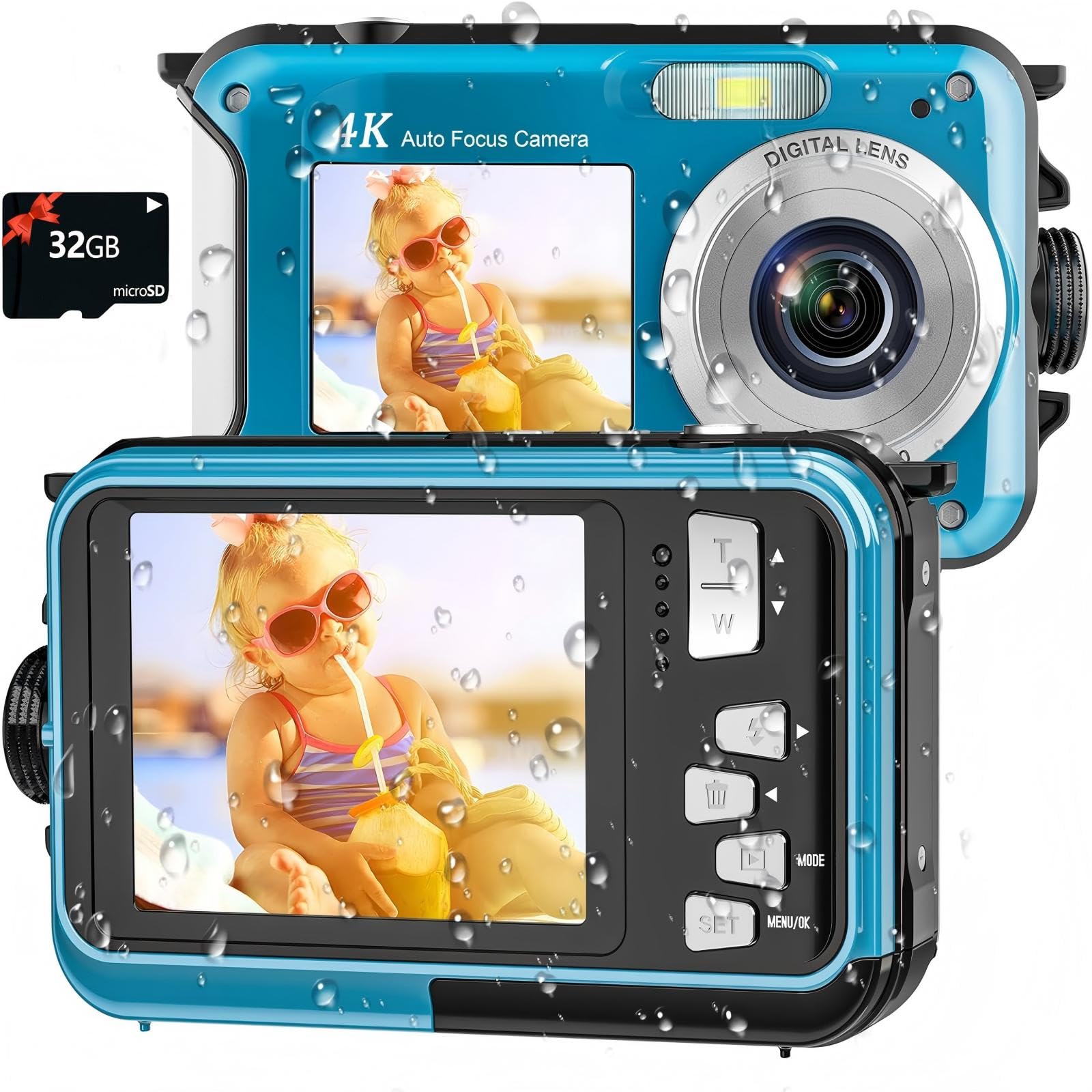
YISENCE 4K UW
Key Features
- Waterproof Depth: 5m
- Video: 4K
- Mounting: Floatable
- Price: Budget
For its price, the YISENCE delivers crisp, vibrant stills in bright conditions and simple autofocus for quick point-and-shoot use. The 4K video is interpolated, so true resolution is lower than the spec suggests, and the waterproof seal’s longevity is unverified. With a perfect rating across a handful of sales, actual durability under repeated wet use remains unclear. This fits best as a pool toy or budget option for kids’ first snorkel, not a daily kayak companion where you need a proven seal and consistent performance.
Pros
- Produces vibrant, clear photos in good light at a very low entry price
- Floats and includes a 32GB card plus autofocus — ready out of the box for pool use
- Waterproof to 16ft as marketed for shallow snorkeling and splash environments
Cons
- 4K video is interpolated; actual resolution is lower — may disappoint those expecting sharp footage
- Seal consistency can vary between units; leaks have been noted after repeated water exposure — best for occasional shallow use
Reserve this for poolside fun or a child’s first underwater camera; for kayaking, choose a model with a higher waterproof rating and established build quality.
How to Choose
Battery life is the hidden trade-off: a camera that claims 2 hours at 4K may only last 45 minutes in practice.
Waterproof Depth
Most action cameras are natively sealed to 10m or more, enough for kayaking splashes and brief submersion. Point-and-shoots often list a depth rating (e.g., 15m) but rely on O-rings that degrade over time. A camera rated to 10m without a housing will survive accidental drops, but repeated pressure changes or sand can compromise seals. For kayaking, anything beyond 5m is sufficient; deeper ratings matter only if you plan to dive or snorkel regularly.
Video Resolution and Frame Rates
4K at 60fps is the sweet spot for smooth slow-motion and clear footage on choppy water. Higher resolutions like 5.3K or 8K offer more cropping flexibility but demand faster storage and drain the battery faster. Many budget cameras advertise ‘4K’ but use sensor interpolation, resulting in soft video. Stick to models that list actual sensor size (e.g., 1/1.3-inch) for confirmed quality.
Frame rate matters more than resolution for action: 120fps at 1080p often looks better than 30fps at 4K when slowing down paddle strokes. Check whether the camera can maintain high frame rates without overheating – a common issue on sunny days.
Image Stabilization Quality
Electronic image stabilization (EIS) is standard, but sensor-shift and gyro-assisted systems (like RockSteady or FlowState) handle kayak vibrations far better. Cheap EIS only crops the frame and adds latency, creating a ‘jello’ effect on fast pans. Top-tier stabilization keeps the horizon level even during 360-degree spins, which is critical for watchable kayak videos.
Test: if a camera lists ‘gyroscope’ or ‘6-axis stabilization’ in its specs, it likely beats basic digital stabilization. Optical stabilization is rare in action cameras but can be found in rugged point-and-shoots like the TG-7 – though it adds bulk.
Battery Life for Extended Outings
Manufacturer battery ratings (e.g., ‘160 min’) are measured in ideal lab conditions at lower resolutions. In real-world 4K recording with stabilization on, expect 40-60% of that number. For a full day of kayaking (6-8 hours), you need either a camera with a 200+ minute rated battery (like the DJI Action 5 Pro) or a set of spare batteries. Action cameras with swappable batteries are easier to manage than sealed point-and-shoots.
Capacity (mAh) is a rough guide: 1400mAh typically yields 90 min of moderate use. Also consider charging speed – cameras that support fast charging can top up during lunch breaks.
Mounting Versatility and Ruggedness
Action cameras use a standard folding mount that fits on helmet straps, handlebars, and float grips. Point-and-shoots lack this ecosystem, requiring third-party sticky mounts or a waterproof housing with a tripod thread. For kayaking, a floating hand grip or a POV mount on the paddle shaft is most versatile. Look for cameras with multiple mounting points and compatible accessories (e.g., GoPro’s magnetic latch or DJI’s quick-release).
Ruggedness goes beyond waterproofing: cameras rated shockproof (2m drop) and dustproof survive paddle wipeouts and sandy beaches. Pay attention to the temperature range if kayaking in cold climates – freezeproof cameras (to -10°C) prevent battery drain in winter.
FAQ
Can I mount a waterproof camera on a kayak without a special mount?
Yes, most action cameras use the standard 20mm folding mount interface that works with universal adhesive mounts or suction cups. For a clean setup, a paddle mount or a chest strap keeps the camera stable and out of the way. Point-and-shoot cameras require a third-party housing with a tripod thread, which adds bulk and can’t attach to curved surfaces.
How deep does a camera need to be waterproof for kayaking?
5m (16ft) is enough for splashes, rain, and accidental drops overboard. If you plan to snorkel or capsize frequently, choose a camera rated to at least 10m (33ft). Deeper ratings (15m+) are overkill for kayaking unless you also scuba dive. Remember that depth ratings apply to static water pressure, not repeated impacts.
Why does my action camera overheat when recording 4K on the water?
4K processing generates heat, and direct sunlight on a dark camera body accelerates it. Many cameras will auto-shut down to protect the sensor after 10-15 minutes of continuous 4K recording in warm weather. To avoid this, drop to 1080p at 60fps, use a sun shield, or pause recording between paddle segments. Cameras with larger sensors and better heat dissipation (like the DJI Action 5 Pro) handle this better.
Is a 360 camera worth it for kayaking, or is a standard action camera better?
A 360 camera is worth it if you plan to reframe shots in post-production to capture the entire scenery without missing action behind you. The Insta360 X5 delivers stunning immersive footage but requires editing time and costs more. For most kayakers, a standard action camera with HyperSmooth or RockSteady stabilization gives great footage with zero editing effort. Choose 360 only if you enjoy after-the-fact creativity.