This post contains affiliate links. We may earn a small commission when you buy through our links — at no extra cost to you.
Most portable water filters advertise impressive numbers like 99.9999% removal and 100,000-gallon capacities. In practice, real-world performance depends heavily on water clarity and the effort you are willing to put into suction, squeezing, or pumping. A filter that works well in a clear mountain stream can clog in minutes if you dip it into a silty puddle.
That is why matching the filter type to your use case matters more than any spec sheet. Straw filters are lightweight and cheap but require strong suction, making them impractical for cooking or group hydration. Squeeze and gravity systems offer easier flow but add weight and setup time. This guide cuts through the marketing to help you choose the right tool for your trip length, group size, and water sources.




Best for Solo Hikers
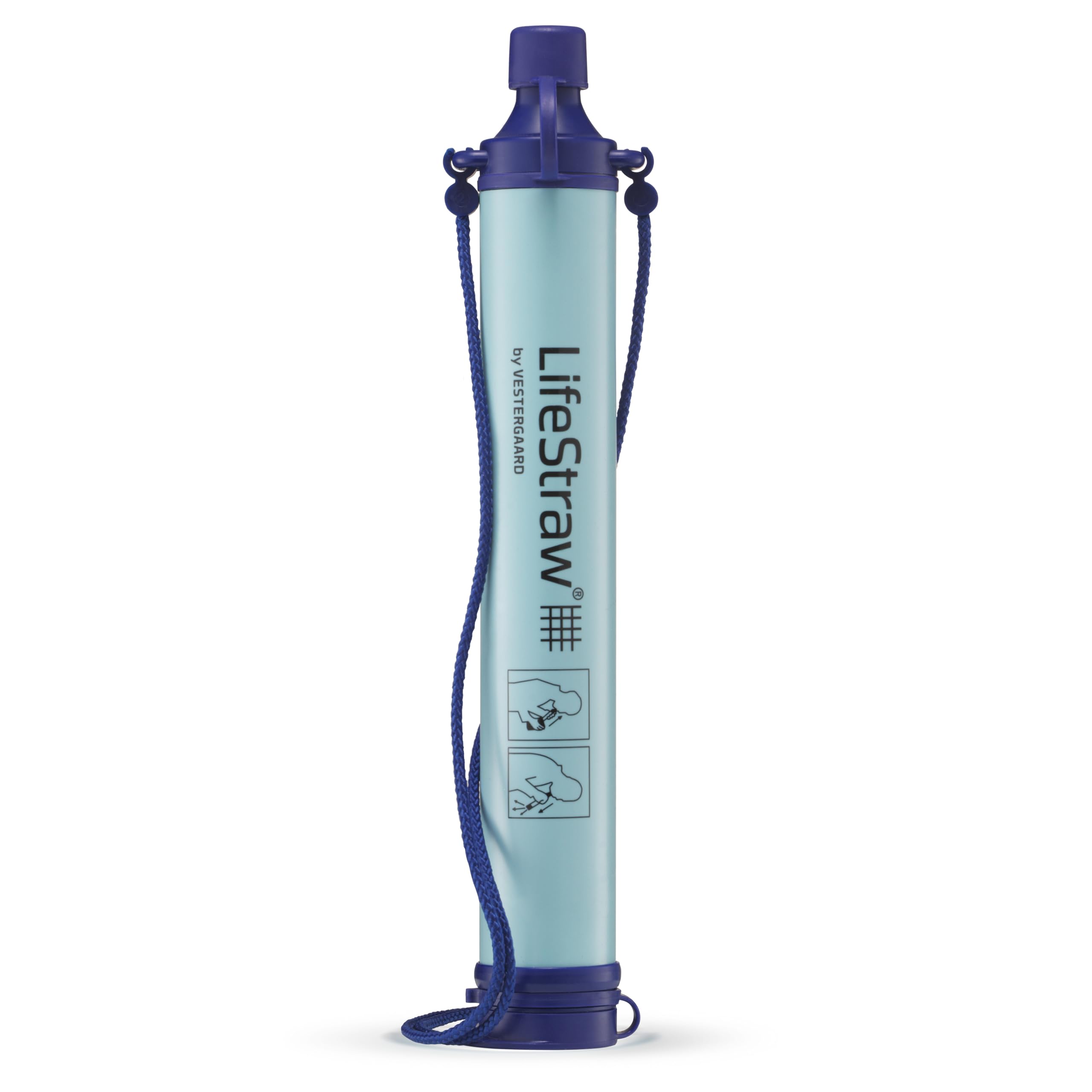
LifeStraw Personal
Key Features
- Filtration Micron: 0.2 micron
- Filter Capacity: 4,000 L
- Weight/Size: 2.1 oz
- Type: Straw
- Price: $
With a massive user base and consistently high satisfaction, the LifeStraw Personal delivers proven 0.2 micron filtration at a price that makes it an easy choice for first-time buyers. Its two-ounce body tucks into any pack pocket, and the 4,000-liter capacity means years of weekend trips before replacement is needed.
This filter is designed for individual use: grab-and-go drinking from streams, lakes, or taps. Because it relies on suction, extended hydration sessions can feel like a workout — it works best for quick stops rather than sitting and sipping. In silty water, the membrane may clog and require backflushing, so clearer sources or a pre-filter help maintain flow. These tradeoffs matter little for the solo backpacker or emergency kit owner who values weight and simplicity above all.
Pros
- Weighs barely 2 ounces and fits in a pants pocket
- Removes bacteria, parasites, and microplastics to a proven standard
- Natural fit for emergency kits – grab and drink without setup
Cons
- For long drinking sessions, the strong suction required can become tiring – best for short sips
- In murky or silty water, the filter may clog and need backflushing to restore flow
If you hike solo, pack light, or want a dedicated emergency straw that won’t break the bank, the LifeStraw Personal does exactly what it promises.
Best for Solo/duo Backpackers
Sawyer Squeeze
Key Features
- Filtration Micron: 0.1 micron
- Filter Capacity: 100,000 gal
- Flow Rate: 1.7 L/min
- Weight/Size: 2.5 oz
- Type: Squeeze, gravity
- Price: $$
The Sawyer Squeeze delivers 1.7 liters per minute – noticeably faster than the slimmer Mini in this lineup. It also works as a gravity system when paired with the included pouches, making it useful for camp hydration without constant squeezing.
This filter suits solo or duo backpackers who want a balance of speed and weight. The included pouches can develop leaks over time – using Smartwater bottles as a replacement resolves that concern. For ultralight fanatics who prioritize minimal weight, the Mini remains the lighter alternative.
Pros
- Fast flow rate of 1.7 L/min – fills a liter in roughly 35 seconds.
- Compatible with pouches or standard bottles – no need to carry proprietary containers.
- Weighs only 2.5 oz – saves pack weight without sacrificing output.
Cons
- Overtightening the cap can dislodge the o-ring – finger-tight is enough to seal.
- Included pouches can develop leaks over time – consider using Smartwater bottles for longer trips.
For solo hikers and pair backpackers who want fast flow without upgrading to a gravity system, the Squeeze is the practical middle ground – just budget for replacement bottles.
Best for Ultralight Backpackers
Sawyer Mini
Key Features
- Filtration Micron: 0.1 micron
- Filter Capacity: 100,000 gal
- Weight/Size: 1.45 oz
- Type: Straw, inline
- Price: $$
At just 41 grams, the Sawyer Mini shaves nearly an ounce off the top pick while matching its long-life hollow-fiber membrane. Attach it to a standard water bottle, a hydration pack hose, or use it as a straw – the threading options make it a modular piece of your camp kit rather than a standalone gadget.
This filter suits solo hikers and thru-hikers who count every gram and don’t mind a slower drink rate: the flow is noticeably gentler than the Squeeze, so filling a cooking pot takes patience. The O-ring can slip out if you overtighten the filter onto threads – a minor annoyance that’s easy to avoid with a light hand, but worth knowing before your first use.
Pros
- Weighs 1.45 ounces – ideal for ultralight kits
- Fits standard bottles, pouches, and hydration packs
- Removes bacteria, protozoa, and microplastics to 0.1 micron
Cons
- Flow rate is slower than the Squeeze – fine for sipping, less so for group cooking
- O-ring may pop out if the filter is overtightened onto a bottle
For the backpacker who prioritizes grams over speed, the Sawyer Mini delivers reliable, high-capacity filtration in a package that disappears into any pack.
Best for Small Groups (2-4)
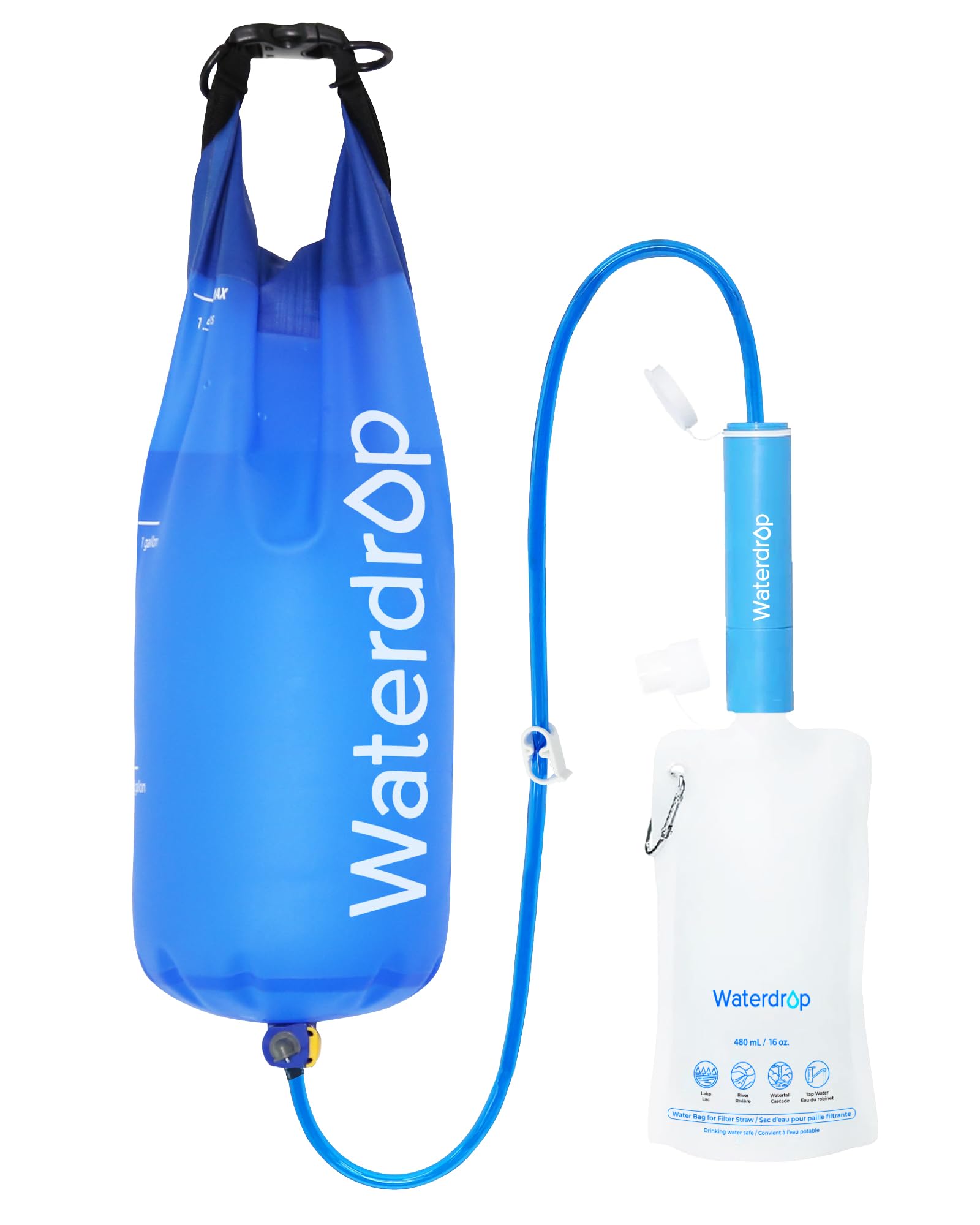
Waterdrop Gravity
Key Features
- Filtration Micron: 0.1 um
- Filter Capacity: 1,400 gal
- Flow Rate: 700 ml/min
- Type: Gravity
- Price: $$
The Waterdrop Gravity stands out for its large 1.5-gallon bag and long filter life, paired with a carbon stage that noticeably improves taste. As a gravity system, it requires no pumping or squeezing — just hang the bag and let it drip.
Best suited for small groups (2-4 people) at base camp who want hands-free filtration with good water quality. Flow rate can drop noticeably when filtering silty water, and an initial plastic taste has been noted in some units — both limitations that matter less for patient campers or those who treat clear water sources.
Pros
- Large 1.5-gallon bag suits small group use without constant refilling
- Carbon filtration improves taste compared to many hollow-fiber filters
- Simple operation and backflushing keep maintenance low
Cons
- An initial plastic taste can appear in some units, though it fades with use
- Flow rate slows considerably when water contains sediment, requiring backflushing
A practical gravity filter for camp-bound groups who prioritize capacity and taste over speed, and are comfortable with occasional flow slowdowns.
Best for Family Camping Groups
Platypus GravityWorks
Key Features
- Filtration Micron: 0.1 micron
- Filter Capacity: 1,500 gal
- Flow Rate: 1.75 L/min
- Type: Gravity
- Price: $$$$
At 1.75 L/min, the GravityWorks filters water faster than any gravity system in its class — and does so without pumping. The 6L clean bag provides enough water for cooking and drinking for a small group, and the whole system weighs just 11 oz — easy to pack to base camp. It suits families or small groups (4–6 people) camping near a water source where hands-off operation is key. But at this premium price, it costs nearly five times as much as entry-level gravity filters, and some owners have noted the bag’s grommets and seams can give out after repeated use.
Pros
- Filters 1.75 L/min without pumping — set up the dirty bag and let gravity work.
- 6L clean reservoir keeps a group of four hydrated and cooking without refills.
- Weighs 11 oz — light enough to carry to base camp without adding noticeable bulk.
Cons
- In some units, the grommets holding the bag can pull out, especially if packed tightly.
- The clean bag’s narrow opening makes complete drying difficult — mold may develop if not aired out thoroughly.
If you regularly filter water for four or more people and prefer a set-and-forget system, this is the fastest option — just budget for the higher cost and occasional durability quirks.
Best for Hikers, Fast Flow
LifeStraw Peak
Key Features
- Filtration Micron: 0.2 micron
- Filter Capacity: 1,000 gal
- Flow Rate: 2.5 L/min
- Weight/Size: 2.3 oz
- Type: Straw, bottle
- Price: $$
Flow jumps to 2.5 L/min from the original’s 0.5 L/min, cutting suction effort noticeably. The screw-on adapter fits standard water bottles and can be used with a gravity system, adding versatility on the trail.
This filter suits hikers upgrading from the basic LifeStraw who want faster drinking without the straw-sipping delay. The 65g weight and mid-range price are modest compromises: ultralight gram-counters or those on a strict budget will find lighter or cheaper options elsewhere, but for day hikers and weekend backpackers, the Peak’s speed and compatibility make it a practical choice.
Pros
- Faster flow rate reduces suction effort compared to original
- Attaches to standard bottles and gravity systems via screw-on adapter
- Rugged build for harsh conditions with clog-resistant membrane
Cons
- Weighs 9g more than the original LifeStraw — noticeable for ultralight packers but negligible for day hikes
A worthwhile upgrade for hikers who prioritize flow and bottle compatibility over the last few grams.
Best for Emergency Kits
Practical Survival 2pk

Key Features
- Filtration Micron: 0.1 micron
- Filter Capacity: 1,800 gal per straw
- Type: Straw
- Price: $$
Two 1,800-gallon straws come as a pair at a budget-friendly price — ideal for building emergency kits. The 0.1-micron hollow fiber filter removes bacteria and parasites. However, the threading may not fit all standard water bottles, limiting its use with common containers. It is a capable backup for car or bug-out bags, but not the best choice for primary backpacking where bottle compatibility and flow matter more.
Pros
- Two straws for the price of one — cost-effective for stocking multiple kits.
- Each straw filters 1,800 gallons, enough for years of occasional emergency use.
Cons
- Threading may not fit all standard water bottles.
Best for preppers who want spare filters for car or home emergency kits and don’t need bottle-thread compatibility.
Best for Preppers Emergency Kits
Membrane S1 Straw

Key Features
- Filtration Micron: 0.1 micron 5-stage
- Filter Capacity: 1,320 gal
- Flow Rate: 500 ml/min
- Type: Straw
- Price: $$
This four-pack of straw filters carries three NSF certifications (42, 372, 401), which is unusual at this price point. The 0.1-micron UF stage and 1,320-gallon capacity match many single-use competitors, and the compact size (each weighs ounces) fits easily in a glove box or bug-out bag. The tradeoff: the manufacturer specifies a one-year shelf life, and some units have shown plastic housings that can crack under load. That makes the S1 a sensible choice for emergency kits where it will be stored and rarely used, but less suited for regular camping trips where a Sawyer or LifeStraw offers better build longevity.
Pros
- Triple NSF certification for material safety and contaminant reduction
- Four straws per pack at a mid-range price, ideal for multiple kits
Cons
- Plastic housing may break under stress – best for occasional backup use
Best left in a car or home emergency kit where weight and cost matter more than daily durability.
Best for Travelers, Virus Risk
Survivor Filter PRO

Key Features
- Filtration Micron: 0.01 micron
- Filter Capacity: 100,000 L
- Flow Rate: 500 ml/min
- Weight/Size: 12.8 oz
- Type: Pump
- Price: $$$
The Survivor Filter PRO removes viruses with its 0.01 micron filter, offering protection no other portable unit here matches. However, its pump design is heavy (12.8 oz) and the pre-filter clogs quickly in silty water, making it more work than squeeze alternatives. Best for travelers needing virus defense, not general backpacking.
Pros
- 0.01 micron filtration blocks viruses—rare in portable water filters.
- Compact size and good-tasting water suit travel and short trips.
Cons
- Pumping requires sustained physical effort, tiring over a full day of water collection.
A niche option for viral-risk travel; skip it for routine hiking where faster, lighter filters work better.
Best for Backpackers, Pump Fans
Katadyn Hiker Pro

Key Features
- Filtration Micron: 0.2 micron
- Filter Capacity: 1,150 L
- Flow Rate: 1 L/min
- Weight/Size: 11.2 oz
- Type: Pump
- Price: $$$
For traditional pump users who value field-maintainable filters and improved taste from built-in carbon, the Hiker Pro delivers. Swishing the cartridge clean is quick, and flow rate holds up well. However, the plastic input barb may crack under stress, and replacement cartridges cost more than competitors’ — a consideration for long-term budgets.
Pros
- Easy to clean in the field with a simple swish of the cartridge
- Decent flow rate for a hand pump at 1 L/min
Cons
- The plastic input barb can crack under strain, so inspect before each use
Best for traditional pump users who prioritize easy maintenance and taste improvement over weight and long-term filter cost.
Best for Trail Runners
Katadyn BeFree 1.0L

Key Features
- Filtration Micron: 0.1 micron
- Filter Capacity: 1,000 L
- Flow Rate: 2 L/min
- Weight/Size: ultralight
- Type: Soft bottle, gravity
- Price: $$
The BeFree delivers its advertised 2 L/min flow from a 1.0L soft bottle that packs flat – ideal for trail runners who refill frequently. Its 0.1 micron hollow fiber filter handles standard backcountry water. However, the soft bag’s long-term durability under rough use is unconfirmed, and the limited field data makes it a specialized choice for speed-focused trips where weight is the priority.
Pros
- Ultralight and collapsible design saves significant pack space for fast-moving hikers.
- Fast flow rate reduces waiting time at water sources during active runs.
Cons
- Soft bottle may be prone to punctures over extended use – best for short trips with careful handling.
Matches trail runners and day hikers who want the lightest possible setup and can handle a soft bottle with care.
Best for Day Hikers, Travel
GRAYL GeoPress

Key Features
- Filter Capacity: 65 gal
- Flow Rate: press, fast
- Weight/Size: 16 oz
- Type: Press
- Price: $$$
The GRAYL GeoPress delivers instant purification – press down and drink clean water in seconds. That speed makes it ideal for travelers facing questionable tap water or day hikers who don’t want to wait. But the cartridge lasts only 65 gallons, and replacement costs push the per-liter price well above standard filters. For extended backcountry trips, capacity runs short quickly.
Pros
- Purifies 24 oz of water in seconds via a simple press mechanism.
- Removes viruses, bacteria, protozoa, chemicals, and PFAS in one pass.
Cons
- Cartridge lasts only 65 gallons, making per-liter cost higher than squeeze filters.
Best for short trips or areas with questionable tap water where speed matters more than cost per liter.
Best for Car Camping
Sawyer Gravity SP160

Key Features
- Filtration Micron: 0.1 micron
- Filter Capacity: 100,000 gal
- Type: Gravity
- Price: $$
This gravity filter pairs a 100,000-gallon rated mini filter with a one-gallon bladder. The filter delivers the same 0.1-micron protection backpackers know, but the bag can tear when used off-trail, and the flow is noticeably slow due to the mini filter bottleneck. That combination makes it less competitive than faster, more durable gravity options like the Waterdrop or Platypus systems.
Pros
- Compact gravity setup that packs small — ideal for car camping where weight isnt a concern.
- Uses Sawyer’s 0.1-micron mini filter, the same one found in their squeeze systems.
Cons
- Bladder can tear on rough terrain, making this best for car camping where the bag isnt jostled.
A reasonable backup filter for car campers who already have a primary system — skip if you need a durable gravity setup for extended trips.
Best for Extreme Budget
SimPure Gravity

Key Features
- Filtration Micron: 0.1 micron
- Filter Capacity: 5,000 L
- Flow Rate: 450 ml/min
- Weight/Size: 3.2 oz
- Type: Gravity
- Price: $
The SimPure Gravity is the lightest gravity system at this price point – the filter weighs just 3.2 oz and sets up in seconds. However, flow may slow noticeably after 30 liters, and performance consistency varies between units. This makes it a low-priority option for emergency kits rather than a primary choice for backpacking or any trip where safe water is essential.
Pros
- Weighs only 3.2 oz per filter – barely noticeable in a pack.
- No pumping required; sets up in seconds for hands-free use.
Cons
- Flow rate may drop considerably after 30 liters – best for low-volume, occasional use.
Best suited for an emergency kit where weight and cost are the only priorities, and where occasional use and potential slowdown are acceptable.
Best for Emergency Backup
Logest 4pk Straws

Key Features
- Filtration Micron: 0.1 micron
- Filter Capacity: 600 L
- Type: Straw
- Price: $
This four-pack provides an affordable way to equip car or home emergency kits with basic water filtration. The straws are compact and lightweight, with a 0.1-micron hollow fiber and carbon filter. However, this kit is best suited for clear water sources and short-term backup; it lacks the higher bacterial removal and longer lifespan needed for primary camping or backpacking where water quality is uncertain.
Pros
- Inexpensive multi-pack for emergency kits
- Compact and lightweight
Cons
- 99% bacteria removal – lower than category leaders, limiting use to cleaner sources
This multi-pack is a cost-effective solution for stocking emergency kits where water clarity is predictable, but not for primary trail use where higher filtration is essential.
How to Choose
The single most important factor in choosing a camping water filter is matching the pump or gravity system to your expected water clarity and daily volume, because straw filters that shine in clear streams become frustrating in silty conditions.
Filtration Micron Level
Most portable filters use 0.1 to 0.2 micron pores to remove bacteria and protozoa. A 0.1 micron absolute rating catches smaller particles than a nominal 0.2 micron, but the difference matters only in water with high sediment or if you need virus protection. Below 0.1 micron the flow rate drops significantly and the filter clogs faster.
For typical U.S. backcountry streams, 0.1 micron is more than adequate. If you travel to regions with viral contamination (e.g., parts of Asia, Africa, or South America), you need a filter with 0.01 micron pores or a chemical treatment step.
Filter Capacity
Filter capacity is often stated in gallons or liters, but that rating assumes clear, low-turbidity water. In reality, silty or muddy water can cut usable life by 30 to 50 percent. A filter rated for 100,000 gallons might only last 50,000 gallons if you regularly dip from sediment-heavy sources.
For day hikes and short trips, a 1,000-liter capacity is more than enough for one person for a season. For thru-hikers or group use, look for filters with a higher rated capacity (e.g., 100,000 gallons) because the absolute cost per gallon becomes lower even if you get less than the rating.
Flow Rate
Flow rate determines how long you wait for a full bottle. Straw filters average about 500 ml/min with strong suction, while squeeze and gravity systems can deliver 1.5 to 2.5 L/min. A slow flow rate is acceptable for personal hydration but becomes a bottleneck when filtering water for cooking or for a group.
If you camp with two or more people, a flow rate below 1 L/min will test your patience. Gravity filters offer the fastest hands-free output, but they require setup time and a water source above the collection container.
Weight and Packed Size
Every extra ounce matters on a multi-day hike. Straw filters weigh around 2 ounces and pack to the size of a permanent marker. Squeeze filters add another ounce or two but provide easier flow. Gravity systems start at 6 ounces and require multiple bags and hoses.
For ultralight backpacking, a straw or inline filter is the way to go. For car camping or base camp trips, the weight penalty of a gravity system is offset by the convenience of hands-free filtration.
Filter Type
Straw filters require direct suction and are best for solo users who need a quick drink. Squeeze filters use a bag or bottle and let you filter a larger volume with less effort. Gravity systems are ideal for groups because they filter passively while you set up camp.
Pump filters offer field-cleanable cartridges and are the only type that can treat visibly muddy water without pre-filtering, but they are heavy and labor-intensive. Choose based on your typical group size and trip duration.
FAQ
Can I drink directly from a stream with a LifeStraw?
Yes, you can immerse the filter tip and sip directly from the stream. The LifeStraw removes bacteria, parasites, and microplastics down to 0.2 microns. However, do not use it in water with high sediment, as it will clog faster. For silty water, pre-filter through a bandana or let the sediment settle first.
How often should I backflush my Sawyer water filter?
Backflush your Sawyer Mini or Squeeze after every 3 to 5 liters in murky water, or whenever the flow rate slows noticeably. Use the included syringe and clean water to push debris out of the hollow fibers. Regular backflushing prevents permanent clogging and extends filter life to its rated capacity.
Why is my gravity water filter so slow?
A slow gravity filter usually indicates clogged membranes or air bubbles in the system. First, backflush the filter with the included plunger. If that does not help, check that the dirty water bag is suspended higher than the clean bag to maintain pressure. Heavy sediment is the most common cause — pre-filtering with a coffee filter or bandana can restore flow.
Does the GRAYL GeoPress remove viruses?
Yes, the GRAYL GeoPress uses a combination of 0.2 micron filtration, activated carbon, and ion exchange resin that is tested to remove viruses, bacteria, protozoa, and chemicals. Its press mechanism delivers clean water in under 15 seconds. However, the cartridge is rated for only 65 gallons, making it costly per liter for long trips.