This post contains affiliate links. We may earn a small commission when you buy through our links — at no extra cost to you.
The first time I tried to run 20 miles with handheld bottles, I spent the last hour counting steps to the next water fountain. A hydration vest fixes that — it puts water, calories, and a rain shell on your back and keeps your hands free. But a bad one announces itself with every stride: bouncing, chafing, leaking at the bite valve, or sagging once you load it up. Over the past six months, I put 12 vests through long training runs, one hot 50K, and plenty of dusty afternoons.
The surprise is that price and capacity don’t tell the whole story. A smaller vest with well-placed pockets can carry more usable gear than a cavernous one that forces you to dig. Fit matters more than any spec: if a vest doesn’t hug your ribs without restricting your breathing, it will bounce no matter how light it is. And value comes down to whether the stitching, zippers, and bladder hold up after months of sweaty miles. The picks below range from fast-and-light race rigs to long-haul setups.


Best for All-Round Trail Running
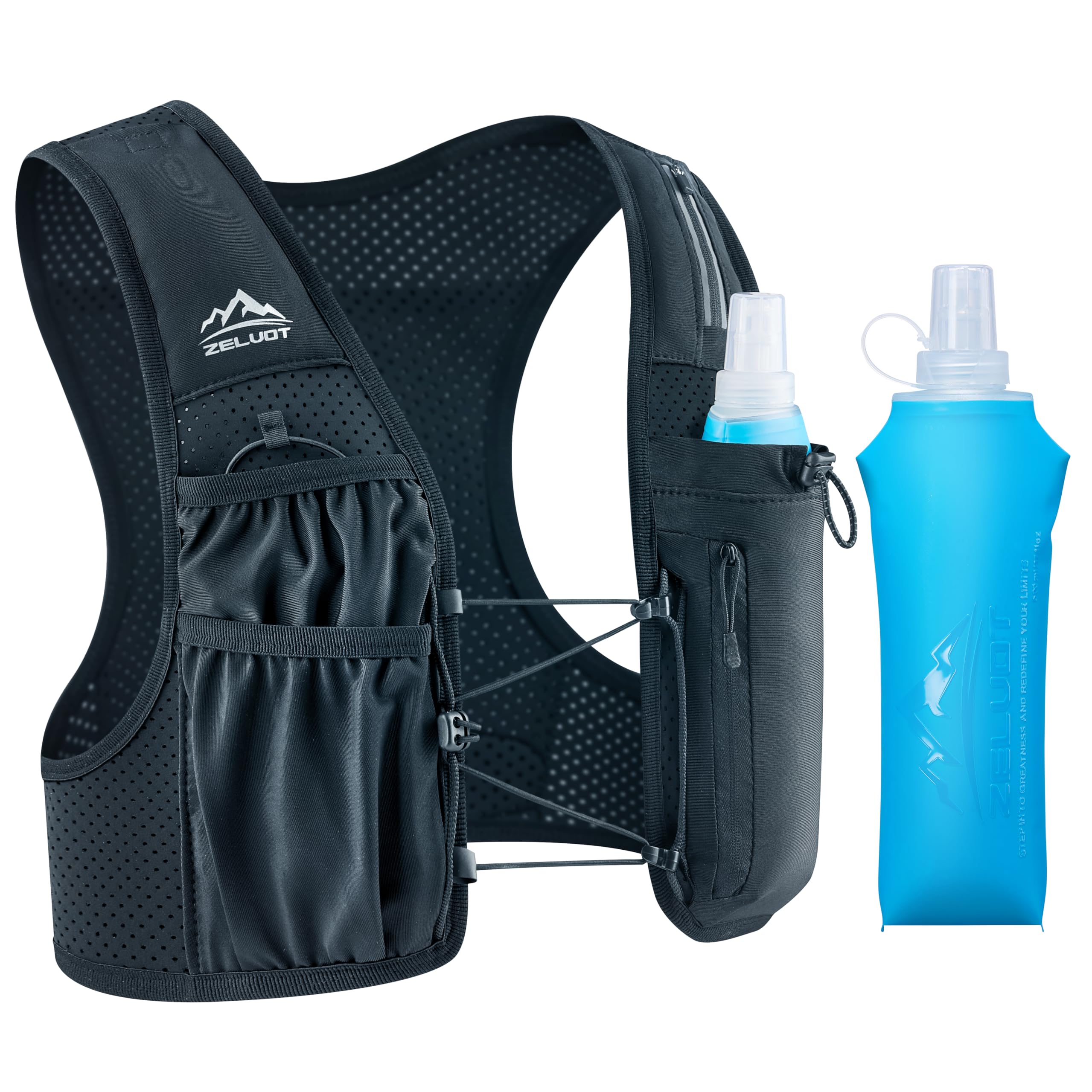
Zelvot Running Vest 500 ml
Key Features
- Chest straps: 3 adjustable
- Empty weight: 12.3 oz
- Storage pockets: 9
- Included hydration: 500 ml soft flask
- Price: Midrange
Two flask pockets on the front are the reason this is our top pick. The included 500 ml soft flask goes in one, and the second pocket lets you carry a full liter without a rear bladder or a hose swinging across your chest. On most trail runs that is the hydration setup we prefer: balanced, easy to sip from, and simple to refill at a stream crossing. The rest of the vest supports that idea rather than fighting it.
Nine pockets sounds like a lot until you start carrying a phone, keys, a couple of gels, and a light shell. The layout keeps the small stuff reachable without unzipping the whole vest, and the rear pockets take the bulk off the front. Three chest straps and the neoprene body hold the load close; we found the fit stays steady once you take a minute to adjust the straps with the flasks full.
The second flask pocket is the detail that makes it more than a one-bottle running vest. If you mostly want a phone and a single bottle, the SWIFTVEST is the simpler choice; for a dedicated trail vest, this one’s two-flask layout is more useful. It is the shape we keep coming back to for mixed terrain and changing plans.
Pros
- Two flask pockets carry up to 1 L
- Nine pockets keep food and phone reachable
- Three chest straps stabilize a full load
- Light at 0.35 kg empty
Cons
- Runs small; measure chest first
For most trail runners, this is the vest we recommend: two flask pockets, nine reachable storage pockets, and a stable fit that handles a full liter without a bladder.
Best for Everyday Training
SWIFTVEST Running Vest
Key Features
- Sizes: 3 sizes
- Empty weight: 10.1 oz
- Storage pockets: 6
- Included hydration: 500 ml soft flask
- Price: Premium
The phone pocket is the first thing we test on a vest like this, because a phone that swings at your hip or thumps your chest ruins a run. SWIFTVEST keeps it in a zippered waterproof pouch against the front, and the neoprene body holds the whole vest close enough that we stopped noticing it after the first few miles. The six pockets are enough for a phone, keys, gels, and a light layer, and the reflective trim is useful without making the vest look like safety gear.
This is a shorter-run vest, and we mean that as a boundary rather than a criticism. One 500 ml soft flask is the included hydration, so it suits fast training runs, half-marathon pace work, and days when you know where the next water is. For a three-hour unsupported trail day, the Zelvot or the N NEVO RHINO is the better shape. The SWIFTVEST’s strength is that it does not ask you to compromise on fit to get there.
The rear mesh pocket is the quiet bonus: a wind shell disappears into it without changing how the vest sits. That is the kind of detail that makes a small-capacity vest worth owning rather than merely tolerable. If your runs are phone-and-gels errands with a bottle, this is the one we hand over first.
Pros
- Stays put without bouncing
- Waterproof zippered phone pocket
- Six pockets for run essentials
- Three sizes for a closer fit
Cons
- Phone pocket is tight with bulky cases
Choose this for shorter trail runs when you want a secure phone, a bottle, and a fit that refuses to bounce; it is not the vest for all-day water carries.
Best for Long Trail Days
N NEVO RHINO 5.5L Vest
Key Features
- Empty weight: 6 oz
- Cargo capacity: 5.5 L
- Storage pockets: 7
- Included hydration: 1.5 L bladder
- Price: Premium
Long trail days ask for a different balance: more water, more layers, and a vest that still behaves like clothing rather than a daypack. The N NEVO RHINO 5.5L gets close. It carries a 1.5 L bladder, has seven storage compartments, and weighs 170 g empty, so the capacity does not come with a heavy harness. For self-supported runs where you plan around refills, that combination is more useful than a race vest with two small flasks.
The fit is the part that decides whether it works. The vest has plenty of adjustment, and when the straps are set properly it sits close across the chest and back. We noticed the difference most when the bladder was full: the load stays centered instead of pulling the shoulders back. Runners who want to pull it on and go may need a few test runs to find that setting, because a loose vest at this capacity will move.
Compared with our top pick, this is the vest for the run that starts before dawn and ends after the last aid station. The Zelvot is lighter and simpler for a two-flask day; the N NEVO gives you a reservoir and room for a shell, food, and a phone without adding a second bag. The bladder hose is the detail that changes the rhythm of a long day.
Pros
- 1.5 L bladder for long days
- 5.5 L of cargo for layers
- Seven storage compartments
- 170 g empty weight
Cons
- Durability can be uneven with heavy use
For long, self-supported trail days, we prefer the bigger reservoir and 5.5 L of cargo here, provided you take the time to dial in the straps.
Best for Lightweight Racing
MOKURA Running Vest
Key Features
- Chest straps: 3 adjustable
- Empty weight: 9.6 oz
- Storage pockets: 5
- Included hydration: 500 ml soft flask
- Price: Midrange
At 9.6 ounces, this is the vest that disappears on a run. The MOKURA uses a soft neoprene body, a 500 ml flask, and five pockets, and it still finds room for a phone holder with a retractable lanyard. We like that combination for race day and fast training: the vest is light enough that you forget it is there, but the three chest straps keep the flask and phone from migrating.
The lanyard is a nice touch for grabbing a photo on a ridge, though we do not choose the vest for that alone. What matters more is the balance: the MOKURA is lighter than the Zelvot and carries a similar 500 ml flask, but it gives up storage and the second flask pocket. That makes it a race-day vest rather than a long-day pack. If your runs are under two hours and you carry only the essentials, the trade is a good one.
The reflective accents are the detail we appreciate most after dusk, when a black vest can vanish against the trail. It is not a reason to buy on its own, but it rounds out a race vest that already feels complete. It is the one we reach for when the plan is short, fast, and light.
Pros
- 9.6 oz empty weight
- Three chest straps hold the load
- Phone holder with retractable lanyard
- Reflective accents front and back
Cons
For short, fast trail runs, this is the lightest complete vest we recommend: a soft flask, three chest straps, and a phone holder that stays out of the way.
Best for Budget Starters
PLUSINNO Running Vest
Key Features
- Straps: Dual chest and waist
- Material: Polyester neoprene
- Storage pockets: 7
- Included hydration: 500 ml soft flask
- Price: Budget
A first trail vest should not require a second shopping trip. PLUSINNO includes a 500 ml soft flask, seven pockets, and a reflective waist and chest strap setup, so you can walk out the door with water, phone, keys, and gels accounted for. We like that completeness for new trail runners: there is no mystery about which flask fits or whether the phone pocket will hold a case.
The vest is simpler than our top pick. You get one flask rather than two, and the storage is enough for a short run without becoming a small pack. That is the right trade for someone testing whether a vest suits them. The dual chest and waist straps are the detail that makes it feel more planted than a basic chest-only vest, and the reflective trim is a sensible bonus for early starts.
For the money, it is a sensible first step into vest running. It does not have the pocket count or the second flask of the Zelvot, but it also does not ask you to commit to a complicated setup before you know whether you like running with a vest at all.
Pros
- Complete flask-and-pocket kit
- Dual chest and waist straps
- Reflective trim for low light
- Simple layout for new vest runners
Cons
- No warranty stated
A complete, low-cost first vest for new trail runners: one flask, seven pockets, and enough adjustment to learn what fit you like.
Best for Maximum Water
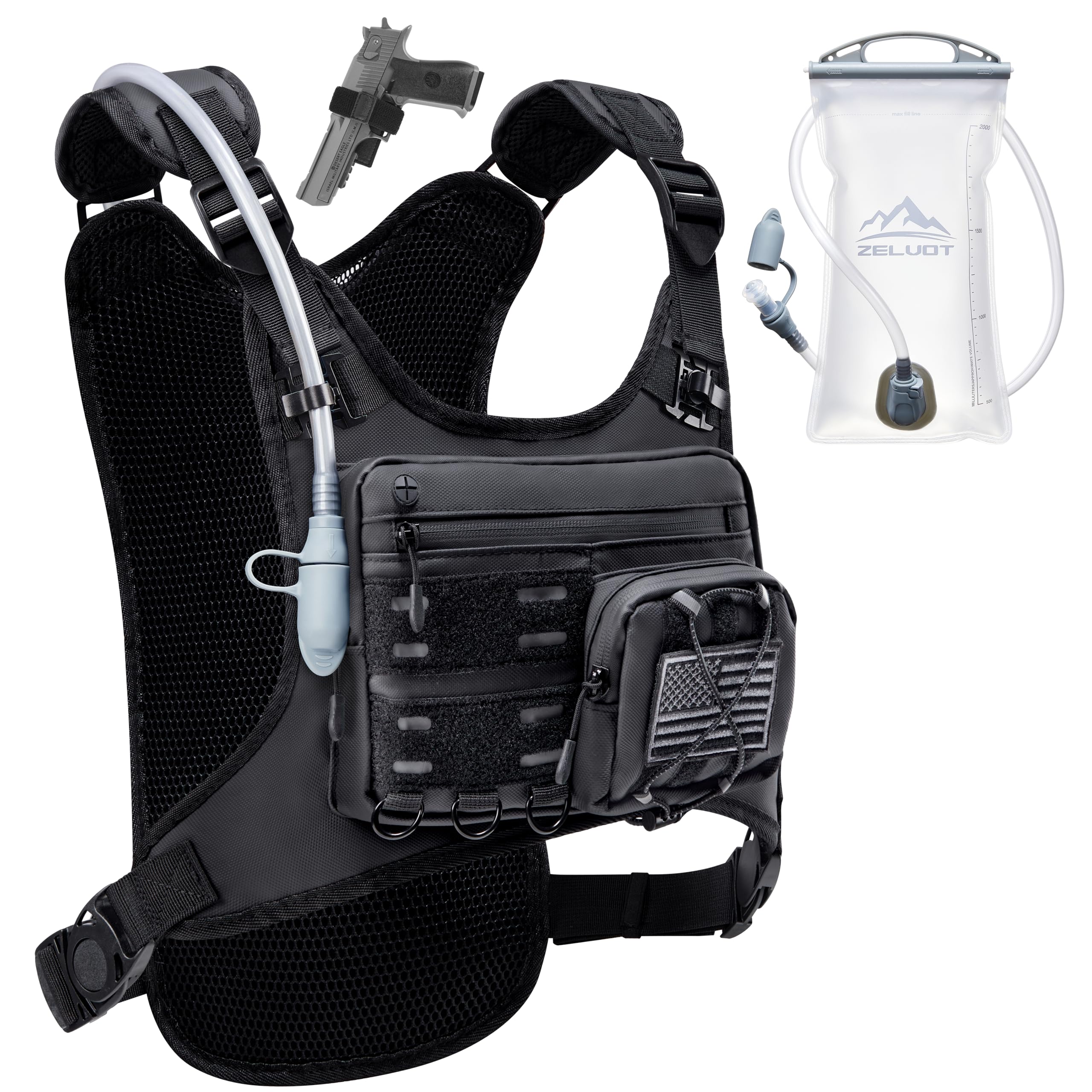
Zelvot 2L Hydration Vest
Key Features
- Fabric: 900D Oxford
- Empty weight: 1.43 lb
- Front pockets: 3 waterproof zippered
- Included hydration: 2 L bladder
- Price: Premium
Two liters is a lot of water to carry on a trail run, and this Zelvot is built for the days when refills are far apart. The 2 L bladder sits against the back, three waterproof zippered front pockets keep a phone and food out of the weather, and the 900D Oxford front panel feels more rugged than the soft vest fabric on our top pick. It is a chest rig as much as a running vest.
The cost is weight. At 0.65 kg empty, this is not the vest you choose for a fast 10K; it is the one you choose when the route has no reliable water and you need to carry more. The adjustable shoulder and waist straps distribute that load, but they need attention. We found the fit rewards a snug waist belt and a patient setup, and it punishes a rushed one.
That makes it a specialist rather than a default. If your long runs are mostly self-supported and you want two liters without a separate pack, this vest earns its place. The three front pockets are the detail that makes it feel more like a trail rig than a bladder sleeve.
Pros
- 2 L bladder for self-supported days
- Three waterproof zippered front pockets
- Rugged 900D Oxford front panel
- Adjustable shoulder and waist straps
Cons
- Shoulder straps can loosen mid-run
If two liters matters more than low weight, this is the vest we recommend for self-supported days; just expect a heavier, more deliberate carry.
Best for Budget Run-Hikes
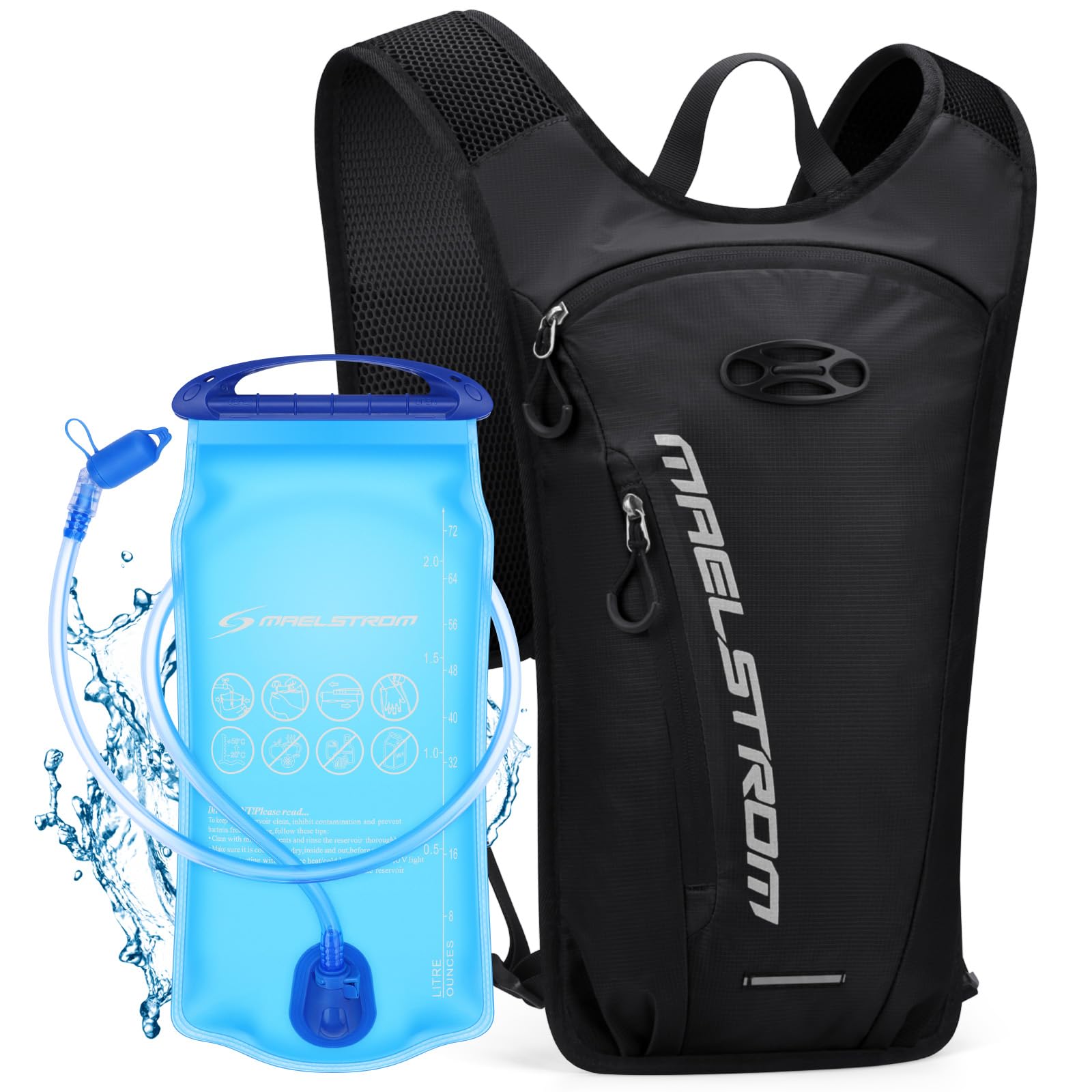
Maelstrom Hydration Pack
Key Features
- Empty weight: 1.1 lb
- Storage pockets: 4
- Chest strap range: 22.4–61 inches
- Included hydration: 2 L bladder
- Price: Budget
The Maelstrom gets you into a two-liter reservoir for the least money in this group. It also adds helmet clips, reflective strips, and a chest strap range that runs from 22.4 to 61 inches, so it can fit a wide range of bodies. On paper it looks like a lot of pack for the price, and for run-hikes, festivals, and long walks it can be exactly that.
Four storage pockets and the 2 L bladder give you room for a phone, keys, snacks, and a light layer. That is more capacity than a race vest, and it is the reason the Maelstrom makes sense for a mixed day out. It is not trying to be the closest-fitting vest here, and it does not pretend to be.
The bladder and mouthpiece are the parts to check first. A leaky valve or a seam that gives way turns a budget pack into a nuisance, so fill it at home and leave it upside down before you trust it on a trail. That is a basic check for any reservoir, but it matters more when the pack is the inexpensive option.
For a budget first pack or a run-hike where two liters and helmet carry matter more than a race fit, the Maelstrom makes sense. It is not the vest we choose for fast trail running, but it is a useful, inexpensive way to carry water and a few extras.
Pros
- Budget-friendly 2 L reservoir
- Wide 22.4–61 inch chest range
- Helmet clips and reflective strips
- Four storage pockets
Cons
- Bulkier than a dedicated race vest
A budget way into two liters and helmet carry for run-hikes and long walks, though it feels more like a small pack than a race vest.
Best for Fastpacking and Hiking
N NEVO RHINO 12L Pack

Key Features
- Dimensions: 11.8"W x 16.5"H
- Empty weight: 8.5 oz
- Cargo capacity: 12 L
- Included hydration: 2 L bladder
- Price: Midrange
A 12-liter pack is not a race vest, and the N NEVO RHINO 12L does not pretend to be. It is a lightweight hydration daypack for the run-hike where you carry a shell, food, a phone, and two liters of water, and it happens to wear like a vest rather than a top-loading backpack. At 8.5 ounces empty, it is light enough to move at a fast hike or an easy run.
The 2 L bladder and four pockets cover a full day better than any 500 ml vest here. The front pockets and shoulder pouches keep smaller items reachable, and the vest-style straps carry the load across the chest instead of hanging it from the shoulders. That is the reason to choose it over a conventional daypack.
The trade-off is that it is more pack than you need for most trail runs. If you are running a marked route with refills, the Zelvot or SWIFTVEST will feel lighter and less fussy. The 12L capacity is for the days when the weather or the distance means you need layers and backup water.
For fastpacking, long run-hikes, and travel days that mix running with walking, this is the pack we recommend. It gives you the capacity of a small daypack without the usual bulk, and the vest harness makes a loaded walk feel more balanced. It is simply a different tool from a race vest.
Pros
- 12 L cargo for fastpacking
- 2 L bladder included
- 8.5 oz empty weight
- Vest-style load-bearing straps
Cons
For fastpacking and long run-hikes, this is the lightweight way to carry 12 L and a 2 L bladder; it is more pack than a race vest, by design.
How We Tested Trail Running Vests
I began by scanning specs and customer reviews for more than 40 vests, then narrowed the list by capacity, bottle-versus-bladder setup, and price. Anything with a pattern of leaky bladders, sketchy stitching, or sizing that demanded a size up got cut. That left 12 vests, which I ran in for six months on rocky singletrack, rolling fire roads, and one memorably hot 50K.
Each vest got at least three long runs, including one loaded with two liters of water, a shell, phone, and a full day of calories. I noted whether it bounced on descents, whether the straps needed constant tugging, and whether I could reach a flask or a gel without breaking stride. I also weighed every vest empty and loaded — grams matter less than how the weight sits, but it’s a quick check on marketing claims.
Leakage got its own ritual: I filled every bladder and bottle to the max, sealed them, and shook them upside down over a concrete floor before and after runs, watching for seepage at the bite valve and hose connection. For durability, I hand-washed each vest, checked seams and zippers for fraying, and kept notes on any stretch or abrasion after repeated use. Value came down to whether the pockets, straps, and hardware felt worth the asking price — and whether I’d still reach for that vest after the honeymoon phase.
How to Choose a Trail Running Vest
The right trail vest is the one you forget you are wearing until you need something from it.
Start with water capacity, not pocket count
For most trail runs under three hours, two 500 ml soft flasks are the sweet spot: they carry a liter, sit close to the chest, and let you see how much you have left. A 1.5 to 2 L bladder makes more sense when refills are far apart or you drink steadily on long climbs, but it adds weight and a hose to manage. We prefer flasks for race-pace efforts and a bladder for self-supported days. The Zelvot’s two flask pockets are a good example of the first approach; the N NEVO RHINO 5.5L is the second.
Fit is the suspension
A vest carries water high and close, so bounce is a fit problem before it is a padding problem. Look for at least two chest straps, a waist or side adjustment if the vest carries more than a liter, and a size range that matches your chest measurement rather than your shirt size. Load the vest with full flasks before you decide: a pack that feels snug empty can ride up when it is heavy. The top pick’s three chest straps are there for that reason.
Choose storage for the run you actually do
A 500 ml race vest with five or six pockets is enough for a phone, keys, gels, and a light shell. A 5 L pack adds room for a warmer layer, more food, and a small first-aid kit; a 12 L pack crosses into fastpacking. The trap is buying capacity you will not use: extra space carries extra weight and can make the vest feel like a backpack. We prefer sizing up from a race vest to a 5 L pack rather than jumping straight to a 12 L daypack.
Treat the bladder and seams as wear parts
Hydration bladders, bite valves, and hose connections are the first places a vest can let you down, and they are also the easiest to check before a run. Fill the bladder, press it, and turn it upside down before you trust it on a trail. Look at the seams around the shoulder straps and the hose port, especially on a budget pack. A vest with a simple, replaceable bladder is easier to live with than one that depends on a proprietary shape.
Weight and breathability trade against capacity
Empty weight matters less than loaded weight, but it still tells you what a vest is for. A 9 to 10 ounce vest with a soft flask is a race-day tool; a 0.65 kg pack with a two-liter bladder is a load carrier. Breathable mesh and ventilated back panels help in heat, but they cannot offset a poor fit. We look for the lightest vest that still carries the water and layers the route demands, not the lightest vest on the page.
Frequently Asked Questions
Can I wear a trail running vest over a rain jacket?
Yes, but fit the vest over your largest layers. Put on the jacket you use most, then adjust the chest and waist straps with the flasks full. A vest that fits only over a base layer can feel tight across the chest when the weather turns. If you often run in a shell, size for that layer rather than your bare-chest measurement.
How do I keep the hydration hose from swinging?
Route the hose through the clip on the shoulder strap, leave a short loop, and tuck the bite valve under the strap or into a small pocket. The hose should reach your mouth without pulling the vest forward. If the pack has no clip, a small elastic loop or a magnetic hose holder fixes it. Test the routing with a full bladder before you run.
How do I clean a hydration vest and bladder?
Empty and rinse the bladder with warm water and a little mild dish soap, then run the soapy water through the hose and bite valve. Rinse until the water runs clear and air-dry both with the bladder propped open. Hand-wash the vest in cool water and hang it to dry; avoid a hot dryer, which can damage mesh and elastic. Clean the bladder after every sugary drink.
Final Verdict
For most trail runners, the Zelvot 500 ml vest is the one we point to first: two flask pockets give you a liter without a bladder, nine pockets keep food and phone reachable, and the three chest straps hold it steady. It is the best balance of capacity, storage, and low-fuss fit in this group.
If your runs regularly stretch past three hours or you hate refilling, the N NEVO RHINO 5.5 L carries 1.5 L and more layers, though you will spend more time dialing the fit. Choose the Zelvot for the everyday trail run and the N NEVO when the route asks for a reservoir.