This post contains affiliate links. We may earn a small commission when you buy through our links — at no extra cost to you.
The promise of a solar power bank is tempting – free power from the sun to keep your phone alive on the trail. In practice, most built-in panels are too small to fully recharge the battery in a day. That doesn’t make them useless; it means you should rely on wall charging before you leave and treat solar as a backup for cloudy days or extended trips.
This guide cuts through the marketing to find power banks that actually deliver reliable USB charging for camping and hiking. We focus on capacity, fast charging, durability, and real-world solar performance – so you know exactly which models earn their place in your pack and which ones leave you guessing.
Whether you’re car camping or backpacking, the right power bank balances capacity and weight without exaggerating what the sun can do.
Best for Camping, Hiking, Budget
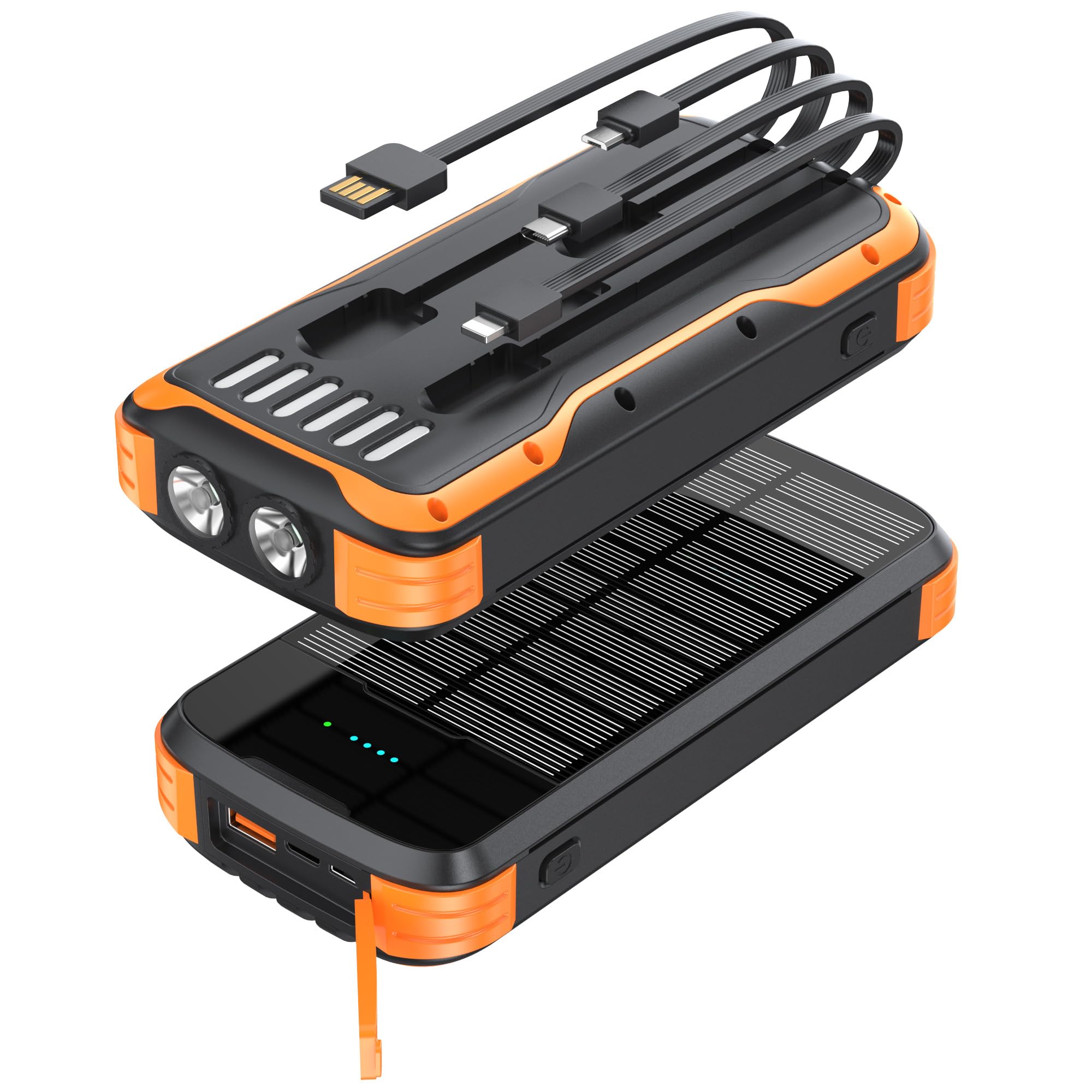
YELOMIN 38800mAh Solar
Key Features
- Battery Capacity: 38800mAh
- Fast Charging: 22.5W USB-C
- Built-in Cables: 4 cables
- Price: Mid-Range
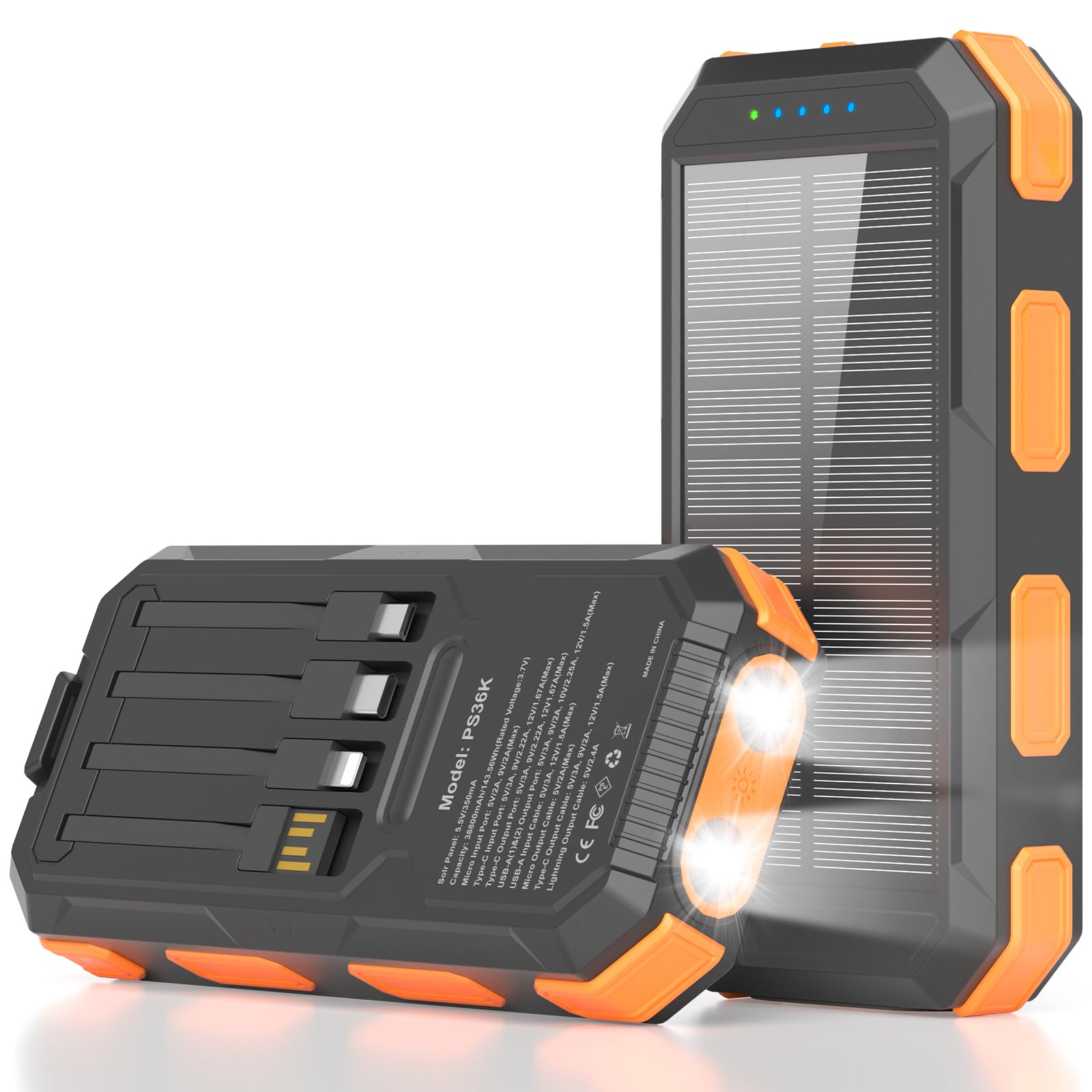
This power bank packs 38,800mAh of capacity and 22.5W USB-C Power Delivery fast charging, letting you recharge a phone several times or top off a tablet during a weekend camping trip. The four built-in cables — including Lightning, USB-C, and Micro-USB — mean you don’t need to carry extra cords, reducing one more thing to lose at the campsite.
In practice, the YELOMIN reliably charges phones, smartwatches, and earbuds during outages and outdoor excursions, with the integrated solar panel absorbing some sun even under partial cloud cover. That solar input is slow — best treated as a trickle to extend battery life rather than a primary recharge method. The IP65 rating keeps rain and dust out, and the dual LED flashlights are handy for navigating a tent or trail after dark.
This unit works best for campers who want a durable backup power source with fast wired charging and don’t expect solar to fully replenish the bank. Hikers on multi-day trips will appreciate the waterproof build and high capacity for keeping devices alive between resupply points. Budget-conscious buyers get a lot of capacity and features for the price, though ultralight backpackers will find the weight (about 1.5 lbs) heavy for a minimalist setup.
Pros
- High 38,800mAh capacity can charge a phone several times over multiple days.
- 22.5W USB-C PD fast charging quickly tops off phones and tablets.
- Four built-in cables eliminate the need to carry separate charging cords.
- IP65 waterproof rating withstands rain, splashes, and dusty trails.
- Solar panel can add some charge in direct sunlight as emergency backup.
Cons
- Solar charging is slow and may not fully recharge the bank even after a full day in direct sun — rely on wall outlets or car charging for full capacity.
- Some users find the effective capacity lower than advertised; a phone may charge only 1-2 times instead of the expected 6-8.
For campers and hikers who need a rugged, high-capacity power bank with fast wired charging and built-in cables, this is a practical choice — just plan to recharge it via outlet or car, not as a primary solar charger.
Best for Car Camping, Emergency
Kepswin 49800mAh Foldable
Key Features
- Battery Capacity: 49800mAh
- Fast Charging: PD 22.5W
- Built-in Cables: 4 cables
- Price: Mid-Range
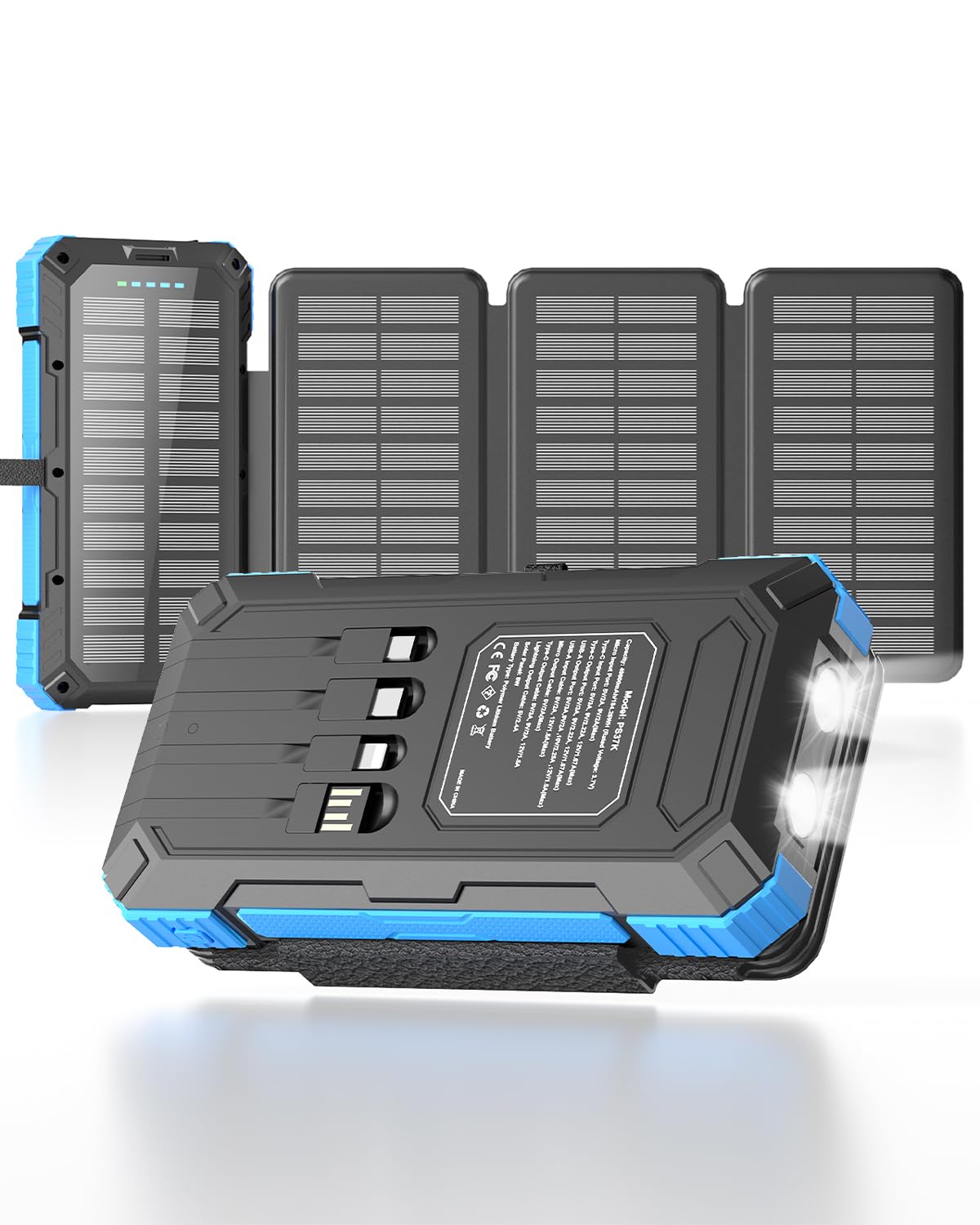
The Kepswin stands out with three foldable solar panels that capture more direct sunlight than the single-panel designs on the top pick. This makes it a stronger option when you can leave it in the sun for hours at a stationary campsite. The tradeoff is weight: at 0.74 kg with the panels, it is too heavy for backpacking.
This power bank suits drivers who set up a base camp and need to replenish a large battery over a few days. The 49800mAh capacity holds enough charge for multiple phone and tablet top-ups. That said, durability can vary—some units have become inoperative after a handful of uses, so testing before a trip is wise. If you prioritize lightweight gear for hiking, consider the top pick instead.
Under direct sunlight, the foldable panels deliver a trickle charge that can refill the battery over a full day. The built-in cables (four types) simplify connecting devices without hunting for cords. However, solar charging pace is not fast; expect a slow accumulation. For quicker charging, use the PD 22.5W USB-C input from a wall outlet or car charger.
Pros
- Three foldable solar panels provide effective recharging when left in full sun all day.
- Large 49800mAh capacity holds enough power for multiple device charges over a weekend.
- PD22.5W fast charging via USB-C allows quick recharging from wall or car when sun is limited.
- Built-in four cables eliminate the need to carry separate cords for different devices.
Cons
- Heavy and bulky design makes it impractical for hiking or backpacking trips.
- Solar charging speed can be inconsistent; full recharge from the panels may take a full day of sun.
- Reliability varies between units; some have stopped functioning after limited use, so testing before a trip is recommended.
A high-capacity solar charger for car campers who can leave it in the sun; its weight and possible durability concerns make it a deliberate choice rather than a grab-and-go device.
Best for Multi-Device Charging
BLAVOR 20000mAh Multi-Device
Key Features
- Battery Capacity: 20000mAh
- Fast Charging: 20W USB-C
- Built-in Cables: 4 cables
- Price: Mid-Range
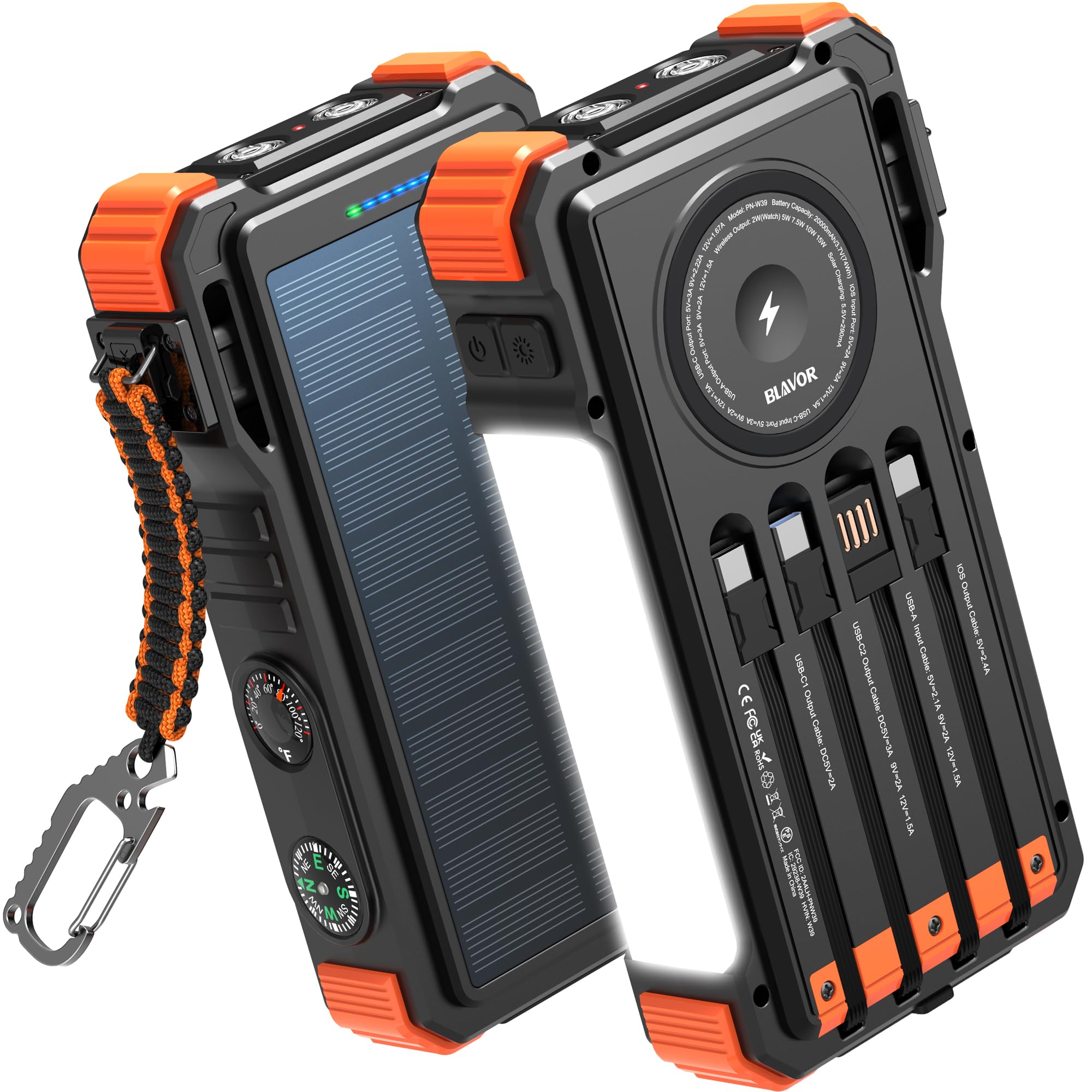
The BLAVOR stands out by integrating wireless charging for both phones and Apple Watch with four built-in cables — Lightning, USB-C, micro-USB, and a USB-A output. The 20W USB-C port can fast-charge a recent iPhone or Samsung, while the wireless pad delivers up to 15W. A compass, flashlight with strobe mode, and thermometer round out the package, making it a self-contained charging hub for car camping.
This power bank is best suited for car campers and emergency kits where carrying a slightly heavier pack is acceptable. The 20000mAh capacity provides enough power for multiple device recharges over a weekend. You can charge a laptop, phone, and earbuds simultaneously using the built-in cables, though the 20W output is shared among ports. However, the solar panel is too small to meaningfully recharge the battery — think of it as an emergency trickle source, not a primary charging method. Use the USB-C input for consistent recharging. The rugged build includes a carabiner clip for attaching to a tent or pack.
The flashlight has multiple brightness levels and a strobe mode, and the compass is functional for basic orientation. These extras feel purposeful rather than tacked-on, adding genuine utility without gimmicks.
Pros
- Charges a laptop, iPad, and phone at the same time via built-in cables.
- Wireless charging pad works with both phones and Apple Watch.
- Integrated compass, flashlight, and thermometer add utility at a campsite.
Cons
- Charging speed may not meet the expectations of users who need rapid top-ups for large devices.
- Weight over a pound is noticeable in a backpack — better for stationary camp setups.
If you need one power bank to charge multiple devices simultaneously and value the convenience of built-in cables and wireless watch charging, the BLAVOR delivers — just don’t count on its solar panel for meaningful recharging.
Best for Preppers, Emergency
BLAVOR Hand Crank Solar
Key Features
- Battery Capacity: 20000mAh
- Fast Charging: 20W USB-C
- Built-in Cables: 4 cables
- Price: Mid-Range
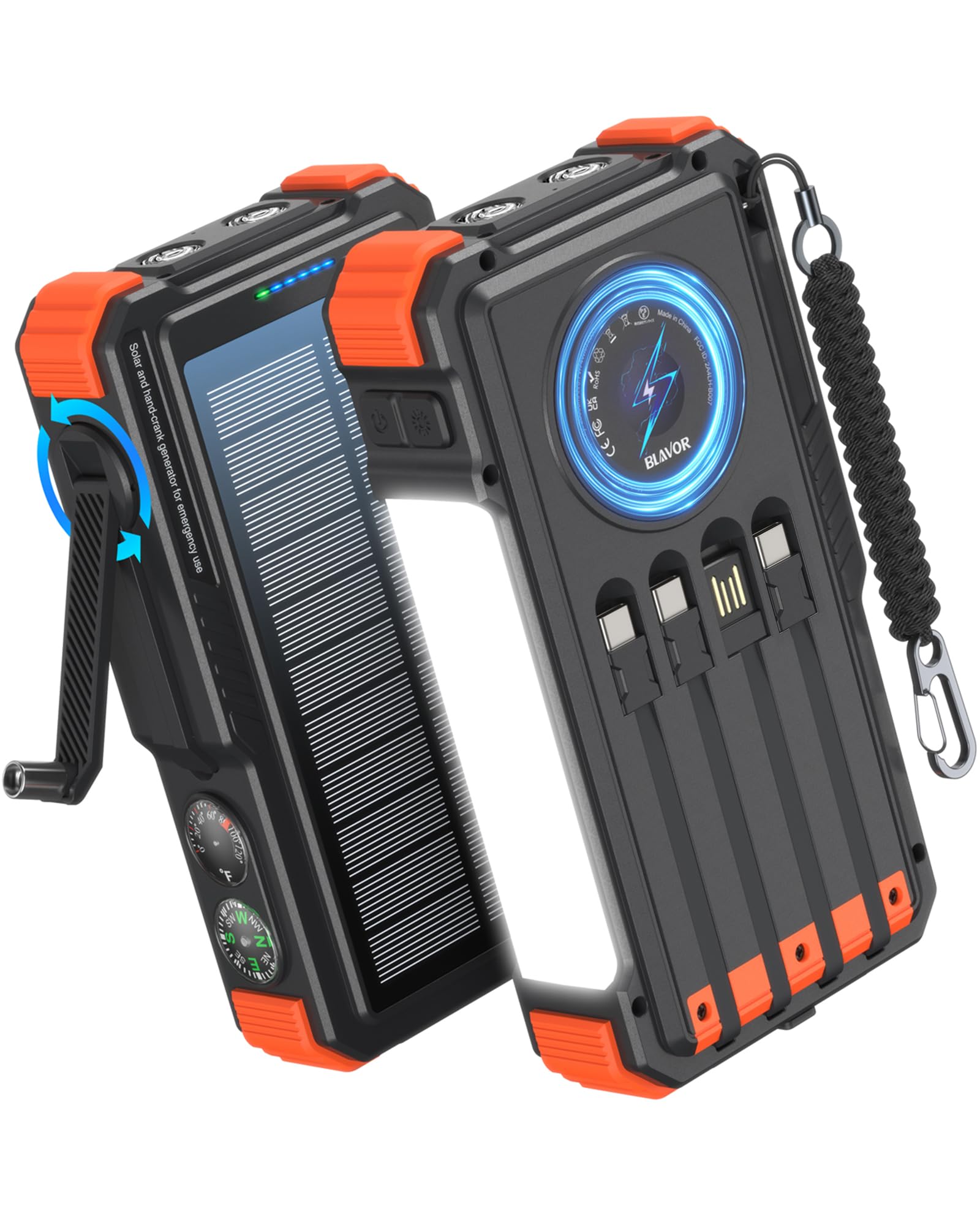
The BLAVOR Solar Power Bank stands apart by including a hand crank that lets you generate power without sun or wall outlets. Its 20,000mAh capacity, wireless 15W pad, four built-in cables, and 20W USB-C output make it a capable multi-tool for campsite use. The physical build quality is solid, with a sturdy feel that suits packing into a gear bag or emergency go-kit.
This is a sensible pick for preppers who want an off-grid backup that works even on overcast days or indoors. The hand crank delivers small amounts of power per minute — enough for a trickle charge to top off a phone in a pinch, not a full recharge. For campers who already carry a standard power bank, the added wireless charging and built-in cables reduce cable clutter at the tent. The solar panel, like most integrated panels this size, is too slow to be a primary charging source; treat it as a secondary trickle option.
Charging speed is a tradeoff: wireless and solar are both slow compared to wall adapters, and the hand crank requires sustained effort for minimal gain. Some units have shown occasional charging issues after months of use, so it’s worth testing the unit early and keeping it topped off before a trip. At roughly a pound and a half, the BLAVOR is heavier than smaller capacity banks — a detail to check if you’re weight-conscious for backpacking.
Pros
- Hand crank provides manual power without sun or outlets — unique for emergencies.
- Solid build with wireless pad and four built-in cables reduce gear bulk at camp.
- 20,000mAh capacity is enough for multiple phone charges during weekend outings.
Cons
- Hand crank yields very little power per minute — good for emergency trickle, not full charge.
- Wireless and solar charging speeds are slow; plan for overnight top-offs.
- At roughly 1.5 lbs, the unit is heavy for backpacking; better suited for car camping or kits.
The BLAVOR is the right choice if you want a backup power source that works without sun or outlets — the hand crank makes it a true emergency companion, but slower charging and weight limit it to car camping or preparedness kits rather than ultralight hikes.
Best for Budget High Capacity
MINRISE 40000mAh Solar
Key Features
- Battery Capacity: 40000mAh
- Fast Charging: 20W PD
- Built-in Cables: 4 cables
- Price: Mid-Range
The MINRISE packs 40,000mAh into a compact shell at a budget price, with 20W PD fast charging and four integrated cables — USB-A, USB-C, micro-USB, and Lightning — covering laptops, phones, and accessories without extra cords. At 1.07 pounds, it’s portable enough for a hiking daypack or car camping trip, and the USB-C port supports PD input for reasonably quick recharging from a wall plug.
This power bank is built for budget-conscious campers who need a high-capacity backup for weekend excursions or emergency kits. The large battery can recharge a phone multiple times, and the built-in cables simplify packing — no loose wires to lose. The dual LED flashlights with SOS mode add practical utility for campsite tasks or power outages.
For occasional emergency use, the capacity is a clear advantage. However, charging speed can vary between devices — the 20W PD isn’t always sustained — and the solar panel delivers very slow charging, best treated as an emergency trickle rather than a primary recharge method. Some units may show wear after a few months of regular use, so this is better suited for light, sporadic charging than daily heavy reliance.
If your main concern is getting maximum capacity for the lowest cost, the MINRISE delivers. Just know that speed and solar are secondary performance factors — the real value is the large battery and cable convenience at a low entry price.
Pros
- Generous 40,000mAh capacity at a budget-friendly price
- Portable enough for travel and camping despite the large capacity
- Can charge a laptop via 20W PD output
Cons
- Charging speed can be inconsistent depending on the device; solar recharging is very slow
- Some units may not hold up beyond a few months of regular use
If you need a high-capacity backup on a tight budget and can accept variable performance, this MINRISE delivers solid capacity and cable convenience — just don’t rely on solar or expect uniform speed.
Best for Travel, Car Camping
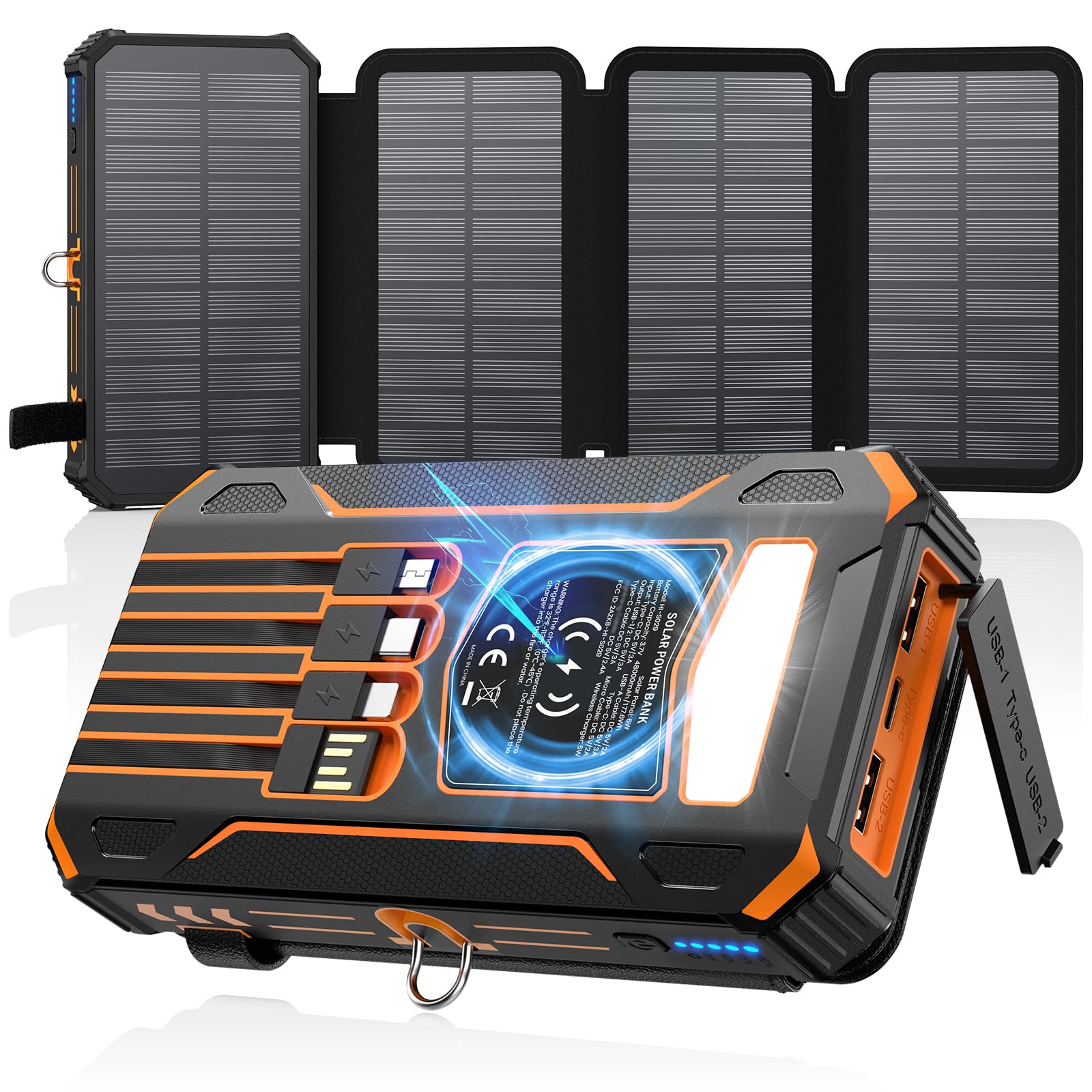
SOARAISE 48000mAh Wireless
Key Features
- Battery Capacity: 48000mAh
- Fast Charging: 5V/3A
- Built-in Cables: 4 cables
- Price: Mid-Range
The SOARAISE packs 48,000mAh, wireless charging, and four built-in cables for easy multi-device power. Solar panels can trickle-charge in direct sun, but the small area makes full recharge impractical. Charging speed is limited to 5V/3A — slower than PD models — and some units may stop charging within months. At over a pound, it is best for car camping, not hiking. It is priced higher than the top pick without offering better speed or long-term performance.
Pros
- Solid build quality and easy portability for travel.
- Wireless charging pad plus four built-in cables cover most devices without extra adapters.
Cons
- Some units may stop charging after a few months of use.
- At over a pound, this power bank is best left in a vehicle rather than carried in a daypack.
Ideal for car campers who prioritize wireless charging and high capacity over fast recharging and consistent long-term performance.
How to Choose
The most important buying insight: solar charging is too slow to be a primary recharge method; always pre-charge via wall outlet and treat solar as a backup for emergencies.
Battery Capacity: Real vs Advertised
Advertised mAh figures refer to the internal battery cell capacity. After voltage conversion to 5V USB output, real usable capacity is typically 60-70% of the label. A 20000mAh power bank might only charge an iPhone 14 about three full times. For a weekend trip, 20000mAh is sufficient; for longer multi-day trips without wall access, consider 30000mAh or more.
Solar Panels: Trickle Charge vs Hype
Built-in solar panels on portable power banks are small — typically 0.5-2W. Even in direct sunlight, a 2W panel will take 20+ hours to charge a 20000mAh battery. Manufacturers often claim ‘8x faster’ but real-world output is a fraction of that.
For solar to be useful, you need foldable panels that deploy larger surface area, or accept that solar is only an emergency top-off.
Fast Charging: PD vs QC Compatibility
USB Power Delivery (PD) and Quick Charge (QC) are the two common fast-charging standards. PD 20W or higher will charge most modern phones at full speed, while QC 3.0 is common for Android devices. A power bank with PD 22.5W can top up a phone from 0-50% in about 30 minutes.
Without fast charging, a standard 5V/2A output will take significantly longer, which matters when you have limited time.
Built-in Cables: Convenience vs Durability
Built-in cables eliminate the need to carry separate charging cords, which is handy when packing light. However, these cables are often thin and prone to fraying at the connector heads after repeated bending. Some power banks use reinforced or detachable cables — these hold up better to trail abuse.
For long-term reliability, consider models where cables can be replaced or are stored in a protective slot.
Durability: IP Ratings and Ruggedness
If you plan to use the power bank in rain, mud, or dusty trails, an IP rating matters. IP65 means fully dust-tight and protected against low-pressure water jets — enough for a downpour. Lower ratings like IPX5 only cover splashes. Without any rating, keep the device in a dry bag.
A rugged build also prevents damage from drops, which is common on rocky campsites.
FAQ
How long does it take to fully charge a solar power bank using the sun?
For a 20000mAh power bank with a built-in 2W panel, expect 20-30 hours of direct sun for a full charge. Foldable panel models can cut that to 8-10 hours. In practice, solar is best for emergency top-ups, not primary recharging.
Can I take a 40000mAh power bank on a plane?
TSA regulations allow power banks up to 100Wh (roughly 27,000mAh at 3.7V) in carry-on luggage. A 40000mAh bank (around 148Wh) exceeds the limit and cannot be flown. Keep your power bank under 27,000mAh for air travel.
Why does my solar power bank charge my phone so slowly?
Solar panels on portable banks output very low current, often 0.3-0.5A. Combined with voltage conversion losses, your phone may only receive a trickle charge. Also, if the phone is in use while charging, the solar input may not keep up. Use wall charging for speed; solar for maintaining charge.
Are solar power banks worth it for hiking and camping?
They are worth it as a backup power source if you pre-charge the bank via wall outlet before your trip. Solar can extend your battery life for an extra day or two, but relying solely on solar is unrealistic for most hiking scenarios. Best for car camping or emergency kits.