This post contains affiliate links. We may earn a small commission when you buy through our links — at no extra cost to you.
Solar camping lanterns promise freedom from disposable batteries, but the reality often falls short. Many budget multi-packs work fine out of the box, then stop charging or dim after a few trips. The problem isn’t solar technology itself—it’s inconsistency in build quality and battery cells.
This guide focuses on the lanterns that hold up over time, with reliable charging and useful runtime. Whether you’re a weekend car camper or a thru-hiker, the right choice depends on how much light you need and how you plan to charge it.
The best solar lanterns earn their place by balancing brightness, battery capacity, and charging options—not by packing the most units into a box.


Best for Single Reliable Lantern
Raynic 650LM
Key Features
- Lumens: 650 adjustable
- Battery & Runtime: 6000mAh, 200hr low
- Charging: Solar, crank, USB
- Water Resistance: IPX4
- Form Factor: Rigid
- Price: $
The Raynic 650LM packs a 6000mAh battery that on low settings keeps the light running through the night and beyond. A smooth dimmer allows adjusting brightness from 0 to 650 lumens while shifting color temperature from warm to cool white. Three charging methods – solar, hand crank, and micro USB – give flexibility, with the hand crank working as a genuine backup when other power sources aren’t available.
This lantern suits campers who want a single, consistent source of light without the need for multiple units. The compact size is smaller than some might expect, but still provides decent illumination for a tent or picnic table. Solar charging is slower than using the included USB cable, so plan for that if you need a quick top-up. At this budget-friendly price, it’s a sensible choice for emergency kits and car camping, though ultralight backpackers will find the 0.83 lb weight a bit heavy.
Pros
- Battery life on low settings lasts through the night and beyond.
- Smooth dimmer with adjustable color temperature from warm to cool white.
- Three charging methods – solar, hand crank, and micro USB – ensure power availability.
Cons
A cost-effective single lantern that balances brightness, battery capacity, and emergency charging – best for campers and preppers who want one light that delivers without overspending.
Best for Ultralight Backpacking
LuminAID PackLite
Key Features
- Lumens: 75 lumens
- Battery & Runtime: Lithium-ion, 24hr low
- Charging: Solar + USB
- Water Resistance: IP67
- Form Factor: Inflatable
- Price: $$
Weighing less than a deck of cards and packing down to the thickness of a phone, the LuminAID PackLite is the lightest full-featured solar lantern in this roundup. Its inflatable design provides a soft, diffused 75-lumen glow that works well inside a tent or as a tabletop ambient light — though it won’t compete with brighter area lanterns for group campsite illumination.
This lantern suits ultralight backpackers and emergency kit builders who need a compact, waterproof (and floating) light source. The tradeoff: lithium-ion battery capacity can shrink after repeated full cycles, and the inflatable bladder may develop a slow leak over time — less of a concern for occasional use or if you top up via USB instead of relying solely on solar.
Pros
- Packs flat and weighs only 5.3 oz — ideal for weight-conscious backpackers
- Provides consistent ambient light for tent interiors and close-range tasks
Cons
- Battery capacity may drop after a year of regular use — noticeable on longer trips
- Inflatable envelope can develop air leaks over time, reducing brightness from partial deflation
The LuminAID PackLite is the right choice when every gram counts and you need a waterproof, solar-rechargeable lantern for tent use or emergency kits — just keep expectations modest on long-term battery retention.
Best for Car Camping High Output
iToncs 1500 Lumen
Key Features
- Lumens: 1500 lumens
- Battery & Runtime: 7500mAh, 8hr high
- Charging: Solar + USB-C
- Water Resistance: IPX65
- Form Factor: Rigid
- Price: $$
This lantern blasts 1500 lumens of white light and adds RGB color modes for campsite ambiance. The built-in 7500mAh power bank can top off a phone over a weekend, and the tripod mount and hanging strap give flexible placement. At 1.1 pounds it’s heavy, so it suits car camping or base camps rather than backpacking. Solar charging is slow – plan to recharge via USB-C after heavy use.
Pros
- Extremely bright white light plus RGB color modes for fun campsite lighting
- Large 7500mAh battery that also charges phones and other USB devices
- Tripod mount and hanging strap make setup easy on uneven ground or inside a tent
Cons
- Heavier than typical camping lanterns at 1.1 pounds – not ideal for backpacking
- Solar charging is too slow to keep up with heavy use; USB-C is the main charging method
For car campers who want a bright party light and phone charging backup, this is a strong value. Backpackers should pick something lighter.
Best for Emergency Preparedness
Mesqool Hand Crank
Key Features
- Lumens: 200/350 lumens
- Battery & Runtime: 3000mAh, 35hr low
- Charging: Solar, crank, USB-C
- Water Resistance: IPX4
- Form Factor: Rigid
- Price: $
The Mesqool Hand Crank packs three charging methods into a compact body, with a 3000mAh battery that runs 4–35 hours depending on mode. It pairs a 200-lumen lantern with a 350-lumen flashlight — a brighter beam than typical camp lanterns. This design suits emergency kits and car camping where weight is less of a concern, and the hand crank provides peace of mind when outlets are unavailable. The compact size may be smaller than expected, and occasional unit variability means checking function soon after purchase.
Pros
- Hand crank, solar, and USB-C charging — multiple ways to keep it lit off-grid
- Combined lantern and flashlight offers focused beam plus ambient light
- Strong value for a single unit with multiple power sources
Cons
- In a large campsite, the smaller lantern body may not spread enough light; better suited for small tents or close-range use
- Some units may exhibit glitches after a few uses — check functionality quickly after purchase
A practical backup light for budget-conscious campers who value hand crank backup, but plan to verify unit operation early.
Best for Budget Multi-Pack
XTAUTO 4-Pack Lantern
Key Features
- Battery & Runtime: 1600mAh, 25hr
- Charging: Solar + USB
- Water Resistance: Waterproof
- Form Factor: Collapsible
- Price: $
Four bright lanterns for the price of one premium, each collapsing to phone size. Unlike the Raynic 650LM single robust unit, this pack trades consistency for quantity. Each lantern is surprisingly bright for its collapsible frame, lighting up a campsite or room without issue.
This set suits families, car campers, or emergency kits needing multiple lights spread across a property. However, some units may develop issues after limited use, so purchasing from a retailer with easy returns is advisable. Solar charging can be inconsistent in low light, but USB recharging works well as the primary method.
Pros
- Very bright for its size
- Great value for a 4-pack
- Compact and portable
Cons
- Some units may become inoperable after limited use – buy from a retailer with easy returns
- Solar panel may not charge effectively in low light – USB charging is more dependable
A budget-friendly way to get multiple bright lanterns for car camping or home backup, as long as you are prepared for possible unit variation.
Best for Long Runtime Camping
Lepwings 6000mAh

Key Features
- Lumens: 280 lumens
- Battery & Runtime: 6000mAh, 80hr low
- Charging: Solar + USB-C
- Water Resistance: IPX4
- Form Factor: Rigid
- Price: $$
This lantern delivers 80 hours on low with a warm light option, plus a 6000mAh battery that can charge your phone. The tradeoff: max output is 280 lumens and the 1.3-pound build limits backpacking use. Solar charging is slow, so plan on USB-C for typical recharging.
Pros
- Long runtime on low settings for all-night ambient light
- Dimmable warm light reduces eye strain
Cons
- Solar charging is slow; USB-C is the primary method to recharge
For car campers or emergency kits where weight is not a concern and low-light runtime is key, this lantern provides extended use without frequent recharging.
Best for Budget Car Camping
DIBMS 4-Pack

Key Features
- Lumens: 300 lumens
- Battery & Runtime: 1600mAh, 11hr
- Charging: Solar + USB
- Water Resistance: IPX4
- Form Factor: Collapsible
- Price: $
The DIBMS 4-pack delivers 300 lumens per collapsible lantern, with solar charging that works well in full sun — enough for car camping or home backup. However, battery runtime fades toward the end of the night, and water resistance is inconsistent despite the IPX4 rating, making it unsuitable for wet conditions.
Pros
- Each lantern provides 300 lumens for adequate campsite lighting.
- Four-pack pricing offers good value for multi-light setups.
Cons
- Water resistance is inconsistent; rain exposure may cause issues despite the IPX4 rating.
Best for dry-weather car camping or emergency kits where multiple budget lights are needed, but avoid relying on it in rain.
Best for Adjustable Color Temp
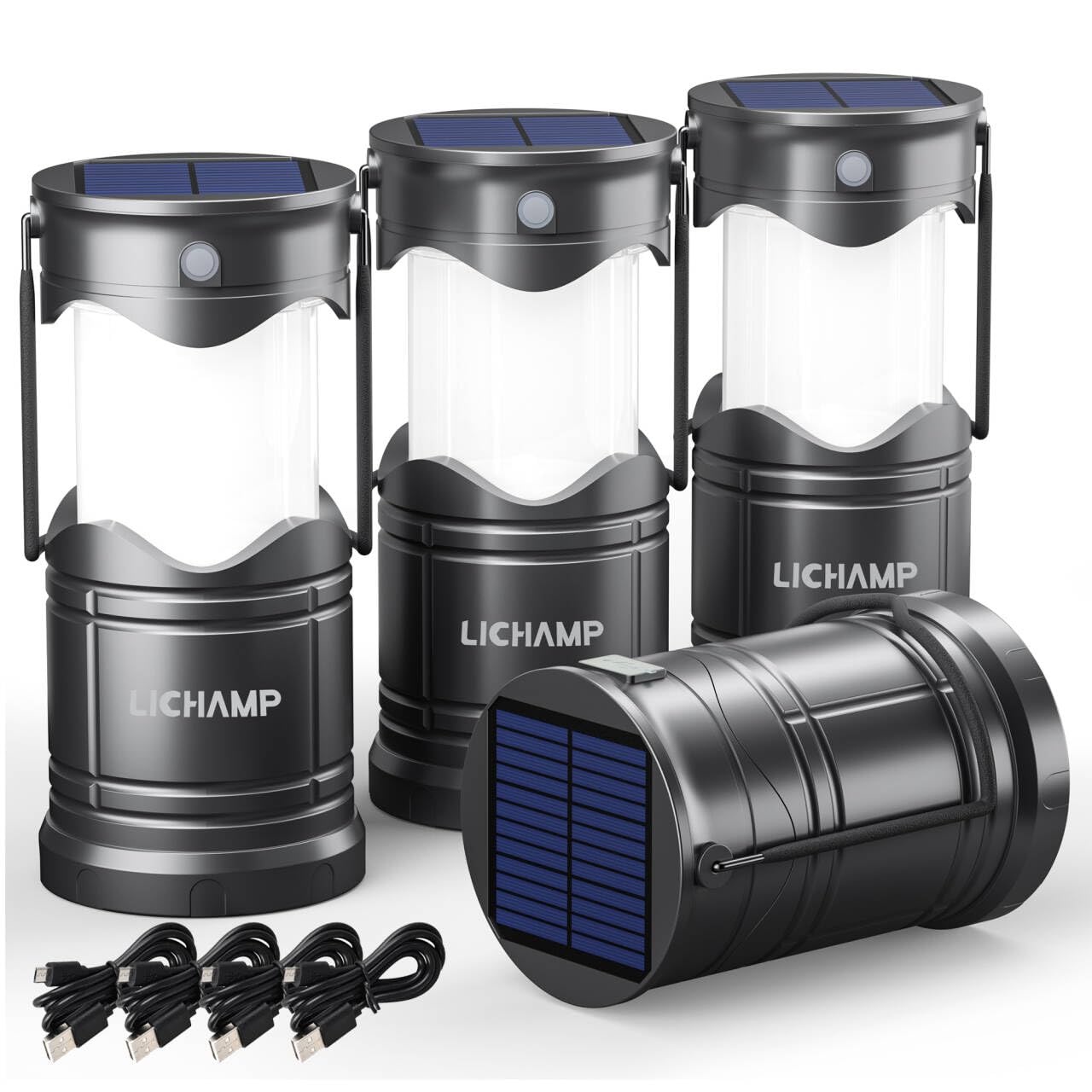
Lichamp 4-Pack
Key Features
- Lumens: 600/200 lumens
- Charging: Solar, USB, AA
- Water Resistance: Water resistant
- Form Factor: Collapsible
- Price: $$
This four-pack delivers strong brightness and adjustable color temperature (warm orange to cool white) from each lantern, making it suitable for campsite or emergency areas where light quality matters. Solar charging is useful in full sun but slows noticeably on overcast days, so USB is the more dependable recharge option. The 1.5-pound set is too heavy for backpacking, and some units may show battery degradation over time—worth checking return policy before buying for long-term emergency kits.
Pros
- High maximum output (600 lumens) with three color modes for versatile lighting.
- Four lights for the price of one premium model, good value for car camping or home use.
Cons
- Individual units can experience battery degradation over time, so consistent long-term performance isn’t guaranteed.
A bright multi-pack for car campers or emergency prep where you need multiple lights at once, provided you can accept some quality variance.
Best for Magnetic Mounting
Xynover 4-Pack

Key Features
- Lumens: 100 lumens
- Battery & Runtime: Rechargeable, 12hr
- Charging: Solar, USB, AA
- Water Resistance: Waterproof
- Form Factor: Collapsible
- Price: $$
Magnetic bases and hanging hooks let you place these lanterns on tent poles or metal surfaces for hands-free illumination. The 100-lumen output is adequate for a tent or small room but won’t light a campsite. Some units may have shorter runtime on high, and the plastic body feels less robust than premium alternatives.
Pros
- Bright enough for tent and room illumination
- Magnetic base and hanging hook offer versatile placement
Cons
- Battery life on high setting may be shorter than expected in some units
Fits emergency kits or tent camping where close-range ambient light and multiple mounting options matter more than brightness.
Best for Brand-Conscious Campers
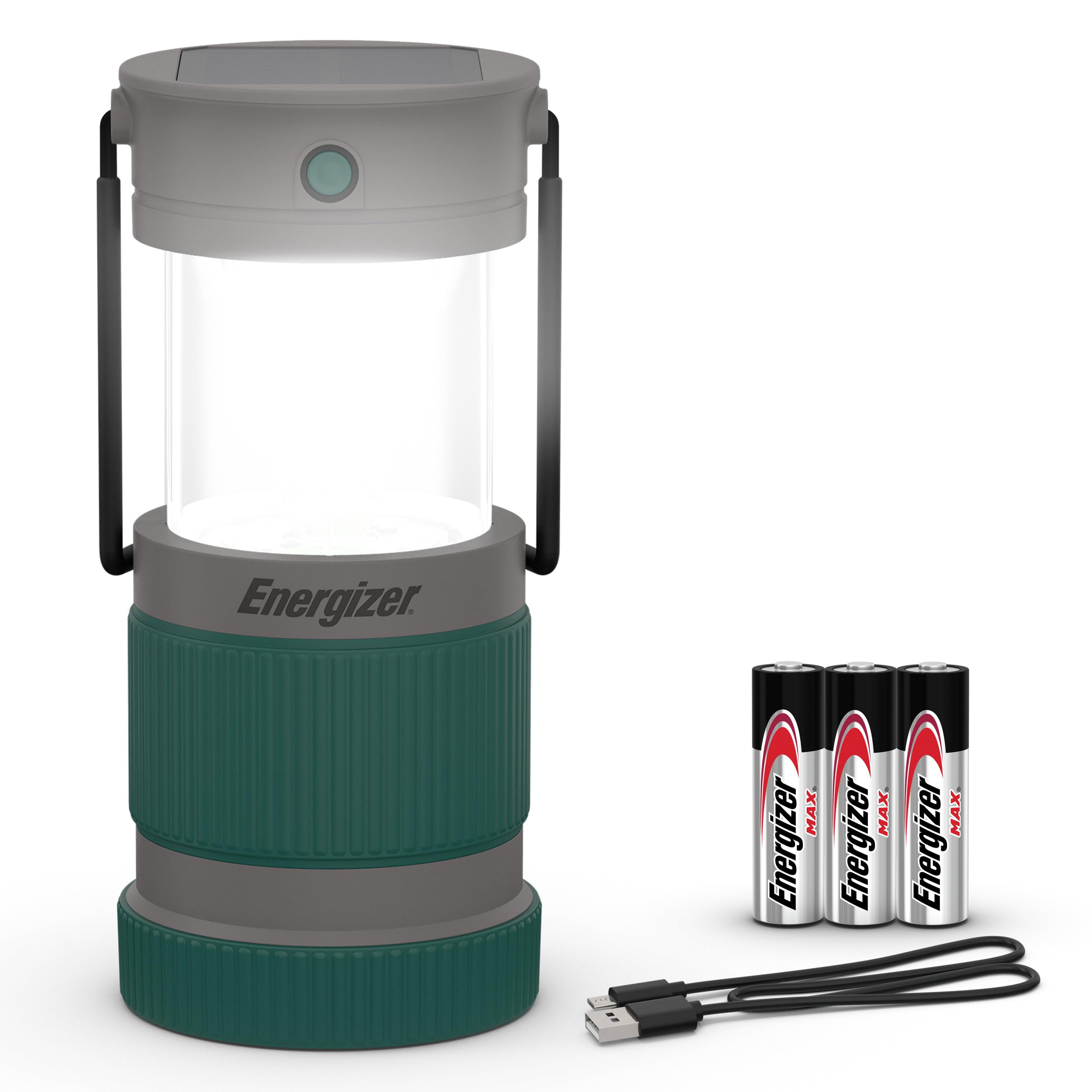
Energizer S-500
Key Features
- Lumens: 500 lumens
- Charging: Solar, USB, AA
- Water Resistance: IPX4
- Form Factor: Collapsible
- Price: $
The Energizer S-500 delivers 500 lumens of 360-degree light and gives you a rechargeable battery plus AA backup – a practical combination for dry-weather camping. However, the water resistance labeling is contradictory (IPX4 vs ‘Not Water Resistant’), and some units may fail after rain, making it a poor choice for wet conditions.
Pros
- Hybrid power with rechargeable and AA battery backup
- Bright 500 lumens with 360-degree illumination
Cons
- Water resistance claims conflict – IPX4 rating vs ‘Not Water Resistant’ spec
This lantern suits brand-loyal buyers who camp in dry conditions and want power flexibility – but confirm the water resistance rating before purchase.
Best for Ultralight with Charging
LuminAID Max

Key Features
- Lumens: 200 lumens
- Battery & Runtime: 2000mAh, 25hr low
- Charging: Solar + USB
- Water Resistance: IP67
- Form Factor: Inflatable
- Price: $$
This inflatable lantern delivers good brightness for its size and packs flat. Phone charging may not work with all devices, and some units have been noted to have limited longevity. It fits best in emergency kits where compactness is critical.
Pros
- Folds flat for compact storage
- Adequate brightness for tent use
Cons
- Phone charging may not be compatible with all devices
A lightweight option for emergency kits or ultralight packing, but phone charging is inconsistent and durability varies.
How to Choose
The most important thing to know about solar camping lanterns is that the solar panel on most budget models is too small to fully recharge the battery in a single day—USB or hand crank backup is what makes a lantern reliable.
Brightness (Lumens)
Lumens measure how much light the lantern throws. A 100-lumen lantern is fine for a tent or reading, while 500+ lumens can light up a campsite. Higher lumens drain the battery faster, so many lanterns offer adjustable brightness.
The trade-off: a 600-lumen lantern on high may last only a few hours, while the same lantern on low can run all night. Look for a model with a wide dimming range so you can stretch runtime when needed.
Battery & Runtime
Battery capacity (mAh) directly affects how long the lantern runs. A 1600mAh battery might give 6-8 hours on medium, while a 6000mAh battery can last multiple nights on low. But manufacturers often quote runtime at the lowest brightness setting.
The hidden trade-off: battery chemistry matters. Lithium-ion cells hold capacity well over hundreds of cycles, while NiMH batteries (found in some budget models) degrade faster and lose runtime after a few months of use.
Charging Methods
Solar charging is convenient but slow—a small panel on most lanterns needs a full day of direct sun to recharge. USB charging from a power bank or wall outlet is much faster and more reliable.
Hand crank models add a manual backup that works in any weather, but cranking for 10 minutes may give only 30-60 minutes of light. For serious off-grid use, choose a lantern with at least two charging methods.
Water Resistance
IPX4 means the lantern can handle light rain and splashes. IP67 means it can be submerged briefly and even float. For tent and car camping, IPX4 is usually enough. Hikers facing downpours or river crossings should prioritize IP67.
The catch: some budget lanterns claim IPX4 but fail after a single exposure to rain, because seals aren’t consistent across units. Check recent reviews for water damage reports before trusting a low-cost claim.
Form Factor
Collapsible lanterns crush down to a disc about the size of a phone, saving space in a pack. Inflatable designs like LuminAID pack even smaller but rely on an air valve that can leak over time. Rigid lanterns are bulkier but often more durable.
The decision hinges on how you carry it. Backpackers prize packability and will trade some durability for weight savings. Car campers can afford sturdier, more rigid designs that offer higher brightness and longer runtime.
FAQ
Why does my solar camping lantern not charge in the sun?
The solar panel on most camping lanterns is small, often less than 2-3 watts. Charging requires direct, unobstructed sunlight—cloud cover, shade, or even a slightly overcast sky can cut the charging rate by 80% or more. If your lantern isn’t charging, try placing it in full sun with the panel facing upward, and expect a full charge to take 8-12 hours.
Can a solar camping lantern really charge my phone?
Some lanterns include a power bank function, but the solar charge rate is usually too slow to make a difference for phones. The internal battery stores enough energy to give a partial phone charge, but relying on solar to replenish that battery while also charging a phone is unrealistic in most conditions. Plan to use USB input for reliable phone charging.
How long do rechargeable camping lanterns actually last?
Battery life depends heavily on the brightness setting you use. On low mode (50-100 lumens), a 6000mAh lantern can last 80-200 hours. On high mode (600+ lumens), that same battery may last only 4-8 hours. Over several years, lithium-ion batteries gradually lose capacity—expect 70-80% of original runtime after 300-500 charge cycles.
Are solar camping lanterns waterproof?
Many claim IPX4 water resistance, which means they can handle splashes and light rain. However, actual water protection varies widely between brands and even individual units. Models rated IP67 are reliably waterproof and can survive submersion. For heavy rain conditions, stick with IP67 and avoid budget lanterns that may have inconsistent seals.