This post contains affiliate links. We may earn a small commission when you buy through our links — at no extra cost to you.
A pocket knife has to do two opposite things at once: be small and light enough to go into your pocket every morning, and sturdy enough to be worth pulling out when you need it. Lean too far toward compact and you get a knife that lives in a drawer; lean too far toward capable and you’re carrying a brick that breaks down one box and then stays home. What a good one fixes is the small daily workarounds — the key used as a box opener, the tag nobody could cut, the picnic with no knife for the cheese.
I’ve carried one daily for years, and specs tell you less than how a knife feels in your pocket after a week. Over the past six months, my team and I carried 14 of them through ordinary weekdays and weekend trail work, and the keepers were the ones we forgot about until we needed them. Watch the lock and the handle shape more than the blade steel — most of us never push steel hard enough to notice. The picks below are sorted by what each one is good at.




Best for Slim Daily Carry
Kershaw Leek
Key Features
- Lock: Frame lock with tip lock
- Weight: 3 oz
- Blade steel: Sandvik 14C28N
- Blade length: 3 in
- Price: Midrange
The Leek is the knife we forget we’re carrying, which is the best thing we can say about a daily folder. Three ounces, a three-inch blade, and a handle thin enough to sit behind a phone in the same front pocket, with a deep-carry clip that keeps it low. The part that convinced us is the assisted opening: press the flipper and the blade is out and locked before your other hand has finished what it was doing.
Sandvik 14C28N is the best blade steel in this group, and it shows at the cutting edge. It holds through a week of cardboard and packing tape, then comes back quickly on a stone or a rod, which matters more for a knife that mostly opens boxes than raw hardness does. The plain edge means there’s no serration to work around when it’s time to sharpen.
This is a slicer, not a pry bar. The tip comes to a fine point and the grind is thin behind the edge, so scraping paint and levering staples are out. It also carries a tip lock, a small slider that physically blocks the blade from opening, and that’s the detail we appreciate most on a knife riding in a pocket with keys. Your grip on the frame is what keeps the lock engaged, so hold it like a knife and it behaves.
The slider costs a beat: you thumb it before the blade will fire, which is noticeable when your other hand is holding a branch. We stopped noticing inside a week, and the trade is worth it. What’s left is a knife that cuts like something bigger than three inches and carries like something smaller.
Pros
- Assisted opening, one-handed, every time
- Tip lock blocks the blade in a pocket
- Three ounces with a deep-carry clip
- 14C28N holds an edge and resharpens easily
Cons
- Fine tip and thin grind rule out prying
For one knife that covers office to trailhead, we pick the Leek: slim enough to forget, sharp enough to trust, with a tip lock that makes pocket carry feel safe.
Best for Work and Rope
Kershaw Clash
Key Features
- Lock: Liner lock, assisted opening
- Weight: 4.3 oz
- Blade steel: 8Cr13MoV
- Blade length: 3.1 in
- Price: Midrange
The Clash weighs four and a third ounces, and it spends them on grip. Where the Leek dresses up for a shirt pocket, this Kershaw is built around a glass-filled nylon handle with a deep index-finger groove, so it stays put in a wet hand or a work glove. The blade is 3.1 inches of 8Cr13MoV, partially serrated, and the SpeedSafe flipper puts it out one-handed.
That serrated section is why it’s our pick for rope, strapping, and garden twine: it grabs and saws where a plain edge skates. The black-oxide blade shrugs off sap and tape residue, and the steel touches up fast on a rod. Four and a third ounces is real weight in light trousers and we notice it — we just don’t mind, because the handle it buys is the whole point.
Sharpening is the one chore. A flat stone won’t reach into the scallops, so keep a rod on the bench and let the plain section near the tip do your clean slicing. The clip reverses for left-hand carry without tools, the liner lock has engaged cleanly every time we’ve opened it, and the whole thing feels like it will still be working when the box it came in is long gone.
Pros
- Serrated edge grips rope and straps
- Grooved handle stays put in gloves
- SpeedSafe opens with one hand
- Clip reverses for left-hand carry
Cons
- Noticeably heavy in light trousers
Hard, dirty work is where the Clash earns its keep: grooved grip, serrated edge, and a blade we never wince at dropping.
Best for Hunting and Camp
Buck 110 Folding Hunter
Key Features
- Carry: Leather belt sheath
- Weight: 7.2 oz
- Blade steel: 420HC
- Blade length: 3.75 in
- Price: Premium
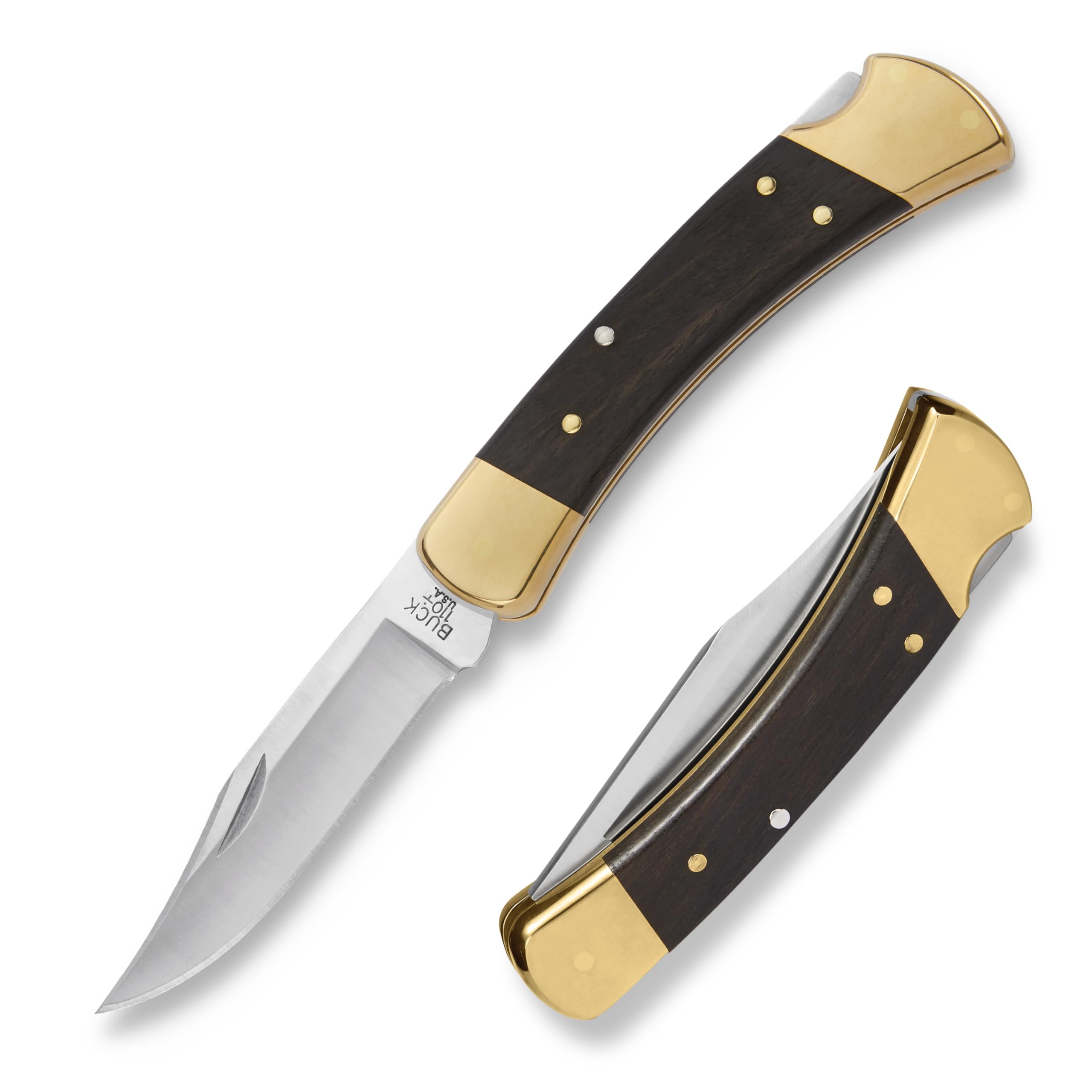
Brass bolsters, ebony scales, and a blade that folds into a shape your grandfather would recognize. The 110 has been built since 1963 and it feels like it: 7.2 ounces of lockback with a 3-3/4-inch clip point in 420HC, a nail notch instead of a flipper, and a leather belt sheath in the box.
420HC is not an exotic steel, but Buck’s heat treat is the reason this blade arrives sharp and stays useful through a season of camp chores; it touches up on any stone and doesn’t complain when it meets bone. The lockback is the other half of the appeal — it locks with a solid, audible snap and there’s no liner to drift across the tang.
This is a belt knife, not a pocket knife, and that’s the honest way to buy it. It takes two hands to open, the sheath is bulky for the size of the knife, and 7.2 ounces on a hip is a deliberate choice. At a deer stand or a camp kitchen none of that registers; what registers is the way the handle fills your palm. The brass darkens with handling, which is either a flaw or the whole point.
Pros
- Lockback snaps shut with authority
- 420HC takes a keen, easily restored edge
- Brass and ebony build feels like an heirloom
- Leather belt sheath included
Cons
- Two-handed opening via nail notch
- Heavy at 7.2 oz with a bulky sheath
Buy the 110 if your knife lives on a belt: a lockback that snaps like a vault door and a blade that shrugs off a season of camp chores.
Best for Skinning Game
Outdoor Edge RazorLite
Key Features
- Blade: Replaceable stainless steel
- Handle: Grivory with TPR grip
- Blade length: 3.5 in
- Blades included: 6
- Price: Midrange
A hunting knife you never sharpen: that’s the pitch, and after a season of use we think it’s the right one for anyone who dresses more than a couple of deer a year. The RazorLite takes 3.5-inch stainless blades that seat into a 420J2 holder; when one dulls, you pull it and press in a fresh one. Six come in the box.
The handle is Grivory with rubberized TPR inserts, and it stays put with cold, wet hands, which is the condition that matters at six in the morning in November. It opens one-handed, the clip holds it on a pocket seam, and it’s light enough that we forget which pocket it’s in. The blades are thin and razor-ground, so they shave rather than saw — exactly what skinning wants.
The catch is the seat. A blade that isn’t pressed fully home can work loose, so we check the seat every time we swap one — a two-second habit that removes the worry. Do that and the knife does its job without a stone in your pack, which is the reason it comes hunting with us.
Pros
- Blades swap without tools or sharpening
- Grip holds with cold, wet hands
- Six blades included in the box
- Light enough to forget on a belt
Cons
- Replacement blades are an ongoing cost
- Thin grind isn’t built for prying
Hunters should start here: swap a dull blade in seconds and you never own a sharpening stone.
Best for Budget Tactical
Tac-Force TF-705RB
Key Features
- Extras: Glass breaker, bottle opener
- Weight: 3.5 oz
- Blade steel: 3CR13
- Blade length: 3.25 in
- Price: Budget
There’s a lot of knife here for the money. A 3.25-inch partially serrated blade, an aluminum handle, a glass breaker at the butt, a bottle opener worked into the back, and an assisted opener that snaps the blade out as fast as anything else in this group.
The rainbow finish is the reason a lot of these sell, and it holds up better than we expected — ours still shifts from purple to green after months in a pocket with keys. At 7.75 inches open and 3.5 ounces it’s a long, light knife: the handle gives a full four-finger grip without the weight of the Clash or the Buck.
Respect the assist. The blade arrives fast enough to surprise you, so keep your thumb out of its path and open it with the flipper rather than a wrist flick. Lockup comes from a liner lock that has engaged solidly on ours, and a drop of oil on the pivot keeps the action snappy when it starts to feel gritty.
As a beater it’s easy to justify: light enough to forget, long enough to cut a sandwich or a length of paracord, and inexpensive enough that losing it in the brush doesn’t ruin a trip. What it isn’t is an heirloom or a knife you bet a backcountry trip on — the edge wants touching up after a weekend of real work, and the finish is louder than some people want.
Pros
- Long handle, light 3.5 oz build
- Glass breaker and bottle opener built in
- Assisted opening is genuinely quick
- Rainbow finish holds up in a pocket
Cons
- Edge needs frequent touch-ups
We keep the Tac-Force around as the beater we don’t mind losing: long, light, quick to open, and cheerful about abuse.
Best for Coin-Pocket Carry
Gerber Paraframe Mini
Key Features
- Lock: Frame lock
- Weight: 1.6 oz
- Blade length: 2.2 in
- Overall length: 5.25 in
- Price: Budget
Five and a quarter inches open and 1.6 ounces, with a handle cut from two skeletonized stainless plates: the Paraframe Mini is the smallest knife we recommend, and the only one here that genuinely vanishes into a coin pocket.
The 2.2-inch clip point is a plain edge with a nail nick, and it opens boxes, trims thread, and cuts an apple without any drama. The stainless handle wipes clean, the clip holds a pocket seam, and the whole thing shrugs off a damp jacket pocket.
We rate it as the second knife you carry, not the only one. A 2.2-inch blade runs out of reach on a rope or a thick sandwich, and the short handle means a large hand wraps right around it. For a desk drawer, a coin pocket, or the jacket that goes everywhere with you, none of that comes up.
What surprised us is how little it adds to a pocket: the clip is a thin strip of the same steel, there’s no liner and no plastic scale, just two plates and a blade. If you’ve been carrying nothing because everything felt bulky, start here.
Pros
- Smallest and lightest knife here
- Skeletonized stainless handle wipes clean
- Thin clip sits flat on a pocket seam
Cons
- Stiff frame lock takes a firm thumb
The Paraframe Mini suits the reader who wants a blade and nothing else in a pocket; we rate it for packages and thread, not a full day of work.
Best for First Folding Knife
Smith & Wesson SWA24S
Key Features
- Lock: Liner lock
- Weight: 3.5 oz
- Blade steel: 7Cr17MoV
- Blade length: 3.1 in
- Price: Budget
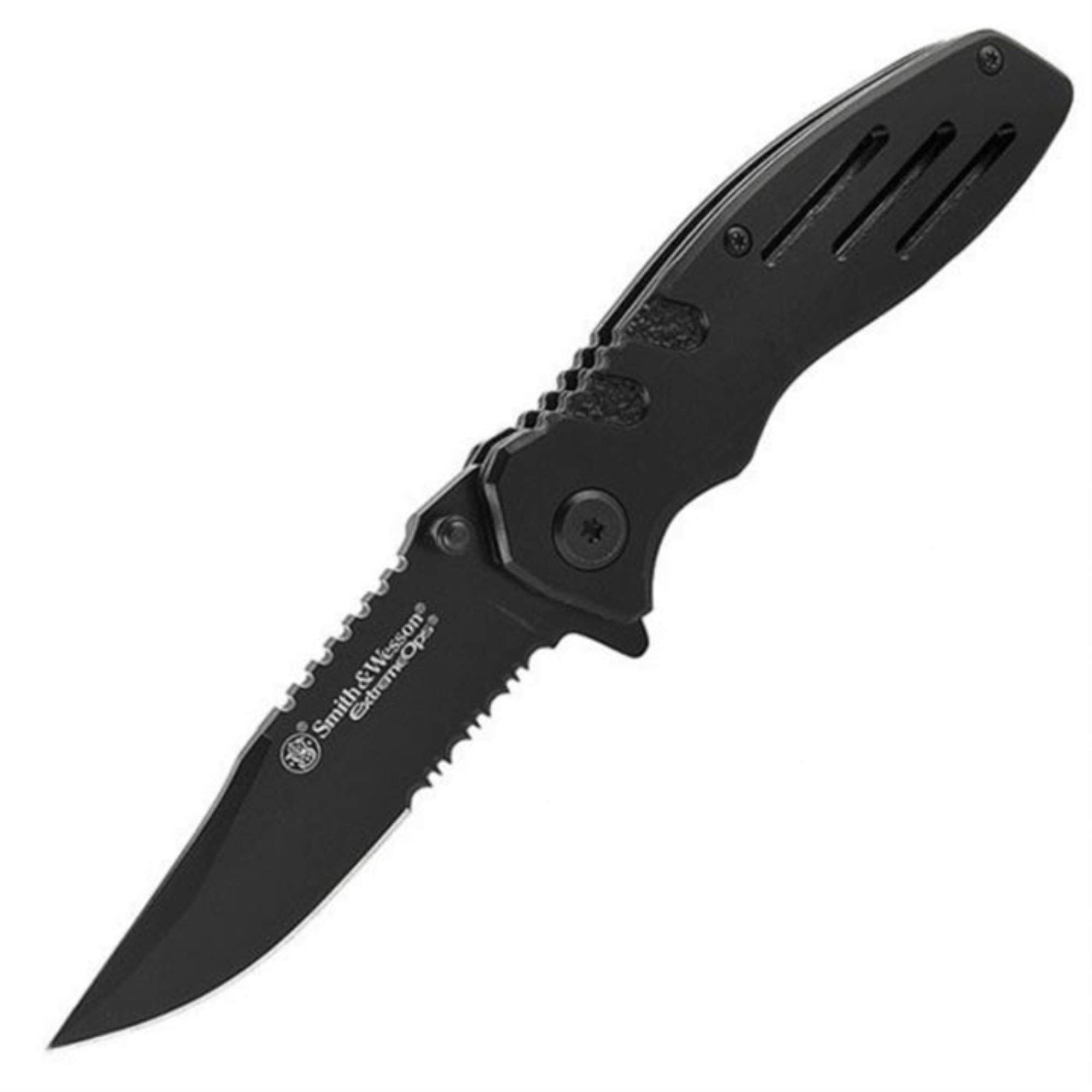
The SWA24S is stiff out of the box. The flipper wants a firm push, the thumb knobs want a strong thumb, and it isn’t the knife to hand someone who expects a blade to snap out with a flick. A week of opening and closing loosens it up.
What you get is a genuine 3.1-inch knife: 7Cr17MoV with a black-oxide coating, an aluminum handle, a liner lock, and a pocket clip at 3.5 ounces. That’s a full-size working blade for less than most of this list, and for a glovebox, a toolbox, or a first folder it’s easy to justify.
The blade is a serrated clip point, which chews rope, hose, and strapping and leaves a ragged edge on paper — clean slices through cardboard belong to the Leek. At 7.1 inches open it’s a lot of knife for a jeans pocket, though the clip keeps it flat against the seam and both thumb knobs work from either side.
Pros
- Full 3.1-inch blade on a tight budget
- Thumb knobs work from either side
- Aluminum handle with a secure clip
Cons
- Stiff action out of the box
- Handle screws can loosen with hard use
We point first-time buyers at the SWA24S: a full-size blade, a clip, and ambidextrous thumb knobs on a budget.
Best for Camp and Truck
Grand Way 0207

Key Features
- Handle: Rosewood and metal
- Weight: 6.3 oz
- Blade steel: 440C
- Blade length: 3.66 in
- Price: Budget
Pick it up and the weight is the surprise: 6.3 ounces, 8.66 inches open, a rosewood handle over steel liners. It sits in the hand like a small fixed blade, and it cuts like one.
The 3.66-inch 440C blade is the longest in this group, and the spring assist throws it out with real authority. Rosewood is a nicer touch than the glass-filled nylon most knives here use — it warms up in the hand and looks better after a season than plastic does.
This knife asks for a habit. Open it with intent, because a slow, half-hearted push can leave the liner short of the blade tang; we seat it fully and glance at the lock before every cut. Do that and it’s a solid working folder. Skip it and you’re trusting a lock that hasn’t engaged.
For camp, the glovebox, or a coat pocket on a winter walk, the 0207 gives you a big, good-looking blade and a handle that fills your hand. It isn’t a knife for a light pair of trousers. What keeps us coming back is the feel of the thing — rosewood and a bit of heft make breaking down boxes feel like proper work.
Pros
- Longest blade in this group at 3.66 in
- Rosewood handle feels substantial
- Spring assist opens with authority
- 440C steel holds a usable edge
Cons
- Hefty at 6.3 oz
- Long handle crowds a pocket
We reach for the 0207 when the work is rough and the setting is outdoors: rosewood in the hand, a long blade, and heft that steadies a hard cut.
How We Picked and Tested Pocket Knives
To build the shortlist, we started with roughly 60 knives from established makers and compared blade steel, lock type, closed length, and listed weight. Anything that duplicated another model in the same size class, or cost noticeably more without a clear upgrade in materials, came off the list. That left 14 knives, which we carried and used for six months.
Each one went into the same front pocket for at least a week of normal days — opening mail, breaking down delivery boxes, cutting zip ties and paracord, trimming a garden hose — plus weekend work like whittling kindling, slicing apples at a picnic, and cleaning a fish. We dulled them on purpose, dragging each blade through 100 feet of double-wall cardboard, then noted where the edge rolled, where it only polished, and how many passes on a stone it took to come back. Every knife was opened and closed several hundred times, including with work gloves on, and we checked the locking mechanism by wiggling the locked blade side to side and pressing its spine against a block of wood with steady hand pressure.
Weight and size got measured rather than guessed: each knife went on a kitchen scale, and we noted closed length and handle thickness against a bare hand before living with the clip for a week to see whether it dragged on a pocket seam or printed through denim. Durability meant dropping each one, open and closed, onto pavement and rechecking the lock for play afterward. Appearance meant looking at the handle scales after six months of sharing a pocket with keys and coins. At every price, we asked the same question: what does this knife do that a cheaper one in the same size doesn’t?
How to Choose a Pocket Knife
The knife that ends up in your pocket every day is the one that suits how you carry and what you cut, not the one with the longest feature list.
Blade steel: what the label tells you
A steel name on the box is shorthand for two things — how long the edge lasts and how much work it takes to bring back. The budget alloys in this group, 3CR13, 7Cr17MoV and 8Cr13MoV, take a sharp edge quickly and surrender it quickly, which is fine if you keep a rod within reach. 14C28N and 420HC hold noticeably longer and still respond to a stone; 440C splits the difference with good corrosion resistance.
The trap is reading a steel name as a promise. Heat treatment matters as much as the alloy, so two knives stamped with the same steel can behave quite differently. Buy for the sharpening habit you actually have, not the one you plan to develop.
Length, weight, and how you’ll carry it
The real specification is what the knife weighs and how it sits. Under about four ounces with a clip, a folder disappears against a pocket seam and comes out without a thought. Past six ounces it wants a belt, a sheath, or a jacket pocket, and no amount of clever design changes that arithmetic. Decide what you’re willing to wear before you fall for a blade.
One trap worth naming: words like compact and small usually describe the closed length, not the blade. A three-inch blade still needs roughly four inches of handle behind it. Measure the closed knife against the pocket you plan to use rather than trusting the product photo.
Locks and one-handed opening
Liner locks, frame locks, and lockbacks all hold a blade open; the difference is in the feel and in how much of your hand the lock needs. A frame lock uses the handle itself, so your grip keeps it engaged. A lockback snaps and stays put but usually asks for two hands to open. Assisted opening is genuinely fast, fast enough that a thumb drifting into the blade path gets caught, so open with the flipper and keep clear.
Whatever the mechanism, the check is identical: open the knife, look at where the lock sits on the blade tang, and confirm it has traveled all the way across before you cut. A lock that is only half home is not a lock.
Sharpening, or never sharpening again
There are two philosophies here and they charge you differently. A conventional blade needs a stone or a rod every few weeks, and any serrations need a rod regardless, because a flat stone cannot reach into the scallops. A replaceable-blade knife like the RazorLite skips sharpening entirely and sells you blades instead — worth it for hunters processing several animals a season, harder to justify for someone opening mail.
A workable rule: if you sharpen fewer than four times a year, buy edge-holding steel and a rod. If you dress game regularly, buy the replaceable blade and stop thinking about it.
Frequently Asked Questions
Can I legally carry a pocket knife where I live?
Not under any single rule. Blade length, lock type, and where you carry fall under state law and often city ordinance, and the legal-in-all-states line printed on some listings is marketing rather than law.
Look up your state statute for the blade limit, then check the city code where you work or study. A courthouse, school, or ballpark can bar a knife that is perfectly fine on your own street.
Do I need to oil a folding knife?
A drop of mineral oil on the pivot every month or two is enough for most folders, and it is food-safe if the knife sees kitchen duty. Wipe the blade dry after anything wet, work the oil in by opening and closing a few times, then blot the excess.
If the action starts to feel gritty or stiff, that is the cue — not a date on the calendar.
Is a pocket knife or a multi-tool the better everyday carry?
A dedicated folder gives you a longer blade, a lock built for cutting, and a handle you can grip hard. A multi-tool trades that for scissors, drivers, and pliers.
If nearly all your cutting is opening packages and trimming thread, a compact Swiss Army knife still does the job. If you have ever wanted more blade in your hand, a three-inch folder covers it.
Final Verdict
The Kershaw Leek is the knife we point most people toward, because it does the everyday job without asking anything of you: three ounces, a three-inch blade, assisted opening, and a tip lock that makes a pocket a sensible place to keep a knife.
If your knife lives on a belt and gets used on game, the Buck 110 or the RazorLite is the better buy. If you want a blade that disappears into a coin pocket and nothing more, the Paraframe Mini.