This post contains affiliate links. We may earn a small commission when you buy through our links — at no extra cost to you.
Walk into any outdoor retailer and you’ll see boots labeled ‘mountaineering’ that are better suited for a day hike. The catch: many lack the full shank and heel welt needed to safely lock in crampons on ice or snow. That mix-up leads to cold feet, wasted money, and sketchy footing when it counts.
This guide separates real alpine boots from the rugged hikers wearing the wrong label. Every pick here meets the core requirement—stiff sole, crampon compatibility, and waterproofing—so you can focus on the trade-offs that matter: fit, break-in, and longevity.
Whether you’re crossing glaciers or climbing mixed rock and snow, the right boot is the one that matches your foot shape and your willingness to break it in.
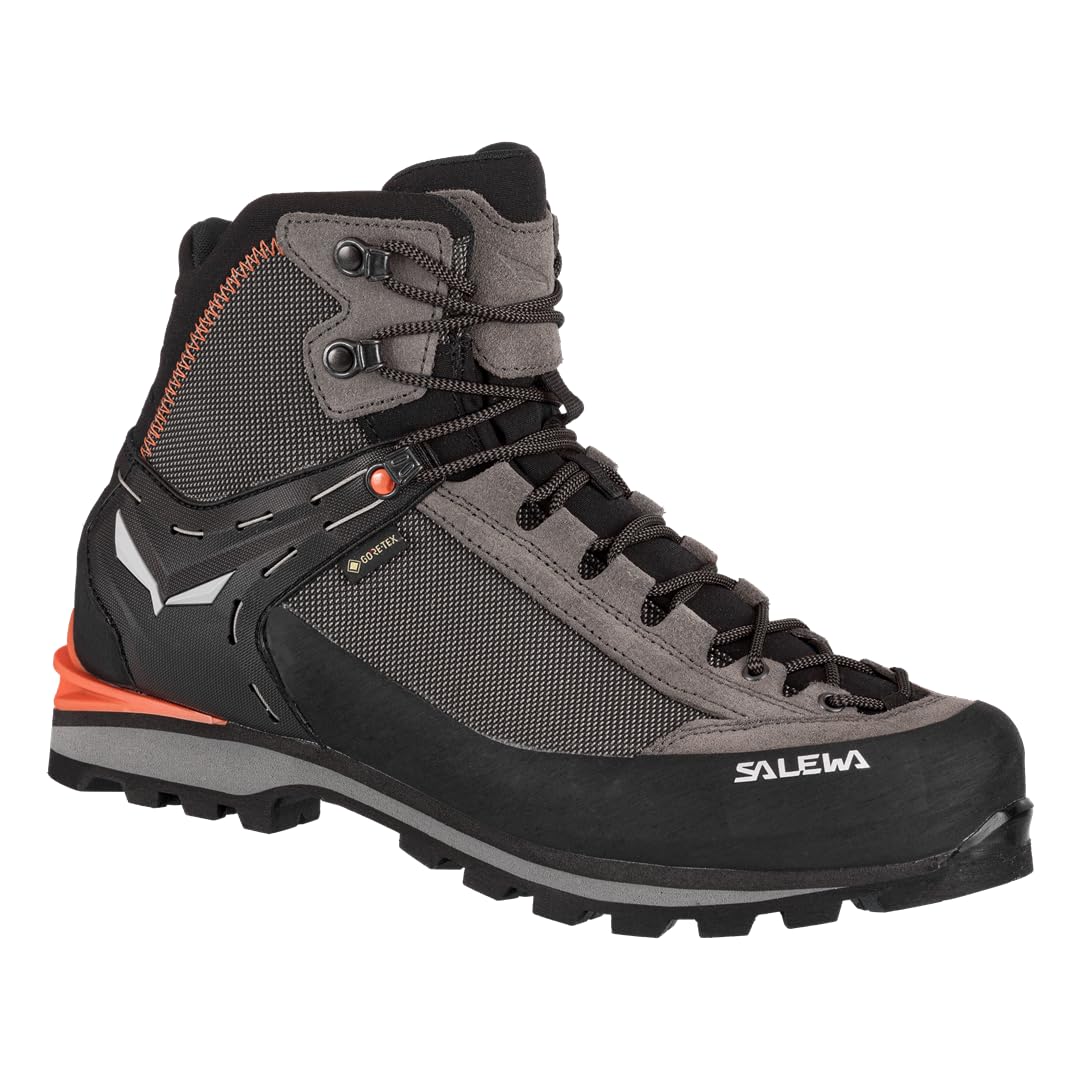


Best for Technical Mountaineering
Salewa Crow GTX
Key Features
- Crampon Compatibility: Semi-auto
- Sole Stiffness: Stiff partial
- Waterproofing: Gore-Tex
- Fit Profile: Medium, snug wide
- Price: $$
The stiff shank sole provides precise edging on snow and rock while accepting semi-automatic crampons, making it a capable partner for glacier travel and mixed terrain. Gore-Tex lining keeps feet dry across rain and snow crossings, and the ankle support is immediate — many find no break-in period at all. This combination of stiffness and comfort is rare at the mid-range price point.
This boot suits mountaineers and alpine scramblers who need technical performance without a painful break-in. The fit runs snug, particularly across the midfoot — those with wider feet should try a half-size up before committing. It is not designed for extreme cold requiring insulation, nor for very narrow feet that may find the volume too high (the slimmer alternative in this set addresses that niche).
Pros
- Stiff sole delivers precise edging and crampon compatibility.
- Gore-Tex waterproofing keeps feet dry in wet snow and rain.
- Comfortable ankle support with minimal break-in needed.
Cons
- Snug fit may require sizing up for wider feet.
- Outsole wear can accelerate on abrasive surfaces under heavy use.
For mountaineers who want a technical boot ready for action without weeks of discomfort, the Crow GTX is a smart buy.
Best for Heavy-Duty Mountaineering
La Sportiva Makalu
Key Features
- Crampon Compatibility: Auto
- Sole Stiffness: Full shank
- Waterproofing: Leather (wax needed)
- Fit Profile: Narrow, full-size up
- Price: $$$
Full steel shank delivers instant edge control for crampon work and steep ice — no flex, no hesitation. That rigidity requires an extended break-in (50+ miles) and the unlined leather uppers need wax treatment for water resistance. Sized a full step small, the Makalu fits narrow-footed climbers who plan to resole and keep a single boot for years. For anyone wanting immediate comfort or out-of-box waterproofing, the top pick in this category solves both.
Pros
- Leather upper withstands years of rugged use and can be resoled.
- Steel shank supports heavy loads and automatic crampons without flex.
- Arch and ankle support provides stability for technical climbing with heavy packs.
Cons
- Sizing runs a full size small; ordering up is necessary for proper fit.
- Leather uppers are not waterproof without aftermarket wax treatment.
For mountaineers willing to invest in a proper break-in and maintenance, the Makalu offers unmatched longevity and edging precision that resoling can extend for years.
Best for Alpine Climbing
Salewa Condor EVO GTX
Key Features
- Crampon Compatibility: Semi-auto
- Sole Stiffness: Stiff partial
- Waterproofing: Gore-Tex
- Fit Profile: Narrow, low-volume
- Price: $$$
Designed for narrow and low-volume feet, the Salewa Condor EVO GTX provides a glove-like fit that eliminates the break-in period typical of stiff mountaineering boots. This allows climbers to focus on edging precision on alpine scrambles and mixed rock-and-snow routes right out of the box.
This boot suits narrow-footed mountaineers who prioritize immediate comfort and Gore-Tex waterproofing without the weight of full-leather boots. However, the narrow toe box is not suitable for wider feet, and the leather upper can shrink if repeatedly soaked and dried in heat — careful drying at room temperature helps maintain fit.
Pros
- Glove-like fit for narrow and low-volume feet — no break-in required.
- Gore-Tex lining keeps feet dry in snow and wet conditions.
- Sturdy construction holds up to years of regular alpine use.
Cons
For narrow-footed mountaineers who want immediate edging precision and Gore-Tex reliability without a painful break-in, the Condor EVO is a strong pick — just be mindful of the narrow fit and leather care.
Best for Rugged Hiking
Salewa Mountain Trainer

Key Features
- Sole Stiffness: Partial shank
- Waterproofing: Gore-Tex
- Fit Profile: Standard
- Price: $$
The Salewa Mountain Trainer delivers immediate comfort and strong ankle support for rugged trails and heavy packs, with zero break-in. However, it lacks a full shank and crampon welt, so it is not suited for glacier travel or technical climbing. Best for hiking, tree climbing, and light scrambling—not mountaineering.
Pros
- Zero break-in period with a comfortable fit right out of the box.
- Solid ankle support for uneven terrain and heavy loads.
Cons
- Stiff sole can feel overly rigid for casual trail walking — better suited to rugged terrain.
A good match for backpackers and arborists who prioritize immediate comfort and ankle support over crampon compatibility or alpine performance.
Best for Fast Hiking
Salewa Rapace GTX-M

The Salewa Rapace GTX-M is the lightest boot in this roundup, offering exceptional grip on wet rock and immediate comfort with zero break-in. For approach hiking, light backpacking, or trail running on technical terrain, it’s a standout. However, its flexible sole lacks the stiffness needed for glacier travel or automatic crampons, and sole wear can be uneven after extended use — this is a specialist for fast, low-tech outings, not mountaineering.
Pros
- Ultra-lightweight (1.2 lbs) reduces fatigue on long approaches and fast scrambles.
- Outstanding traction on wet rock and uneven terrain, with near-zero break-in comfort.
Cons
- Sole stiffness is insufficient for technical mountaineering or automatic crampon use; durability of the sole may be mixed under heavy wear.
Best for climbers and hikers who prioritize weight and agility on rocky terrain over technical ice and snow capability.
How to Choose
Many boots sold as mountaineering are simply rugged hiking boots lacking the full shank and sole welts needed for safe crampon use on glaciers.
Crampon Compatibility
Crampons attach via heel and toe welts. Automatic crampons lock into both welts for maximum security on steep ice; semi-automatic clip the toe and strap the heel. A boot without welts cannot safely hold any crampon—a common oversight in hiking boots marketed as mountaineering.
If you plan to cross glaciers or climb moderate snow, semi-automatic compatibility is sufficient. For technical ice or mixed routes, automatic welts (full steel shank) provide the stability needed to kick steps without the boot flexing.
Sole Stiffness
Stiffness comes from the shank material—nylon partial shanks offer some flex for hiking, while full steel shanks lock the sole for precise edging. A stiffer sole transfers more force to the foothold but feels clunky on flat trails. For alpine climbing, partial shank is the minimum; full shank is mandatory for vertical ice.
Waterproofing
Gore-Tex membranes block liquid water while letting sweat escape, ideal for wet snow and rain. Full-grain leather without a membrane requires periodic wax treatment to stay waterproof—neglect it, and leather absorbs moisture, adding pounds. The trade-off: leather breathes better in warm conditions but demands maintenance.
Insulation
Most mountaineering boots sold for spring/summer alpine use have no added insulation—your socks do the job. Insulated models (often 200–400g) are for winter expeditions where temperatures stay below freezing all day. Adding insulation also stiffens the boot and reduces dexterity for technical climbing.
Fit Profile
Mountaineering boots tend toward narrow lasts for precise foot placement. A boot that’s too wide causes heel lift, reducing crampon security. Try boots with the socks you’ll wear in the field—a half-size up is common to accommodate thick wool socks. Expect a break-in period of 20–50 miles for full-leather models.
FAQ
Are Salewa Crow GTX boots crampon-compatible?
Yes, the Crow GTX has a stiff shank and a heel welt that accepts semi-automatic crampons. It is not rated for automatic (step-in) crampons, but it works well for glacier travel and moderate snow climbs.
How long does it take to break in La Sportiva Makalu boots?
Expect 50+ miles of walking before the full-grain leather softens. Many users report blisters and hot spots in the first two weeks. Wear them with thick socks on short hikes before committing to a long alpine day.
Can I use mountaineering boots for everyday hiking?
You can, but the stiff sole will feel awkward on flat ground and may cause fatigue. Mountaineering boots are optimized for edging and load support on snow and rock, not for casual trails. A dedicated hiking boot or trail runner is more comfortable for day hikes.
Do mountaineering boots run true to size?
Most run small, especially full-leather models like the Makalu. Always try a half to full size up from your street shoe to accommodate thick socks. If ordering online, plan to return if the fit is not snug with a light wiggle room for toes.