This post contains affiliate links. We may earn a small commission when you buy through our links — at no extra cost to you.
A mountain bike tire can make or break a ride. Cheap ones often wear fast or sidewalls blow out after a few rocky descents. Premium models offer grip and durability but at a cost that doesn’t always suit casual trail riders.
The key is matching the tire’s strengths to where you ride most. Fast-rolling compounds save energy on smoother trails, while aggressive knobs bite into loose dirt but drag on pavement. Puncture protection matters for rocky terrain, but adds weight.
This guide cuts through the noise by focusing on real-world use: which tires hold up under actual trail conditions, and which ones are better left for the bike path.




Best for Front Wheel Trail
Maxxis Minion DHF
Key Features
- Tread Compound: Dual compound
- Sidewall Protection: EXO
- Wheel Size/Width: 29×2.3
- Price: $$
The Minion DHF delivers exceptional bite and hold across loose, rocky, and rooty terrain, making it the go-to front tire for riders who push into technical descents. Its deep, blocky tread pattern grabs loose surfaces without hesitation, and the dual-compound rubber balances cornering grip with reasonable wear. Paired with a faster-rolling rear tire like the DHR II, this setup handles aggressive trail and enduro conditions with confidence.
This tire is best suited for all-mountain and enduro riders running it on the front wheel, where its high rolling resistance becomes a non-issue and its grip is most valuable. If your riding involves steep, loose climbs or rooty, rocky sections, the DHF maintains composure where lesser tires wash out. The occasional quality control variance – a warped bead or wobble – means inspecting the tire on arrival and being prepared to exchange if needed, but for most users the tubeless setup is straightforward and the grip payoff is significant.
Pros
- Superior cornering and braking traction on loose, rocky, or rooty terrain
- Holds up to aggressive trail riding with minimal sidewall damage
- Most users find tubeless installation simple and airtight
Cons
- Some units arrive with a warped bead or wobble that requires return exchange
For front-end grip on demanding terrain, the Minion DHF sets the benchmark – the occasional QC quirk is worth accepting for its cornering authority.
Best for Rear Wheel Trail
Maxxis Aggressor
Key Features
- Tread Compound: Dual compound
- Sidewall Protection: EXO
- Wheel Size/Width: 29×2.3
- Price: $$
Fast-rolling rear tire for trail and enduro that delivers consistent braking traction without dragging on climbs. Its dual compound and EXO casing balance speed with durability for aggressive riding.
This tire suits riders who prioritize rolling efficiency on dry trails and pair it with a more aggressive front tire like the Minion DHF. Installation can be tight on some rims, and it clogs in sticky mud — best kept for dry conditions.
Pros
- Build quality that holds up to rocky terrain
- Fast rolling with minimal drag on climbs
- Consistent braking and cornering traction on dry trails
Cons
- Installation requires patience and strong tire levers on tighter rims
- Mud shedding is limited — clogs in wet, sticky conditions
A focused rear tire for dry trail and enduro riding where speed and braking matter more than mud clearance. Pair with a DHF up front for a balanced setup.
Best for Xc Racing Fast
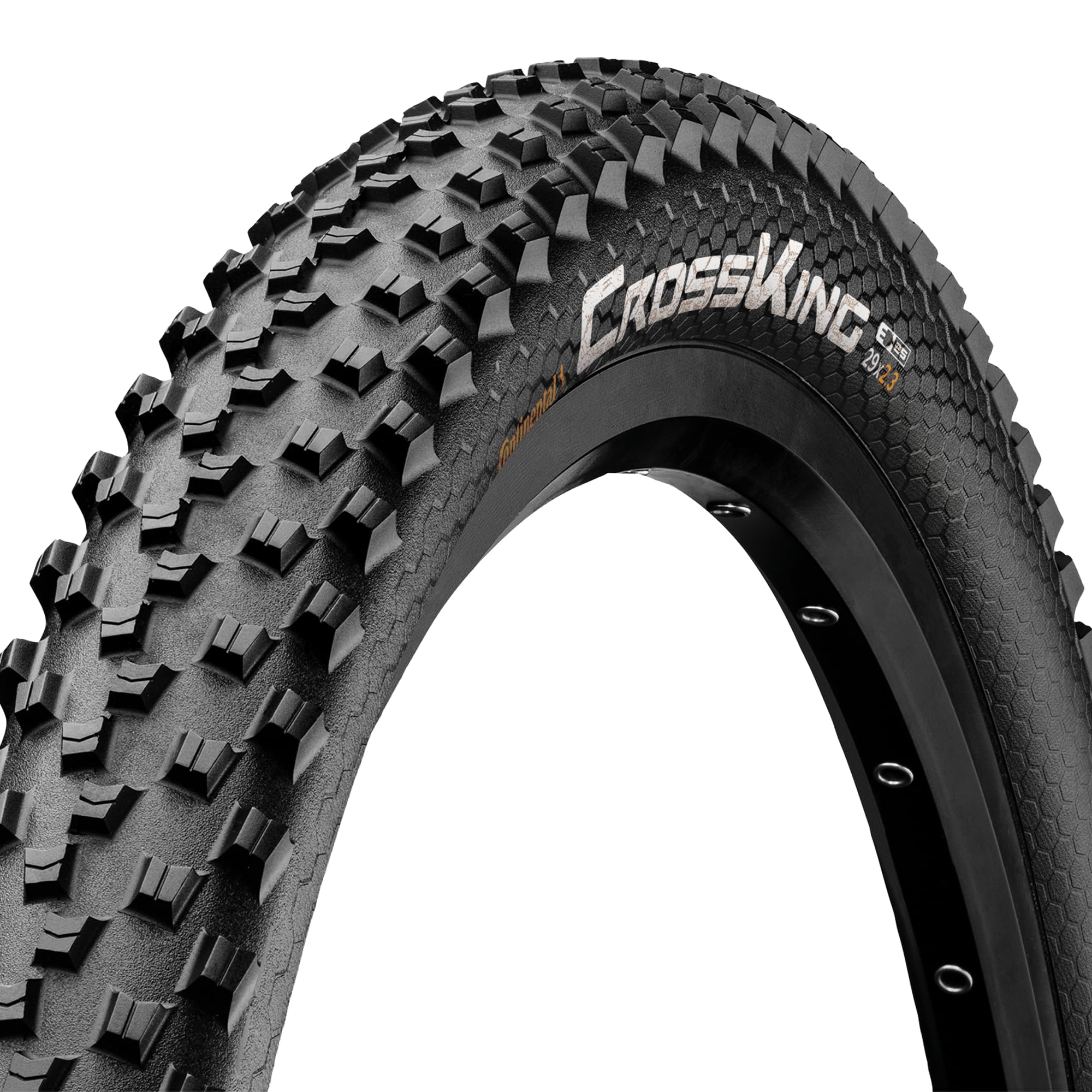
Continental Cross King
Key Features
- Tread Compound: PureGrip
- Sidewall Protection: ShieldWall
- Wheel Size/Width: 29×2.2
- Price: $$
The Continental Cross King uses PureGrip rubber and ShieldWall casing to deliver low rolling resistance without sacrificing cornering or braking bite on hardpack, loose-over-hard, and dry trails. This makes it a strong fit for XC racers and riders who cover miles quickly on varied terrain rather than picking through rocks and roots.
Where it steps back from the top pick is in long-term toughness: sidewall tears can happen on rough, rocky trails, and tread life is shorter than some competitors. Mounting the tire onto tight rims can also take serious effort, especially for riders new to tubeless setups.
Pros
- Fast rolling with strong grip on hardpack and loose-over-hard terrain.
- Good all-round performance for cross-country and trail riding.
Cons
- Sidewall tears may occur on rocky or abrasive trails; tread wears faster than some comparable tires.
- Mounting can be very tight on certain rims, requiring extra force or tire levers.
Best for XC racers and fast trail riders who want low rolling resistance and capable grip, and are willing to accept shorter tread life and careful line choice on rocky sections.
Best for Budget All-Terrain
Schwinn All-Terrain
Key Features
- Sidewall Protection: Puncture guard
- Wheel Size/Width: 26×1.95
- Price: $
This Schwinn All-Terrain tire adds puncture guard protection to a basic tread pattern, offering a step up in flat resistance over simpler budget tires. The steel bead makes installation straightforward and the 26×1.95 size fits most standard rims without forcing. On pavement it rolls smoothly, and the blocky knobs provide usable off-road grip on light trails and gravel. For casual hybrid riding and budget replacements, this works well but sidewall durability varies, with some riders encountering blowouts or accelerated wear after extended use. That makes it less suitable for aggressive trail riding or heavy commuting.
Pros
- Good value with solid quality for the price.
- Straightforward installation with reliable rim fit.
- Smooth ride on pavement and usable off-road traction.
Cons
A cost-effective upgrade for hybrid riders who want puncture guard protection without spending much.
Best for 26-Inch Technical
WTB Velociraptor
Key Features
- Tread Compound: Aggressive knobby
- Wheel Size/Width: 26×2.1
- Price: $$
Deep, widely spaced knobs dig into loose dirt and rocky climbs, giving this 26-inch tire strong traction on technical trails. It is a legacy design well-suited for vintage mountain bikes or riders who want an aggressive tread pattern on a classic wheel size.
Best for 26-inch mountain bike users who prioritize grip on loose, technical terrain over rolling speed or paved riding. The wire bead adds heft, and belt separation has been noted under hard use — a consideration for aggressive riders pushing the tire’s limits.
Pros
- Deep knobs provide confident grip on loose dirt and rocky climbs.
- Solid construction for a mid-range price point.
Cons
- Belt separation can occur under heavy use, especially on rough terrain.
A grip-focused option for 26-inch technical trail riding, but the durability tradeoff makes it better suited for less aggressive riders or occasional use.
Best for Budget Trail Riding
WTB Trail Boss
This trail tire balances rolling speed and grip for budget-conscious riders, but its lower puncture resistance means it suits smoother, less technical trails where sidewall impacts are minimal.
Pros
- Confident grip and low rolling resistance on hardpack and dirt.
- Simple installation with consistent fit on common rims.
Cons
- Sidewall blowouts and punctures can occur on rocky or sharp terrain.
A cost-effective choice for casual trail riders who accept occasional tire replacement as part of the budget equation.
Best for —
Maxxis Minion DHR II

Key Features
- Tread Compound: Dual compound
- Sidewall Protection: EXO
- Wheel Size/Width: 29×2.3
- Price: $$
The DHR II delivers strong braking bite on loose descents thanks to deep, widely spaced tread knobs. The EXO sidewall adds cut resistance for rocky trails. While the tread design and protection are promising, the track record for this model under demanding trail use is still emerging — riders who need well-documented long-term performance may want to look at the front-focused DHF alternative.
Pros
- Deeply spaced tread knobs provide consistent braking bite on loose and steep descents.
- EXO sidewall reinforcement adds cut and abrasion resistance for rocky trail conditions.
Cons
- For riders logging high-mileage technical descents, long-term tread wear data is limited.
A good choice if you prioritize braking traction on loose terrain and are comfortable with a tire that has less documented real-world use under heavy loads.
Best for —
Bell Flat Defense

Key Features
- Tread Compound: Tall knobby
- Sidewall Protection: Flat defense
- Price: $
The Bell Flat Defense offers a puncture-protection layer and tall knobby tread at a budget price, which is appealing for light trail use. Without real-world feedback from riders, the durability and effectiveness of that protection remain unverified — it suits casual riders who prioritize low cost over proven long-term performance.
Pros
- Flat defense layer adds puncture protection for the price.
- Tall knobby tread provides traction on loose terrain.
Cons
- Durability under heavy trail use is not yet established.
Best for budget-minded riders on easy trails who want extra puncture protection and accept that long-term toughness remains unknown.
Best for 27.5-Inch Budget
Fincci Durable 27.5

The Fincci Durable 27.5 tires bring Kevlar folding beads and quality construction at a mid-range price point. This pair suits budget-conscious riders for XC or light trail use, though durability over extended hard riding remains unverified.
Pros
- Quality construction at a fair price.
- Kevlar folding bead reduces weight and simplifies mounting.
Cons
- On aggressive trails, long-term durability has not been established.
Best for budget-conscious riders seeking a Kevlar pair for light off-road use, not for heavy-duty trail riding.
Best for Budget 29Er
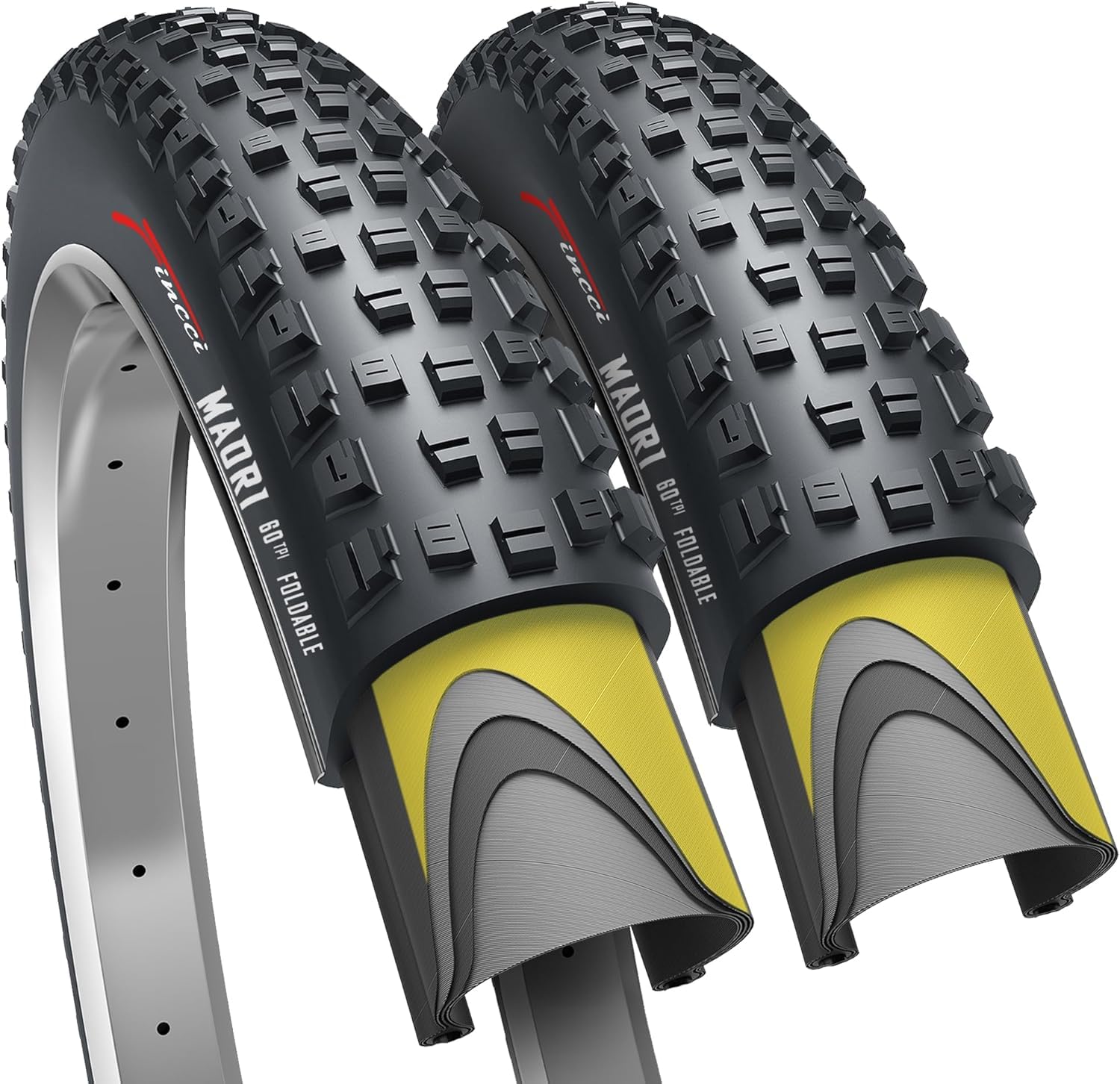
Fincci Maori 29×2.25
Key Features
- Sidewall Protection: 1mm nylon
- Wheel Size/Width: 29×2.25
- Price: $$
The Fincci Maori brings a nylon antipuncture layer and folding Kevlar beads to budget 29er builds, offering stable rolling on mixed surfaces for a low upfront cost. The tradeoff is that sidewall blowouts or punctures can occur on rougher trails, making these better suited for light XC and gravel riding than aggressive terrain.
Pros
- Good build quality and value for a pair
- Stable and smooth rolling on mixed surfaces
Cons
- Sidewall blowouts or punctures can occur on rougher terrain
A sensible choice for light XC or gravel riders on a budget who accept the possibility of occasional tire issues and don’t need maximum durability.
Best for —
Blackburn 26×1.75-2.25

Key Features
- Sidewall Protection: Puncture-resistant
- Wheel Size/Width: 26×1.75-2.25
- Price: $
This tire delivers a folding bead and flat protection at the lowest price point. Buyers get a puncture-resistant layer under the tread, which helps on paved paths and smooth gravel. However, long-term durability under regular trail riding has not been widely confirmed, with some wear noted after a month of use. It works for casual replacements on pavement, but riders who push tires on loose terrain should consider alternatives with more established track records.
Pros
- Carbon steel folding bead for easier storage and installation.
- Puncture-resistant layer reduces flat risk on smooth surfaces.
Cons
- Long-term durability under frequent trail use remains uncertain.
A budget-friendly option for casual paved riding, but trail riders should look to tires with more durability feedback.
Best for Emergency Use
Chao YANG 26×1.95

Key Features
- Tread Compound: Dual compound
- Wheel Size/Width: 26×1.95
- Price: $
This kit bundles a 26×1.95 dual-compound tire with tubes and levers at an entry-level price, making installation straightforward for a quick swap. However, the included tubes have a high failure rate – some can lose pressure or tear during initial use. That limits the kit to low-risk roles like emergency replacements or kids’ bikes where a sudden flat won’t strand a rider.
Pros
- Complete kit with tire, tube, and levers at a low price
- Installation is easy and the tire fits standard 26-inch rims well
Cons
- Tube durability can be inconsistent – some may leak or fail shortly after installation
Best kept as a spare for casual use or a child’s bike where a flat is an inconvenience rather than a problem.
How to Choose
The best mountain bike tire starts with matching tread compound and sidewall protection to the terrain you ride most.
Tread Compound
Tread compound refers to the rubber hardness and formulation. Softer compounds (like Maxxis 3C or Continental PureGrip) give better grip on wet rocks and roots but wear faster. Harder dual compounds last longer but slide on slick surfaces.
Most trail riders benefit from a dual compound front tire for cornering grip and a harder rear for braking and climbing. If you ride mostly dry, hardpack trails, a single compound may save weight and cost.
Sidewall Protection
Sidewall protection layers (EXO, ShieldWall, puncture guard) add weight but prevent cuts from sharp rocks and pinch flats. Without it, a single trailside rock can slice the sidewall open.
For aggressive enduro or rocky terrain, EXO or similar is worth the weight. On smooth XC trails, a lighter sidewall saves rolling resistance and keeps the tire supple.
Tubeless Readiness
Tubeless tires seal small punctures and allow lower air pressure for traction without pinch flats. But setting them up requires a tubeless valve, sealant, and often a compressor to seat the bead.
If you ride rocky trails where pinch flats are common, tubeless is a major upgrade. For occasional pavement and light trail, tubes are simpler and cheaper to maintain.
Weight and Rolling Resistance
Heavier tires (over 900g) offer more puncture protection but make climbing feel sluggish. Light tires (under 700g) accelerate fast but sacrifice durability. Rolling resistance depends on tread pattern and compound.
A fast-rolling tire like the Continental Cross King saves energy on long XC rides, but a heavier tire with aggressive knobs is safer on steep descents. Choose based on whether you climb more than you descend.
Wheel Size and Width
Wheel size (26, 27.5, 29 inches) is determined by your bike frame. Width affects traction and comfort: a 2.3-inch tire floats over loose dirt, while a 1.95-inch tire rolls faster on hardpack.
Wider tires also need wider rims to avoid pinch flats. For most trail riding, a 2.25 to 2.4 width provides a good balance of grip and rolling speed.
FAQ
Why does my mountain bike tire keep getting punctures even with a puncture-resistant layer?
Puncture-resistant layers help against thorns and glass, but they do not protect sidewall cuts from sharp rocks. If you ride rocky terrain, look for tires with reinforced sidewall protection like Maxxis EXO or Continental ShieldWall. Also check tire pressure: too low can cause pinch flats, too high makes the tire more vulnerable to sharp impacts.
Are tubeless mountain bike tires worth the installation hassle?
For regular off-road riding, yes. Tubeless eliminates most pinch flats and lets you run lower pressure for better traction. The setup is more involved (sealant, compressor often needed), but frequent riders find the trail reliability worth the effort. If you ride mostly pavement or very light trails, tubes remain simpler and cost effective.
How often should I replace mountain bike tires?
Replace when the center tread knobs are worn down to half their original height, or when sidewall cuts, bulges, or cracking appear. For aggressive riders on rocky terrain, that can be as often as every 6 months. Casual trail riders may get 1-2 years. Check for squared-off edges on front tire knobs, which reduce cornering grip.
What’s the difference between Maxxis Minion DHF and DHR II?
The DHF (Front) is designed for the front wheel with ramped center knobs for rolling speed and tall edge knobs for cornering grip. The DHR II (Rear) has a more continuous center tread for braking traction and a tighter knob spacing for lower rolling resistance. Many riders pair DHF front with DHR II rear for balanced performance on aggressive trails.