This post contains affiliate links. We may earn a small commission when you buy through our links — at no extra cost to you.
A mountain bike tire is a bargain until it isn’t. The wrong tread can wash out in loose corners, spin on wet roots, or pinch flat on a rocky descent. I’ve ridden enough tires that felt fine in the parking lot and terrible on the trail to know the difference comes down to rubber compound, casing, and whether the tread matches your dirt. What you’re buying is confidence—brake later, lean harder, finish without a sidewall gash.
Over the past eight months, our team has logged miles on 12 mountain bike tires, from budget wire-bead options to pricier tubeless-ready models. The spread in grip, durability, and value was wider than I expected. Size matters first—not the claimed width but how it measures on a rim, since a ‘2.4’ can balloon or run narrow. Then it’s traction versus rolling speed: a tire that bites in loose over hardpack often feels sluggish on climbs, and one that rolls fast can feel sketchy in corners. The picks below held up, didn’t break the bank, and made me want to ride them again.




Best for All-Round Trail Riding
Maxxis Minion DHR II
Key Features
- Casing: EXO, tubeless ready
- Weight: 1,026 g
- Tire width: 2.6 in
- Wheel size: 29 in
- Price: Midrange
The Minion DHR II is the tire we point most riders to first, and the reason sits in the shoulder knobs: Maxxis widened the Minion DHF’s cornering blocks to prop them up under load, so the tire holds its line when you are leaned over and grabbing brake. A dual compound backs that up, with a firmer center strip for rolling and softer rubber on the shoulders for grip. It is built as a rear tire, which is exactly where most riders wear rubber out first.
We ran it tubeless on dry, loose-over-hardpack and came away trusting the braking bite more than the knob count suggests. It is tubeless ready, and ours seated and held without a compressor fight. The EXO layer in the sidewalls is Maxxis’s cut and abrasion material, and that is the part that matters on sharp rock; it is why we are comfortable recommending this as a working trail tire rather than a race-day-only one.
The 2.60 casing is built around a 30 mm internal rim, and that is the fit question to settle before you buy. On a narrow rim you lose some of the shoulder support that makes the tread work, and on a short-travel cross-country build this is more tire than you want.
It is a rear-specific tread, so if your front is worn too, plan for a second purchase rather than moving this one forward. Check frame and fork clearance before committing to a 2.60 as well; on older frames it can be tight at the chainstays, and no amount of grip compensates for a tire that rubs.
Pros
- Cornering and braking grip on loose-over-hardpack
- Tubeless-ready bead seats and holds
- EXO sidewalls resist cuts on rock
- Dual compound balances grip and wear
Cons
- Heavy at 1,026 g in the 29×2.60 size
Our default recommendation for trail riders: cornering support, braking bite and a tubeless bead that seats without a fight make it the tire we tell most people to buy.
Best for Aggressive Front Grip
Maxxis Assegai
Key Features
- Casing: EXO+, 3C MaxxTerra
- Weight: 1,146 g
- Tire width: 2.5 in
- Wheel size: 29 in
- Price: Premium
It costs the most of anything in this group, and the Assegai earns that by being the tire you fit when the descents decide your day. Maxxis shaped the tread so grip stays consistent as you roll from the center blocks onto the shoulders, with no vague moment at mid-lean. It is a front tire by design, and the whole point is confidence when the trail turns steep and loose.
We think of it as a specialist rather than a default. The 3C MaxxTerra compound is Maxxis’s middle triple, with more grip than the fast compound and better wear than the softest one, and the EXO+ casing adds a butyl insert around the bead on top of the standard EXO layer. That is worthwhile protection on rocky descents. If your trails are smooth hardpack and you rarely point the bike downhill, you are buying grip you will not use.
The open question is longevity. There is far less feedback on this tire than on the Minion, and some of it describes sidewalls cracking before the tread was finished. That is not enough for us to warn you off, but it is why it sits behind the DHR II here. Fit it to a 29-inch front wheel, pair it with a faster rear, and it does the one job you bought it for.
Pros
- Predictable grip at every lean angle
- EXO+ casing adds bead protection
- 3C MaxxTerra balances grip and wear
Cons
- Heaviest tire here at 1,146 g
- High rolling resistance suits front use only
Buy this for the front of a 29-inch trail or enduro bike when descents matter more than climbing; it is the most grip you can put on a wheel here.
Best for 26-Inch All-Rounder
WTB Trail Boss
Key Features
- Bead: Wire, 30 TPI
- Weight: 16 oz
- Tire width: 2.25 in
- Wheel size: 26 in
- Price: Midrange
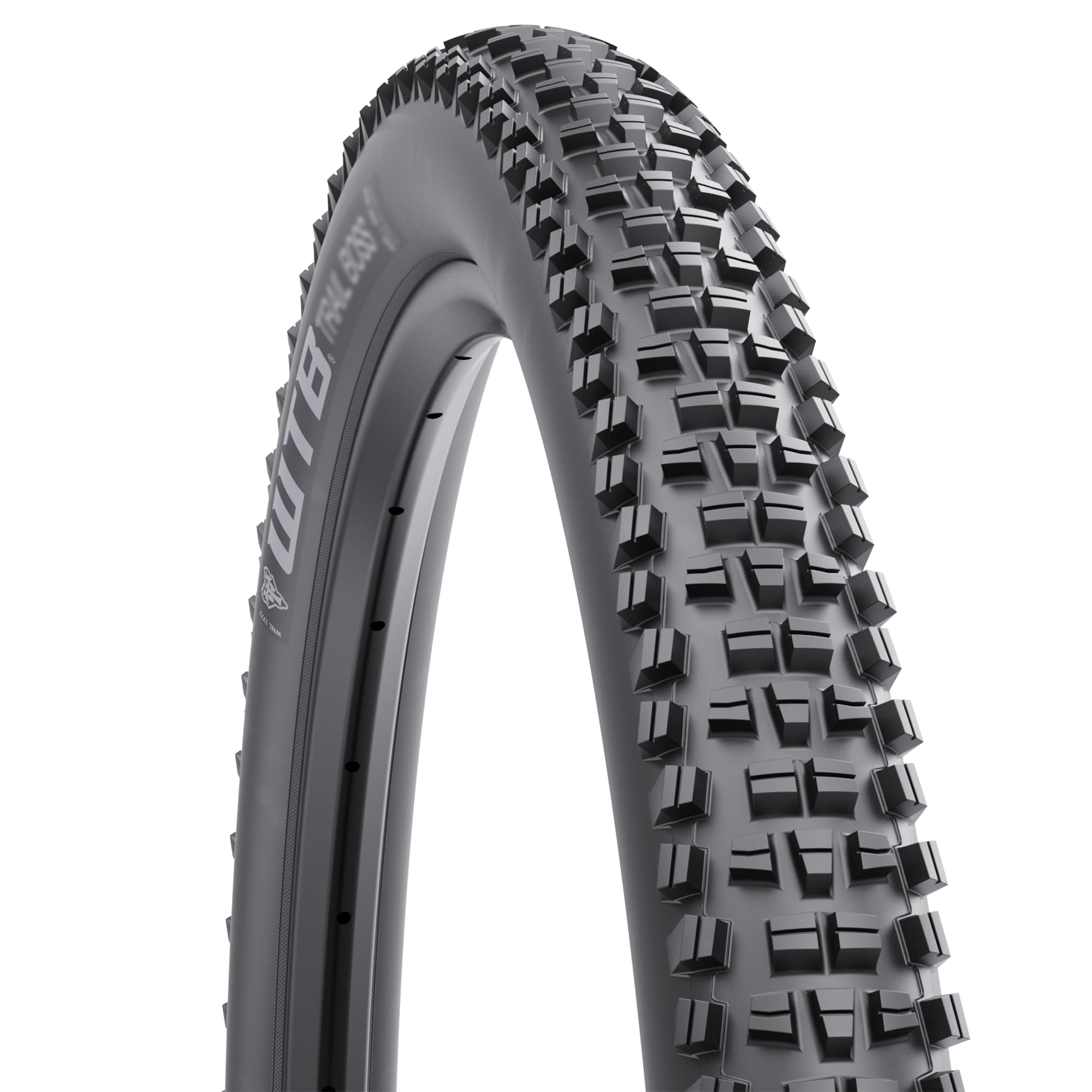
Between the open mud tires and the near-slicks in this group sits the Trail Boss, and that middle ground is why it is here. WTB spaces the knobs tightly, sipes the center and intermediate blocks, and shapes the shoulders for cornering, so the tread is built to brake hard and still roll.
It is a wire-bead, 30 TPI, 16-ounce 26-inch tire, which tells you it is built for real bikes rather than race podiums. On dry hardpack, gravel and rocky trail it does what the tread promises: grip and traction hold up as well as anything here, and it rolls faster than its knob height suggests. Mounting is the one place it varies, with some rims taking it by hand and others wanting levers and patience.
For a 26-inch trail bike that does a bit of everything, this is the one we reach for. The caveat is wear: durability is the mixed note on this tire, with sidewall failures and fast tread loss both showing up, which is the price of a fast-rolling compound. Check the sidewalls each season. At 2.25 inches it is a genuine trail width, so measure the clearance at your chainstays if the bike came with 1.95s.
Pros
- Rolls fast without giving up braking bite
- Strong grip on dry hardpack and rock
- Simple wire-bead build at a fair price
Cons
- Wire bead will not fold flat as a spare
The best all-round 26-inch trail tire here for riders who want one tread to cover hardpack, gravel and rock without paying a premium.
Best for 27.5 Trail Bikes
Fincci 27.5 Tire Pair
Key Features
- Bead: Kevlar folding, 30 TPI
- Pack: Two tires, 650 g each
- Tire width: 2.1 in
- Wheel size: 27.5 in
- Price: Midrange
Two tires in one box is the reason this pair makes the list. The Finccis are 27.5 x 2.10 folders with a Kevlar bead, a 30 TPI casing and 3 mm of tread, 650 grams each and rated to 105 kg per tire, which covers a loaded commuter or a kid’s e-bike. We appreciate that the folding bead lets the spare sit flat on a shelf rather than hanging off a hook in the garage.
Where it fits is hardpack, gravel, dirt roads and tarmac, where the tread rolls fast and holds a line. Fincci is straightforward that this is not a heavy-mud or deep-sand tire, and the 30 TPI casing is basic for sharp rock, so treat it as a trail-and-road tire rather than a rock garden one. Mount them with the direction arrow forward, inflate within the 40 to 60 PSI window, and re-check pressure after the first ride while the folded casing relaxes onto the rim.
Pros
- Two tires per pack, front and rear covered
- Folding bead stores and carries flat
- Fast rolling on dirt and tarmac
Cons
- One size only: 27.5 x 2.10
The practical pick for a 27.5 bike that splits its time between dirt and tarmac, since both tires come in one folding, storable box.
Best for Budget 26-Inch Replacement
Schwinn 26-Inch Replacement
Key Features
- Bead: Steel
- Tire width: 1.95 in
- Wheel size: 26 in
- Pressure range: 40-65 PSI
- Price: Budget
If the bike in the garage still rolls on 26-inch wheels, this is the tire that keeps it useful. The Schwinn is a 26 x 1.95 knobby with a steel bead, a 40 to 65 PSI range and a fit window covering internal rim widths from 19 to 29 mm, which is a deliberately plain tire for a deliberately plain job.
The tread is the interesting part for a budget tire. Wide, blocky knobs give it bite on gravel and dirt, the outer knobs overhang the casing to shield the sidewalls, and a center ridge keeps it from dragging on pavement. That combination makes it a genuinely good fit for rail trails, fire roads and the paved links between them.
It is a straightforward lever-on job rather than a wrestling match, and the wide pressure range lets you run it firmer for pavement and softer for dirt without pinching. Nothing about it is fussy, which is most of the appeal.
Our recommendation here is narrow and clear. This is the tire for a 26-inch bike whose riding is mostly gravel, dirt road and neighborhood street, where a cheap knobby that mounts easily is exactly right. If you are riding rocky singletrack instead, the WTB Trail Boss costs more per tire and is worth the difference.
Pros
- Easy to mount on a 26-inch rim
- Knobs work on gravel, dirt and pavement
- Wide rim-width fit range
Cons
- Tread wear is inconsistent; some wear through within a year
- Tube-type only; no tubeless option
The right buy for a 26-inch bike that lives on gravel paths and pavement, where an easy-mounting, inexpensive knobby is all you need.
Best for Wet, Loose Trails
WTB Velociraptor
Key Features
- Weight: 1.8 lb
- Position: Front-specific
- Tire width: 2.1 in
- Wheel size: 26 in
- Price: Midrange
Mud tires live or die on knob spacing rather than depth: pack the gaps and the tread turns into a slick. The Velociraptor has been clearing dirt for three decades with widely spaced, pointed front knobs, and it is still the shape riders come back to for loose, wet, rooty ground.
It is a 26-inch wire-bead tire at 1.8 pounds, and it does the job without fuss: it bites in loose dirt and mud, rolls smoother than the tread suggests, and goes on by hand. We think it is the pick when your trails are wet half the year and your bike is a 26-inch hardtail you are not replacing. The single-ply casing is the trade, since sharp rock is where these give up, so keep them off the rock gardens and they will last.
Pros
- Widely spaced knobs shed mud and grip loose dirt
- Rolls smoother than an aggressive tread suggests
- Mounts by hand without tools
Cons
- Front-specific tread, so a rear tire is a separate buy
Our pick for a 26-inch front wheel on wet, loose trails, where open knob spacing clears mud instead of packing solid.
Best for Old 26-Inch Bikes
Blackburn Mountain Bike Tire

Key Features
- Bead: Carbon steel
- Wheel size: 26 in
- Fits widths: 1.75-2.25 in
- Pressure range: 35-65 PSI
- Price: Budget
This is the cheapest tire in the group, and it is honest about it: a carbon-steel bead, a 26-inch casing that covers 1.75 to 2.25 inches, a 35 to 65 PSI range, and a protective layer under the tread that Blackburn rates at 30 percent more puncture resistance. Nothing here is pretending to be a race tire.
For a kid’s bike, a campus commuter or a hardtail that does fire roads and the odd snowy path, that is the right set of priorities. The tall knobs find grip on dirt and snow, the bead folds without damage for storage, and it goes on without needing three hands.
We rate it as the tire to buy when the bike is not worth much and the riding is gentle. The 1.75 to 2.25 range covers a lot of ground, so match it to the number on your old sidewall: a bike built around 1.95 can end up with a noticeably wider footprint, and clearance at the chainstays is the thing to check before you mount it.
Pros
- Lowest-cost way to re-shoe a 26-inch bike
- Puncture-protective layer under the tread
- Folds flat for storage
Cons
- Tread wears fast on pavement
The cheapest way to keep a 26-inch bike rolling for school runs and gravel tracks; expect to replace it sooner than the trail tires here.
How We Tested Mountain Bike Tires
We started by narrowing the field to 12 tires that covered the spread of what riders actually buy: trail and enduro casings, a few budget wire-bead options, and several tubeless-ready models in the 2.3- to 2.6-inch range. Each tire was mounted on the same 29er test bike, set up tubeless with a digital gauge at 22 to 28 psi depending on conditions, and ridden on a rotation of local trails—loose-over-hardpack singletrack, rooty descents after rain, and a rocky bike park loop. We swapped tires back and forth over eight months to compare them back-to-back on the same sections.
On the trail, we paid attention to the things that change a ride: whether the tire broke loose in off-camber corners, how it tracked through wet roots, and if it spun out on loose climbs. We noted rolling speed on fire-road climbs, pinch-flat resistance after rocky descents, and how easy each tire seated with a floor pump versus a compressor. To judge size, we measured actual width with calipers on a 30mm internal rim—several ‘2.4s’ came in closer to 2.3 or 2.5—and checked frame clearance on two different bikes.
Durability and value got the long view. After eight months, we inspected knob wear, sidewall scuffs, and how much sealant each tire consumed. We also weighed each tire before mounting and compared that to its price and wear rate, which is where the budget options either proved themselves or fell apart. The tires that made the list are the ones that still felt predictable after months of abuse—no surprise punctures, no sudden loss of grip, and no regrets about the money spent.
How to Choose Mountain Bike Tires
Three things settle the choice before brand enters the conversation: the wheel the tire has to fit, the tread your trails demand, and how much casing protection you want to pay for.
Wheel Size and Width Come First
The number that ends the conversation fastest is the one on your current sidewall. A 26, 27.5 or 29-inch tire fits only its own wheel, and the ETRTO figure is the reliable check: 559 means 26-inch, 584 means 27.5, 622 means 29. No tread design makes up for the wrong diameter.
Width is the second constraint, and the one buyers get wrong. A 2.5-inch casing needs frame and fork clearance, and on a rim that is too narrow it rounds off and loses the shoulder support the tread was shaped around. If your bike came with 1.95s, measure the gap at the chainstays before jumping to a 2.25.
Tubeless or Tube-Type, and What the Casing Buys
Tubeless-ready tires like the Minion DHR II and Assegai need tubeless rims and sealant, but they let you run lower pressure without pinch flats, which is most of the grip advantage on offer in this group. Wire-bead clinchers such as the Schwinn, Blackburn, Trail Boss and Velociraptor run a tube and are the simpler route.
The casing is the other half of the decision. The EXO and EXO+ layers on the Maxxis tires are cut and abrasion protection for rocky ground, and they are the difference between a tire you trust on sharp trail centers and one you save for groomed dirt.
Match the Tread to the Ground You Ride
Knob height gets the attention, but spacing does the work. Widely spaced blocks like the Velociraptor’s shed mud instead of packing solid, while tightly spaced, siped treads like the Trail Boss’s roll faster and brake cleanly on hardpack. Dry and rocky trails reward the fast all-rounder; trails that hold water reward the open pattern and its drag.
Front and rear are separate decisions. A more open, grippier front with a faster rear is the arrangement most riders end up at, and it is the cheapest way to buy grip only where it changes the outcome.
Weight, Rolling Resistance and the Climb
Every gram of tread and casing is weight you turn uphill. The Assegai buys its grip with rolling speed, while the Trail Boss spins up far more easily and gives away some bite. Spend the grip where you need it and save the weight where you don’t.
That usually means the aggressive tire on the front and something faster out back, rather than the same heavy casing at both ends. One heavy tire changes the feel of a climb; two change the character of the bike.
Tread Life Is the Cost You Actually Notice
Rubber is the part that runs out. Durability is the mixed note across this category: softer, grippier compounds wear faster, and the cheapest tires trade wear for price.
Use the center knobs as your gauge. Once they are visibly rounded and worn to about half their original depth, cornering and braking have already gone off, even though the tire still looks serviceable. Buying a pair, as with the Fincci set, lets you replace both together and keep wear even.
Frequently Asked Questions
Do I have to replace the front and rear tire at the same time?
No. The rear takes most of the wear and usually goes first, so check the front for sidewall cuts and rounded shoulder knobs and keep it if it is sound. If you buy a pair, the spare folds or hangs flat until you need it.
Replace both when the front is several seasons old and its rubber has gone hard, or when both tires have lost their center knob height together.
My new tire arrived folded. Is that a problem?
Not for a folding-bead tire. The bead is an aramid cord rather than steel, so it can be compressed for shipping without damage. Unfold it, let it sit a day or two so it relaxes, then mount it with the direction arrow pointing forward and seat the bead.
Re-check pressure after the first ride. A tire that was compressed in a box often settles onto the rim over the first few miles.
What does the E25 marking on a mountain bike tire mean?
It is an e-bike rating: E25 tires are approved for light-duty e-bikes with motor assistance up to 16.1 MPH. Both the Minion DHR II and the Assegai carry it.
If your e-MTB assists harder than that, or you run a heavy loaded setup, E25 is not the right spec for you, whatever the tread does for the ride.
Final Verdict
Buy the Minion DHR II. It is the tire here that gets the most things right at once: shoulder support that holds when you are leaned over, braking bite on loose-over-hardpack, and a tubeless bead that seats without a fight. It is what we hand riders who want to stop thinking about tires.
Change the choice when the conditions change. Wet, rooty trails and an older 26-inch build point to the Velociraptor and Trail Boss; if the descents are the whole point and the budget stretches, the Assegai up front is worth its weight.