This post contains affiliate links. We may earn a small commission when you buy through our links — at no extra cost to you.
A flat in your driveway is a ten-minute annoyance. A flat four miles out, with the sun dropping and a pump that wheezes instead of inflates, is a different kind of evening — and I’ve had both. The difference came down to the pump in my pack: how much air each stroke moved, whether the head stayed seated on the valve, and whether the gauge told the truth. A good one turns a dead tire into a rideable one in a few minutes of honest work, no valve cores lost along the way.
Size and price pull against each other in this category — the smallest pumps take forever, and the lovely big ones are a misery to carry. We spent six months working through 12 pumps, from palm-sized frame models to garage floor pumps, and rode with all of them. What separates the keepers isn’t the spec sheet; it’s whether the thing still feels solid after a season of muddy hands and gritty valves. The picks below cover that whole range.

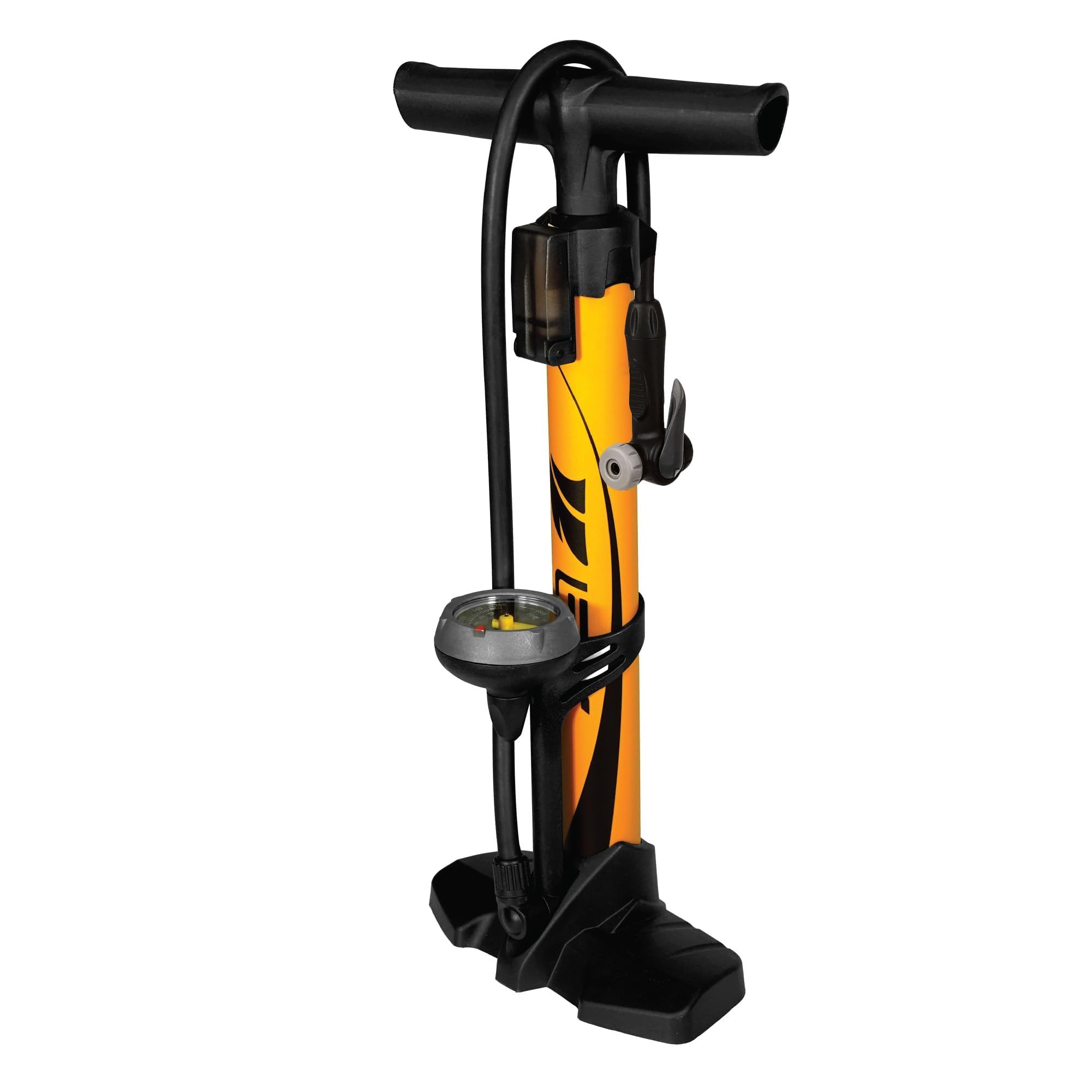


Best for Home Mtb Inflation
Topeak JoeBlow Sport III
Key Features
- Gauge: 3 in analog, mid-mount
- Air flow: 318 cc per second
- Valve head: TwinHead DX5, Presta/Schrader/Dunlop
- Max pressure: 160 psi
- Price: Premium
A three-inch dial is the reason the JoeBlow Sport III is our top pick. Mountain bike tires live between roughly 20 and 30 psi, which is the very bottom of a 160 psi gauge, and that is where small dials turn into guesswork — the needle sits just off the stop and you find yourself squinting at it. Topeak mounts this one mid-barrel with large numerals, and we could set a pressure, ride, and come back to the same number without crouching over the pump.
Volume is the other half of the job. Topeak rates the pump at 318 cc per second, and a 2.4-inch tire comes up in a short run of strokes instead of the long grind a narrow barrel gives you. The hardened steel base stays flat when you lean on the handle, and the padded grip does not cut into your palm at the end. Left standing in our garage since spring, it has not walked across the floor once. At 3.7 pounds, though, it is not a pump you carry.
The TwinHead DX5 takes Presta, Schrader and Dunlop with nothing to swap, and the 360-degree hose lets you come at the valve from whichever side you can reach. The head does want a firm, straight push to seat properly, and it can miss a valve core that sits deep in the rim; a core with more thread showing usually fixes that. Beyond the head, this is a floor pump and that is the boundary — if the pump has to travel with you, it is not the one.
Pros
- Three-inch gauge readable at low pressure
- High volume per stroke at 318 cc/s
- Steel base and padded handle stay stable
- TwinHead fits Presta, Schrader and Dunlop
Cons
- Dial steps in 5 psi increments
The pump we recommend to most mountain bikers: a big readable dial, real volume per stroke, and a steel base that stays put when you lean on it.
Best for Tight Budgets
BV Floor Pump 160 psi
Key Features
- Height: 16.25 in
- Weight: 16 oz
- Valve head: Reversible Presta/Schrader
- Max pressure: 160 psi
- Price: Budget
Sixteen inches tall and a pound on the scale, the BV floor pump is the one that fits behind a car seat or in a hall closet and still stands on its own base. Height costs you strokes: a short barrel moves less air per push than the Topeak, so a fat tire takes more of them. At mountain bike pressures that is a few extra pushes rather than a chore, because the strokes stay easy when you are only going to 25 psi.
Where the budget shows is the gauge. On a 160 psi dial your riding pressure sits near the bottom, and inexpensive movements are least reliable there, so the reading can drift from one unit to the next. We cross-check a new pump against a known-good digital gauge and then work from the offset. Do that once and this pump is perfectly usable; skip it and you will spend a season chasing pressure that was never really there.
The head is a reverser: you switch the internal parts to go between Presta and Schrader. If everything in the house is Presta, you set it once and forget it; with both valve types it is a small annoyance every time. What we like is that nothing about this pump is precious. It is the one behind the passenger seat for rides that start somewhere else, and the one you do not mind lending out.
Pros
- Short and light enough to store anywhere
- Reversible head covers both valve types
- Easy strokes at trail pressures
- Inexpensive enough to buy as a second pump
Cons
- Durability is uneven over months of use
Cheap, short and light enough to keep in the car, with one caveat: check its gauge once and work from the offset you find.
Best for On-Bike Carry
Vibrelli Mini Bike Pump
Key Features
- Weight: 4.3 oz
- Warranty: 5 years
- Valve head: Presta and Schrader, no swapping
- Max pressure: 120 psi
- Price: Budget
A mini pump is built for pressure when a mountain bike tire wants volume, and Vibrelli’s answer is a two-stage barrel. Extended, the handle gives you a high-volume stroke for the soft part of the fill; collapsed, it switches to the high-pressure stroke for the last few psi. That single detail decides whether a trailside flat is a two-minute stop or a ten-minute wrestle with your bike.
At 4.3 ounces it disappears on the frame. The bracket bolts to your bottle-cage holes and a Velcro strap holds the body down, which matters more than it sounds: an unstrapped pump rattles over chatter and eventually leaves. Strapped properly, ours has stayed quiet through a season of rough descents. The aluminum body feels like a tool rather than a toy, and a five-year warranty is unusual on a pump this size.
Vibrelli lists it as not for seating tubeless tires, and that is fair — no pump this size moves the burst of air a bead needs. We prefer a pump that admits the limit. Carry a tube, treat this as the thing that gets you home, and it does exactly the job it is sold for.
Pros
- Two-stage barrel puts volume first
- 4.3 ounces with a bolted, strapped mount
- Presta and Schrader with no adapters
- Five-year manufacturer warranty
Cons
- 120 psi maximum is short of road tubeless needs
Light enough to forget it is on the frame, with a high-volume stroke that suits fat tires — and no pretense about seating a tubeless bead.
Best for Effortless Top-Ups
CYCPLUS Tiny AS2 Pro
Key Features
- Weight: 4.23 oz
- Battery: 420 mAh, USB-C
- Display: LED gauge with auto shut-off
- Max pressure: 120 psi
- Price: Premium
The AS2 Pro weighs 120 grams, less than any of the frame pumps here, and it does the pumping itself. Push the hose onto the valve, set the target on the screen, press start, and it runs until it reaches the number and shuts off. For a rider who checks pressure before every ride, that turns a chore into a five-second decision.
The screen is the part that convinced us it is more than a gadget. You set 25 psi, not a vague target, and the pump stops there, so you can hold the bike or the wheel while it works instead of counting strokes. The claimed accuracy is plus or minus 1 psi; readings a few psi high do turn up, so cross-check once against a gauge you trust and note the difference.
The battery is the compromise. CYCPLUS rates a charge at two 700x25C tires from zero to 110 psi, which is a harder job than topping up a mountain bike tire, so range is not the problem for trail use — holding charge over months is. Some units stop taking a charge, which is the usual way a small lithium pack fails. Charge it before a big ride rather than trusting the bar from last month.
It is also loud, a high-pitched whine that carries across a quiet parking lot, and it is the most expensive pump here. What you are buying is the end of the effort and the end of the guesswork. If you ride tubeless, top up often and prefer to skip pumping altogether, neither objection will bother you much.
Pros
- Preset pressure with automatic shut-off
- 120 grams and pocket-sized
- USB-C and a 30-minute full charge
- One head for Presta and Schrader
Cons
- High-pitched whine while running
If you want a mountain bike tire topped up without any effort, this is the one: pocketable, self-stopping, and accurate once you have checked it against a known gauge.
Best for Simple Home Setup
Schwinn Air Center Plus
Key Features
- Hose: 26 in
- Weight: 2.9 lb
- Valve head: Dual Presta/Schrader
- Max pressure: 120 psi
- Price: Midrange
Twenty-six inches of hose is the reason to stop at the Schwinn Air Center Plus. It reaches a bike hanging in a repair stand, a tire on a roof rack, or the far side of a car without dragging anything by the valve stem — the sort of thing you never think about until a short hose makes every top-up a small negotiation.
The rest is conventional in a way that ages well: a wide steel base that keeps the pump upright when you pull hard, a soft grip handle, a dual head that takes Presta and Schrader without swapping parts, and a needle and cone for balls and inflatables. A 120 psi ceiling is several times what a mountain bike tire asks for, and it keeps this pump honest about what it is for.
There is a gauge on the barrel, and nothing else about this pump is designed to impress anybody. We do not think a mountain biker needs the showroom features. You need a base that does not tip, a hose that reaches and a head that seals, and the Schwinn delivers all three without asking you to learn anything. It is the simplest good choice here.
Pros
- 26-inch hose reaches stands and roof racks
- Wide steel base stays upright
- Dual head takes Presta and Schrader
- 120 psi ceiling covers MTB with room
Cons
For riders who want one stable pump by the door and no features to think about, the Schwinn’s long hose and wide base make it the simplest good choice here.
Best for Pack and Pocket
Tiakia Mini Bike Pump

Key Features
- Length: 7.8 in
- Weight: 5.3 oz
- Valve head: Presta/Schrader/Woods
- Max pressure: 260 psi
- Price: Budget
The hose is what we keep coming back to on the Tiakia. On a pump this small — 7.8 inches, 5.3 ounces — a hose means you can stand the pump on the ground and push down with your weight instead of holding the bike steady with one hand and working the valve with the other. Kneeling in the dirt with the bike upside down, that is the difference between a steady job and a wrestling match. It turns a fiddly task into a boring one, which is exactly what you want at the side of a trail.
Tiakia claims 260 psi and 44 ml per stroke. Ignore the first number — a mountain bike tire never sees a quarter of it — and pay attention to the second. 44 ml is a small lungful, so filling a fat tire is a long series of easy strokes rather than a few hard ones. The aluminum body and anodized finish feel better than the price suggests, and the bracket mounts under a bottle cage.
It earns its place as the pump that lives in a pack. It rides on the frame or in a jersey pocket without complaint, and the Presta, Schrader and Woods head covers whatever bike you happen to be on that day. It is the pick for a rider who wants one small pump and no further decisions.
Pros
- Hose keeps the valve straight while you pump
- Light enough for a jersey pocket
- Covers Presta, Schrader and Woods
- Anodized aluminum body, IPX4 rated
Cons
- Too long for a small saddle bag
- Some units fail at the valve head
Small enough for a jersey pocket, with a hose that turns trailside inflation into a boring job — which is exactly what you want from a pack pump.
Best for Spare Pump
West Biking Mini Pump

Key Features
- Length: 22.5 cm
- Weight: 4.59 oz
- Valve head: Dual Presta/Schrader
- Max pressure: 100 psi
- Price: Budget
The cheapest pump here has the lowest ceiling, and for a mountain biker that trade works in your favor. 100 psi is about four times what a trail tire runs, so the number that reads like a limitation never actually comes up. What you get instead is a 130-gram aluminum pump with a frame bracket, two screws, a ball needle and a pair of balloon needles — for less than almost anything else on this page.
Mounting is straightforward: the bracket screws to your bottle-cage holes and the pump clips into it, and at 22.5 cm it sits on a frame without fouling the crank. Buy it as a second pump — one on the commuter, one in the car, one in the bag you keep forgetting to restock — and it earns its keep the first time you need it.
The one caution is the build. This is the least substantial of the mini pumps here, and the head is where inexpensive pumps usually give up first. For a backup that lives on a bike and gets used a few times a season, we think that is a fair trade. It is not the pump to buy if it is going to be your only one.
Pros
- Very light at 130 grams
- Frame bracket and screws included
- 100 psi is ample for trail pressures
Cons
- Build quality is the weakest of the mini pumps here
A genuine bargain as a second pump: light, frame-mountable and inexpensive enough to keep on the commuter, as long as you already own a better one for the workshop.
How We Tested a Dozen Mountain Bike Pumps
We started with a shortlist of roughly 40 frame, mini, and floor pumps, then cut it by comparing spec sheets for maximum pressure, weight, and valve compatibility, and reading owner reviews for the failure patterns that repeat: heads that leak, gauges that drift, barrels that scratch the frame. That narrowed it to 12, spanning about $25 to $120 — the range most riders actually shop in.
Each pump lived with us for six months. That meant topping off tires on the garage floor before a Saturday ride, seating a stubborn tubeless tire in the kitchen, and fixing a pinch flat at a trailhead in the rain more than once. We weighed each one packed down for a jersey pocket or frame mount, counted strokes from flat to 25 psi on a 29er tire, and noted how much effort each stroke cost near the top of the range.
The gauge and the head got the closest attention. We checked every gauge against a digital reference and rechecked after a month to see whether it had drifted or stuck. For valve connectivity, we fitted each pump to Presta and Schrader valves, screw-on and thumb-lock alike, watching for cores that unscrewed or heads that popped off mid-stroke. Durability showed up in small things — a hose that kinked, a foot pedal that crept, a handle that wobbled after a few dozen uses. Ease of use we judged with cold hands and gloves on, because that’s when it matters.
How to Choose a Mountain Bike Pump
Mountain bike tires want a lot of air at very little pressure, which is the opposite of what most pump shopping is built around — so buy for volume per stroke and a gauge you can read at 25 psi, not for a pressure ceiling you will never reach.
Volume per stroke, not the pressure ceiling
A 160 psi rating sounds like headroom and is really a description of a narrow barrel. Narrow barrels are built to push hard against high pressure, and pushing one to 25 psi means more strokes, not fewer. What you want is air moved per push: the floor pumps here list figures around 318 cc per second, while a five-ounce mini claims 44 ml per stroke, and the gap between those numbers is the gap between topping up in seconds and settling in for minutes.
Here is the part that trips people up: a fat tire holds far more air than a road tire at a fraction of the pressure. That is good news for a small pump, because the strokes stay easy; it is bad news for your patience, because there are a lot of them. With a floor pump it never comes up. With anything you carry, budget the time and stop worrying about the psi number on the box.
A gauge you can read at 25 psi
Mechanical gauges are most accurate near the middle of their range, and mountain bike pressures sit at the very bottom of a dial marked to 120 or 160 psi. Two habits follow. Look at the smallest increment before you buy — a coarse dial leaves a 23 psi target sitting between two marks, and you will round up or down every time. Then check the pump once against a gauge you trust and work from the offset you find.
If you run tubeless and genuinely care about two psi, the money is better spent on a small digital gauge than on a bigger pump. A pump gets you close; a gauge tells you where you are. Riders who set pressure by feel alone are usually one rim strike away from a different opinion.
Heads, hoses and deep valve cores
A pump head either pushes on and clamps, screws onto the threads, or uses a hammer-style lever. All three work; what separates them is how they behave on your rims. The hose matters as much as the head, because it lets you approach the valve straight on instead of levering the wheel around by the stem.
The most common failure is not the pump at all. A Presta core that sits deep in the rim can stop a push-on head from engaging, and the fix is a core with more thread showing rather than a new pump. Before you blame the hardware, check that the core is fully unscrewed at the top and that the head is going on straight. Carry a spare core; they cost almost nothing and they end a lot of trailside arguments.
Where the flat happens picks the pump
A floor pump belongs wherever the bike lives, and at that job a wide base and a long hose matter more than anything else on the spec sheet. A frame or pack pump belongs on the bike, which makes the mount as important as the pump: bolt it to the bottle-cage holes, use the retaining strap every single time, and check the length against your frame before you order.
An electric pump belongs in the pack of someone who would rather not pump at all, and it needs charging the way your lights do — before the ride, not after. Buy for the riding you actually do. If you never leave the trail network, one good floor pump covers everything; if you are an hour from the car, the pump on the frame is the one that decides how the day ends.
Frequently Asked Questions
Can you seat a tubeless mountain bike tire with a hand pump?
Usually not on a fresh setup. Seating a bead takes a sudden, high-volume burst, and a mini or frame pump cannot deliver it. Plan on a compressor or a chamber-style floor pump for the first mount, then use an ordinary floor pump for top-ups. On the trail, carry a tube — a pump’s job out there is to get you home, not to reseat a bead.
Is it better to carry a pump or CO2?
CO2 is faster and smaller, but each cartridge is one shot, and a misfire leaves you walking. A mini pump is unlimited, works in the cold, and does not care how many attempts it takes. Carrying a pump plus a single cartridge is a sensible combination: speed when you want it, certainty when you need it.
How do I stop losing air when I take the pump head off?
Brace the wheel against the ground or a tree, release the head’s lock lever or unscrew it fully before pulling, and pull straight rather than sideways. On Presta valves, check that the little nut at the top of the core is fully unscrewed — a half-open valve is the usual reason a tire reads lower after you have just filled it. A hose helps here too, because you are not using the pump body as a lever.
Can I use a mountain bike pump on my suspension fork?
No. A fork or shock needs a dedicated shock pump: the air chamber is tiny, pressures run higher than a tire’s, and you need a bleed button to come down in small steps. A tire pump adds too much air per stroke and its gauge is not precise at that volume. Keep the shock pump for suspension and the tire pump for tires.
Final Verdict
The Topeak JoeBlow Sport III is the pump we point most mountain bikers to, because it fixes the two things that actually go wrong: not enough air per stroke, and a gauge you cannot trust at trail pressure. Nothing else here does both as well.
If the pump has to travel, take the Vibrelli — light, quiet on the mount, and geared for volume before pressure. And if you want to skip the pumping entirely, the CYCPLUS does the work and stops on its own, provided you charge it before you ride.