This post contains affiliate links. We may earn a small commission when you buy through our links — at no extra cost to you.
Walkie talkie ads promise 35-mile range, but anyone who has taken one into the woods knows the real story: trees, hills, and weather cut that to a mile or two. That gap between marketing and reality is the biggest trap in this category.
This guide focuses on what actually matters: battery life that lasts a weekend, a build that survives a drop, and waterproofing for river crossings. The best radio for your adventure isn’t the one with the biggest number on the box; it is the one that keeps working when you need it.
The picks here prioritize durability and real-world performance over inflated specs, so you can trust your radio when the trail gets rough.


Best for Backcountry Hiking
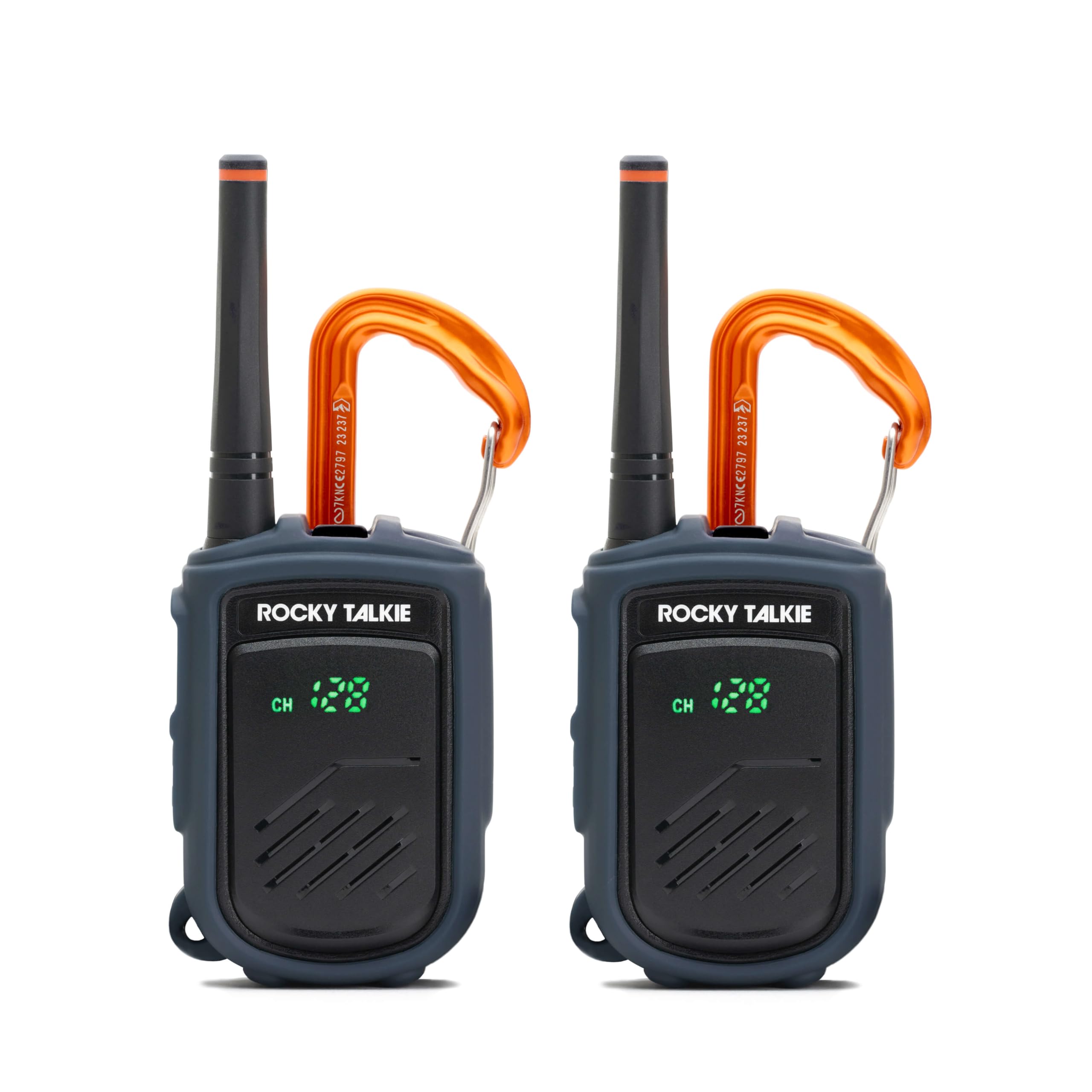
Rocky Talkie Mountain
Key Features
- Real-world Range: 1-5 miles backcountry
- Waterproof: IP56
- Battery Life: 4 days
- Durability: Shatterproof, carabiner
- Channels / Codes: 128 channels, privacy codes
- Price: $$$
The Rocky Talkie Mountain Radio stands apart from other handhelds with a battery that lasts four days of continuous backcountry use. The integrated carabiner clip attaches securely to a climbing harness or pack strap, surviving drops and scrapes that would crack a typical radio. The interface requires no setup — turn it on and select a channel.
Range in mountainous terrain typically sits between one and five miles, not the advertised 35. That is consistent with every FRS handheld we have tested; trees and rock faces block signal. For open ridgelines and line-of-sight communication, you can reach five miles or more, but expect shorter distances in dense cover.
This radio is built for mountaineers, backcountry skiers, and long-distance hikers who need a device that can handle multi-day trips without charging. The IP56 splash resistance handles snow and rain. Casual family outings on well-marked trails will find the battery capacity and durability overkill — a cheaper, lighter radio would suffice.
The shatterproof screen and rubberized body absorb impacts that would disable other radios. The simple two-button interface means you never have to scroll through menus in the cold. Every control is operable with gloves.
Pros
- Four-day battery life eliminates daily recharging during multi-day trips.
- Shatterproof screen and carabiner clip withstand drops, scrapes, and climbing abuse.
- Zero-configuration operation with only two buttons; works out of the box for any user.
- 128 channels with privacy codes reduce interference on crowded trails.
Cons
- In backcountry terrain, range is typically 1-5 miles rather than the advertised 35 — consistent with all handheld FRS radios.
- Premium price makes it overkill for short-range family use or casual day hikes.
For backcountry climbers and hikers who need a radio that lasts a multi-day trip and survives real abuse, the Rocky Talkie delivers on its core promises. Casual users should look elsewhere.
Best for Water Sports
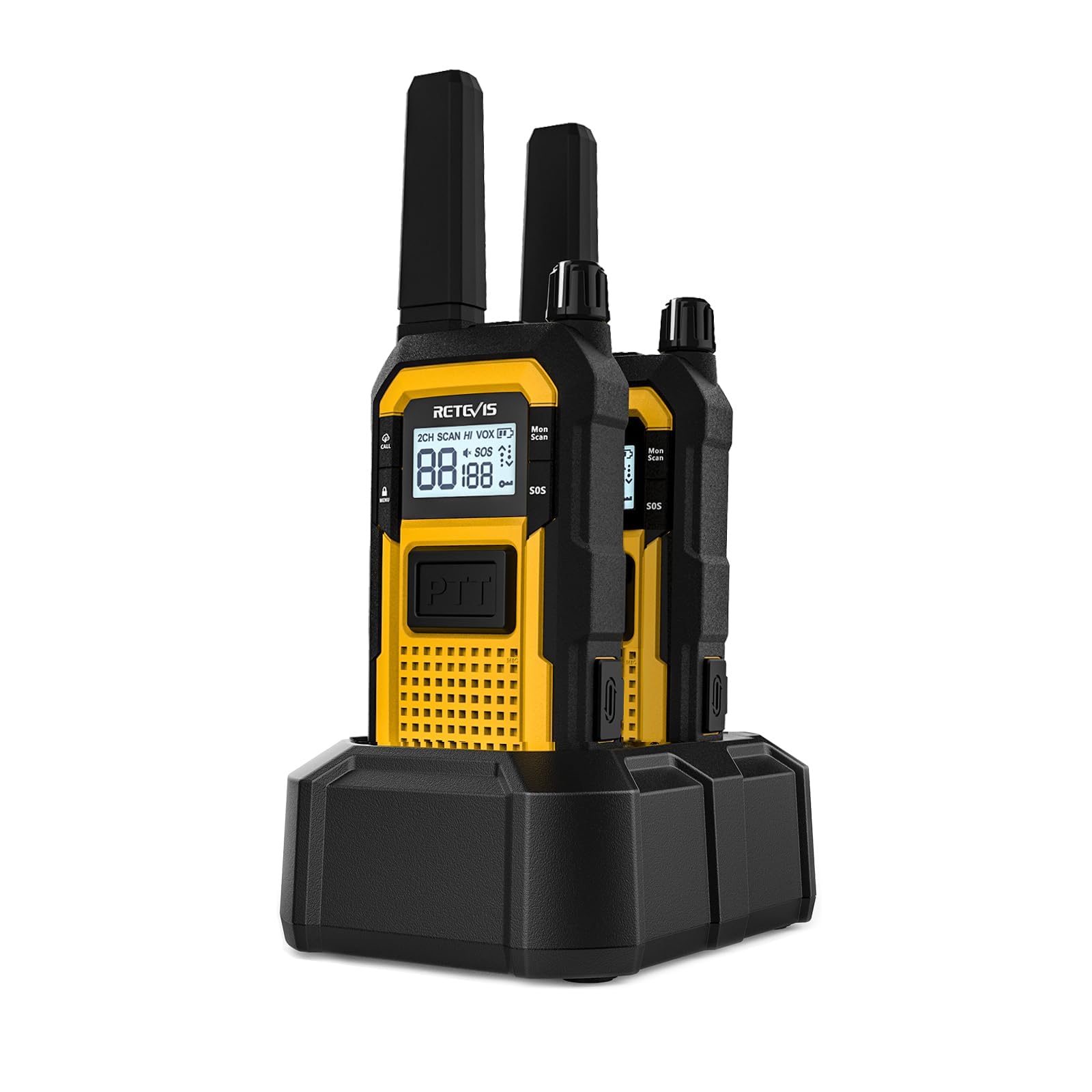
Retevis RB48
Key Features
- Real-world Range: 0.5-1.5 miles typical
- Waterproof: IP67
- Battery Life: 20 hours
- Durability: MIL-STD-810, floats
- Channels / Codes: 22 FRS channels
- Price: $$
The RB48 stands apart from the top pick by focusing on water and wet-weather resilience: fully submersible to 1 meter for 30 minutes and buoyant enough to float. While the climbing-oriented Mountain Radio uses a shatterproof screen and carabiner, the RB48 targets kayakers, boaters, and anyone who might drop a radio in a lake. Its 2000mAh Li-ion battery delivers the advertised 20 hours, and MIL-STD-810H drop testing adds confidence in rough handling.
This radio is best suited for water sports enthusiasts, hikers in wet or muddy environments, and emergency kits for flood-prone areas. The bright yellow color improves visibility on the water or against snowy terrain. However, the range is limited in hilly or wooded areas — expect about a quarter mile in dense forest, though up to 3 miles on open water. That tradeoff is fine for close-proximity group use but not for long-distance backcountry communication.
Clear audio and straightforward controls make it easy to hand to guests or family members. NOAA weather alerts provide an extra layer of safety in coastal or backcountry settings, reinforcing its role as a dedicated wet-weather radio.
Pros
- Battery life supports 3-5 days of regular use on a single charge.
- IP67 waterproof rating and floating design handle immersion and drops.
- Clear audio and straightforward controls make operation simple.
Cons
- In wooded hills, range can drop to 0.25 mile — works best in open or line-of-sight conditions.
For wet and rugged environments where range is secondary to waterproofing and durability, the RB48 is a cost-effective pick.
Best for Family Outings
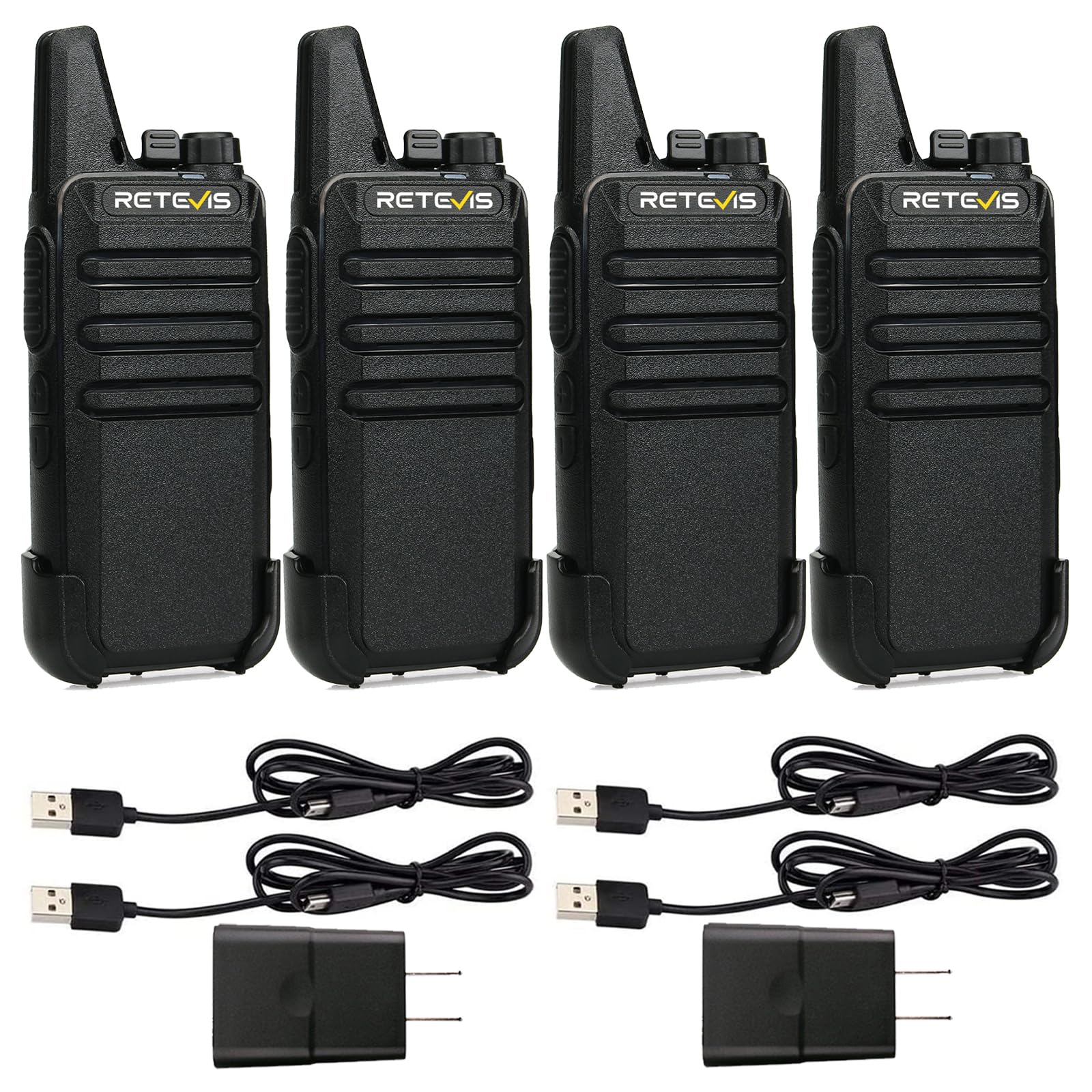
Retevis RT22 4-Pack
Key Features
- Real-world Range: 0.5-1 mile
- Battery Life: 10 hours
- Durability: Compact plastic
- Channels / Codes: 16 FRS channels
- Price: $
The Retevis RT22 delivers four radios with USB-C charging for under $60, making it the most cost-effective compact option for families who need short-range communication on cruise ships or easy trails. Unlike rugged backcountry units, this pack prioritizes affordability and portability over range and waterproofing.
Audio clarity is good enough for casual conversation in quiet settings, and the single-button channel scan makes it simple for all ages to use. The lightweight design fits easily in a pocket or small bag.
This set suits families coordinating at amusement parks, groups on cruise ships, or hikers on well-marked easy trails where group members stay within sight. The 0.5-1 mile range and lack of waterproofing mean it’s not suitable for backcountry adventures, job sites requiring durability, or emergency kits exposed to the elements.
Pros
- Four radios with chargers at a budget-friendly price point
- Compact and lightweight design for easy carrying
- Clear sound quality and straightforward operation
Cons
- In suburban settings with obstacles, range can drop below half a mile
- Battery life may require recharging during an all-day outing
For families on cruise ships or short hikes where group members stay close, the RT22 is a practical budget buy. Those needing reliable range for backcountry or job sites should look at purpose-built options like the Rocky Talkie.
Best for Large Groups
Midland GXT1000 3-Pack
Key Features
- Real-world Range: 1-3 miles
- Waterproof: IPX4
- Battery Life: 8 hours
- Channels / Codes: 50 GMRS, 142 codes
- Price: $$
The Midland GXT1000 3-Pack delivers a broad feature set that includes 50 GMRS channels, 142 privacy codes, built-in NOAA weather scanning, and an SOS siren — all at a price that works out to roughly $38 per radio. This makes it a practical choice for family reunions, large camping groups, or emergency car kits where having multiple units matters more than peak performance.
Real-world range is typically 1 to 3 miles in mixed terrain, not the advertised 36 miles. Battery life from the included NiMH pack averages around eight hours, though some users find it shorter depending on transmit frequency. These limitations are acceptable for day trips and close-quarters coordination, but not for backcountry hiking or scenarios where long-range communication is critical.
The radio feels solid in hand, channel programming is straightforward, and audio clarity holds up well at typical distances. Compared to the entry-level three-packs for under $40, the Midland adds weather alerts, more channels, and a splash-resistant shell — meaningful upgrades for anyone who wants basic outdoor readiness without jumping to premium-priced models.
Pros
- Broad channel set with 50 GMRS frequencies and 142 privacy codes for minimizing interference
- Three radios at a mid-range price, offering strong value for groups
- Clear sound and easy channel setup out of the box
- NOAA weather alerts and SOS feature add practical safety options
Cons
- Advertised 36-mile range does not reflect real-world performance; expectation is 1–3 miles in most conditions
- Battery life from the included NiMH pack can be shorter than eight hours, especially with frequent transmissions
- Unit-to-unit consistency varies; some radios show durability concerns within weeks of use
A solid multi-pack for short-range group coordination, provided you accept the gap between advertised and actual range.
Best for Job Sites
DEWALT DXFRS800 6-Pack
Key Features
- Real-world Range: Up to 1-2 miles open
- Waterproof: IP67
- Battery Life: 18 hours
- Durability: IP67, drop-rated
- Channels / Codes: 22 FRS, 121 codes
- Price: $$$$
IP67 waterproofing, drop-resistant construction, and a multi-unit gang charger distinguish the DEWALT DXFRS800 for team communication in demanding environments. The 2-watt radios deliver clear, loud audio even in noisy construction zones and maintain useful range through concrete and steel structures.
Real-world range in open areas reaches up to 1–2 miles, consistent with typical FRS performance, while building penetration is noticeably better than many consumer radios. The 18-hour battery life supports full shifts, though some units have shown charging inconsistencies.
This six-pack is built for construction crews, security teams, and event staff who need waterproof radios and a centralized charging station. At around $730, the value depends on that professional use case; occasional reports of fragile belt clips and antennas mean careful handling is advisable. Solo hikers or small groups will find it overpriced and overkill.
Pros
- Drop-rated chassis and IP67 sealing survive job site dust and full immersion.
- Clear, loud audio cuts through construction noise and maintains intelligibility at distance.
- Effective building penetration for communication across concrete and steel floors.
Cons
- Battery life can vary between units; some may have charging issues.
- Antennas and belt clips can be damaged under normal job site wear.
- Premium price of around $730 for six radios makes sense only for professional teams, not casual users.
A purpose-built job-site radio pack that earns its price for large teams needing IP67 protection and gang charging—leave it behind for casual outdoor trips.
Best for Family Camping
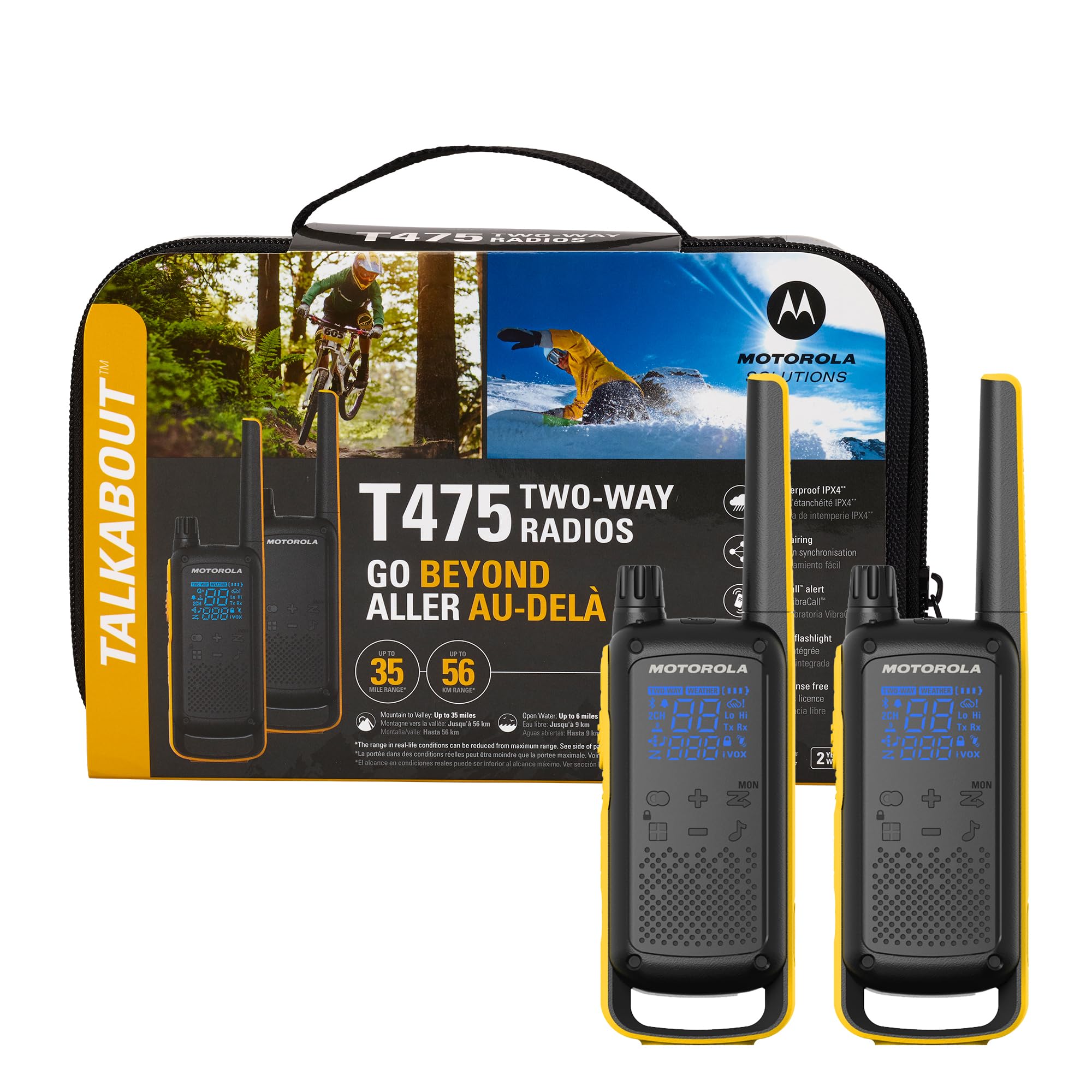
Motorola T475
Key Features
- Real-world Range: 1-3 miles
- Waterproof: IPX4
- Battery Life: 12 hours
- Channels / Codes: 22 FRS, 121 codes
- Price: $$
The Motorola T475 delivers the brand’s typically solid build, clear audio, and simple setup — ideal for family camping trips and emergency kits where communication stays within a mile. However, the advertised 35-mile range is unrealistic; expect 0.5–1 mile in tree cover, and battery life can be inconsistent, sometimes requiring extra cells or a backup. Some units may also have durability quirks. These limitations keep it behind the Rocky Talkie’s battery endurance and the Retevis RB48’s waterproofing, both at similar or lower prices. For short-range neighborhood use or a grab-and-go emergency pack, it works fine.
Pros
- High build quality feels durable in hand
- Audio clarity stays crisp even in noisy environments
- Simple setup and operation with no learning curve
Cons
- Battery life inconsistency may require frequent recharging or spare batteries for day-long outings
- Real-world range is typically 0.5–1 mile, far from the 35-mile claim, making it unsuitable for open-country communication
A decent option for short-range family camping and emergency kits, provided you manage expectations on range and keep spare batteries handy.
Best for Waterproof Budget
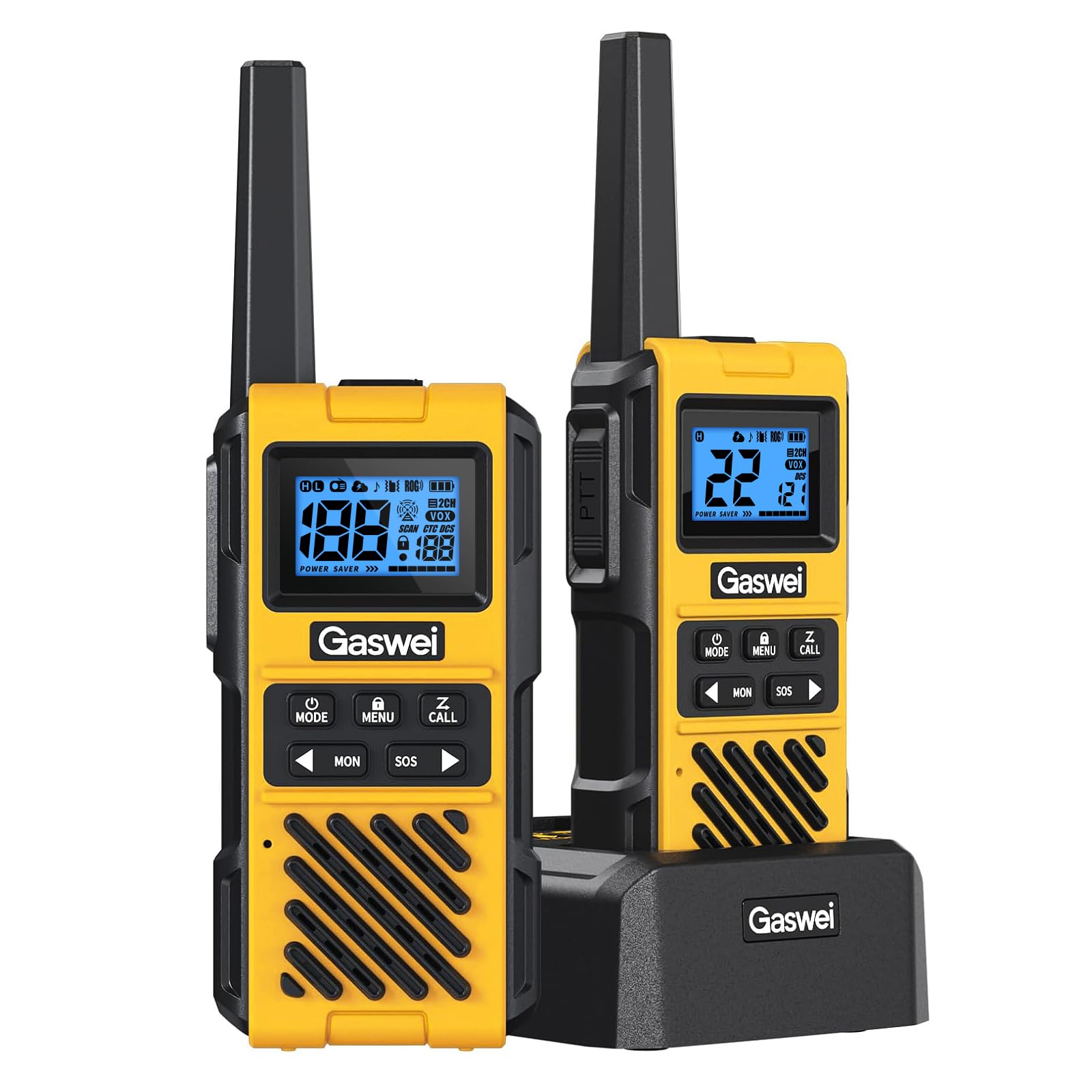
Gaswei G1pro+
Key Features
- Real-world Range: 1-3 miles
- Waterproof: IP67
- Battery Life: 24 hours
- Durability: IP67
- Channels / Codes: 22 FRS channels
- Price: $$
The Gaswei G1pro+ delivers genuine IP67 protection, a full day of battery life, and a USB-C port — features that place it alongside the Retevis RB48 at a similar cost. Early adopters report solid performance for short to medium distances and a durable build that holds up to wet conditions. However, the available user feedback is limited, making it a less certain purchase compared to models with extensive testing histories. If you are comfortable with a newer brand and want IP67 without paying a premium, this radio is worth considering.
Pros
- IP67 waterproof rating allows the radio to survive submersion and heavy rain.
- USB-C charging provides convenience with widely available cables.
- Clear audio for communication within typical outdoor distances of 1-3 miles.
Cons
This radio fits if you need IP67 on a mid-range budget and are willing to accept a shorter track record compared to the Retevis RB48.
Best for Family Outings
Retevis RT22 4-Pack
Key Features
- Real-world Range: 0.5-1 mile
- Battery Life: 10 hours
- Durability: Compact plastic
- Channels / Codes: 16 FRS channels
- Price: $
The Retevis RT22 stands out as an ultra-compact four-pack with USB-C charging at a price that undercuts most competitors — a practical option for casual, close-range use rather than the rugged backcountry focus of the top pick.
This set works well for families at amusement parks, on cruise ships, or along easy hiking trails where groups stay within half a mile. For backcountry adventures, emergency preparedness, or job sites demanding durable, long-range radios, the limited range and absence of waterproofing create a clear mismatch.
The radios deliver clear audio and simple operation straight from the box, and USB-C charging simplifies cable management. Battery life covers a typical day of intermittent use, though continuous all-day operation may require a midday recharge.
Pros
- Four radios with USB-C chargers at a budget-friendly price
- Compact and lightweight design fits easily in a pocket or small bag
- Clear audio and straightforward controls for users of all ages
Cons
- In suburban or wooded settings, range drops to under half a mile — fine for close groups but not for separated hikers
- Battery life can require a recharge during a full day of continuous use, though it handles short outings without issue
The RT22 is a smart buy for families who need multiple radios for close-range fun at a low cost. If your communication needs extend beyond half a mile or into wet conditions, consider the top pick or the waterproof RB48 instead.
How to Choose
The single most important insight: advertised range is almost always inflated; real-world performance depends on terrain, weather, and line-of-sight.
Real-world Range
Ignore the big numbers on the box. In forested or hilly terrain, even the best handheld radios typically deliver 1-3 miles. Open water or flat desert can stretch that to 5-10 miles, but don’t plan your trip around the maximum claim. Trees absorb signal, ridges block it, and weather (heavy rain, snow) reduces range further. When comparing radios, look for user-reported range in conditions similar to where you’ll use it.
Waterproof Rating
Waterproofing is measured by IP ratings: IPX4 handles light rain, IP67 means full immersion up to 1 meter for 30 minutes. If you hike near rivers, lakes, or in steady downpours, IP67 is worth the upgrade. A radio that survives a dunk can be the difference between a working com and a brick. For dry-weather camping, IPX4 is sufficient and saves weight.
A note on floating: only a few models (like the Retevis RB48 and Motorola T605_H2O) actually float. If you paddle or fish, that feature may save your radio from a quick trip to the bottom.
Battery Life
Battery life varies dramatically between models. NiMH batteries (common in Midland units) often deliver 8-12 hours but degrade over time. Lithium-ion packs (Rocky Talkie, Retevis RB48) can last 20 hours to multiple days. For multi-day backcountry trips, choose a radio with a removable battery or USB-C charging so you can top off from a power bank.
Cold weather saps battery capacity: expect a 20-50% reduction below freezing. If you hike in winter, a radio with field-replaceable AA batteries (like some Motorola models) gives you a fallback.
Durability and Drop Resistance
Drop resistance matters if you’ll be scrambling over rocks or working on a construction site. Look for MIL-STD-810 certification, reinforced antenna mounts, and shatterproof screens. Plastic clips and belt hooks are common failure points; metal-reinforced designs (Rocky Talkie) survive better. A radio that survives a 6-foot drop into gravel will serve you longer than one that cracks after a single fall.
Channels and Privacy Codes
More channels help you find a clear frequency in crowded areas (parks, events). Privacy codes (CTCSS/DCS) reduce chatter but don’t create private channels; they filter out other users on the same frequency. For hiking, 22 FRS channels are plenty. GMRS radios (like Midland’s 50-channel models) require an FCC license but offer more power and channels. If you’re using them for emergency preparedness, NOAA weather alerts are a useful bonus.
FAQ
Why is my walkie talkie range so much shorter than advertised?
Manufacturers test range under ideal line-of-sight conditions over flat water or unobstructed desert. Real-world obstacles like trees, hills, buildings, and weather cut range drastically. Expect 1-3 miles in typical hiking terrain regardless of what the box says. The best way to estimate usable range is to read user reviews for environments similar to yours.
Do I need a license to use FRS walkie talkies?
No license is required for FRS (Family Radio Service) radios, which include all models in this guide except the SAMCOM FPCN30A (which requires a Part 90 license). GMRS radios (like Midland’s 50-channel models) require a low-cost FCC license, but most casual users skip it. For hiking and emergency use, FRS is the simplest legal option.
How well do walkie talkie batteries last in freezing temperatures?
Cold temperatures reduce battery capacity by 20-50%, depending on chemistry. Lithium-ion batteries hold up better than NiMH in the cold. To preserve battery life in winter, keep the radio close to your body (inside a jacket) and switch it off when not in use. Some models accept AA batteries as a backup, which you can warm in a pocket before inserting.
What is the best walkie talkie for hiking in the mountains?
For serious mountain hiking, the Rocky Talkie Mountain Radio is the clear choice. It delivers a genuine 4-day battery life, a shatterproof screen, a climbing-rated carabiner, and a simple interface that works without menus. It trades inflated range claims for durability and reliability where it counts.
Can I use a walkie talkie for emergency communication in the backcountry?
Yes, but with limitations. In many remote areas, walkie talkies only reach a few miles; they are not a substitute for a satellite messenger or PLB. For emergencies, choose a radio with NOAA weather alerts (like the Midland GXT1000 or Retevis RB48) and keep batteries fresh. Always carry a backup communication device for serious backcountry travel.