This post contains affiliate links. We may earn a small commission when you buy through our links — at no extra cost to you.
Most insoles sold as ‘work’ or ‘sport’ models end up in hiking boots. That’s fine for well-groomed paths, but the moment you hit uneven terrain or carry a pack, the gaps show: weak heel cups let your foot slide on descents, foam flattens under repeated impact, and moisture-wicking is an afterthought.
The real divide isn’t between budget and premium — it’s between insoles built for flat, predictable surfaces and those that handle the lateral forces and prolonged pressure of a trail. A plush gel insole might feel great on pavement, but after three miles of rocky switchbacks, you’ll notice the difference in foot fatigue and stability.
This guide cuts through the marketing by focusing on what actually matters under boot soles: arch height alignment, heel cup depth, material density, and how long the support lasts before it compresses. Whether you have high arches, flat feet, or just want to spend less on replacements, the right insole is out there — but it’s not always the most expensive one.



Best for Arch Pain Day Hikes
PowerStep Pinnacle
Key Features
- Arch Support: Moderate pronation control
- Cushioning: Dual-layer foam + gel
- Fit Method: Size-specific, no trim
- Intended Use: Hiking, sport
- Price: $$
The PowerStep Pinnacle delivers the rare combination of strong arch support and dual-layer cushioning that feels comfortable immediately — no break-in period required. This insoles design targets moderate pronation and common arch pain, which aligns with what most day hikers and backpackers encounter on uneven terrain. The moderate arch control provides stability without forcing feet into an extreme position, making it a versatile fit for many boot styles.
For hikers dealing with plantar fasciitis or general foot fatigue, this is the straightforward choice. It works well across a range of foot types but is not ideal for those with very high arches, who may find the support too low, or for anyone wanting ultra-soft cushioning. A small number of units can show top-layer peeling or foam compression after months of heavy use — something to check periodically if you log many trail miles.
Pros
- Out-of-box comfort with immediate pain relief for plantar fasciitis.
- Highly effective at reducing arch and heel pain during long hikes.
- Podiatrist-recommended arch support with moderate pronation control.
Cons
- Top layer may peel or foam can compress prematurely after extended use.
If you need immediate comfort and solid arch support for hiking boots, the Pinnacle delivers — just keep an eye on its long-term durability.
Best for High Arches
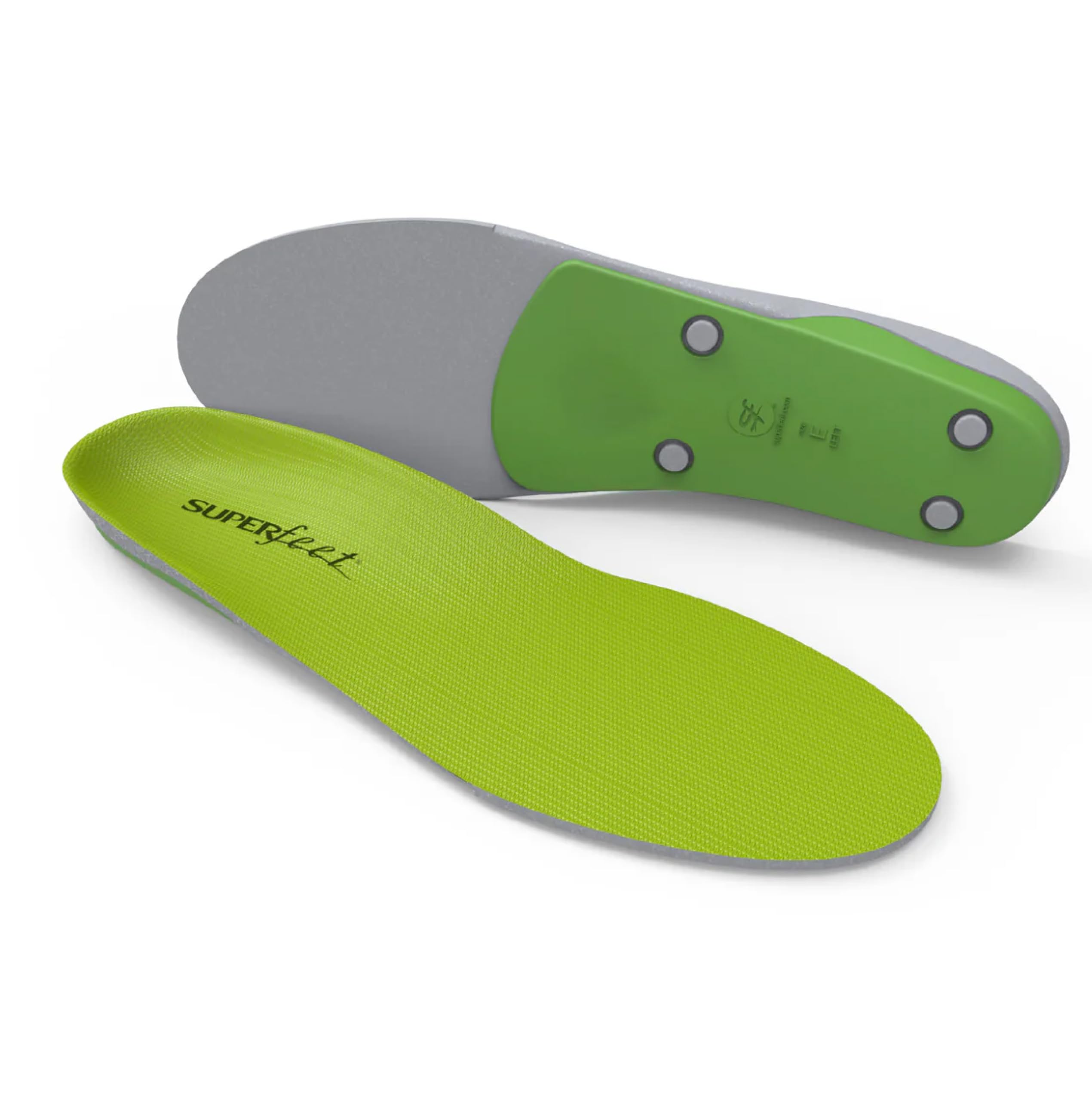
Superfeet Green High Arch
Key Features
- Arch Support: High arch, deep heel cup
- Cushioning: Dense closed-cell foam
- Fit Method: Trim-to-fit
- Intended Use: Hiking, backpacking
- Price: $$$
The Superfeet Green’s deep heel cup and dense foam hold their shape over a year of rugged trail use, making it a premium choice for backpackers with high arches. Unlike the top pick’s immediate comfort, this insole requires a gradual break-in but delivers longer-lasting support. The high-density closed-cell foam and moisture-wicking cover manage sweat during long hikes. The insole is noticeably stiff during the first week, and the narrow fit can be an issue for wide feet — a trade-off that favors those willing to endure break-in for long-term durability. It is not suitable for flat feet or those seeking soft cushioning.
Pros
- Firm arch support prevents supination on uneven trails.
- Dense foam and deep heel cup resist compression through multiple hiking seasons.
- Relieves heel and arch pain associated with high arches and plantar fasciitis.
Cons
- The rigid construction can feel uncomfortable during the first week of wear.
- The insole’s shape may be too narrow for hikers with wide feet.
Buy this if you have high arches and want a durable insole that outlasts softer options; expect a firm break-in and a narrower fit.
Best for Big & Tall Hikers
Dr. Scholl’s Heavy Duty Big & Tall
Key Features
- Arch Support: Neutral arch, extra width
- Cushioning: Massaging gel
- Fit Method: Trim-to-fit
- Intended Use: Work, light hiking
- Price: $
Specifically designed for users over 200 lbs with wide feet, these insoles deliver robust shock absorption and arch support that relieve foot and back pain on uneven trails. The trim-to-fit shell accommodates most work and hiking boots without crowding. Durability is a tradeoff — the foam can lose its shape after several months of heavy use, making this a budget-friendly option that prioritizes immediate comfort over longevity.
Best for heavy hikers with wide feet who need immediate support and don’t mind replacing insoles every six to nine months. Those with narrow feet or a preference for plush cushioning should look elsewhere — the support is firm and the fit is roomy.
Pros
- Superior comfort for heavy users
- Relieves foot and back pain effectively
- Good arch support for wider feet
Cons
- Support foam can flatten after a few months under continuous heavy load, requiring replacement sooner than premium options.
For heavy hikers with wide feet on a budget, these provide solid immediate support — just plan to swap them out annually.
Best for Plantar Fasciitis
CRUVHEAL Heavy Duty
Key Features
- Arch Support: High arch 1.4 inch
- Cushioning: Firm gel pads
- Fit Method: Size-specific, no trim
- Intended Use: Hiking, work
- Price: $$
The CRUVHEAL Heavy Duty stands apart from the Superfeet Green by targeting heavy users with a firm 1.4-inch arch and shock-absorbing gel pads that don’t flatten under 220+ lbs. It delivers reliable plantar fasciitis relief for hikers who need rigid support on uneven terrain, but the lack of plush cushioning means those accustomed to soft insoles may find it too firm – a tradeoff that suits heavier builds and high arches better than average.
Pros
- Comfort holds up under heavy loads – no collapse on long hikes.
- High arch support reduces tension from plantar fasciitis during steep climbs.
- Contoured arch and gel pads provide stable footing on rocky trails.
Cons
- Firm cushioning may feel harsh for those used to plush insoles, especially on long descents.
Best for heavy hikers with high arches who prioritize support over cushion and don’t mind a firm ride.
Best for Keen Boot Users
KEEN Utility K20
Key Features
- Arch Support: Low to medium
- Cushioning: Full-length K20 foam
- Fit Method: Anatomically contoured
- Intended Use: Work, hiking
- Price: $$
For hikers who own KEEN boots, the K20 cushion delivers plush comfort that feels like a tailored fit. Its full-length pad reduces fatigue on long trails, and the contoured shape stays put inside the boot without shifting. This works best as a drop-in upgrade for low-to-medium arches — the thickness may limit use in low-volume boots, and the arch support is moderate, so those needing firm high-arch support will find the slimmer option in this set a better match.
Pros
- Plush cushioning reduces fatigue on long hikes
- Anatomically contoured shape matches KEEN boots for a secure fit
- Durable construction holds up to rugged trail use
Cons
- Thick profile can make low-volume boots feel snug
- Moderate arch support won’t satisfy hikers with high arches
Best for KEEN boot owners who want plush cushioning and don’t need firm arch support.
Best for Budget Day Hikes
Copper Fit Work Gear
Key Features
- Arch Support: Minimal
- Cushioning: Copper-infused foam
- Fit Method: Trim-to-fit
- Intended Use: Work, casual
- Price: $
Under $11, the Copper Fit Work Gear delivers soft cushioning comparable to insoles costing several times more. The thick copper-infused foam absorbs shock well on maintained trails, but it can make low-volume boots feel cramped — check your boot’s interior space before committing.
This insole suits hikers who want maximum comfort for day hikes without spending much, provided their boots have ample extra room. It’s also a sensible trial pair before upgrading to supportive orthotics. Those with narrow feet or boots that fit snugly should look elsewhere.
Pros
- Plush cushioning at a price that fits any budget
- Lasts longer than expected given the low cost
- Outstanding value for comfort-focused buyers
Cons
- Thick foam can reduce volume in already snug boots
- Trim-to-fit shape may still be too wide for narrower shoes
Worth a try if your hiking boots have room to spare and you want a cheap comfort boost — just don’t expect arch support for uneven terrain.
Best for Tight Boots
PowerStep Original

Key Features
- Arch Support: Neutral arch firm
- Cushioning: Firm dual-layer
- Fit Method: Size-specific, no trim
- Intended Use: Hiking, tight boots
- Price: $$
PowerStep Original delivers a low-profile fit for tight hiking boots, offering firm neutral arch support that helps with mild pronation. The orthotic stays secure without adding bulk, a boon for boots with limited interior volume. Its stiffness, however, can feel uncomfortable initially, making it a better fit for those who prioritize support over cushioning.
Pros
- Low-profile design fits comfortably in tight hiking boots without crowding toes.
- Contoured neutral arch support helps manage mild pronation on uneven terrain.
Cons
- Firmness may cause initial arch discomfort during break-in, especially for those accustomed to softer insoles.
Ideal for hikers with neutral arches in tight boots who want firm support and are willing to trade plush cushioning for a secure, low-profile fit.
Best for All-Day Standing
Spenco Polysorb Heavy Duty

Key Features
- Arch Support: Metatarsal support
- Cushioning: Polysorb + heel pad
- Fit Method: Sized, minimal trim
- Intended Use: Standing, walking
- Price: $$
This insole delivers reliable cushioning for long hours on concrete floors or casual walks, using Polysorb foam and a SpenCore heel pad to absorb shock. Build quality is consistent, and the metatarsal support helps reduce forefoot pressure. However, the arch support is less pronounced than orthotic-focused options, and sizing can be off — some find the insoles too big or narrow. Durability is mixed; the foam may compress sooner under heavy use. Best for light day hikes or standing work, not for backpacking or uneven trails where pronounced arch support matters.
Pros
- Comfortable cushioning for all-day standing and walking on firm surfaces.
- Solid build quality with consistent materials and stitching.
Cons
- Fit can be inconsistent — some users find them too large or too narrow for their boots.
A good option for flat-terrain day hikes or work boots where cushioning matters more than arch support, but not the pick for technical trails.
Best for Timberland Boots
Timberland PRO Anti-Fatigue

Key Features
- Arch Support: Minimal
- Cushioning: Anti-fatigue foam
- Fit Method: Trim-to-fit
- Intended Use: Work, flat terrain
- Price: $$
The Timberland PRO Anti-Fatigue Insole delivers comfortable cushioning that reduces leg fatigue on flat surfaces, with solid construction that holds up to daily use. But arch support is minimal, making it a poor fit for uneven hiking trails. Sizing can also be off – some find the insole too large even after trimming.
Pros
- Cushioning that reduces fatigue during long periods on hard floors
- Sturdy build that withstands daily wear
Cons
- For hiking on uneven terrain, the minimal arch support may not provide enough stability
Suitable as a budget-friendly replacement for Timberland factory insoles for work or flat-ground walking, but not for serious hiking.
Best for Easy Trails
Dr. Scholl’s Walk Longer

Key Features
- Arch Support: Minimal
- Cushioning: Plush foam
- Fit Method: Trim-to-fit
- Intended Use: Casual walking
- Price: $
Plush foam cushioning helps reduce muscle fatigue during casual walks and hikes on flat, easy terrain. The trim-to-fit design adapts to most boots. However, the arch support is mild — insufficient for uneven trails, heavy packs, or those with plantar fasciitis. This pair works best for light day hikes on paved paths, not for rugged backpacking.
Pros
- Plush cushioning reduces fatigue on flat hikes and daily walks
- Trim-to-fit design suits most hiking boots
Cons
- Mild arch support may not be enough for uneven terrain or plantar fasciitis
Best for casual day hikers on flat paved trails who prioritize cushion over arch support.
How to Choose
The best hiking insole balances arch height, cushion density, and fit volume — and none of those can be judged from a product page alone.
Arch Support Type and Height
Arch height determines where pressure concentrates underfoot. Low arches need a flat or slightly contoured base to avoid overstretching the plantar fascia; high arches require a pronounced dome to fill the gap and prevent collapse onto the arch itself.
Neutral arches work with moderate support. The trade-off: aggressive arch support for high arches often feels like a rock under your foot initially, while flat-friendly insoles may lack stability for supinators. Try to match your arch shape closely — insoles that are ‘one size fits all’ usually fit none perfectly.
Cushioning Density and Material
Foam density dictates how much impact energy returns and how fast it degrades. Open-cell foams (like many gel-infused models) feel plush but compress under 150+ lbs loads, turning into a thin pancake after 200 miles. Closed-cell foams (Superfeet, PowerStep) resist compression better but take longer to break in.
Gel inserts add shock absorption at the heel but can make the insole thick, stealing toe room in boots with low volume. Dual-layer constructions (firm base + soft top) offer a middle ground: the bottom layer provides structure, while the top layer delivers initial comfort.
Fit Method and Thickness
Trim-to-fit insoles give flexibility for odd boot shapes but often have inaccurate cut lines, leading to bunching or slipping. Size-specific insoles (PowerStep, CRUVHEAL) eliminate guesswork but limit sizing to a single boot length.
Thickness matters more than most buyers realize: an insole that is 5mm thick in the forefoot can push your toes against the boot cap, causing numbness on descents. Measure the space under your existing insole (by removing it) before adding a thicker one. A deep heel cup also keeps your foot from sliding forward on steep downhills.
Intended Activity
A ‘work’ insole designed for concrete floors lacks the lateral support needed for uneven trails. Heel stability — a rigid plastic or deep cup that wraps the calcaneus — reduces ankle rolling on rocks. Moisture-wicking top cloth prevents blisters during long days, yet most budget insoles skip this entirely.
For backpacking with a 30+ lb pack, look for insoles with a rigid heel stabilizer (often a plastic shell under the foam). Day hikers on maintained trails can get away with softer, cheaper options that prioritize comfort over structure.
FAQ
Why do my new insoles squeak when I walk?
Squeaking usually comes from friction between the insole bottom and the boot’s footbed. Sprinkle a thin layer of baby powder or cornstarch under the insole to reduce friction. If the squeak persists, the insole might be slightly oversized — trim a millimeter off the edge where it rubs the side of the boot.
How long do PowerStep insoles last for hiking?
Most users get 6 to 12 months of regular hiking before the foam compresses noticeably or the top layer peels. Heavy load (over 200 lbs) or daily use shortens that to 4-6 months. The shell stays supportive longer, but the cushioning fades — replace them when you start feeling the boot’s sole through the insole.
Are Superfeet insoles too stiff for hiking boots?
Superfeet Green is firm by design, but that stiffness translates to long-term support for high arches. The first few hikes may feel uncomfortable — a 5-10 mile break-in period is normal. If you have low or neutral arches, choose a softer model like Superfeet Blue or PowerStep instead. They are not too stiff for hiking, but they do require patience.
Should I buy trim-to-fit insoles or size-specific ones for hiking?
Size-specific insoles (like PowerStep Pinnacle) provide a precise fit without loose edges that cause slipping, which matters on descents. Trim-to-fit insoles (Superfeet, Dr. Scholl’s) are more forgiving for boot brands with unusual shapes, but you must cut carefully — a trim line that is too small can create pressure points. If your boot has a removable insole, try size-specific first; if it fits, that is the easier choice.