This post contains affiliate links. We may earn a small commission when you buy through our links — at no extra cost to you.
Many inflatable kayaks promise lake-ready fun but deliver a short lifespan once seams see regular use. The real challenge isn’t finding a low price — it’s knowing where that lower price stops working.
This guide cuts through the glossy marketing and focuses on the trade-offs that matter after you’ve paddled a few times: how materials, seat design, and inflation ease actually hold up on calm water. Whether you’re a weekend paddler or a first-time buyer, the right choice depends on matching your expected use to the construction quality that supports it.


Best for Budget Beginners
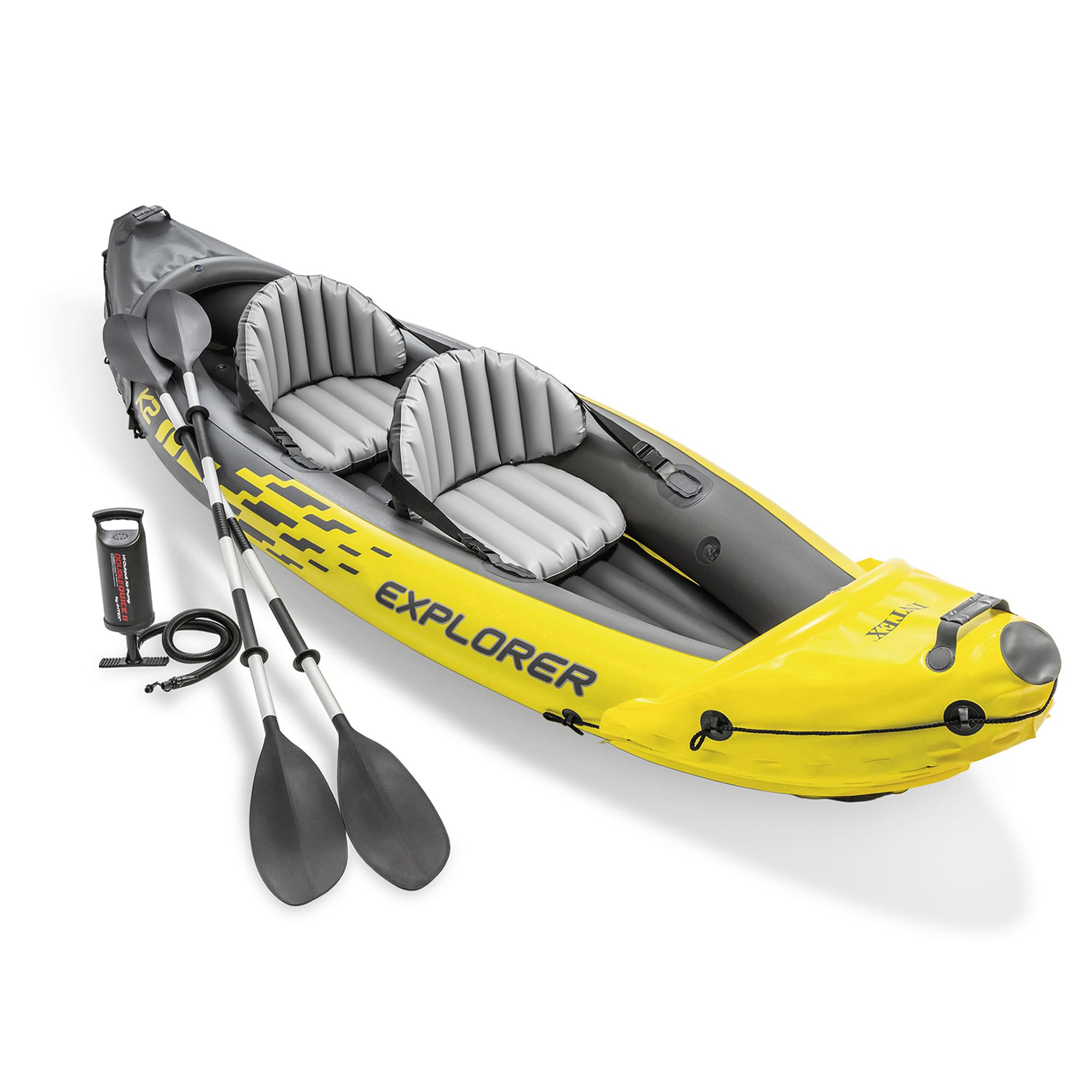
Intex Explorer K2
Key Features
- Material: Vinyl (SuperStrong PVC)
- Capacity & Seating: 2-person, 400 lbs
- Inflation & Pump: Pump included
- Portability: 30.6 lbs
- Build Durability: Seam separation reports
- Price: Budget
The Intex Explorer K2 inflates in minutes using the included dual-action pump, and at just over 30 pounds, one person can carry it to the water. Once inflated, the 10-foot hull fits two adults comfortably, and the three-chamber design provides adequate flotation for calm lakes and slow-moving rivers. When the trip is over, it deflates quickly and packs into a bag roughly the size of a large duffel — small enough for apartment storage or a car trunk.
On flat water, the Explorer K2 tracks reasonably well for a non-drop-stitch inflatable, though the seats can slide forward during sustained paddling. A simple bungee cord tied between the seat strap and a D-ring keeps it in place. The pump works efficiently, and the Boston valves hold pressure without noticeable air loss over a half-day outing. The included oars are basic but functional for leisurely paddling.
This kayak is best for first-timers and families who paddle a few times per season on gentle water. The vinyl material and seam construction are the primary tradeoffs — they can be vulnerable to punctures from submerged rocks or sharp objects, and seam durability can vary between units. Gentle handling, such as avoiding dragging the hull ashore and storing out of direct sunlight, extends its useful life to several seasons.
The included accessories — aluminum-shaft oars and a dual-action pump — are complete and ready for a first outing with no hidden costs. The pump offers both inflate and deflate modes, speeding up take-down. For the price, the package delivers everything needed to get on the water without additional purchases.
Pros
- Inflates and deflates quickly with the included pump.
- Packs into a compact carry bag for easy storage and transport.
- Budget-friendly price makes it accessible for first-time kayakers.
- Light enough at 30 lbs for one person to carry to the water.
Cons
- Seat straps can loosen during paddling, causing the seat to slide forward.
- Seams may develop leaks after repeated use on abrasive surfaces or with rough handling.
For casual lake paddlers on a budget, the Explorer K2 delivers easy setup and portability — just avoid rocky launches and harsh storage conditions.
Best for Anglers
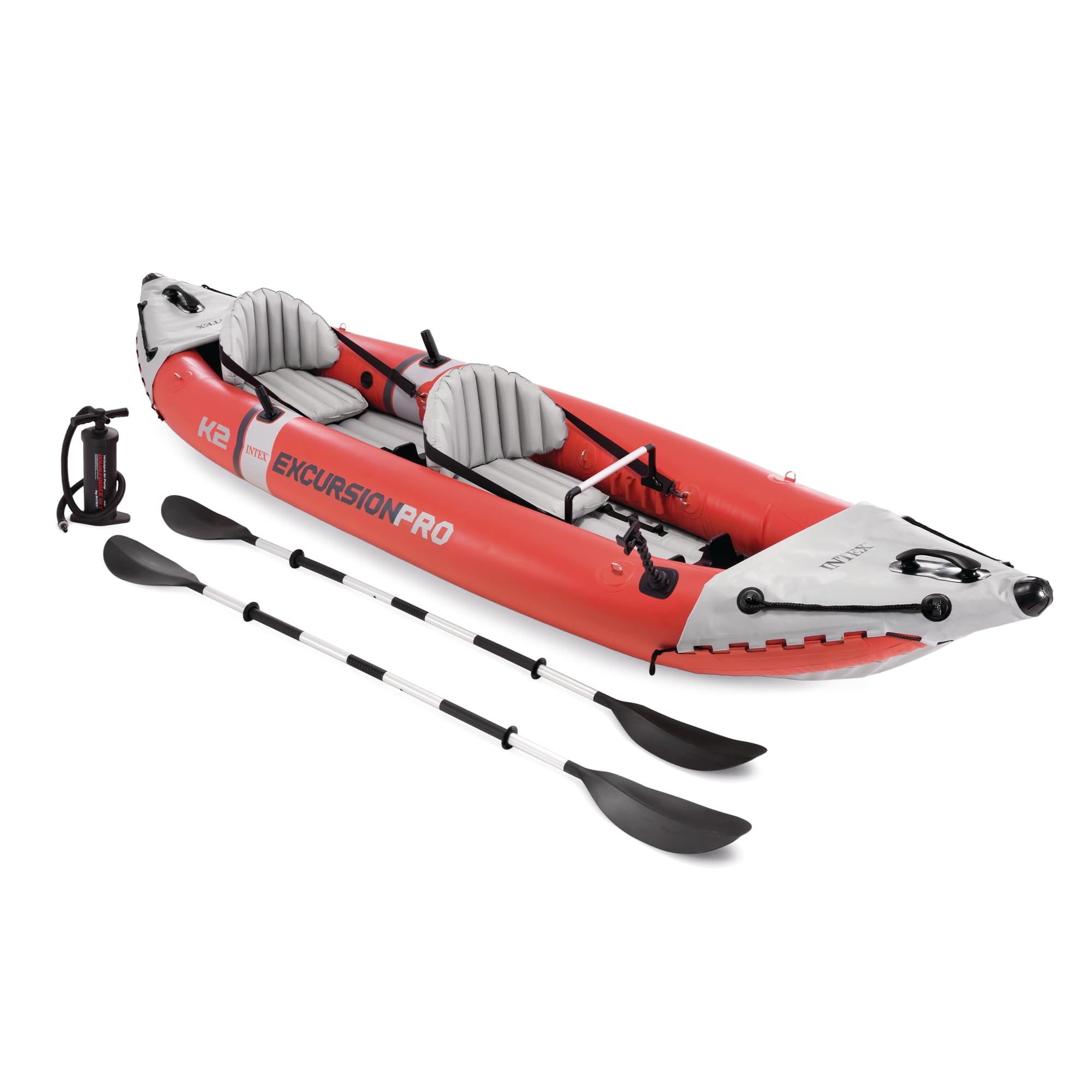
Intex Excursion Pro K2
Key Features
- Material: 3-ply laminate PVC
- Capacity & Seating: 2-person, 400 lbs
- Inflation & Pump: Pump included
- Portability: 44.7 lbs
- Build Durability: Seam leaks after use
- Price: Mid-Range
The Excursion Pro K2 sets itself apart from the basic Explorer K2 with built-in fishing rod holders and a GoPro mount, plus a 3-ply laminate PVC hull that keeps the kayak stable with two adults aboard. That said, seam durability mirrors cheaper models — occasional leaks can still occur around the skeg area, so this isn’t a step up in lifespan despite the higher price.
This kayak suits anglers who want ready-to-fish gear without buying aftermarket add-ons, and couples looking for a stable tandem for day trips on lakes or mild rivers. The seats may lose padding over time, and seam leaks can appear after several uses, so it’s best for recreational outings rather than heavy, frequent use.
Pros
- Three-ply PVC hull handles two adults well on calm water.
- Inflates and assembles quickly with the included pump.
- Comes with rod holders, GoPro mount, and carry bag at a mid-range price.
Cons
- Seam leaks can develop after repeated use, particularly around the skeg area.
- Seat padding and material may compress over time, reducing comfort on longer trips.
For anglers who want rod holders and a GoPro mount without aftermarket tinkering, the Excursion Pro K2 delivers those features at a fair price — just keep realistic expectations about long-term seam durability.
Best for Small Groups
Sea Eagle 370 Pro
Key Features
- Material: Heavy-duty synthetic
- Capacity & Seating: 3-person, 650 lbs
- Inflation & Pump: Pump included
- Portability: 33 lbs
- Build Durability: Quality material construction
- Price: Mid-Range
The Sea Eagle 370 Pro delivers a roomy 12.5-foot deck with a 650-pound capacity, giving small groups or families real space for gear and passengers. The synthetic fabric feels denser and more durable than the typical PVC found on entry-level inflatables, and the included pump gets the hull ready in under ten minutes without much effort.
Portability is a standout feature for a three-person boat — the whole package packs into a bag small enough to toss in a car trunk, and at 33 pounds it won’t strain one person to carry. This makes it a practical choice for car-campers or anyone with limited storage who still wants a kayak that can handle longer trips on lakes and calm rivers.
The tradeoff shows up on breezy days or when weight isn’t balanced evenly: the wide, high-volume shape can feel wobbly, and the seats may shift during use, requiring a quick adjustment. This isn’t a hazard on flat water, but it does mean paddlers need to stay mindful of their setup. Ideal for recreational outings with two or three people who value build quality and easy transport over rock-solid stability.
Pros
- Build quality and fabric feel are above what most inflatables offer at this price
- Inflation is quick and the included pump works well
- Packs down small enough for easy storage and transport given the three-person size
- Generous 650-pound capacity fits two adults plus gear or three smaller paddlers
Cons
- In windy conditions or with uneven weight distribution the kayak can feel less stable
- Seats may slide around during use and need periodic readjustment
If you want a family-friendly inflatable that feels better made than the cheapest options and don’t mind a bit of wobble in wind, the Sea Eagle 370 Pro is a solid mid-range choice for lake and river recreation.
Best for Solo Paddlers
OCEANBROAD Sit-In 1P
Key Features
- Material: Vinyl with drop-stitch floor
- Capacity & Seating: 1-person, 308 lbs
- Inflation & Pump: Pump included
- Portability: 38 lbs
- Build Durability: Drop-stitch floor rigidity
- Price: Mid-Range
The drop-stitch floor sets this kayak apart from typical inflatables. Instead of the soft, flexing bottom that slows you down and drifts in wind, this one stays flat and firm. Paddlers report noticeably better straight-line tracking and stability, especially on calm lakes and slow rivers where every paddle stroke counts. The floor rigidity also makes standing up to stretch or re-enter from the water more feasible than with standard air-floor designs.
Inflation and deflation are straightforward — the included pump and valve system work well for most users. The padded seat provides good lower-back support during longer paddles, and the overall setup takes under ten minutes. These conveniences make it a practical option for solo day trips where you want to spend time on the water, not wrestling with gear.
This kayak suits the solo paddler who values rigidity and tracking over budget savings. The relatively small pool of user feedback and occasional reports of pump thread or zipper issues mean it’s best for someone comfortable with a bit of uncertainty around long-term durability. If a proven, high-volume option like the Intex Explorer K2 is the safe bet, this is the more targeted choice for those who want a stiffer floor in a one-person package.
Pros
- Drop-stitch floor provides near-rigid tracking and stability for solo paddling.
- Quick inflation and deflation with included pump; seat is comfortable for extended use.
- Padded back support helps maintain posture on longer trips.
Cons
- Some units have valve threads or zipper issues that can complicate setup or storage.
- Mid-range cost for a solo kayak undercuts the value proposition compared to two-person alternatives.
If a stiff, tracking-focused solo inflatable matters more than brand track record or getting a two-seater for similar money, this kayak delivers on that promise.
Best for Tight Budgets
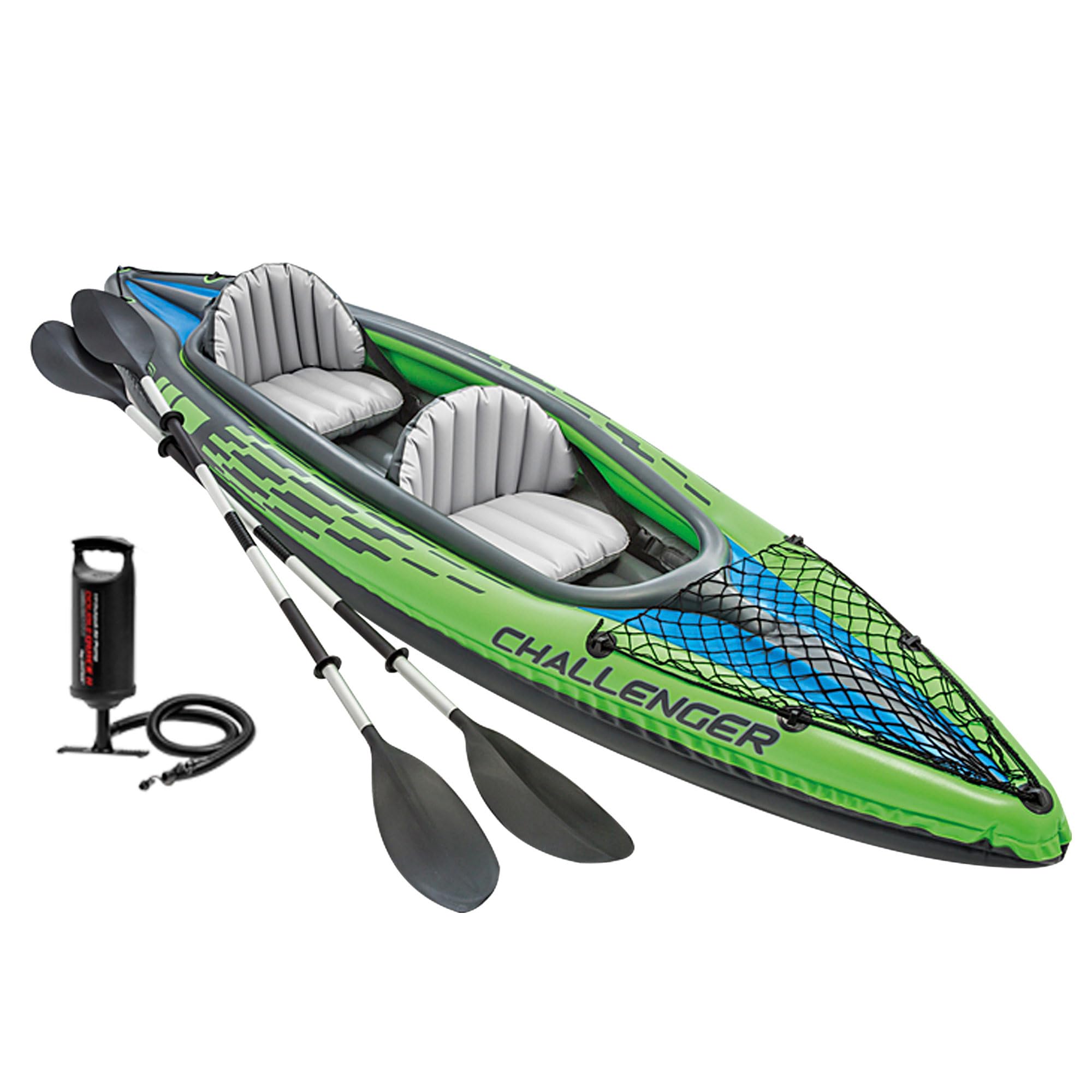
Intex Challenger K2
Key Features
- Material: PVC (SuperStrong)
- Capacity & Seating: 2-person, 400 lbs
- Inflation & Pump: Pump included
- Portability: 32.7 lbs
- Build Durability: Frequent leak reports
- Price: Budget
The Intex Challenger K2 sets itself apart by being the lowest-priced tandem inflatable kayak on the market, while still packing quick inflation and portability that make it a breeze to set up at a calm lake. It packs down to a size that fits in the trunk of a small car and weighs only 32 pounds, so getting it to the water is easy. This is the budget option for anyone who wants to try tandem kayaking without a big upfront investment.
Where this kayak shines is occasional use on flat, sheltered water — think a weekend trip on a pond or slow-moving river. The removable skeg helps it track reasonably well in still conditions, and the 400-pound capacity can handle two average-sized adults or a parent with a small child. But legroom is tight for anyone over about 5-foot-10, and the PVC material, while light, can be more vulnerable to punctures than higher-priced alternatives. Some units have arrived with small holes or developed seam splits after a handful of outings, so expect a limited lifespan if you plan to use it more than a few times a season.
On the water, the Challenger K2 feels stable in calm conditions but gets skittish in wind or light chop — it has a noticeable tendency to wobble when a gust hits. The three-chamber design adds a layer of safety, but the tradeoff is a softer hull that doesn’t track as firmly as a drop-stitch floor. For the target buyer — first-time kayakers sticking to protected waters — these limitations are manageable, not dealbreakers.
Pros
- Inflates and deflates in a few minutes with the included pump — no hassle at the launch site.
- Light enough (32.7 lbs) and packs small for easy transport and storage.
- Hard to find another two-person kayak at this low price point.
- Three separate air chambers keep the boat afloat even if one section is compromised.
Cons
- Limited legroom makes it uncomfortable for taller paddlers over roughly 5’10".
- In windy or choppy conditions the hull feels tippy — best kept for flat, sheltered water.
- Seam splits and small punctures can appear after a few trips; some units arrive with pre-existing holes.
A true entry-level tandem kayak for the occasional calm-water outing — but if you plan to paddle more than a handful of times a year, consider spending a bit more for the top pick’s slightly better track record.
Best for Calm Lakes
Intex Dakota K2

Key Features
- Material: Vinyl
- Capacity & Seating: 2-person, 400 lbs
- Inflation & Pump: Pump included
- Build Durability: High leak complaint rate
- Price: Budget
The Dakota K2 improves straight-line performance with dual skegs, making it a touch more stable on open water than the standard Explorer K2. Setup takes about ten minutes, and the deflated bundle stores easily. However, the same thin vinyl that keeps the weight down can develop seam leaks after a few trips. Tall paddlers will find the footwell cramped, and rocky shorelines are best avoided entirely. This kayak suits shorter excursions on calm lakes where the occasional puncture risk is acceptable.
Pros
- Dual skegs improve directional stability on flat water.
- Inflates and deflates in roughly ten minutes.
- Compact storage when packed down.
Cons
- Seam integrity can be an issue – leakage at joints has been noted after limited use.
- Legroom is tight for anyone over about 5’10’ – tall paddlers may feel cramped.
A reasonable budget pick for smaller paddlers who prioritize tracking over long-term durability.
Best for Whitewater
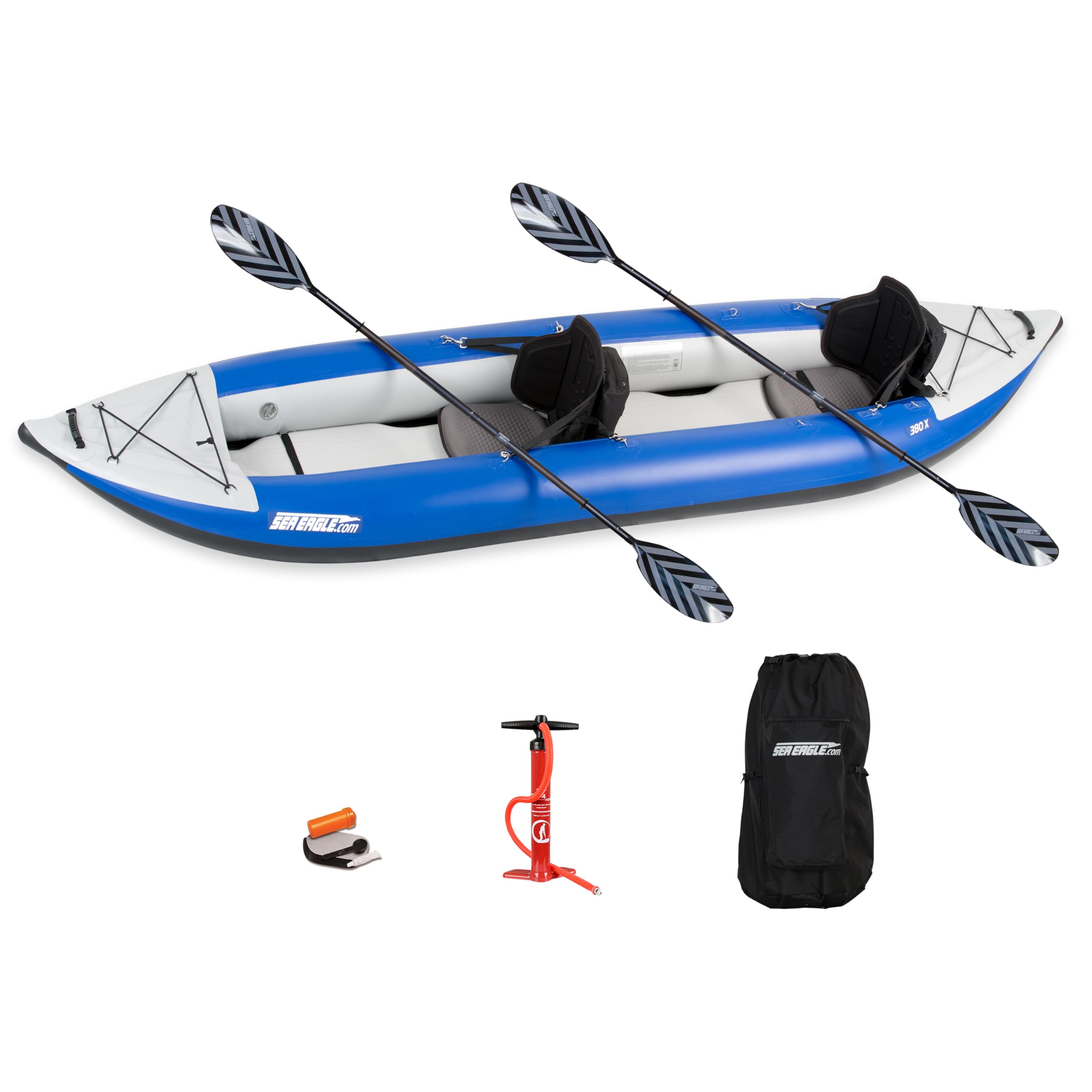
Sea Eagle 380x Pro
Key Features
- Material: 1000 Denier reinforced PVC
- Capacity & Seating: 2-3 person, 750 lbs
- Inflation & Pump: Pump included
- Portability: 40 lbs
- Build Durability: Heavy-duty whitewater build
- Price: Premium
With a drop-stitch floor that delivers hardshell-like rigidity and a 750-pound capacity, the Sea Eagle 380x Pro is a heavy-duty inflatable designed for serious whitewater. Its tough 1000-denier PVC construction and wide beam provide a stable, predictable ride even in class IV rapids. For recreational lake use, however, this kayak is overbuilt and premium-priced, with limited user feedback available to gauge long-term performance. The investment makes sense only if you plan to tackle demanding rivers — casual flatwater outings are better served by more affordable alternatives.
Pros
- Drop-stitch floor provides rigidity close to a hardshell kayak
- High weight capacity (750 lbs) supports two paddlers and expedition gear
Cons
- Premium price is difficult to justify for occasional lake trips
- The PVC material can be punctured by sharp rocks, though incidents are rare
This kayak fits paddlers who intend to tackle class III-IV rapids and need a single inflatable that can also handle calm water — for exclusive lake recreation, the price and overbuilt design are mismatched.
Best for Solo Touring
Adv. Elements Exped. Elite

Key Features
- Material: PVC Tarpaulin, aluminum rib
- Capacity & Seating: 1-person, 450 lbs
- Inflation & Pump: Pump included
- Portability: 47 lbs
- Build Durability: Valve durability issues
- Price: Premium
The AdvancedFrame Expedition Elite uses an aluminum rib frame to create a stiff hull that tracks straight across flatwater, a rare quality in an inflatable. Tall paddlers benefit from ample legroom uncommon in solo kayaks. However, the 47-pound weight makes it a workout to carry and inflate, and some owners have encountered air valve failures that leave the kayak unusable. This is a niche pick for those who prioritize performance and have a vehicle to transport it.
Pros
- Ample legroom accommodates tall paddlers comfortably.
- Aluminum rib frame provides excellent tracking on flatwater.
- High-flow valves allow quick inflation with less effort.
Cons
- Air valve may fail after limited use, potentially leaving the kayak unusable.
- At 47 pounds, it is heavier than many tandem inflatables, adding setup effort.
Best suited for tall solo paddlers on calm lakes who want near-hardshell stiffness and can accept the extra weight and occasional valve attention.
Best for Couples
Pelican iESCAPE

Key Features
- Material: Polyester, PVC Tarpaulin
- Capacity & Seating: 1-2 person, 400 lbs
- Inflation & Pump: Pump included
- Portability: 35.9 lbs
- Build Durability: Mixed build quality
- Price: Mid-Range
The Pelican iESCAPE includes a pressure relief valve that prevents over-inflation, a thoughtful safety addition for inflatable kayaks. However, the inflatable seats lack back support and can buckle when leaning back, and stability is reduced when paddling solo. This makes the kayak better suited for tandem use on calm lakes than for solo trips or choppy water. Those considering it should note that more budget-friendly Intex options have garnered stronger overall feedback, but the Pelican’s portability and safety feature still appeal to couples wanting a lightweight recreational tandem.
Pros
- Easy to inflate and deflate, cutting setup time.
- Very portable for a tandem kayak – fits in a car trunk.
- Pressure relief valve prevents over-inflation damage.
Cons
- Seats lack back support – pontoons can buckle when leaning back.
- Stability is reduced for solo use – feels tippy in some conditions.
Best for couples who prioritize portability and over-inflation safety over seat comfort and solo stability, and who don’t expect the same feedback volume as top-selling Intex models.
Best for Flatwater Families
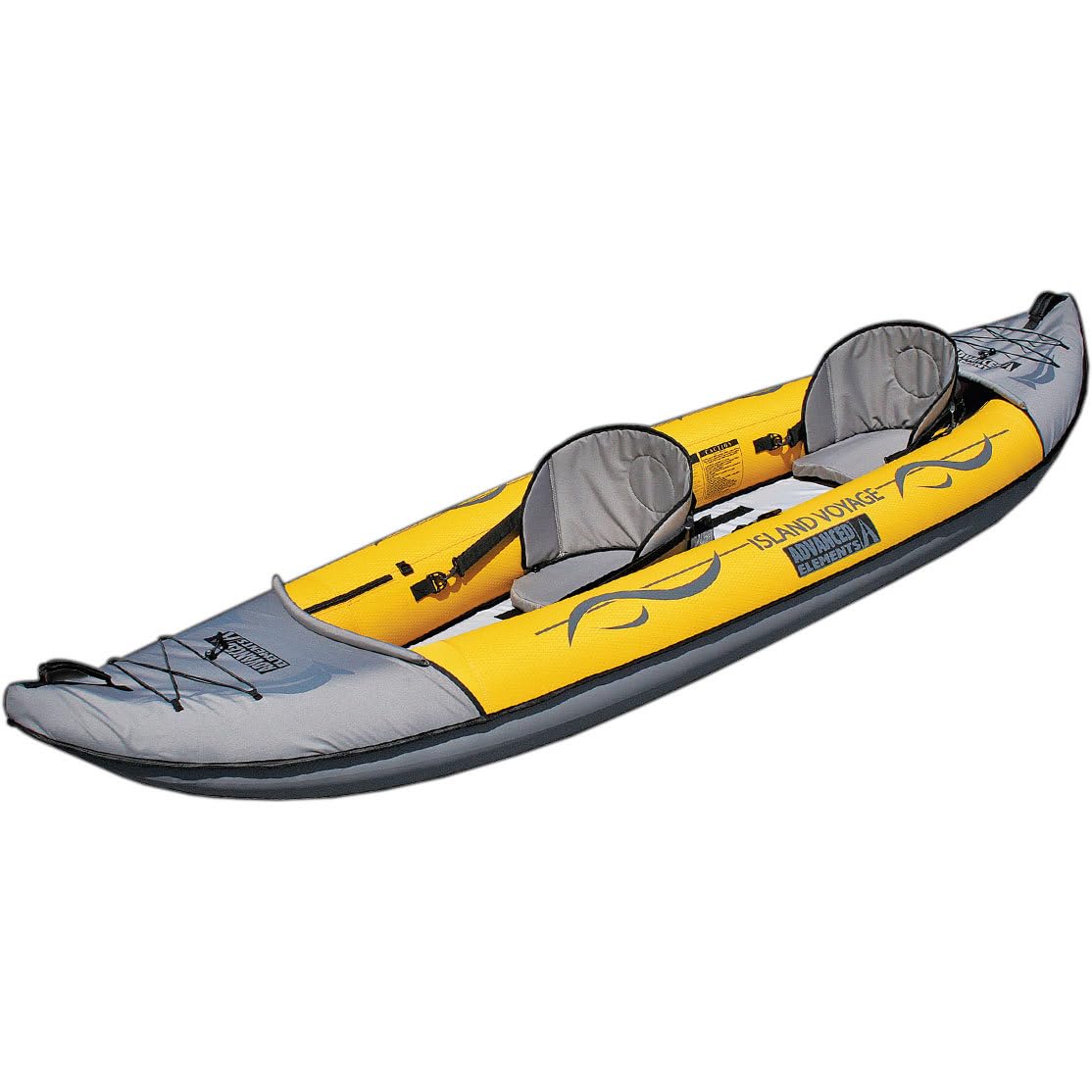
Adv. Elements Voyage 2
Key Features
- Material: Inflatable PVC
- Capacity & Seating: 1-2 person, 400 lbs
- Inflation & Pump: Pump not included
- Portability: 31.5 lbs
- Build Durability: Seam splitting reports
- Price: Mid-Range
The Advanced Elements Island Voyage 2 combines quality materials with stable flatwater performance, making it a comfortable choice for calm lakes and gentle rivers. The kayak inflates quickly with a standard pump, and the sturdy hull keeps tracking predictable on relaxed outings. However, it arrives without a pump — a notable omission at this price — and some units have shown seam splitting after several uses. This suits paddlers who prioritize build quality and already own a pump, but it’s less fitting for first-time inflatable buyers or those expecting a complete package with long-term durability under frequent use.
Pros
- Quality materials and construction that hold up well on calm water
- Quick inflation with a standard pump and straightforward setup
- Stable platform for relaxed paddling on lakes and gentle rivers
Cons
- No pump included — requires separate purchase, adding cost and potential inconvenience
- Seam splitting can occur after several uses, affecting long-term durability
Best for recreational paddlers who already own a pump and want a well-built inflatable for occasional flatwater trips — not ideal for frequent use or those seeking a complete ready-to-go kit.
Best for Family Bundle
Intex Explorer+Challenger

Key Features
- Material: Vinyl
- Capacity & Seating: 2+1 person, 400+400 lbs
- Inflation & Pump: Pump included
- Portability: ~50 lbs
- Build Durability: Entry-level durability
- Price: Budget
The Intex Explorer K2 & Challenger K1 Combo gives you two separate inflatable kayaks in one purchase, making it a practical way for a couple or family to get on the water without buying two boats individually. Each kayak is entry-level in construction, so long-term durability is limited and some units may have seam leaks or other minor defects. For occasional use on lakes and calm rivers, this bundle delivers solid value, especially for beginners who want to try different sizes or for groups that paddle together only a few times a season.
Pros
- Two kayaks for the price of one – a sensible budget option for families or couples.
- Lightweight and portable – each kayak is easy to inflate and carry to the water.
- Simple inflation and beginner-friendly design.
Cons
- Manufacturing defects such as seam leaks have been noted in some units – worth inspecting before first use.
- Both kayaks use basic vinyl construction, so their lifespan under regular use is limited.
This combo works best for occasional, calm-water outings where having two separate kayaks outweighs the need for long-term durability, and where budget is the primary concern.
How to Choose
The key to a lasting inflatable kayak is matching material and seam construction to your typical water conditions.
Material & Build Quality
PVC is the standard material, but its thickness and lamination method determine puncture resistance. Single-layer PVC (common in budget models) is light but can tear on sharp objects. Three-ply laminate or reinforced 1000-denier fabrics add weight and cost but hold up to rocks and sticks.
Drop-stitch floors use thousands of internal threads to create a rigid deck when pressurized. This reduces flex and improves tracking but makes the kayak heavier and harder to pack. For smooth lakes, standard floors are sufficient; for choppy water or long distances, drop-stitch is a meaningful upgrade.
Weight Capacity & Seating
Capacity ratings include paddler plus gear. A two-person kayak rated for 400 pounds can fit two average adults with minimal gear, but a third passenger or heavy cooler pushes it toward instability. Check the definition: some brands include boat weight in the rating.
Seating design affects comfort and control. Inflatable seats with back support are better for longer trips, but straps often loosen and cause sliding. Look for molded backrests or integrated attachment points. Some budget models use simple inflatable pillows that offer no lateral support.
Inflation & Deflation
Manual pumps are standard, but pressure and volume vary. High-volume pumps inflate quickly but require more effort to reach full pressure. Foot pumps are easier on the arms but slower. Electric pumps (12V) cut inflation time to under 5 minutes and are worth the investment if you paddle more than a few times a year.
Valve type matters: Boston valves are common and allow both inflation and deflation, while Halkey-Roberts valves seal automatically. Some premium kayaks use high-flow inflation ports that shave minutes off setup.
Portability
Packed weight and size determine how easy it is to carry to the water. Tandem inflatables range from 30 to 50 pounds. A kayak that weighs 45 pounds may be manageable for short carry distances, but a one-person boat at 47 pounds (like the Advanced Elements Expedition) becomes a burden for a single paddler.
Packed dimensions vary widely. Some roll into a duffel-sized bag, others into a barrel. Check the dry weight against your own carrying ability, especially if you hike in from a parking area.
Durability Track Record
Seam integrity is the most common failure point. Glued seams can separate after repeated exposure to heat and water pressure. Welded or heat-sealed seams are stronger but less common at lower price points. Regular inspection and careful storage (out of direct sun) extend lifespan.
Puncture resistance depends on material denier and coating. Vinyl under 0.5mm is easily cut by rocks or oyster shells. Brands like Sea Eagle use 1000-denier reinforced PVC that withstands moderate abuse. For any inflatable, avoid dragging over rough surfaces and use a repair kit on the water.
FAQ
Can I take an inflatable kayak on a river with rocks?
Yes, but only if it’s built for it. Budget vinyl models risk punctures and seam failure on sharp rocks. Look for drop-stitch floors or reinforced PVC like the Sea Eagle 380x for river use. For most casual lakes, standard inflatables are fine.
How long does it take to inflate and deflate an inflatable kayak?
Typically 10-15 minutes with a manual pump. An electric pump cuts inflation to under 5 minutes. Deflation and packing add another 10-15 minutes. Time varies by kayak size and valve type.
Is a drop-stitch floor worth the extra money?
Yes if you prioritize rigidity and tracking. Drop-stitch floors create a stiff deck that resists flexing, similar to a hardshell. For flatwater touring or solo paddling, the improvement is noticeable. For casual lake floating, standard floors are adequate.
Why do my inflatable kayak seats keep sliding?
Most budget kayaks use simple straps that loosen during use. You can secure seats by tying the straps under the inflated tubes or adding adhesive patches. Higher-end models have integrated seat attachment systems that stay in place.