This post contains affiliate links. We may earn a small commission when you buy through our links — at no extra cost to you.
Every hunter knows the frustration of a blade that goes dull halfway through dressing a deer. You either stop to sharpen or struggle through with a less effective edge. That wasted time and frustration is the single biggest complaint among game processors.
Replaceable-blade hunting knives solve that problem by letting you swap to a fresh, razor-sharp edge in seconds — no sharpening stones, no strops, no field maintenance. But not every hunt needs that approach. Fixed blades still excel for heavy-duty tasks like splitting the pelvis or processing elk, and folding knives pack smaller for day hunts where weight matters.
The right knife for you balances blade material, sheath design, and the tasks you actually perform in the field. This guide focuses on the practical differences that matter when you’re miles from the truck — not marketing claims.


Best for Deer Hunters
Outdoor Edge RazorLite
Key Features
- Blade Material: Replaceable stainless
- Blade Length: 3.5 in
- Sheath: Plastic pocket clip
- Weight: 0.3 lb
- Blade Type: Replaceable
- Price: $$
The Outdoor Edge RazorLite solves the biggest hassle of field dressing: dull blades. Its replaceable stainless steel blades cut through hide and tissue like a scalpel, and swapping in a fresh blade takes seconds. The Grivory handle with TPR grip stays secure even with wet hands, and the pocket clip keeps the knife ready on your hip.
This knife is built for hunters who process multiple deer in a season and want zero downtime for sharpening. The blade lock needs a firm push until it clicks — if not fully seated, the blade can slide out during a cut. The plastic frame isn’t for batoning or prying, but for skinning and slicing it feels solid and well-balanced.
Pros
- Razor-sharp replaceable blades eliminate sharpening — fresh edge in seconds.
- Quick and simple blade changes take just seconds to replace.
- Durable Grivory handle with TPR grip stays comfortable and secure.
Cons
- Blade lock can allow the blade to slip out if not fully seated; always check for a solid click.
- Plastic frame feels less sturdy than full-tang knives; not for heavy prying or batoning.
For hunters who want a consistently sharp knife without carrying sharpening gear, the RazorLite delivers on its core promise. Just make sure the blade clicks into place before each cut.
Best for Budget-Conscious Campers
Morakniv Companion 4.1
Key Features
- Blade Material: Sandvik 12C27 Stainless
- Blade Length: 4.1 in
- Sheath: Plastic with belt clip
- Weight: 3.9 oz
- Blade Type: Fixed
- Price: $
The Morakniv Companion delivers exceptional sharpness and a comfortable grip at a price that rivals disposable tools. Its Sandvik 12C27 stainless steel blade holds an edge well for carving, food prep, and light field tasks. However, the plastic sheath can allow the knife to slide out if not fully seated, making it less suited to the jostling of a long hunt. The thin blade also limits heavy-duty work like batoning wood or processing large game. This knife fits best as a backup or budget camp companion for hikers and occasional hunters who prioritize weight and cost over dedicated hunting features.
Pros
- Surgical sharpness right from the package
- Comfortable polymer grip stays secure even when wet
- Cost-effective – far more blade than the price suggests
Cons
- Plastic sheath may not hold the knife securely during active field use
A fantastic value for campers and day hikers who need a sharp, light knife; serious hunters should step up to the RazorLite’s replaceable blade system.
Best for Traditional Hunters
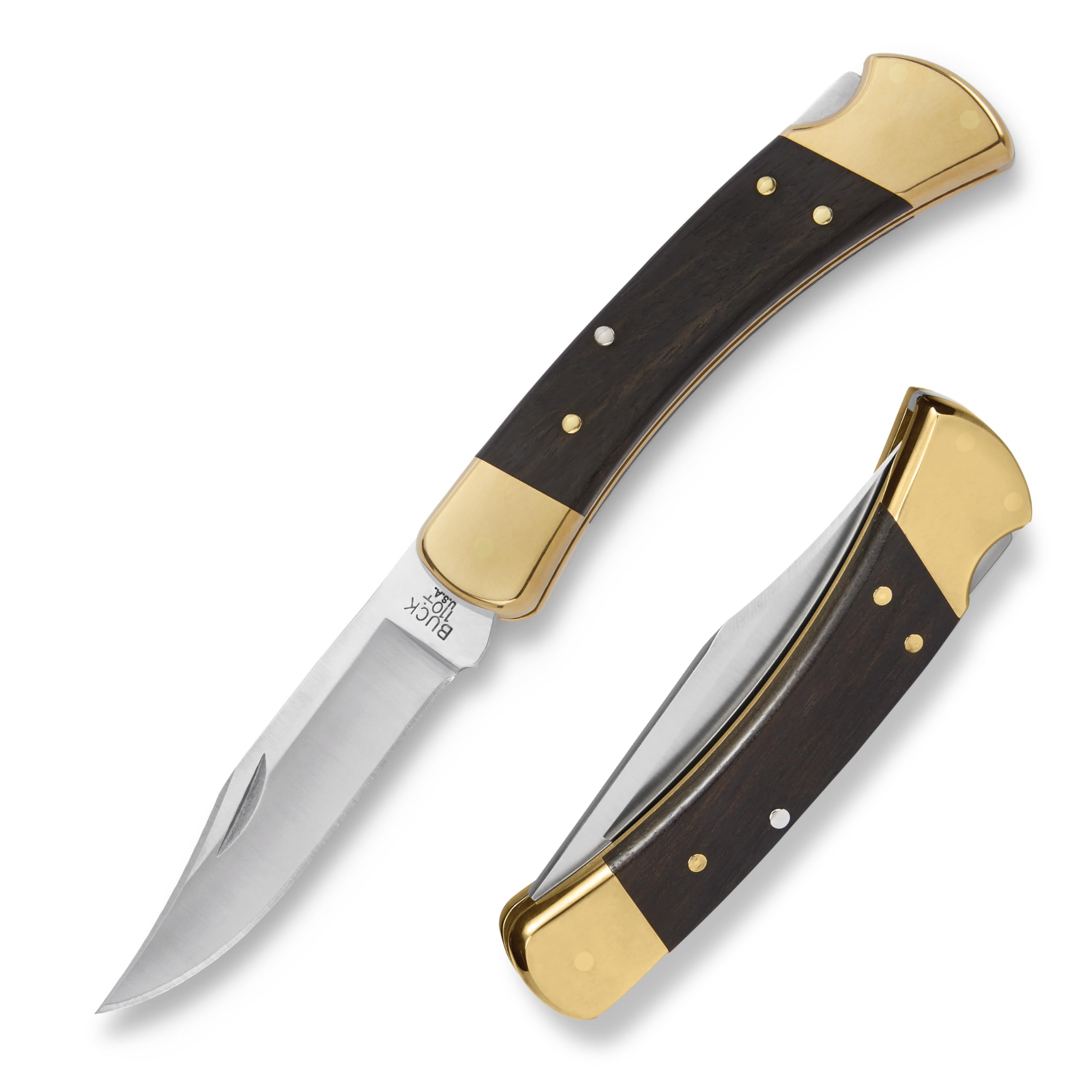
Buck 110 Folding Hunter
Key Features
- Blade Material: 420HC Stainless
- Blade Length: 3.75 in
- Sheath: Leather
- Weight: 7.2 oz
- Blade Type: Folding
- Price: $$$
The Buck 110’s ebony wood handle and brass bolsters give it a classic look that stands apart from modern tactical knives, while its 420HC stainless steel blade holds a factory edge sharp enough for field dressing. This folding hunter appeals to traditionalists who prefer a two-hand opening lockback and don’t mind its 7.2 oz weight on a belt sheath. It’s not suited for one-handed deployment or lightweight pocket carry — the tradeoff for an heirloom-quality build that has defined the hunting knife category for decades.
Pros
- Factory edge is razor sharp and stays sharp through multiple game processing sessions.
- Ebony and brass construction with lockback mechanism offers lasting durability across years of use.
- American manufacturing and lifetime warranty provide long-term value for a premium-priced knife.
Cons
- Leather sheath is stiff and bulky, requiring break-in and not ideal for concealed carry under clothing.
- At 7.2 oz, it adds noticeable heft when carried in a pocket — better suited for belt or pack carry.
For the hunter who values heritage, American craftsmanship, and a knife that will outlast many seasons, the Buck 110 is a straightforward choice — just be prepared for its old-school two-hand opening and substantial weight.
Best for Campers, Survivalists
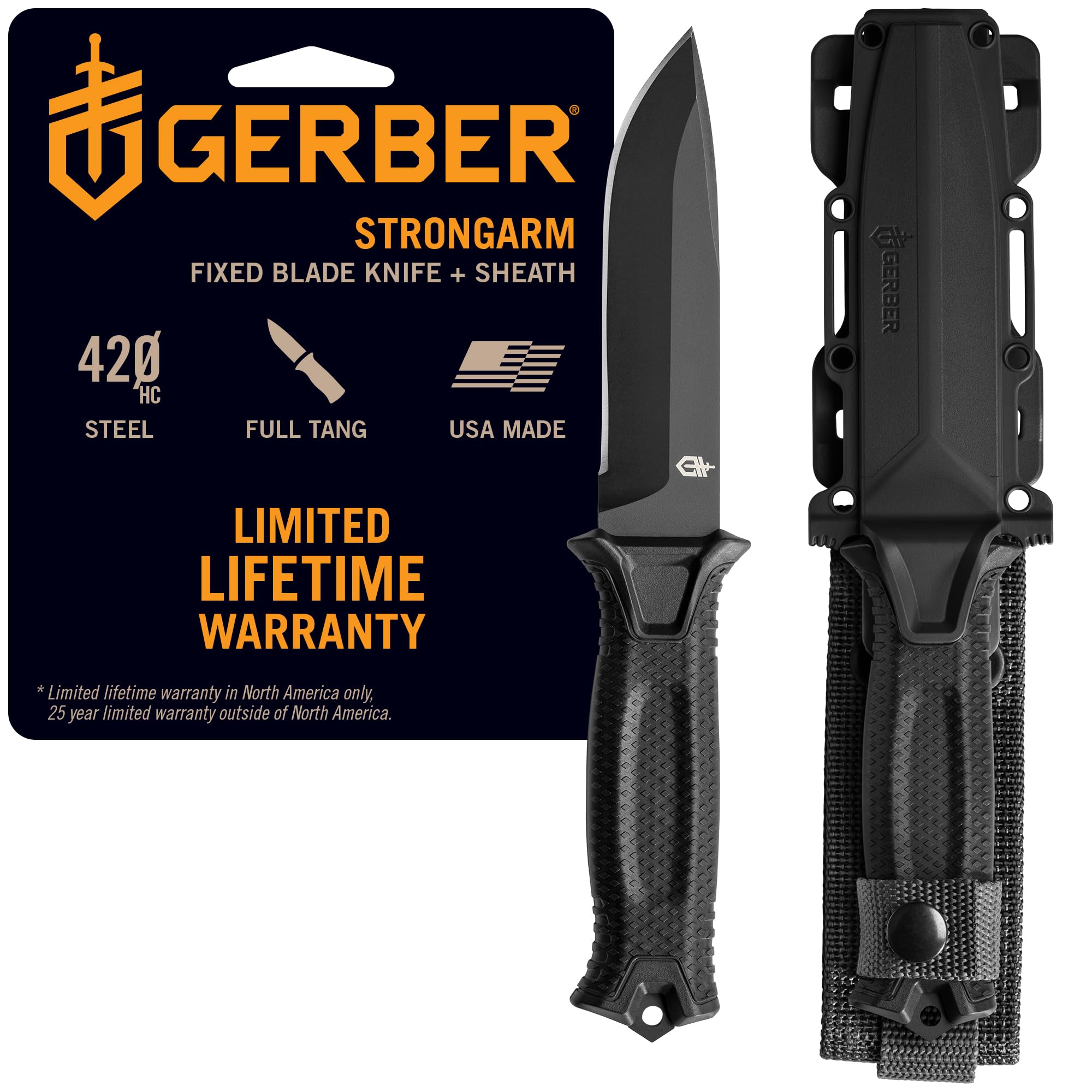
Gerber StrongArm 4.8
Key Features
- Blade Material: 420HC Stainless
- Blade Length: 4.8 in
- Sheath: MOLLE-compatible
- Weight: 7.9 oz
- Blade Type: Fixed
- Price: $$$
The Gerber StrongArm is a full-tang American-made fixed blade that handles skinning and batoning with equal composure. Its rubberized diamond-texture grip stays secure in wet conditions, and the 420HC steel takes a sharp edge out of the box. The MOLLE-compatible sheath offers multiple carry options, though the plastic retention system can wear the edge over time. Hunters who also split firewood or need a do-it-all camp knife will find it capable, but it lacks the slim profile of a dedicated skinner.
Pros
- Made in the USA with a full-tang design that withstands heavy abuse.
- Edge holds well through field dressing and camp tasks out of the box.
Cons
- Plastic retention sheath can dull the blade over time with repeated draws.
- Factory edge may need a quick touch-up to reach peak sharpness for those accustomed to razor edges.
Best for the hunter who wants one knife that can do both camp work and game processing without switching tools.
Best for Home Processors
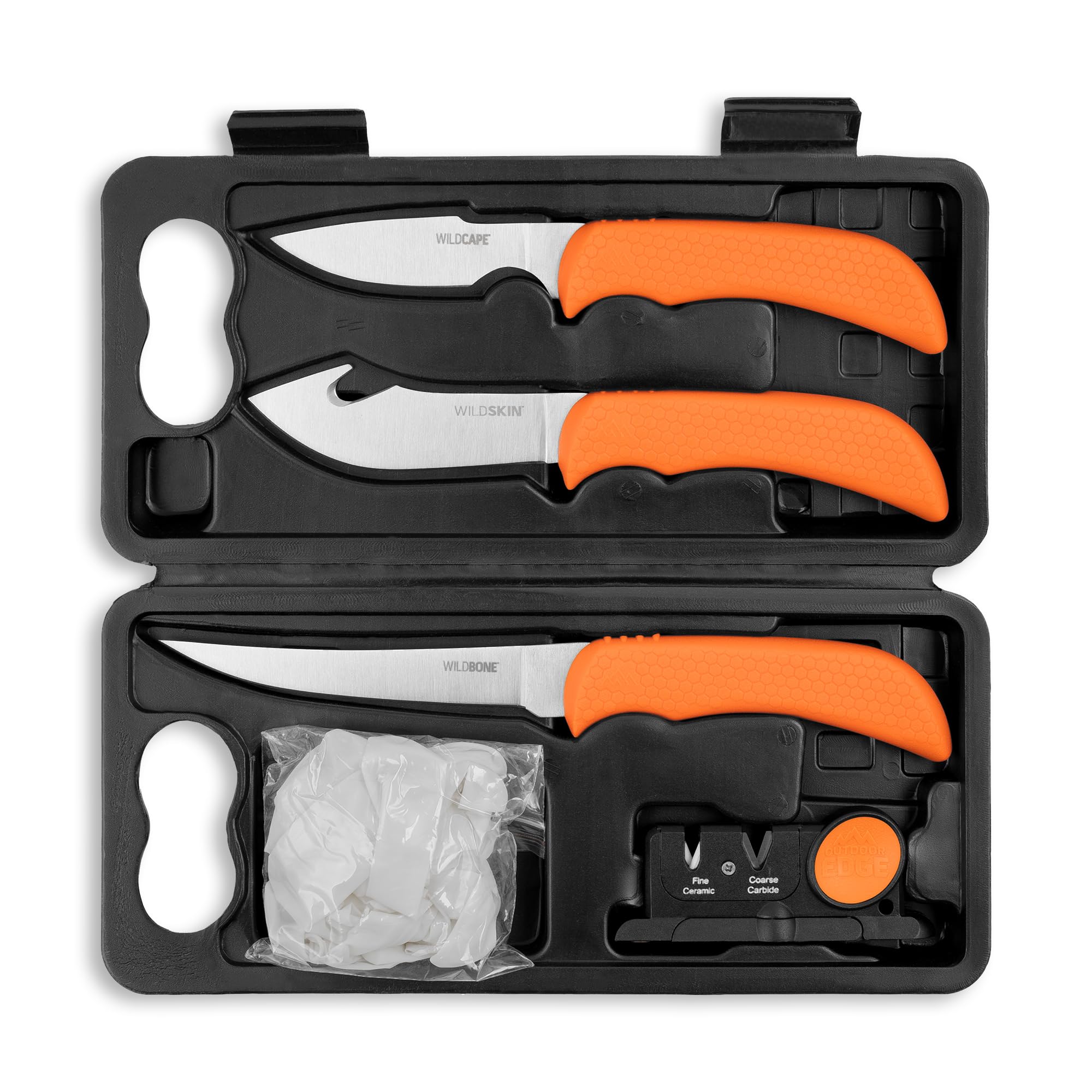
Outdoor Edge WildLite
Key Features
- Blade Material: 420J2 Stainless
- Blade Length: Various
- Sheath: Hard case
- Weight: 1.3 lb
- Blade Type: Replaceable
- Price: $$
This set includes a gut hook blade, caping knife, boning knife, gloves, sharpener, and hard case – everything needed to go from field to freezer without buying separate knives. Some blades may arrive dull and require sharpening before first use, and the 420J2 steel demands more frequent touch-ups during heavy processing than premium alloys. Best suited for home deer processors who want a turnkey kit rather than assembling individual pieces, the WildLite delivers solid organization and visibility with blaze orange handles.
Pros
- Complete all-in-one set eliminates the need to purchase separate hunting knives
- Hard-shell case keeps all six pieces organized and protected during transport
- Good value for a dedicated processing kit with gloves and sharpener included
Cons
- Some blades may arrive dull and need sharpening before heading into the field
- During extended game processing, the softer steel may require more frequent edge touch-ups
If you prefer a single box of dedicated tools for home deer processing over collecting individual knives, the WildLite is a practical buy – just be ready to maintain the edges.
Best for New Hunters
Mossy Oak 2-Piece

Key Features
- Blade Material: Stainless steel
- Blade Length: 5.1 in + 4.3 in
- Sheath: Nylon dual carry
- Weight: 1.06 lb
- Blade Type: Fixed
- Price: $
This two-knife set delivers a straight-edge and gut-hook blade that arrive sharp and ready for field dressing. For the price, you get solid build and a comfortable grip that suits occasional use. The handle material, however, feels plasticky and may not hold up to years of heavy processing, and the nylon sheath is basic. That trade-off is fine for new hunters on a tight budget or as a truck backup, but serious hunters seeking long-term durability should look at pricier options.
Pros
- Two sharp blades out of the box at a budget-friendly price.
- Full-tang design with comfortable camo grip for the cost.
Cons
- Plasticky handle material may not endure frequent heavy use.
A smart pick for new hunters or anyone needing a cheap backup set; not meant for season-after-season abuse.
Best for New Hunters
Mossy Oak 8-Piece

Key Features
- Blade Material: Stainless steel
- Blade Length: Various
- Sheath: Hard case
- Weight: 3.3 lb
- Blade Type: Fixed
- Price: $$
This kit packs a bone saw, spreader, caping knife, gut hook, boning knife, sharpener, and gloves for under $50. It works well for deer and other game, but the stainless steel blades are soft and will need frequent touch-ups. Some handles may develop cracks over time, making this a solid starting set for new hunters rather than a long-term investment.
Pros
- Complete field dressing set includes bone saw and spreader for processing game in the field.
- Good value for the number of tools included in one purchase.
Cons
- Steel is soft; knives need frequent resharpening during heavy use.
Best for new hunters who want a low-cost starter kit and don’t mind sharpening between deer; experienced processors should look to higher-end steel options.
Best for Budget Hunters
Old Timer Sharpfinger

Key Features
- Blade Material: High carbon stainless
- Blade Length: 3.3 in
- Sheath: Leather belt sheath
- Weight: 3.1 oz
- Blade Type: Fixed
- Price: $
The Old Timer Sharpfinger’s clip-point skinner blade is sharp out of the box and simple to maintain, making it a capable tool for small game and fish. However, the leather sheath is flimsy and likely to need replacement, the handle is too small for larger hands, and heavy use may limit its lifespan to roughly two years. For budget-minded hunters with smaller hands who don’t mind replacing the sheath, this knife offers good value.
Pros
- Sharp edge straight from the box; simple to keep sharp with occasional touch-ups.
- Solid build quality for the price, with a full-tang design that feels sturdy.
Cons
- The leather sheath feels cheap and may wear out quickly, requiring a replacement.
A budget-friendly skinner for small hands and light game processing, provided you’re willing to swap the sheath.
Best for Large Game Hunters
Buck 120 General 7.4

Key Features
- Blade Material: 420HC Stainless
- Blade Length: 7.375 in
- Sheath: Genuine leather
- Weight: 8.3 oz
- Blade Type: Fixed
- Price: $$$
The Buck 120 General delivers a razor-sharp 7.375-inch blade from American-made 420HC stainless steel, making deep cuts on large animals straightforward. However, the blade’s length can feel unwieldy for smaller game or detail work, and some users note blade flex under heavy use. This premium-priced knife is overkill for deer-sized game but suits hunters processing elk or moose where the reach is an advantage.
Pros
- High-quality American-made fixed blade with full-tang construction
- Extremely sharp out of the box with a razor edge
Cons
- Oversized blade can feel cumbersome for cutting smaller game or detail tasks
Best reserved for hunters routinely field-dressing elk or moose where the long blade is an asset; for deer or smaller game, a shorter knife is more practical.
Best for Collectors
Bigcat Roar Predator

Key Features
- Blade Material: Damascus steel
- Blade Length: 4.8 in
- Sheath: Hand-stitched leather
- Weight: 8.2 oz
- Blade Type: Fixed
- Price: $$
The 288-layer Damascus pattern and walnut handle offer stunning looks at a mid-range price. Inconsistent sharpness, potential handle cracking, and a poor-quality sheath mean this knife isn’t built for field dressing or heavy outdoor work. Best suited for display or light outdoor use.
Pros
- Beautiful Damascus pattern and craftsmanship
- Comfortable ergonomic walnut handle
Cons
- Inconsistent sharpness out of box; needs sharpening before use
This knife fits as a display piece or gift for Damascus enthusiasts, but not for hunters needing reliable field performance.
How to Choose
The most important factor in a hunting knife is how it handles the shift from cutting hair to cutting hide without dulling.
Blade Material & Edge Retention
Blade steel determines how long the edge stays sharp and how easy it is to sharpen in the field. High-carbon stainless like 420HC offers a good balance of corrosion resistance and edge holding, while softer steels like 420J2 require more frequent touch-ups.
Harder steels like Sandvik 12C27 hold an edge longer but can be more brittle. For hunters processing multiple animals, a knife with replaceable blades sidesteps the trade-off entirely.
Blade Length & Type
Blade length correlates with the size of game. A 3- to 4-inch blade works well for deer-sized game, while elk or moose benefit from a longer 5- to 7-inch blade for deep cuts. Fixed blades offer more durability and no moving parts, while folding knives pack smaller for day hunts.
The trade-off: fixed blades are stronger but bulkier on the belt. Folders like the Buck 110 are classic but require two hands to open and add weight.
Sheath Quality & Carry
The sheath protects both the blade and you. Leather sheaths look classic and won’t dull the edge, but can stiffen over time and retain moisture. Plastic or nylon sheaths are lighter and resist water, but some designs can wear down the blade with repeated draws.
A secure retention system is critical. A sheath that lets the knife slide out can lead to lost gear or unsafe carry.
Weight & Ergonomics
Weight affects how the knife feels on your belt and in your hand. A lightweight knife under 4 ounces is easy to carry but may lack the heft for heavy prying or batoning. Heavier knives offer more control but can tire your hand during extended processing.
Handle shape and texture matter more than weight. A good grip stays secure when wet with blood and fat. Rubberized or contoured polymer handles outperform smooth wood or metal in realism.
Replaceable Blade Capability
Replaceable-blade knives are the most practical innovation for hunters who process multiple animals. You carry spare blades and swap them in seconds, always working with a sharp edge. The downside is that you’re tied to proprietary blades and the knife body is typically lighter-duty.
For a weekend hunter who processes one or two deer a season, a traditional sharpening routine may be perfectly adequate. The choice comes down to how much you value convenience over long-term durability.
FAQ
Is a replaceable blade hunting knife better than a traditional fixed blade?
For hunters who process multiple animals in a season, yes — replaceable blades keep you sharp without field sharpening. For heavy-duty tasks like batoning wood or splitting pelvis bones, a full-tang fixed blade is stronger. Choose based on your primary use: convenience for dressing, or brute strength for camp chores.
What size hunting knife is best for field dressing deer?
A blade between 3.5 and 4.5 inches is ideal for deer. It’s long enough to make deep cuts without being unwieldy. Anything over 5 inches can be too large for internal work and risks puncturing organs.
How do I keep my hunting knife from rusting in the field?
Wipe the blade dry after each use and apply a light coat of mineral oil or a food-grade lubricant. Avoid storing it in the sheath while wet — leather retains moisture, and plastic traps it. Stainless steel resists rust but isn’t immune; high-carbon blades need more care.
Why does my hunting knife get dull so fast after processing game?
Hair and hide contain silica and minerals that blunt edges quickly. Using a knife with a harder steel (like Sandvik 12C27 or VG-10) extends edge life. If dulling is a recurring issue, consider switching to a replaceable-blade model — fresh blades perform like new every time.