This post contains affiliate links. We may earn a small commission when you buy through our links — at no extra cost to you.
Many folding saws look great in the package but disappoint on the trail — blades flex, locks loosen, and cuts take forever. The real trick is finding one that cuts quickly and holds up without adding unnecessary weight to your pack.
Matching blade length and tooth pattern to your typical camp chores is the key difference between frustration and efficiency. A 6-inch saw works for kindling but not firewood; a 14-inch model is overkill for a day hike. The best saws use hardened steel with a secure lock that stays engaged.
This guide cuts through the hype by focusing on saws that actually work: they stay sharp, lock tight, and slice through green and dry wood without drama. For most campers, the sweet spot is a 7- to 9-inch blade with coarse teeth.




Best for Budget Backpackers
Bahco Laplander 7.5"
Key Features
- Blade Length: 7.5 in
- TPI: 7 TPI
- Blade Material: Swedish steel, rust-protected
- Locking Mechanism: Safety lock open/closed
- Weight: 0.47 lb
- Price: Budget
The 7.5-inch Swedish steel blade with XT toothing cuts through 3-inch limbs quickly on both pull and push strokes, making green and dry wood processing feel effortless. At under half a pound, it tucks into a pack or back pocket without weighing you down.
This saw suits campers who need one tool for firewood and trail maintenance without spending a premium. The thin blade can bend if forced or used for prying — stick to straight cutting strokes to keep it in shape.
Pros
- Cuts green and dry wood quickly with minimal effort
- Lightweight and portable for backpacking
- Outstanding performance for the price
Cons
- Locking button can feel slightly loose in some cases
- Thin blade can bend if forced or used for prying
The Bahco Laplander is the go-to folding saw for campers who want cutting capacity without paying a premium — just avoid prying with it.
Best for Ultralight Backpackers
Silky PocketBoy 170
Key Features
- Blade Length: 6.75 in
- TPI: 8.5 TPI
- Blade Material: Hard chrome plated steel
- Locking Mechanism: 2-position lock
- Weight: 10.4 oz
- Price: Mid-Range
The Silky PocketBoy 170 packs a razor-sharp 6.75-inch blade into a sub-11-ounce package that disappears into a pocket. This makes it the go-to saw for ultralight backpackers who need kindling and small branches but don’t want to carry a larger saw. The compact design means cutting capacity is limited to branches under 3-4 inches, and the thin blade requires careful technique – avoid twisting or side-loading to prevent snapping. If you routinely process larger firewood, the Bahco Laplander offers more blade length at a lower cost.
Pros
- Razor-sharp medium teeth cut through green and dry wood quickly
- Fits in a pocket or small pack – ideal for ultralight setups
- Two locking positions allow flush cutting against a surface
Cons
- Thin blade can snap if twisted or side-loaded during cutting
For gram-counting backpackers who only need kindling and small branches, this is the most weight-efficient folding saw available – just respect the blade’s limits.
Best for Car Campers
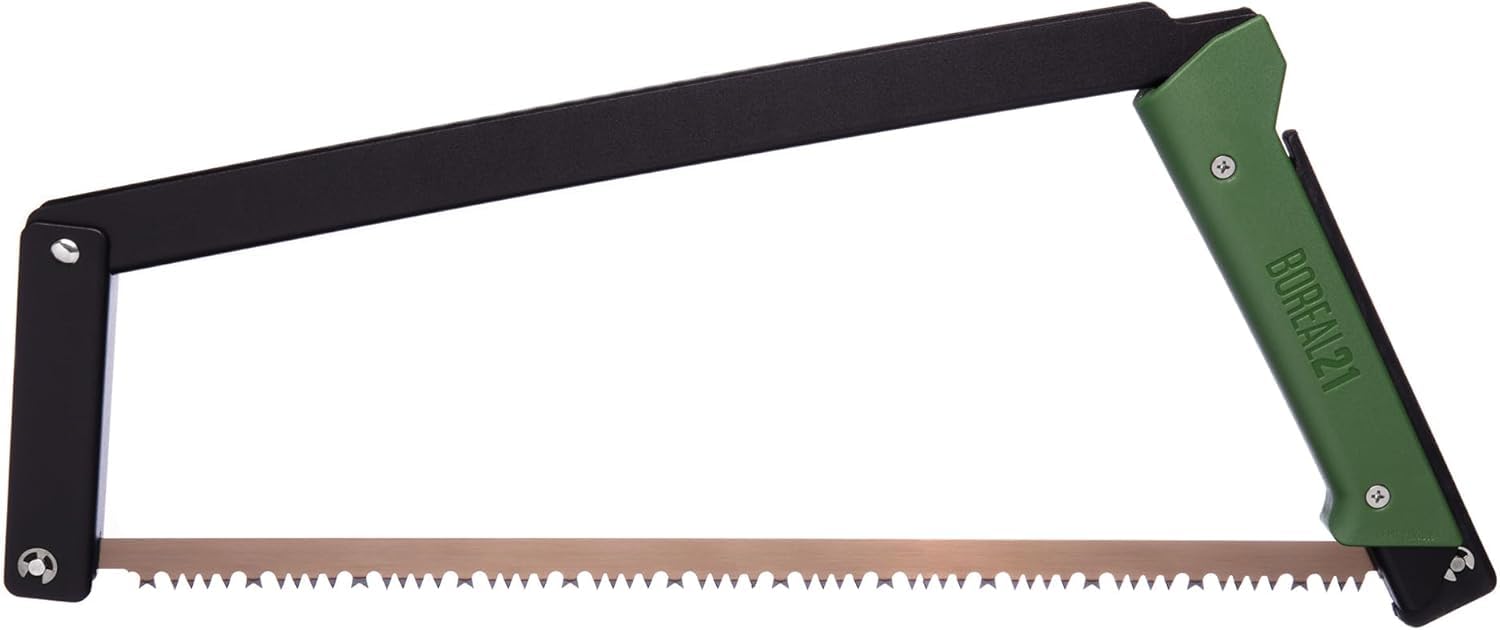
Agawa BOREAL21
Key Features
- Blade Length: 21 in
- TPI: 6 TPI
- Blade Material: Stainless steel, rust protective coating
- Locking Mechanism: 3-hinged trapezium frame
- Weight: 18 oz
- Price: Mid-Range
The Agawa BOREAL21’s 21-inch blade cuts logs significantly faster than any traditional folding saw, yet it folds flat to a compact package suitable for a car trunk or duffel. This makes it a strong choice for car campers and trail maintainers who need bow-saw efficiency without carrying a full-size bow saw. The 18-ounce weight is higher than most folding saws, so ultralight backpackers should look elsewhere, and replacement blades require careful handling of the c-clips – having spares on hand is wise.
Pros
- Long 21-inch blade rips through logs faster than any folding saw of comparable packability
- Folds flat to a compact shape that stows easily in a car trunk or duffel
- Aluminum frame and stainless steel hardware hold up to rugged outdoor use
Cons
- At 18 oz it’s heavier than most folding saws – not ideal for backpacking
- Blade replacement uses small c-clips that can be lost during field changes
The BOREAL21 delivers unmatched cutting capacity in a packable form – best for car campers and trail crews, not for weight-conscious backpackers.
Best for Bushcrafters
Silky GomBoy 240
Key Features
- Blade Length: 9.5 in
- TPI: 8.5 TPI
- Blade Material: Hard chrome plated steel
- Locking Mechanism: 2-position lock
- Weight: 0.92 lb
- Price: Premium
The Silky GomBoy 240 hits the sweet spot between portability and cutting power. Its impulse-hardened teeth stay sharp through years of use, making quick work of firewood and trail clearing. Two locking positions enable both inline and flush cuts, adding flexibility for bushcraft tasks. The trade-off: blade base separation has occurred in some units, so inspection before heavy use is wise. This saw suits backpackers and bushcrafters who need more reach than a pocket saw but want to keep pack weight manageable.
Pros
- Cuts through logs and branches with minimal effort, like a hot knife through butter.
- Blade stays sharp for a long time, reducing maintenance.
- Two handle positions increase cutting versatility.
Cons
- Premium pricing compared to saws with similar blade length.
- Blade base separation can occur in a small number of units.
A capable mid-size saw for frequent campers who want Silky cutting performance without the bulk of the BigBoy — worth the investment if used regularly.
Best for Packable Bow Saw
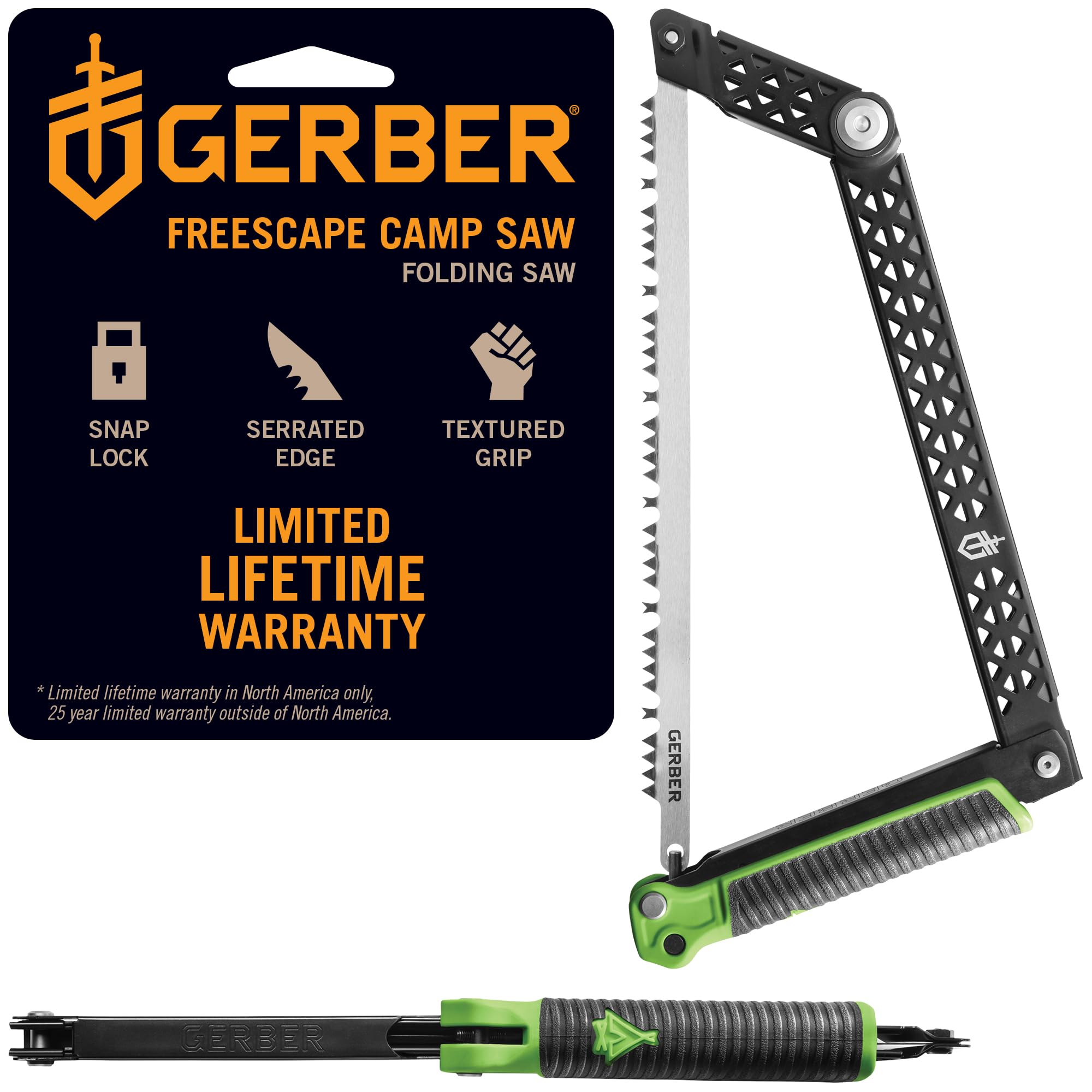
Gerber Freescape 12"
Key Features
- Blade Length: 12 in
- TPI: 6 TPI
- Blade Material: Aluminum oxide coating
- Locking Mechanism: 4 pivot points, folds flat
- Weight: 16 oz
- Price: Premium
The Gerber Freescape uses four pivot points to fold into a flat, tensioned package that cuts through logs up to 6 inches with surprising speed. This clever mechanism means no loose parts to lose, but the 16-ounce weight and proprietary blade replacements put it in a niche: campers who value the folding convenience over pack weight and ongoing costs.
Pros
- Innovative fold-flat design eliminates disassembly and lost parts
- Cuts quickly through logs up to 6 inches with minimal effort
- Packs flat in backpacks without taking up much space
Cons
- Heavier than many folding saws at 16 oz, noticeable for backpacking
- Proprietary replacement blades add long-term cost; blade coating may wear
The Freescape suits car campers and base-campers who want bow-saw performance in a packable form and are comfortable with the extra weight and future blade costs.
Best for Budget Multi-Tool
Mossy Oak 3-in-1
Key Features
- Blade Length: 7.5 in each
- TPI: 5/11/18 TPI
- Blade Material: 65Mn & 58CrV steel
- Locking Mechanism: Threaded knob
- Weight: 0.77 lb
- Price: Budget
The Mossy Oak 3-in-1 includes three interchangeable blades (pruning, hardwood/plastic, and metal) plus a nylon pouch for easy carry. It lacks the refined cutting feel of the Bahco Laplander but makes up for it with material versatility. This saw suits car campers and occasional users who need one tool for varied jobs — just don’t expect it to handle heavy-firewood processing; the blades can feel flimsy when cutting dense logs.
Pros
- Three interchangeable blades cover wood, plastic, and light metal cutting.
- Includes a nylon pouch that keeps blades organized and portable.
- Budget-friendly price for a multi-blade system.
Cons
- Blades may feel flimsy when cutting dense firewood and can bend under pressure.
- Locking knob can loosen during use, requiring re-tightening to keep the blade secure.
Good value for campers who occasionally need to cut wood, plastic, or light metal, but lacks the rigidity for regular firewood processing.
Best for Lightweight Bushcraft
Silky F180

Key Features
- Blade Length: 7 in
- TPI: 6.5 TPI
- Blade Material: SK4 high-carbon steel, chrome
- Locking Mechanism: Folding lock
- Weight: 0.4 lb
- Price: Mid-Range
The Silky F180 brings the brand’s aggressive cutting speed to a pocket-friendly 0.4 lb package. Its large teeth chew through branches up to 4 inches with minimal effort — the tradeoff is a thinner blade that can bend or break if twisted, and the saw does not include a storage sheath. This makes it best for backpackers who prioritize pack weight and fast cutting over durability in heavy or side-loaded cuts, and who are comfortable buying a separate case.
Pros
- Large teeth cut through branches quickly with minimal effort
- Lightweight and compact enough to fit in a cell phone pocket
Cons
- Thin blade can bend or break if used with side force, and no sheath is included for safe carry
For backpackers who need a fast-cutting, ultralight saw for small to medium branches and don’t mind adding a separate sheath, the Silky F180 offers Silky performance at a budget-friendly price.
Best for Long Blade Budget
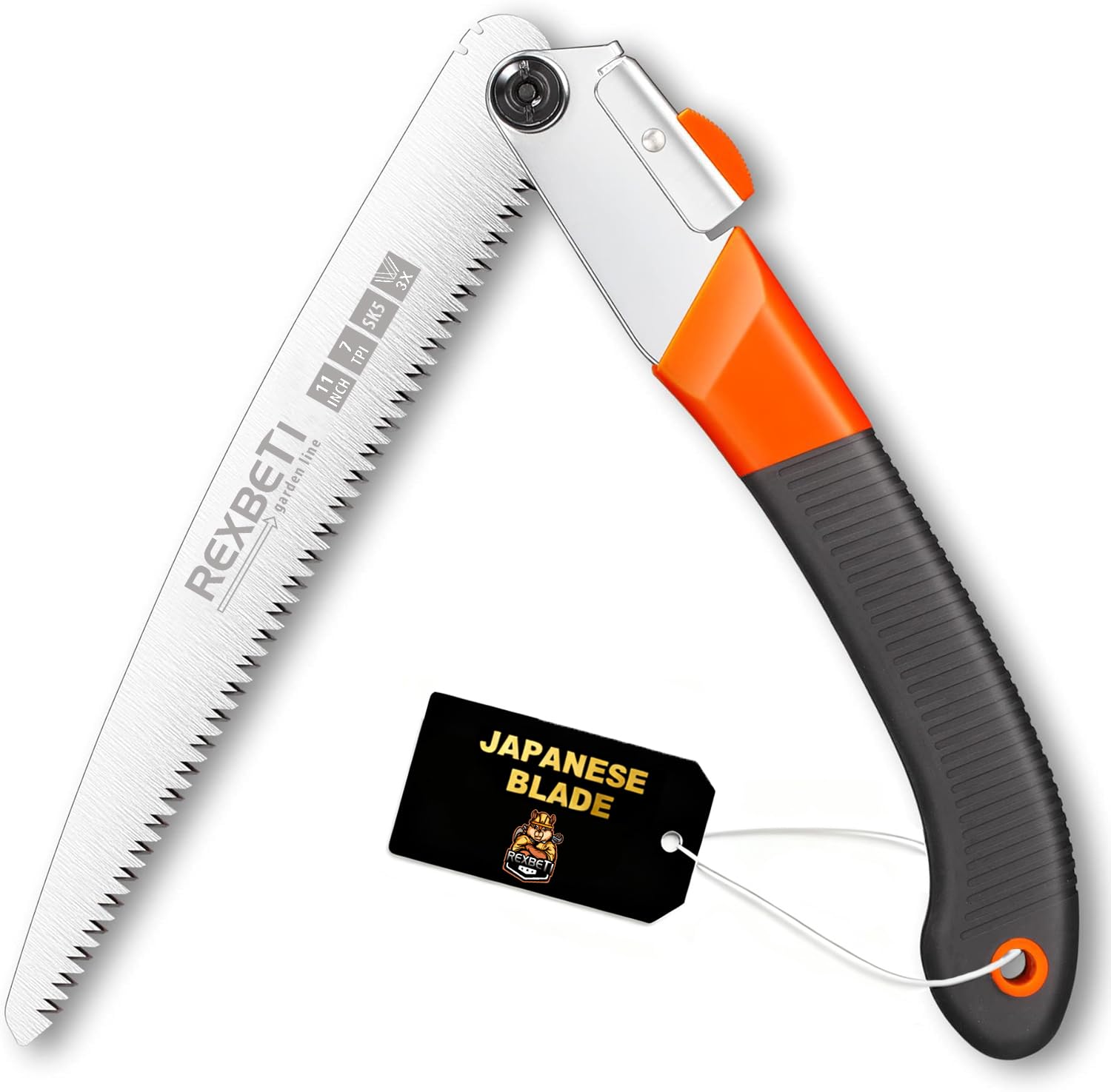
REXBETI 11" Heavy Duty
Key Features
- Blade Length: 11 in
- TPI: 7 TPI
- Blade Material: SK-5 steel
- Locking Mechanism: Folding lock
- Weight: ~0.5 lb
- Price: Budget
This folding saw delivers a long 11-inch SK-5 blade that can cut through 6-inch logs quickly, appealing for budget-conscious campers. But blade snapping has been noted after limited use, making it suitable only for occasional light-duty cutting rather than dependable multi-day trips.
Pros
- Long 11-inch blade cuts larger branches quickly
- Sharp teeth that maintain edge well
Cons
- Blade can snap after a few uses
Worth considering only for light, occasional branch cutting where cost is the top priority and you accept possible early failure.
Best for Garden Campers
Felco F600

Key Features
- Blade Length: 6 in
- TPI: 6 TPI
- Blade Material: Steel, chromium coating
- Locking Mechanism: Folding
- Weight: 6.4 oz
- Price: Mid-Range
The Felco F600 packs a precision Swiss-made pull-saw into a pocket-friendly size, making it a natural fit for gardeners who also camp and need to trim small branches. However, the 6-inch blade can bow under pressure on harder wood and is best reserved for branches under 4 inches — not suitable for processing campfire wood.
Pros
- Fits in a pocket and is lightweight enough for day hikes.
- Pull-stroke design cuts cleanly with minimal pressure, reducing effort.
Cons
- Blade can bow on harder wood and is limited to branches under 4 inches.
Works well for light trail pruning and cutting small kindling, but leave the campfire wood processing to a longer blade.
Best for Budget Gardeners
WEIMELTOY 10"

Key Features
- Blade Length: 10 in
- TPI: 6 TPI
- Blade Material: SK5 steel
- Locking Mechanism: Button lock
- Weight: 0.66 lb
- Price: Budget
This saw delivers a sharp 10-inch blade that chews through branches up to 6 inches without much effort, and the price is hard to beat. However, the thin metal construction can feel flimsy — some owners report blade bending under normal use. It’s fine for the occasional campfire or light pruning, but not a tool to count on for regular trips or heavy cutting.
Pros
- Cuts quickly through branches up to 6 inches with a sharp SK5 blade
- Budget-friendly price for a 10-inch saw
Cons
- Blade may bend if forced, especially on larger or knotted wood
Worth a look if you need a cheap saw for occasional firewood at a campsite, but don’t rely on it season after season.
Best for Budget Campers
EverSaw 8"

Key Features
- Blade Length: 8 in
- TPI: 9 TPI
- Blade Material: SK5 carbon steel
- Locking Mechanism: Gear lock (open only)
- Weight: 11.2 oz
- Price: Budget
The EverSaw cuts well for the price, handling branches up to four inches with its sharp SK5 steel blade. But the blade doesn’t lock closed, so it can open in a pack — storage in a sheath is essential. For campers who want a secure lock, the top pick in this roundup offers a better design.
Pros
- Good cutting performance on branches up to 4 inches
- Affordable price with good quality for the money
Cons
- Blade does not lock closed – can open accidentally in pack
A decent budget choice for campers who carry a sheath and accept the open-closed lock limitation. Not for those who want a saw that locks closed for pack safety.
Best for Base Camp Hunters
Silky BIGBOY 2000

Key Features
- Blade Length: 14.2 in
- TPI: 5.5 TPI
- Blade Material: SK4 high-carbon, chrome plated
- Locking Mechanism: Folding lock, rubber handle
- Weight: 1.1 lb
- Price: Premium
The BIGBOY 2000’s 14.2-inch blade chews through 10-inch logs quickly, with a durable edge and comfortable grip. It excels at base camps and trail work where weight isn’t a concern. But its size and weight rule out backpacking, and the high cost makes sense only for users who regularly process large wood. The GomBoy balances portability and cutting power better for typical camping.
Pros
- Cuts through 10-inch logs in seconds
- Blade stays razor-sharp through extended use
Cons
- At 1.1 pounds and 14.2 inches folded, it is too bulky for most backpacking kits
A top pick for base campers and trail crews who need to cut large wood quickly, but not for backpackers seeking a compact saw.
Best for Hunters Trappers
Silky KATANABOY 650

Key Features
- Blade Length: 25.6 in
- TPI: 3.4 TPI
- Blade Material: Electroless nickel plated steel
- Locking Mechanism: Two-handed folding
- Weight: 2.8 lb
- Price: Luxury
This folding saw cuts through 12-inch logs as fast as a power tool, thanks to its long blade and aggressive teeth. It is light for its size at 2.8 lbs and includes a nylon shoulder bag. However, the premium price and bulk require frequent heavy use to justify — best reserved for hunters, trappers, and trail crews.
Pros
- Unmatched cutting power for a manual saw – slices through 12-inch logs with ease.
- Extremely sharp and aggressive teeth make fast work of large branches and firewood.
Cons
- Premium price and large size only make sense for users who regularly cut oversized logs – overbuilt for light-duty use.
Ideal for hunters, trappers, and trail crews who need a manual saw capable of cutting 12-inch logs without a chainsaw – the power justifies the investment for frequent heavy use.
How to Choose
The single most important factor in a folding saw is matching blade length and tooth pitch to the wood you actually cut — a saw that is too short or too fine-toothed will turn a five-minute job into a half-hour struggle.
Blade Length
Blade length determines the maximum diameter of wood you can cut in one stroke and how fast you can process it. A 6- to 7-inch blade is fine for branches up to 3 inches thick, but for firewood logs (4-6 inches) you need at least 9 inches. Longer blades (14 inches and up) cut larger logs quickly but add weight and packed length.
The trade-off is portability: a 6-inch saw fits in a pocket, while a 21-inch folding bow saw (like the Agawa) is nearly as long as a camp chair when folded. Choose the shortest blade that handles the largest wood you expect to process on a typical trip.
Teeth Per Inch (TPI)
TPI controls cut speed and finish. Coarse blades (5-7 TPI) remove material fast and are ideal for green wood and rough firewood. Fine blades (8-10 TPI) give cleaner cuts but take longer and clog more easily on wet wood.
Most campers should look for 6-7 TPI — it balances speed and versatility. If you only cut dry deadwood, a slightly finer tooth works better. Avoid general-purpose blades that try to do everything; they often do nothing well.
Blade Material And Coating
High-carbon steel (SK4, SK5, 65Mn) holds a sharp edge longer than stainless steel but rusts quickly if not coated. A hard chrome, electroless nickel, or epoxy coating prevents rust without compromising sharpness. Uncoated blades require drying after use or they spot within hours.
The thickness of the blade is equally important: thin blades (under 0.05 inches) flex under side load and can bend or snap. Look for blades at least 0.05 inches thick for durability without excessive weight.
Locking Mechanism
The lock must hold the blade rigid during cutting and secure when folded. A button lock with a spring is common on budget saws but can loosen over time, allowing the blade to fold on your hand. Better designs use a threaded collar or two-position lock that physically stops rotation.
Some budget saws (like the EverSaw) only lock open but not closed — a safety hazard in a pack. Always verify that the saw locks in both positions. For backpacking, a lock that engages automatically is preferred over one that requires a separate step.
Weight
Weight is the sum of blade, handle, and lock mechanism. Every additional ounce must be justified by cutting capacity. For backpacking, stay under 12 ounces (0.75 lb). For car camping or base camps, 1-2 pounds is acceptable if you cut large logs.
A heavy saw with a long blade can actually be more efficient because it cuts faster, reducing total effort. But if you carry it for miles without using it, the weight penalty multiplies. Consider how often you actually need the saw versus how far you carry it.
FAQ
Why does my folding saw blade bend when cutting?
It means the blade is too thin or the teeth are pulling sideways against the grain. Thin budget blades (under 0.05 inches) flex under side load, especially when cutting twisted or knotty wood. Use a pull-cut technique with steady pressure, and avoid sawing at awkward angles. If the blade bends often, upgrade to a thicker blade like the Bahco Laplander or a Silky.
Is a pull-cut saw better than a push-pull saw for camping?
Yes, for most campers. Pull-cut saws (like Silky and Bahco) cut on the pull stroke, which requires less force and gives cleaner cuts because the blade tension naturally straightens. Push-pull saws are more common in cheap models and are slower, with more vibration and a higher chance of binding. Stick to pull-cut designs for efficiency.
How long should a camping folding saw blade last?
With proper use and maintenance, a quality blade (SK4, SK5, or Swedish steel) can last several seasons of regular camping — 100+ cuts through 3-4 inch logs. Signs of dulling include increased effort and splintering instead of clean sawdust. You can sharpen folded saws with a small file, but many users simply replace the blade when it dulls. Avoid using the saw on dirty or abrasive wood to extend life.
Can I use a pruning saw for cutting firewood while camping?
Yes, if the saw is designed for green wood and has a coarse tooth pattern (5-7 TPI). Many pruning saws like the Bahco Laplander are excellent for firewood. But pruning saws with fine teeth (9+ TPI) clog on green wood and are slow on dry branches. Check the TPI rating: 6-7 TPI is ideal for both pruning and firewood. Avoid using a metal-cutting blade on wood — it will bind and take forever.