This post contains affiliate links. We may earn a small commission when you buy through our links — at no extra cost to you.
Many folding saws under $30 promise heavy-duty performance but often fail on the second branch. Thin blades bend under pressure, locking pins loosen, and plastic handles crack. The sweet spot is around $20 to $35, where you get reliable Swedish or Japanese steel without the fragility of ultra-cheap models. This guide focuses on those winners.
The trade-off between portability and cutting capacity determines the right saw for your needs. A lightweight saw with a 7-inch blade works great for backpacking but can’t handle 6-inch logs. A longer blade cuts faster but adds weight and requires careful technique to avoid binding. This guide helps you match the saw to your actual cutting load, not just the price tag.




Best for Backpacking & Camping
Bahco Laplander 7.5"
Key Features
- Blade Length: 7.5 in
- Weight: 7.5 oz
- TPI / Tooth Shape: 7
- Blade Material: Swedish steel
- Price: $
The Bahco Laplander weighs just 7.5 oz and uses Swedish steel that stays sharp through multiple cutting sessions. It slices through both green branches and seasoned wood in a few strokes, making trail maintenance and firewood prep faster than most folding saws in this weight class.
On the trail, the saw handles the typical mix of saplings, dead branches, and small logs without binding. The two-component grip stays secure even with wet hands, and the blade locks open firmly during use. Users who keep cuts straight and avoid twisting will find it performs consistently across many outings.
This saw suits backpackers, campers, and budget-conscious outdoor users who need a lightweight tool for branches up to about six inches in diameter. The blade is thin and can bend if twisted or forced against the grain, so it rewards proper cutting technique rather than prying. That tradeoff keeps weight low and cutting speed high.
At roughly $20, it matches the cutting speed and edge retention of premium saws that cost three times as much. The combination of portability, sharpness, and affordability makes it a practical first saw for anyone building a camp kit or maintaining trails on foot.
Pros
- Cuts efficiently through both green and dry wood, reducing effort on medium branches.
- Weighs only 7.5 oz, stows easily in a pack or pocket without adding bulk.
- Sharp from the first use and maintains its edge through repeated cutting sessions.
- Delivers performance comparable to saws costing three times as much, at a budget-friendly price.
Cons
- Blade length limits capacity to branches roughly six inches or less in diameter.
For backpackers and campers who want a lightweight saw that handles most trail maintenance tasks without breaking the bank, the Bahco Laplander delivers consistent performance at a budget-friendly price.
Best for All-Round Outdoor
Silky GomBoy 9.5"
Key Features
- Blade Length: 9.5 in
- Weight: 14.7 oz
- TPI / Tooth Shape: 8.5
- Blade Material: Hard chrome plated steel
- Price: $$$
The Silky GomBoy cuts through green and seasoned wood faster and cleaner than the top pick, with medium teeth (8.5 tpi) that handle both fine pruning and larger logs. The Japanese two-component handle feels planted in the hand, translating arm power into smooth strokes without slipping.
This saw is for serious campers, bushcrafters, and gardeners who want professional-grade cutting speed and don’t mind carrying 14.7 oz. The blade stays sharp noticeably longer than budget options. The tradeoff: heavy use or improper technique can lead to blade breakage at the hinge; avoiding binding is key. For light users, the price premium may not justify the performance.
Pros
- Superb build quality and ergonomic feel
- Fast, clean cuts through green and seasoned wood
- Razor sharp and holds edge remarkably well
Cons
- Blade breakage possible at hinge under heavy use or binding
- Premium price may not justify for light users
For those who prioritize cutting speed and a smooth feel over budget and weight, the GomBoy delivers a noticeable upgrade in performance — but proper technique is required to avoid hinge stress.
Best for Car Camping
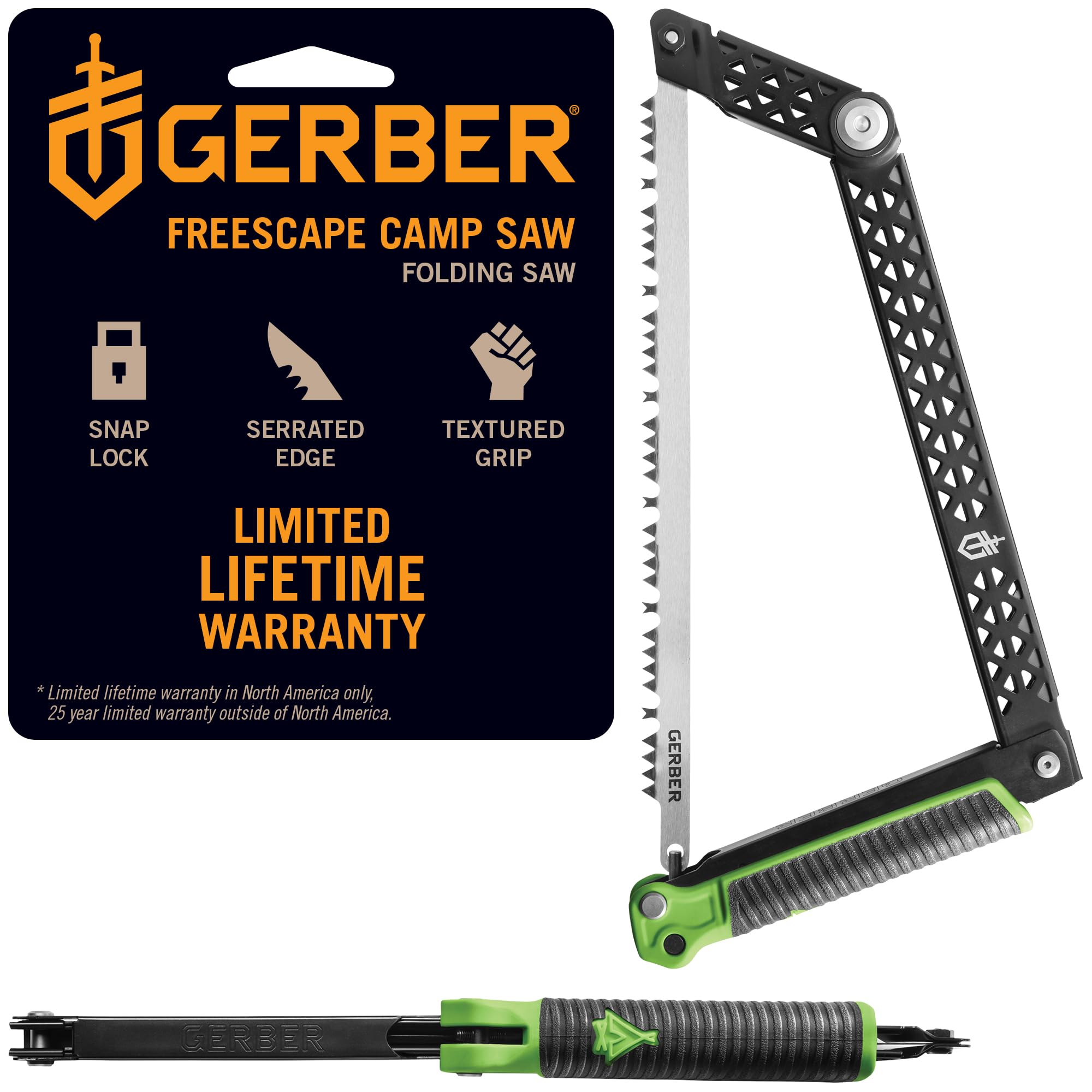
Gerber Freescape 12"
Key Features
- Blade Length: 12 in
- Weight: 16 oz
- TPI / Tooth Shape: 6
- Blade Material: Aluminum oxide coated steel
- Price: $$
The Gerber Freescape’s flat-folding design keeps the entire bow frame intact when packed — no loose parts to track or reassemble. Setup is immediate, and the 12-inch blade with 6 teeth per inch cuts aggressively through smaller to medium logs, making firewood processing at a base camp straightforward.
This saw is built for car campers and overlanders who want the cutting capacity of a bow saw without the bulk of a separate frame. At 16 ounces it’s heavier than non-bow folding saws, and blade tension may loosen during extended use — periodic tightening of the adjustment knob maintains clean cuts. For very large logs a traditional bow saw is faster, but the Freescape’s flat-packed form fits easily in vehicle gear.
Compared to the top pick’s compact folding-saw profile, the Gerber offers a different tradeoff: more cutting depth and rigidity in a package that still stows flat, but with the need to monitor blade tension over time.
Pros
- Flat-folding design stays fully assembled — no parts to remove or lose.
- Cuts efficiently through smaller to medium logs for firewood processing.
- Compact when folded; fits in gear bags without taking up much space.
Cons
- Blade tension may loosen during extended use, requiring periodic adjustment.
- Slower cut speed than dedicated bow saws on large logs.
For car campers who want bow-saw capability without a separate blade and frame, the Freescape delivers a clever folding solution that packs small and cuts reliably on medium firewood.
Best for Pruning & Gardening
Corona RS 7245 7"
Key Features
- Blade Length: 7 in
- Weight: 9.6 oz
- TPI / Tooth Shape: Impulse-hardened
- Blade Material: Steel
- Price: $$
Cuts on the pull stroke for precision, staying sharp through seasons of pruning. The impulse-hardened teeth slice through small to medium branches with little effort, matching the cutting speed of premium-priced Japanese saws for a fraction of the cost. Its curved blade is purpose-built for gardening and light camp tasks, but the tip is vulnerable under side load – prying or aggressive use can cause breakage, making it a specialized tool rather than a bushcraft all-rounder.
Best for gardeners, campers, and hikers who need a lightweight saw that disappears in a pocket. The 7-inch blade handles branches up to 4 inches, and the ergonomic non-slip grip makes one-handed cuts easy. However, the delicate tip means this saw is not for heavy bushcraft or users who prefer a straight blade – it thrives in pruning and light wood processing where clean pull cuts are the norm.
Pros
- Cuts quickly and smoothly through small to medium branches
- Blade stays sharp for years with heat-treated teeth
- Lightweight and fits easily in a pocket
Cons
- Blade tip can break if used for prying or side-loading
For gardeners and light campers who value a sharp, durable blade that stays sharp without frequent maintenance, this Corona saw delivers practical performance without the premium price tag.
Best for Large Logs
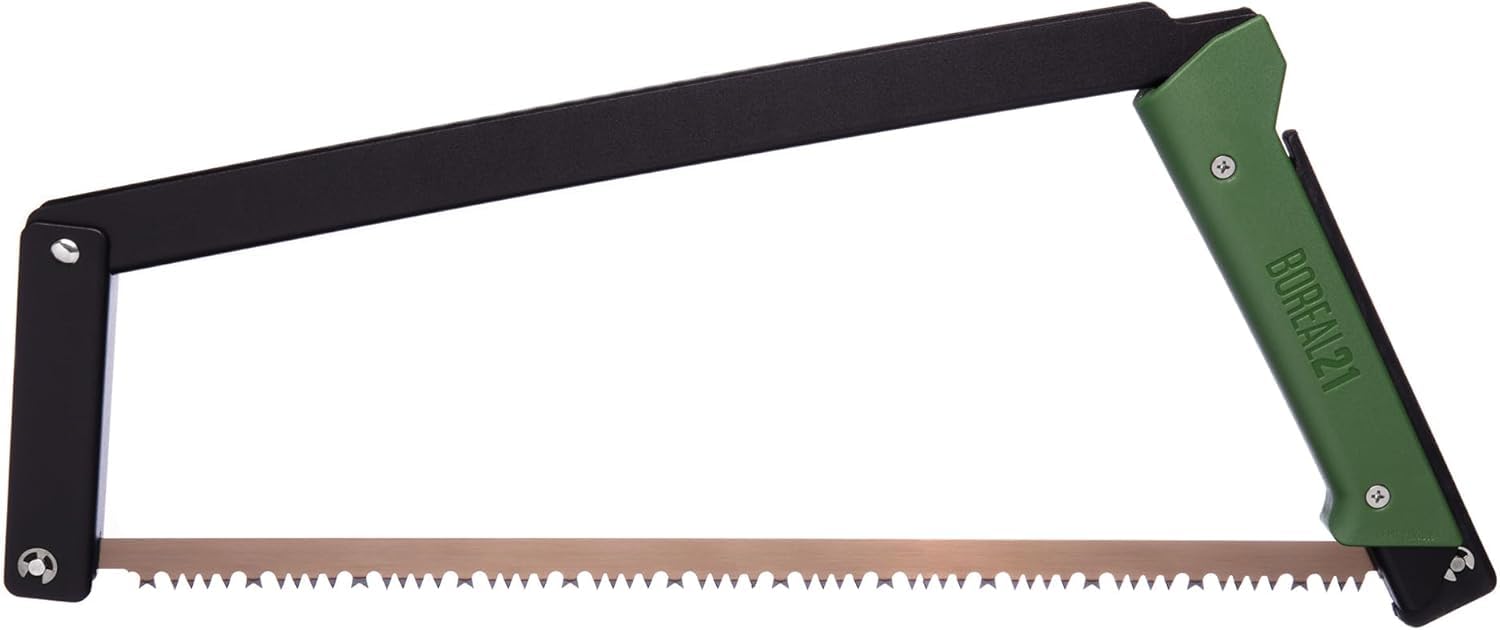
Agawa BOREAL21
Key Features
- Blade Length: 21 in
- Weight: 18 oz
- TPI / Tooth Shape: 6
- Blade Material: Stainless steel
- Price: $$
The Agawa BOREAL21 delivers a 21-inch blade that folds into a surprisingly small shape — enough to cut through 6-inch logs quickly without the bulk of a traditional bow saw. The anodized aluminum frame and fiberglass-reinforced nylon handle hold up to repeated use, and the saw unfolds in seconds without loose parts.
This saw is built for car campers, overlanders, and trail crews who need to process firewood or clear branches in a vehicle-accessible setting. At 18 ounces, it is heavier than typical folding saws — not a problem for base camps but noticeable in an ultralight pack. The blade tension can loosen over several uses, so occasional retightening is expected.
Pros
- Large 21-inch blade cuts through logs over 6 inches thick with ease
- Folds into a compact shape for easy transport in a vehicle or pack
- Sets up in seconds without tools or loose parts
Cons
- Blade tension may need periodic adjustment after extended cutting sessions
- At 18 oz, this saw is heavier than most folding saws — fine for vehicle trips but a weight penalty for backpacking
For car campers who need a packable bow saw for firewood, the BOREAL21 delivers without the bulk of a traditional frame — just keep an eye on blade tension for consistent cuts.
Best for Ultralight Backup
Silky PocketBoy 6.7"
Key Features
- Blade Length: 6.75 in
- Weight: 10.4 oz
- TPI / Tooth Shape: 8.5
- Blade Material: Hard chrome plated steel
- Price: $$$
The PocketBoy trades blade length for pocketability, making it the slimmest folding saw in Silky’s lineup. Where the top pick (GomBoy) handles mid-size logs with ease, this one stops at branches under 3 inches — but it tucks into a pants pocket without bulging.
This saw suits ultralight backpackers who want a backup for trail clearing or small camp tasks. The hard chrome-plated blade cuts aggressively on the pull stroke, but its short length demands patience on anything thicker than a wrist. A minority of owners have reported blade snap under side load — avoiding binding and keeping cuts straight reduces that risk.
Pros
- Fits in a pocket or small pouch without adding noticeable bulk.
- Cuts through small branches and saplings with minimal effort.
- Solid rubber handle and locking positions feel premium in hand.
Cons
- Blade length limits cuts to branches under 3 inches; not suitable for larger firewood processing.
- Occasional reports of blade snapping when cutting a 2-inch branch under stress.
For backpackers who carry weight in grams and only need to clear small limbs, the PocketBoy delivers Silky’s cutting speed in an ultra-packable form. If you process larger wood regularly, the GomBoy or Bahco Laplander stretch a few more ounces for far more capacity.
Best for Light Pruning
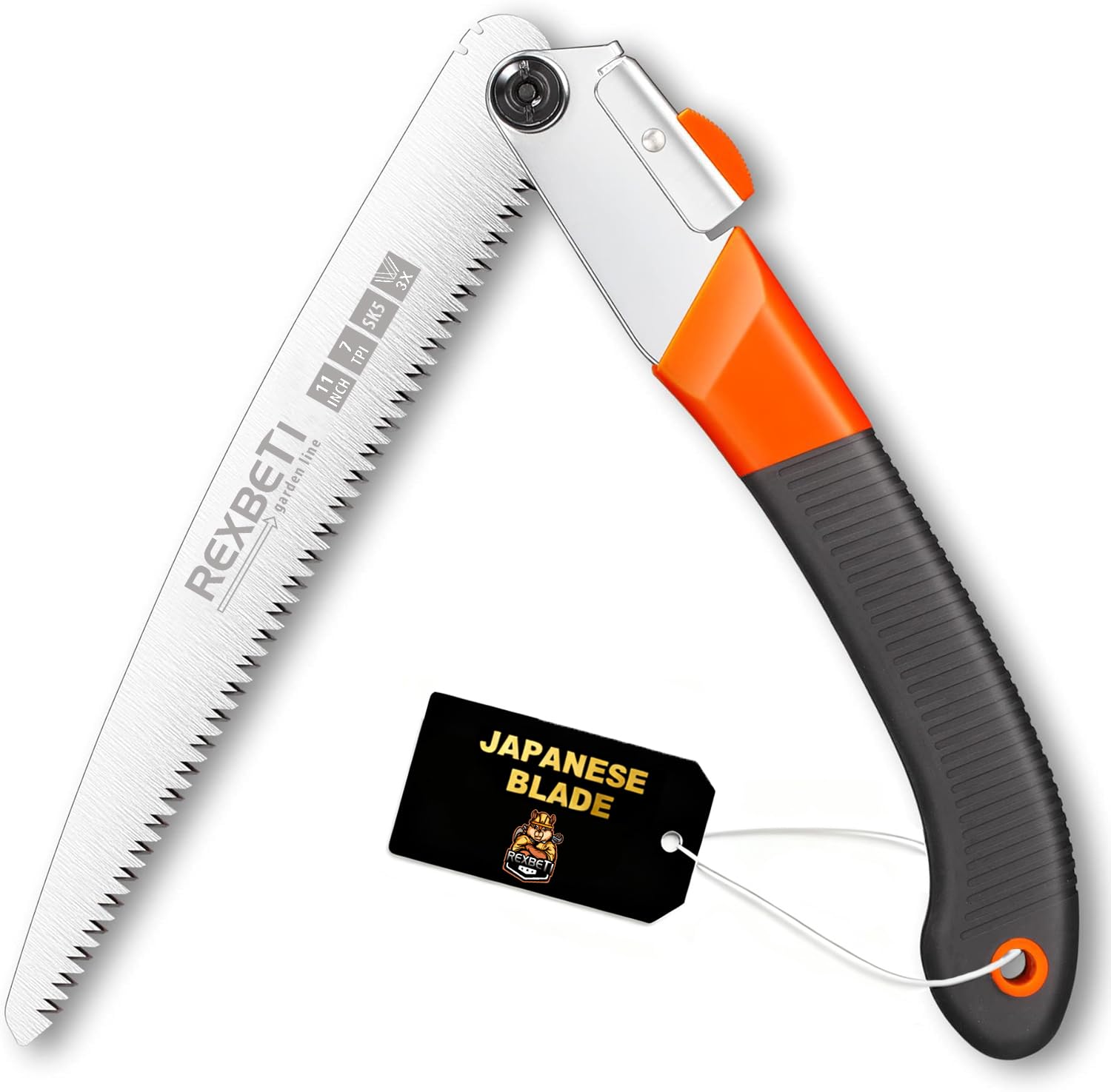
REXBETI 11"
Key Features
- Blade Length: 11 in
- Weight: 9 oz
- TPI / Tooth Shape: 7
- Blade Material: SK-5 steel
- Price: $
This saw cuts green wood quickly and arrives razor-sharp, offering decent performance for the price. However, the thin blade can snap under moderate side stress, and the plastic handle may separate after limited use — issues that make it a gamble for regular outdoor tasks. It suits light pruning or get-home bags where a failure is acceptable, not daily bushcraft.
Pros
- Cuts fast through green wood
- Very sharp out of the box
Cons
- Plastic handle can crack or separate under stress
- Blade can snap when subjected to side load or binding
Best for light pruning or emergency kits where occasional use and low cost outweigh the chance of handle or blade issues.
Best for Home Gardening
WEIMELTOY 10"

Key Features
- Blade Length: 10 in
- Weight: 10.6 oz
- TPI / Tooth Shape: 6
- Blade Material: SK5 carbon steel
- Price: $
The WEIMELTOY 10-inch saw cuts through pine like butter and costs under $10, making it an appealing pick for light pruning tasks. However, the thin blade can flex under heavy stress, and the locking pin may loosen over time — these traits limit its suitability for regular camping or bushcraft where durability matters. It fits best as an emergency backup or for occasional trimming of soft branches in the yard.
Pros
- Sharp SK5 carbon steel blade slices through pine and thick branches with minimal effort.
- Budget-friendly price delivers respectable cutting performance for occasional yard work.
Cons
- Thin blade can flex or bend when cutting dense or knotted wood under heavy stress.
- Locking pin may loosen after repeated use, allowing the blade to fold unintentionally.
Best suited for home gardeners with small pruning tasks on softwood, or as a backup in an emergency kit — not for anyone needing a saw for regular outdoor use.
Best for Very Light Pruning
Fiskars 10" Folding

Key Features
- Blade Length: 10 in
- Weight: 8 oz
- TPI / Tooth Shape: 6
- Blade Material: Alloy steel
- Price: $
The 10-inch blade folds into a compact shape that tucks into a toolbox or garden apron for occasional pruning tasks. However, the thin steel binds easily when cutting thicker branches or if any twisting force is applied, and the plastic locking button can wear or break over time, making the blade feel less secure. Compared to the Bahco Laplander, this saw lacks the durability and lock reliability needed for any kind of outdoor work beyond the lightest garden trimming.
Pros
- Folds down for easy storage and transport despite the 10-inch blade.
- Cuts small branches up to an inch or two without issue.
Cons
- Blade can bind during cuts on thicker or twisted wood, requiring careful technique.
- Lock may wobble or break over time, so check it before each use.
Best for very light, occasional pruning at home where the Fiskars name is a plus, but not for camping, bushcraft, or any task that demands a durable lock and blade.
How to Choose
The folding saw that works for one trip may fail on another — the key is matching blade length and steel quality to the wood you actually cut.
Blade Length
Longer blades (10-14 inches) cut larger logs faster but require more arm extension and are heavier. Shorter blades (6-8 inches) are easier to control and pack, but limit you to branches under 3-4 inches. For backpacking, a 7-inch blade saves weight and avoids the temptation to cut oversized wood that strains the blade. For base camp or car camping, a 12- or 21-inch blade lets you process firewood efficiently.
Weight
Every ounce matters on the trail. A saw under 10 ounces is ideal for backpacking, while 14-18 ounces is acceptable for shorter trips or vehicle-based use. Heavier saws often have thicker blades and more robust locks, which improve durability but add pack weight. The trade-off: a lighter saw may feel flimsy under heavy cutting, so match weight to your typical cutting volume.
Tooth Configuration
Tooth count (TPI) and shape determine cut speed and finish. Low TPI (5-6) cuts fast but leaves a rough surface, ideal for firewood. High TPI (8-10) gives a smoother cut for pruning. Impulse-hardened teeth (like Silky and Corona) stay sharp much longer than standard steel teeth but are harder to resharpen. For general camping, a medium TPI (7-8) balances speed and finish.
Tooth geometry also matters: curved blades cut on the pull stroke (Japanese style) for more control, while straight blades cut on both push and pull (like Bahco) reduce fatigue. If you prune a lot of branches, a pull-cut curved blade gives cleaner cuts with less effort.
Locking Mechanism Reliability
A weak lock can cause the blade to fold during a cut — a safety risk that also ruins cutting efficiency. The most reliable designs use a metal rotating cam or a thick steel spring button. Plastic locks (common on budget saws) wear out and loosen after a few trips. Check if the lock engages with a solid click and has no side play before buying. If a saw has multiple reviews of the lock failing, avoid it for any real use.
Blade Material and Thickness
High-carbon steel (like SK-5 or Swedish steel) holds an edge longer but can rust if not dried. Hard chrome plating (Silky) resists corrosion and reduces friction. Thicker blades (over 0.04 inches) are less likely to snap under side load but cut more slowly. Thin blades (under 0.03 inches) cut faster and are lighter but can bend or break if twisted. For all-around use, a medium-thickness blade from a reputable steel source gives the best balance.
FAQ
Why do some folding saw blades snap so easily?
Blades snap because they are too thin for the cutting force applied or the lock allows the blade to twist. Many budget saws use thin steel (under 0.03 inches) to save weight and cost, which cannot handle side loads or binding. Always match blade thickness to the size of wood you cut — a 7-inch blade is for branches, not logs.
What is the best folding saw for backpacking under 10 ounces?
The Bahco Laplander at 7.5 ounces and the Silky F180 at 6.4 ounces are top choices. For even lighter weight, the Silky PocketBoy 130mm (8.6 oz) is an option but limits you to very small branches. Under 10 ounces, you sacrifice cutting capacity, so prioritize a saw that matches your typical wood size.
Can a folding saw cut through 6-inch thick logs?
Yes, but only with a blade at least 10 inches long and a robust lock. The Silky BIGBOY 2000 and Agawa BOREAL21 handle 6-inch logs in seconds. A short blade (under 8 inches) will struggle and risk binding or breaking. Use a folding saw designed for large cuts, not a compact pocket saw.
How do I tighten a loose folding saw blade lock?
Most locks have a pivot screw or bolt that can be tightened with a small screwdriver or hex key. If the lock is a spring-loaded button, check for debris or wear — replace the saw if the spring is weak. For blade tension issues (like on bow saws), tighten the tensioning knob or use a small wrench to adjust the nut. Regular maintenance prevents sudden failure.