This post contains affiliate links. We may earn a small commission when you buy through our links — at no extra cost to you.
Portable solar panels have a habit of promising more power than they actually deliver under a real sun. A 100W panel might only push 60W to your power station, leaving you with a dead battery at dusk.
The trick is not to chase the highest number on the box, but to find a panel that consistently produces at least 70-80% of its rating. That means looking at weight, build quality, and how the panel handles partial shade and mounting.
You’ll often face a choice: a lighter, lower-cost panel that matches heavy hitters on output, versus a heavier, more expensive one with a proven track record. We’ve sorted through the trade-offs so you can pick the one that fits your camping style.


Best for High-Output Camping
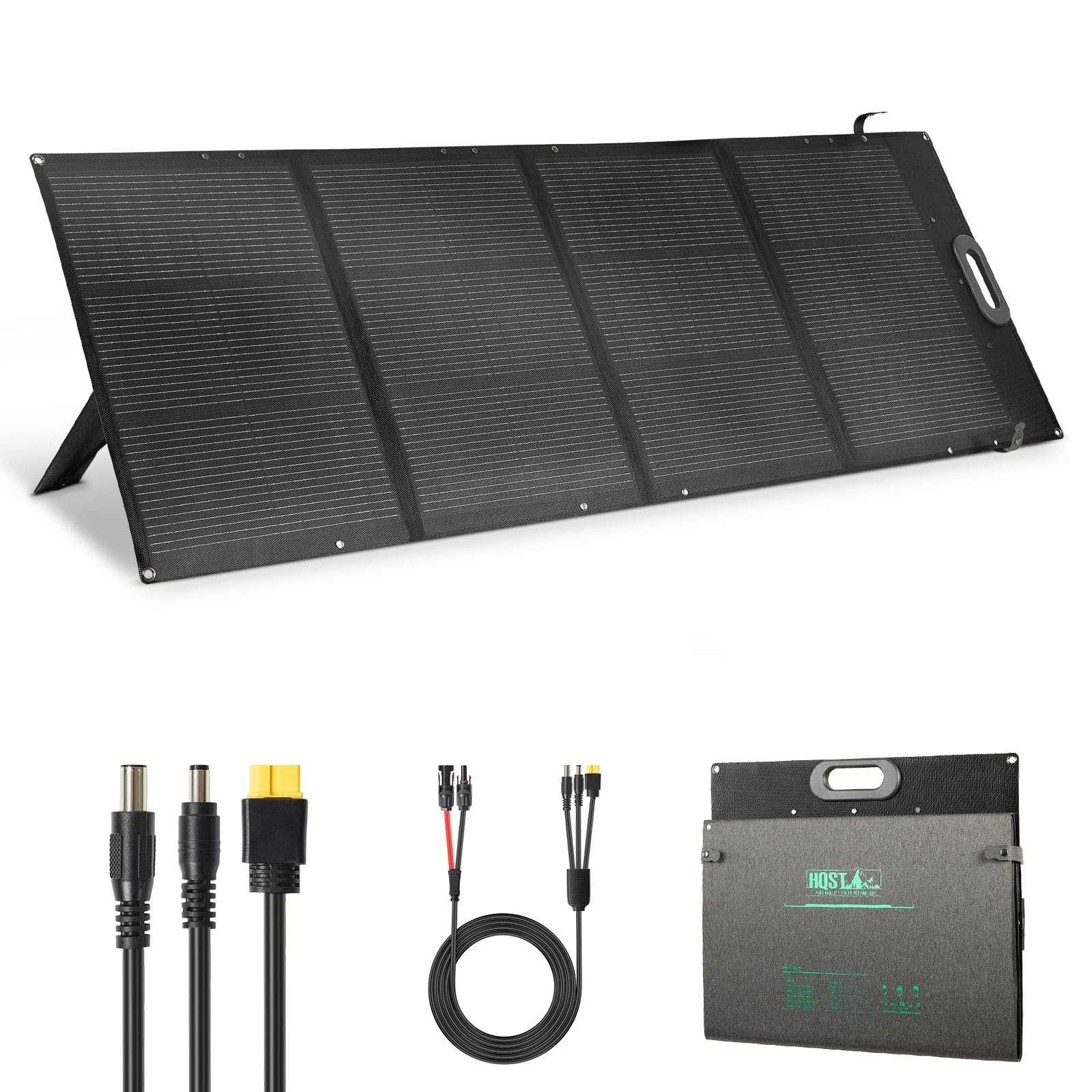
HQST 200W
Key Features
- Wattage vs Output: 160-180W typical
- Weight & Size: 11 lbs
- Waterproof: IP67
- Connectors: 3-in-1 adapter
- Stand Type: Kickstands
- Price: Mid-Range
The HQST 200W consistently produces power close to its rated output, a rarity among foldable panels. At 11 lbs, it’s light enough to carry from the car to the campsite without strain, and the mid-range price undercuts many alternatives while matching their performance.
In full sun, the panel outputs 165-180W, sufficient to recharge a 300Wh power station in under two hours. The IP67 rating handles rain and humidity, and the included 3-in-1 adapter connects to most common power station input ports.
This panel is best for campers and RVers who want high wattage without the weight of traditional glass panels. It is not designed for backpackers — at 11 lbs it is too heavy for long hikes. Buyers should inspect the frame on delivery, as the aluminum can arrive bent in some shipments. For those who prioritize consistent build quality over price, the Renogy alternative offers fewer shipping concerns.
Pros
- High real-world power output near 200W rating
- Lightweight at 11 lbs for easy portability
- Good value for the performance
- IP67 waterproof rating for outdoor use
Cons
- Aluminum frame can arrive with dents or bends due to shipping
If you want the highest real-world wattage per dollar and weight, the HQST 200W is the clear choice — just check the frame on delivery.
Best for Power Station Campers
ZOUPW 100W
Key Features
- Wattage vs Output: 70-85W typical
- Weight & Size: 9.5 lbs
- Waterproof: IP67
- Connectors: 5-in-1 cable
- Price: Mid-Range
The ZOUPW 100W panel ships with a 5-in-1 cable that includes DC8020, XT60, Anderson, DC7909, and DC5521 connectors – this covers the vast majority of portable power stations on the market.
This makes it a strong choice for campers who own multiple brands or plan to upgrade their power station. The 23.5% monocrystalline cells are efficient for the price. At 9.48 lbs, it is manageable for car camping but not suited for hiking to a remote site.
In direct sun, most users see 70-85W drawn by their power station, which is solid for a 100W panel. That said, a small fraction of units produce only 20-40W. If that happens, the panel will not meet expectations – this is a known but occasional quality control variance.
Pros
- Connector kit covers Jackery, EcoFlow, Bluetti, and Anker power stations without extra adapters.
- Consistent 70-85W output in real-world conditions for quick charging.
- Cost-effective compared to other 100W panels with similar performance.
Cons
- No USB output – requires a separate power station or charge controller to charge phones or devices.
- Output can drop to 20-40W in some units, well below the typical 70-85W.
For multi-brand power station owners, the ZOUPW 100W eliminates adapter headaches at a competitive price – just be prepared to test output on arrival.
Best for Backpacking Essentials
FlexSolar 40W
Key Features
- Wattage vs Output: 25-33W typical
- Weight & Size: 1.76 lbs, 8×11 in
- Waterproof: IP67
- Connectors: USB-C, USB-A, DC
- Price: Budget
At just 1.76 lbs and folding to the size of a notebook, the FlexSolar 40W is the go-to choice for hikers who count every ounce. It slips into any backpack pocket and the IP67 waterproofing means you can leave it strapped to your pack in light rain. Compared to the larger 100W panels that weigh 4 lbs or more, this panel sacrifices total capacity for unmatched portability.
This panel is built for day-trippers and backpackers who need a lightweight backup charger for phones, power banks, and small USB gadgets. It is not suitable for power stations or larger electronics — real-world output typically falls between 25 and 33W instead of the advertised 40W, and some units may experience intermittent charging that prevents a steady top-off. Keep expectations aligned with its intended use as a compact emergency charger rather than a primary power source.
When the sun is out, the FlexSolar reliably pushes charge through its USB-C PD and USB-A outputs, even in partly cloudy conditions. The built-in panels handle direct sunlight well, and the foldable design makes setup quick — just unzip and angle toward the sun. For anyone whose main goal is keeping a phone alive on the trail, this panel gets the job done without adding bulk.
Pros
- Extremely lightweight and compact — folds to 8 x 11 inches at 1.76 lbs
- Reliable charging for phones and small USB devices in sunny and cloudy conditions
- IP67 waterproof rating allows use in wet weather without damage
Cons
- Charging may be inconsistent: some units have intermittent output or stop working after a few uses
- Real-world output is lower than 40W (typically 25-33W), making it slower for larger tablets or multiple devices
If your priority is packing light and keeping a phone topped off on the trail, this panel delivers portability and decent performance within its narrow use case.
Best for Ultralight Hiking
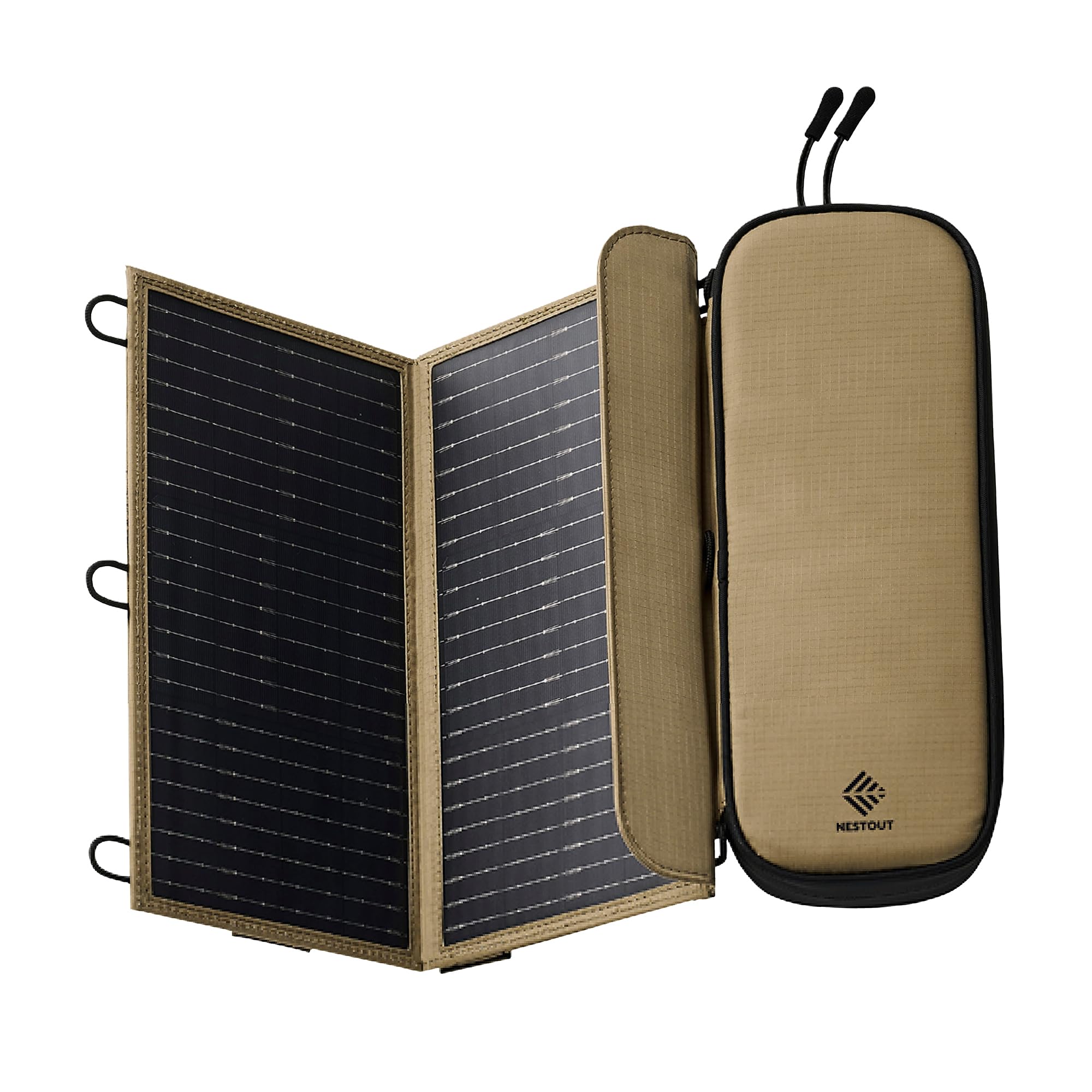
NESTOUT 14W
Key Features
- Wattage vs Output: 14W typical
- Weight & Size: 1.34 lbs, 5.9×11 in
- Waterproof: Water-repellent
- Connectors: USB-C, USB-A
- Stand Type: Adjustable stand
- Price: Premium
The NESTOUT 14W folds down to 5.9 x 11.0 x 2.2 inches and weighs just 1.34 lbs, making it one of the most packable solar panels available. Its ripstop nylon exterior sheds light moisture, and the built-in digital ammeter lets you adjust the angle until you see peak current — a feature absent from most sub-20W panels. This is a thoughtfully designed piece of kit, not a generic budget panel.
This panel is for the ultralight backpacker who needs to top off a phone or a small power bank during multi-day trips. The 14W output is the hard limit: it won’t charge a laptop, a power station, or anything drawing more than 5-10W in practice. If your off-grid setup includes larger electronics, look at the 40W FlexSolar instead. For the solo hiker who values ounces and aesthetics, the tradeoff makes sense.
The storage pocket on the back holds a slim battery or cable, reducing fumbling when you set up camp. The adjustable stand angles the panel toward the sun without needing a rock or backpack. These details matter when you’re moving daily and want to minimize setup time.
Pros
- Compact, award-winning design that fits a backpack pocket easily
- Digital ammeter helps you find the optimal sun angle quickly
- Built-in storage pocket holds a power bank or cables during charging
- Adjustable stand allows propping without extra gear
Cons
- 14W output limits charging to phones and small USB devices — no laptop or power station support
- Premium price per watt compared to higher-output panels, making sense only for ultralight use
A beautifully executed panel for the weight-conscious camper, but only if your charging needs stop at a phone or small battery.
Best for Rv & Van Use
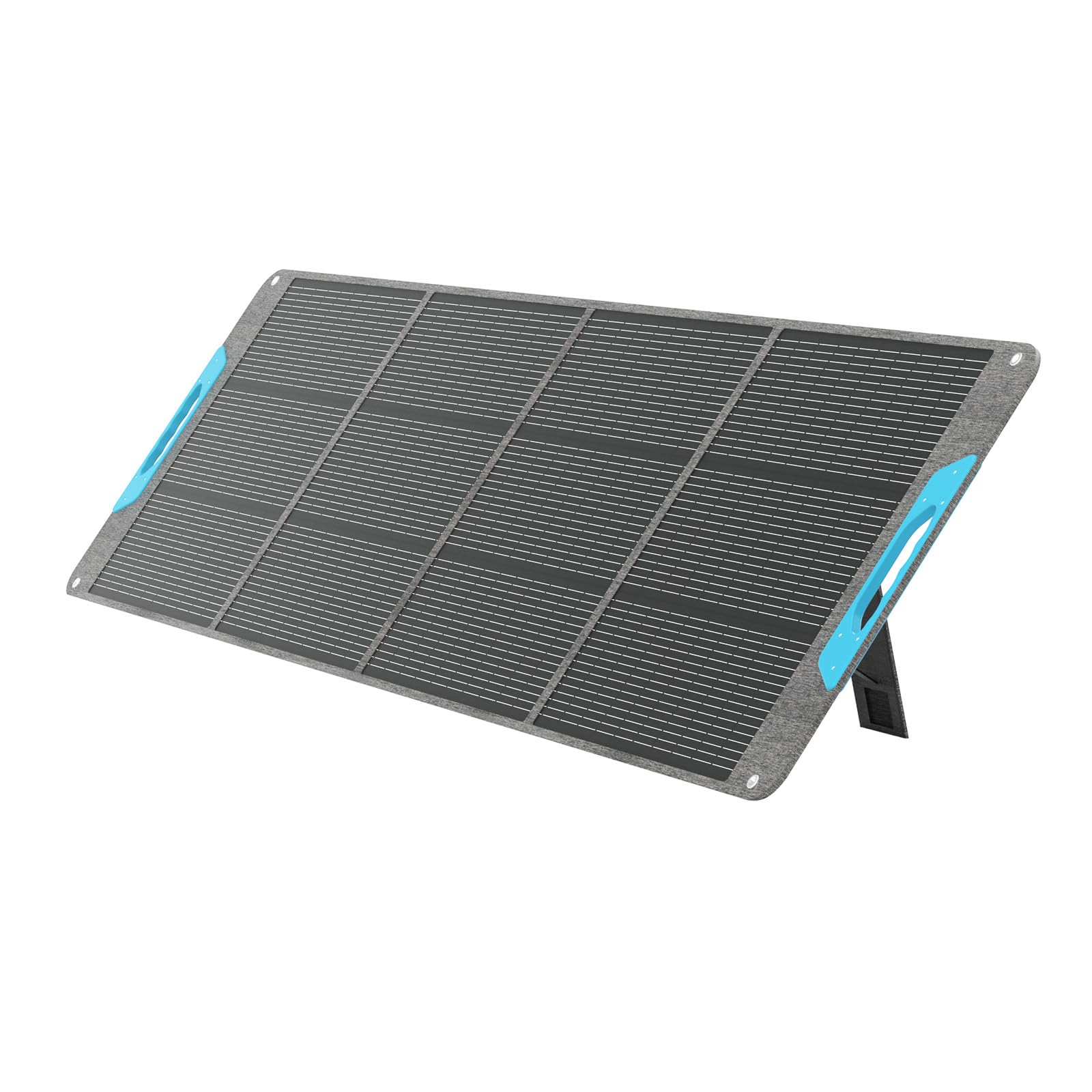
Renogy 200W E.Flex
Key Features
- Wattage vs Output: 160-180W typical
- Weight & Size: 13.9 lbs, large fold
- Waterproof: IP65
- Stand Type: Kickstands
- Price: Premium
Renogy’s reputation for consistent construction shows in the 200W E.Flex. The panel uses high-efficiency cells (25%) and an IP65-rated fabric that holds up in wind and light rain. Real-world output lands between 160-180W in full sun — close to rated capacity. That reliability comes at a cost: at 13.9 lbs and a premium price, it’s heavier and more expensive than the top pick HQST, which delivers similar output for around $135.
This panel suits RV and van travelers who leave the panel deployed for days at a time and need something that can withstand weather and frequent setup. The magnetic closure and compact folded size make storage straightforward. But at nearly 14 lbs, it’s not the best choice for backpacking or long carries from a parking spot to a campsite. The kickstand legs can be fiddly to align alone — easier with two people or a flat surface.
Pros
- Sturdy build with high-efficiency cells that deliver near-rated power in real sun
- Folds compactly with a magnetic closure for secure storage
- IP65 waterproof rating handles light rain and splashes without issue
Cons
- The kickstand legs can be awkward to set up solo — best to align on a flat surface before unfolding
- At 13.9 lbs, the panel is heavier than comparable 200W options, which matters for carrying any distance
If you’re willing to pay more and carry extra weight for a panel that feels built to last through years of RV trips, the Renogy 200W delivers. For lighter budgets or lighter packs, the HQST offers similar output at a lower price.
Best for Kickstand Campers
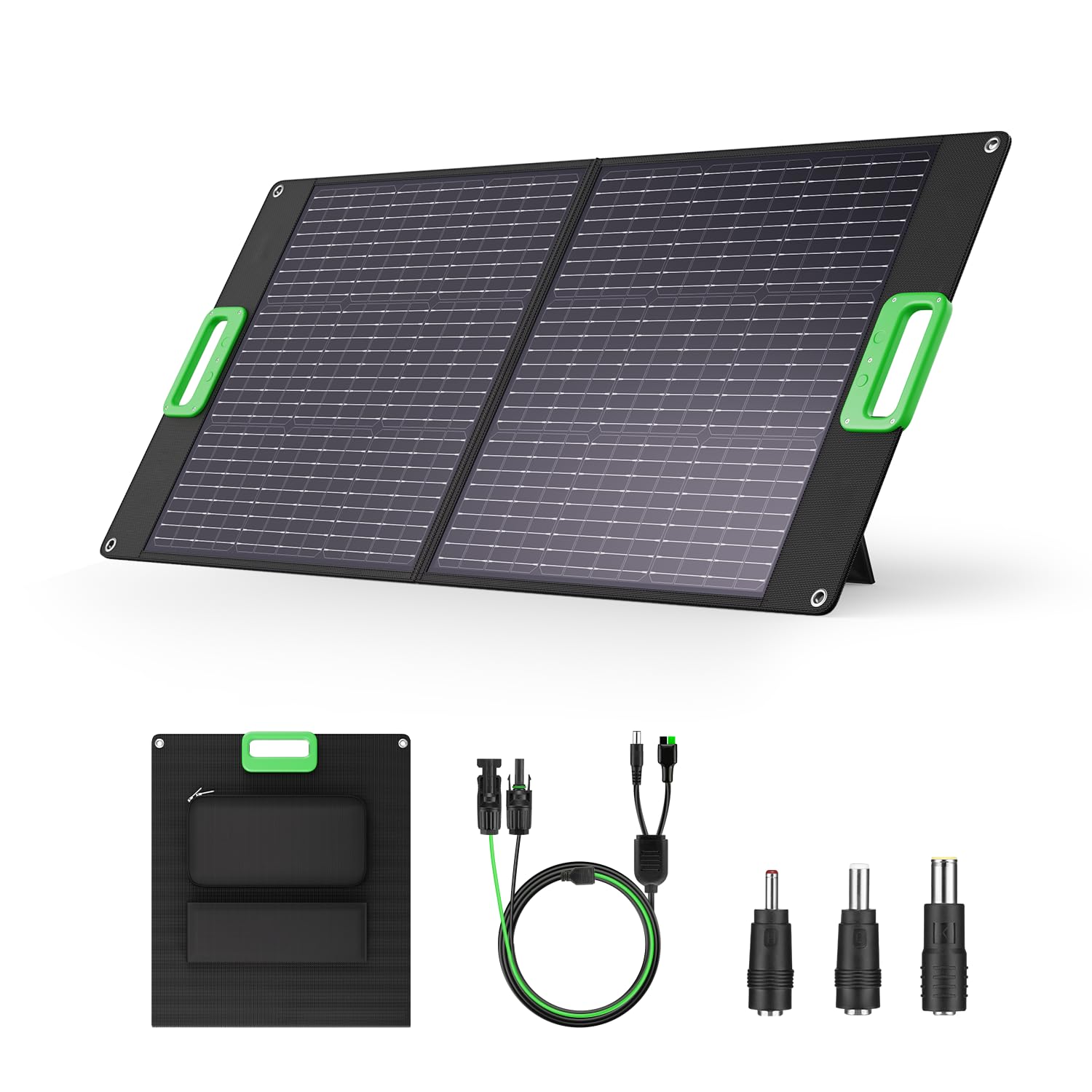
GRECELL 100W
Key Features
- Wattage vs Output: 60-70W typical
- Weight & Size: 6.1 lbs claimed
- Waterproof: IP65
- Connectors: MC4, multi-adapter
- Stand Type: Kickstands
- Price: Mid-Range
The GRECELL 100W excels with its robust kickstands and grip that make angle adjustment and deployment simple at a campsite. It charges power stations at 60-80W, enough to top off a midday drain. But output is typically 60-70W, far from the rated 100W, and the weight may be over 10 lbs rather than the advertised 6.1 lbs. This panel suits campers who value build quality and don’t need full rated power or ultralight packing.
Pros
- Sturdy kickstands and grip allow easy angle adjustment on uneven ground
- Charges power stations consistently at 60-80W in direct sun
- Includes MC4 connector with multi-adapter kit for broad power station compatibility
Cons
- Output is around 60-70W in direct sun, not the rated 100W
- Weight may be closer to 10 lbs than the listed 6.1 lbs, making it heavier than expected for portable carry
Best for campers who prioritize sturdy panel positioning and don’t mind a heavier, lower-output panel – works well as a supplementary charging source.
Best for Car Camping
SOLUPUP 30W
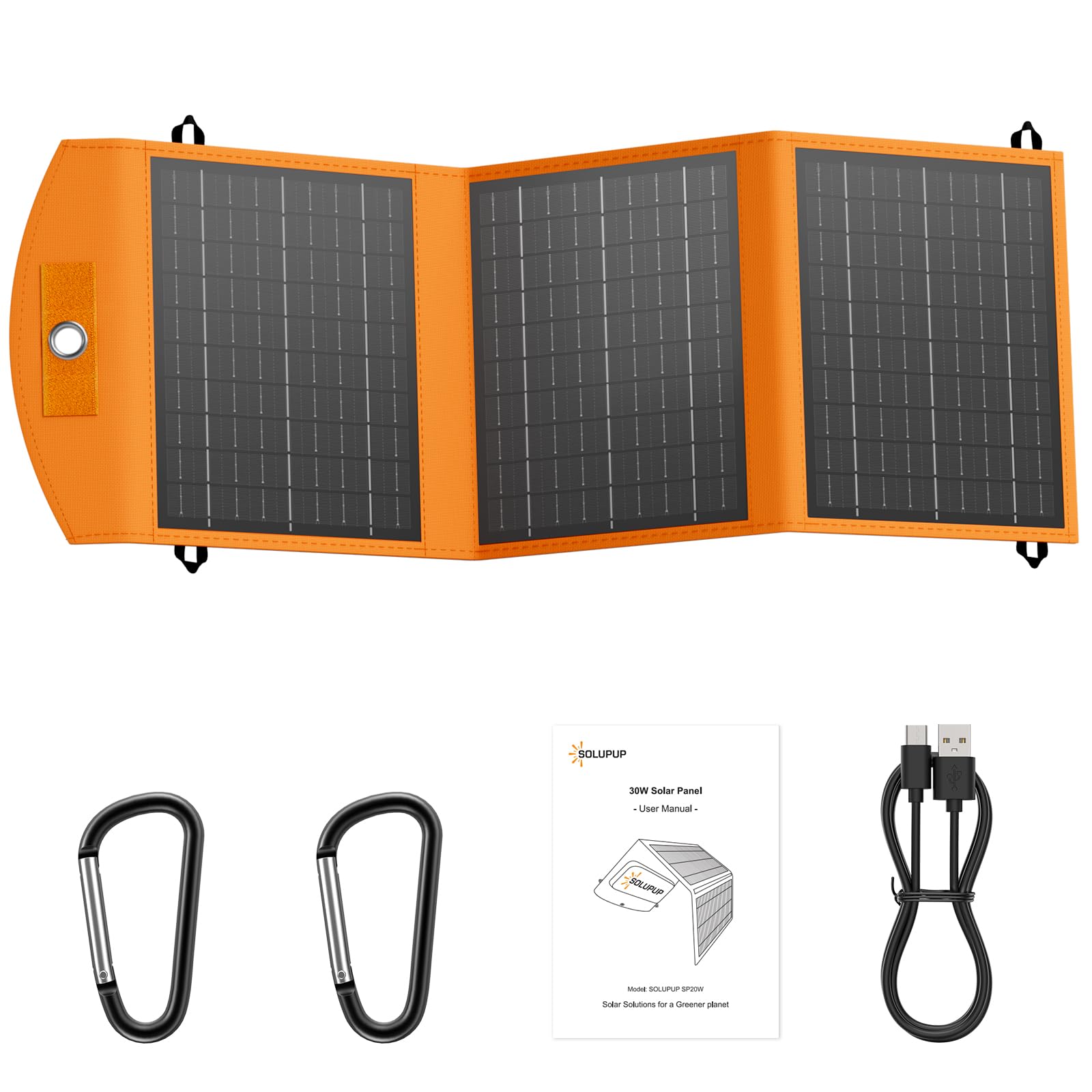
Key Features
- Wattage vs Output: under 20W typical
- Weight & Size: 2.4 lbs
- Waterproof: IPX5
- Connectors: USB-A, USB-C
- Price: Budget
The SOLUPUP 30W delivers decent build quality for its price, with a compact folded size that tucks into a backpack easily. Charging speed, however, is slow even under direct sun – expect output well below the 30W rating, closer to 15-20W. At 2.4 lbs, the weight-to-wattage ratio falls short for backpackers counting ounces. This panel works for topping off phones and power banks during car camping, but hikers needing reliable power on the trail will find better options in lighter, more efficient panels.
Pros
- Build quality feels solid and well-made for the price.
- Compact folded size packs easily into a backpack or glovebox.
Cons
- Charging output under direct sun often falls below 20W – slow for the rated 30W.
- At 2.4 lbs, the panel is heavy for its wattage – a concern for backpackers.
This panel suits casual car campers who want a cheap, compact option for emergency phone charging. Not the choice for backpackers or anyone needing faster top-ups.
Best for Occasional Use
DOKIO 100W Suitcase
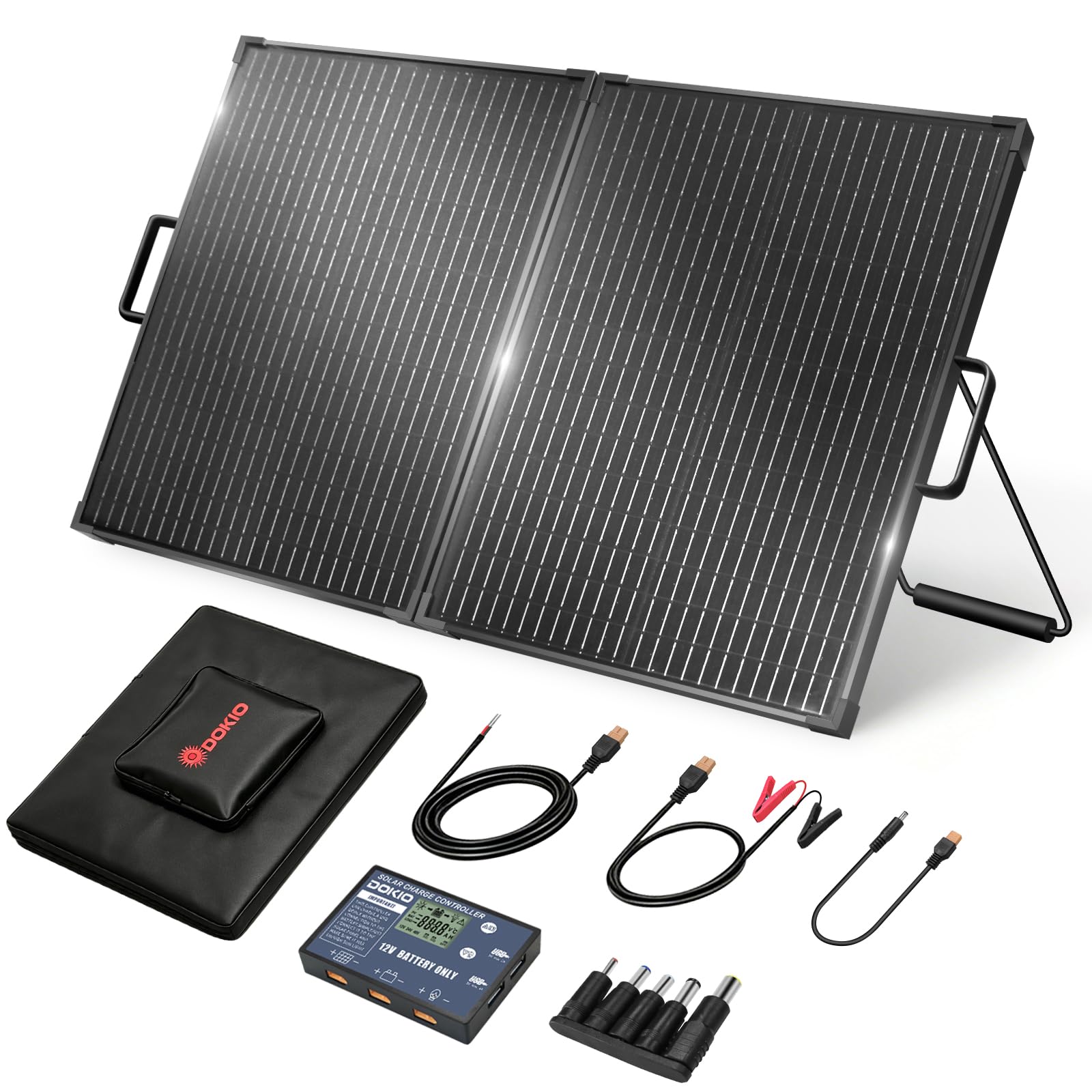
Key Features
- Wattage vs Output: 50-70W typical
- Weight & Size: 10-12 lbs
- Waterproof: Not rated
- Stand Type: Legs/kickstands
- Price: Budget
This DOKIO suitcase pairs directly with 12V lead-acid batteries using its built-in PWM controller — no additional gear needed. The low price makes it an attractive entry point for occasional campers who want a basic battery maintainer. That said, real-world output tends to land between 50 and 70 watts in direct sun, well below the 100W label. The fabric and plastic legs can show wear after modest use; corner guards may break and rust may appear. This panel suits someone who needs a lightweight, cheap option for topping off a battery on a weekend trip, not someone expecting daily charging or long-term outdoor reliability.
Pros
- Ready to use with 12V batteries — built-in controller included.
- Low cost for a complete solar charging kit.
Cons
- Legs and fabric are prone to wear; corner guards may break and rust can appear after limited use.
- In full sun, actual output can be 50-70W rather than the advertised 100W — sufficient for battery maintenance but not for powering devices.
Best suited as a low-cost battery maintainer for occasional camping trips where portability and price matter more than long-term durability or full rated output.
How to Choose
The most important insight: expect 70-80% of rated wattage in real-world conditions — a 100W panel will realistically output 60-80W on a sunny day.
Wattage vs Real Output
No portable solar panel hits its advertised wattage under typical conditions. Factors like panel temperature, sun angle, partial shade, and cable losses cut output by 20-40%. A 100W panel that delivers 70W is performing well.
To compensate, buy a panel rated 20-30% higher than your needs. If you need 100W continuous, look for a 120-130W panel. Avoid budget models where the gap between rated and real output is often 50% or more.
Weight & Folded Size
Weight determines where you can use a panel. A 200W panel at 11-14 lbs is fine for car camping or RV use but too heavy for backpacking. Sub-2 lb panels under 50W are better for hiking.
Folded size matters for packing. Panels that fold to roughly the size of a laptop or notebook fit easily in a backpack. Larger 200W panels fold to the size of a large suitcase — plan storage space accordingly.
Waterproof Rating
IP67 panels can handle rain and even brief submersion, making them ideal for unpredictable weather. IP65 panels resist splashes but not direct water exposure. Panels without a rating should be kept dry.
If you camp in rainy regions, prioritize IP67. For occasional light rain, IP65 is sufficient. A water-repellent fabric panel (like the NESTOUT) is fine for drizzle but not a downpour.
Connectors & Compatibility
The right connector saves headaches. Many power stations use XT60, DC7909, or Anderson ports. Panels with a 3-in-1 or 5-in-1 adapter cable work with most brands. USB-C PD ports are handy for direct phone charging.
If you have a specific power station, check its input connector before buying. Some panels come with proprietary cables that limit flexibility. Universal kits add weight but reduce the need for adapters.
Stand Type & Angle Adjustment
Built-in kickstands or legs let you angle the panel toward the sun, increasing output by 20-30% compared to laying it flat. However, kickstands on budget panels can be flimsy or hard to adjust on uneven ground.
For optimal charging, tilt the panel perpendicular to the sun. A digital ammeter (like on the NESTOUT) helps you find the sweet spot. Without a stand, you can prop the panel against a backpack or tree.
FAQ
Why does my 100W foldable solar panel only output 60 watts?
That’s normal. Expect 70-80% of rated wattage in real sunlight due to heat, angle, and cable losses. A 100W panel delivering 60-80W is typical. Panels below 50W of-rated may indicate excessive shading or a poorly performing unit.
Can I leave a foldable solar panel out in the rain?
Only if it has an IP67 or higher rating. IP67 panels can handle rain and brief submersion. IP65 panels resist splashes but not continuous exposure. Unrated panels should be dried immediately after use. Check the waterproof rating before relying on a panel in wet weather.
How do I angle a portable solar panel for maximum charging?
Tilt the panel directly toward the sun, roughly perpendicular to its rays. A digital ammeter built into some panels helps you find the peak. If your panel lacks a stand, prop it against a pack or use rocks. Adjust every hour as the sun moves to keep output high.
Is a 200W solar panel too heavy for backpacking?
Yes, for multi-day hikes. Most 200W panels weigh 11-14 lbs, which is manageable for car camping but excessive for backpacking. For backpacking, consider a 40W panel under 2 lbs or a 14W ultralight panel if you only need to charge phones.