This post contains affiliate links. We may earn a small commission when you buy through our links — at no extra cost to you.
Many dry bags start strong but develop leaks or broken buckles after a few outings. The difference between a bag that lasts and one that doesn’t often comes down to seam construction and clip quality. This guide separates the ones built for repeated submersion from those best left for occasional use.
Spending a little more on a bag with reinforced seams and a proven closure system often pays off within a single season. Budget options can work if you’re only heading out once or twice, but the real cost shows when a wet sleeping bag cuts a trip short.
Whether you need a compact essentials pouch or a 35-liter hauler for multi-day camping, the picks here balance price with the durability that keeps your gear dry when it counts.



Best for Day Kayakers
Earth Pak 20L Dry Bag
Key Features
- Capacity: 20L
- Material: PVC
- Strap Type: Adjustable shoulder
- Accessories: IPX8 phone case
- Closure: Roll-top with buckle
- Price: Mid-Range
The Earth Pak 20L dry bag comes with an IPX8 phone case and a Wirecutter recommendation – a combo that signals it’s built for surface-level water sports. The roll-top closure and PVC material keep gear dry during kayaking, paddleboarding, and beach trips, and the adjustable shoulder strap makes it easy to carry. Functionality and portability are strong points, with positive feedback backing the overall design.
This bag suits day kayakers, paddleboarders, and beachgoers who need a straightforward waterproof sack for gear and electronics. Over time, seam durability can degrade under heavy use – it is not intended for rough backcountry conditions or extended submersion. For its intended use on calm waters and occasional trips, it performs well.
Pros
- Waterproof performance keeps gear dry on the water
- Build quality holds up over regular use
- Cost-effective kit that includes a phone case
Cons
- Seam durability can weaken with very frequent heavy use
For day paddlers wanting a dependable bag with a phone case, this is a straightforward buy.
Best for Budget Kayakers
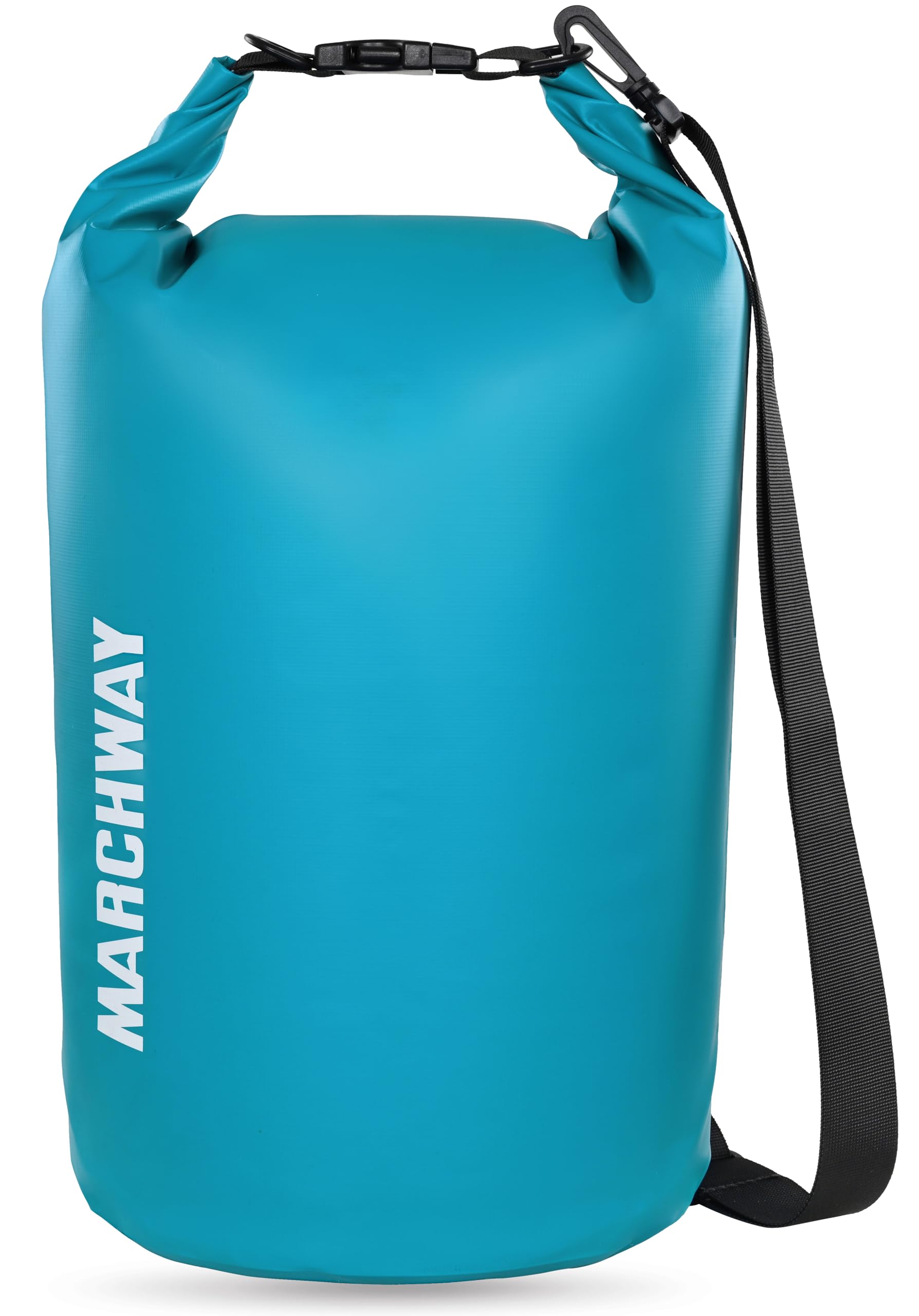
MARCHWAY 10L Dry Bag
Key Features
- Capacity: 10L
- Material: PVC tarpaulin
- Strap Type: Adjustable shoulder
- Closure: Roll-top with buckle
- Price: Budget
The MARCHWAY dry bag floats when properly sealed — a feature that saves time fishing gear out of the water — and costs less than the Earth Pak equivalent. Its water resistance holds up for kayaking and rafting in moderate conditions. The PVC tarpaulin material resists abrasion from rocky landings, and the strap options suit both small day packs and larger loads.
This bag suits kayakers who stick to flat water and want a lightweight, affordable option for day trips. It is not designed for extended submersion; occasional seam issues may appear under heavy use. For those who need a bag that can handle rough conditions or multi-day expeditions, the Earth Pak remains the more durable choice.
Pros
- Budget-friendly price for a bag that keeps gear dry on kayaking trips.
- Water resistance holds up in typical paddling conditions like rafting and SUP.
- Floats when sealed, making retrieval after a capsize straightforward.
Cons
- Under prolonged underwater use, water can seep through the closure.
- Seams may separate or buckles break under heavy use over time.
A smart buy for budget-minded paddlers who stay on flat water — just keep it out of the deep end.
Best for Multi-Day Kayak
Earth Pak 35L Backpack
Key Features
- Capacity: 35L
- Material: PVC
- Strap Type: Padded backpack straps
- Accessories: Phone case, pockets
- Closure: Roll-top with buckle
- Price: Premium
The Earth Pak 35L stands out for portaging heavy loads – the padded backpack straps and waist belt make carrying a full camp kit manageable over long carries. Its large capacity suits multi-day trips where you need a change of clothes, tent, and food all in one waterproof roll-top.
This bag suits paddlers who prioritize comfort for extended trips and don’t mind a premium price. Some buckle closures can break under stress, so checking them before each trip is wise.
Pros
- Padded shoulder straps and waist belt distribute heavy loads comfortably
- 35L capacity fits gear for multi-day kayak camping
- Roll-top closure provides solid water resistance for submersible use
Cons
- Buckle closures can break under heavy stress – worth inspecting before use
If you need a dry bag that handles long portages with heavy gear, the Earth Pak 35L delivers the comfort to make the carry easier – just keep an eye on the buckles.
Best for Compact Essentials
Skog Å Kust 5L DrySak
Key Features
- Capacity: 5L
- Material: Vinyl
- Strap Type: Detachable shoulder
- Accessories: Splash-proof pocket
- Closure: Roll-top with buckle
- Price: Mid-Range
The Skog Å Kust DrySak stands out with its attractive patterns and splash-proof front pocket with reflective trim. Built from durable vinyl with a roll-top closure, it keeps phone, keys, and snacks dry during short kayak trips. The 5-liter capacity means it won’t hold a towel or change of clothes—this is an essentials-only bag for those who already carry a larger dry sack.
Pros
- Eye-catching design with reflective trim improves visibility in low light.
- Solid vinyl construction with quality stitching stands up to regular use.
- Effective water resistance from the roll-top closure during paddling.
Cons
- 5L capacity limits carry to phone, keys, and small snacks — not for towels or clothes.
A well-made, good-looking dry bag for paddlers who need a small stash pocket — not a primary gear hauler.
Best for Ultralight Campers
Sea to Summit 20L
Key Features
- Capacity: 20L
- Material: 70D PU-coated nylon
- Strap Type: None (stuff sack style)
- Closure: Roll-top with Hypalon buckle
- Price: Mid-Range
The Sea to Summit 20L weighs just 137g, making it one of the lightest roll-top dry bags in its class. Its double-stitched, tape-sealed seams and Hypalon buckle provide a build quality that rivals bags twice its weight. Compared to the top pick’s heftier build, the Sea to Summit prioritizes low weight – a good trade for minimalist paddlers who carry gear inside a canoe hatch or larger pack. However, the hard plastic closure band can crack under repeated heavy use; this bag suits occasional or weight-conscious trips rather than daily expeditions.
Pros
- Weighs 137g – easy to stow and carry on long paddles.
- Taped seams and Hypalon buckle keep gear dry in typical kayaking conditions.
- 70D coated nylon with DWR finish feels robust for its weight class.
Cons
- In scenarios involving frequent heavy loading, the hard plastic closure band can crack.
The Sea to Summit is the right pick when every gram counts – just be aware the closure band is less durable than the rest of the bag.
Best for Infrequent Kayakers
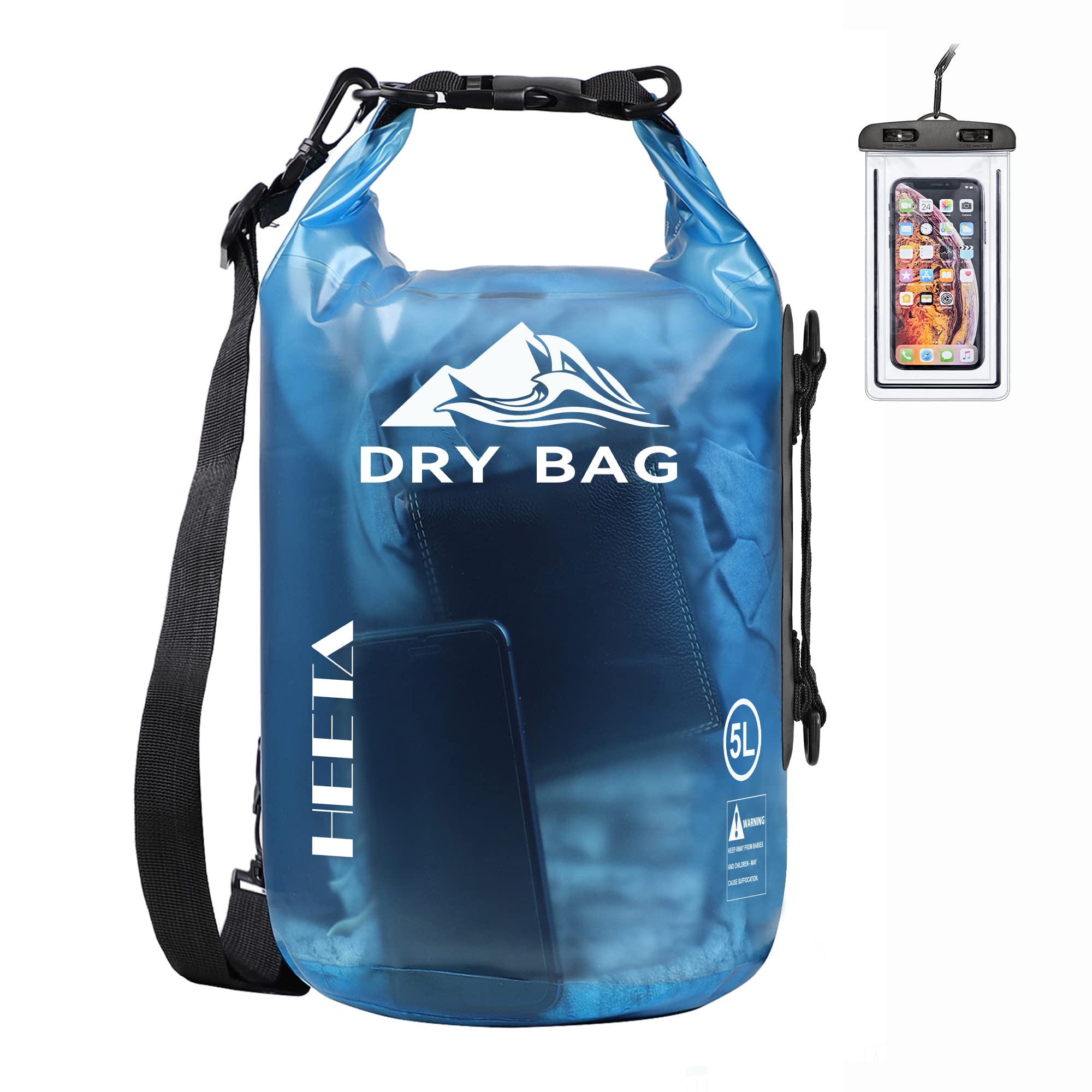
HEETA 10L Dry Bag
Key Features
- Capacity: 10L
- Material: PVC (0.6mm bottom)
- Strap Type: Adjustable shoulder
- Accessories: Phone case
- Closure: Roll-top with buckle
- Price: Budget
The HEETA dry bag offers the lowest price among well-known options and includes a waterproof phone case, with sizes from 5L to 40L. However, the thin PVC material can tear under strain or react with bug spray, and waterproofing may be inconsistent when submerged. This bag works best for infrequent kayakers carrying non-critical items, not as a long-term investment.
Pros
- Very affordable – lowest price among popular dry bags with similar features.
- Keeps contents dry in normal conditions – roll-top closure works well for splashes and rain.
Cons
- Thin PVC material can tear under load or degrade with bug spray contact – best for gentle, infrequent use.
This bag suits budget-conscious beginners who need a dry bag for occasional flat-water trips and don’t mind the risk of durability issues.
Best for Casual Kayakers
Piscifun 10L Dry Bag

Key Features
- Capacity: 10L
- Material: 500D PVC
- Strap Type: Double shoulder straps
- Accessories: Phone case, mesh pocket
- Closure: Roll-top with buckle
- Price: Budget
The Piscifun Dry Bag stands out for its double shoulder straps and external mesh pocket, making on-water access easy for quick items like sunscreen or a water bottle. The roll-top closure and included IPX8 phone case add practical value at a budget-friendly price. However, strap stitching can pull under heavier loads, and some bags may let in moisture after repeated use — fine for flat-water trips and casual kayaking, but not a long-term investment for rough conditions.
Pros
- Double shoulder straps and external mesh pocket give quick access to items while on the water.
- Good build quality and design for the price point.
Cons
- Strap stitching can fail under heavier loads, limiting long-term durability.
A decent budget option for occasional flat-water kayaking or SUP trips where convenience matters more than ruggedness.
Best for Occasional Trips
OMGear 10L Dry Bag

Key Features
- Capacity: 10L
- Material: PVC
- Strap Type: Shoulder strap
- Accessories: Phone pouch
- Closure: Roll-top with buckle
- Price: Budget
This OMGear dry bag stands out with its playful patterns and generous capacity for the price. It handles light splashes and casual use without issue. However, the straps and buckles are not built for repeated heavy loading or rough handling; occasional trips on calm water are its natural habitat.
Pros
- Eye-catching patterns that stand out on the water.
- Roomy interior with multiple size options for different needs.
Cons
- Straps and clips can give out under moderate stress – fine for occasional float trips but not for regular kayaking.
If you need a cheap, stylish bag for a few slow river floats or beach days and aren’t counting on it to last multiple seasons, the OMGear delivers on looks and space.
Best for Budget Beginners
Freegrace 5L Set

Key Features
- Capacity: 5L
- Material: 500D tarpaulin
- Accessories: Waist pouch, phone case
- Closure: Double zip lock
- Price: Budget
For the price, you get three pieces including a waist pouch and phone case with submersible claims. However, the double zip-lock closure requires strong hands and patience to seal properly, and the accessory seams can separate after some use. This set works for occasional, low-stakes trips where you have time to fuss with the closure.
Pros
- Three-piece kit at a budget-friendly price includes waist pouch and phone case
- Keeps contents dry when the closure is fully sealed
Cons
- Double zip-lock closure is difficult to operate, requiring strong hands and patience
Suitable for occasional flat-water trips if you don’t mind a fussy closure and can accept that accessories may wear out quickly.
Best for Organizing Inserts
Wise Owl 3-Pack

Key Features
- Capacity: 5L, 10L, 20L
- Material: 190D nylon
- Closure: Roll-top with buckle
- Price: Mid-Range
This three-pack covers 5L, 10L, and 20L capacities with a featherweight 190D ripstop nylon shell. The bags are handy for sorting clothes, electronics, or snacks inside a larger waterproof container. However, water can seep through the fabric under sustained exposure, so these work best as non-critical organizers rather than primary dry bags for kayaking.
Pros
- Three-size set offers flexibility for organizing gear at a reasonable price.
- Ultralight construction makes these easy to pack as spares inside another bag.
Cons
- Water can seep through the fabric under sustained exposure – not suitable as a primary dry bag.
Use these as lightweight organizers inside a larger waterproof container or for non-critical items on calm days.
Best for Day Trips
Earth Pak 10L Zipper

Key Features
- Capacity: 10L
- Material: 500D PVC
- Strap Type: Single shoulder
- Accessories: Phone case, front pocket
- Closure: Roll-top with buckle plus zipper
- Price: Mid-Range
Shares Earth Pak’s reliable roll-top water resistance with a convenient front zippered pocket for quick access to phone and snacks. The pocket is splash-proof only, not fully waterproof, and the 10L capacity limits use to short day trips. Edged out by the standard Earth Pak for larger loads and submersion.
Pros
- Front zippered pocket keeps phone and snacks within easy reach without opening the roll-top
- Roll-top closure provides reliable water resistance for gear inside the main compartment
Cons
- Front zippered pocket is splash-proof only and may let water in if fully submerged
Best for kayakers who want quick access to small items on calm-water day trips, but not a primary dry bag for full submersion or larger gear.
Best for Phone/keys Only
Unigear 2L Dry Bag

Key Features
- Capacity: 2L
- Material: 500D PVC
- Strap Type: Single shoulder
- Accessories: Phone case
- Closure: Roll-top with buckle
- Price: Budget
The Unigear 2L Dry Bag is an ultra-affordable, floating pouch perfect for keeping a phone, keys, and wallet dry on a quick kayak trip. However, its tiny 2L capacity cannot hold a change of clothes or any gear, making it unsuitable as a primary dry bag for kayaking. It works best as a backup phone pouch inside a larger bag.
Pros
- Budget-friendly price makes it an easy addition to any trip
- Keeps phone, keys, and wallet dry and accessible
Cons
- Only fits phone and wallet — no room for extra clothes or gear
Ideal for ultra-light day trips where you just need to keep essentials dry, but not for any kayaking trip requiring gear storage.
Best for Accessory Pouch
YETI Sidekick 3L

Key Features
- Capacity: 3L
- Material: TPU laminate
- Strap Type: Attachment loops
- Closure: Magnetic waterproof
- Price: Premium
The Sidekick’s DryHide shell and welded construction give it genuine waterproofing for phone and wallet storage. Its magnetic closure seals quickly without fuss. But at 3L, it only holds small items — not a replacement for a roll-top main dry bag. This is an add-on for paddlers who already carry a proper gear bag.
Pros
- Fully waterproof shell with welded seams keeps phone and wallet dry.
- Magnetic closure seals quickly and securely — no roll-top rolling required.
Cons
- 3L capacity limits use to small items like phone and wallet — not for gear storage.
Best for kayakers who already have a main dry bag and need a secure, quick-access pocket for phone and wallet.
Best for Pack Liner
Osprey Dry Sack 3L

Key Features
- Capacity: 3L
- Material: 40D ripstop nylon
- Closure: Roll-top
- Price: Mid-Range
At just 27g, the Osprey Dry Sack is impressively light and well-made for sorting gear inside a larger pack or canoe hatch. But with an IPX5 rating and a tiny 3L capacity, it is not built for kayaking where full submersion and larger volume are needed. Use it as a pack liner or organizational insert, not a standalone dry bag on the water.
Pros
- Extremely lightweight at 27g – barely adds weight to any kit
- Quality roll-top construction from Osprey holds up well inside a larger bag
Cons
- IPX5 rating means it handles splashes but not submersion – water can seep in if fully dunked
Fine for keeping a phone or snacks organized inside a larger dry bag, but not a replacement for a proper kayak dry bag.
How to Choose
The real differentiator among dry bags is not the initial waterproof claim but how well the seams and buckles hold up after a season of use.
Capacity
Capacity (5L to 40L) determines what you can carry. A 5L bag fits a phone, keys, and a light jacket; 20L handles a change of clothes and lunch; 35L+ accommodates camping gear for multi-day trips. Overestimating leads to excess bulk, while underestimating forces you to leave gear behind. Match capacity to the longest trip you’ll take, not the shortest.
Material & Seam Construction
PVC is the most common material in this price range – it’s waterproof and affordable, but low-grade PVC tears easily when snagged or exposed to bug spray. Look for at least 500D thickness and reinforced seams (taped or welded) that resist separation over time. Budget bags often use thinner material (0.3mm sides) that can develop pinhole leaks after a few uses.
Strap Type
A single shoulder strap is fine for light loads under 10L. For 20L and up, backpack-style straps with a sternum or waist belt distribute weight much better during portages. Without proper straps, a heavy bag will dig into your shoulder and make walking to the put-in uncomfortable. If you plan to hike any distance, prioritize padded backpack straps.
Included Accessories
Many dry bags include a waterproof phone case – a useful bonus, but check its rating: IPX8 means submersible, while cheaper ones only handle splashes. A front zippered pocket adds convenience for quick-access items, but understand that pocket is usually splash-proof, not fully waterproof. If you need to keep small items dry without unrolling the main bag, look for a separate dry pouch or a bag with a dedicated waterproof pocket.
Closure Design
Roll-top closures are the industry standard: fold the top down three to five times and clip. The number of rolls directly affects water resistance – fewer rolls risk leaks when submerged. Some budget bags use a zip-lock style closure that is harder to seal and more prone to failure. Stick with a roll-top for reliability; the buckle and strap material matter – plastic clips can snap in cold weather, while metal or Hypalon hold up longer.
FAQ
Can I fully submerge a roll-top dry bag while kayaking?
Most roll-top dry bags are designed to handle splashes and brief submersion, not prolonged underwater use. If your bag goes overboard and stays submerged for more than a minute, water can seep through the roll. For gear that absolutely must stay dry in a capsize, double-bag or use a bag with taped/welded seams and roll it tightly at least four times.
Why does my dry bag smell like plastic and how do I get rid of it?
The smell comes from the PVC material, especially in new budget bags. Rinse the bag with warm soapy water and let it air out in the sun for a few hours. Baking soda paste inside can help absorb odors. If the smell persists after a week, it’s inherent to the material and won’t disappear – choose a bag with a fabric exterior or TPU laminate if you’re sensitive to it.
Are 5L dry bags big enough for a day of kayaking?
A 5L bag holds only essentials: a phone, keys, wallet, and maybe a snack bar. It’s fine for a short flat-water paddle where you don’t need extra clothes or a towel. For a full day on the water, you’ll likely want at least 10L to 20L to accommodate lunch, a dry shirt, and a small first-aid kit. 5L works best as a secondary pouch for items you want to access without unrolling the main bag.
How do I properly roll and seal a dry bag to prevent leaks?
Place your gear inside, squeeze out as much air as possible, then fold the top down three to five times. Each roll should be tight and even. Clip the buckle over the rolled section – the strap should be snug but not overly tight. Before your trip, test the seal by submerging the bag in a bathtub for 30 seconds with a paper towel inside. If the towel stays dry, you’re good to go.