This post contains affiliate links. We may earn a small commission when you buy through our links — at no extra cost to you.
A dry bag that claims to be waterproof on the box might still let water in after a few rolls. The common truth: roll-top closures are excellent for splashes and rain, but they aren’t submarine-grade. Many first-time buyers learn this the hard way when their phone case arrives wet after a capsize.
The real test isn’t the material — it’s how well the bag seals around the fold and holds up over time. Thin PVC can develop pinprick holes at the crease, and backpack straps often fail before the bag itself. This guide focuses on the models that balance reliable sealing, durable construction, and the right features for how you actually use them.
Whether you need a bag that floats for whitewater recovery, an ultralight sack for a thru-hike, or a comfortable waterproof backpack for a rainy commute, the right choice comes down to matching the closure and build quality to your specific conditions.




Best for All-Around Water Sports
Earth Pak Original 10L-55L
Key Features
- Closure: Roll-top with snap buckle
- Material: PVC
- Capacity: 10L-55L
- Extras: IPX8 phone case, shoulder strap
- Price: Mid-Range
The Earth Pak Original delivers on its core promise: an IPX8-rated phone case fully submerges your phone without leaking, and the roll-top closure secures with three folds and a buckle to keep water out during rain and splashes. Multiple strap configurations — a removable shoulder strap on 10L and 20L versions, and padded backpack straps on 30L and above — let you decide how to carry the load. The PVC material is thick enough to resist punctures from branches and rocky surfaces.
Under standard use, contents stay dry, and the carry system remains comfortable even when packed full. The main tradeoff is the welded seam construction: under heavy abuse — dragging over sharp edges, prolonged submersion, or overstuffing — seams may separate over time. For typical recreational kayaking, paddle boarding, or camping, this is not a concern, but those who push the bag hard should inspect the seams after each trip.
This bag suits first-time dry bag buyers who want a dependable all-rounder without a premium price. Kayakers and paddle boarders who need a day bag with phone protection will appreciate the included case. The seam vulnerability is a boundary for heavy-duty whitewater or frequent rough handling; otherwise, this is a practical choice for most outdoor water activities.
Pros
- Keeps contents dry in rain and splashes with a secure roll-top seal.
- Includes an IPX8 phone case that protects your phone from full submersion.
- Heavy-duty PVC and straps withstand repeated outdoor use and resist punctures.
- Available in sizes from 10L to 55L with backpack or shoulder carry options.
Cons
- Under heavy abuse or rough handling, welded seams may separate over time.
For most weekend kayakers and paddle boarders, the Earth Pak Original covers the necessities with a phone case and multiple carry options at a mid-range price.
Best for Whitewater & Rafting
MARCHWAY Floating 5L-40L
Key Features
- Closure: Roll-top with buckle
- Material: Reinforced multi-layer PVC
- Capacity: 5L-40L
- Extras: Floating, D-ring, backpack straps
- Price: Mid-Range
The MARCHWAY’s reinforced multi-layer PVC construction creates a buoyant dry bag that stays afloat when others sink. While most dry bags prioritize low weight or minimal bulk, this model adds floating as a practical feature for rafters and kayakers who regularly dump their boats. The available sizes from 5L to 40L cover day trips and multi-day expeditions, and the backpack straps on 20L and up allow hands-free carrying.
This bag suits adventurers who need a reliable dry bag for multi-day trips across calm lakes and moderate rivers. The floating design makes retrieval easy after capsizing. However, the seam seal can develop leaks under repeated submersion, and the backpack straps on larger sizes may feel less robust than dedicated hiking packs. These tradeoffs matter less for boaters who keep gear in the boat and rarely submerge the bag for extended periods.
Pros
- Floating design and water resistance keep gear dry after capsizing
- Multi-layer PVC holds up against rocks and scrapes
- Wide size range with comfortable backpack straps for carrying gear
Cons
- Backpack strap clips can break under heavy loads on larger sizes
- Seam leaks may develop after extended heavy use in submerged conditions
For rafters and kayakers who frequently find themselves upside down, the MARCHWAY’s floating capability makes it a smart choice over non-buoyant alternatives.
Best for Light Use & Travel
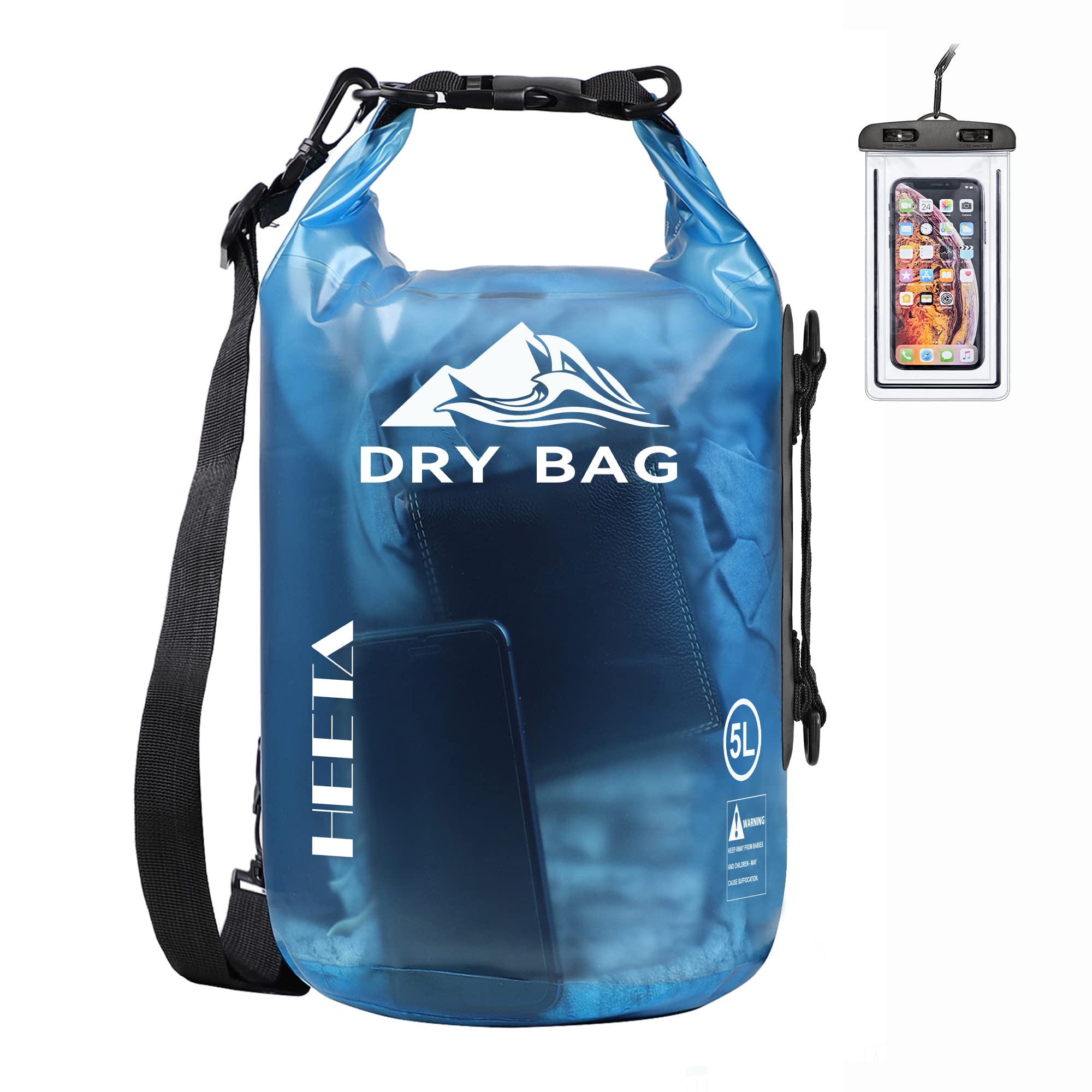
HEETA Lightweight 5L-40L
Key Features
- Closure: Roll-top with buckle
- Material: 0.3-0.6mm transparent PVC
- Capacity: 5L-40L
- Extras: Phone case, transparent
- Price: Budget
The HEETA Dry Bag is the lowest-priced option in our lineup, and the transparent PVC material lets you see contents without opening — a handy feature for airport security or quick gear checks. Available in sizes from 5L to 40L and including a waterproof phone case, it offers good flexibility for day trips. Weighing under 200 grams for the 10L version, it packs easily as a spare. Compared to the Earth Pak Original, the HEETA saves money upfront but uses a noticeably thinner PVC that trades long-term durability for weight and cost.
This bag suits budget-conscious shoppers who need a backup for occasional beach trips or poolside storage, not for daily kayaking or gear that must stay bone-dry. The thin PVC can tear at the fold after a few outings, so it is not the right choice for carrying sensitive electronics on multi-day trips or for anyone who needs a bag to survive repeated abuse on rocky shorelines.
Pros
- Very affordable with multiple size options from 5L to 40L.
- Lightweight and easy to carry for day trips.
- Transparent material allows quick item location without opening.
Cons
- Water resistance can be inconsistent; leakage may occur after submersion.
For occasional light use where budget is the priority, this bag offers decent value — but keep it away from extended wet conditions.
Best for Hiking & Commuting
Earth Pak Backpack 35L/55L
Key Features
- Closure: Roll-top with buckle
- Material: PVC
- Capacity: 35L/55L
- Extras: Padded back, sternum strap, phone case
- Price: Premium
The Earth Pak Backpack’s padded shoulder straps, sternum strap, and roll-top closure make long portages or rainy hikes more bearable than hauling a standard dry bag. The roll-top seal creates a watertight closure, and the included IPX8 phone case provides additional protection for electronics. Multiple pockets, both internal and external, allow organized access to gear without unrolling the main compartment. Unlike a simple roll-top sack, this has a padded back panel and waist belt for load distribution, turning a waterproof container into a functional hiking pack.
This backpack suits hikers and kayak campers who prioritize carrying comfort over ultralight weight. The padded back panel adds heft — 2.5 pounds — but improves load distribution for heavy gear. The chest buckle can break if overloaded, so treat it as a light stabilizer rather than a load-bearing strap. That makes it less suitable for ultralight backpackers, but for multi-day trips in wet climates, the tradeoff is worth it.
Wet-weather commuters will appreciate the padded back panel and the ability to carry a laptop securely, though the 2.5-pound weight is more than a simple dry bag.
Pros
- Waterproof roll-top seal keeps gear dry in sustained downpours.
- Padded straps and back panel reduce fatigue on long hikes.
- Multiple internal and external pockets for organizing multi-day gear.
Cons
- Chest buckle may break if overloaded with heavy gear.
- Heavier than a simple dry bag due to padding — not ideal for ultralight backpacking.
For hikers and kayak campers who want a waterproof backpack that carries well on portages, this adds comfort without sacrificing dry storage.
Best for Ultralight Backpacking
Sea to Summit Ultra-Sil 20L
Key Features
- Closure: Roll-top with Hypalon
- Material: 30D Ultra-Sil Cordura Nylon
- Capacity: 13L/20L/35L
- Extras: Ultralight, packable
- Price: Premium
At only 1.8 ounces, this 20-liter sack compresses down to nearly nothing — a clear priority for backpackers counting every gram. The 30D Ultra-Sil Cordura nylon keeps rain and splashes at bay, making it a capable liner or stuff sack for a sleeping bag or clothes inside a pack. What it sacrifices is puncture resistance and submersion protection; the thin fabric can tear against sharp edges, and it won’t keep gear dry if fully submerged.
This sack suits ultralight hikers and thru-hikers who need to organize and waterproof items within their backpack, not kayakers or rafters who expect a rugged, submersible dry bag. For those who subject gear to rough handling or full submersion, the Earth Pak Original offers thicker PVC construction — but at three times the weight. If your priority is saving grams and keeping gear dry from rain or casual splashes, the Sea to Summit Ultra-Sil delivers without burdening your pack.
Pros
- Weighs just 1.8 oz for a 20-liter capacity — exceptional for gram-counting backpackers.
- High-quality stitching and 30D Cordura nylon hold up well under regular packing.
- Roll-top closure with Hypalon strap seals reliably against splashes.
Cons
- Thin fabric can puncture if compressed against sharp items like tent stakes or multitools.
- Not designed for submersion — only splash-proof, so keeping it afloat won’t keep contents dry.
For the hiker who values every gram, this is the lightest way to keep gear dry from rain. Kayakers and boaters should look to heavier PVC bags for true waterproofing.
Best for Paddle Boarding & Style
Skog Å Kust DrySak 5L-20L
Key Features
- Closure: Roll-top
- Material: Vinyl
- Capacity: 5L-20L
- Extras: Splash pocket, reflective trim
- Price: Mid-Range
The Skog Å Kust DrySak stands out with its splash-proof front pocket and reflective trim, offering quick access to small items while enhancing visibility on the water. This design choice makes it a more fashion-forward alternative to the top pick’s no-frills approach, but it comes with a trade-off in ruggedness.
This bag suits paddle boarders and kayakers who want a trendy look and easy access to phone or keys without opening the main compartment. The vinyl material handles rain and splashes well, but it can stiffen in cold weather, and the front pocket is not intended for submersion — keep it above the waterline.
Pros
- Reflective trim improves visibility during dawn or dusk paddling sessions.
- Front pocket allows quick access to phone or keys while on the water.
- Keeps contents dry in rain and splashes during kayaking and paddle boarding.
Cons
- Vinyl material can stiffen in cold weather, making the bag less flexible.
- Front pocket handles splashes but not submersion; water may enter if fully immersed.
For paddlers who prioritize style and quick-access convenience over heavy-duty submersion protection, this bag pairs decent waterproofing with visibility features.
Best for Quick-Access Items
Earth Pak Zip Pocket 10L-40L

Key Features
- Closure: Roll-top + zippered pocket
- Material: 500D PVC
- Capacity: 10L-40L
- Extras: IPX8 phone case, front zipper
- Price: Mid-Range
Zippered front pocket allows quick access to keys and phone without unrolling the main dry compartment. The pocket is splash-resistant but not waterproof — submerging it lets water in. This trade-off suits day trippers who carry a phone in the pocket and keep electronics in the roll-top main compartment. The added complexity means the simpler Earth Pak Original remains a more robust choice for heavy exposure.
Pros
- Zippered front pocket for instant access to small items without opening the main compartment.
- Rugged 500D PVC material resists punctures and fraying over repeated use.
Cons
- Front pocket lets in water when fully submerged, making it unsuitable for situations where the entire bag goes underwater.
Best for kayakers and paddlers who need quick phone access and keep valuable electronics inside the main roll-top compartment.
Best for Anglers & Boaters
Piscifun 10L-40L Backpack

Key Features
- Closure: Roll-top with buckle
- Material: 500D PVC
- Capacity: 10L-40L
- Extras: IPX8 phone case, mesh pocket
- Price: Mid-Range
The Piscifun dry bag offers a practical mesh pocket for stashing wet items and an IPX8 phone case, making it a convenient choice for kayakers and anglers. However, compared to the MARCHWAY and Earth Pak options, it falls short in long-term durability and floating performance. Some buyers have noted that the straps may loosen or break, and the waterproof seal can be inconsistent under pressure. This bag works best for casual boating or fishing trips where full submersion is unlikely.
Pros
- Outer mesh pocket provides quick access to wet gear
- Included IPX8 phone case keeps your device dry
Cons
- Straps may loosen or break after repeated use
- Waterproofing can be inconsistent under pressure, making it more water-resistant than submersible
A good fit for anglers and casual boaters who value the mesh pocket and phone case over maximum durability; not the choice for whitewater or heavy abuse.
Best for Travel & Day Hikes
Sea to Summit Lightweight 5L-20L

Key Features
- Closure: Roll-top with Hypalon
- Material: 70D nylon with PU coating
- Capacity: 5L-20L
- Price: Mid-Range
For backpackers who want to shave weight without switching to paper-thin fabric, this 70D nylon dry bag handles rain and splash conditions well while packing down small for travel. The plastic clip can break under stress, and full submersion is not advised, so it fits best as a pack organizer and rain protector rather than a whitewater dry bag.
Pros
- Balances lightweight carry with enough toughness for regular pack use
- Keeps contents dry in rain and splash conditions with a reliable roll-top seal
Cons
- Clip may break under heavy stress, limiting long-term durability for rough handling
Best suited for backpackers and day hikers who need a lightweight, packable dry sack for rain protection and gear organization, not for submersion or high-stress carries.
Best for Large Capacity Trips
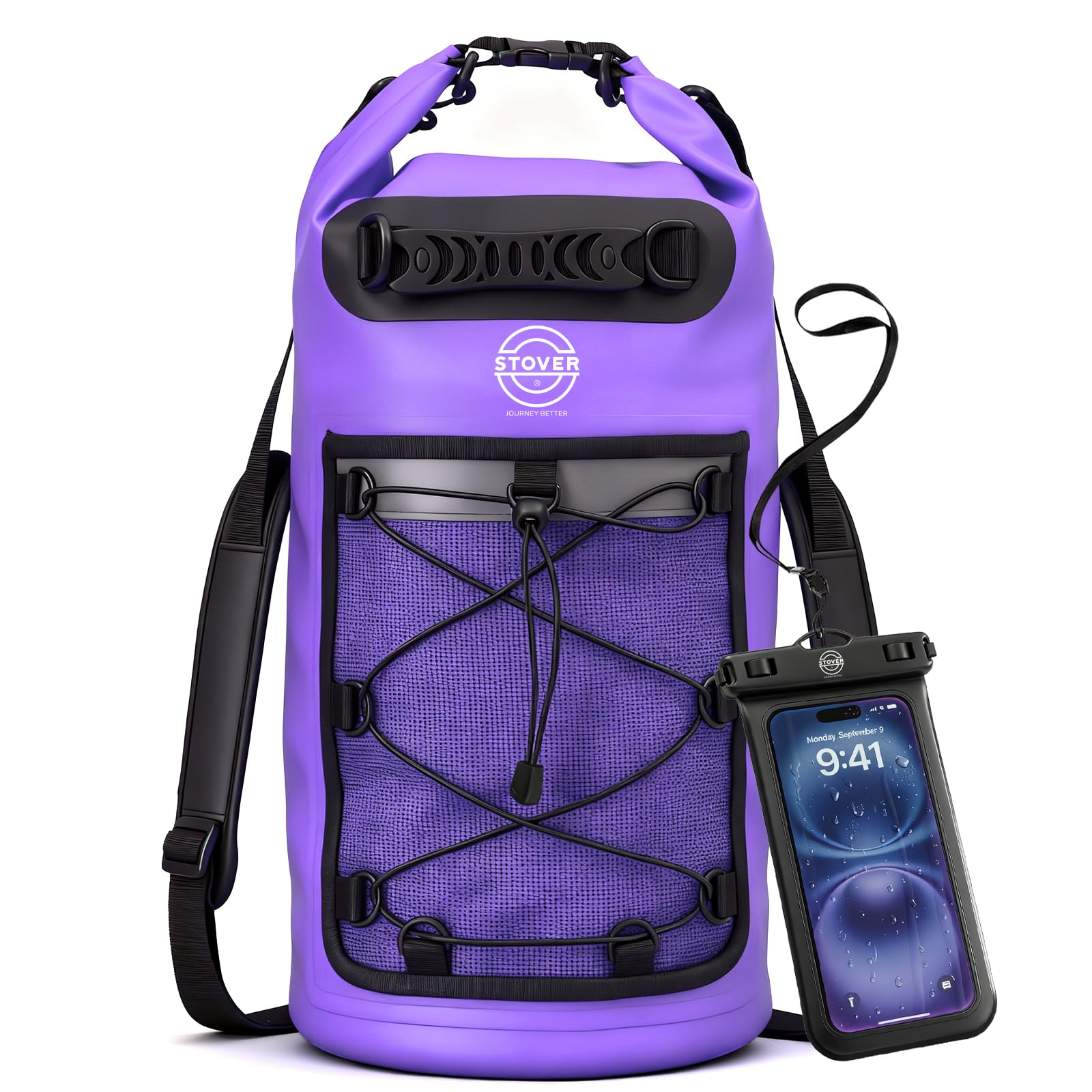
STOVER 5L-55L Backpack
Key Features
- Closure: Roll-top with buckle
- Material: Vinyl
- Capacity: 5L-55L
- Extras: IP58 phone case, mesh pocket
- Price: Mid-Range
The STOVER dry bag backpack includes an IP58-rated phone case, a front mesh pocket for wet items, and reflective trim for visibility, all in sizes from 5L to 55L. It offers good storage organization with compression straps and comfortable backpack carry. However, the vinyl material can be stiff to roll, and some units may have stitching that separates under heavy loads — a tradeoff for the low price and feature set compared to more established brands like Earth Pak. Best suited for kayakers and casual boaters who want a large-capacity bag with extras rather than long-term durability under hard use.
Pros
- Fully waterproof seal with a quality phone case included for electronics protection.
- Good storage capacity and organization with mesh pocket and compression straps.
Cons
- Stitching can separate if the bag is heavily loaded — a concern for dense gear or rough handling.
- Vinyl material resists smooth rolling, especially when new or in cold temperatures.
Best for casual kayakers who want a phone case and mesh pocket in a large dry bag backpack and are willing to accept possible seam separation under heavy loads.
Best for Occasional Use
Unigear Budget 2L-40L

Key Features
- Closure: Roll-top with buckle
- Material: 500D PVC (ripstop)
- Capacity: 2L-40L
- Extras: Phone case, floating, straps
- Price: Budget
The Unigear Dry Bag delivers functional waterproofing at a price that undercuts most competitors. It floats, comes in multiple sizes from 2L to 40L, and includes a phone case. However, the 500D PVC material can develop leaks or tears after a few outings, and the phone case quality varies between units. This makes it best suited for occasional trips or as an emergency backup in a car or boat rather than daily use or transporting sensitive electronics.
Pros
- Extremely affordable with solid basic waterproofing for light use
- Lightweight and available in multiple sizes and colors for various activities
Cons
- Seams and PVC can show wear after a few trips, making it less suitable for regular heavy use
- Phone case can be inconsistent in quality – some units may not hold up to repeated use
Pick this bag if you need a cheap, functional dry bag for occasional use or as a spare — but don’t expect it to survive a full season of weekly trips.
How to Choose
The most important thing to know: roll-top dry bags are water-resistant, not submarine-proof — how you roll and seal determines success.
Waterproof Rating & Submersion
IPX ratings (like IPX8) indicate ability to withstand submersion under controlled conditions. But real-world submersion — especially if the bag floats upside down — can force water past the roll-top seal. A bag that claims waterproof is only as good as the number of rolls and the compression of the buckle.
For kayakers who capsize regularly, look for reinforced welded seams and a stiffer PVC that holds shape. Ultralight nylon sacks (like Sea to Summit Ultra-Sil) are fine for rain but not for falling into a river.
Material Thickness & Seam Construction
Thicker PVC (500D or multi-layer) resists abrasion from rocks and sand, but adds weight and stiffness. Thin transparent PVC (0.3mm) is lightweight and lets you see contents, but it tears at the fold after repeated use. Welded seams are more durable than stitched seams for waterproofing, but if the welding separates, the bag is done.
If you drag your bag over sharp shale or carry it in a whitewater raft, prioritize a thicker, welded construction. For casual beach trips, a thin transparent bag is fine.
Size Range & Strap Configuration
Larger bags (30L+) are harder to seal because you must push out all air before rolling. A half-empty large bag leaves more material to fold, increasing leak risk. Manufacturers offer shoulder straps (smaller bags) or full backpack harnesses (20L+). Backpack straps are great for hiking but add weight and potential failure points at the clips.
Choose a size that fits your gear snugly — a 20L is ideal for a day trip, while a 40L works for multi-day camping but requires careful packing to exclude air.
Included Accessories
Many dry bags come with a waterproof phone case, but these are often the weakest link. The included case may be IPX8-rated, but the plastic can tear or the seal can fail under pressure. Some bags add a mesh pocket for wet items or a splash-proof front pocket for quick access — note these pockets are not waterproof.
If you rely on your phone in wet conditions, consider buying a separate high-quality case. The phone case in a dry bag bundle is a bonus, not a primary solution.
Weight & Packability
For backpackers counting grams, every ounce matters. Ultralight sacks like the Sea to Summit Ultra-Sil (1.8 oz for 20L) compress to almost nothing. The trade-off: thin nylon punctures easily and offers no submersion protection. Heavier PVC bags (8-12 oz) are tougher but take up pack space.
If you’re thru-hiking and staying on trails, an ultralight sack is perfect. If you’re crossing rivers or camping in wet canyons, the extra weight of PVC is worth it.
FAQ
Can I really submerge a roll-top dry bag completely?
Not reliably. Roll-top closures are designed for splashes and rain, not prolonged submersion. Even a well-rolled bag can let water in if you float upside down for more than a minute or if the bag is compressed underwater. For true submersion, look for a dry bag with a welded seam and a stiff closure that allows at least four tight rolls.
Why does my dry bag let water in at the fold?
The fold is the weakest point because the PVC or nylon creases repeatedly, creating micro-tears over time. Thin materials (0.3mm PVC) are especially prone. To minimize leaks, avoid over-tightening the roll, and store the bag flat when not in use. If you see cracks at the fold, it’s time to replace the bag.
How many rolls do I need for a watertight seal on a dry bag?
Three full rolls is the standard recommendation for PVC and nylon roll-top bags. Fewer than two rolls leaves the seal too loose; more than four can over-compress the material and create a channel for water. Always buckle the clip tightly across the rolled section, not on the flat part of the bag.
Is the phone case included with dry bags actually waterproof?
Most are IPX8-rated and work fine for splashes and short submersions, but they are not as durable as dedicated cases. The plastic can tear after a few uses, and the seal may fail under pressure. If you rely on your phone for navigation, buy a separate high-quality waterproof case instead of relying on the included one.