This post contains affiliate links. We may earn a small commission when you buy through our links — at no extra cost to you.
Budget trekking poles are a minefield of lock failures and broken joints. Many pairs under $30 look good but don’t survive a season of regular hikes. The good news: there are affordable poles that do hold up.
The difference often comes down to simple mechanical choices: flip locks vs. twist locks, cork vs. foam grips, and whether the aluminum is 7075 or 6061. These specs determine whether a pole stays extended when you need it or collapses at the worst moment. For example, cork grips absorb sweat and last longer than foam, while flip locks are easier to tighten mid-hike than twist locks.
This guide focuses on poles that get those details right – reliable locks, comfortable grips, and enough durability for day hikes and weekend trips. The best value isn’t the cheapest price; it’s the pole that saves you from buying a replacement in six months.


Best for First-Time Hikers
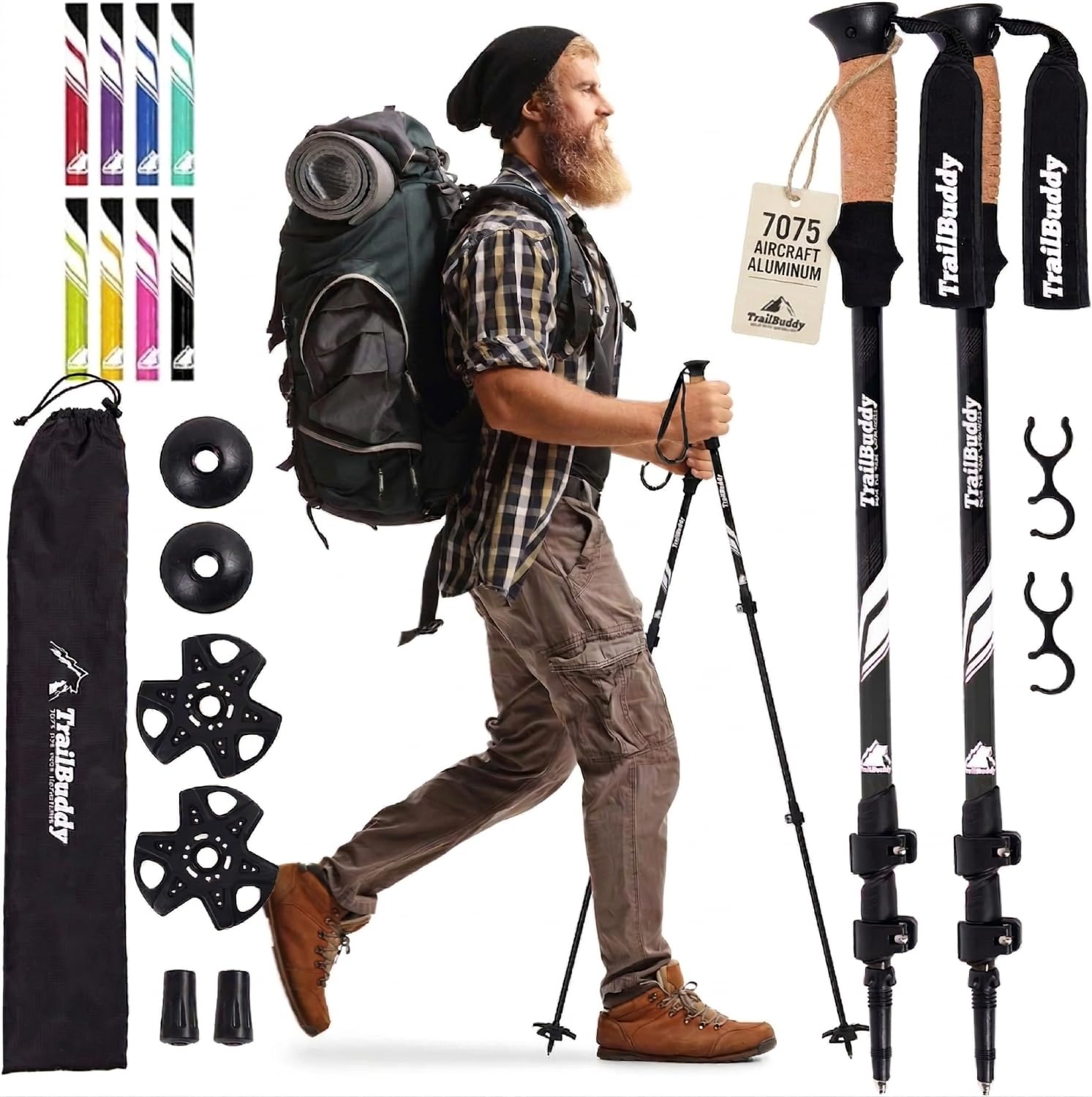
TrailBuddy Trekking Poles
Key Features
- Lock Type: Lever
- Grip Material: Cork
- Weight per Pole: 9.7 oz
- Collapsed Length: 24.5"
- Accessories: Multiple baskets, tips
- Price: $$
The TrailBuddy poles pair 7075 aircraft-grade aluminum with cork grips that mold to your hand and stay comfortable in warm weather. The lever lock system allows quick height adjustments from 24.5 to 54 inches, covering most adult heights. Each pole weighs 9.7 ounces — light enough for a full day on the trail without feeling fragile.
On rocky ascents and muddy descents, the tungsten carbide tips bite securely, and the included trekking baskets prevent sinking. After many miles of use, the lever locks can require a turn of the tension screw to maintain their grip — a straightforward adjustment that takes seconds. The poles show no bending or fatigue under normal loads.
This set suits first-time hikers who want a single pair that works for varied terrain and family members of different heights. Weekend backpackers and day hikers get a dependable companion without overspending. If you need sub-10-ounce carbon poles or a tri-fold design for carry-on luggage, look elsewhere — these are telescopic and prioritize durability over ultralight travel.
With a full accessory kit including mud baskets, rubber tips, and a carrying bag, the TrailBuddy poles deliver more than the price suggests. They lack the frills of premium models but cover all the essentials for confident hiking.
Pros
- Build quality that holds up across rugged trails and repeated use
- Height adjustments are quick and stay secure during hikes
- Lightweight enough for all-day carry without strain
- Sturdy construction provides confidence on uneven terrain
- Accessories and materials provide strong value at this price
Cons
- Lever locks can require occasional re-tightening after extended use on rough trails
For budget-conscious hikers who want a durable, adjustable pole with proven real-world performance, the TrailBuddy is the easy choice — just be ready to tighten the locks occasionally.
Best for Value-Seeking Hikers
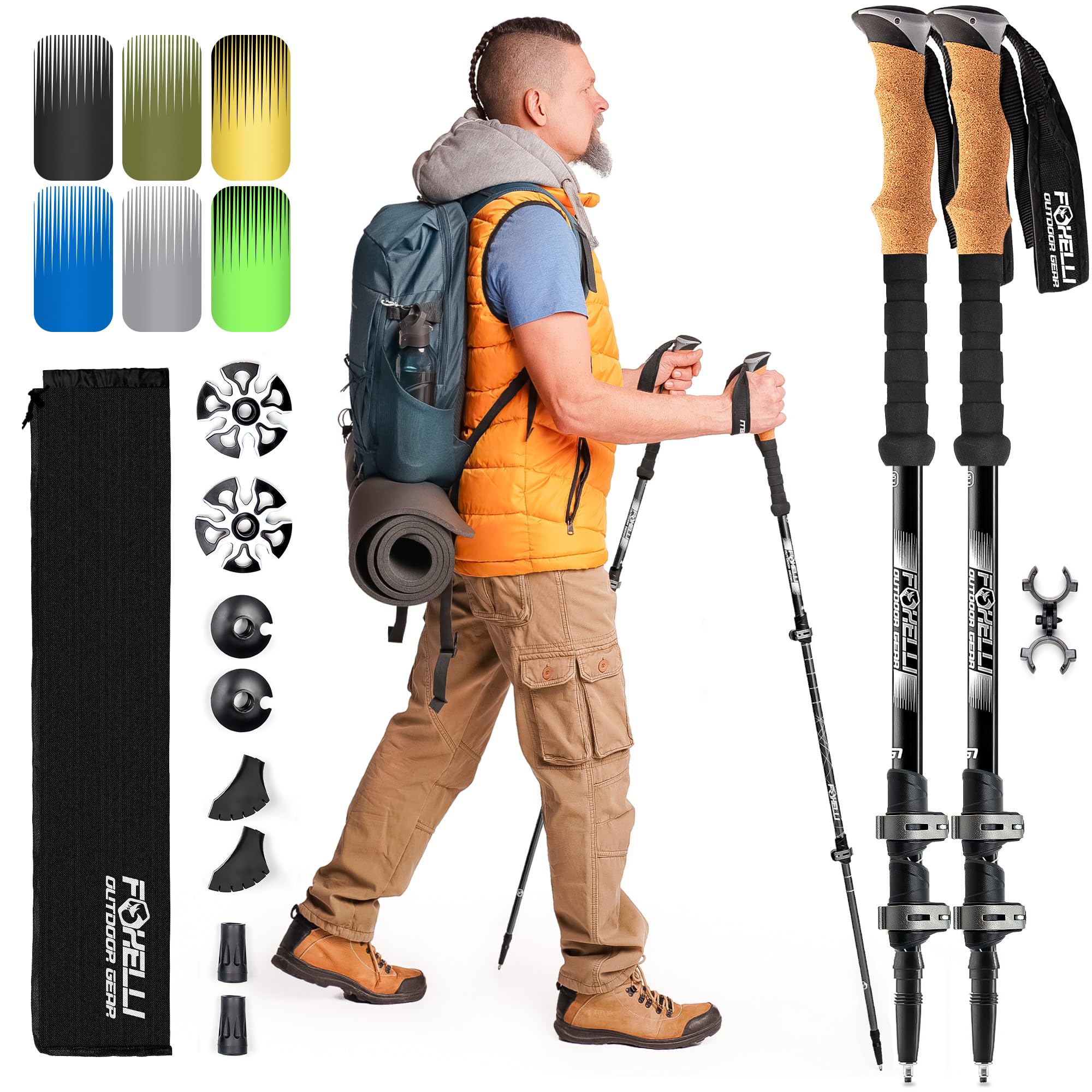
Foxelli Aluminum Cork
Key Features
- Lock Type: Flip lock
- Grip Material: Cork
- Weight per Pole: 9.4 oz
- Collapsed Length: 24"
- Accessories: All-terrain kit
- Price: $$
Cork grips, flip-lock mechanisms, and a lightweight aluminum build give the Foxelli poles a refined feel usually reserved for poles costing $80 or more. The twist-free locking system stays put once tightened, and the 9.4-ounce weight per pole keeps fatigue low on long ascents. The cork handles wick moisture during hot hikes, and the EVA foam extension provides a secure grip for steep sections.
On the trail, these poles feel rigid and dependable. The telescoping sections adjust smoothly across the full 24- to 54-inch range, and the included carbide tips, baskets, and trekking baskets cover most terrain types. The flip locks hold firmly during normal hiking without slipping.
This pair suits hikers who want premium touches — cork grips, flip locks, aircraft-grade aluminum — without paying premium prices. One tradeoff: the rubber tips can detach on very rough trails; a drop of glue before departure solves that. If you need extreme compactness for travel, the folding version from the same brand is a better fit.
Pros
- High-quality aluminum construction feels solid and durable.
- Locked sections remain rigid with no wobble on uneven ground.
- Delivers cork grips, flip locks, and full accessory kit at a fraction of the price of comparable poles.
- Lightweight poles (9.4 oz each) minimize arm fatigue without sacrificing durability.
Cons
- Rubber tips can detach on rough, rocky terrain; a simple adhesive fix prevents this.
A near-perfect budget pole that gives you premium materials and construction for under $50 — just add a dab of glue for rough terrain.
Best for Budget-Conscious Hikers
KINGGEAR TP1 Aluminum
Key Features
- Lock Type: Flip lock
- Grip Material: Cork
- Weight per Pole: 9.35 oz
- Collapsed Length: 25.5"
- Accessories: Full accessory kit
- Price: $$
KINGGEAR delivers cork grips and 7075 aluminum at a price that undercuts the entry-level REI Co-op pole while offering a similar feature set. The flip locks adjust smoothly and hold securely across the full height range, making these a strong alternative for anyone who wants quality materials without spending over $50.
These poles suit budget-conscious hikers, teens, and seniors who need lightweight support on day hikes or moderate trails. The cork grip manages sweat and stays comfortable in heat, and at 9.35 oz per pole they won’t weigh you down. One specific check: the threading for basket attachments can be slightly oversized on some units, so swapping baskets may require a bit more force than expected. This does not affect normal use with the included baskets, but it’s worth noting if you plan to switch tips frequently.
Overall quality holds up well for the price point — the 7075 aluminum resists bending under typical loads, and the flip lock mechanism has good longevity. The full accessory kit (mud baskets, rubber tips, and carrying bag) adds value for those exploring varied terrain.
Pros
- Cork grip stays comfortable in heat and resists slipping
- 7075 aluminum provides solid strength without excess weight
- Flip locks adjust easily and hold firmly during use
- Includes a full set of accessories for different trail conditions
Cons
- Basket threading can be oversized, requiring extra force to swap attachments
For hikers on a tight budget who still want cork grips and durable 7075 aluminum, the KINGGEAR TP1 delivers the core features without the premium price.
Best for Travelers
Trekology Trek-Z Folding
Key Features
- Lock Type: Flip lock
- Grip Material: Cork
- Weight per Pole: 11.5 oz
- Collapsed Length: 15"
- Accessories: All-terrain kit
- Price: $$
The Trek-Z folds to just 15 inches, making it one of the few trekking poles that fits inside a carry-on bag without checking luggage. Cork grips and flip locks add comfort and adjustability, while the tri-fold design deploys quickly on the trail.
This pole is best for travelers who hike moderate terrain and need a packable stick for occasional use. The tradeoff for compactness is reduced durability compared to telescopic poles – the folding joint may experience loosening over time, and the flip lock requires full engagement to stay stable. Hikers over 220 lbs or those tackling aggressive long-distance treks should look elsewhere.
Given the budget-friendly price, the Trek-Z offers a satisfying balance for its intended use: lightweight, easy to pack, and decent on moderate trails. The cork grip remains comfortable even in wet conditions.
Pros
- Folds compactly to fit in most carry-on bags, eliminating checked luggage fees.
- Sets up in seconds with a simple flip-lock and folding mechanism.
- Lightweight at 11.5 oz per pole, reducing fatigue on moderate hikes.
- Solid build quality for the price, with cork grips that stay comfortable.
Cons
- Folding joint may loosen with heavy use; better suited for moderate terrain.
- Flip lock can slip if not fully closed; requires deliberate check before each step.
For travelers who prioritize packability and need a budget-friendly pole for moderate hikes, the Trek-Z delivers a compact solution without major compromises.
Best for Casual Walkers
TheFitLife Anti-Shock
Key Features
- Lock Type: Twist lock
- Grip Material: Rubber
- Weight per Pole: 9.92 oz
- Collapsed Length: 25.6"
- Price: $$
TheFitLife poles stand out in the budget segment with a built-in shock spring that cushions each step, a feature uncommon at this price. The spring compresses under load, which can add a subtle bounce — fine for pavement or packed dirt but less predictable when you need a firm push on uneven ground.
These are best for leisurely walks and short day hikes on well-maintained trails where joint comfort is a priority. The aluminum sections and twist-lock joints have been known to separate or lose grip under strenuous use, so these poles are not suited for rocky terrain, steep ascents, or multi-day trips.
Pros
- Height adjusts from 25.6 to 51.2 inches, fitting a wide range of users
- Lightweight at under 10 ounces per pole, easy to carry for hours
- Disassembles into compact sections for convenient storage in a daypack
- Budget price point with solid build quality for the cost
Cons
- On rocky trails, the telescopic sections can slip or separate under repeated stress
- The anti-shock spring compresses unexpectedly during push-off, making the pole feel wobbly on firm ground
A cost-effective option for gentle walks where shock absorption outweighs the need for rugged durability.
Best for Occasional Travel
Hiker Hunger Foldable
Key Features
- Lock Type: Metal flip locks
- Grip Material: Cork/EVA
- Weight per Pole: 9.95 oz
- Collapsed Length: 14-15"
- Price: $$
The Hiker Hunger Outfitters folding pole uses metal flip locks and aircraft aluminum to achieve a 300-pound load rating – a notable step up from similarly compact tri-fold designs like the leading travel pole. The collapsed length of 14-15 inches fits easily in a carry-on or daypack, and the cork-and-EVA grip provides a secure hold in wet conditions.
This pole suits hikers who prioritize packable size for occasional travel but need a pole that can handle heavier loads when used. The tri-fold format limits on-trail adjustment to three preset sections, so it’s less convenient for quick tweaks compared to telescopic poles. Assembly out of the box requires a few extra minutes – the manufacturer’s video clarifies the locking mechanism that the printed manual leaves vague.
Pros
- Rugged build with metal flip locks and aircraft aluminum construction.
- Supports up to 300 lbs – suitable for heavier packs and larger hikers.
- Height adjustments are straightforward with clear click stops at three positions.
Cons
For hikers who value load capacity and packability over on-trail adjustability, this folding pole delivers where many budget tri-folds come up short.
Best for Beginners
Cascade Mountain Tech Alum

Key Features
- Lock Type: Flip lock
- Grip Material: Cork
- Weight per Pole: 10.08 oz
- Collapsed Length: 26"
- Accessories: Tip kit
- Price: $$
Cascade Mountain Tech brings a known name (also sold at REI) to the budget segment with a cork grip, flip-lock adjustability, and a price that undercuts most competitors. The 6061 aluminum construction keeps weight manageable for day hikes but may bend under sustained heavy loads — this pole suits casual trail walking rather than backpacking with a packed pack. Fewer included accessories than some rivals, but the basics are covered.
Pros
- Stable footing with cork grip on moderate trails.
- Cost-effective entry from a brand carried by REI.
- Quick flip-lock adjustment without tools.
Cons
- Under heavy loads or repetitive impact, the 6061 aluminum can bend.
Best for day hikers who want a recognizable brand at the lowest possible price — skip it if your pack regularly tops 30 pounds.
Best for Travel Hikers
Foxelli Compact Fold

Key Features
- Lock Type: Flip lock
- Grip Material: Cork
- Weight per Pole: 11.6 oz
- Collapsed Length: 14.6"
- Accessories: All-terrain kit
- Price: $$
The Foxelli Compact Fold packs the brand’s signature cork grip into a tri-fold format that collapses to 14.6 inches, making it a natural fit for airline carry-on and daypack storage. Included snow baskets, rubber tips, and carbide tips cover most terrain without extra purchases. However, at 11.6 ounces per pole these are heavier than many telescopic competitors, and the folding mechanism introduces occasional play in the locks and baskets that may detach on sharp rocks. Travel hikers who value packability over ounces and accept minor hardware quirks will get good use from these poles, but anyone needing bombproof stability for rough trails should look at the standard Foxelli or the top pick.
Pros
- Cork grips stay comfortable in wet conditions and provide good traction over long hikes.
- Tri-fold design packs down to 14.6 inches, making it easy to stow in luggage or a small backpack.
- All-terrain accessories included (baskets, tips, rubber feet) cover snow, mud, and pavement without extra cost.
Cons
- Baskets can detach more easily than expected on rocky trails, potentially losing them mid-hike.
- Locking mechanism may feel less solid on some units, requiring periodic re-tightening during use.
Best for travelers who prioritize compact storage and Foxelli’s grip feel over absolute durability, and are willing to tolerate occasional hardware quirks on uneven terrain.
Best for Ultra-Compact Budget
Covacure Tri-Fold Pink

Key Features
- Lock Type: Flip lock
- Grip Material: EVA foam
- Collapsed Length: 14"
- Price: $$
The Covacure tri-fold packs down to 14 inches, making it one of the most compact budget options for day hikes and travel. The EVA foam grip provides a comfortable hold, and the pink variant adds a stylish touch. However, the maximum height of 47 inches suits shorter hikers — anyone over 5’8" will find the poles too low. The locking button and joints may show wear over time, a tradeoff for the extreme portability and low price.
Pros
- Collapses to 14 inches for easy storage in a daypack.
- Lightweight build reduces arm fatigue on long climbs.
- Easy flip-lock assembly gets you moving in seconds.
Cons
- Locking button and folding joints can develop looseness with regular use.
- Height is fixed at three positions with no micro-adjustment for varying terrain.
Best for petite hikers who prioritize packability over height range and don’t mind occasional maintenance on the locking mechanism.
Best for Occasional Hikers
Covacure Telescopic

Key Features
- Lock Type: Twist lock
- Grip Material: EVA foam
- Collapsed Length: 14"
- Price: $$
This pole pairs a lightweight 7075 aluminum build with a practical flip-lock system and a full accessory kit, delivering value for the price. Joint separation can occur under uneven terrain and the locks may shift during use, so it suits occasional walks on easy trails or as a travel backup rather than frequent or demanding hikes. These durability tradeoffs keep it from competing with more established budget poles that have stronger user validation.
Pros
- Lightweight build packs easily for travel
- Accessory kit adds value at this price point
Cons
- Joints can separate under load on uneven terrain
- Quick-lock system may shift during use, requiring re-tightening
Best suited as a backup pole for occasional day hikes on well-maintained trails where weight and packability matter more than long-term durability.
Best for Weight-Conscious Hikers
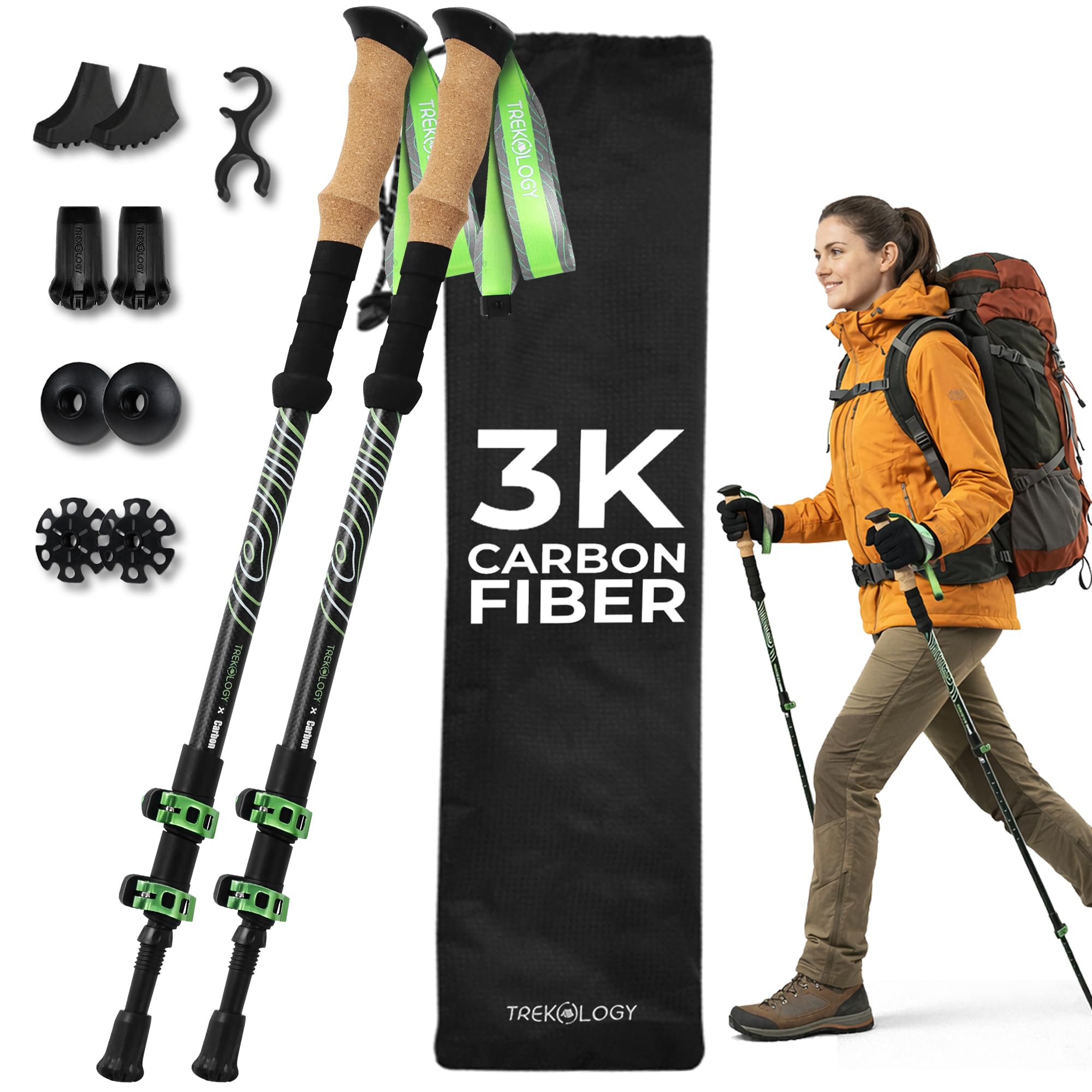
Trekology 3K Carbon
Key Features
- Lock Type: Flip lock
- Grip Material: Cork
- Weight per Pole: 7.4 oz
- Collapsed Length: 25.6"
- Accessories: All-terrain kit
- Price: $$
At 7.4 oz per pole, the Trekology 3K Carbon is the lightest budget option available, with cork grips and a telescopic design. The flip locks offer a wide height range and adjust smoothly. However, because the poles have seen limited real-world use, durability on rocky trails or frequent trips is not yet confirmed. This makes it a better fit for early adopters willing to accept some uncertainty over more established options with extensive user feedback.
Pros
- Extremely lightweight – one of the lightest budget poles
- Good adjustability – telescopic flip locks cover a wide height range
Cons
- Long-term durability under heavy use has not been verified across a large number of users
Best for weight-conscious day hikers who prioritize low weight and are comfortable accepting some uncertainty over long-term durability.
How to Choose
A reliable locking mechanism is the most critical feature; even the best materials are useless if the pole collapses on the trail.
Lock Type: Flip or Twist?
Flip locks are the most common on budget poles and allow fast, tool-free adjustments on the trail. They can loosen over time, but a quick re-tightening with a multitool solves it. Twist locks are simpler mechanically and less prone to loosening, but they can be harder to operate with cold, gloved hands and may slip if the internal sleeve gets dirty.
For day hikers who adjust height frequently, flip locks are more convenient. For long-distance trekkers who set and forget, twist locks can be reliable if kept clean.
Grip Material: Cork vs. Foam vs. Rubber
Cork grips conform to your hand over time, absorb sweat better than foam, and don’t get sticky in heat. They are the preferred choice for most hikers and are found on many poles in the $30-40 range. EVA foam is lighter and cheaper but wears down faster and can become slippery when wet. Rubber grips are durable but less breathable and can cause hot spots on long hikes.
If you hike in humid conditions or for hours, cork is worth the small premium. For short, cool-weather walks, foam is adequate.
Weight per Pole: How Light Matters
Weight differences of a few ounces become noticeable on long days or when poles are strapped to a pack. Most budget aluminum poles weigh 9-11 ounces each. For day hikes under 10 miles, this is fine. For backpacking or fast-paced hiking, sub-10 ounces reduces fatigue. Carbon fiber is lighter but rarely available under $50 without compromising durability.
We recommend aiming for poles under 10.5 oz each if you hike regularly. Above that, you are carrying unnecessary weight without added strength.
Collapsed Length: Portability vs. Durability
Telescopic poles collapse to about 25 inches, which typically requires checked luggage on flights. Tri-fold folding poles collapse to 14-15 inches and fit easily in a carry-on. The trade-off is that folding poles have more joints, which can be points of failure. For travelers who fly, the portability benefit often outweighs the slightly higher failure risk.
If you rarely fly, save money and weight with a telescopic design. If you fly multiple times a year, a folding pole is the better choice.
Included Accessories: What to Expect
Most budget poles come with rubber tips, snow baskets, and mud baskets. The quality varies: rubber tips often detach on rocky terrain, and baskets can crack after a season. Some brands include carbide tungsten tips that last much longer. Expect to replace rubber tips every 200-300 miles.
If you hike on a mix of surfaces, look for a kit with both baskets and spare tips. Aftermarket upgrades are inexpensive and can extend the life of your poles significantly.
FAQ
Are cork grips better than foam grips on budget trekking poles?
Yes, for frequent use. Cork molds to your hand, absorbs sweat, and remains grippy when wet. Foam is lighter and cheaper but wears faster and can become slippery. For day hikers or weekend backpackers, cork is worth the extra few dollars.
Why do my trekking poles keep collapsing even after tightening the locks?
This usually happens with twist-lock poles when the internal collar is dirty or the threads are worn. Clean the sections with a dry cloth and apply a very light coating of beeswax or lock lubricant. If the problem persists, the lock mechanism may be defective – replace the pole.
Can I fit budget folding trekking poles in a carry-on suitcase?
Most tri-fold trekking poles collapse to 14-15 inches, which fits in standard carry-on luggage. However, some airlines may still classify them as a potential weapon, so check with your carrier. Telescopic poles are usually too long for carry-on.
How often should I replace the rubber tips on my hiking poles?
Every 200-300 miles on mixed terrain, or sooner if you hike predominantly on pavement or rock. When the rubber wears down to the carbide tip inside, replace them to maintain grip and prevent scratching trail surfaces.