This post contains affiliate links. We may earn a small commission when you buy through our links — at no extra cost to you.
Many bike light sets shine bright out of the box but fall apart after a few months — straps snap, batteries stop charging, or the rear light dies mid-ride. That frustration is common even among highly-rated budget options.
This guide focuses on real-world durability alongside brightness. The key trade-off is between raw lumens and the reliability of mounts and electronics. A 1000-lumen light is useless if it falls off on a bumpy road or runs out of battery before you get home.
Whether you ride on dark trails or well-lit streets, the right set balances visibility, build quality, and battery life for your specific conditions — not just the highest number on the box.




Best for Casual Urban Riders
Ascher Ultra Bright Set
Key Features
- Brightness: 300 lumens
- Battery: 2000mAh front, 330mAh rear
- Mounting: Silicone strap, 360 deg rotatable
- Water Resistance: IPX4
- Price: $
The Ascher set lights up paved paths with a clear 300-lumen beam that holds its own against far pricier options. Installation takes seconds — silicone straps wrap around handlebars and seatpost without tools, and the front light rotates 360 degrees for precise aiming.
Battery life suits daily short commutes; the 2000mAh front cell runs several hours on lower modes. Some units may stop accepting a charge after weeks to months of use — a quality-control variance that makes this set better suited for riders who can tolerate occasional replacement rather than those needing unwavering reliability on long routes.
This is the default choice for casual cyclists on paved roads who want bright, affordable lights without fuss. The mounting strap can loosen over time on rough pavement, so off-road or bumpy trail use is not recommended. Riders who prioritize battery consistency above all else should look at more premium options.
Pros
- Bright 300-lumen headlight clearly illuminates the path ahead.
- Solid build quality and strong value for the price.
- Tool-free installation and removal — quick to mount and take off.
Cons
- Charging reliability can vary between units — some may stop holding a charge after a few months.
- Silicone mounting strap may break or slip over time, causing the light to shift on rougher roads.
For short, paved commutes where seeing and being seen matters more than long-term battery certainty, this set offers the widest buyer consensus at a budget-friendly price.
Best for Trail Night Riders
Zewdov G90
Key Features
- Brightness: 1000 lumens
- Battery: 2000mAh, up to 19hr low
- Mounting: Bracket + elastic strap
- Water Resistance: IP65
- Price: $$
The Zewdov G90 pumps out a genuine 1000 lumens, enough to light up the trail over 650 feet ahead. That puts it ahead of the top pick in raw brightness, but the trade-off comes in day-to-day simplicity and rear light stamina.
This set suits serious night riders and mountain bikers who need maximum visibility on unlit paths. However, the rear light can shut off after 30-45 minutes in some cases, and the mode switching (single-click, double-click, long-press) takes getting used to. Riders who want a straightforward on/off experience or rely heavily on the rear light for safety may want to look at the top pick instead.
Pros
- Beam reaches over 650 feet, illuminating dark trails with ease.
- Battery lasts up to 19 hours on low, reducing charging frequency.
- Aluminum alloy body feels solid and handles bumps well.
Cons
- Rear light may turn off after 30-45 minutes, requiring a power cycle.
- Mode switching requires multiple button patterns, not intuitive for quick changes.
If you ride unlit trails at speed and value visibility over convenience, the Zewdov G90 delivers the brightness you need — just keep an eye on the rear light and budget time for the learning curve.
Best for Bright Headlight Need
BLITZU Gator 320
Key Features
- Brightness: 550 lumens
- Battery: USB-C (front), coin cell rear
- Mounting: Tool-free quick mount
- Water Resistance: IPX5
- Price: $
The BLITZU Gator 320’s 550-lumen front light is notably brighter than the top pick’s 300 lumens, and the integrated bell is a handy extra for shared paths. USB-C charging on the headlight adds modern convenience. While the top pick offers a fully rechargeable set, the Gator’s rear light uses coin cell batteries that require periodic replacement.
This set suits riders who want maximum front visibility at a budget price and are comfortable with the occasional battery swap. It is a strong match for commuters on well-lit streets where the rear light’s shorter runtime is less of a concern. For long-distance night riders who rely on consistent tail light operation, the non-rechargeable rear is a limiting factor.
Pros
- 550-lumen headlight provides strong illumination with a beam pattern useful for seeing the road ahead.
- Build quality of the front light holds up well to daily handling and weather exposure.
- Tool-free mount lets you attach and remove the lights quickly without any tools.
Cons
- Rear light runs on coin cell batteries that need periodic replacement rather than recharging.
- Rear light’s rubber strap mount may loosen or break after extended use, requiring replacement.
If you can accept the coin-cell rear, this is a bright, well-built front light with an integrated bell at a very competitive price.
Best for Durable Commuter Set
NP BX-400
Key Features
- Brightness: 420 lumens
- Battery: USB-C, ~12hr low/strobe
- Mounting: Adjustable strap, helmet comp.
- Water Resistance: IP65
- Price: $$
The NP BX-400’s aluminum body and IP65 rating give it a durability edge over budget plastic sets, while the amber side blinkers improve visibility from angles other lights miss. The 420-lumen front light is bright enough for dark urban streets, and the tool-free mount stays secure on most handlebars.
This set suits commuters who value build quality and side visibility, but there are tradeoffs. High mode delivers only 3-4 hours of runtime, not the 12 hours claimed on low. The rear light may stop functioning after several months in some cases. Riders with long commutes or those needing consistent rear performance may want to check other options, but for shorter rides and those wanting a solidly built set, the BX-400 delivers.
Pros
- Bright front beam with excellent pattern and side-facing amber blinkers for 270-degree visibility.
- Sturdy aluminum body that feels premium and resists wear from daily use.
- Tool-free installation that stays secure on handlebars and seatposts without slipping.
Cons
- High mode battery life runs around 3-4 hours, less than the advertised runtime on low.
- Rear light may stop holding a charge after several months of use in some cases.
A well-built light set for commuters who prioritize durability and side visibility over maximum runtime; just be aware the rear unit’s longevity can vary.
Best for Compact Daily Use
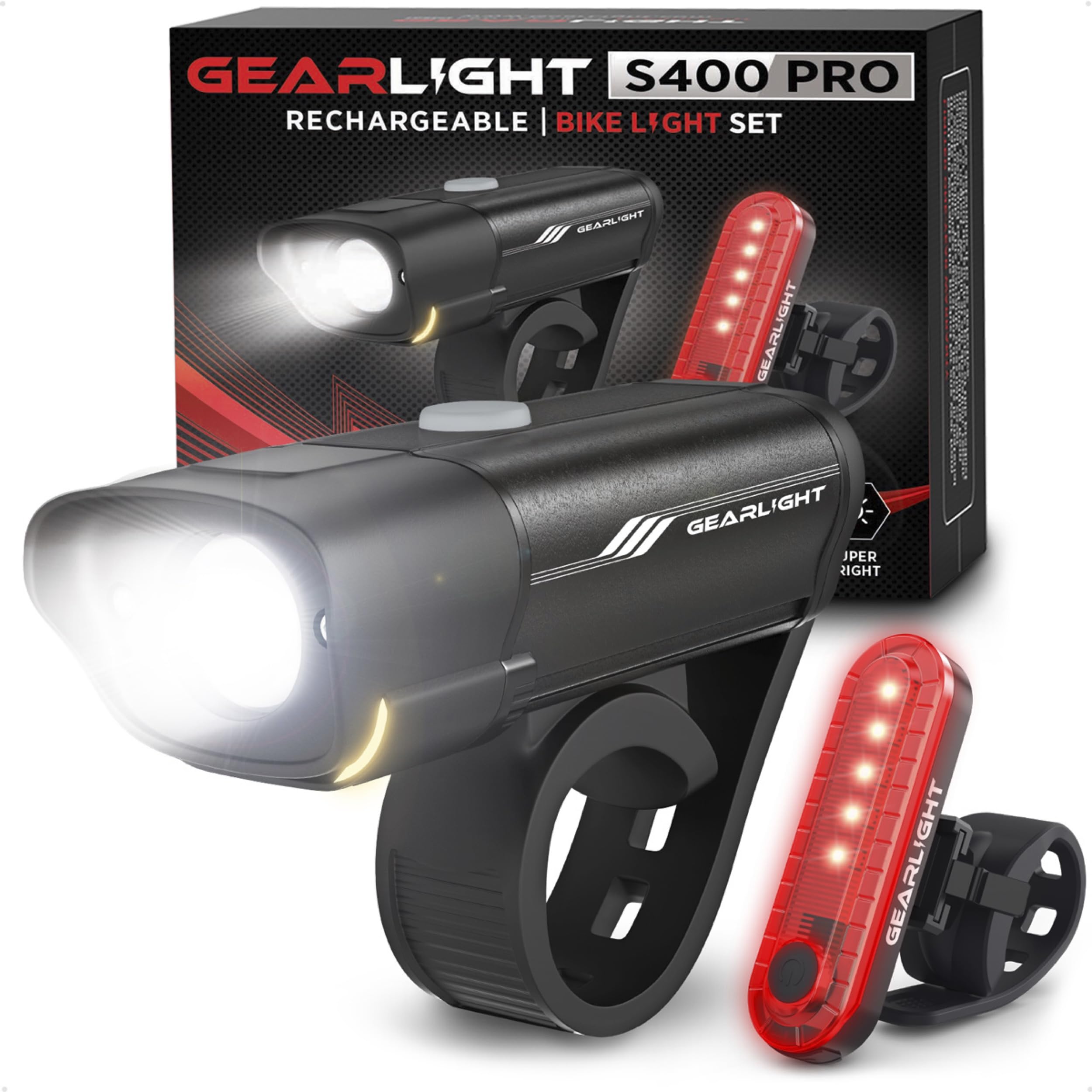
GearLight S400 Pro
Key Features
- Brightness: 400 lumens
- Battery: Rechargeable micro-USB
- Mounting: Quick universal mount
- Water Resistance: IPX4
- Price: $$
The GearLight S400 Pro delivers 400 lumens from a headlight compact enough to pocket, with a tool-free mount that swaps between bikes in seconds. Spare batteries extend runtime without waiting for a charge — a practical touch that larger sets like the top pick don’t offer.
This set is best suited for urban commuters and parents outfitting kids’ bikes who need a reliable, bright-enough setup without overspending. The plastic hook securing the mount can break under stress, and the micro-USB port feels dated — riders who hit rough trails or prefer USB-C should look elsewhere.
Pros
- Compact and bright with tool-free mounting
- Good battery life and value for the price
- Reliable for night riding and commuting
Cons
- Micro-USB charging port is outdated and may develop issues over time
- Plastic securing hook on the mount can break, causing the light to detach during rides
A balanced choice for city riders who value compact brightness and a simple mount — just be mindful of the plastic hook and micro-USB limitations.
Best for Long Runtime Wet
Cuvccn Q4
Key Features
- Brightness: LED array (very bright)
- Battery: 1100mAh front, 350mAh rear
- Mounting: Tool-free strap
- Water Resistance: IPX6
- Price: $
The Cuvccn Q4 stands out in the budget tier for its exceptional battery life and IPX6 waterproofing — a combination that keeps you visible through long rides and heavy downpours. Front and rear lights offer multiple patterns (2×4 front, 2×6 rear), giving flexibility for different riding conditions. The tradeoff is in the mounting: tool-free rubber straps are convenient but can wear out after months of use, especially if frequently removed. For smoother surfaces and moderate vibrations, they hold fine.
This set suits budget-conscious riders who ride in rain or fog and need lights that last between charges. Riders tackling rough trails or who prefer a bombproof mount will find the strap durability a concern. If you can accept replacing the straps occasionally, the Cuvccn delivers strong value with easy USB recharging and reliable brightness.
Pros
- Very bright with multiple lighting patterns (2×4 front, 2×6 rear)
- Long battery life, especially on slow flash modes
- Easy to install and recharge via USB
Cons
- Rubber mounting straps can break after months of use, requiring replacement
- Occasional charging or power anomalies (light won’t turn off, stops charging) may occur
Ideal for riders who need reliable runtime and weather resistance on a budget, but be prepared to replace the straps over time.
Best for Max Budget Brightness
APECYC 1200L
Key Features
- Brightness: 1200 lumens (claimed)
- Battery: USB-C rechargeable
- Mounting: Tool-free bracket
- Water Resistance: IPX6
- Price: $$
The APECYC set delivers a noticeable brightness advantage over the top pick for a similar price, with a headlight that rivals more expensive options. The USB-C charging is fast and the IPX6 rating handles rain well. However, the plastic mount can strip if over-tightened, and long-term durability is unproven.
This set suits urban riders who want car-level visibility on well-lit streets and don’t mind a mount that may need occasional adjustment. It’s less ideal for daily commuters who need a set that holds up to frequent use over years without issues.
Pros
- Brightness that competes with lights costing significantly more.
- USB-C charging is fast and battery life holds up well on lower modes.
- Tool-free mount easily attaches to handlebars without tools.
Cons
- Plastic mount can strip over time, especially if over-tightened.
- Some units may experience electronic failure within a year of use.
Outstanding brightness for the price, but the mount and long-term durability are areas of caution. Best for riders who prioritize visibility over build longevity.
Best for Casual Riders
Akale Set

Key Features
- Brightness: Not specified
- Battery: USB rechargeable 2.5hr
- Mounting: Silicone strap
- Water Resistance: IPX4
- Price: $$
This bike light set charges in 2.5 hours and offers bright, noticeable output for short commutes. However, some units may arrive with a non-working light or straps that detach, and brightness is not specified in lumens — fine for lit streets but uncertain on dark paths.
Pros
- Very bright and easy for drivers to see.
- Quick 2.5-hour recharge with good battery life.
Cons
- Brightness is not specified in lumens; may not be enough for unlit paths.
- Some units have components that arrive non-functional or straps that detach.
This set works well for short, well-lit commutes if you get a functional unit — not the pick for riders who need consistent performance or unlit trail use.
Best for Urban Well-Lit
Victoper 150L

Key Features
- Brightness: 150 lumens
- Battery: USB rechargeable
- Mounting: Handlebar mount
- Water Resistance: IPX4
- Price: $
The Victoper set is budget-friendly, easy to install, and USB rechargeable. It provides enough light to be noticed by drivers on well-lit city streets. However, 150 lumens is too dim to illuminate unlit paths or trails — this is a ‘be seen’ light only.
Pros
- Easy to install and lightweight for quick mounting.
- Adequate brightness for being visible on well-lit streets.
Cons
- On dark roads, 150 lumens won’t light the path ahead — only suitable for places with street lighting.
- Charging issues can occur with some units, affecting convenience.
Works for kids’ bikes or short rides on well-lit streets where being seen matters — not for unlit roads or trail riding.
Best for Early Adopters
Cuvccn 2026

Key Features
- Brightness: 1000 lumens
- Battery: 2200mAh front, 250mAh rear
- Mounting: 360 deg swivel, elastic rear
- Water Resistance: IP65
- Price: $
The Cuvccn set brings side-facing LEDs and a bright 1000-lumen headlight at an entry-level price. USB-C charging and included dual cable add convenience. However, long-term durability is a question mark — occasional reports of headlight failure after a few months, typical for this price range. The side lights are a genuine asset for urban visibility, but the unproven track record makes it better suited as a secondary set or for riders who accept some risk.
Pros
- Side-facing LEDs enhance visibility from angles other lights miss.
- USB-C charging with included dual cable simplifies power management.
Cons
- Headlight may stop working after several months in some cases.
Best for riders who want extra side visibility on a budget and are willing to accept some durability risk.
Best for Compact Bright Set
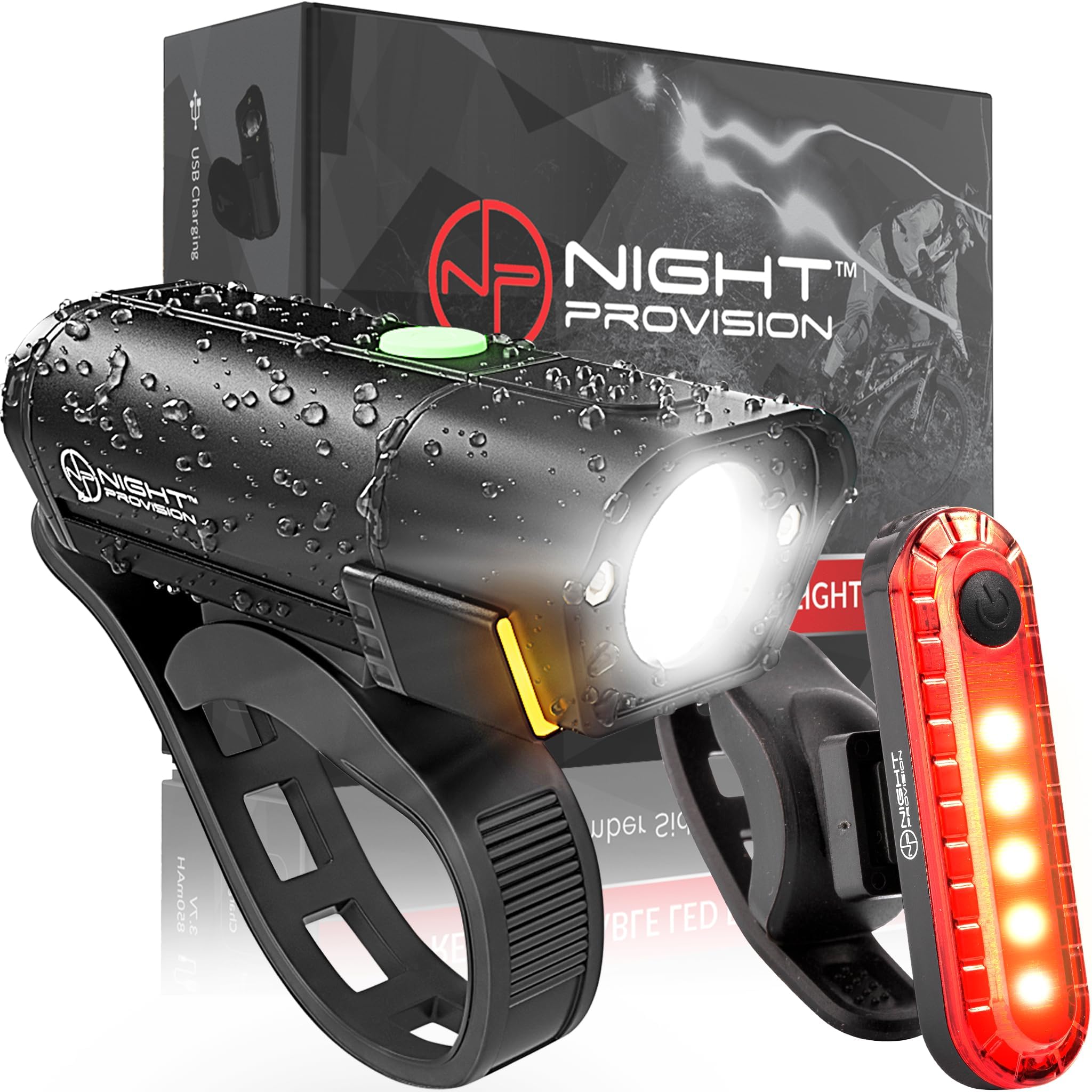
NP BX-500
Key Features
- Brightness: 540 lumens
- Battery: USB-C up to 10hr low
- Mounting: Adjustable strap
- Water Resistance: IP65
- Price: $$
The BX-500 offers the same sturdy aluminum construction and USB-C convenience as the top pick, with a brighter 540-lumen headlight and amber side blinkers for side-on visibility. The strap mount can shift on bumpy roads, and the rear light is less powerful than the front — fine for well-lit streets but not for pitch-black trails. It is a strong alternative if you want extra output and side safety lights.
Pros
- Bright beam with amber side blinkers for side-on visibility.
- Machined aluminum body for long-term durability.
Cons
- Strap mount can rotate on bumpy roads, requiring occasional readjustment.
- Rear light output is noticeably lower than the headlight, reducing rear visibility at distance.
This set suits urban commuters who prioritize headlight brightness and side visibility over mount stability on rough terrain.
Best for Occasional Riders
BV Battery Set

Key Features
- Brightness: 400 lumens (claimed)
- Battery: AAA batteries
- Mounting: Quick-release mounts
- Water Resistance: IPX3
- Price: $
For riders who need a set of lights right now and want to spend as little as possible, the BV Battery Set delivers enough brightness to be seen on dark roads. However, the plastic mounts can break under impact, and the reliance on disposable AAA batteries adds ongoing cost and inconvenience — a setup better suited as an emergency backup than for regular night riding.
Pros
- Bright enough to be seen at night
- Good value for the low upfront cost
Cons
- Mounts are made of brittle plastic and can break on impact
- Runs on disposable AAA batteries, adding ongoing cost and inconvenience
Only worth considering as a cheap backup set or for short, infrequent rides where USB charging is not needed.
How to Choose
The brightest light is useless if the mount fails or the battery dies mid-ride—focus on durability first, then brightness.
Brightness (Lumens)
Lumens measure how much light the headlight emits. For well-lit city streets, 200-300 lumens is enough to be seen. On unlit trails or country roads, you need 400 lumens or more to actually see obstacles and turns.
Many budget lights inflate their lumen claims by 20-40%. Focus on real-world beam pattern and throw distance: a 500-lumen light with a focused beam can outperform a 1000-lumen flood light in cutting through darkness.
Battery Type and Runtime
USB rechargeable batteries are far more convenient than coin cells or AAA batteries, which need frequent replacement. Look for a USB-C port for faster charging and modern compatibility.
Runtime varies hugely by mode. A light that claims 10 hours may only achieve that on a slow flash mode. On high, many budget sets run 2-4 hours. If your commute is 30 minutes each way, you will need to charge every 2-3 days. For long tours, prioritize sets with 2000mAh+ batteries and low-runtime modes.
Mounting Security
Rubber straps are the default on budget lights, but they degrade under UV and vibration. A snapped strap means losing your light mid-ride. Clamps with plastic hooks can also break, especially on bumpy terrain.
For off-road or rough pavement, choose a mount with a secondary lock or a strap that wraps around the handlebar multiple times. Tool-free mounts are convenient but can loosen over time; periodic retightening helps.
Water Resistance Rating
IPX4 is splash-proof and fine for light rain. IPX5 or IPX6 handle heavy downpours and hose spray. IPX7 would survive submersion, but no lights in this test offer that.
If you ride year-round in wet climates, IPX5 or higher is worth the extra cost. Lower ratings risk moisture ingress into the charging port or battery, which can cause failure.
FAQ
How many lumens do I really need for night road cycling?
If you ride on well-lit roads, 200-300 lumens is sufficient to be seen by drivers. For unlit country roads or trails, you need at least 400 lumens to see the path ahead. A focused beam helps more than raw numbers — look for lights with a clear cutoff and throw distance.
Why do my bike lights keep falling off on bumpy trails?
Most budget lights use thin rubber straps that stretch or snap under vibration. For rough terrain, choose a light with a rigid clamp, a secondary safety tether, or a mount that wraps fully around the handlebar. Tool-free mounts can loosen over time — check tightness before each ride.
Are cheap bike lights from Amazon worth it for daily commuting?
Many cheap lights are bright enough for urban visibility, but battery and strap failures are common within 6-12 months. Treat them as consumables. If you commute daily, spending $20-25 on a set with USB-C charging and a more durable mount often pays off in reliability.
Can I use bike lights in heavy rain without them breaking?
Yes, if the lights have an IPX5 or higher rating. IPX4 can handle light rain but may fail under sustained downpour. Always close the charging port cover securely, and dry the light after wet rides to prevent moisture damage to the battery.