This post contains affiliate links. We may earn a small commission when you buy through our links — at no extra cost to you.
A water filter on the trail should be a tool you forget about until you need it. But many backpackers find themselves wrestling with a slow clogging straw or a squeeze pouch that gave out after a weekend. The problem isn’t the filtration — it’s the container.
Most pouches included with squeeze filters develop pinhole leaks, and straws require you to get uncomfortably close to murky water sources. This guide cuts through the marketing noise to match you with a system that actually works for how you hike — whether that’s lightweight speed, group capacity, or reliable emergency backup.




Best for Solo & Duo Hikers
Sawyer Squeeze
Key Features
- Filtration Microns: 0.1
- Flow Rate: 1.7 L/min
- Weight: 2.5 oz
- Filter Life: 100,000 gal
- System Type: Squeeze
- Price: $$
The Sawyer Squeeze delivers a best-in-class flow rate of 1.7 liters per minute, outpacing other squeeze filters by a clear margin. At 71 grams (2.5 oz), it keeps pack weight low while filtering up to 100,000 gallons through a 0.1-micron absolute membrane.
In practice, the included squeeze pouches can develop leaks after moderate use, prompting many users to replace them with a standard Smartwater bottle, which threads directly onto the filter. The drinking cap may also come loose, but the core filtration remains consistent.
This filter suits solo and duo backpackers who value speed and simplicity over all-in-one pouch durability. Ultralight hikers comfortable swapping the bag for a plastic bottle will find it ideal. For group trips requiring a dedicated gravity setup, a Platypus system may be more convenient.
Pros
- Fastest flow rate among squeeze filters – refills bottles quickly
- Simple to use and backflush clean – no pumping required
- Adaptable as a squeeze, gravity, or inline filter for different trip styles
Cons
- Included squeeze pouches can develop seam leaks after moderate use
- Pop-up drinking cap may come loose or be easy to misplace
For solo and duo backpackers who want fast, simple water filtration without the weight of a pump, this is the filter to grab.
Best for Ultralight Trail Runners
Katadyn BeFree 1.0L
Key Features
- Filtration Microns: 0.1
- Flow Rate: 2 L/min
- Weight: 2.2 oz
- Filter Life: 1,000 L
- System Type: Collapsible bottle
- Price: $$
The BeFree’s 2 L/min flow rate is the fastest among collapsible bottle filters, and the whole setup packs flat at under 3 ounces. That combination makes it ideal for trail runners, cyclists, and day hikers who prioritize speed and minimal bulk. The soft bottle, however, can develop pinhole leaks or seam splits if stressed — this matters less for those who handle it gently and replace the bottle seasonally, but it rules out rough multi-day trips.
Pros
- Fastest flow rate among squeeze bottles at 2 L/min
- Collapses flat, taking up minimal pack space
- No priming or assembly – just fill, squeeze, and drink
Cons
- May not thread onto standard wide-mouth bottles for backup use
- Soft bottle can develop pinhole leaks or split at seams under pressure or rough handling
A fast, ultralight option for day trips and gram-counting outings where the bottle gets gentle treatment — not suited for extended backcountry use or those who want a single durable system.
Best for International Travelers
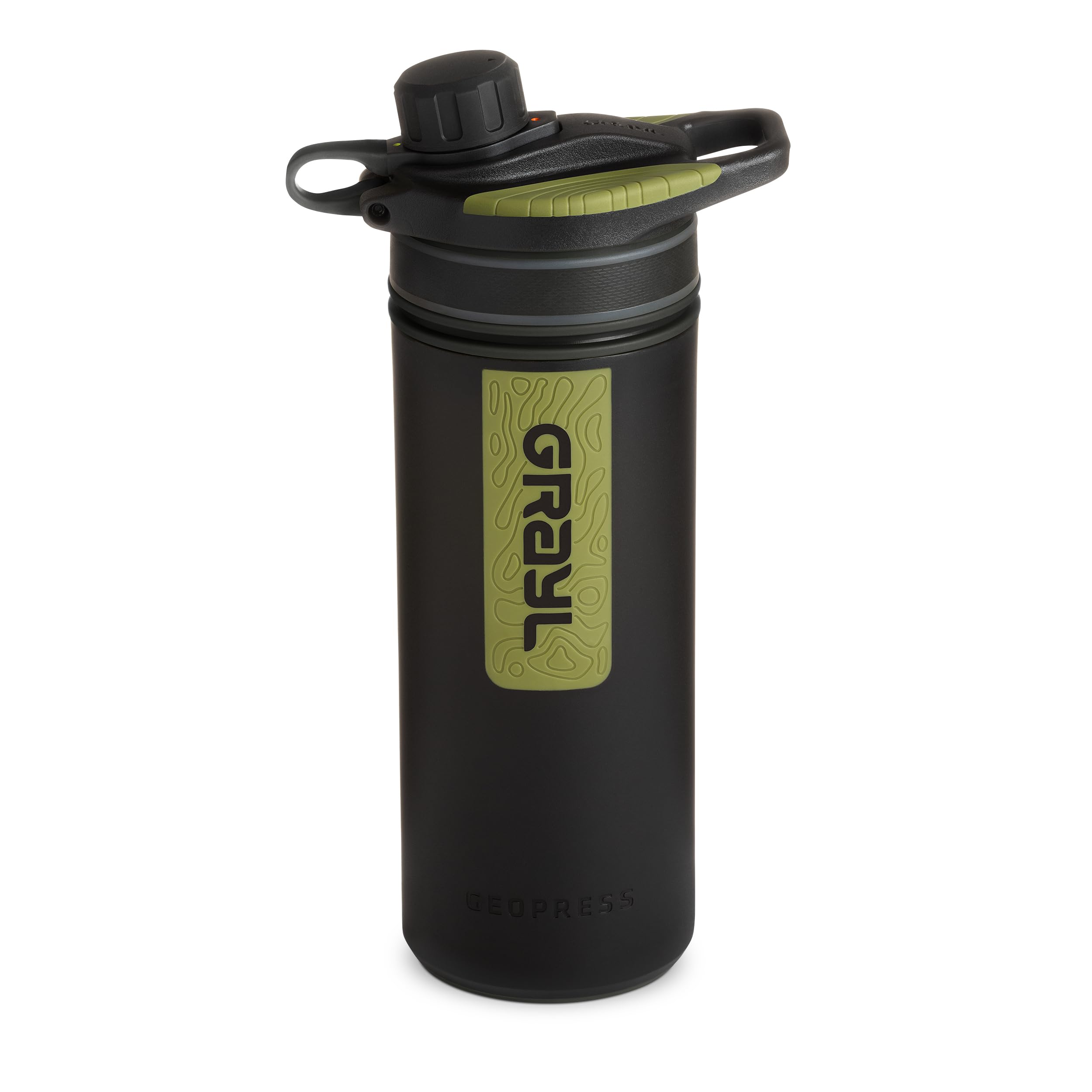
GRAYL GeoPress
Key Features
- Flow Rate: 5 L/min
- Weight: 15.9 oz
- Filter Life: 65 gal per cartridge
- System Type: Press bottle
- Price: $$$
The GeoPress removes viruses, bacteria, and protozoa with a single press, no pumping or waiting, while the carbon filter improves taste noticeably. Ideal for international travelers who need virus protection and can accept the extra weight and pressing effort.
Pros
- Removes viruses – critical for travel and backcountry with viral risk.
- Fast and easy – no pumping or waiting.
Cons
- Heavy and bulky for backpacking – twice the weight of squeeze filters.
- Pressing requires significant hand strength – difficult for children or small hands.
Best for travelers and emergency kits where virus protection outweighs weight and effort. Not for ultralight backpacking.
Best for Group Camping
Platypus GravityWorks
Key Features
- Filtration Microns: 0.2
- Flow Rate: 1.75 L/min
- Weight: 11.5 oz
- Filter Life: 1,500 gal per cartridge
- System Type: Gravity
- Price: $$$
The GravityWorks delivers fast, gravity-fed filtration at 1.75 L/min using a 4L dirty bag that hangs from a tree. No pumping, no squeezing – just fill, hang, and let it work. This setup handles water for four or more people in minutes, making it the go-to choice for group trips where weight isn’t a concern. The 0.2-micron hollow fiber filter meets EPA/NSF standards for bacteria and protozoa, and each cartridge lasts 1,500 gallons.
This system is bulky (11.5 oz) and overkill for solo backpackers or day hikes – it’s built for base camps, canoe trips, and family outings. Some reports note that the grommets holding the hose can pull out under strain, and the filter may clog faster if used with very silty water without pre-filtering. For groups who want effortless clean water without carrying a pump, this is the premium option to beat.
Pros
- Filters 4 liters of water in under 3 minutes with gravity alone
- Simple hang-and-fill operation – no pumping or squeezing required
- Large capacity suitable for groups of 4 or more
Cons
- Too heavy and bulky for solo or ultralight backpacking
- Grommets can pull out under strain; filter may clog sooner in silty water
If your trips involve four or more people and you’re not counting grams, this is the most convenient gravity filter on the market – just know its weight and occasional grommet wear are part of the package.
Best for Solo Hikers
LifeStraw Peak
Key Features
- Filtration Microns: 0.2
- Flow Rate: 2.5 L/min
- Weight: 2.3 oz
- Filter Life: 1,000 gal
- System Type: Straw
- Price: $
The Peak’s faster draw and screw-on compatibility make it a modest but meaningful step up from the original LifeStraw. At 65 grams and under $25, it’s a compact backup that won’t weigh down a daypack. It remains a straw-style filter – you drink directly from the source and need the adapter to fill a bottle, so it’s not as versatile as a squeeze system. Best for solo hikers who prefer sipping directly from streams and want a lightweight option for day hikes or emergency kits.
Pros
- Faster draw than the original LifeStraw – less effort per sip.
- Screw-on threads let it attach to standard water bottles for gravity-fed drinking.
- Light and compact with better grip than the classic design.
Cons
- For refilling bottles, the straw requires active suction and the adapter – not as quick as a squeeze system.
A worthwhile upgrade over the classic LifeStraw for nearly the same price – best value straw filter for solo hikers who drink directly from the source.
Best for Ultralight Backpackers
Sawyer Mini Water Filter
Key Features
- Filtration Microns: 0.1
- Flow Rate: 0.5 L/min
- Weight: 1.45 oz
- Filter Life: 100,000 gal
- System Type: Squeeze / Straw
- Price: $
Incredible filter lifespan in a 1.45-ounce package — the Sawyer Mini is the lightest full-filtration system you can carry. Its 0.1-micron hollow fiber removes bacteria, protozoa, and microplastics without the weight penalty of a pump or gravity bag. The tradeoff is flow rate: squeezing water through this filter to fill multiple bottles is noticeably slower than what the top pick delivers, making it best suited for solo trips where patience isn’t a problem.
This is the filter for ultralight backpackers and thru-hikers who count every gram and don’t mind a slower refill cadence. The included pouch can develop leaks after extended use, but the Mini threads directly onto standard 28mm water bottles or works as an inline filter with a hydration bladder, giving you workarounds. Budget buyers get outstanding value from its 100,000-gallon rated capacity.
Pros
- Filter lasts for 100,000 gallons — exceptional cost per liter over the long haul.
- Weighs only 1.45 ounces — one of the lightest fully functional filters on the market.
- Works as a straw, squeeze filter, or inline with a hydration bladder — adaptable to different setups.
Cons
- Included squeeze pouch can develop leaks after repeated use; easily replaced with a standard water bottle.
- Squeezing to fill bottles is noticeably slower than the top pick — tedious for more than one liter at a time.
The Sawyer Mini is the right pick if weight is your primary concern and you’re willing to accept a slower flow in exchange for a filter that outlasts your hiking boots.
Best for Emergency Kits
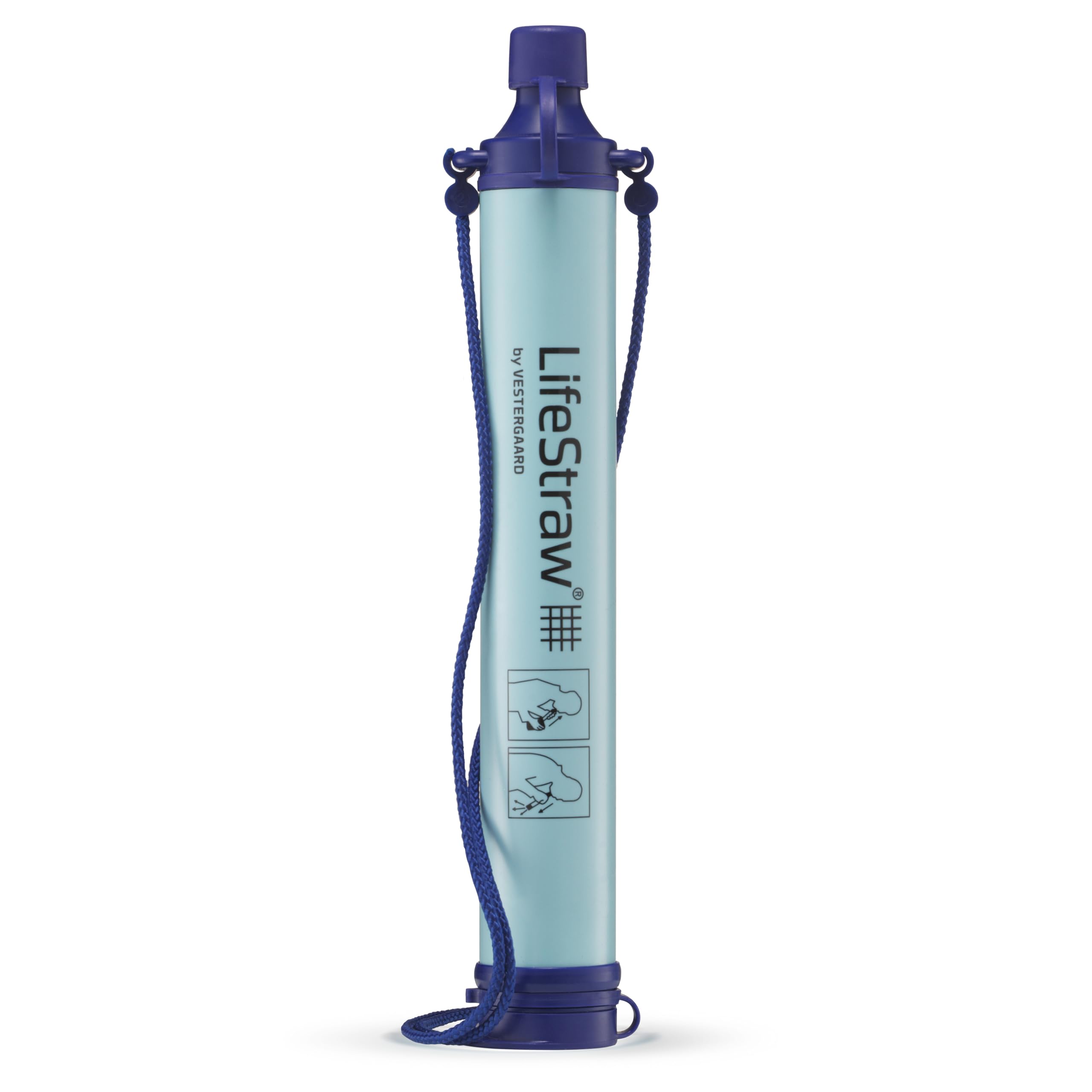
LifeStraw Personal Water Filter
Key Features
- Filtration Microns: 0.2
- Flow Rate: 0.5 L/min
- Weight: 2.1 oz
- Filter Life: 1,000 gal
- System Type: Straw
- Price: $
This straw is light at 2.1 oz and cheap enough to stash in any emergency kit. The 0.2-micron filter removes bacteria and parasites effectively. However, drinking requires active suction that grows tiring as the filter catches debris, and there is no way to fill a water bottle. It works best as a backup for solo outings or emergency preparedness, not as a primary filter for active backpacking trips where you need to carry water away from the source.
Pros
- Exceptional value for emergency and solo use
- Ultra-light and compact
Cons
- Drinking requires strong suction that can be tiring, especially as the filter begins to clog
Best kept as a lightweight backup for emergency kits or solo day hikes where you can drink directly from the source.
Best for Car Campers
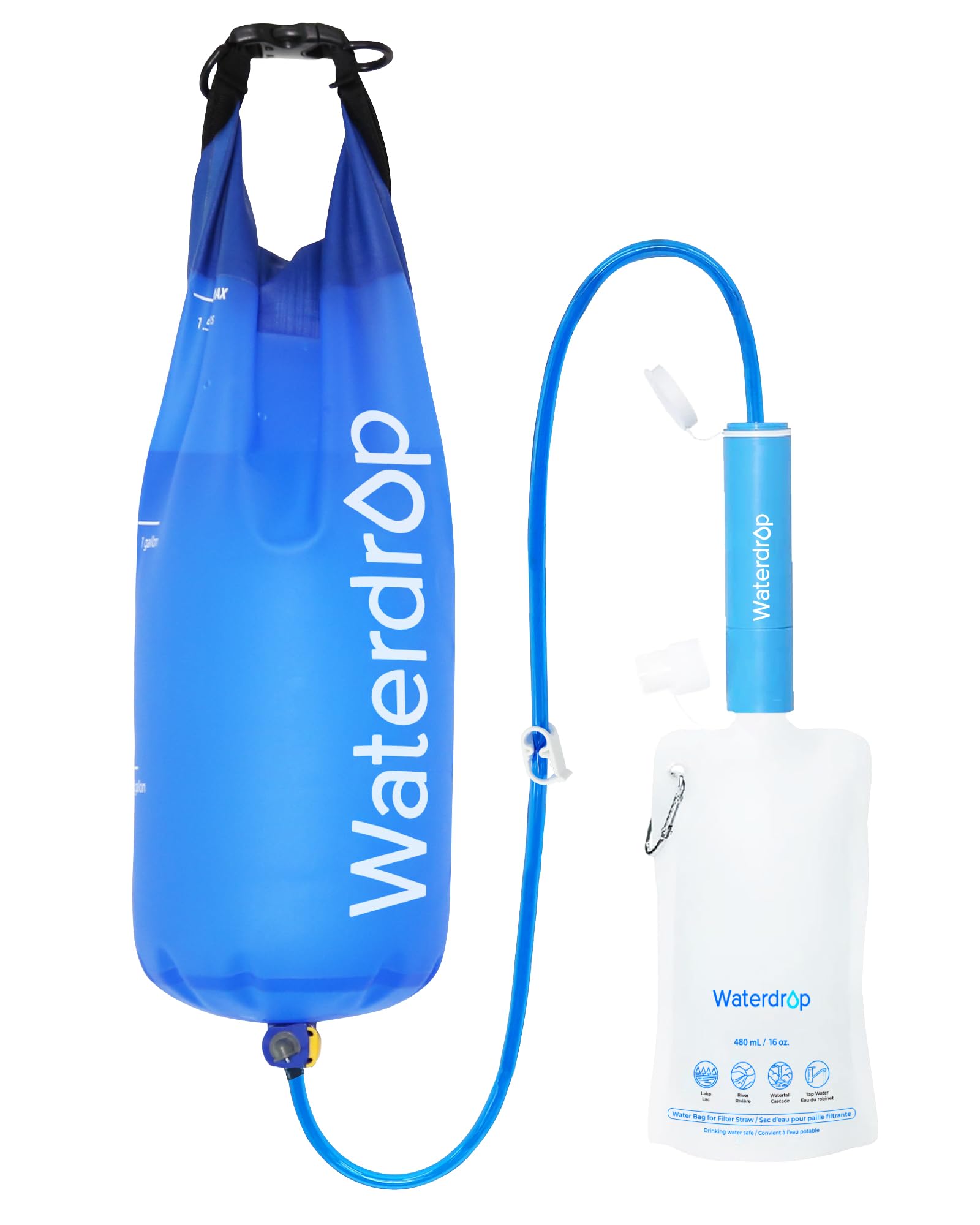
Waterdrop Gravity Filter
Key Features
- Filtration Microns: 0.1
- Flow Rate: 0.7 L/min
- Weight: 4.6 oz
- Filter Life: 1,400 gal
- System Type: Gravity
- Price: $$
The Waterdrop’s gravity design hangs your water bag and filters without pumping, and the carbon stage noticeably improves taste. However, the flow rate depends on elevation—without full height it slows to a trickle, and the bag adds weight that backpackers won’t want. It’s a decent option for base camp or emergency kits, not for light-and-fast trips.
Pros
- Gravity system filters without pumping or squeezing – just hang and wait.
- Carbon filter improves taste by reducing chlorine and odor.
Cons
- Flow rate slows noticeably when the bag isn’t fully elevated – a consideration for faster-paced setups.
This filter works well for car camping or as a group backup where gravity and capacity matter more than pack weight.
Best for Emergency Prep
Practical Survival 2-Pack Straws

Key Features
- Filtration Microns: 0.1
- Weight: 2 oz
- Filter Life: 1,800 gal each
- System Type: Straw
- Price: $
The Practical Survival 2-Pack offers two 1,800-gallon straws at a budget-friendly price, making it a strong choice for building emergency kits. However, the brand has limited field testing compared to Sawyer or LifeStraw, so consider these as backups rather than your primary backpacking filter.
Pros
- Two filters with 1,800-gallon capacity each – exceptional value for emergency preparedness.
- No expiration date allows long-term storage in bug-out bags without worry.
Cons
- Threading onto standard bottles can be inconsistent, and the brand’s field reliability is less established than top-tier alternatives.
Best suited for emergency kits and prepper supplies where backup filters are needed – not for primary backpacking trips.
Best for Budget Virus Protection
Survivor Filter PRO

Key Features
- Filtration Microns: 0.01
- Flow Rate: 0.5 L/min
- Weight: 12.8 oz
- System Type: Pump / Squeeze
- Price: $$$
The Survivor Filter PRO offers virus-rated 0.01-micron filtration at a lower price than GRAYL, plus a full kit with cup and bag. The 12.8 oz weight and bulk make it less suited for weight-conscious backpackers, and the brand is less established. It works well for those who want a complete virus-removal system and can accept the extra load.
Pros
- Virus removal at a lower price than GRAYL
- Comprehensive kit includes cup, bag, and tubes – no separate purchases needed
Cons
- Weighs 12.8 oz, roughly four times heavier than typical straw or squeeze filters, adding noticeable bulk to a pack
Best suited for backpackers who want a complete virus-removal kit and are willing to carry the extra weight rather than chasing ultralight grams.
Best for Modular Preppers
Membrane Solutions S2 Straw

Key Features
- Filtration Microns: 0.1
- Flow Rate: 0.5 L/min
- Weight: 3 oz
- Filter Life: 5,000 L
- System Type: Straw
- Price: $$
The S2 straw offers a clever replaceable cartridge that cuts waste and cost per liter, with NSF/ANSI 42, 372, and 401 certifications. However, the smaller brand lacks the extensive field testing of major competitors, and some units may stop working after a couple uses. This makes it a reasonable backup or emergency option rather than a primary filter for demanding trips.
Pros
- Replaceable cartridge saves money over time and reduces plastic waste.
- Cost-effective when buying in four-pack – low cost per filtered liter.
Cons
- Some units may stop filtering after limited use – less field-tested than top brands.
Best kept as a backup or for non-critical trips where the weight and cost savings outweigh the reliability risk.
How to Choose
The right backpacking filter balances flow speed, weight, and durability against your trip length and group size.
Filtration Micron Rating
Micron rating determines what gets removed. A 0.2-micron filter catches bacteria and protozoa but not viruses. A 0.1-micron filter is still not fine enough for viruses — you need 0.01 micron or electroadsorption for that.
For most North American backcountry water, 0.1 or 0.2 micron is sufficient. If you travel internationally to areas with viral contamination, look for a purifier that explicitly states virus removal.
Flow Rate
Flow rate directly impacts how long you wait for a full bottle. Squeeze filters like the Sawyer Squeeze hit 1.7 L/min, while straws often struggle at 0.5 L/min. Gravity systems are hands-free but slower — expect 0.7 to 1.75 L/min depending on elevation.
If you hike in a group or want quick refills, prioritize flow rate above 1 L/min. For solo ultralight trips, a slower straw may be acceptable.
Weight and Packed Size
Weight is critical for backpacking. Straw filters weigh 1.5–2.5 oz, squeeze filters add another ounce for the bag, and pump filters tip the scale at 11+ oz. A heavier filter means more effort every step.
But lightweight often sacrifices durability — the Katadyn BeFree’s collapsible bottle is prone to leaks. Decide whether you’ll baby your gear or want something that survives rough handling.
Filter Lifespan
Filter life determines how often you buy replacements. Sawyer products boast 100,000 gallons — effectively lifetime for most backpackers. Straws typically last 1,000 gallons, and cartridge-based systems like GRAYL last 65 gallons per cartridge.
A long lifespan reduces long-term cost and waste, but only if the filter doesn’t clog prematurely. Backflushing and proper storage extend life.
System Type
Straws are simple and cheap but require you to drink directly from the source — awkward on shallow creeks. Squeeze systems let you collect water in a bag and filter into a bottle, offering more flexibility.
Gravity systems are best for base camps: hang a bag and let it drip. Pumps work well in silty water but are slower and heavier. Choose based on how you’ll be moving and how many people you’re supplying.
FAQ
Why does my Sawyer Squeeze bag keep leaking after a few uses?
The included squeeze pouches are the weakest link in the system. The seams and material can develop pinhole leaks after moderate use, especially under pressure. Many experienced users replace the pouches with a standard 1L Smartwater bottle, which threads directly onto the Sawyer filter and is far more durable.
Can a LifeStraw filter out viruses like norovirus or hepatitis?
No. Standard LifeStraw filters use a 0.2-micron membrane that removes bacteria and protozoa but not viruses. For virus protection you need a purifier rated at 0.01 micron or using electroadsorption, such as the GRAYL GeoPress or Survivor Filter PRO.
How do I backflush a water filter straw to restore flow?
Most straw filters come with a backflushing syringe or plunger. Inject clean water backward through the filter to dislodge trapped sediment. Do this after every few uses or when flow slows. If your straw lacks a backflush tool, soaking in a mild vinegar solution can help, but don’t use bleach as it may damage the membrane.
Is a pump filter or squeeze filter better for backpacking with a group of 4?
For a group of 4, a gravity system like the Platypus GravityWorks is more efficient than either a pump or squeeze. It filters 4 liters hands-free in under 3 minutes. Squeeze filters work but require constant squeezing and bag refills. Pumps are slower and more effort. Gravity is the clear winner for group volume.