This post contains affiliate links. We may earn a small commission when you buy through our links — at no extra cost to you.
Many bottles promise leak-proof performance but start dripping after a few trips. Others boast insulation but add a pound to your pack – a trade-off that doesn’t always pay off on long climbs.
This guide cuts through the claims to focus on what actually holds up on the trail. We’ve looked at real-world reports of lid failures, dents, and weight penalties to identify which bottles deliver on their promises without surprise defects.
The best choice often comes down to matching the bottle’s actual strengths – durability, weight, or temperature retention – to your specific hike length and climate, not the marketing tagline.



Best for Day Hikers
Nalgene 32 oz Wide Mouth
Key Features
- Capacity: 32 oz
- Weight: 6.25 oz
- Leak-Proof: Screw lid
- Mouth Type: Wide
- Portability: No cup holder
- Price: $
Screw-cap simplicity makes this bottle one of the most reliable options for trail carry. The thick Tritan plastic withstands drops on rock and gravel without cracking, and the airtight seal keeps water inside the pack even when the bottle is jostled. At 6.25 oz, it adds negligible weight to a backpack—no extra latches or gaskets to fuss with.
For day hikers and ultralight backpackers who prioritize weight and toughness over insulation, this is the standout choice. The wide base doesn’t fit car cup holders, and water warms quickly in direct sunlight—tradeoffs that matter less on the move than at a desk. The wide mouth and dishwasher-safe design simplify cleaning after a dusty trail day.
Pros
- Withstands repeated drops on rocks and trails without cracking or denting.
- Screw-top seal keeps water inside the pack even when the bottle is jostled.
- Wide mouth and dishwasher-safe design simplify cleaning after trail use.
Cons
- In hot weather, water temperature rises quickly—better suited for moderate conditions or with ice added.
- Wide base prevents use in most car cup holders, less of an issue on foot.
For backpackers who want a bottle that won’t let them down—no complex lids, no dent-prone metal—this Nalgene earns its place with simple, proven reliability.
Best for Ice-Cold All-Day
Hydro Flask 32 oz Insulated
Key Features
- Capacity: 32 oz
- Weight: 15.52 oz
- Insulation: 24h cold
- Leak-Proof: Flex cap
- Mouth Type: Wide
- Portability: Heavy, wide base
- Price: $$$
The Hydro Flask keeps ice cold for 24 hours — a clear advantage for long summer treks. At 15.5 oz empty, it is noticeably heavier than a plastic bottle like the top pick, and the stainless steel shell can dent if dropped on rocks. This bottle suits hikers who will trade weight for cold water and pack it in a padded pocket rather than a side mesh holder.
Pros
- Keeps ice cold for a full day — ideal for hot-weather hikes.
- Wide-mouth Flex Cap seals tightly when properly threaded.
Cons
- Weighs 15.5 oz empty — heavier than most plastic bottles for backpacking.
- Steel body can dent or scratch on hard drops.
The best choice for hikers who value ice-cold water above weight and dent resistance.
Best for Ultralight Thru-Hikers
Platypus 2L Collapsible
Key Features
- Capacity: 70 oz
- Weight: 1.3 oz
- Leak-Proof: Screw cap
- Mouth Type: Screw (filter compat)
- Portability: Packs flat
- Price: $$
Weighing just 1.3 oz and folding flat when empty, this Platypus is the go-to for weight-conscious backpackers who need a backup water container or a primary bottle on ultralight trips. Its standard screw cap threads directly onto Sawyer and GravityWorks filters for easy backcountry treatment. However, the cap is not tethered — easy to lose — and thin walls mean punctures are possible if packed against gear. The same screw cap can also develop leaks after extended use. This bottle suits thru-hikers who prioritize ounces over ruggedness, but it isn’t the right choice for those who want a no-leak main bottle or plan to toss it in a pack without care.
Pros
- Weighs 1.3 oz and packs flat to save space.
- Compatible with standard water filters via screw cap.
Cons
- Screw cap may leak over time and is not attached — easy to lose.
- Thin walls can puncture if pressed against sharp gear.
Best for ultralight backpackers who treat weight as the top priority and accept minor leak risk and careful packing in return.
Best for Remote Water Sources
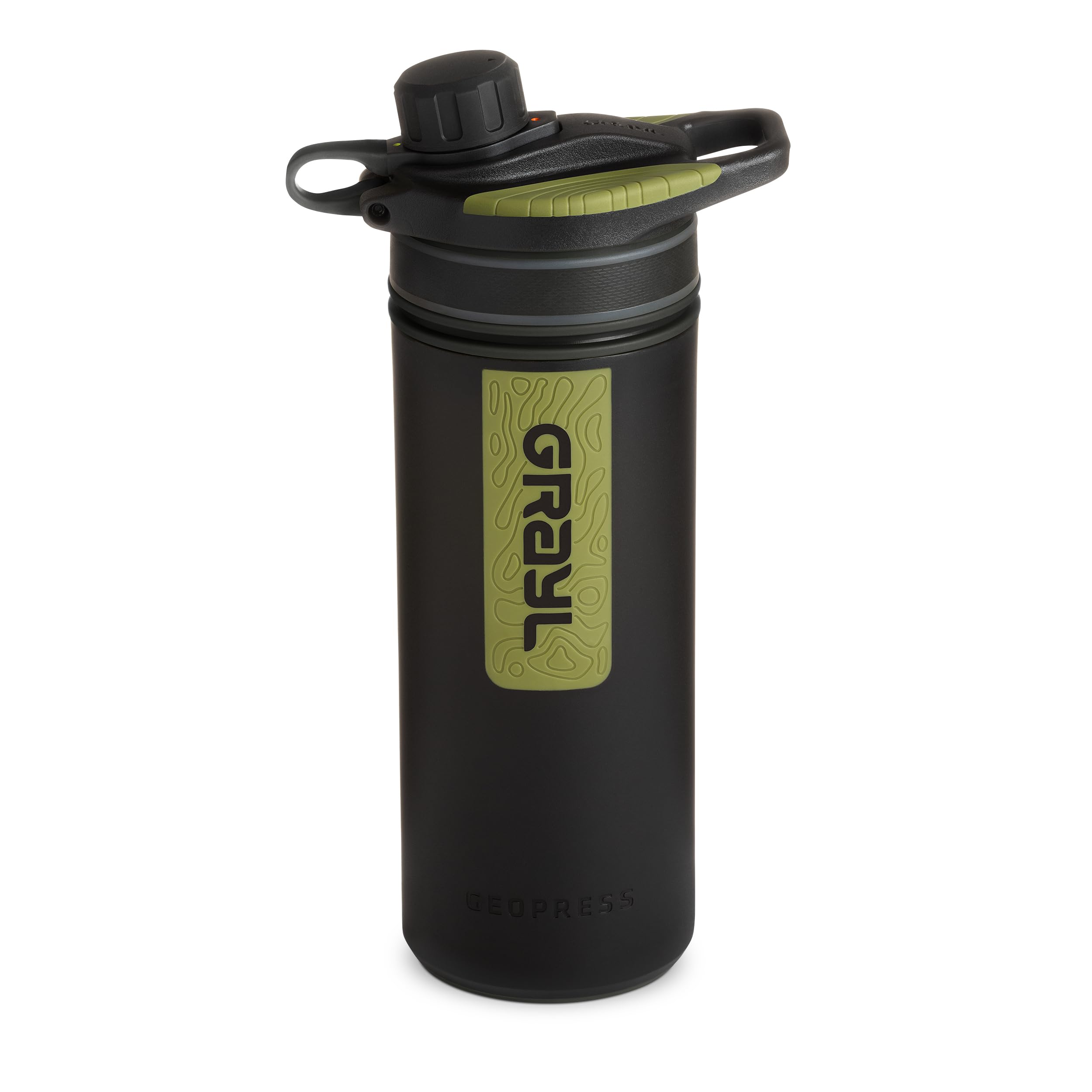
GRAYL GeoPress Purifier
Key Features
- Capacity: 24 oz
- Weight: 15.9 oz
- Insulation: None (purifier)
- Leak-Proof: Press seal
- Mouth Type: Wide
- Portability: Compact
- Price: $$$$
The GeoPress eliminates the need for separate purification tablets or filters by combining the bottle and purifier into one unit. It removes viruses, bacteria, and protozoa with a quick press action, delivering safe drinking water in seconds. However, pressing the filter requires a firm hand — a real barrier for those with weak grip or arthritis. Best for backpackers heading into remote areas with untreated water, or international travelers who want safe tap water without buying bottled.
Pros
- Filters out all pathogens — viruses, bacteria, and protozoa — for safe drinking from any source.
- Fast purification: fill, press, drink in seconds with no waiting time.
- Compact and portable design fits easily into a backpack or carry-on.
Cons
- Requires significant hand strength to press the filter — may be difficult for some users.
- Premium price compared to standard water bottles, though it replaces separate purification gear.
If you need safe water from any source and can manage the press force, this is a compact self-contained solution that removes the need for separate purification tablets or filters.
Best for Dual-Mode Drinking
Owala FreeSip 24 oz
Key Features
- Capacity: 24 oz
- Weight: 16.2 oz
- Insulation: Double-wall vacuum
- Leak-Proof: Twist cap
- Mouth Type: FreeSip (straw+chug)
- Portability: No cup holder
- Price: $$
The FreeSip spout toggles between straw and chug modes with a simple turn of the lid, backed by double-wall vacuum insulation that keeps water cold for hours. The twist-top design seals tight enough to toss in a pack without leaks. For backpacking, the stainless steel finish scratches against rocks and gear, and the wider base won’t fit typical trail-side cup holders. This bottle suits hikers who value drinking flexibility and cold water over a rugged, scratch-free exterior.
Pros
- FreeSip spout provides both straw and chug options without swapping caps.
- Double-wall vacuum insulation holds cold temperatures through full-day hikes.
- Twist-top lid seals leak-free when closed.
Cons
- Stainless steel finish can scratch from contact with rocks or gear on the trail.
- Wider base may not fit standard cup holders — relevant for car-to-trail transitions.
Choose this if you want insulated drinking with two options on the move and can accept cosmetic wear from trail use.
Best for Lightweight Hiking
YETI Yonder 34 oz

Key Features
- Capacity: 34 oz
- Weight: Lightweight plastic
- Leak-Proof: Chug cap
- Mouth Type: Chug cap
- Portability: No cup holder
- Price: $$
Lightweight, shatter-resistant plastic with a leak-proof chug cap for easy drinking. No insulation means water warms quickly on hot days—fine for temperate hikes. Lid can warp in high heat, though warranty covers replacement. Priced at a premium for non-insulated, this suits hikers who prioritize low weight over cold water.
Pros
- Lightweight, shatter-resistant build that handles drops well.
- Leak-proof chug cap makes drinking easy while moving.
Cons
- Not insulated; water warms quickly in sunlight.
Works for weight-conscious day hikers on mild trails who carry a separate cooler or don’t mind tepid water.
Best for One-Hand Drinking
CamelBak Chute Mag 25 oz

Key Features
- Capacity: 25 oz
- Weight: 5.96 oz
- Leak-Proof: Magnetic cap
- Mouth Type: Screw top
- Portability: Fits some cup holders
- Price: $
The magnetic cap flips open and locks out of the way, making one-hand hydration easy during commutes or gym sessions. On the downside, some units have inconsistent seals that can drip, and the cap threading occasionally feels finicky. No insulation means ice melts faster, so this fits best for short trips or daily use where convenience outweighs absolute leak-proof performance.
Pros
- Magnetic cap stays out of the way while drinking
- Lightweight and durable for everyday carry
Cons
- Leak-proof performance can vary, with some units dripping when laid on their side
Good pick for daily commuters or gym-goers who value easy one-hand drinking and don’t need a bottle that stays completely dry in a pack.
Best for Long Day Hikes
Nalgene 48 oz Silo

Key Features
- Capacity: 48 oz
- Weight: 7.375 oz
- Leak-Proof: Screw lid
- Mouth Type: Wide
- Portability: Bulky side pocket
- Price: $
This plastic bottle carries a full 48 ounces while staying as light as the standard 32 oz model, so you can skip a second bottle on all-day hikes. The wide mouth makes ice loading and cleaning easy. But the extra height and width mean it does not fit most backpack side pockets, and the simple screw cap — though generally dependable — has occasional reports of cracks or leaks between units.
Pros
- Very large capacity without added weight compared to the 32 oz version.
- Durable, leak-proof design with a wide mouth for easy cleaning and ice.
Cons
- Bulky shape may not fit standard backpack side pockets or cup holders.
Great for day hikes where you need the extra capacity and don’t mind carrying it inside your pack or by hand.
Best for Controlled Drinking
Nalgene Narrow Mouth 32 oz

Key Features
- Capacity: 32 oz
- Weight: 6.25 oz
- Leak-Proof: Screw lid
- Mouth Type: Narrow
- Portability: No cup holder
- Price: $
This Nalgene delivers the same tough, drop-resistant build and leak-proof screw cap as the wide mouth version, but with a narrower opening that reduces splashing and makes sipping while hiking more controlled. The tradeoff is that the narrow neck makes cleaning harder, and there is no insulation, so water warms up in direct sun. It fits best for those who value spill-free drinking and can accept a bit more effort during washing.
Pros
- Durable body that withstands drops on rocky trails.
- Leak-proof screw lid with a spout that allows easy sipping on the move.
Cons
- Narrow mouth makes cleaning more difficult than wide mouth models.
A good choice for hikers who prefer a narrow mouth for controlled drinking and can manage the extra cleaning effort over the wide mouth alternative.
Best for Camping, Day Hikes
RAYMYLO 40 oz Insulated

Key Features
- Capacity: 40 oz
- Weight: 40 oz (2.5 lb)
- Insulation: 36h cold
- Leak-Proof: Straw/spout lid
- Mouth Type: Wide, straw
- Portability: Paracord handle
- Price: $$
The RAYMYLO 40 oz delivers strong insulation for keeping water cold all day, and the included carrying pouch, extra straws, and cleaning brush add value. However, the lid and straw assembly can break after moderate use, and some units leak from the lid. At 2.5 lb, it’s heavy for backpacking, making it better suited for car camping or day hikes where weight isn’t critical.
Pros
- Keeps ice cold for 36 hours – ideal for multi-day trips with access to ice.
- Comes with a carrying pouch, extra straws, and a cleaning brush for added convenience.
Cons
- Lid and straw assembly may fail after limited use, especially if dropped.
Best for casual day trips or car camping where you can keep the bottle upright and handle with care.
Best for Insulated Lightweight
Stanley IceFlow 24 oz

Key Features
- Capacity: 24 oz
- Weight: 14.08 oz
- Insulation: Double-wall vacuum
- Leak-Proof: Angled spout
- Mouth Type: Angled spout
- Portability: Lightweight steel
- Price: $$$
The Stanley IceFlow 24 oz is a lightweight insulated bottle that keeps water cold for hours — a useful feature for hikes. Cap cracking has been noted over time, which affects long-term durability. It works well for day trips if you can accept the potential for lid replacement.
Pros
- Weighs 33% less than standard steel bottles for easier trail carry.
- Double-wall vacuum insulation keeps drinks cold for hours and ice for two days.
Cons
- Some units arrive with cosmetic scratches or dents, which may be noticeable on a premium-priced bottle.
Works well for day hikes where cold water is a priority, provided you are prepared for potential cap issues.
Best for Short Hikes/kids
Nalgene 16 oz Narrow

Key Features
- Capacity: 16 oz
- Weight: 3.75 oz
- Leak-Proof: Screw lid
- Mouth Type: Narrow
- Portability: Fits cup holders
- Price: $
This compact Nalgene brings the same leak-proof reliability and lightweight build of the larger models, but in a 16 oz package that slips into car cup holders and small backpack pockets. The narrow mouth makes sipping easy while moving, though it is harder to get a brush inside for thorough cleaning. Its small capacity limits it to short day hikes or kid use — not enough water for a full day on the trail.
Pros
- Fits standard car cup holders and small bag pockets without wobbling.
- Lightweight at 3.75 oz with the same durable construction as full-size Nalgene bottles.
Cons
- Narrow mouth can be tricky to clean thoroughly without a bottle brush.
A good choice for short walks, dog outings, or as a kid’s bottle, but too small for serious hiking where a liter or more is needed.
How to Choose
The most overlooked factor in choosing a backpacking water bottle is how the lid design interacts with your pack setup and daily use – not just the capacity or brand name.
Capacity
Capacity dictates how often you refill and how much weight you carry. A 32 oz bottle (1 liter) balances most day hikes, while 48 oz or 2L collapsible options suit dry stretches longer than half a day.
The trade-off: larger capacity means more weight when full – each liter of water adds about 2.2 pounds. For climbs, every ounce counts; choose capacity that matches your nearest water source distance, not your thirst.
Weight
Bottle weight directly affects your pack’s base load. Plastic bottles like Nalgene weigh around 6 oz empty, while insulated stainless steel models start at 15 oz – over double the weight before adding water.
That extra weight buys temperature retention, but if you hike in mild climates or have short refill stops, the insulation cost outweighs the benefit. Ultralight collapsibles drop to 1.3 oz but sacrifice durability and leak-proof consistency.
Insulation
Double-wall vacuum insulation keeps water cold for 24+ hours but adds significant bulk and weight. The hidden cost is that the bottle’s steel walls dent on rocks, and the lid often becomes the failure point after repeated thermal cycling.
If you need cold water for a full day in summer, insulation is worth the penalty. For morning starts in cool conditions or short outings, a non-insulated plastic bottle lets you shed nearly half a pound and avoid dent worries.
Leak-Proof Reliability
A bottle that leaks inside your pack can ruin gear and add frustration. Simple screw caps with a gasket, like Nalgene’s, have decades of proven reliability. Fancier lids (bite valves, magnetic caps, straw mechanisms) introduce more seals, each a potential leak point.
Many bottles rated 4.5+ stars show high leak complaint rates in the long term. The practical choice is to favor a simple, well-sealed lid over convenience features, especially if you carry the bottle in a side pocket without a waterproof bag.
Mouth Type
Wide mouths make cleaning and adding ice easy but can spill when drinking on the move. Narrow mouths reduce splash but require a dish brush for cleaning. Straw or bite valve designs allow hands-free drinking but add parts that wear out or break.
The biggest hidden trade-off is that wide mouths don’t fit standard car cup holders – a nuisance for transitions. Narrow mouths do, but you lose the ability to drop in cleaning tablets or ice cubes. Match mouth type to your primary use scenario.
Portability
How the bottle fits in your pack or on your hip matters more than you think. A tall 32 oz bottle may not fit shallow side pockets; a wide 48 oz bottle might poke into your back. Collapsible bottles solve this by flattening when empty, but the screw cap can be lost.
Also consider whether you need to clip the bottle to a carabiner (paracord handles help) or stash it in a hydration sleeve. Ultralight hikers often prefer a bottle that can be stored inside the pack vertically to avoid side pocket strain.
FAQ
Why does my insulated water bottle dent so easily from small drops?
Insulated bottles are made of double-wall stainless steel, which is inherently softer than solid steel or plastic because the inner and outer walls are thin to save weight. A drop on a rock creates a dent that doesn’t affect insulation but looks bad. If denting bothers you, stick with a plastic or collapsible bottle for rugged use.
Is a Nalgene bottle truly leak-proof for backpacking?
Nalgene’s standard screw cap with the Loop Top or standard cap uses a gasket that creates an airtight seal when tightened. Thousands of hikers confirm it’s leak-proof when the cap is fully closed. The only risk is not screwing it on straight or leaving the cap loose – it’s a simple, reliable design with very few failure reports.
How can I prevent the lid on my Stanley or Hydro Flask from breaking?
The most common failure is the flip-up straw or hinge mechanism cracking after repeated opening or heat exposure. Avoid putting these bottles in a dishwasher’s top rack (the heat warps plastic parts). Hand wash and store the lid separately. If the lid does break, both brands sell replacement caps for about $10-15, so you don’t need to replace the whole bottle.
Does a collapsible water bottle like the Platypus hold up for multi-day hikes?
Platypus collapsible bottles are designed for backpacking and can survive multiple trips if treated carefully – avoid setting them on sharp rocks or stuffing them in a pack with crampons. The main durability concern is the screw cap threads wearing out after many refills, causing slow leaks. For thru-hikes, consider it a disposable lightweight option that may need replacement every season. It’s best as a secondary water carrier rather than your primary bottle.