This post contains affiliate links. We may earn a small commission when you buy through our links — at no extra cost to you.
The term ‘backpacking tarp’ covers everything from 20-ounce ultralight shelters to two-pound car camping covers. Many options marketed for backpacking are simply too heavy for a multiday hike, forcing you to choose between a reliable shelter and a tolerable pack weight.
Once you sort by real weight, the next trade-off is open ends versus enclosed doors. Open tarps save ounces but let wind-driven rain in; enclosed designs add a few ounces but block drafts. The right pick depends on your hammock setup, typical weather, and how much you value a dry night over a lighter load.
This guide focuses on tarps that honestly deliver on their weight claims and provide the coverage you need for your specific trips.


Best for Solo Backpackers
Wise Owl 11x9ft Rain Fly
Key Features
- Weight: 26 oz
- Waterproof Rating: 3000mm
- Size: 11 x 9 ft
- Material: Ripstop nylon
- Price: $$
This rain fly delivers a lightweight 26-ounce build with a 3000mm waterproof coating that keeps moisture out during downpours. The ripstop nylon construction and taped seams add durability, while the 11×9-foot size provides generous coverage for a single hammock. Setup is intuitive with the included stakes, guy lines, and carry bag.
Over repeated use, the fly holds up to wind and rain without developing leaks. The lightweight stakes work fine in soft soil but can bend when forced into rocky ground — a simple upgrade to heavier stakes resolves that.
This fly suits solo backpackers and hammock campers who prioritize weight and packability for three-season trips. The open ends allow wind-driven rain to reach hammock ends in heavy storms, so those who frequently camp in windy, rainy conditions may want a tarp with doors — such as the Onewind design. The 11×9 size fits one hammock comfortably; two would be a squeeze.
At a mid-range price, this tarp undercuts many competitors while delivering comparable weight and waterproofing. It is a practical choice for anyone building a lightweight kit without overspending.
Pros
- Lightweight and compact for backpacking
- Dependable water resistance keeps users dry in downpours
- Easy to set up with included hardware
- High durability for the weight
Cons
- Open ends can allow wind-driven rain to reach hammock ends in heavy storms
- Included stakes may bend when used on rocky or hard-packed ground
This is the smart pick for solo backpackers who want a lightweight, waterproof shelter that won’t break the bank.
Best for All-Weather Hammock
Onewind 12×10 Silnylon
Key Features
- Weight: 29 oz
- Waterproof Rating: 4000mm
- Size: 12 x 10 ft
- Material: 20D ripstop silnylon
- Price: $$
The Onewind tarp sets itself apart from lighter open-ended options by adding overlapping doors that block wind-driven rain and snow. The 12×10 ft footprint provides generous coverage for hammocks or ground sleeping, while the 20D ripstop silnylon keeps packed weight at 1.8 lb — a reasonable trade for the extra weather defense.
This tarp suits hammock campers who camp in exposed or storm-prone sites where open ends would let moisture reach the hammock ends. The silnylon fabric requires careful staking to avoid sag after rain, and the included stuff sack is snug for repacking. Those new to silnylon should practice pitching at home to manage the stretch characteristic.
Pros
- Overlapping doors block wind and rain effectively, keeping the hammock dry in storms.
- Weighs 1.8 lb — competitive for a tarp this size with full enclosure.
- Silnylon construction feels sturdy and well-reinforced at stress points.
Cons
- Stuff sack is small; fitting the tarp back in takes extra effort after use.
- Silnylon fabric can sag when wet, requiring a tighter initial pitch or mid-trip adjustments.
If your priority is all-weather hammock camping with door-level storm sealing, this tarp delivers at a weight penalty you can carry — just budget a few extra minutes for pitching technique.
Best for Budget Hammock Campers
Gold Armour 12×10 Tarp
Key Features
- Waterproof Rating: 5000mm
- Size: 12 x 10 ft
- Material: Polyester
- Price: $
33 tie-down loops let you pitch this tarp in nearly endless configurations — a standout feature for group shelters and base camps. Unlike the Onewind’s storm doors, this one prioritizes sheer coverage and flexibility. The plastic tie-out loops can snap under high tension, but replacing them with stronger cordage is a simple fix.
This tarp suits budget-conscious hammock campers who want abundant coverage without spending over $50. Its moderate weight (around 1.5-2 lbs) is acceptable for weekend backpacking trips, but not for gram-counting thru-hikes. The 5000mm waterproof coating keeps rain out effectively, so you stay dry in moderate storms.
The included accessories — centerlines, stakes, ropes, and tensioners — are functional for casual use. Water resistance holds up well in steady rain, and the generous 12x10ft footprint easily covers a hammock and gear. For the price, you get a lot of fabric and adjustability.
Pros
- 33 tie-down loops allow endless pitch configurations.
- High waterproof rating keeps occupants dry in moderate rain.
- Excellent coverage for group or base camp use at a budget price.
Cons
- Plastic tie-out loops may snap under high tension; upgrading cordage recommended.
- Weight is moderate; ultralight backpackers should look at silnylon options.
For budget-minded hammock campers who need massive coverage and don’t mind moderate weight, this is an unbeatable value — just be prepared to reinforce the tie-out loops.
Best for All-In-One Kit
NoCry 12×10 Tarp
Key Features
- Weight: 26.4 oz
- Size: 12 x 10 ft
- Material: 210T polyester TPU
- Price: $$
The NoCry 12×10 stands out among budget tarps because it arrives with everything you need to pitch it: six stakes, adjustable guylines, carabiners, and even a survival bracelet. That makes it a straightforward option for someone buying their first shelter who doesn’t want to piece together accessories separately.
The 210T polyester with TPU coating handles rain and UV exposure well, and at 1.65 pounds it’s light enough for a weekend backpacking trip without dominating your pack weight. The 12×10-foot footprint provides generous coverage for a hammock setup or a small group tarp shelter.
This kit suits backpackers who value convenience and a complete package over the lightest possible weight. The grommets have been noted to separate after repeated use, so a quick inspection before each trip is recommended. For those who prefer silnylon or need to shave every ounce, the top-pick Wise Owl offers a lighter build with similar coverage.
Pros
- Complete kit with stakes, ropes, carabiners, and survival bracelet included
- Lightweight for its size at 1.65 lb
- Good water resistance and UV protection from 210T polyester with TPU coating
- Durable construction for the price withstands wind and rain
Cons
- Grommets may separate from the fabric after repeated use – inspect before each trip
- At 1.65 lb it is not ultralight for weight-focused thru-hikers
For backpackers who want a ready-to-go tarp without hunting down separate stakes and lines, the NoCry delivers solid coverage and waterproofing at a fair price – a practical entry-level shelter.
Best for Ultralight Solo Budget
Bear Butt 11×9 Tarp
Key Features
- Weight: 17.6 oz
- Size: 11 x 9 ft
- Material: Waterproof polyester
- Price: $
Where the top pick balances weight, coverage, and proven durability, the Bear Butt sacrifices size and pitch options for a significant reduction in pack weight and cost. At just over a pound it disappears into a daypack, making it a natural choice for gram-conscious solo backpackers who need a minimal waterproof shield.
This tarp suits solo hikers and ultralight backpackers who are comfortable with a smaller shelter. The actual dimensions may measure closer to 10×8 feet rather than the advertised 11×9, so measure upon arrival to verify coverage. With only four corner tie-outs and two center loops, pitching configurations are limited — but for a simple A-frame or diamond pitch, it works fine.
Pros
- Weighs 1.1 lb and packs small – fits easily in a pack for multiday trips.
- Budget-friendly price makes it accessible for new backpackers.
- Sets up quickly with included stakes and guylines.
- Keeps you dry in light to moderate rain without adding bulk.
Cons
- Actual size may be smaller than the 11×9 listed, reducing coverage area.
- Only six tie-out points restrict pitch variety; complex setups are not possible.
The Bear Butt is the lightest and cheapest option for solo ultralight hikers who prioritize weight savings over coverage and pitch versatility.
Best for Car Camping
Free Soldier 10×10.5ft Tarp

Key Features
- Weight: 42 oz
- Waterproof Rating: 2500mm
- Size: 10 x 10.5 ft
- Material: 210T ripstop polyester
- Price: $
The Free Soldier tarp delivers 10×10.5 feet of coverage with 19 reinforced tie-out points and a 2500mm PU coating that sheds rain and snow effectively. At 42 ounces, it is too heavy for backpacking; the weight and packed size suit car camping, base camps, and short carries where bulk is not a concern. Some buyers have noted seam tearing after extended use under high tension, so periodic inspection is wise. For the price, it offers robust weather protection and multiple pitch configurations — a practical choice when weight is not the priority.
Pros
- 19 tie-out points allow A-frame, lean-to, and hammock setups
- 2500mm PU coating and taped seams keep rain and snow out
- Budget-friendly price for a large, sturdy shelter
Cons
- 42 ounces (1.2 kg) is heavy for backpacking; best kept for car camping or short hikes
- Seam tearing may occur under stress after extended use
Best for car campers and basecampers who need a tough, large tarp and don’t mind the weight — not a backpacking shelter.
Best for Thru-Hikers Ultralight
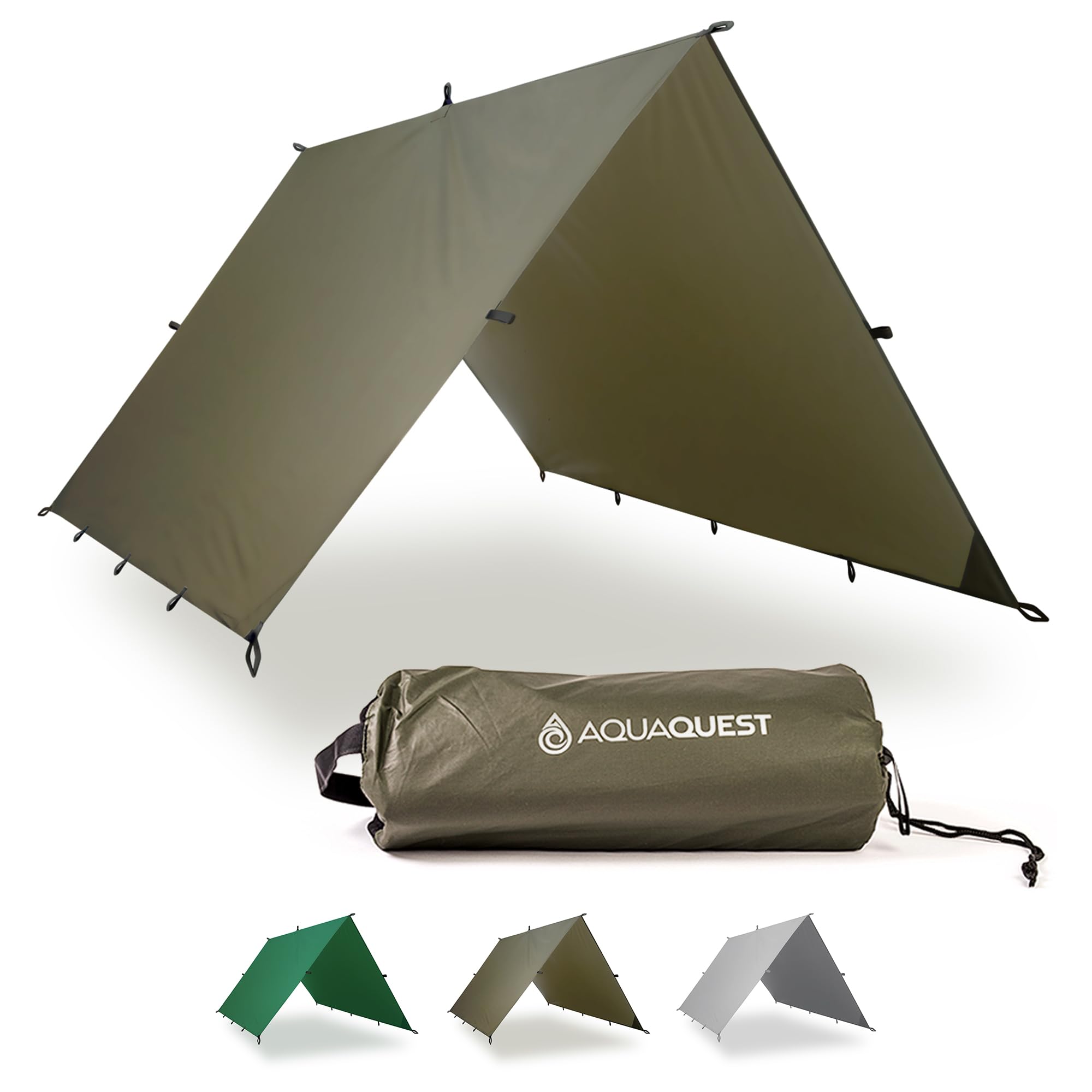
AquaQuest Guide 10×10
Key Features
- Weight: 20.8 oz
- Waterproof Rating: 5000mm
- Size: 9’7" x 9’7"
- Material: 40D ripstop nylon
- Price: $$$
The AquaQuest Guide Tarp delivers a rare combination of sub-1.3-pound weight and 5000mm hydrostatic head waterproofing, with fully taped seams and 17 tie-outs for multiple pitch configurations. The 40D ripstop nylon holds up to trail abrasion better than typical ultralight fabrics, making it a legitimate option for long-distance hikes where every ounce counts and storm protection can’t be compromised.
However, the premium price and relatively smaller review base mean long-term durability under sustained heavy use is less established compared to more widely tested tarps. This is a specialized piece for dedicated gram-counters and thru-hikers who value verified specs over crowd-sourced consensus — casual backpackers will find better value in the top pick.
Pros
- 5000mm waterproof rating with fully taped seams keeps moisture out in sustained rain.
- 20.8-ounce weight with 17 tie-outs offers rare balance of low mass and setup flexibility.
- Lifetime warranty backs the build investment for long-term use.
Cons
- Long-term reliability under repeated heavy trail use is less established than more widely reviewed tarps.
- Premium price limits its appeal to committed thru-hikers — overkill for occasional trips.
Choose this when minimizing weight and maximizing storm protection are your top priorities and you accept a higher upfront cost for a warranty-backed, niche performer.
Best for Bushcraft Cold Weather
Texas Bushcraft 10×10

Key Features
- Weight: 2 lb
- Waterproof Rating: 15000mm
- Size: 10 x 10 ft
- Material: 70D ripstop nylon
- Price: $$
The Texas Bushcraft tarp’s reflective inner layer doubles as a heat reflector and sun shield, while its 15000mm PU coating and taped seams shrug off heavy rain. At roughly 2 lbs, it is heavier than silnylon alternatives, which limits its appeal for ultralight backpacking. For preppers, bushcrafters, or cold-weather campers who prioritize storm protection and warmth over pack weight, this tarp delivers.
Pros
- 15000mm waterproof rating with heat-taped seams ensures reliable storm protection.
- Reflective inner side retains body heat and blocks sun, adding warmth in cold conditions.
- 19 tie-out points provide flexible pitch options for various shelter setups.
Cons
- At roughly 2 lbs, the tarp is heavier than silnylon equivalents, reducing its suitability for weight-conscious backpacking.
Best suited for preppers and cold-weather campers who need a bombproof shelter with heat reflection and extreme waterproofing; not ideal for ultralight thru-hikers.
Best for Budget Short Trips
Unigear 9.8×9.8 Tarp

Key Features
- Weight: 2.4 lb
- Waterproof Rating: 3000mm
- Size: 9.8 x 9.8 ft
- Material: 210D ripstop Oxford
- Price: $
At under $25, the Unigear 9.8×9.8 tarp delivers 3000mm waterproofing and a reflective inner layer that reduces heat loss – impressive for the price. However, the 2.4-pound weight and 9.8-foot square footprint keep it from being a true backpacking shelter. It fits one hammock but leaves ends exposed to wind-driven rain, and the eyelets can pull loose over time. This tarp is best reserved for short carries, car camping, or as a backup when you need cheap coverage and don’t mind the extra ounces.
Pros
- 3000mm waterproof rating and reflective inner layer keep moisture out and add warmth.
- Budget price makes it an affordable option for occasional campers needing a spare tarp.
- At 2.4 lbs, it’s manageable for short hikes when ultralight gear isn’t required.
Cons
- 2.4 lbs is heavier than backpacking-oriented tarps, limiting it to short carries or car camping.
- Eyelets and stitching may weaken after extended use; periodic inspection is advised.
Best for short trips or as a backup tarp when budget is the priority and weight is a secondary concern.
How to Choose
The most overlooked spec when buying a backpacking tarp is the total packed weight, which often exceeds the advertised tarp-only weight by several ounces.
Weight
Weight is the biggest factor separating a true backpacking tarp from a car camping tarp. A tarp that weighs over 24 ounces (1.5 lbs) becomes a burden on long hikes, especially when you add stakes, guylines, and stuff sack. Most budget models list tarp weight only, pushing the real carry weight 3-6 ounces higher.
For thru-hikers, every ounce counts, so look for silnylon or silpoly tarps under 20 ounces. If you mostly do short weekend trips or hammock car camping, a 30-ounce tarp can still be acceptable.
Waterproof Rating
Waterproof rating (in mm) indicates how much water pressure the fabric can withstand before leaking. A 2500mm coating sheds moderate rain, while 5000mm handles downpours. Above 10,000mm is overkill for most hikers but useful for bushcrafters who camp in sustained storms.
Note that PU-coated polyester can degrade over time, especially if stored wet. Silnylon maintains its waterproofness longer but sags when saturated and requires careful pitching to keep a taught roof.
Size
Size determines how much coverage you get. A 10×10 foot tarp works for one person with gear or a small hammock; 12×10 offers more room for two or to keep rain off your pack. Bigger tarps weigh more and catch more wind, so don’t oversize if you’re solo.
For hammock camping, an 11-foot ridgeline is the minimum for an 11-foot hammock to keep ends dry. Diagonal pitches can work but reduce usable space. Measure your hammock length before buying.
Material
Silnylon (silicon-impregnated nylon) is lightweight and packs small, but stretches when wet and requires re-tensioning. PU-coated polyester is heavier, less stretchy, and more affordable, but its waterproof coating can wear with repeated folding.
For ultralight backpacking, silnylon is the standard. For budget-conscious car campers or occasional users, coated polyester offers decent performance at half the price. A middle ground is silpoly, which combines light weight with minimal stretch.
FAQ
How much does a backpacking tarp typically weigh for thru-hiking?
For thru-hiking, a tarp should weigh under 20 ounces (1.25 lbs) including stakes and guylines. Many ultralight options fall between 12-20 ounces. Heavier tarps over 24 ounces are better left for short trips or car camping where pack weight matters less.
Can I use a camping tarp as a standalone shelter without a tent?
Yes, a properly pitched tarp works as a standalone shelter on its own. You’ll need a groundsheet and bug net in summer. In winter, a tarp with doors (or a nested inner tent) provides better wind and snow protection. For hammock camping, a tarp alone covers your hammock directly.
Why do some tarps have doors and others don’t? Which is better for wind?
Doors are fabric flaps that close off the ends of a tarp, blocking wind and rain from entering. Open-ended tarps are lighter and easier to pitch, but let wind-driven moisture in. For hammock campers in rainy or windy areas, a tarp with doors is significantly more comfortable. For dry climates or solo ground shelters, open ends save weight.
How do I prevent my tarp tie-outs from tearing in high wind?
Reinforce tie-outs by using a small rock or twig inside the loop before staking, which spreads the load. Avoid over-tightening guylines; let the tarp flex slightly. Replace plastic tie-out loops with cordage if they show wear. For high-wind camps, pitch the tarp low to the ground with the ridgeline parallel to the wind.