This post contains affiliate links. We may earn a small commission when you buy through our links — at no extra cost to you.
Thermoelectric coolers sound like a budget win, but they cannot freeze and only chill about 40 degrees below outside temp. In summer heat, that leaves your food in the danger zone. Compressor models solve that, yet many promise freezer performance they can’t deliver in real-world conditions.
The real gap is reliability. Budget compressor coolers now match premium brands on basic cooling, but quality control varies widely. Some units lose temperature overnight, others die within a year. This guide focuses on the coolers that hold their set temp, survive bumpy roads, and won’t leave you with warm food on day two of a trip.
Each pick is matched to a specific use-case — solo weekend, family road trip, or off-grid solar setup — so you know exactly what you’re getting before you buy.



Best for Solo/duo Weekend
BougeRV CR22 23QT
Key Features
- Cooling Method: Compressor
- Capacity: 23 qt
- Power: 45W ECO/60W MAX
- Temp Range: -7°F to 50°F
- Price: $$
The 23-quart compressor cooler holds temperatures from -7°F to 50°F, cooling from 77°F to 32°F in about 15 minutes. It runs on 12V or 110V without issue, even in hot Arizona conditions.
The compact size fits behind front seats or in tight SUV cargo areas, and at 22 pounds it is easy to carry. The compressor hum is noticeable in quiet sleeping spaces — this cooler suits car campers who prioritize cooling performance over absolute silence.
Pros
- Reliable cooling on 12V and AC power, even in high ambient heat
- Fast chill from 77°F to 32°F in roughly 15 minutes
- Compact and portable at 22 lbs, fits behind car seats
Cons
- Compressor hum may be audible in quiet sleeping environments
If you need a compact, reliable cooler for weekend car camping trips without overspending, the BougeRV CR22 is the right match.
Best for Large Groups
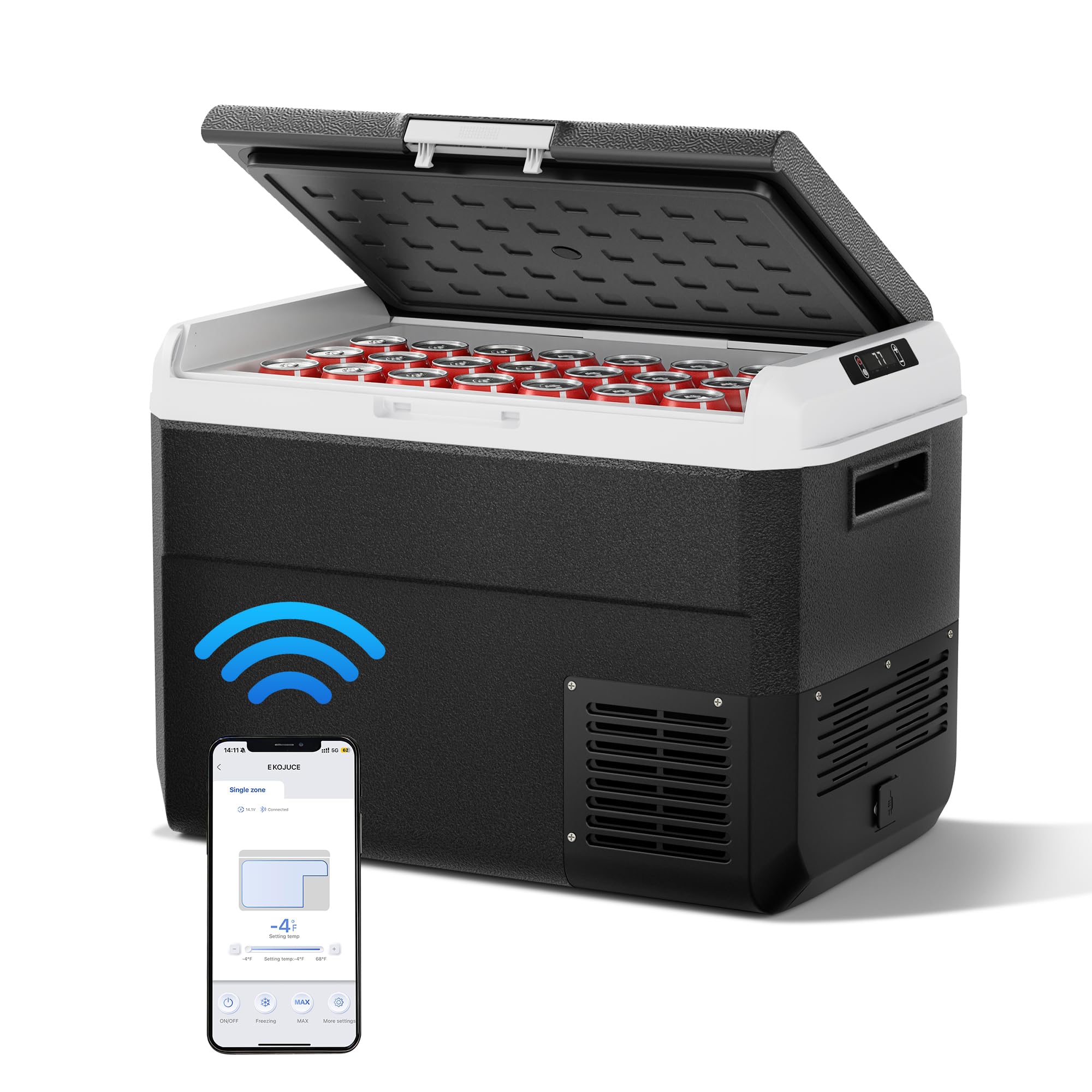
EKOJUCE XCF-51 54QT
Key Features
- Cooling Method: Compressor
- Capacity: 54 qt
- Power: 45W (est.)
- Temp Range: -4°F to 68°F
- Price: $$$
The EKOJUCE 54QT stands out for its generous capacity and rapid cooling — it pulls food and drinks down to temperature quickly on both 12V and AC power, and runs quietly enough that you might forget it’s on. That combination is hard to find at this price point, especially at this size.
This unit suits extended car camping or RV trips where every quart counts, and you’re comfortable buying from a brand without the long track record of established competitors. The compressor design holds a steady chill, though a few degrees of fluctuation are normal — fine for general food storage, less ideal for items that demand precise temps.
Pros
- Cools fast on AC or DC — drinks and food hit temp quickly.
- Near-silent operation; barely audible even when running.
- Large 54-quart capacity at a price well below Dometic equivalents.
Cons
- Temperature can wander by a few degrees — acceptable for most camping food, but not precision storage.
If you need a big cooler that chills fast and stays quiet, the EKOJUCE delivers strong performance for the money — just be aware it’s a newer player, so long-term data is still building.
Best for Overland/truck
BougeRV CRPRO 21QT
Key Features
- Cooling Method: Compressor
- Capacity: 21 qt
- Power: 60W MAX/45W ECO
- Temp Range: -8°F to 50°F
- Price: $$$
The CRPRO’s built-in tie-down points and weather-resistant storage box give it a clear edge over standard compressor coolers — it stays securely mounted on rough trails without extra straps. The compressor holds set temperatures well even in hot conditions, and the 45W ECO mode keeps power draw low enough for extended battery or solar use. It can freeze down to -8°F, making it suitable for frozen goods.
This 21-quart capacity works well for one person’s weekend food and drinks, but leaves minimal room for anything beyond that. Solo travelers who value ruggedness and a compact footprint will appreciate the premium build; those needing space for a partner or family should look at larger models.
Pros
- Integrated tie-downs and storage box keep the cooler secure and organized on rough trails
- Maintains set temperature even in hot summer conditions
- Low power draw in ECO mode works well with battery and solar setups
Cons
- Compressor hum at about 45 dB can be noticeable in very quiet campsites
- 21-quart capacity fits one person’s weekend supplies but leaves no extra room
For solo overlanders who need a cooler that stays put and freezes hard, the CRPRO’s rugged build and tie-downs justify the premium price — just recognize the capacity limit.
Best for Solar/battery
Setpower RF20 21QT
Key Features
- Cooling Method: Compressor
- Capacity: 21 qt
- Power: 28W ECO/40W MAX
- Temp Range: -4°F to 68°F
- Price: $$
The Setpower RF20 uses just 28W in ECO mode, letting a 100Ah battery run it for days — a clear advantage over the rugged BougeRV CR22 for campers relying on small solar setups. Its compressor keeps items cold steadily during weekend trips, and the included 50-hour ice pack adds a backup. The tradeoff is the 21-quart capacity: ideal for one or two people, but too tight for groups.
Pros
- Low 28W ECO power draw suits small battery systems
- Steady cooling performance for 2–3 day trips
- Near-silent operation with solid build
Cons
- 21-quart capacity limits use to solo or couple camping
- Compressor cooling efficiency can vary between units in some cases
For solo campers or couples relying on solar power, the Setpower RF20 offers exceptional efficiency at a reasonable price — just respect its compact size.
Best for Short Off-Grid
EUHOMY J30 32QT Battery
Key Features
- Cooling Method: Compressor
- Capacity: 32 qt
- Power: 45W avg
- Temp Range: -4°F to 68°F
- Price: $$
The EUHOMY J30 stands apart from standard 12V coolers by packing its own battery, giving you up to six hours of cooling without needing a vehicle or power station. It keeps contents cold and runs quietly, making it a practical choice for campers who make brief stops or tailgate without shore power.
This unit suits those who want an all-in-one solution for short off-grid use, but the battery life falls short of overnight camping without recharging. Temperature consistency can vary by a few degrees, so it works best for drinks and perishables where minor swings don’t matter.
Pros
- Built-in battery enables up to six hours of portable cooling without external power.
- Quiet compressor and effective cooling keep items cold on the go.
- Carrying handles and an interior LED light make it easy to move and use at night.
Cons
- Temperature can fluctuate a few degrees under some conditions, less precise than premium units.
- Battery lasts roughly six hours and is not user-replaceable, limiting overnight use without recharging.
If you need a cooler that runs on its own battery for short off-grid stops and don’t need full overnight capacity, the EUHOMY J30 delivers that unique capability at a reasonable price.
Best for Budget Entry
Alpicool C15 16QT
Key Features
- Cooling Method: Compressor
- Capacity: 16 qt
- Power: ~36W running
- Temp Range: -4°F to 68°F
- Price: $
For the price of a decent thermoelectric cooler, the Alpicool C15 gives you a genuine compressor. It keeps drinks cold on day trips or overnight stops and fits between car seats or under a bed. The build feels solid for the price. But the temperature accuracy is loose — expect swings of 5°F or more, and it struggles to maintain a deep freeze in warm weather. This suits first-time buyers who want to try compressor cooling or anyone who mainly needs cold drinks, not precise freezing.
Pros
- Solid build quality for the price — feels like a real refrigerator, not a toy.
- Compact size fits in tight spaces like between seats or under beds.
- Long-term performance holds up for months of regular use in a budget cooler.
Cons
- Temperature control can drift by around 5°F, making it unsuitable for precise refrigeration.
- Freezer mode may soften ice cream in warm weather — best treated as a drink cooler.
A budget-friendly entry into compressor cooling, but the temperature imprecision limits it to drinks and short trips.
Best for Solo/duo Quiet
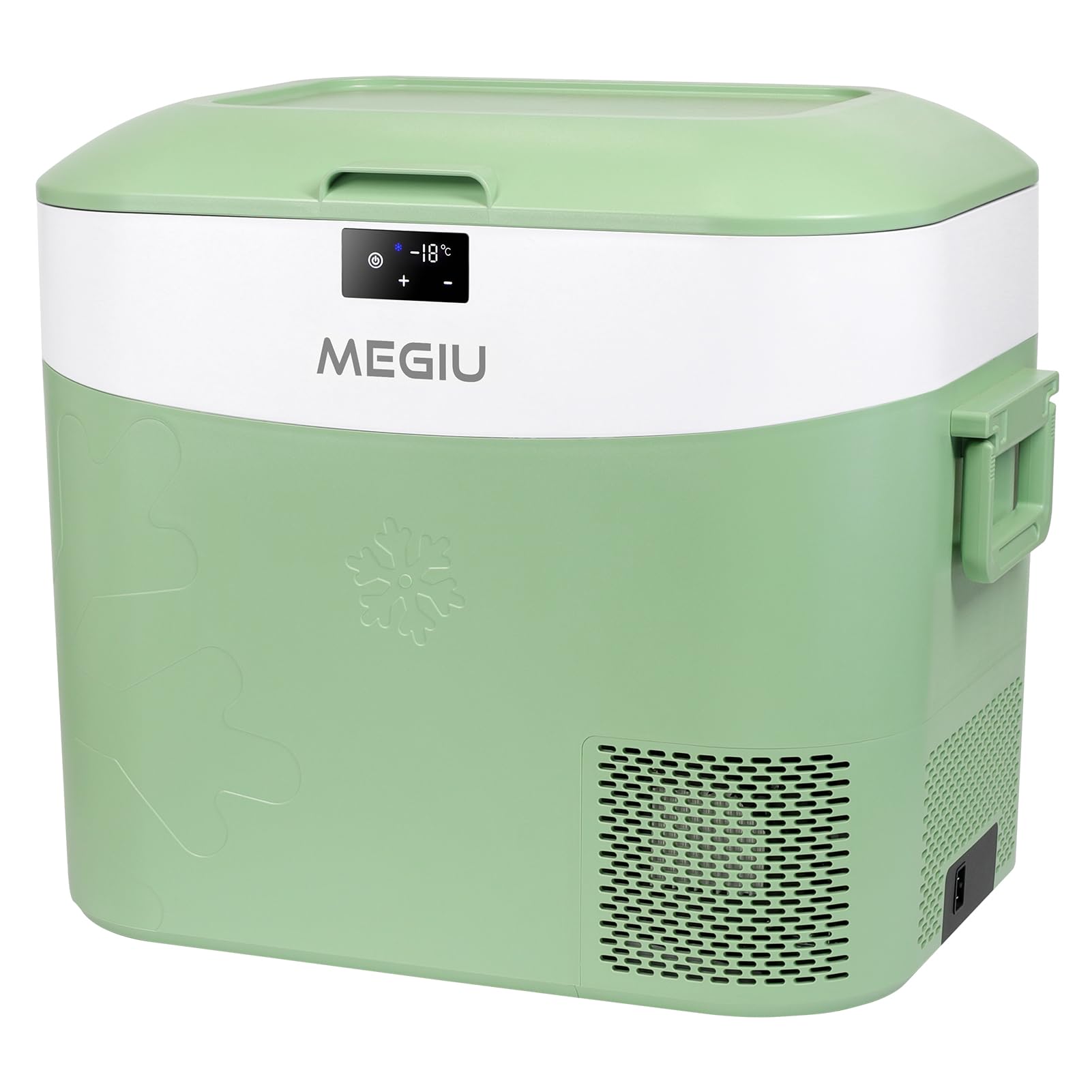
Megiu HC-22P2 23QT
Key Features
- Cooling Method: Compressor
- Capacity: 23 qt
- Power: 45W avg
- Temp Range: -0.4°F to 59°F
- Price: $$
This 23-quart compressor cooler runs whisper-quiet (under 40 dB) and handles bumpy roads well. Build quality is solid. In hot weather, freezing performance can be inconsistent — fine for chilling drinks but not guaranteed for frozen food. Capacity works best for one person on short trips.
Pros
- Quiet operation at under 40 dB — won’t disturb sleep in a tent
- Sturdy build handles off-road travel without rattling
Cons
- In hot ambient temperatures, the cooler may not freeze items — best for keeping drinks cold rather than storing frozen meat
A fit for solo campers who value quiet and a solid build, and don’t need guaranteed freezing in hot weather.
Best for Large Capacity
BODEGACOOLER T50T 53QT

Key Features
- Cooling Method: Compressor
- Capacity: 53 qt
- Temp Range: -4°F to 68°F
- Price: $$$
This 53-quart compressor cooler delivers strong cooling performance even in extreme heat, and its wheels and handles make it easy to move around camp. The dual freezer/refrigerator function adds flexibility for longer trips. However, durability can vary — some units have experienced compressor or handle issues after months of use, which keeps it from ranking with more consistent options.
Pros
- Maintains cold temperatures reliably even in hot desert conditions.
- Built-in wheels and handles simplify transport during road trips and camping.
Cons
- Long-term durability may vary; some units develop compressor or handle issues over time.
Best for extended car camping trips where large storage outweighs occasional component issues.
Best for Budget Family
EUHOMY CF-45 48QT

Key Features
- Cooling Method: Compressor
- Capacity: 48 qt
- Power: 45W avg
- Temp Range: -4°F to 68°F
- Price: $$
The EUHOMY 48QT offers generous 48-quart capacity at a mid-range price, with fast compressor cooling that drops temperature quickly. Temperature accuracy can vary, and latch durability may show wear over extended use. These limitations make it less suitable for daily reliability, placing it behind the EKOJUCE 54QT for consistent performance.
Pros
- Good value: large 48-quart capacity at a budget-friendly price.
- Fast cooling: reaches 32°F from room temperature in about 15 minutes.
Cons
- Latch mechanism may not hold up over time, with some units showing wear after a few months of use.
For campers who prioritize capacity and price over long-term durability, the EUHOMY 48QT is a practical choice for weekend outings.
Best for Wheels & Org
EUHOMY CFB-35 37QT

Key Features
- Cooling Method: Compressor
- Capacity: 37 qt
- Power: 45W avg
- Temp Range: -4°F to 68°F
- Price: $$
The EUHOMY 37QT offers useful features like wheels for portability and two baskets to separate food and drinks, and its compressor cooling quickly brings temperatures down. However, durability is a concern — some units may stop cooling or develop handle issues after months of use, making this a better fit for infrequent trips rather than regular use.
Pros
- Wheels and dual handles make it easy to move across uneven campsite terrain.
- Compressor cooling drops temperature quickly, keeping food cold even in hot conditions.
Cons
- Some units may stop cooling or develop handle issues after several months of occasional use.
This cooler works well for short camping trips where wheels and organization are valued, but plan to replace it sooner than more expensive options if used frequently.
Best for Midsize Mod.
BougeRV E40 42QT

Key Features
- Cooling Method: Compressor
- Capacity: 42 qt
- Power: 45W ECO/60W MAX
- Temp Range: -4°F to 50°F
- Price: $$
This 42-quart cooler keeps food and drinks cold consistently during travel, runs quietly at most campsites, and feels solidly built for its price range. Temperature may not match the set point closely — interior conditions often differ by a few degrees — and some compressors have stopped working after extended use. It suits campers who need a midsize option and can accept moderate temperature precision.
Pros
- Maintains cool temperatures over long periods during trips
- Quiet operation makes it unobtrusive at a campsite
Cons
- Set temperature may not match actual interior conditions, often differing by several degrees
A reasonable pick for campers who want a 42-quart cooler and don’t require exact temperature readouts — just keep expectations measured for long-term compressor life.
Best for Solo Truck Use
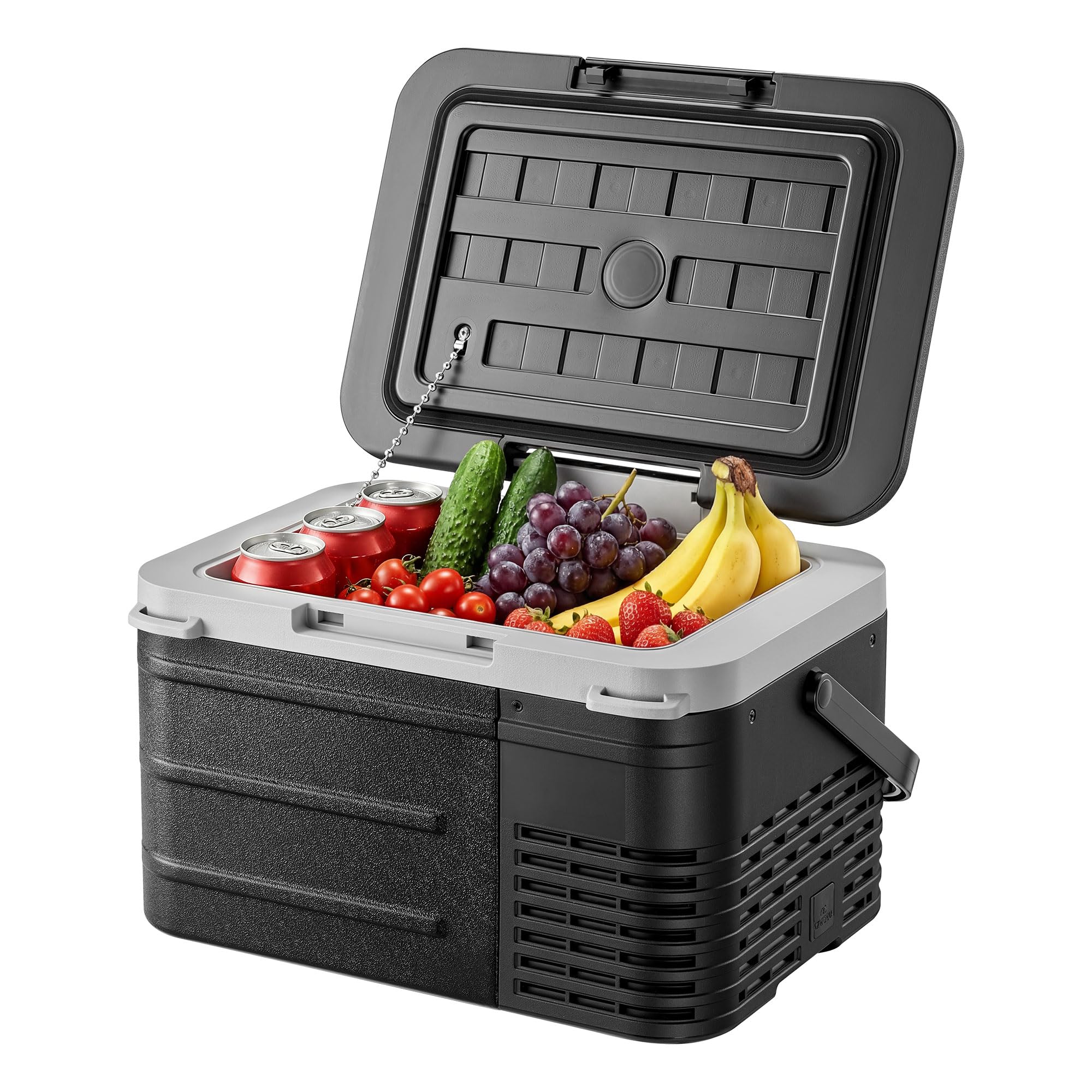
EKOJUCE CF029-10 11QT
Key Features
- Cooling Method: Compressor
- Capacity: 11 qt
- Power: 45W (est.)
- Temp Range: -4°F to 68°F
- Price: $
This 11-quart compressor cooler cools effectively, runs quietly, and costs less than any other compressor model. But the tiny capacity holds only a few items — not enough for car camping with others. It suits solo truck drivers or commuters who want real refrigeration without spending much.
Pros
- Compact compressor cooling for personal use
- Nearly silent operation, good for quiet cab environments
Cons
- Capacity holds only a few drinks and snacks — not suitable for more than one person
A practical choice for a solo traveler on a budget who needs real cooling, but too small for any shared car camping trip.
Best for Tiny Personal
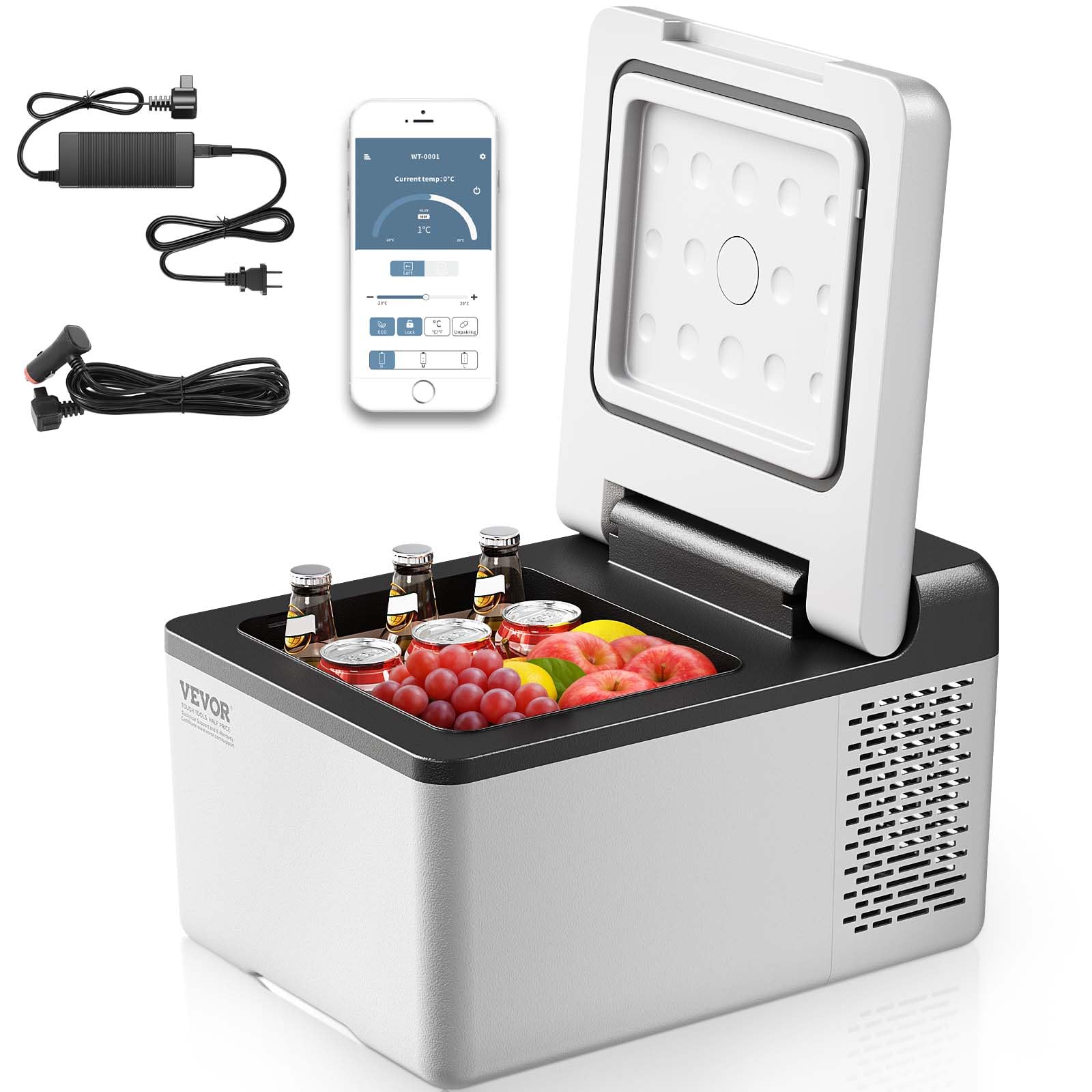
VEVOR C9 10QT
Key Features
- Cooling Method: Compressor
- Capacity: 10 qt
- Power: 45W (est.)
- Temp Range: -4°F to 68°F
- Price: $
This 10-quart compressor cooler chills quickly and tucks into tight car corners. Its size limits use to personal items, and long-term performance is not yet well established. It is a viable choice for a single person on a day trip, but for anything more, a larger cooler with more feedback is a safer bet.
Pros
- Compact enough to fit in small car boots or behind seats
- Cools drinks faster than many larger budget compressors
Cons
- 10-quart capacity holds only a few drinks and a lunch — not enough for two people
Serves the solo driver who values size and speed over capacity, but look to a 15-quart or larger model for shared trips.
Best for Short Day Trips
Ivation 27QT Thermoelectric

Key Features
- Cooling Method: Thermoelectric
- Capacity: 27 qt
- Temp Range: ~40°F below ambient
- Price: $
The Ivation 27QT is lightweight and offers both cooling and warming, making it handy for short day trips in mild weather. However, its thermoelectric cooling can’t freeze items and struggles above 80°F, and durability may not hold up over multiple seasons.
Pros
- Lightweight and easy to move
- Dual hot/cold function for warming food
Cons
- Cooling limited to roughly 40°F below ambient, so it does not freeze and performance drops in hot weather.
Best for short, mild-weather trips where you need to keep drinks cool and have the option to warm food, but not for camping that demands freezing or long-term reliability.
Best for Insufficient Data
EUHOMY CFC-18 19QT

Key Features
- Cooling Method: Compressor
- Capacity: 19 qt
- Power: 45W avg
- Temp Range: -4°F to 68°F
- Price: $$
The EUHOMY CFC-18 delivers a 19-quart compressor cooler with app control at a mid-range price, making it an affordable entry point for car camping. Without detailed user accounts, however, its real-world performance and durability remain unconfirmed, which limits confidence compared to models with extensive feedback.
Pros
- Compact 19-quart size fits easily in small vehicles or tight trunk spaces.
- Compressor cooling reaches -4°F, allowing for freezing capability.
Cons
- The unit’s durability in continuous use is an open question.
A gamble worth taking for budget-focused campers on short trips where a cooler failure is an inconvenience, not a disaster.
How to Choose
Compressor coolers are the only choice for reliable freezing and hot weather; thermoelectric units are limited to mild conditions.
Cooling Method: Compressor vs Thermoelectric
Compressor coolers work like a household fridge — they use a refrigerant cycle to actively pump heat out, allowing them to freeze and maintain set temperatures regardless of outside heat. Thermoelectric coolers use a Peltier chip that creates a temperature difference; they can only cool about 40°F below ambient, so on a 90°F day the interior might reach 50°F — not safe for raw meat or dairy.
For car camping where you need reliable food storage above 80°F, a compressor cooler is the only real option. Thermoelectric units are okay for keeping pre-chilled drinks cool on a short drive, but nothing more.
Capacity: How Much Space Do You Need?
Capacity is measured in quarts, but usable space depends on how you pack. A 20-quart cooler typically holds about 20 cans plus a few sandwiches; 30 quarts covers a couple’s weekend; 50+ quarts suits a family or week-long trip. Consider that a compressor cooler’s internal volume is reduced by the compressor hump — check internal dimensions, not just quart rating.
For car camping, think about how many days you go between resupplies and whether you need space for frozen items. Overbuying capacity adds weight and power draw, so match size to your actual trip length.
Power Consumption and Battery Protection
Most compressor coolers draw 45–60W when running, but they cycle on and off. A 45W cooler at 12V pulls about 3.75 amps. On a 100Ah deep-cycle battery, that gives roughly 20 hours of run time before hitting 50% depth of discharge (safe for lead-acid). Lithium batteries can go deeper, extending useful time.
Built-in battery protection settings are critical: look for adjustable cut-off voltages (e.g., 11.1V for AGM, 12.0V for LiFePO4) to prevent draining your vehicle’s starting battery. Models without this feature can leave you stranded. For solar or small power stations, the Setpower RF20’s 28W ECO mode is a standout.
Temperature Range: Can It Freeze?
Many coolers advertise freezing capability down to -4°F, but real-world performance depends on ambient temperature and insulation. In hot weather (90°F+), even good compressors may struggle to maintain deep freeze — expect 5–10°F drift. Pre-cooling your food and using a thermal blanket helps.
If you need rock-solid freezing for raw meat or ice cream, look for a cooler with a proven track record in heat (like BougeRV or EKOJUCE) and accept that it may not hold -4°F on a scorching day. Budget models like Alpicool often fluctuate by ±5°F, making them unreliable for freezing.
Weight and Size: Fitting in Your Vehicle
Weight ranges from 10 lbs (tiny thermoelectric) to 36 lbs (large compressor). For car camping, you’ll carry it short distances, so weight matters less than dimensions. Measure your vehicle’s available floor space — many compact models (16–23 qt) fit behind front seats or in footwells. Larger units may require the cargo area.
Always measure height as well: some coolers open from the top and need clearance. For trucks, check tie-down options — models with integrated loops (like BougeRV CRPRO) are easier to secure. If you frequently move the cooler, consider wheeled options (e.g., EUHOMY 37QT).
FAQ
How long can a 12V compressor cooler run on a car battery before draining it?
It depends on battery capacity and the cooler’s draw. A typical 45W cooler pulls about 3.75A. On a 100Ah deep-cycle battery, you can expect roughly 20 hours of run time before reaching 50% discharge (safe for lead-acid). For starting batteries, limit run time to a few hours or use a separate battery. Always use a cooler with adjustable low-voltage cutoff to avoid being stranded.
Why does my portable 12V fridge temperature fluctuate by several degrees?
Temperature swings of 5–10°F are common with compressor coolers due to cycling, ambient heat, and insulation limits. Pre-cooling the cooler and food, adding a thermal blanket, and parking in the shade all reduce fluctuations. Budget models tend to drift more; if precision matters, stick with units that have over 2,000 reviews and consistently positive feedback like the BougeRV CR22.
Can a thermoelectric cooler keep food safe in summer car camping?
No. Thermoelectric coolers only chill about 40°F below ambient. In 90°F summer heat, the interior hits 50°F – above the safe 40°F limit for perishables. They cannot freeze and struggle to maintain even cool temperatures. For car camping with raw meat or dairy, a compressor cooler is the only safe choice.
What size 12V cooler fits behind the front seat of a truck or SUV?
Most compact compressor coolers (16–23 qt) fit behind front seats. Typical dimensions: width 15–20 inches, depth 10–14 inches, height 12–15 inches. The BougeRV 23QT and Alpicool 16QT are common fits. Always measure your vehicle’s seat clearance, as some trucks have limited height. For larger trucks, a 30–40 qt unit may fit in the rear footwell.