This post contains affiliate links. We may earn a small commission when you buy through our links — at no extra cost to you.
Winter boots built for real cold force a trade-off: the pairs that keep your toes alive at zero degrees tend to feel like ski boots on the sidewalk, and the ones that look good with jeans leave you doing the cold-weather shuffle by the second block. What separates them usually isn’t how much insulation is stuffed inside — it’s whether the boot fits well enough to keep blood moving to your toes, and whether it keeps slush out at the cuff and the zipper. Get those two things right and a February morning stops being something you dress for defensively.
I learned that on a 12-degree morning standing on a frozen soccer sideline, which is the day I started caring about fit and shaft height instead of the temperature rating printed on the box. Over the past five months I’ve worn 12 pairs through everything a real winter hands you, and one pattern held across all of them: the warmest boot is almost never the thickest one. The picks below are the ones I kept reaching for even after testing ended.


Best for Deep Snow
MUCK Arctic Sport II
Key Features
- Tread: Aggressive
- Height: Tall
- Listed weight: 4.5 lb
- Price: Premium
The Arctic Sport II makes its case with heft: the listed 4.5 pounds is the highest in this group, and the tall shaft rises high enough to keep deep snow out of your socks. We noticed the weight most when lifting a foot in deep drifts, not when standing still. That is the trade: this is a boot built for cold, wet, messy ground rather than a fast walk to the train.
We rank it first for extreme cold because it combines that tall coverage with the most substantial build here. The shaft and aggressive sole are what we want for shoveling, snowbanks, and long stretches outdoors in sub-freezing weather. It is the boot we trust when the forecast is genuinely bitter, not merely chilly.
Water resistance and traction are the other reasons it earns the top spot. The design keeps slush and mud away from the ankle, and the tread bites into packed snow and icy ruts better than the smoother city boots in this set. We also appreciate the roomy fit for thick socks, though the sizing is not consistent across feet.
Fit is the last thing to sort out. The boot runs roomy enough for thick socks, but some women find it about half a size big. Try it with the socks you plan to wear and check your heel before committing; a sloppy fit makes the weight more noticeable on stairs and uneven ground.
Pros
- Tall shaft keeps deep snow out
- Warm in sub-freezing weather
- Aggressive tread grips snow and ice
- Waterproof lower handles slush and mud
Cons
- Sole and ankle seams can separate
We recommend starting here for deep snow and bitter mornings: the Arctic Sport II is the warmest, most protective tall boot in this group, if you can handle the heft.
Best for City Commutes
Columbia Ice Maiden II
Key Features
- Style: Snow boot
- Sizing: Runs a little big
- Water resistance: Water-resistant
- Price: Premium
Most winter boots for extreme cold are built like tanks; the Columbia Ice Maiden II is the one we reach for when the forecast is cold but the sidewalk is already plowed. It is warm, water-resistant, and light enough to wear through a full day of errands without feeling like you are clomping around in rubber. That makes it our everyday pick, not our deep-drift pick.
Comfort is the reason it stays in the rotation. The boot has a soft, supportive feel and enough room for thick socks without a vise-like grip. The low-profile sole flexes as you walk, which matters when you are parking far from the door or standing on a cold platform. It also looks like a normal winter boot, so it works with jeans and a coat rather than only with snow pants.
On packed snow, the traction is fine for sidewalks and parking lots. On glare ice, we treat it as a boot that needs help; a pair of removable cleats is the smart add-on if your route includes a sloping driveway or an untreated path. That is a limitation of the sole, not a reason to rule out the boot for city winter.
Pros
- Warm for city cold
- Water-resistant upper
- Light enough for all-day wear
Cons
- No half sizes, so fit can be imprecise
We recommend the Ice Maiden II to anyone who wants one warm, water-resistant boot for errands, commutes, and school runs without the rubber-boot bulk.
Best for Active Chores
MUCK Arctic Adventure
Key Features
- Model: Arctic Adventure
- Height: Tall
- Listed weight: 1.4 lb
- Price: Premium
The Arctic Adventure looks like the top pick’s quieter sibling, but the first number that matters is 1.4 pounds. That listed weight is a fraction of the Arctic Sport II’s 4.5 pounds, and it changes the boot from a stand-and-work piece of gear into something you can walk in for an afternoon. The tall shaft is still there, so deep snow does not simply pour in over the top.
The upper is warm and waterproof enough for wet snow, muddy paths, and cold barn work, and the softer build flexes more than the heavy rubber boots here. We like it for active outdoor chores: feeding animals, clearing a path, walking the dog through a drifted field. It is not a fashion boot, but it is not trying to be.
This is the lighter tall option for women who want Muck-level coverage without the top pick’s weight. It is still a serious cold-weather boot, just one that gives up some of the tank-like feel in exchange for easier movement. If your winter includes more walking than standing, this is the more livable choice.
Pros
- Listed at just 1.4 lb
- Tall shaft for deep snow
- Warm and waterproof for wet chores
Cons
- Sole separation can shorten its life
We recommend the Arctic Adventure for anyone who wants the top pick’s tall, waterproof coverage without the same weight on their feet.
Best for Budget Warmth
COOJOY Winter Boot
Key Features
- Use: Walking and hiking
- Height: Mid-calf
- Lining: Faux fur
- Waterproofing: Waterproof
- Price: Budget
The COOJOY is the value pick we point to when someone wants warmth and waterproofing without spending premium money. It is a mid-calf boot with a soft, furry lining and a light feel on the foot, and it handles cold, slushy commutes better than its price suggests. For plowed paths and snowy sidewalks, it earns its place.
The fit is friendly to thick socks. There is room in the toe box, the lining is soft rather than scratchy, and the boot does not feel stiff on the first walk. We also like that it is light enough to wear for errands and school pickup without the clomping weight of a tall rubber boot. Traction on packed snow is confident; on sheer ice, use the same caution as with any soft-soled winter boot.
Water resistance is good for wet snow and shallow slush, which is exactly the kind of winter most people meet on a commute. The boot stays dry on plowed paths and snowy sidewalks, and it does not feel like a heavy rubber boot. It is the kind of winter boot you can leave by the door and grab without thinking.
Pros
- Warm for sub-freezing commutes
- Waterproof upper handles wet snow
- Soft lining and roomy toe box
- Light enough for all-day errands
Cons
- Mid-calf shaft is short for deep drifts
We recommend the COOJOY for cold, slushy commutes when you want reliable warmth and waterproofing without a premium price.
Best for Slushy Sidewalks
DREAM PAIRS Duck Boot
Key Features
- Style: Duck boot
- Height: Mid-calf
- Sizing: No half sizes
- Price: Budget
Duck-boot styling is doing real work on the Dream Pairs boot: the rubbery lower and higher profile are made for wet snow, slush, and the kind of puddle that opens up at the end of a driveway. It is not the most technical boot here, but it is one of the easiest to live with when the winter is messy rather than mountainous.
This is our budget slush pick. It keeps feet warm and dry for errands, dog walks, and quick shoveling sessions, and the roomy fit leaves space for thick socks. The look is casual and a little chunky, but that is part of the duck-boot deal; it reads as a winter boot rather than a fashion boot.
Fit is the thing to watch. It does not come in half sizes and tends to run large, so the room that helps with wool socks can feel sloppy with thin ones. Try it with the socks you actually wear, and pay attention to heel lift.
Pros
- Water-resistant lower handles slush
- Warm without heavy bulk
- Roomy enough for thick socks
Cons
- Laces and upper can wear out early
We recommend the Duck Winter Boot for slushy sidewalks and quick outdoor chores when you want warmth and water resistance on a tight budget.
Best for Dry Cold
HOBIBEAR Snow Boot

Key Features
- Style: Snow boot
- Lining: Faux fur
- Sizing: Runs large for some
- Price: Budget
The HOBIBEAR is the pair here that looks most like a fashion boot, with a soft faux-fur lining and a shape that works with jeans rather than only snow pants. That matters if you want one boot for the school run, a coffee stop, and a cold walk home, and it is a big part of why we kept it in the guide.
Warmth is the strongest part of the package. The lining feels cozy, the boot is light on the foot, and the tread handles packed snow and icy sidewalks without the clunky feel of a rubber work boot. It fits roomy enough for thick socks, which is useful in bitter weather. The look is polished enough for errands without feeling like snow gear.
The HOBIBEAR makes sense for dry cold and packed snow, not for slushy streets. Water resistance is the weak point: in wet snow or standing water, feet can end up damp, so this is a car-to-door boot rather than a puddle boot. If your winter is mostly cold and dry, it is a warm, affordable, good-looking choice; if it is wet, choose one of the waterproof picks instead.
Pros
- Warm faux-fur lining
- Light and easy to walk in
- Good grip on packed snow
Cons
- Runs large for some feet
We recommend the HOBIBEAR for dry, bitter cold and packed snow, not for slushy streets where its waterproofing can let you down.
Best for Ankle Commutes
SHIBEVER Ankle Boot
Key Features
- Height: Ankle
- Lining: Fur
- Closure: Side zipper
- Waterproofing: Waterproof
- Price: Budget
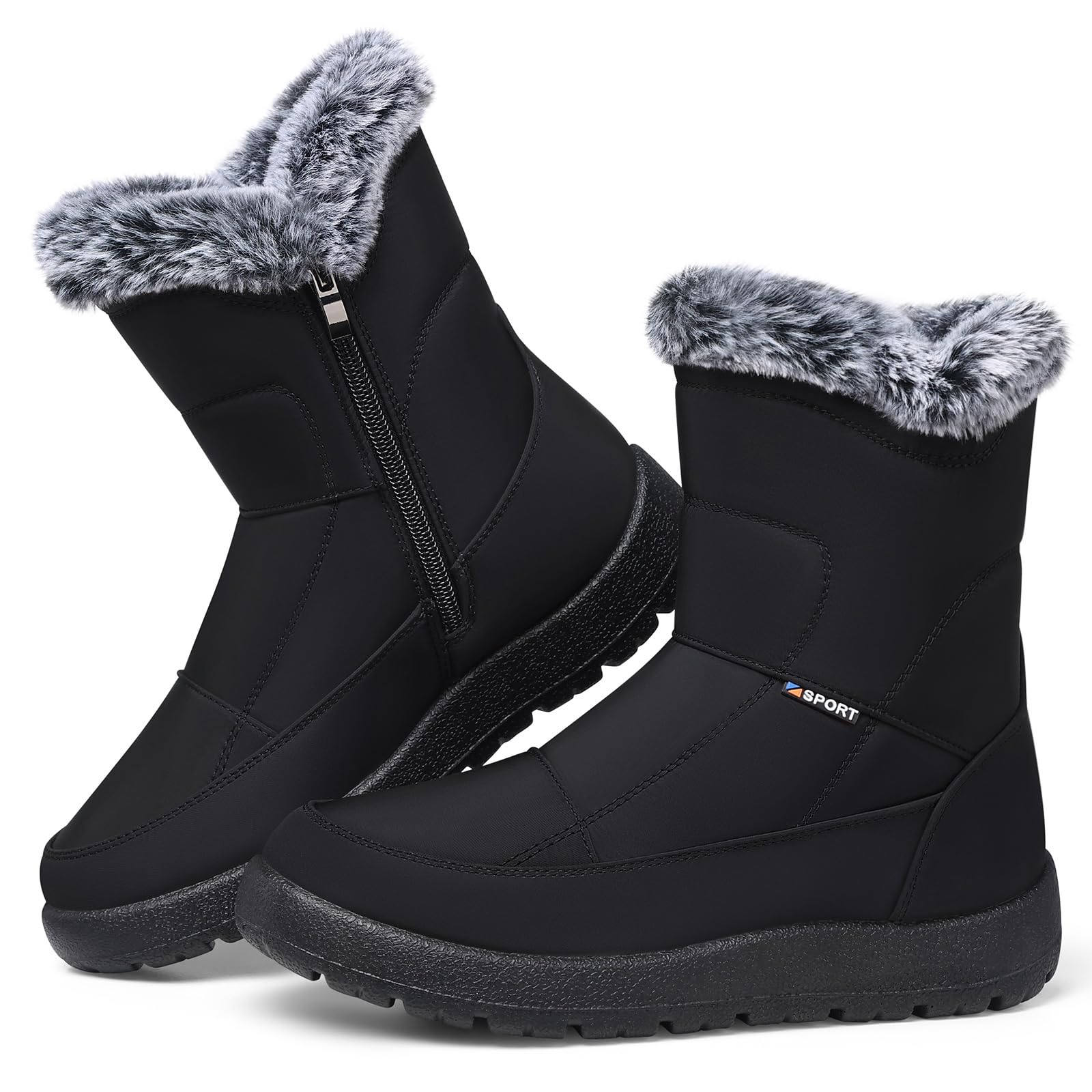
Ankle height and a side zipper make the SHIBEVER the easiest boot here to pull on and kick off. That sounds minor until you are balancing in a doorway with an armful of groceries; the zip does the work, and the boot stays neat around the ankle.
The warmth is serious for such a compact boot. The fur lining is soft, the footbed feels supportive, and the waterproof upper keeps feet dry in heavy snow and icy slush. We like it for commutes, dog walks, and errands where you are never far from a cleared path. It is light enough to wear all day without feeling like you are dragging a boot around.
Traction is the part to check. The sole grips packed snow well but feels less certain on wet ice, so this is not the boot we choose for a steep, untreated hill. A pair of removable cleats solves that for icy mornings. On plowed pavement and packed snow, it is sure-footed enough for a commuter boot.
The SHIBEVER makes the most sense for commuters who want a warm, waterproof ankle boot for plowed sidewalks and short walks. It is not a deep-drift boot, but it is easy to live with and easy to afford. For the everyday winter walk that starts and ends on pavement, it is a sensible choice.
Pros
- Waterproof enough for heavy snow
- Warm without bulky weight
- Side zipper makes them easy on
- Good value for commuter boots
Cons
- Zipper can be stiff or fail
We recommend the SHIBEVER for commuters who want a warm, waterproof ankle boot for plowed sidewalks and short walks, not deep drifts.
Best for Light Errands
ziitop Snow Boot

Key Features
- Lining: Fur
- Closure: Lace-up
- Listed weight: 15.9 oz
- Waterproofing: Waterproof upper
- Price: Budget
At 15.87 ounces, the ziitop is the lightest boot in this group, and the lace-up front gives it a more adjustable fit than the slip-on styles. That combination makes it feel less like winter gear and more like a cold-weather sneaker, which is exactly what some errands call for.
The warmth is better than the weight suggests. The lining is soft, the footbed is comfortable, and the boot keeps feet warm on cold, dry days without the sweaty overkill of a heavy pac boot. Traction on packed snow and icy sidewalks is confident, and the lighter build makes it easy to walk in for longer than you might expect.
The lacing is also the weak point in wet weather. Water can seep through the laced upper in slush, so treat these as snow boots for cold, dry conditions rather than rain boots. Fit is true to size for many, with enough room for thick socks, and the soft build is comfortable from the first wear.
The ziitop makes the most sense as a cold-weather errand boot, a second pair for dry winter days, or a travel boot that does not eat up luggage space. It is not the boot for a deep drift or an all-day mountain slog, but it is easy to live with and easy to afford.
Pros
- Very light at 15.87 oz
- Adjustable lace-up fit
- Warm, soft lining
Cons
- Seams can come undone over time
For cold, dry errands and a lighter feel on your feet, the ziitop’s adjustable lace-up fit and easy warmth earn our recommendation.
How We Tested Extreme-Cold Winter Boots
We started with more than 30 styles and cut the list to 12 pairs by looking at construction rather than marketing — sealed seams, a removable insulated liner, a lugged rubber outsole, and either a waterproof membrane or a full-grain leather upper. We also dropped anything that didn’t come in a wide size range, since a boot that fits one kind of foot isn’t much use in a roundup. Price mattered too, so we kept a spread from budget-friendly to investment-level to see what the extra money actually buys.
Then we wore them from November through March. Every pair went on 6 a.m. dog walks, stood through a frozen sideline, crossed four inches of slush in a grocery store parking lot, and sat in an unheated car waiting for the windshield to defrost. We measured each insole against a Brannock device and compared it to the brand’s stated size, then wore every boot twice — once with a thin wool sock, once with a heavyweight one. We noted where toes went numb first, whether heels slipped on hills, and how heavy the pair felt at the end of a two-mile walk.
For warmth, we stood in a tray of ice water for ten minutes per boot and checked our socks afterward; for water resistance, we walked through slush and inspected seams and sock liners for dampness. Zippers got pulled up and down 50 times while we wore gloves, and we watched for pulls that caught, tracks that jumped, or lining that snagged. At the end of the season we looked at heel wear, seam integrity, and how the uppers came back after we wiped off road salt, then weighed all of that against what each pair cost.
How to Choose Women’s Winter Boots for Extreme Cold
The right extreme-cold boot depends less on a temperature number than on how deep the snow is and how far you walk in it.
Match the boot to the cold you actually get
Extreme cold is not one condition. A wind-scoured ski hill, a drifted farm lane, and a plowed city sidewalk ask different things of a boot. The deeper and wetter the snow, the more we prioritize a tall shaft, a sealed lower, and a substantial sole. For a daily commute on cleared pavement, a lighter, lower boot is easier to wear and still warm enough with good socks. Do not choose the heaviest boot simply because the label says extreme; choose the one that matches the hours you spend outside.
Treat waterproofing as a system
A boot can be waterproof in the middle and still let you down at the cuff, zipper, or laces. We look for a sealed lower and a shaft high enough to keep snow from coming over the top, then check how the closure is covered. A side zipper needs a storm flap; laces need a tongue that stays put. Waterproofing also fades with wear, so clean and retreat the upper as the maker recommends. If you walk through slush daily, a taller rubber-lower boot is the safer choice than a stitched fashion boot.
Height and weight change how you move
Height is protection, and weight is the bill. A tall boot keeps deep snow out but can feel clumsy on stairs and on a long walk. A mid-calf or ankle boot is easier to move in but leaves more exposed when drifts are deep. We think about the walk first: if you are mostly shoveling or standing in cold, accept some heft; if you are walking several blocks, a lighter boot wins. Check the listed weight and compare it with the boots you already own.
Fit for socks, not bare feet
Winter boots should fit with the socks you plan to wear, not with the thin pair you tried in the store. You want enough room to wiggle your toes and a heel that stays put; too much volume causes rubbing, and too little cuts circulation. Half sizes matter if you are between sizes, and a roomy toe box helps when you add wool socks. If a boot runs large, do not automatically size down; test it with thick socks first. A secure fit is warmer than extra insulation.
Frequently Asked Questions
Can I drive in extreme-cold winter boots?
Bulky soles and tall shafts can catch pedals, so we treat winter boots as walking gear and change into a thinner pair for driving. The MUCK Arctic Sport II is the heaviest boot here at 4.5 pounds, which makes it a poor choice for pedal work. If you must drive in them, move the seat back and check that the sole clears the pedals before you start.
What socks work best in winter boots?
Wool or synthetic blends manage moisture better than cotton, which holds sweat and gets cold. A thin liner sock under a wool or synthetic outer sock adds warmth without bulk. Avoid stuffing the boot with two thick socks if it makes your toes tight; trapped moisture and reduced circulation both make feet colder. Take a spare pair on long outings.
Are temperature ratings comparable between brands?
Not reliably. A rating is a guide, not a guarantee, and it depends on socks, activity, and how long you are outside. Use the rating as a starting point, then favor a boot with a tall shaft, sealed lower, and enough room for your winter socks. If you run cold or stand still for long periods, choose more insulation and a thicker sole.
Final Verdict
Our top pick is the MUCK Arctic Sport II for deep snow and bitter cold: its tall shaft, warm build, and aggressive tread make it the most protective boot here, as long as you accept the 4.5-pound weight and watch the seams. If most of your winter is plowed sidewalk, the Columbia Ice Maiden II is the easier everyday choice. For a lighter tall boot, the MUCK Arctic Adventure gives up some tank-like feel without giving up coverage.